The 2.5% Commitment:
Investing in Open
David W. Lewis and Mike Roy
DuraSpace Hot Topics Webinar
May 17, 2018
http://scholarlycommons.net
© 2018 David W. Lewis and Mike Roy. This work is licensed under a Creative Commons Attribution 4.0 International license
Fundamental Truth #1:
There is no sustainable path to an open scholarly commons
without sustained and substantial investment from academic
libraries.
Fundamental Truth #2:
If we do not create the open scholarly commons, Elsevier,
Springer, Wiley, et. al. will own the scholarly record and
continue to exploit the academy.
What should be a public good will be used for private gain.
On the folly of rewarding A, while
hoping for B
Steven Kerr, “On the folly of rewarding A, while hoping for B,” Academy of Management Journal December 1975,
18(4):769-783, https://www.ou.edu/russell/UGcomp/Kerr.pdf
Fundamental Truth #3:
Librarians are generally cooperative. We like to help each
other when we can. Going forward this will not be enough.
What will be required is significant and sustained collective
investment. We need to create new institutions.
The Commitment:
Every academic library should commit to invest 2.5% of its
total budget to support the common infrastructure needed
to create the open scholarly commons.
See: David W. Lewis, “The 2.5% Commitment,”
https://scholarworks.iupui.edu/handle/1805/14063
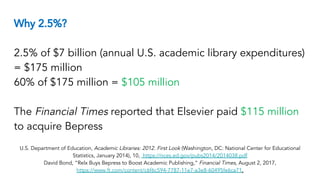
Why 2.5%?
2.5% of $7 billion (annual U.S. academic library expenditures)
= $175 million
60% of $175 million = $105 million
The Financial Times reported that Elsevier paid $115 million
to acquire Bepress
U.S. Department of Education, Academic Libraries: 2012. First Look (Washington, DC: National Center for Educational
Statistics, January 2014), 10, https://nces.ed.gov/pubs2014/2014038.pdf
David Bond, “Relx Buys Bepress to Boost Academic Publishing,” Financial Times, August 2, 2017,
https://www.ft.com/content/c6f6c594-7787-11e7-a3e8-60495fe6ca71.
Why 2.5%?
As a community, academic libraries have a collective action
problem.
“Although it is likely that university libraries could develop a more efficient system
of scholarly communication if they were to redeploy their collective subscription
budgets, each individual library— when it decides how to spend its own little
piece of that huge pie—has little incentive to redirect its own expenditures…
Unfortunately, if every librarian waits for every other librarian to make the
investments necessary to develop a sustainable system of Gold OA publishing, it
may never happen.”
— John Wenzler
John Wenzler, “Scholarly Communication and the Dilemma of Collective Action: Why Academic Journals Cost Too Much,”
College & Research Libraries 78(2):192 February 2017 doi: https://doi.org/10.5860/crl.78.2.16581
Why 2.5%?
An attempt to develop community norms around the level of
contribution to the collective good.
Provide information about what organizations and projects
deserve support.
What gets measured and reported, gets done.
What Has Happened and Next Steps
August 2017 — “2.5% Commitment” paper released
Fall 2017 — Preliminary data collection effort
Fall 2017/Spring 2018 — Develop specifications,
governance, and processes for Tracking Tool, secure funding
Fall 2018 — Build Tool(s)
Spring/Summer 2019 — Use Tool for large scale data
collection
Fall 2017 Data Collection Prototype
Opening Questions:
1. What should we count as an Open Investment?
2. How much do libraries spend on Open annually?
3. How might we understand these investments in the
broader context of overall library spending?
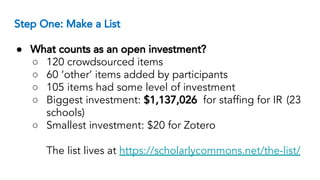
Step One: Make a List
● What counts as an open investment?
○ 120 crowdsourced items
○ 60 ‘other’ items added by participants
○ 105 items had some level of investment
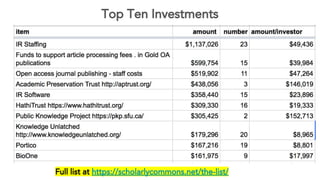
○ Biggest investment: $1,137,026 for staffing for IR (23
schools)
○ Smallest investment: $20 for Zotero
The list lives at https://scholarlycommons.net/the-list/
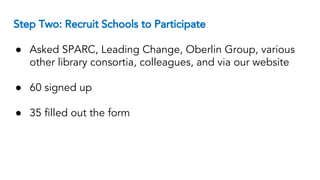
Step Two: Recruit Schools to Participate
● Asked SPARC, Leading Change, Oberlin Group, various
other library consortia, colleagues, and via our website
● 60 signed up
● 35 filled out the form
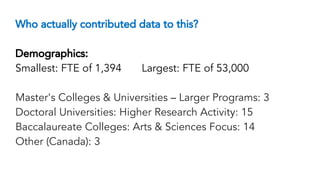
Who actually contributed data to this?
Demographics:
Smallest: FTE of 1,394 Largest: FTE of 53,000
Master's Colleges & Universities – Larger Programs: 3
Doctoral Universities: Higher Research Activity: 15
Baccalaureate Colleges: Arts & Sciences Focus: 14
Other (Canada): 3
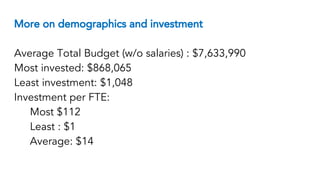
More on demographics and investment
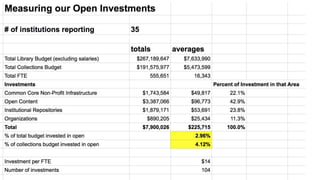
Average Total Budget (w/o salaries) : $7,633,990
Most invested: $868,065
Least investment: $1,048
Investment per FTE:
Most $112
Least : $1
Average: $14
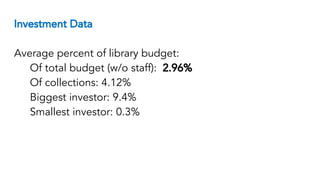
Investment Data
Average percent of library budget:
Of total budget (w/o staff): 2.96%
Of collections: 4.12%
Biggest investor: 9.4%
Smallest investor: 0.3%
Top Ten Investments
Full list at https://scholarlycommons.net/the-list/
We asked participants:
1. How much did you know about your library’s Open contributions
before you undertook this exercise?
2. What about the results was expected? What surprised you?
3. Is your library considering changing its level of contribution to Open
or where they are made as a result of this exercise?
4. What recommendations would you make to advance the project as it
is developed further?
Feedback — Strategy
• Increase the target to 5%. Think about facilitating
conversations among participants and in the broader
community about collective efforts that would tip the
scales in the open / market balancing act.
• What is the vision, how to we get there, who decides?
How do we move quickly and with unified determination,
and yet slowly enough to consult together, deliberate
carefully, and design wisely?
Feedback — What Counts?
• Should we focus primarily on infrastructure (i.e. software,
technology, etc.) and not include open content?
• Within infrastructure, should we focus on initiatives that
are widely adopted and have an international community,
versus more geographically, regionally, or nationally
constrained initiatives? By extension, should
new/emerging initiatives be included and if so, how?
• More detail should be provided on eligible in-kind
contributions, e.g. staff time/costs at the local institution
and how to calculate this.
Feedback — Local Plans
• We are always looking at ways to effectively support a
transition to open access; currently thinking about how to
develop a more comprehensive strategy to increase and
coordinate our efforts.
Feedback — Concerns
• Expanding the definition of shared OA infrastructure may
have the effect of making institutions feel good about
themselves, but it is counterproductive. What is really
needed is a comprehensive vision, not a disparate list of
activities.
• The exercise made it clear that individual library efforts
have limited impact.
Feedback — Concerns
• As the word of the year was just announced as "complicit"
there is much to be said about where the other 97.5% of
library budgets go, and if that aligns with long term values.
Feedback — Statements of Support
• We might need to use a higher percentage target in the
name of the initiative!!
• I would encourage everyone to figure out what you are
already spending.
• Well, if you could drive a certain commercial publisher out
of business, that would be icing on the cake. :)
What Comes Next?
Spring/Fall 2018 — Develop specifications, governance, and
processes for Tracking Tool, secure funding
Conversations and investigation
What Comes Next?
Fall 2018/Spring 2019 — Build Tool
Spring/Summer 2019 — Use Tool for large scale data
collection
What Comes Next?
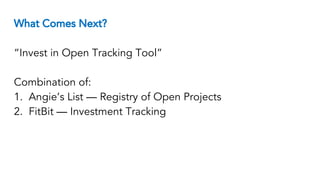
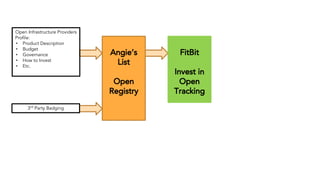
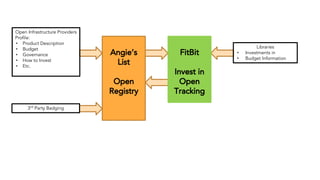
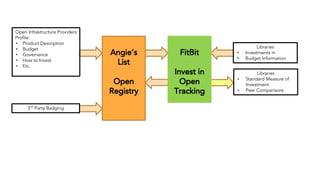
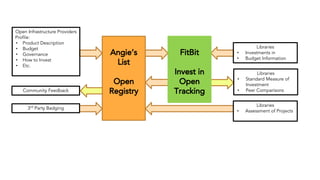
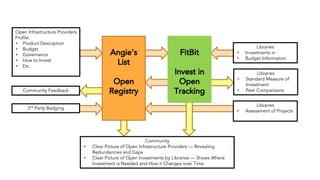
“Invest in Open Tracking Tool”
Combination of:
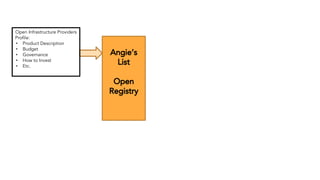
1. Angie’s List — Registry of Open Projects
2. FitBit — Investment Tracking
Angie’s
List
Open
Registry
Angie’s
List
Open
Registry
Open Infrastructure Providers
Profile:
• Product Description
• Budget
• Governance
• How to Invest
• Etc.
Angie’s
List
Open
Registry
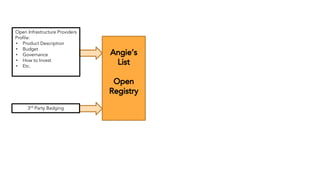
3rd
Party Badging
Open Infrastructure Providers
Profile:
• Product Description
• Budget
• Governance
• How to Invest
• Etc.
Angie’s
List
Open
Registry
3rd
Party Badging
Open Infrastructure Providers
Profile:
• Product Description
• Budget
• Governance
• How to Invest
• Etc.
FitBit
Invest in
Open
Tracking
Angie’s
List
Open
Registry
3rd
Party Badging
Open Infrastructure Providers
Profile:
• Product Description
• Budget
• Governance
• How to Invest
• Etc.
Libraries
• Investments in
• Budget Information
FitBit
Invest in
Open
Tracking
Angie’s
List
Open
Registry
3rd
Party Badging
Open Infrastructure Providers
Profile:
• Product Description
• Budget
• Governance
• How to Invest
• Etc.
Libraries
• Investments in
• Budget Information
Libraries
• Standard Measure of
Investment
• Peer Comparisons
FitBit
Invest in
Open
Tracking
Libraries
• Assessment of Projects
3rd
Party Badging
Open Infrastructure Providers
Profile:
• Product Description
• Budget
• Governance
• How to Invest
• Etc.
Libraries
• Investments in
• Budget Information
Libraries
• Standard Measure of
Investment
• Peer Comparisons
FitBit
Invest in
Open
TrackingCommunity Feedback
Angie’s
List
Open
Registry
Libraries
• Assessment of Projects
3rd
Party Badging
Open Infrastructure Providers
Profile:
• Product Description
• Budget
• Governance
• How to Invest
• Etc.
Libraries
• Investments in
• Budget Information
Libraries
• Standard Measure of
Investment
• Peer Comparisons
Community
• Clear Picture of Open Infrastructure Providers — Revealing
Redundancies and Gaps
• Clear Picture of Open Investments by Libraries — Shows Where
Investment is Needed and How it Changes over Time
FitBit
Invest in
Open
TrackingCommunity Feedback
Angie’s
List
Open
Registry
What Should Count? — Three Buckets
1. Investment in Open Tools and Services
2. Investment in an Institutions Repository
3. Open Content
What Should Count? — Include for-Profits?
Much debate
Likely for repositories — OCLC versus Bepress, Atmire or
Ubiquity
Only if they meet certain criteria
See for example: Paul Peters, “A Radically Open Approach to Developing Infrastructure for Open Science,” Hindawi Blog,
October 23, 2017,
https://about.hindawi.com/opinion/a-radically-open-approach-to-developing-infrastructure-for-open-science/
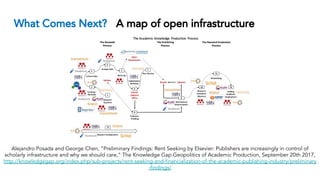
What Comes Next? A map of open infrastructure
Alejandro Posada and George Chen, “Preliminary Findings: Rent Seeking by Elsevier: Publishers are increasingly in control of
scholarly infrastructure and why we should care,” The Knowledge Gap Geopolitics of Academic Production, September 20th 2017,
http://knowledgegap.org/index.php/sub-projects/rent-seeking-and-financialization-of-the-academic-publishing-industry/preliminary
-findings/
What Comes Next?
The standard contribution % becomes part of reported
statistics (ARL, ARCL, etc.)
“Portfolios” for investment developed
United Way like organization to channel funds and evaluate
investments
Questions for You:
1. Is this a good idea?
2. Would your library contribute information?
3. Would your library contribute a modest sum to support
this effort?
(zoom poll)
Questions for You:
4. Who should be able to see what data?
5. How should decisions about policy be made?
6. Other advice would you give us?
https://bit.ly/2wLLA07
Questions/Comments
© 2018 David W. Lewis and Mike Roy. This work is licensed under a Creative Commons Attribution 4.0 International license
David W. Lewis dlewis@iupui.edu
Lori Goetsch lgoetsch@ksu.edu
Diane Graves dgraves@trinity.edu
Mike Roy mdroy@middlebury.edu
http://scholarlycommons.net @in4open
David W, Lewis, Lori Goetsch, Diane Graves, and Mike Roy. “Funding
Community Controlled Open Infrastructure for Scholarly Communication: The
2.5% Commitment Initiative.” College & Research Libraries News,
79(3):133-136 March 2018,
https://crln.acrl.org/index.php/crlnews/article/view/16902
© 2018 David W. Lewis and Mike Roy. This work is licensed under a Creative Commons Attribution 4.0 International license

5.17.18 "The 2.5% Commitment: Investing in Open" presentation slides

  • 1.
    The 2.5% Commitment: Investingin Open David W. Lewis and Mike Roy DuraSpace Hot Topics Webinar May 17, 2018 http://scholarlycommons.net © 2018 David W. Lewis and Mike Roy. This work is licensed under a Creative Commons Attribution 4.0 International license
  • 2.
    Fundamental Truth #1: Thereis no sustainable path to an open scholarly commons without sustained and substantial investment from academic libraries.
  • 3.
    Fundamental Truth #2: Ifwe do not create the open scholarly commons, Elsevier, Springer, Wiley, et. al. will own the scholarly record and continue to exploit the academy. What should be a public good will be used for private gain.
  • 4.
    On the follyof rewarding A, while hoping for B Steven Kerr, “On the folly of rewarding A, while hoping for B,” Academy of Management Journal December 1975, 18(4):769-783, https://www.ou.edu/russell/UGcomp/Kerr.pdf
  • 5.
    Fundamental Truth #3: Librariansare generally cooperative. We like to help each other when we can. Going forward this will not be enough. What will be required is significant and sustained collective investment. We need to create new institutions.
  • 6.
    The Commitment: Every academiclibrary should commit to invest 2.5% of its total budget to support the common infrastructure needed to create the open scholarly commons. See: David W. Lewis, “The 2.5% Commitment,” https://scholarworks.iupui.edu/handle/1805/14063
  • 7.
    Why 2.5%? 2.5% of$7 billion (annual U.S. academic library expenditures) = $175 million 60% of $175 million = $105 million The Financial Times reported that Elsevier paid $115 million to acquire Bepress U.S. Department of Education, Academic Libraries: 2012. First Look (Washington, DC: National Center for Educational Statistics, January 2014), 10, https://nces.ed.gov/pubs2014/2014038.pdf David Bond, “Relx Buys Bepress to Boost Academic Publishing,” Financial Times, August 2, 2017, https://www.ft.com/content/c6f6c594-7787-11e7-a3e8-60495fe6ca71.
  • 8.
    Why 2.5%? As acommunity, academic libraries have a collective action problem.
  • 9.
    “Although it islikely that university libraries could develop a more efficient system of scholarly communication if they were to redeploy their collective subscription budgets, each individual library— when it decides how to spend its own little piece of that huge pie—has little incentive to redirect its own expenditures… Unfortunately, if every librarian waits for every other librarian to make the investments necessary to develop a sustainable system of Gold OA publishing, it may never happen.” — John Wenzler John Wenzler, “Scholarly Communication and the Dilemma of Collective Action: Why Academic Journals Cost Too Much,” College & Research Libraries 78(2):192 February 2017 doi: https://doi.org/10.5860/crl.78.2.16581
  • 10.
    Why 2.5%? An attemptto develop community norms around the level of contribution to the collective good. Provide information about what organizations and projects deserve support. What gets measured and reported, gets done.
  • 11.
    What Has Happenedand Next Steps August 2017 — “2.5% Commitment” paper released Fall 2017 — Preliminary data collection effort Fall 2017/Spring 2018 — Develop specifications, governance, and processes for Tracking Tool, secure funding Fall 2018 — Build Tool(s) Spring/Summer 2019 — Use Tool for large scale data collection
  • 12.
    Fall 2017 DataCollection Prototype Opening Questions: 1. What should we count as an Open Investment? 2. How much do libraries spend on Open annually? 3. How might we understand these investments in the broader context of overall library spending?
  • 13.
    Step One: Makea List ● What counts as an open investment? ○ 120 crowdsourced items ○ 60 ‘other’ items added by participants ○ 105 items had some level of investment ○ Biggest investment: $1,137,026 for staffing for IR (23 schools) ○ Smallest investment: $20 for Zotero The list lives at https://scholarlycommons.net/the-list/
  • 14.
    Step Two: RecruitSchools to Participate ● Asked SPARC, Leading Change, Oberlin Group, various other library consortia, colleagues, and via our website ● 60 signed up ● 35 filled out the form
  • 15.
    Who actually contributeddata to this? Demographics: Smallest: FTE of 1,394 Largest: FTE of 53,000 Master's Colleges & Universities – Larger Programs: 3 Doctoral Universities: Higher Research Activity: 15 Baccalaureate Colleges: Arts & Sciences Focus: 14 Other (Canada): 3
  • 16.
    More on demographicsand investment Average Total Budget (w/o salaries) : $7,633,990 Most invested: $868,065 Least investment: $1,048 Investment per FTE: Most $112 Least : $1 Average: $14
  • 17.
    Investment Data Average percentof library budget: Of total budget (w/o staff): 2.96% Of collections: 4.12% Biggest investor: 9.4% Smallest investor: 0.3%
  • 18.
    Top Ten Investments Fulllist at https://scholarlycommons.net/the-list/
  • 20.
    We asked participants: 1.How much did you know about your library’s Open contributions before you undertook this exercise? 2. What about the results was expected? What surprised you? 3. Is your library considering changing its level of contribution to Open or where they are made as a result of this exercise? 4. What recommendations would you make to advance the project as it is developed further?
  • 21.
    Feedback — Strategy •Increase the target to 5%. Think about facilitating conversations among participants and in the broader community about collective efforts that would tip the scales in the open / market balancing act. • What is the vision, how to we get there, who decides? How do we move quickly and with unified determination, and yet slowly enough to consult together, deliberate carefully, and design wisely?
  • 22.
    Feedback — WhatCounts? • Should we focus primarily on infrastructure (i.e. software, technology, etc.) and not include open content? • Within infrastructure, should we focus on initiatives that are widely adopted and have an international community, versus more geographically, regionally, or nationally constrained initiatives? By extension, should new/emerging initiatives be included and if so, how? • More detail should be provided on eligible in-kind contributions, e.g. staff time/costs at the local institution and how to calculate this.
  • 23.
    Feedback — LocalPlans • We are always looking at ways to effectively support a transition to open access; currently thinking about how to develop a more comprehensive strategy to increase and coordinate our efforts.
  • 24.
    Feedback — Concerns •Expanding the definition of shared OA infrastructure may have the effect of making institutions feel good about themselves, but it is counterproductive. What is really needed is a comprehensive vision, not a disparate list of activities. • The exercise made it clear that individual library efforts have limited impact.
  • 25.
    Feedback — Concerns •As the word of the year was just announced as "complicit" there is much to be said about where the other 97.5% of library budgets go, and if that aligns with long term values.
  • 26.
    Feedback — Statementsof Support • We might need to use a higher percentage target in the name of the initiative!! • I would encourage everyone to figure out what you are already spending. • Well, if you could drive a certain commercial publisher out of business, that would be icing on the cake. :)
  • 27.
    What Comes Next? Spring/Fall2018 — Develop specifications, governance, and processes for Tracking Tool, secure funding Conversations and investigation
  • 28.
    What Comes Next? Fall2018/Spring 2019 — Build Tool Spring/Summer 2019 — Use Tool for large scale data collection
  • 29.
    What Comes Next? “Investin Open Tracking Tool” Combination of: 1. Angie’s List — Registry of Open Projects 2. FitBit — Investment Tracking
  • 30.
  • 31.
    Angie’s List Open Registry Open Infrastructure Providers Profile: •Product Description • Budget • Governance • How to Invest • Etc.
  • 32.
    Angie’s List Open Registry 3rd Party Badging Open InfrastructureProviders Profile: • Product Description • Budget • Governance • How to Invest • Etc.
  • 33.
    Angie’s List Open Registry 3rd Party Badging Open InfrastructureProviders Profile: • Product Description • Budget • Governance • How to Invest • Etc. FitBit Invest in Open Tracking
  • 34.
    Angie’s List Open Registry 3rd Party Badging Open InfrastructureProviders Profile: • Product Description • Budget • Governance • How to Invest • Etc. Libraries • Investments in • Budget Information FitBit Invest in Open Tracking
  • 35.
    Angie’s List Open Registry 3rd Party Badging Open InfrastructureProviders Profile: • Product Description • Budget • Governance • How to Invest • Etc. Libraries • Investments in • Budget Information Libraries • Standard Measure of Investment • Peer Comparisons FitBit Invest in Open Tracking
  • 36.
    Libraries • Assessment ofProjects 3rd Party Badging Open Infrastructure Providers Profile: • Product Description • Budget • Governance • How to Invest • Etc. Libraries • Investments in • Budget Information Libraries • Standard Measure of Investment • Peer Comparisons FitBit Invest in Open TrackingCommunity Feedback Angie’s List Open Registry
  • 37.
    Libraries • Assessment ofProjects 3rd Party Badging Open Infrastructure Providers Profile: • Product Description • Budget • Governance • How to Invest • Etc. Libraries • Investments in • Budget Information Libraries • Standard Measure of Investment • Peer Comparisons Community • Clear Picture of Open Infrastructure Providers — Revealing Redundancies and Gaps • Clear Picture of Open Investments by Libraries — Shows Where Investment is Needed and How it Changes over Time FitBit Invest in Open TrackingCommunity Feedback Angie’s List Open Registry
  • 38.
    What Should Count?— Three Buckets 1. Investment in Open Tools and Services 2. Investment in an Institutions Repository 3. Open Content
  • 39.
    What Should Count?— Include for-Profits? Much debate Likely for repositories — OCLC versus Bepress, Atmire or Ubiquity Only if they meet certain criteria See for example: Paul Peters, “A Radically Open Approach to Developing Infrastructure for Open Science,” Hindawi Blog, October 23, 2017, https://about.hindawi.com/opinion/a-radically-open-approach-to-developing-infrastructure-for-open-science/
  • 40.
    What Comes Next?A map of open infrastructure Alejandro Posada and George Chen, “Preliminary Findings: Rent Seeking by Elsevier: Publishers are increasingly in control of scholarly infrastructure and why we should care,” The Knowledge Gap Geopolitics of Academic Production, September 20th 2017, http://knowledgegap.org/index.php/sub-projects/rent-seeking-and-financialization-of-the-academic-publishing-industry/preliminary -findings/
  • 41.
    What Comes Next? Thestandard contribution % becomes part of reported statistics (ARL, ARCL, etc.) “Portfolios” for investment developed United Way like organization to channel funds and evaluate investments
  • 42.
    Questions for You: 1.Is this a good idea? 2. Would your library contribute information? 3. Would your library contribute a modest sum to support this effort? (zoom poll)
  • 43.
    Questions for You: 4.Who should be able to see what data? 5. How should decisions about policy be made? 6. Other advice would you give us? https://bit.ly/2wLLA07
  • 44.
    Questions/Comments © 2018 DavidW. Lewis and Mike Roy. This work is licensed under a Creative Commons Attribution 4.0 International license
  • 45.
    David W. Lewisdlewis@iupui.edu Lori Goetsch lgoetsch@ksu.edu Diane Graves dgraves@trinity.edu Mike Roy mdroy@middlebury.edu http://scholarlycommons.net @in4open David W, Lewis, Lori Goetsch, Diane Graves, and Mike Roy. “Funding Community Controlled Open Infrastructure for Scholarly Communication: The 2.5% Commitment Initiative.” College & Research Libraries News, 79(3):133-136 March 2018, https://crln.acrl.org/index.php/crlnews/article/view/16902 © 2018 David W. Lewis and Mike Roy. This work is licensed under a Creative Commons Attribution 4.0 International license