1
Dano Roelvink
IHE Delft & DELTARES, Netherlands
ShorelineS and future coastline modelling
Dano Roelvink1,2,3, Bas Huisman2,3 ,
Ahmed Elghandour1,4,5 , Johan Reyns1,3 and
Mohamed Ghonim1
1IHE Delft Institute for Water Education, Delft, The Netherlands
2Deltares, Delft, The Netherlands
3Delft University of Technology, Delft, The Netherlands
4Department of Civil Engineering, Faculty of Engineering, Port
Said University, Port Said, Egypt
5 CIMA, University of the Algarve, Faro, Portugal
2
Motivation
• In complex large-scale systems, resolving the surf zones is
prohibitively expensive on longer timescales
• Coastline modelling has long been a cheap alternative, but
existing models have severe limitations.
• Can we make a better, more flexible coastline model (and
couple it with a 2DH tidal morphology model?)
3
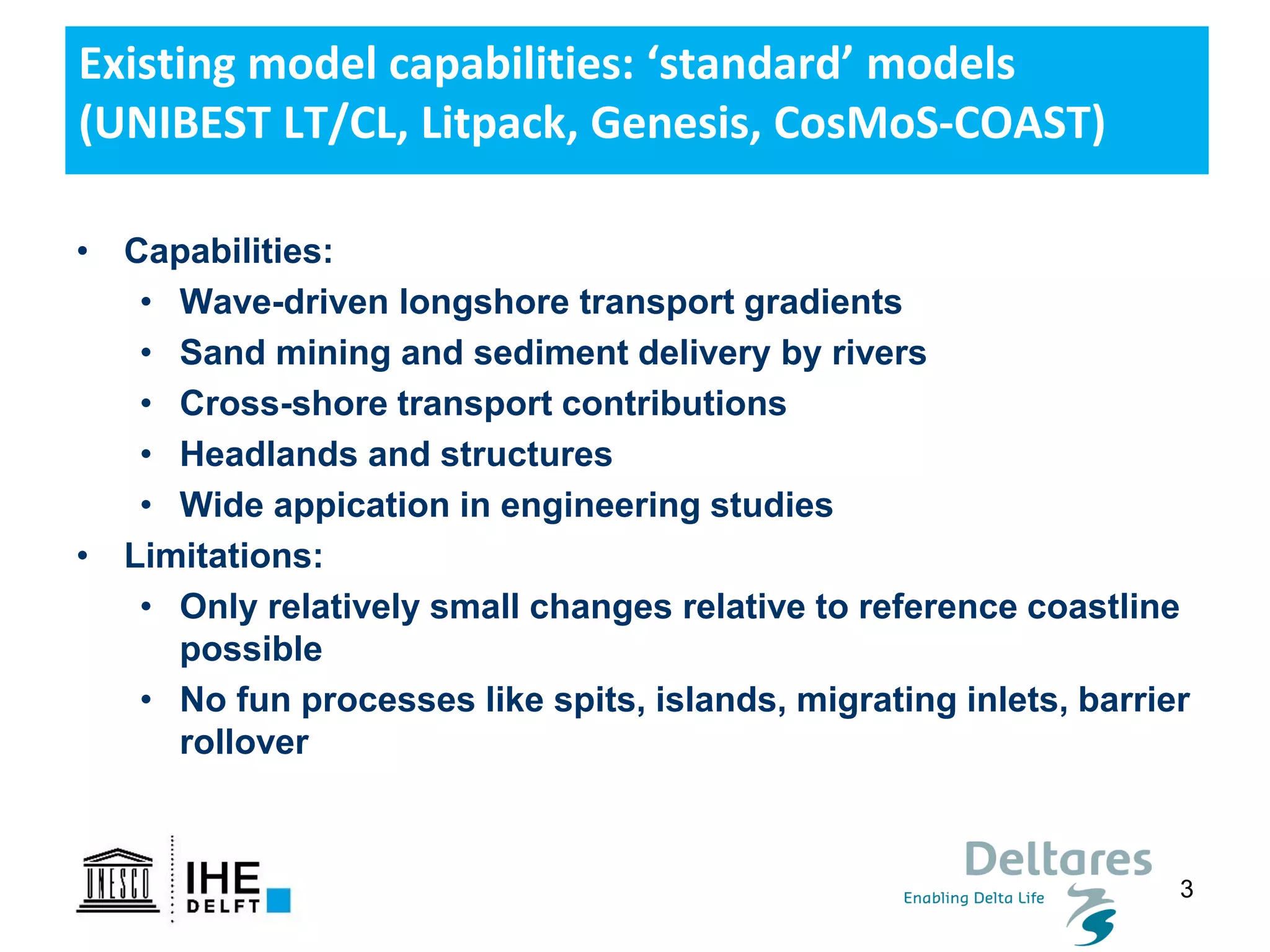
Existing model capabilities: ‘standard’ models
(UNIBEST LT/CL, Litpack, Genesis, CosMoS-COAST)
• Capabilities:
• Wave-driven longshore transport gradients
• Sand mining and sediment delivery by rivers
• Cross-shore transport contributions
• Headlands and structures
• Wide appication in engineering studies
• Limitations:
• Only relatively small changes relative to reference coastline
possible
• No fun processes like spits, islands, migrating inlets, barrier
rollover
4
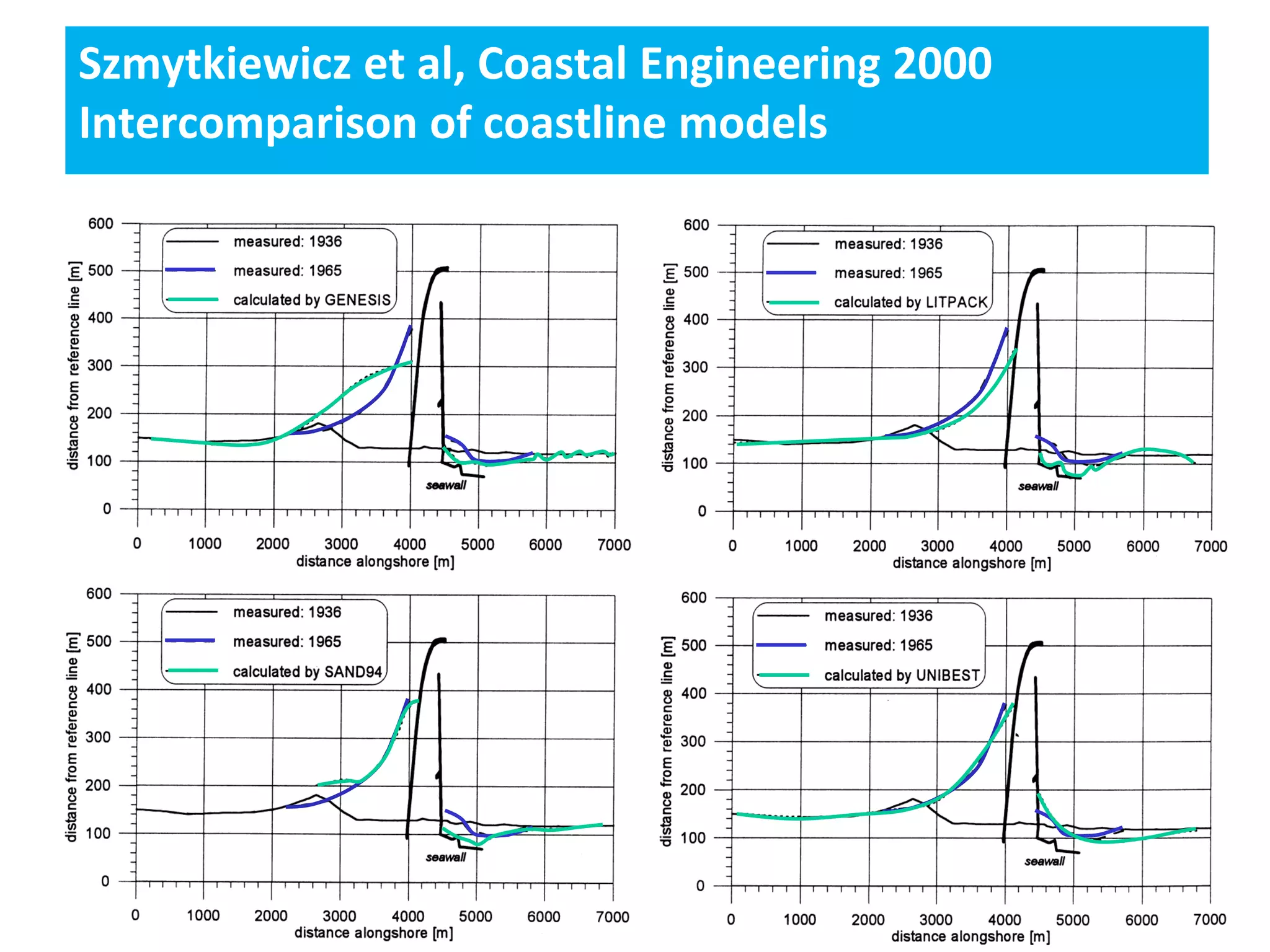
Szmytkiewicz et al, Coastal Engineering 2000
Intercomparison of coastline models
5
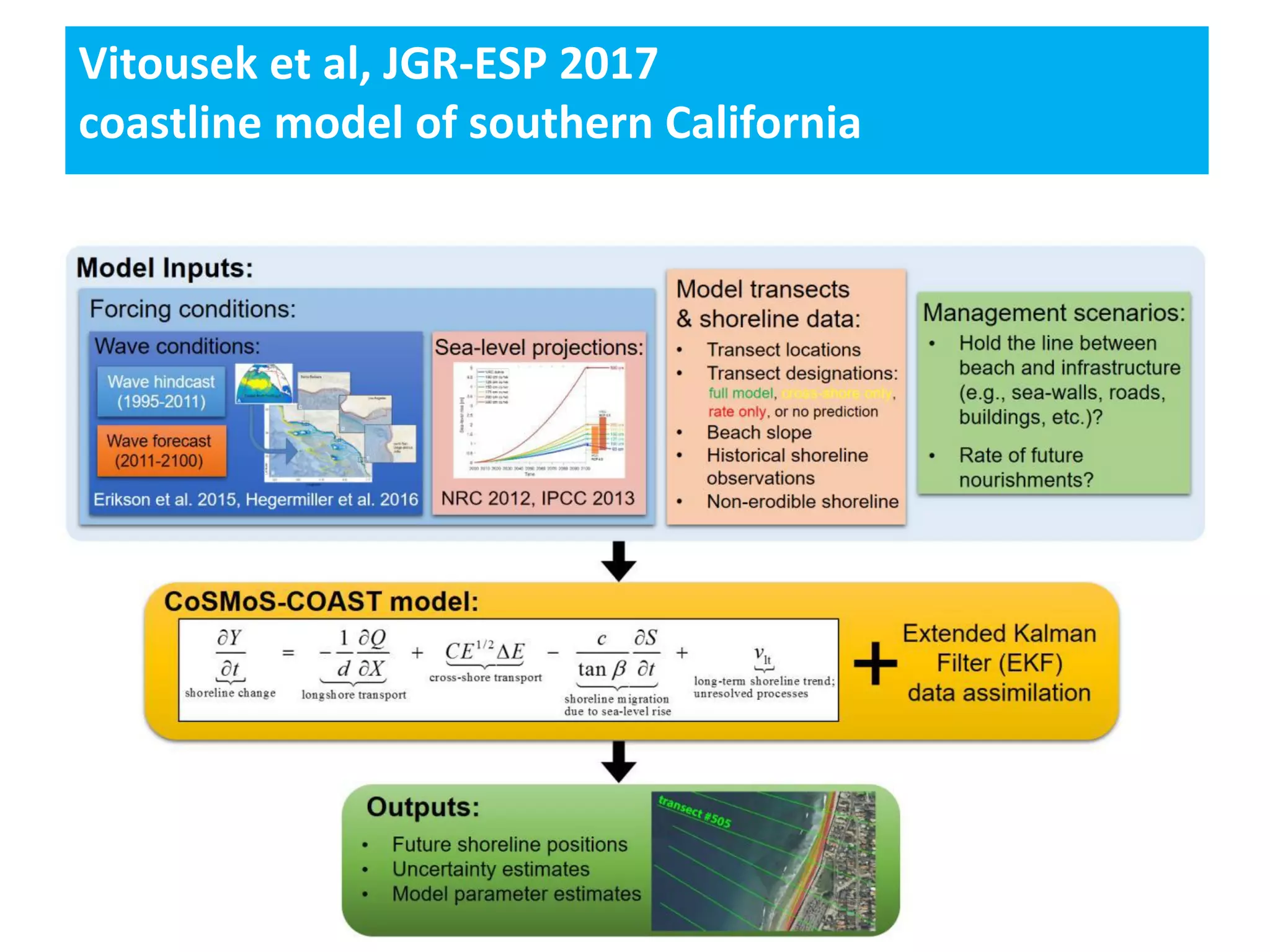
Vitousek et al, JGR-ESP 2017
coastline model of southern California
6
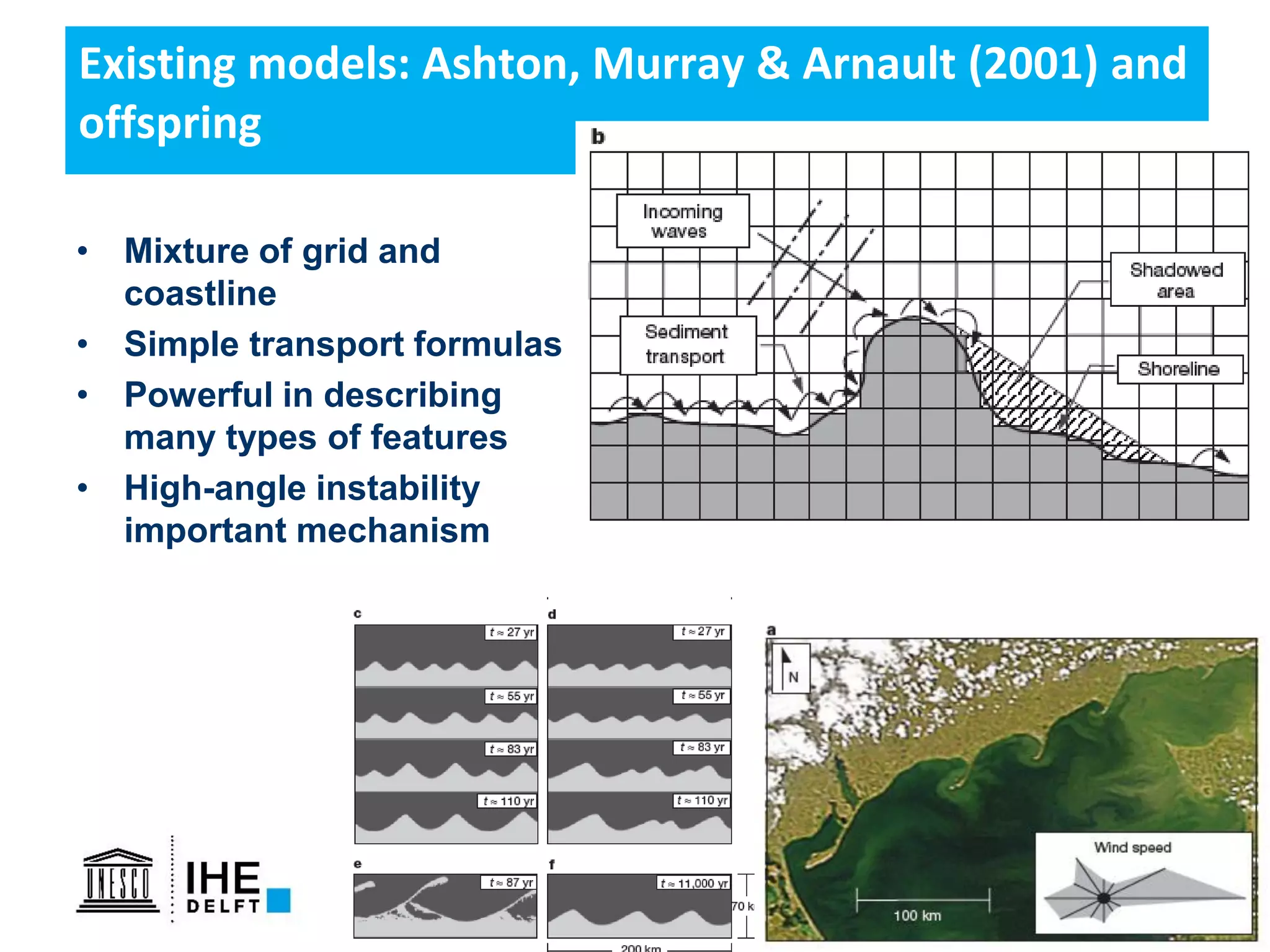
Existing models: Ashton, Murray & Arnault (2001) and
offspring
• Mixture of grid and
coastline
• Simple transport formulas
• Powerful in describing
many types of features
• High-angle instability
important mechanism
7
Pros and cons
• Standard models:
• much experience in engineering
• too inflexible
• not enough processes represented
• CEM and similar models
• beautiful processes represented in elegant way
• relatively complex logic and structure
• only used for schematic system studies
• New, flexible engineering model needed
8
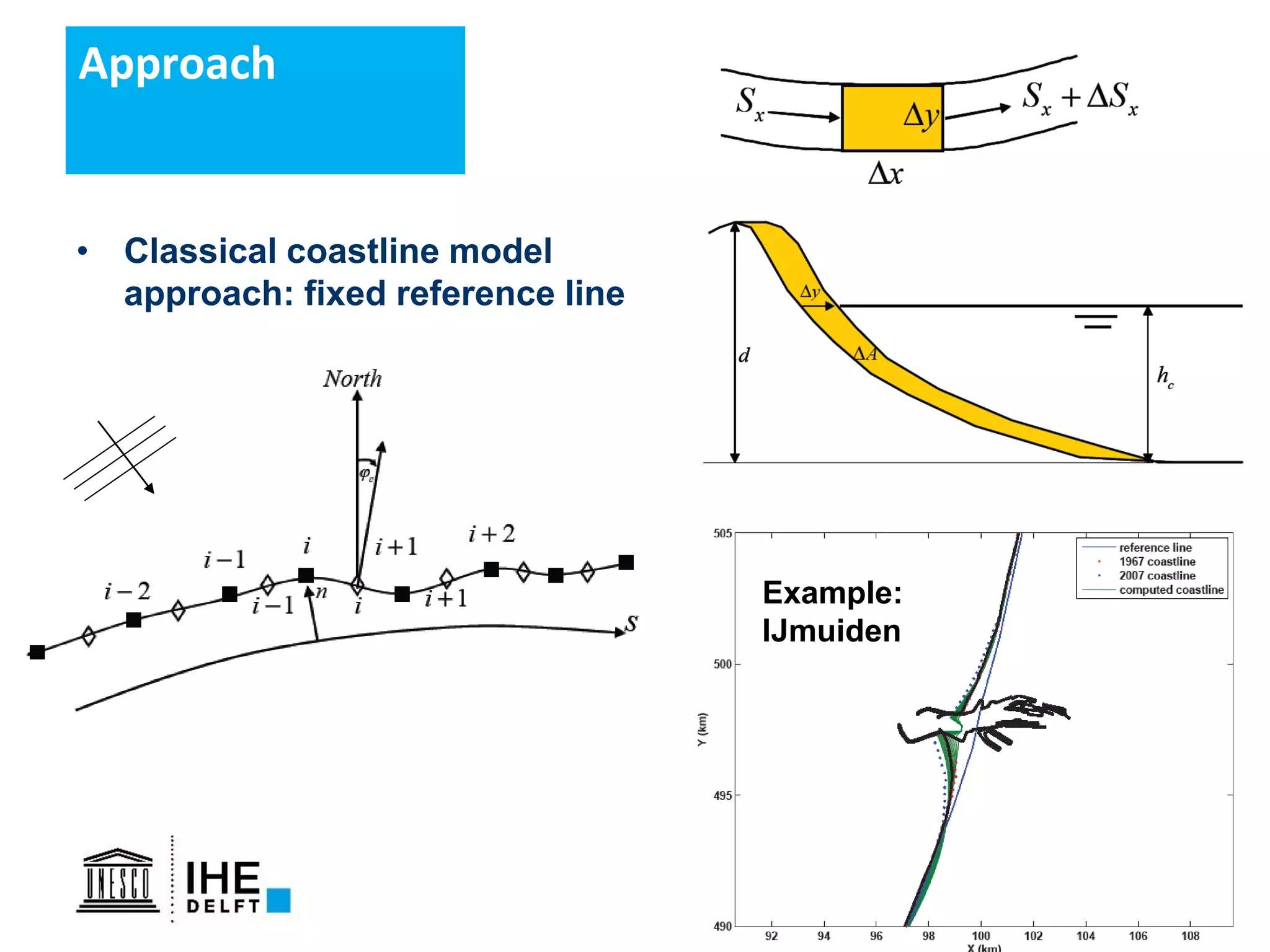
Approach
• Classical coastline model
approach: fixed reference line
Example:
IJmuiden
9
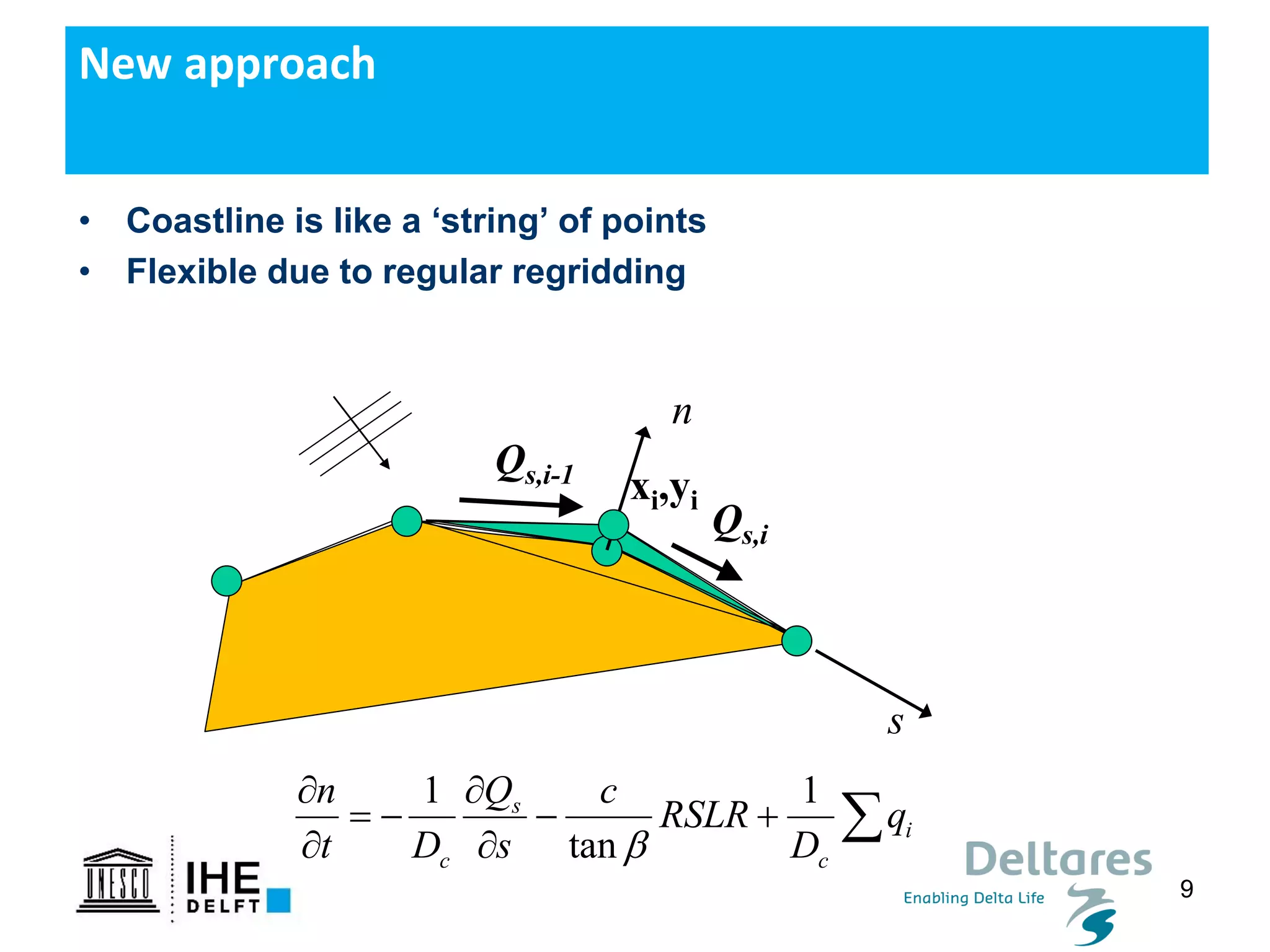
New approach
s
n
Qs,i-1
Qs,i
xi,yi
• Coastline is like a ‘string’ of points
• Flexible due to regular regridding
1 1
tan
s
i
c c
n Q c
RSLR q
t D s D
 
= − − +
 

10
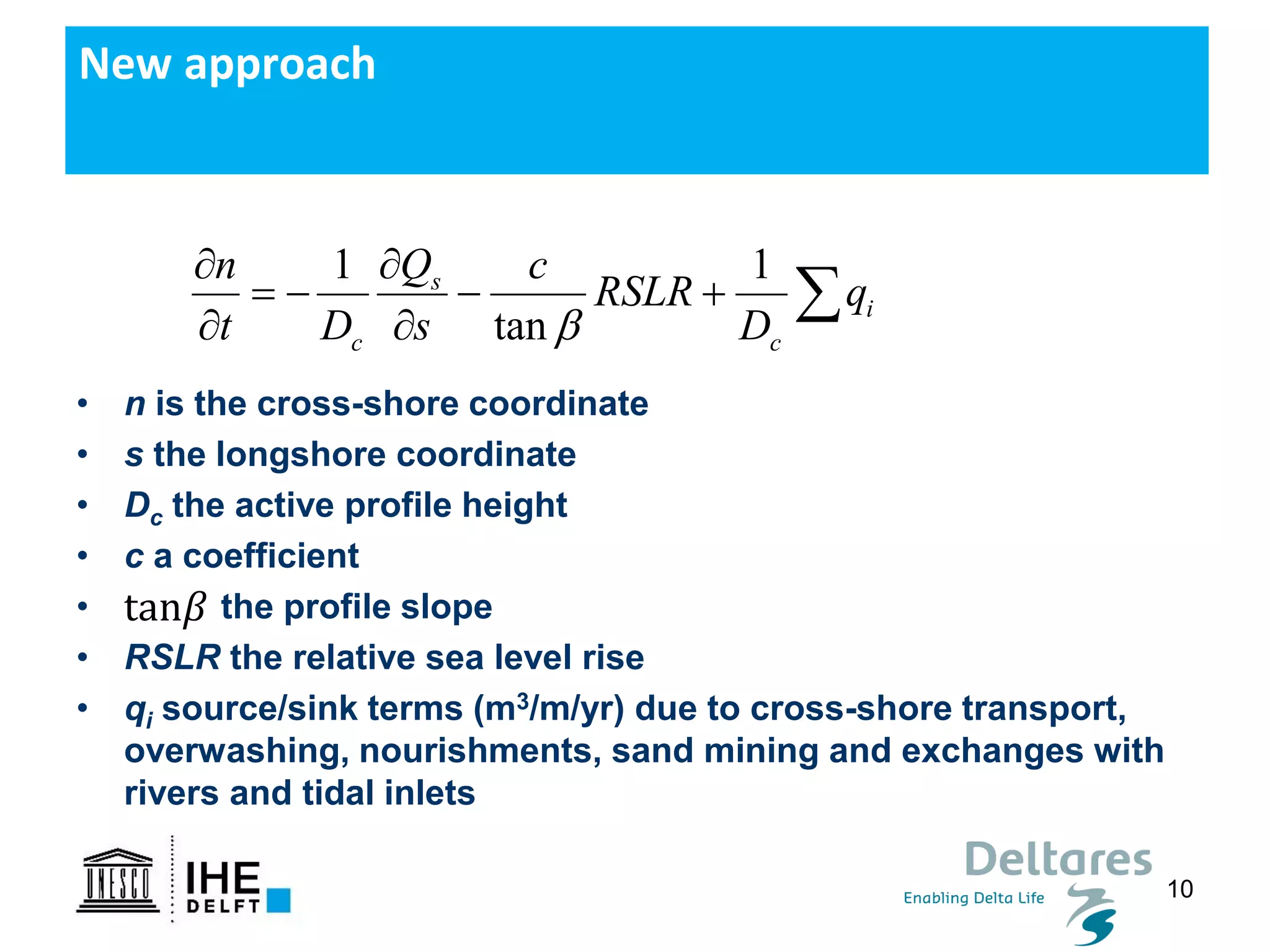
• n is the cross-shore coordinate
• s the longshore coordinate
• Dc the active profile height
• c a coefficient
• the profile slope
• RSLR the relative sea level rise
• qi source/sink terms (m3/m/yr) due to cross-shore transport,
overwashing, nourishments, sand mining and exchanges with
rivers and tidal inlets
New approach
1 1
tan
s
i
c c
n Q c
RSLR q
t D s D
 
= − − +
 

tan𝛽
11
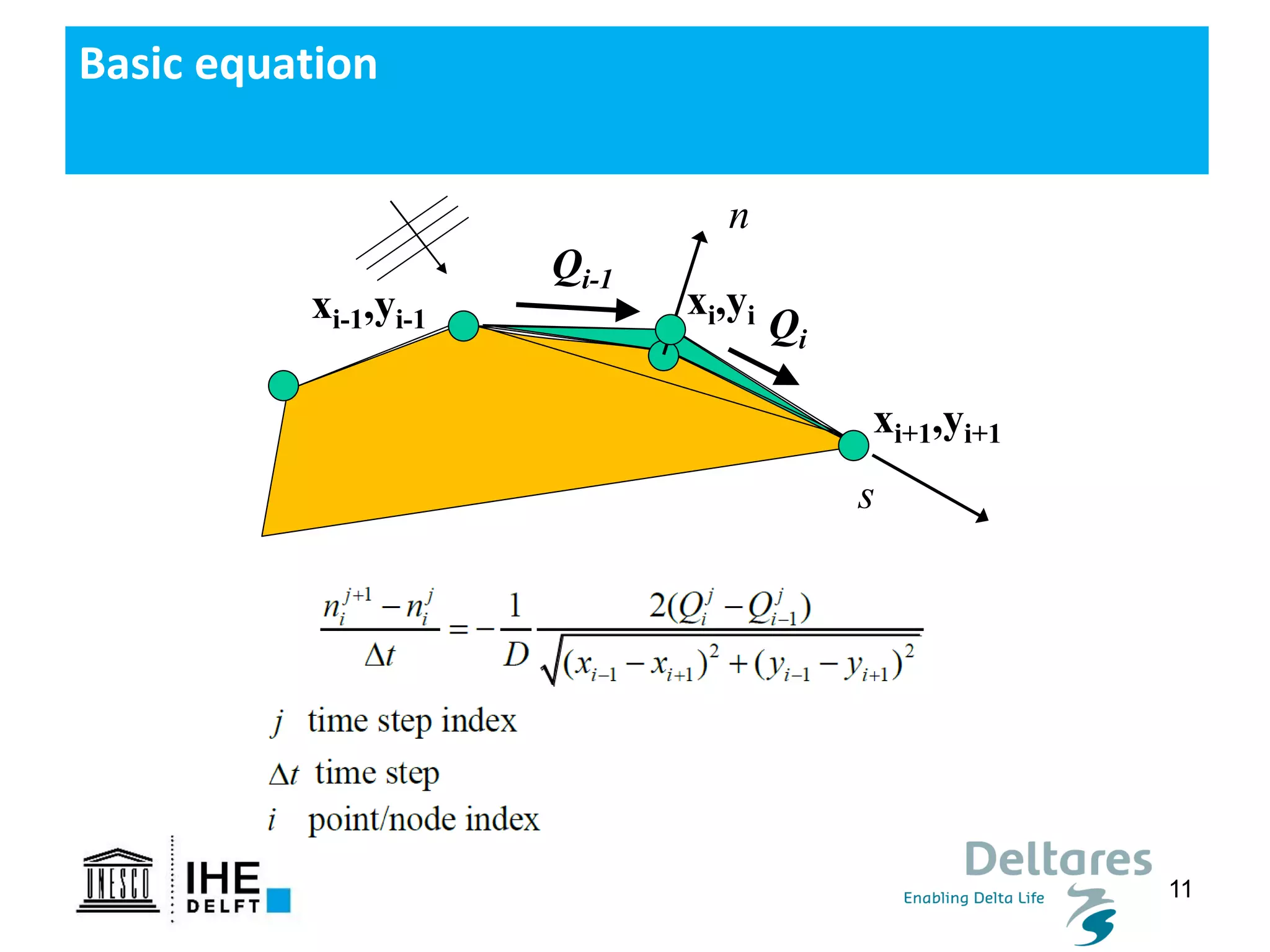
Basic equation
s
n
Qi-1
Qi
xi,yi
xi+1,yi+1
xi-1,yi-1
12
• Simple transport
formulas
• Based on deep water
wave conditions or
conditions at breaker
line
• Similar behaviour as
function of deep water
wave angle
Transport formulations
Author Notation Formula
USACE, 1984
(simplified)
CERC1 5/2
0 sin 2( )s S locQ bH =
Ashton &
Murray, 2006
CERC2 12 1 6
5 5 5
2 0 cos ( )sin( )s S loc locQ K H T  =
USACE, 1984 CERC3 5/2
1 sin2( )s sb locbQ b H =
Kamphuis,
1992
KAMP 2 1.5 0.75 0.25 0.6
502.33 sin (2 )s sb b locbQ H T m D −
=
Where:
b : calibration coefficient CERC1
1
/
, ~ 0.1 0.2
16( )(1 )s
k g k
b k
p

 
= −
− −
( )
sin( )
arctan 2
cos( )
j
j c w
loc i
c w i
 

 
 −
=  
− 
1
5
2 1( )
2
g
K K


= , 1/2
1 0.4 /K m s
0sH : offshore significant wave height
sbH : significant breaking wave height
T : peak wave period
50D : median grain diameter [m]
bm : mean bed slope (beach slope in the breaking zone)
b : breaking wave angle
Author Notation Formula
USACE, 1984
(simplified)
CERC1 5/2
0 sin 2( )s S locQ bH =
Ashton &
Murray, 2006
CERC2 12 1 6
5 5 5
2 0 cos ( )sin( )s S loc locQ K H T  =
USACE, 1984 CERC3 5/2
1 sin2( )s sb locbQ b H =
Kamphuis,
1992
KAMP 2 1.5 0.75 0.25 0.6
502.33 sin (2 )s sb b locbQ H T m D −
=
Where:
b : calibration coefficient CERC1
1
/
, ~ 0.1 0.2
16( )(1 )
k g k
b k
p

 
= −
− −
Transport is a function of wave
height and wave direction
Maximum at around 45o relative to
coast
13
Representation of coastline and structures
• Coastline is represented as an arbitrary number of free-form
polylines that can be open or closed (islands)
0 2000 4000 6000 8000 10000
0
1000
2000
3000
4000
5000
6000
7000
8000
9000
10000
Easting [m]
Northing[m]
Add coastline (LMB); Next segment (RMB); Exit (q)
0 2000 4000 6000 8000 10000
0
1000
2000
3000
4000
5000
6000
7000
8000
9000
10000
Easting [m]
Northing[m]
Add structure (LMB); Next structure (RMB); Exit (q)
14
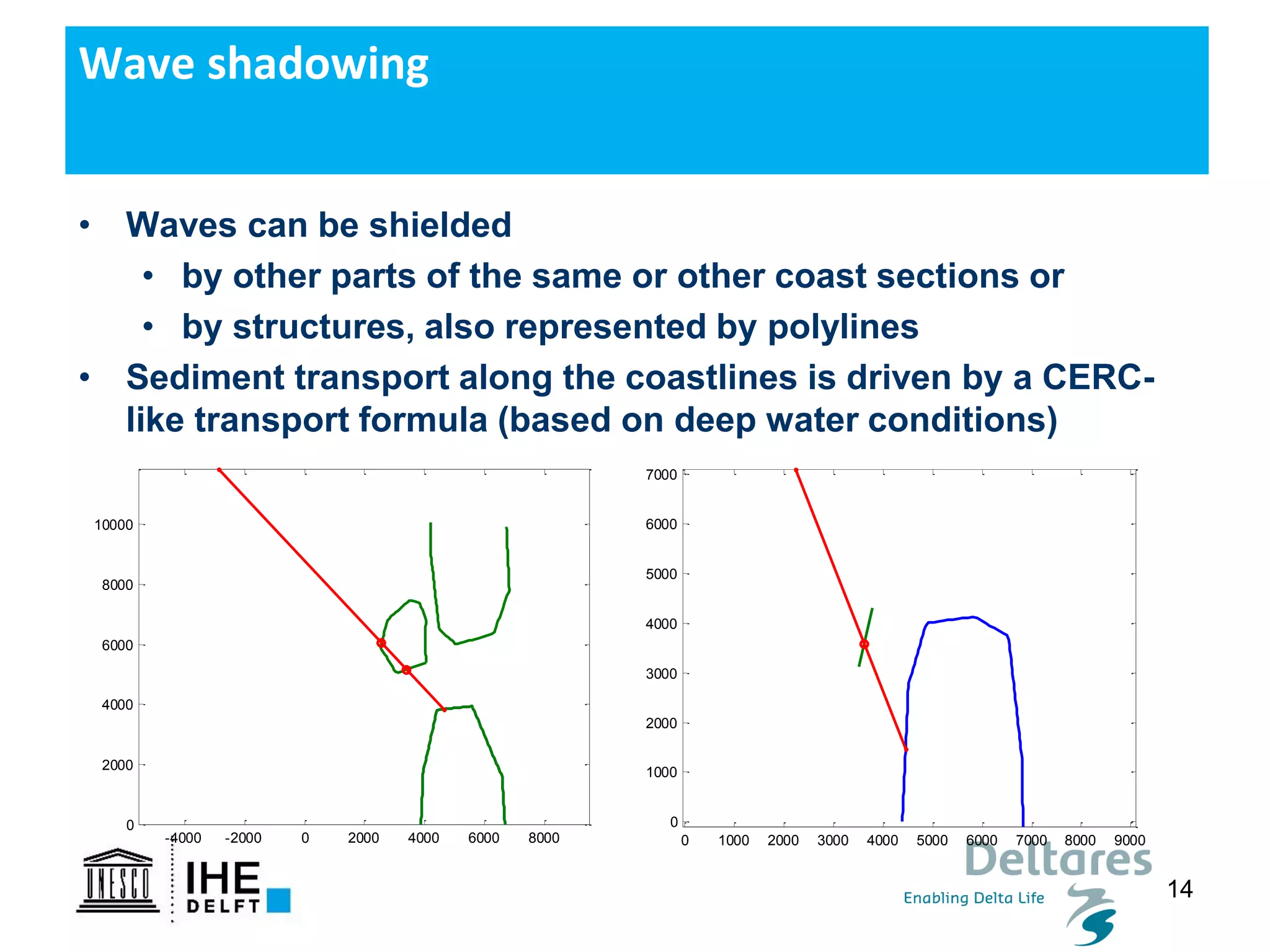
Wave shadowing
• Waves can be shielded
• by other parts of the same or other coast sections or
• by structures, also represented by polylines
• Sediment transport along the coastlines is driven by a CERC-
like transport formula (based on deep water conditions)
-4000 -2000 0 2000 4000 6000 8000
0
2000
4000
6000
8000
10000
0 1000 2000 3000 4000 5000 6000 7000 8000 9000
0
1000
2000
3000
4000
5000
6000
7000
15
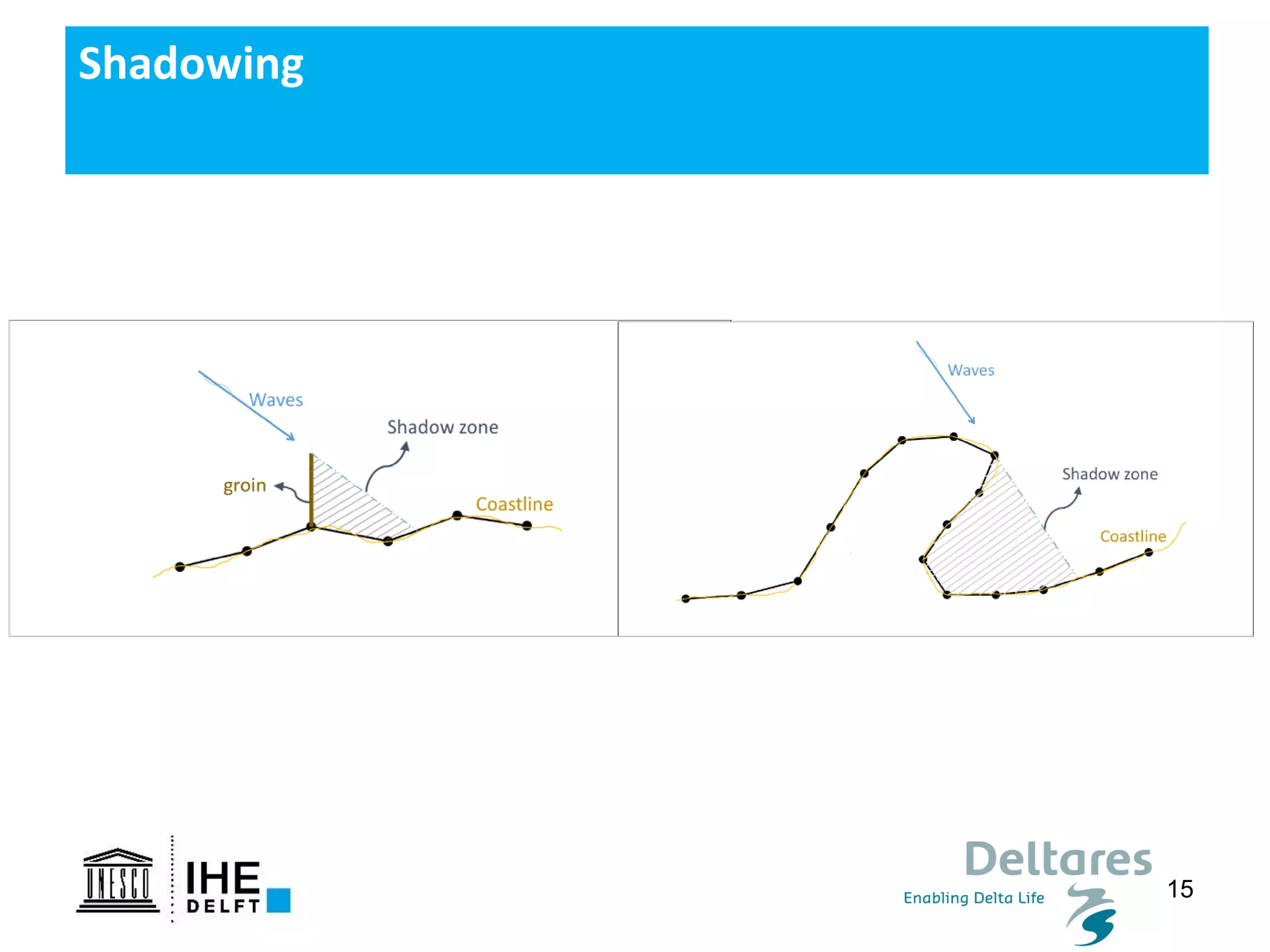
Shadowing
16
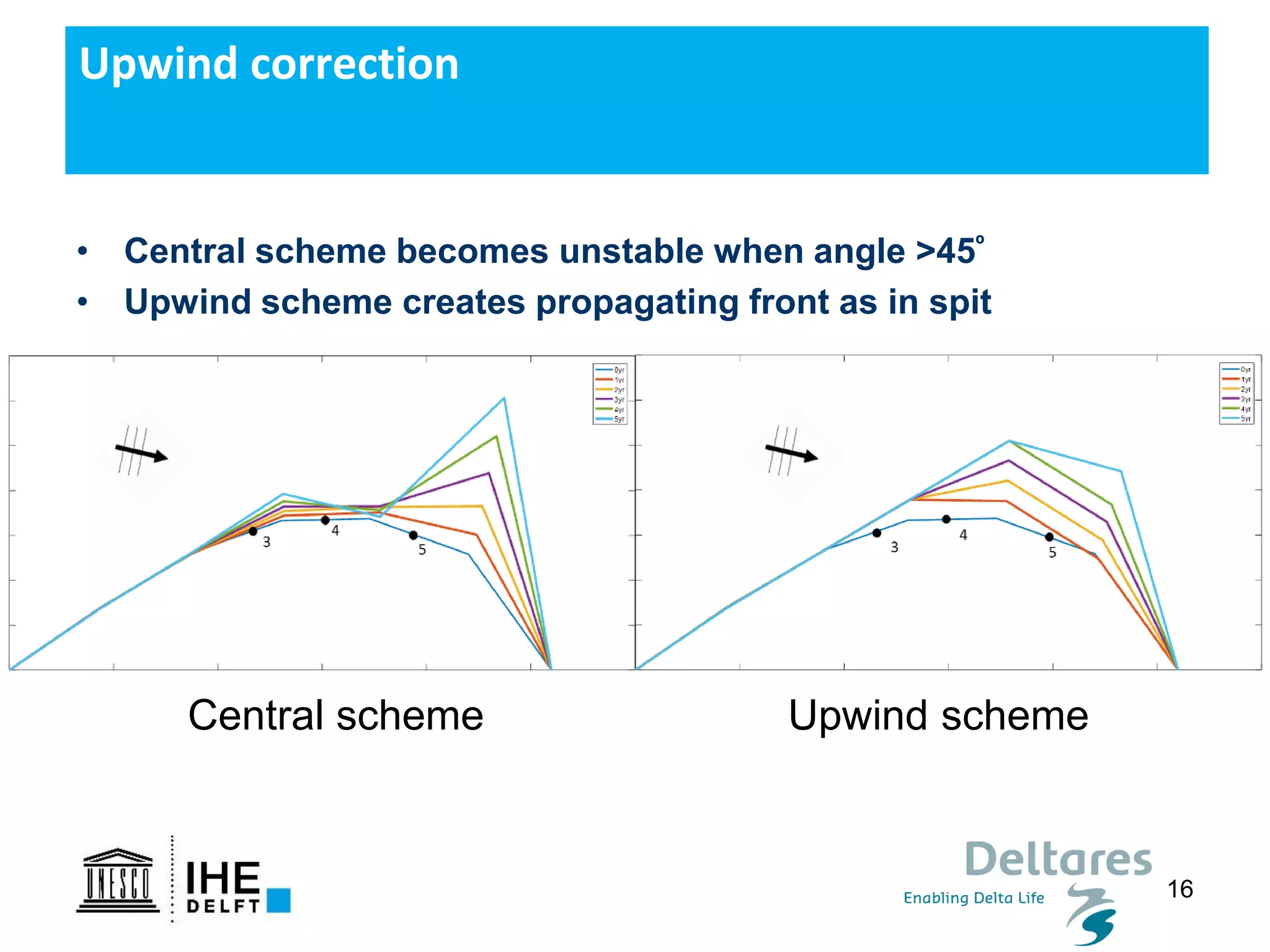
• Central scheme becomes unstable when angle >45º
• Upwind scheme creates propagating front as in spit
Upwind correction
Central scheme Upwind scheme
17
Other features
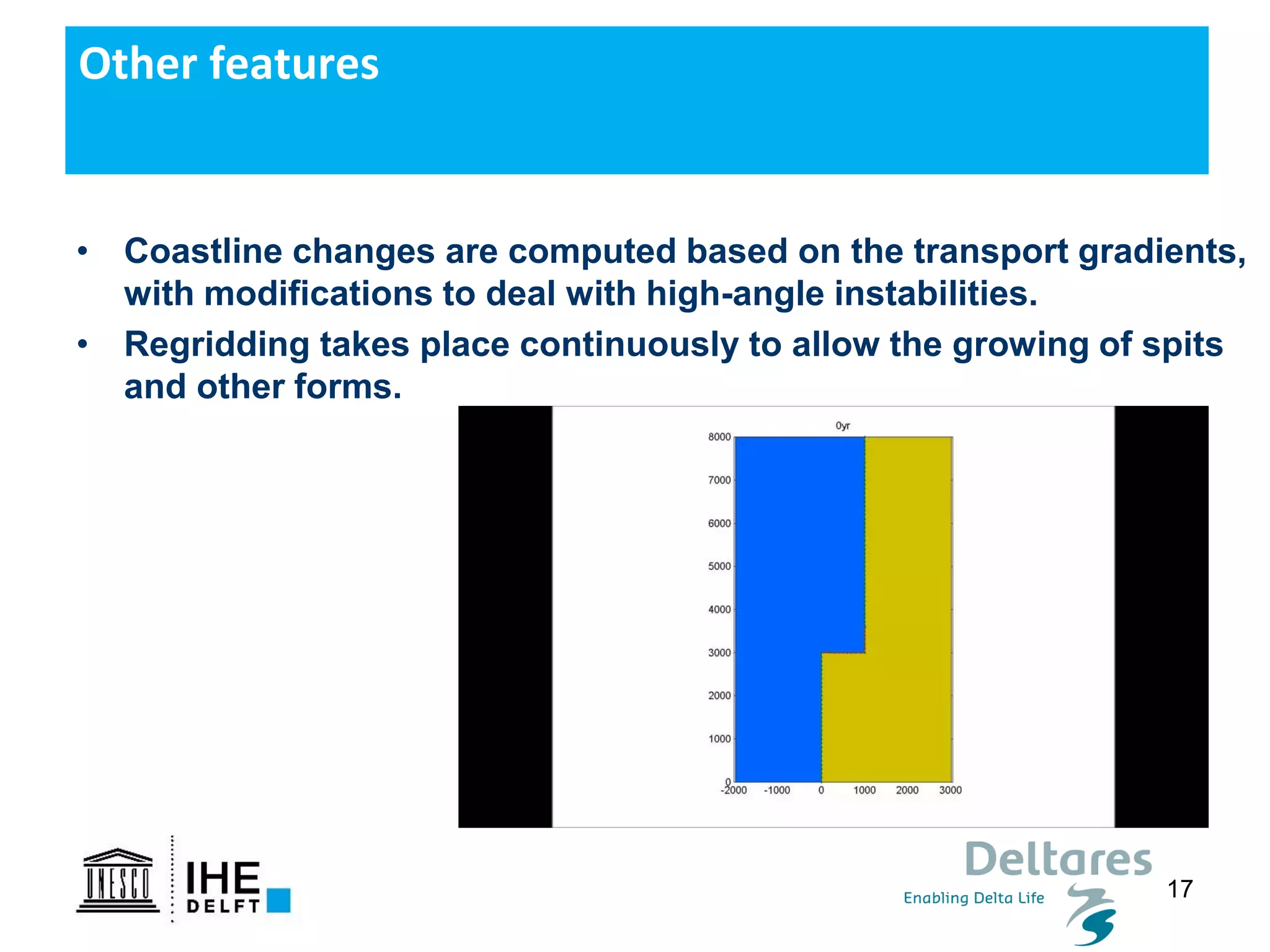
• Coastline changes are computed based on the transport gradients,
with modifications to deal with high-angle instabilities.
• Regridding takes place continuously to allow the growing of spits
and other forms.
18
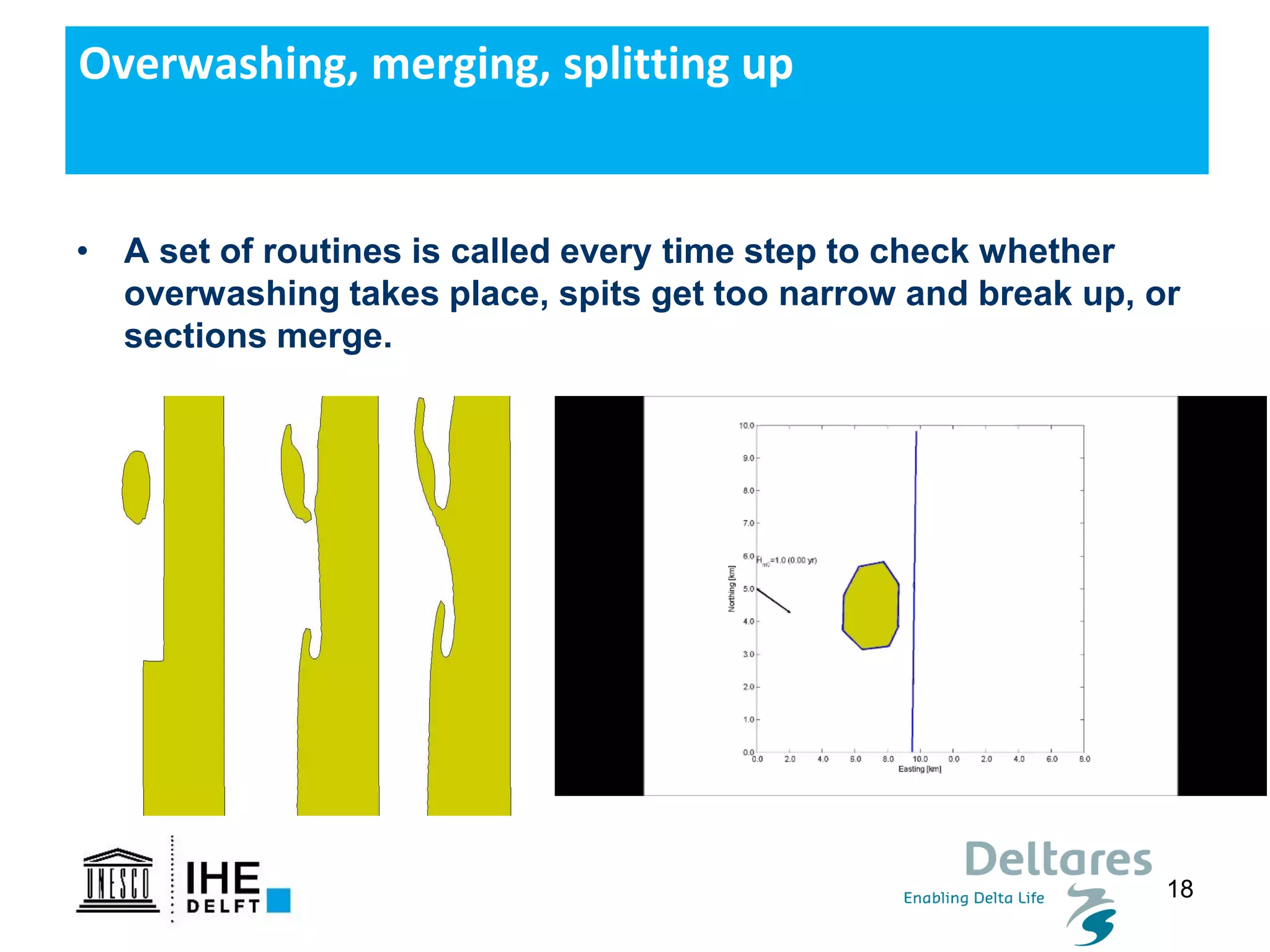
Overwashing, merging, splitting up
• A set of routines is called every time step to check whether
overwashing takes place, spits get too narrow and break up, or
sections merge.
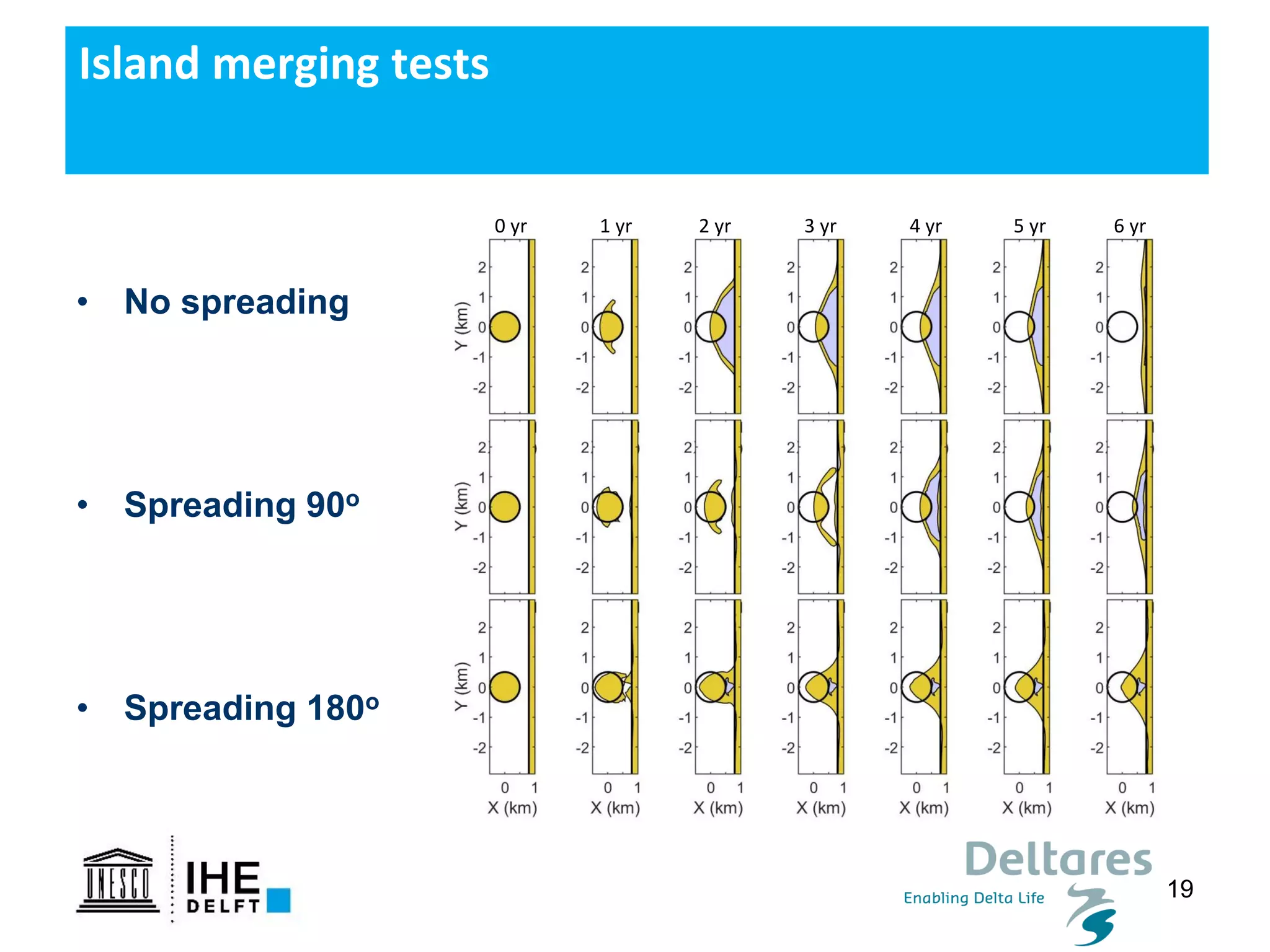
19
• No spreading
• Spreading 90o
• Spreading 180o
Island merging tests
0 yr 1 yr 2 yr 4 yr3 yr 5 yr 6 yr
20
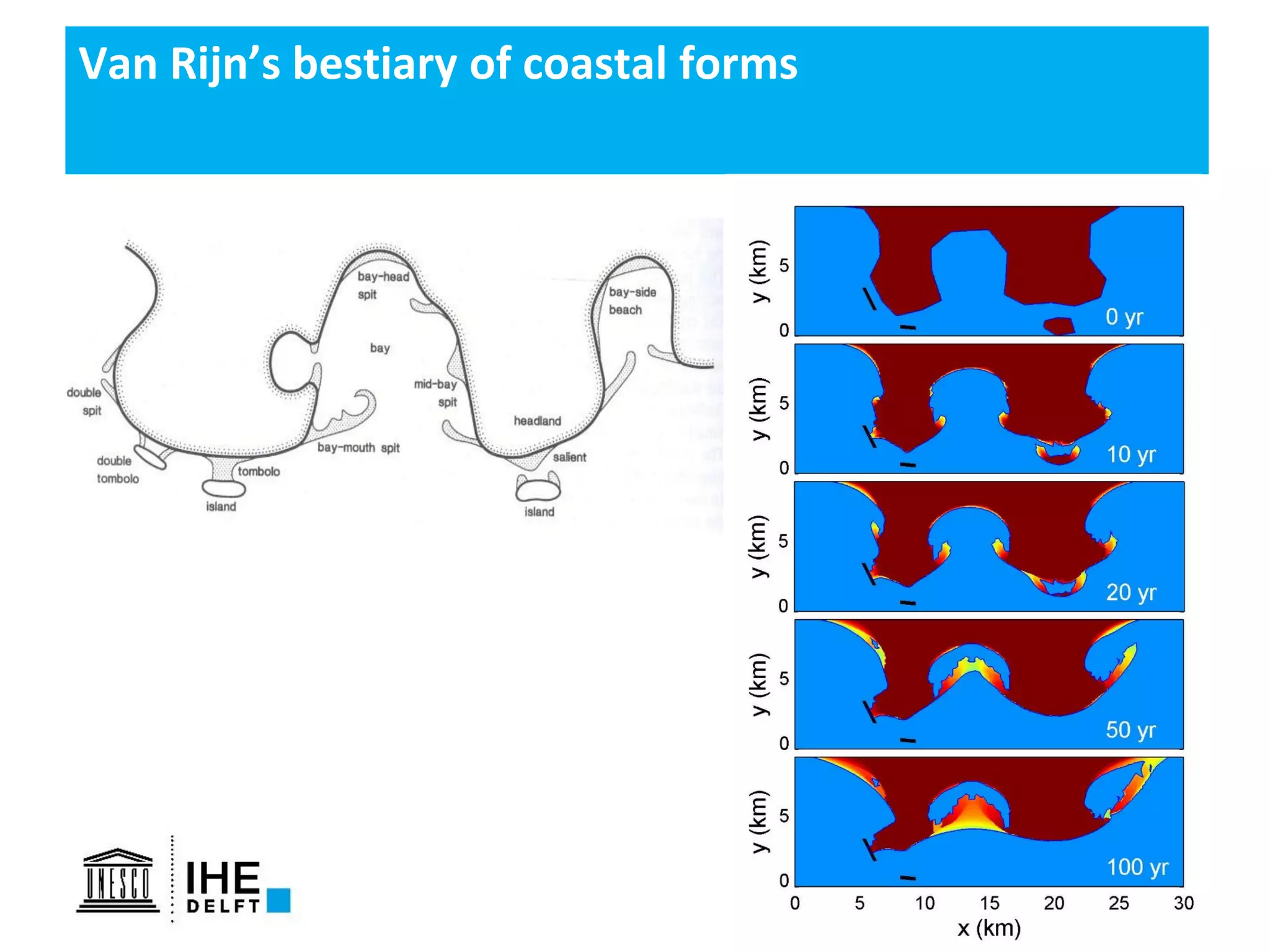
Van Rijn’s bestiary of coastal forms
21
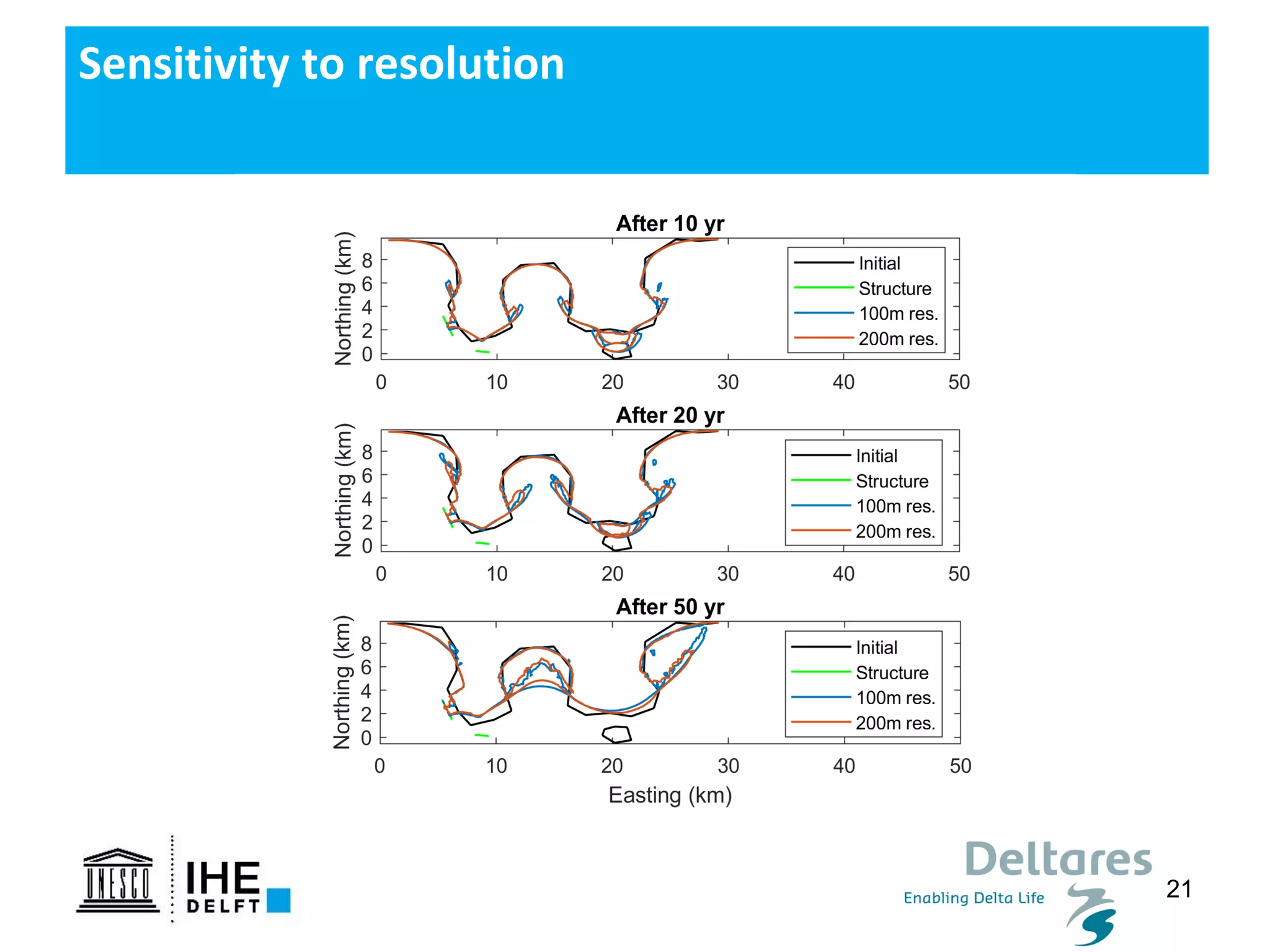
Sensitivity to resolution
22
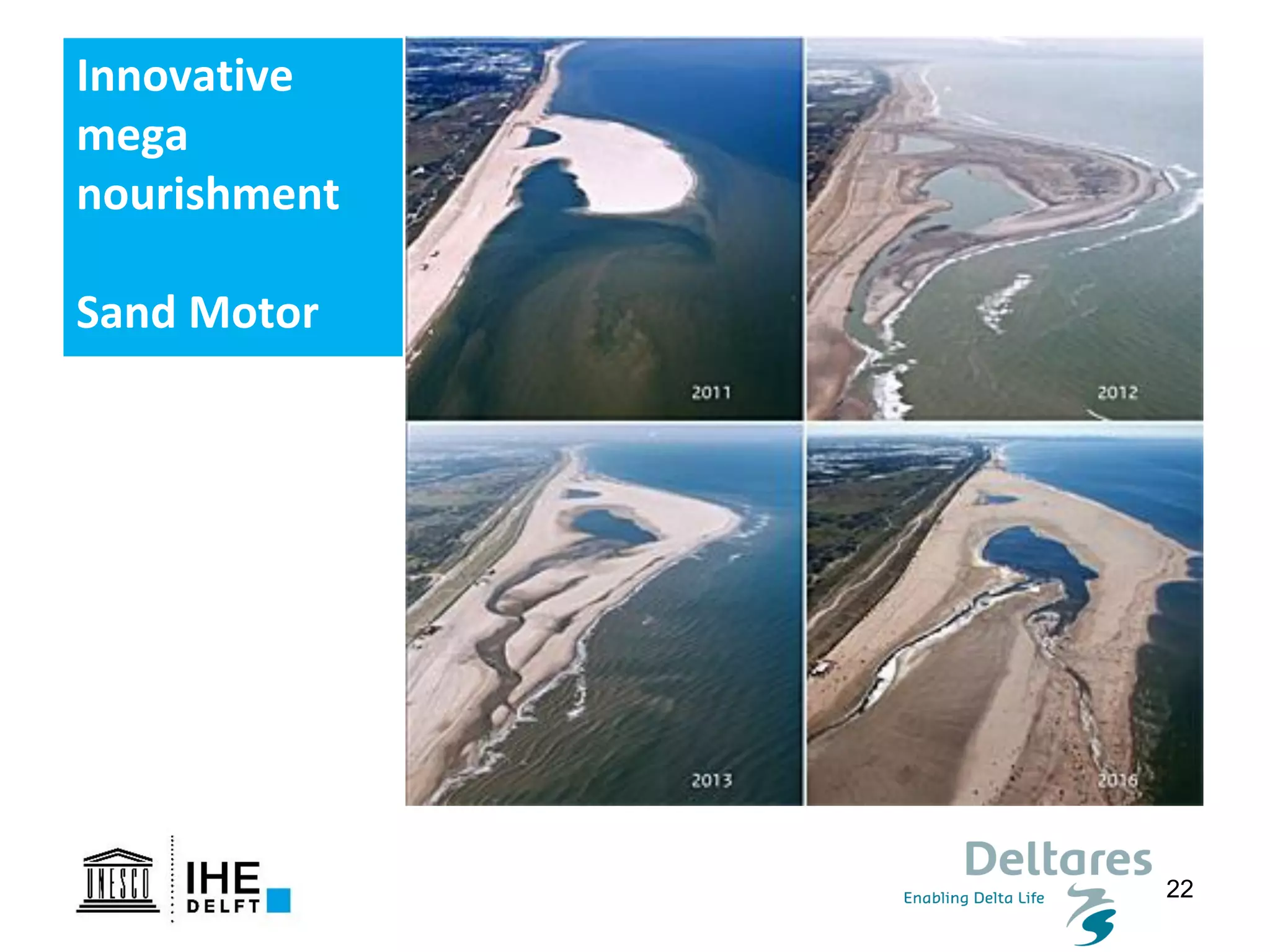
Innovative
mega
nourishment
Sand Motor
23
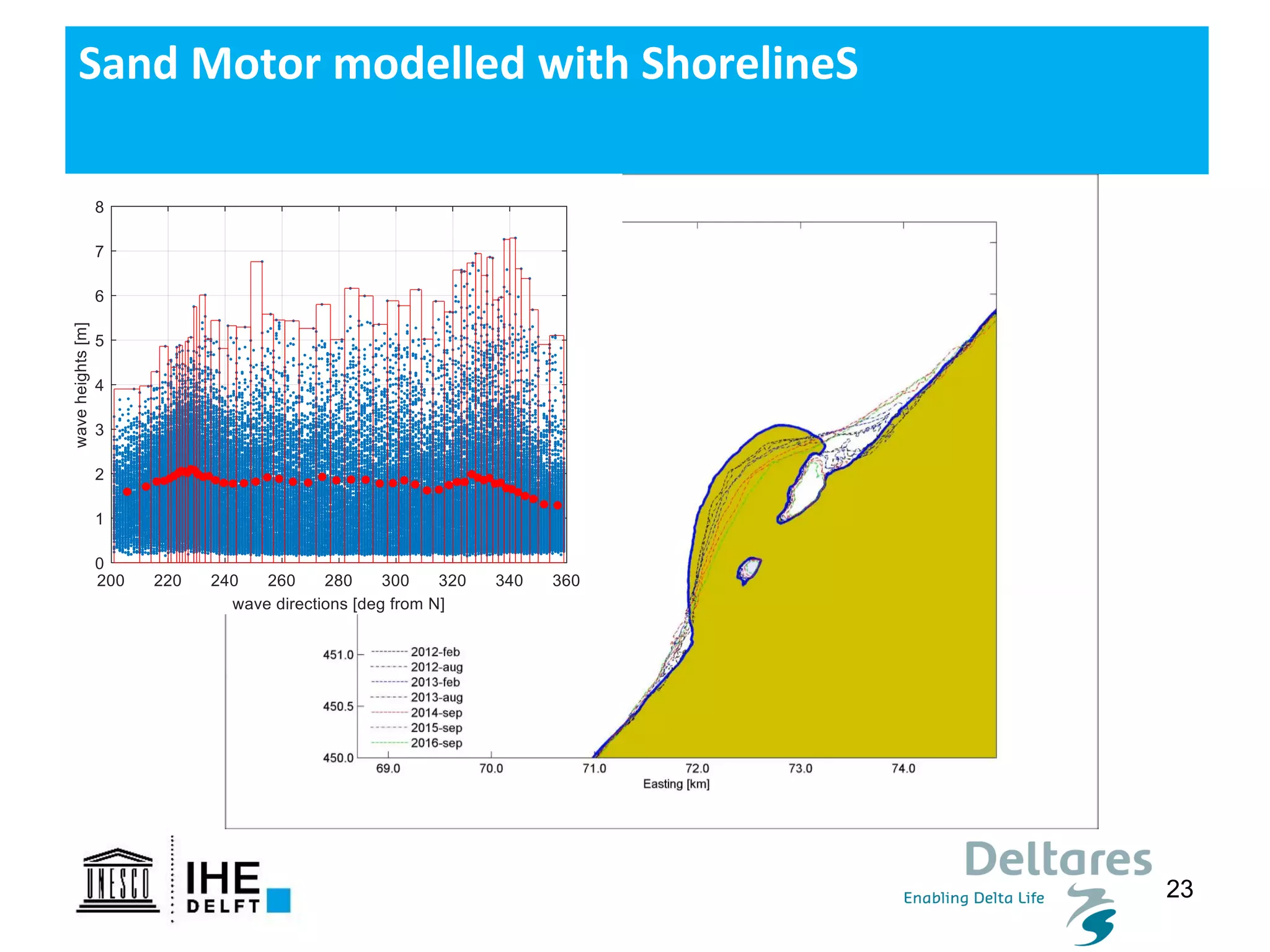
Sand Motor modelled with ShorelineS
24
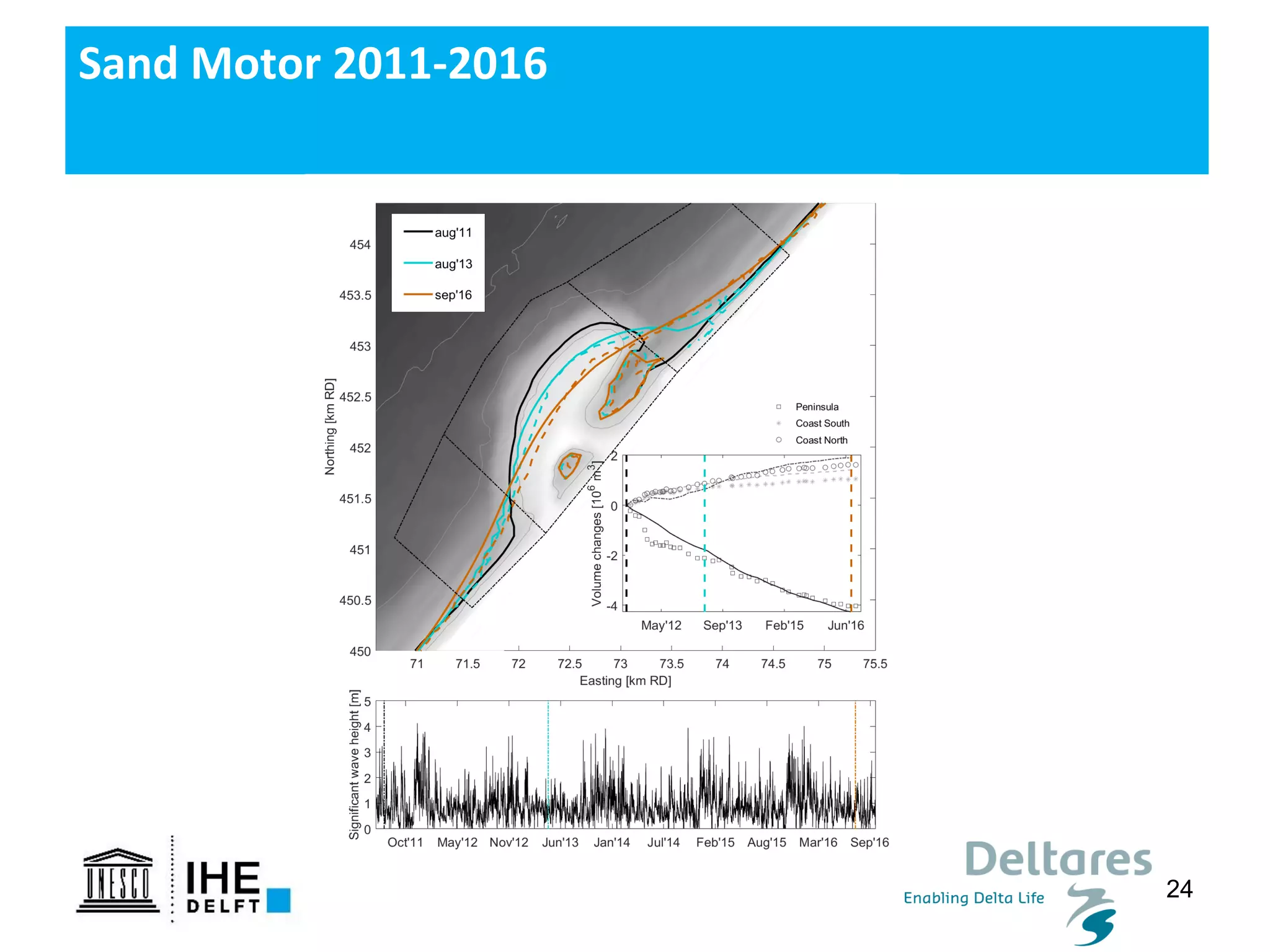
Sand Motor 2011-2016
25
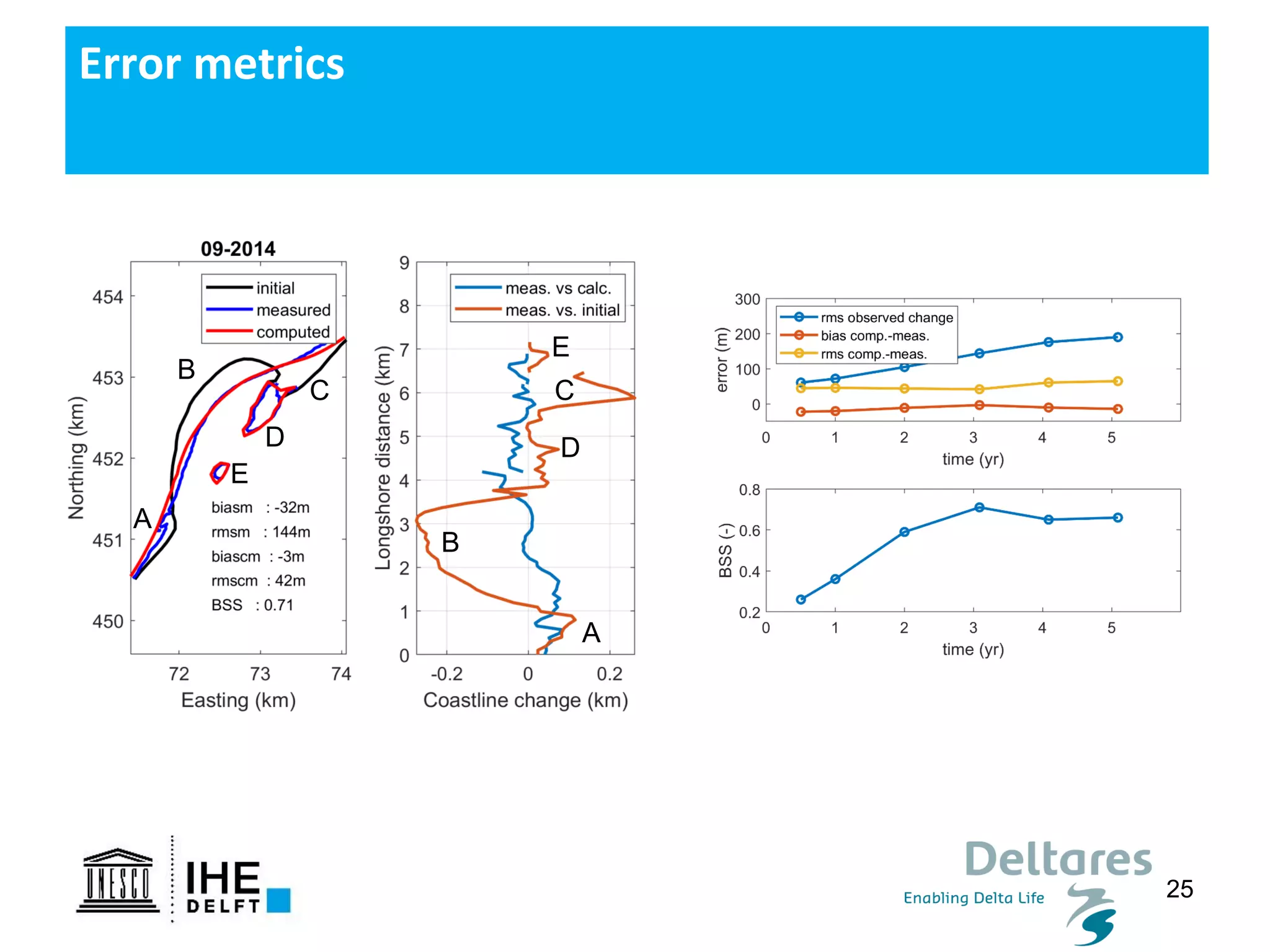
Error metrics
A
B
C
D
A
B
C
D
E
E
26
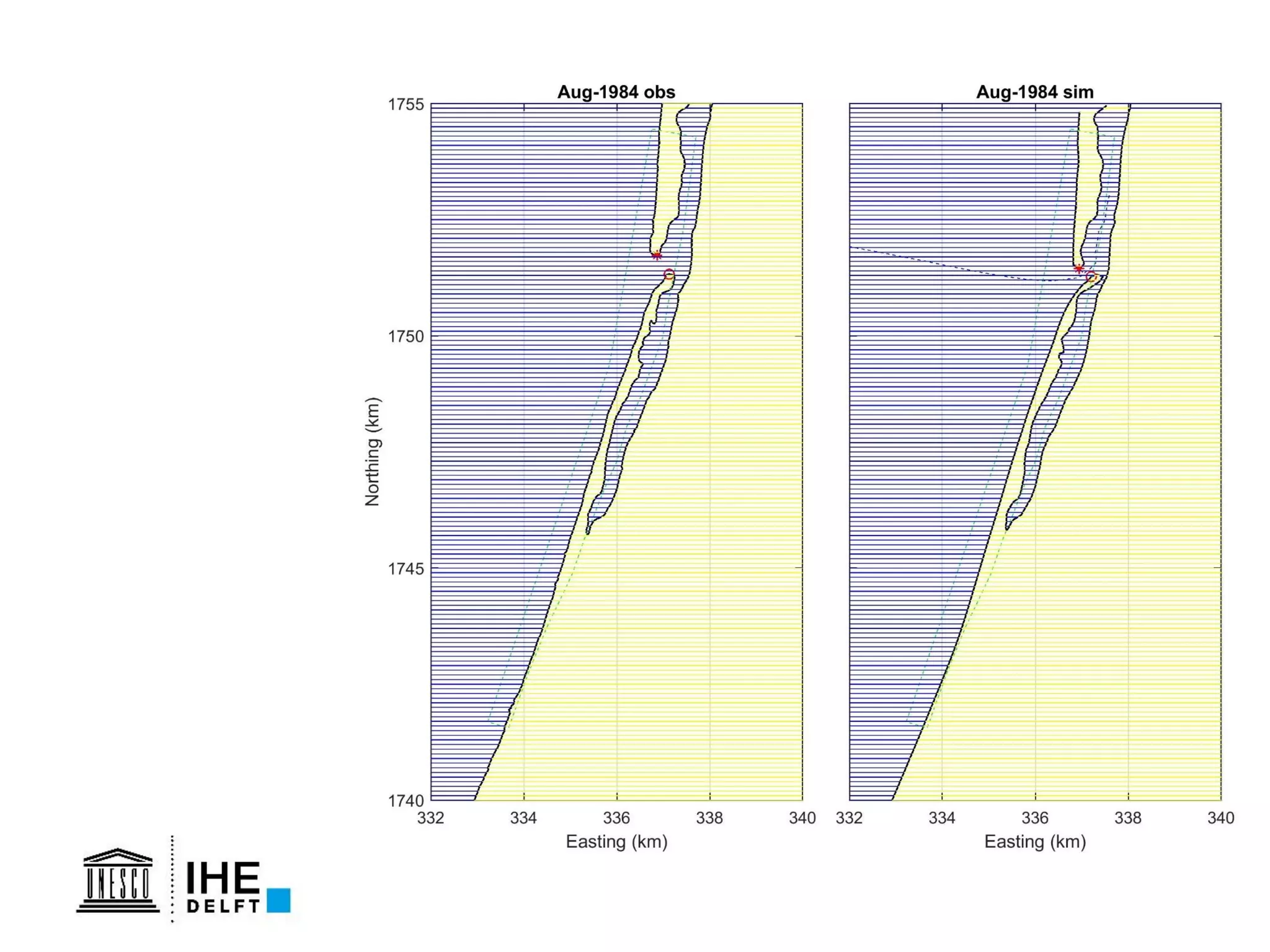
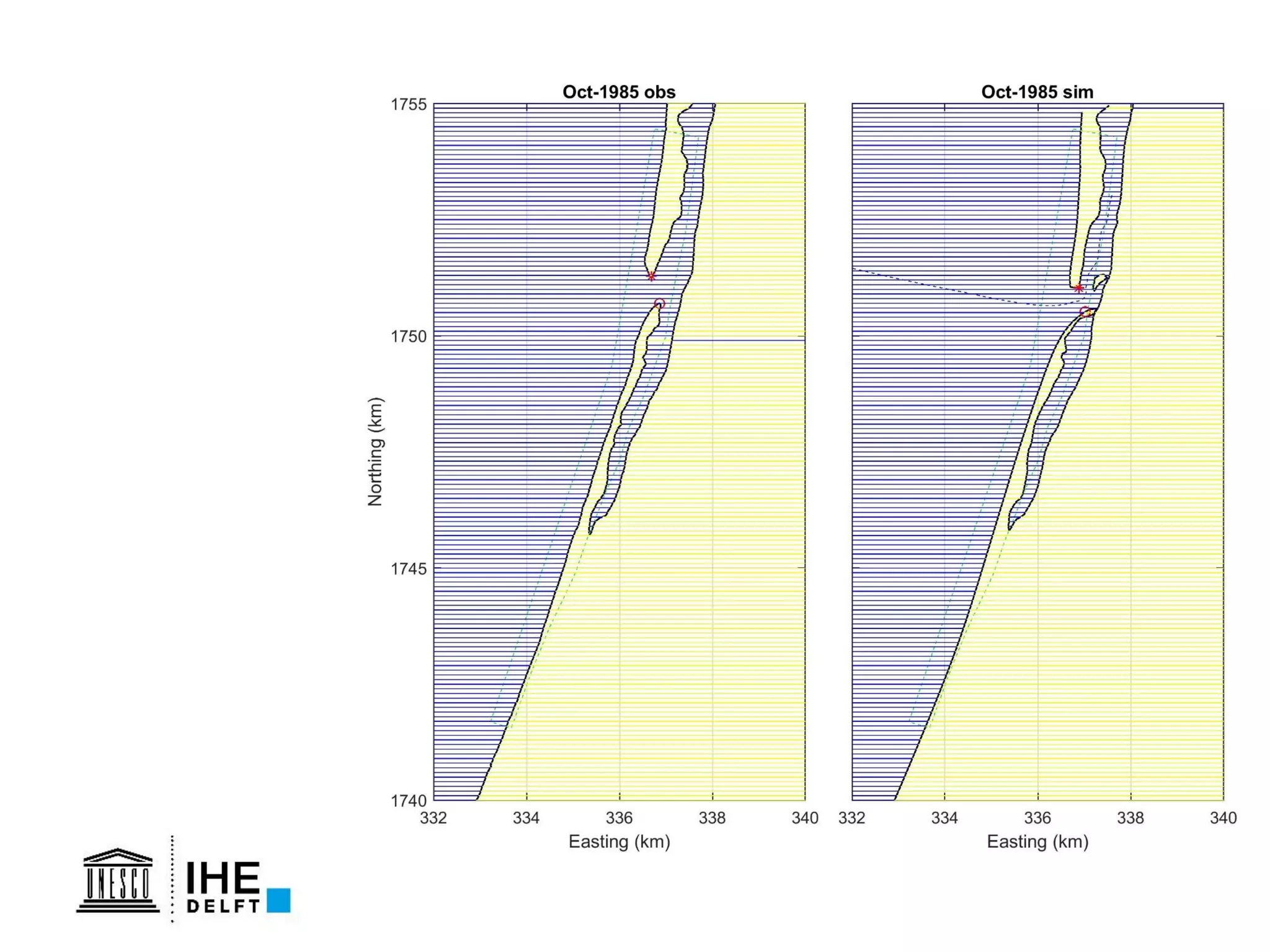
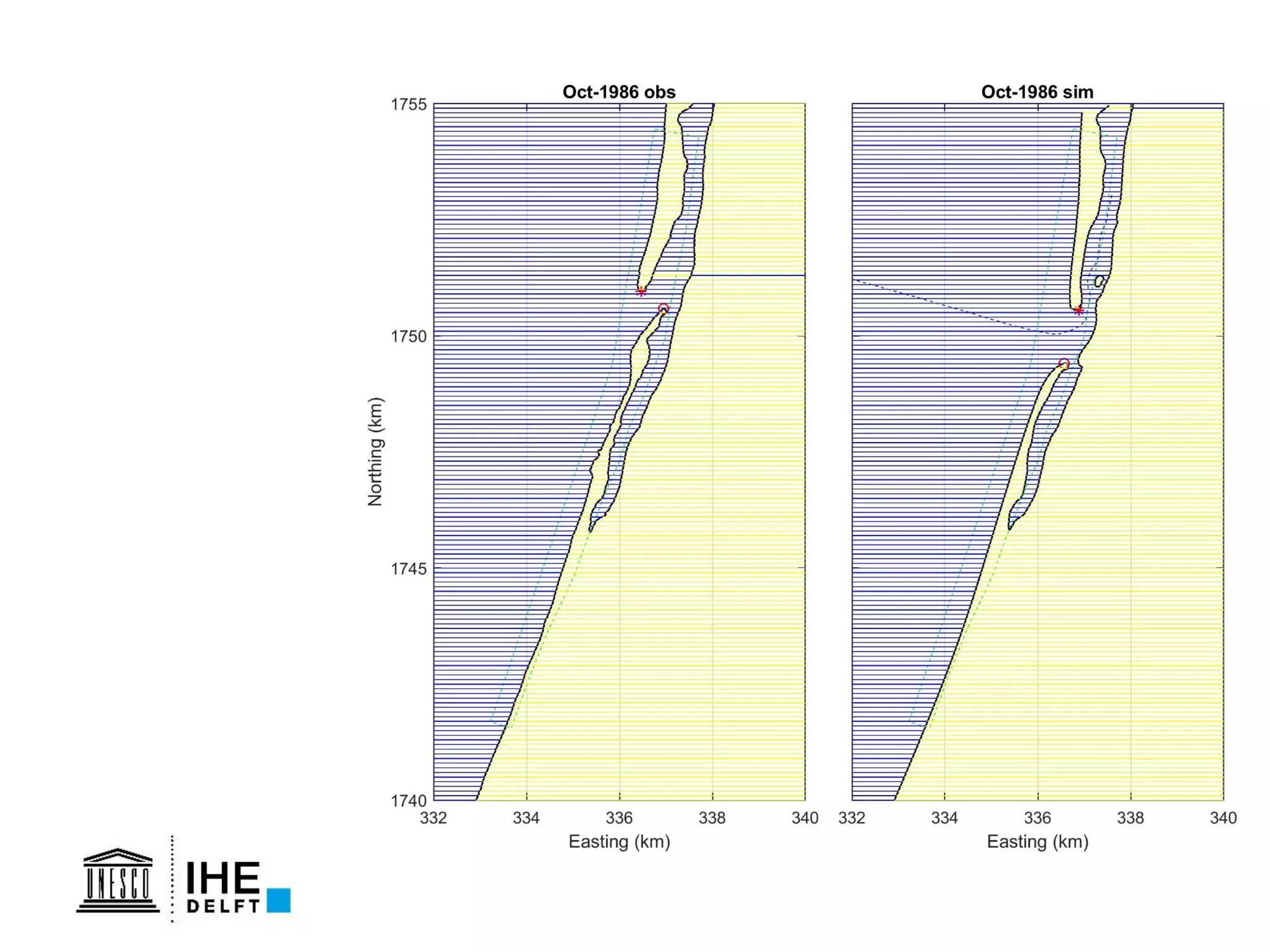
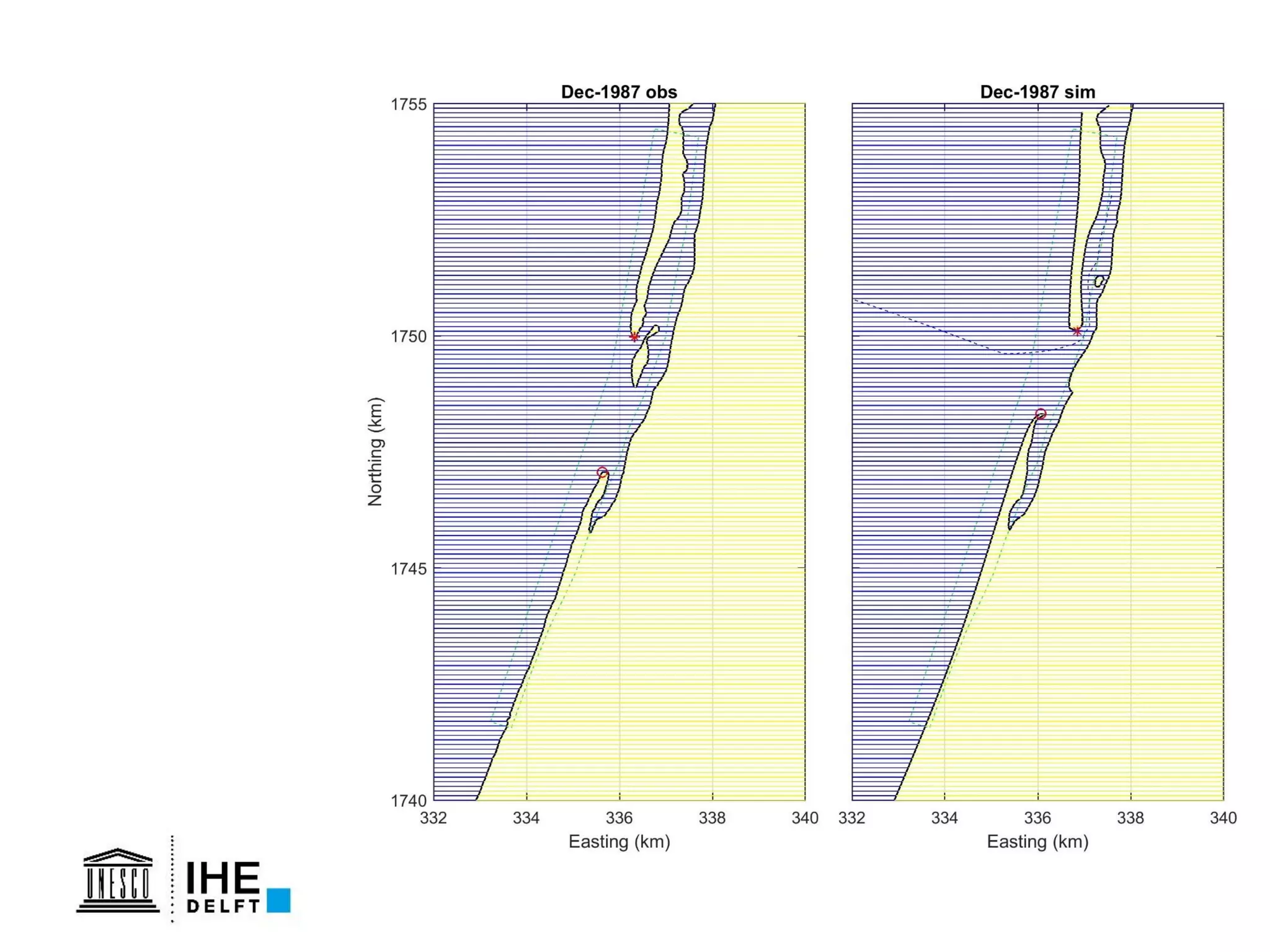
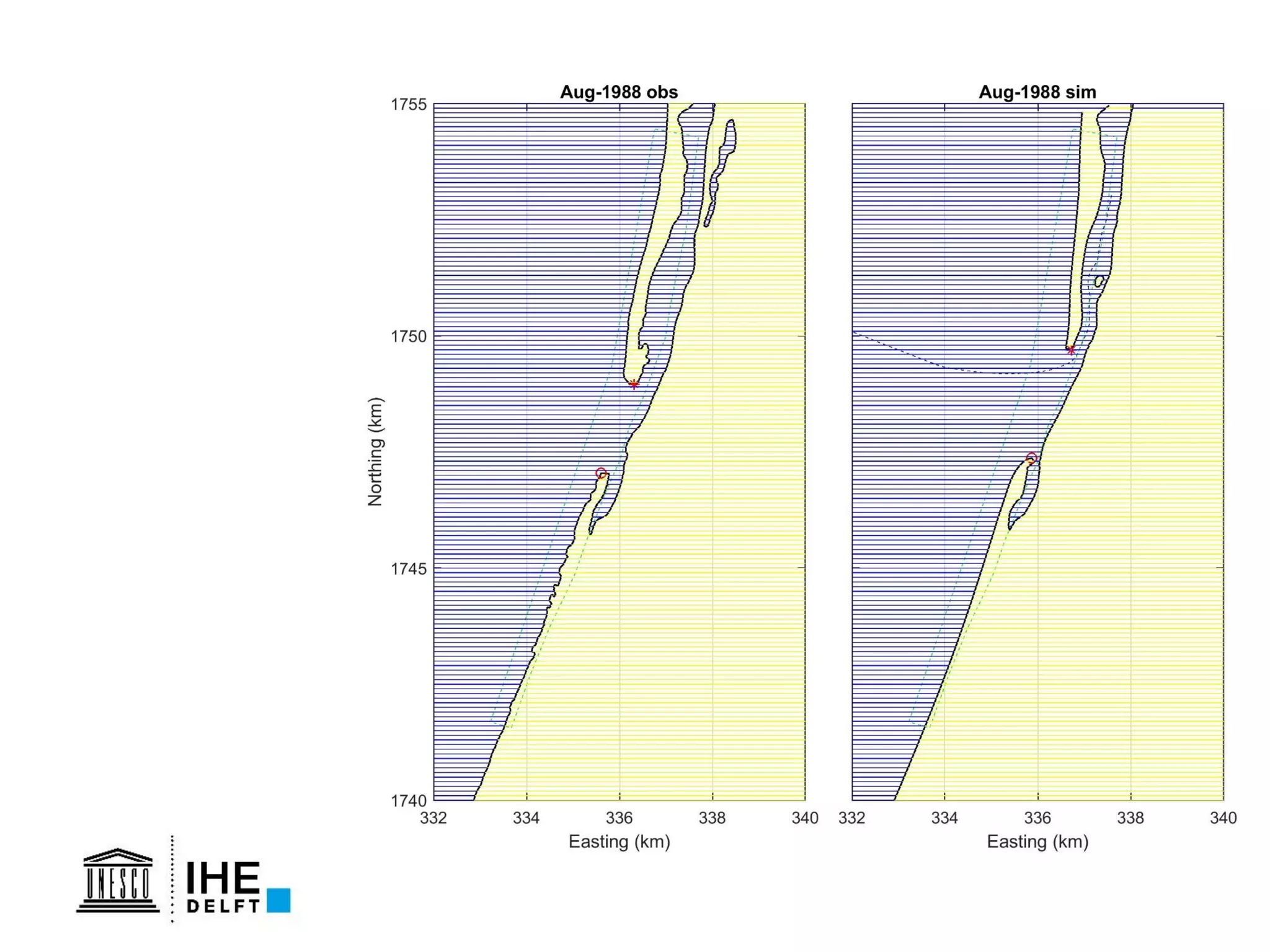
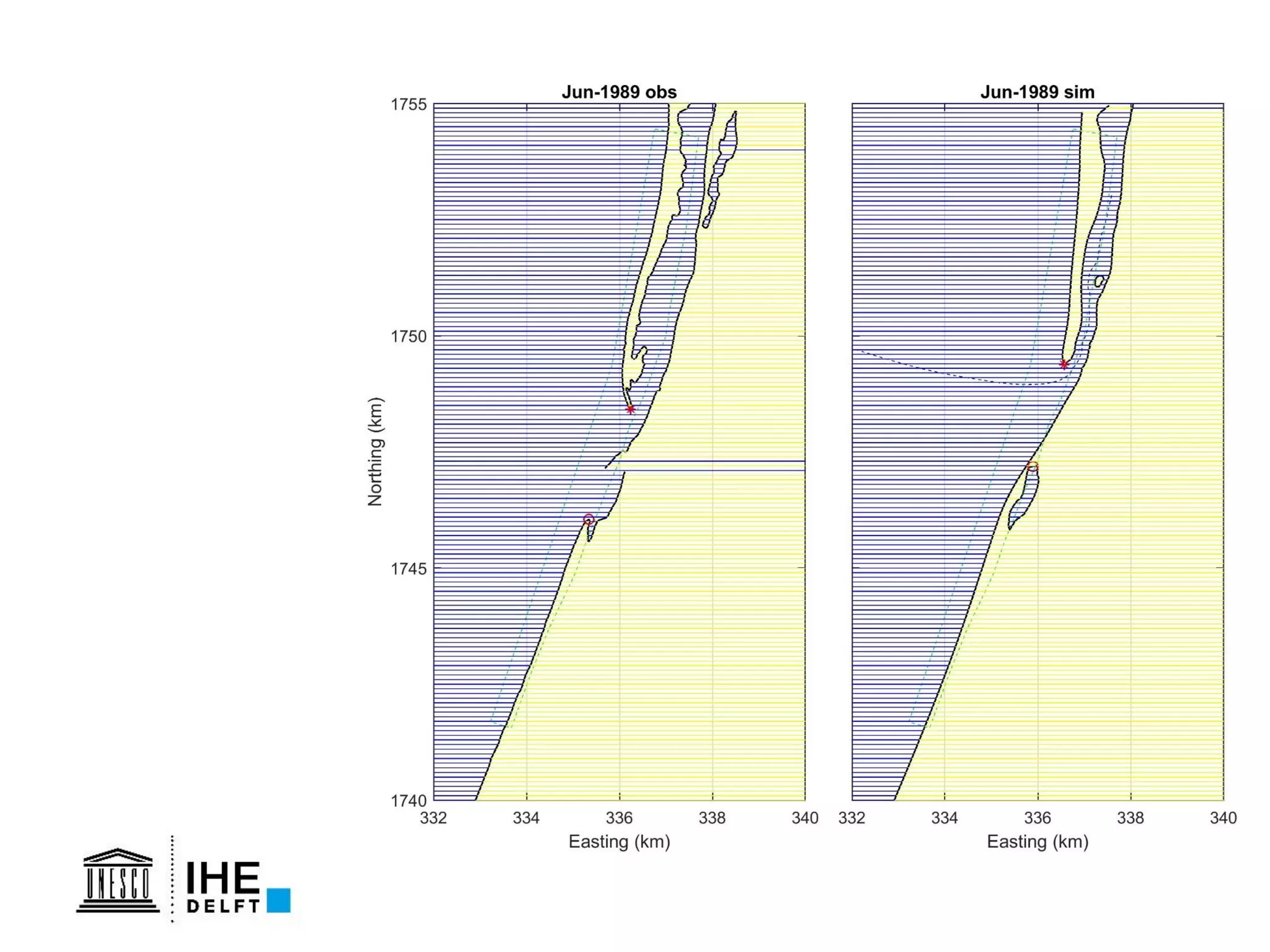
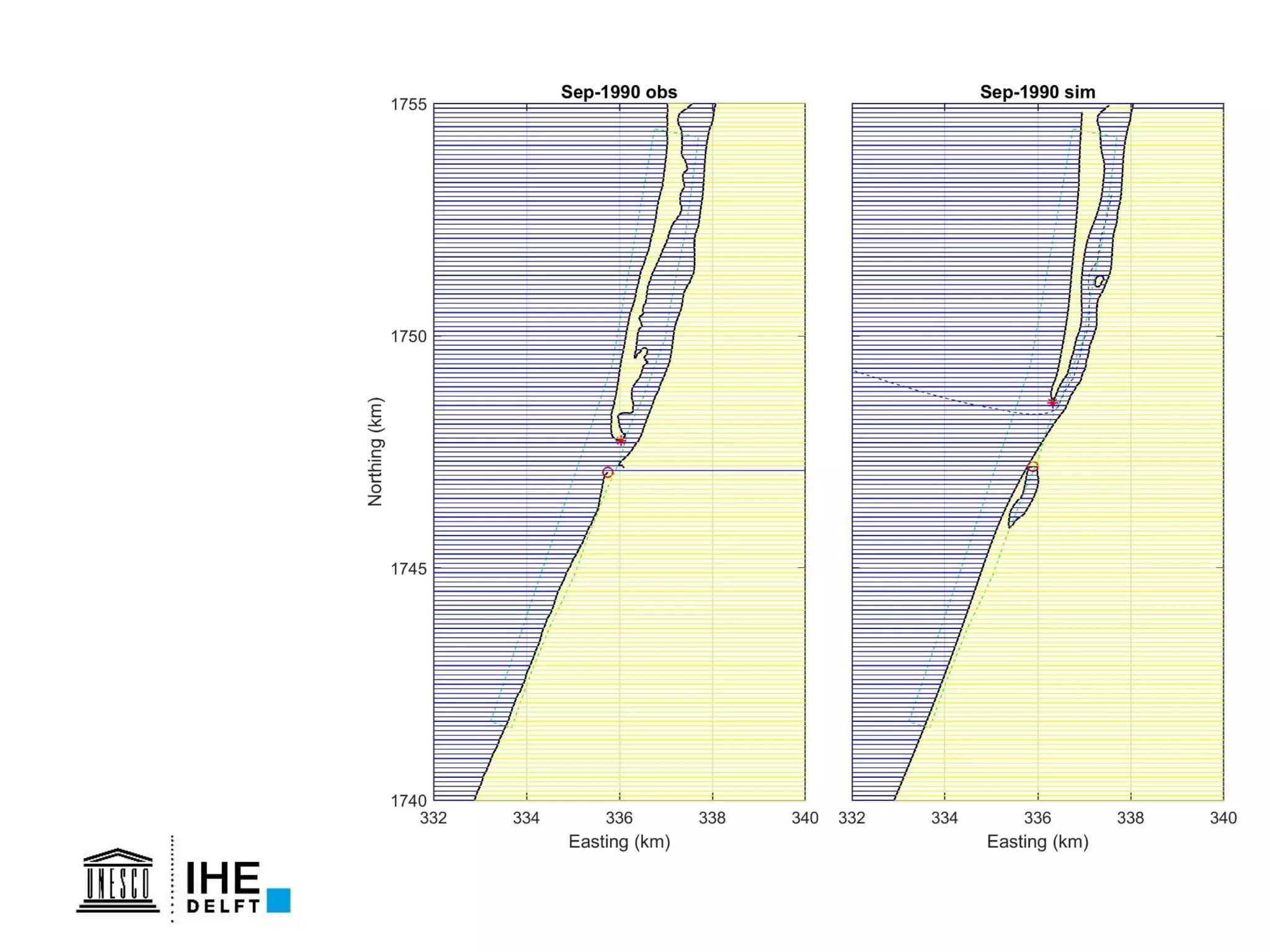
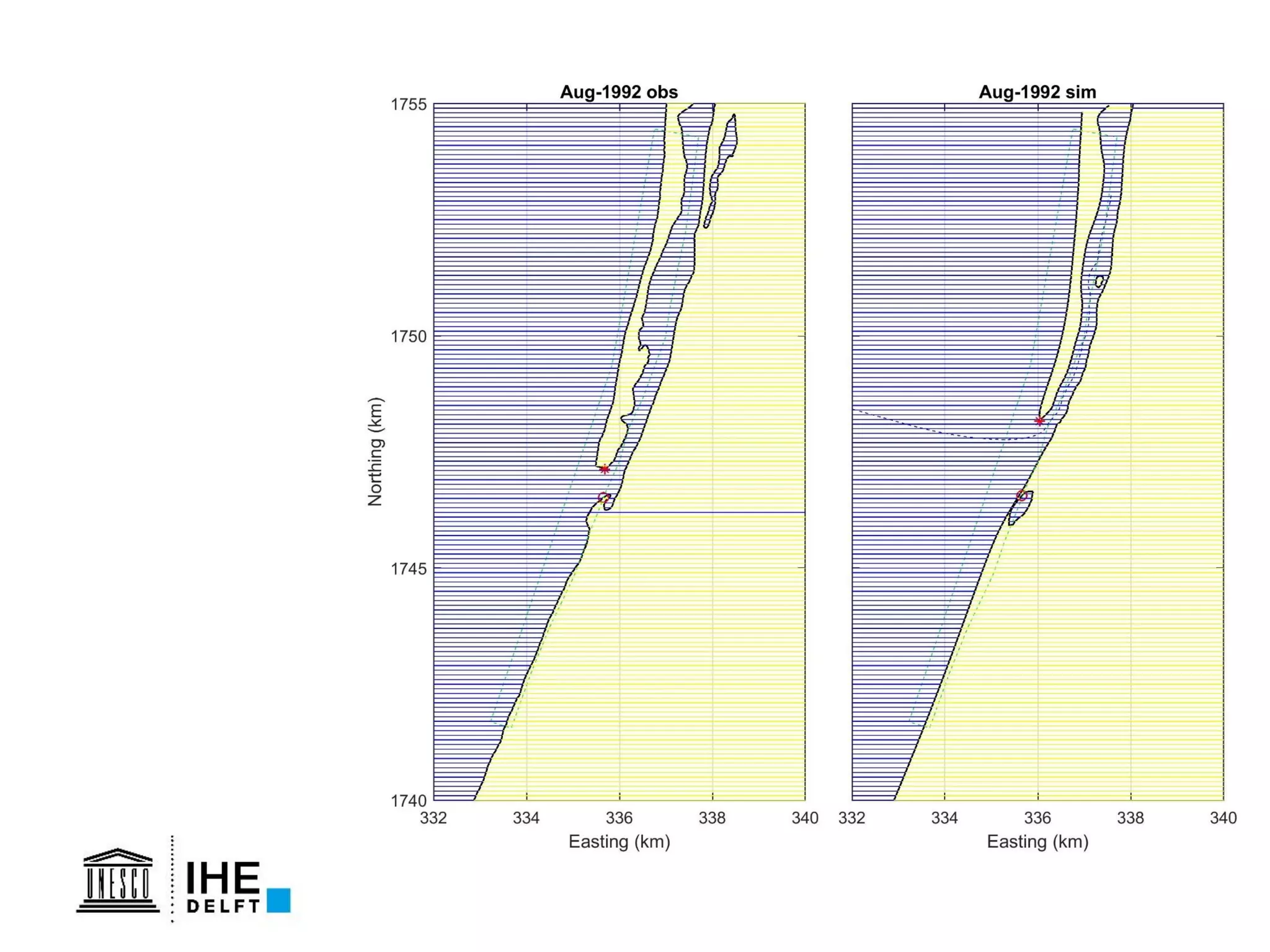
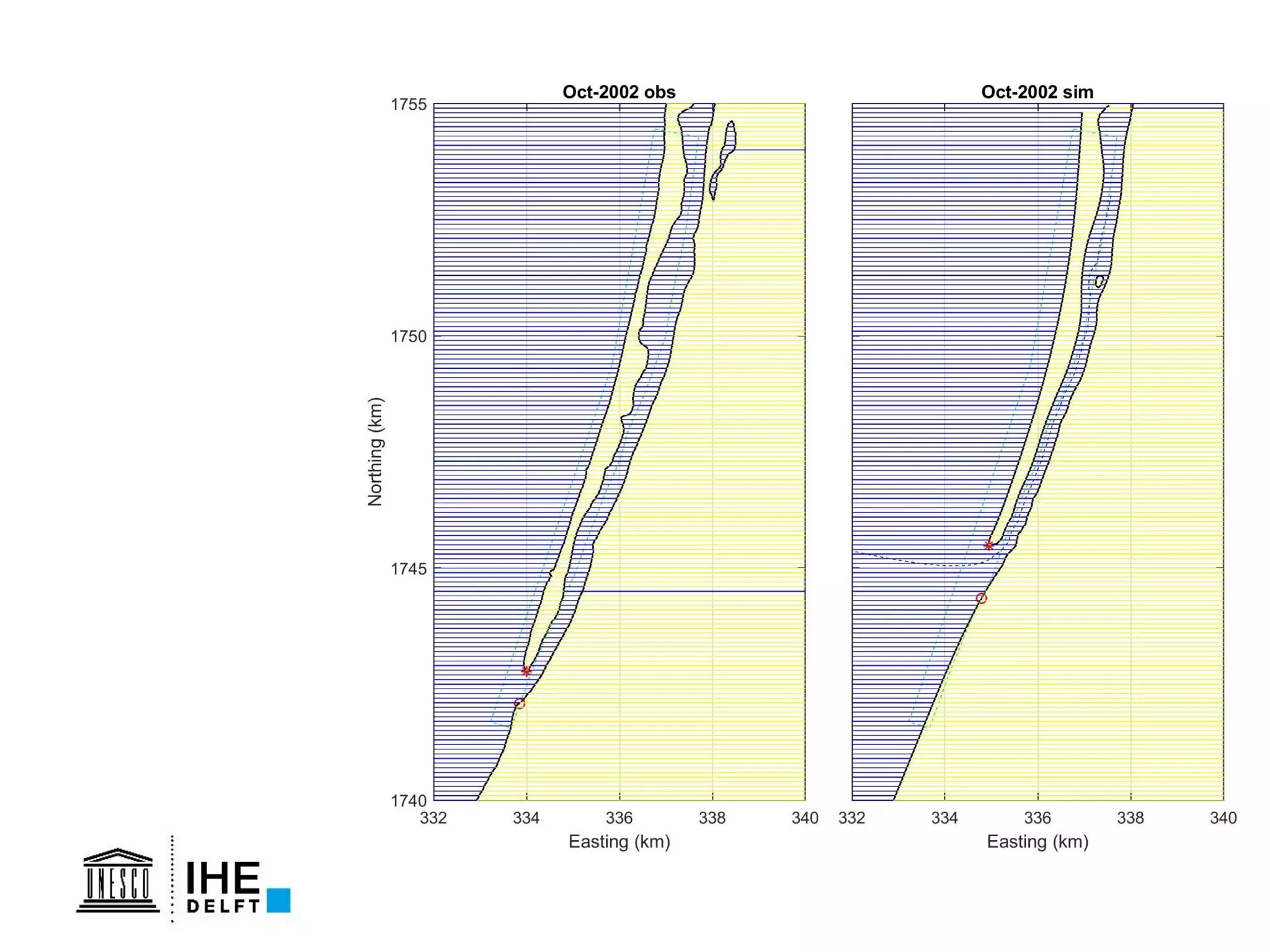
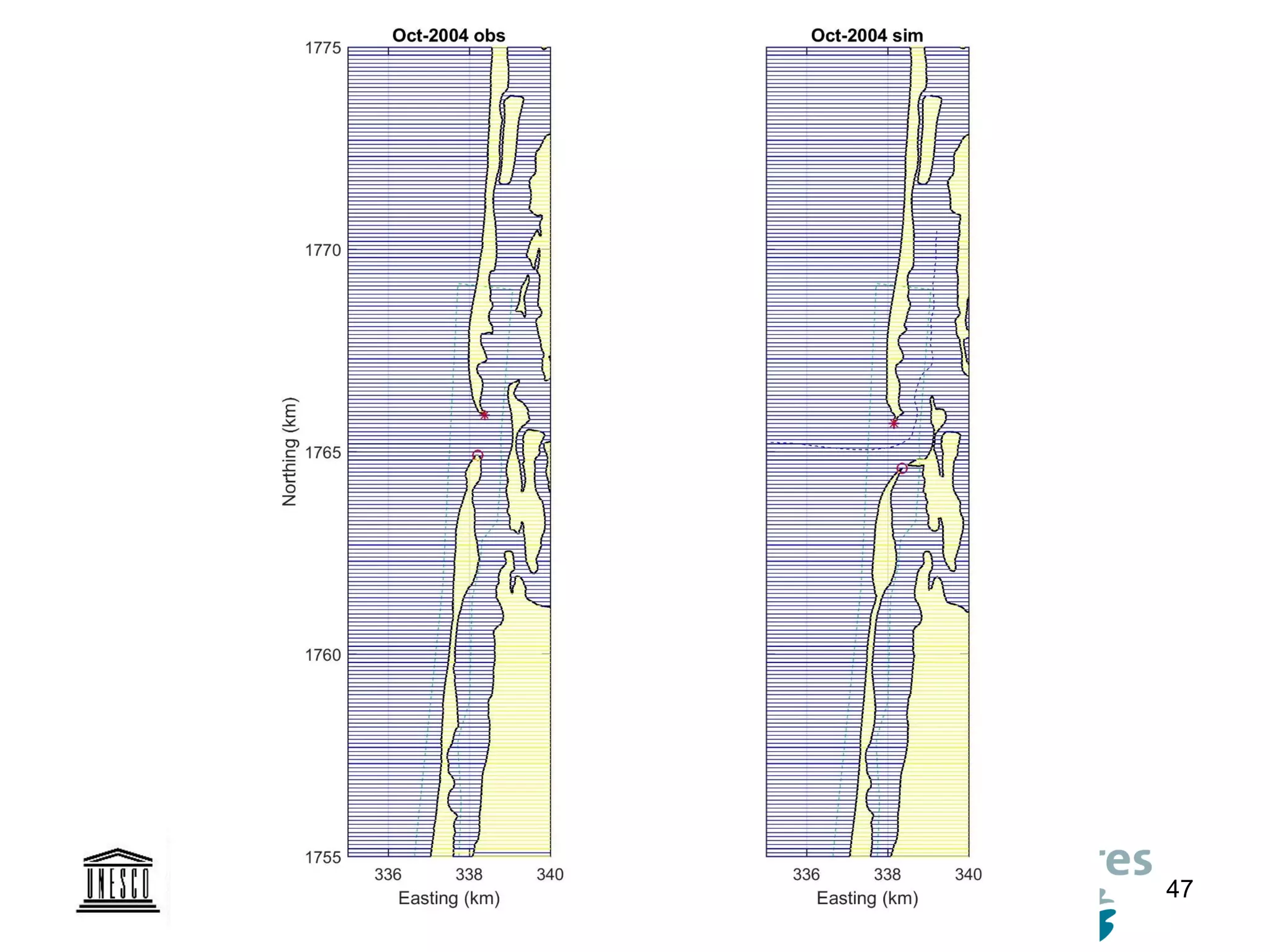
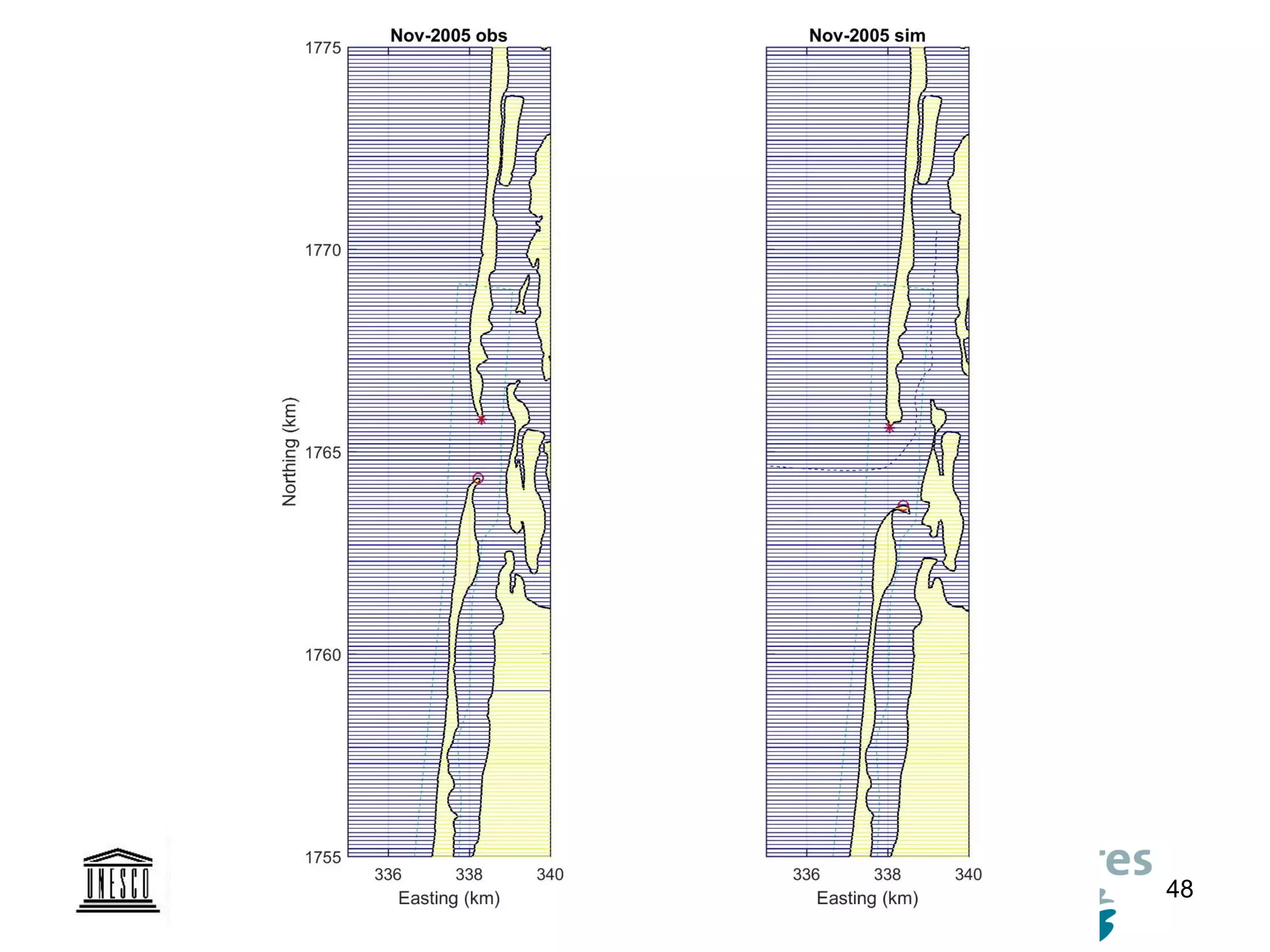
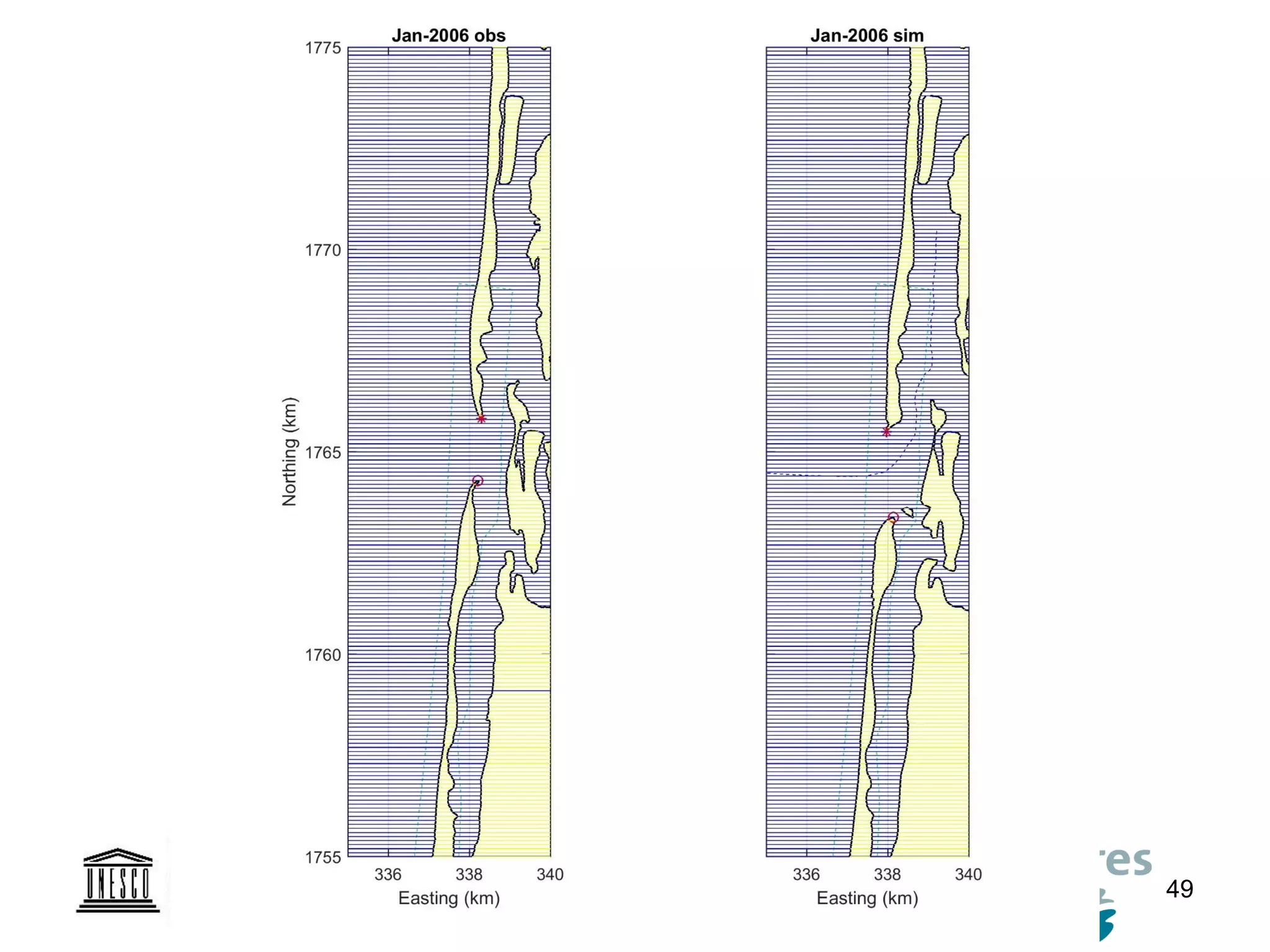
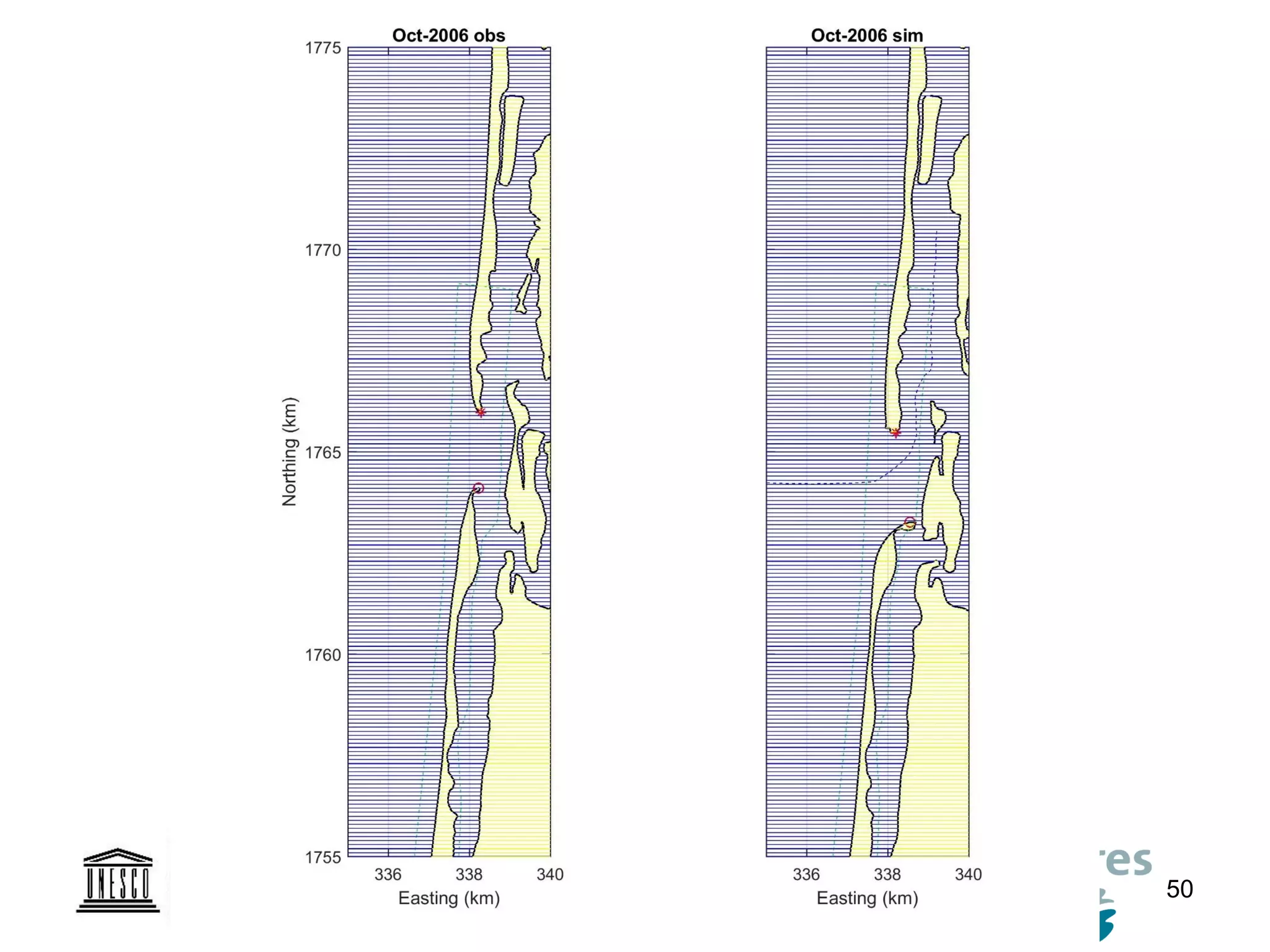
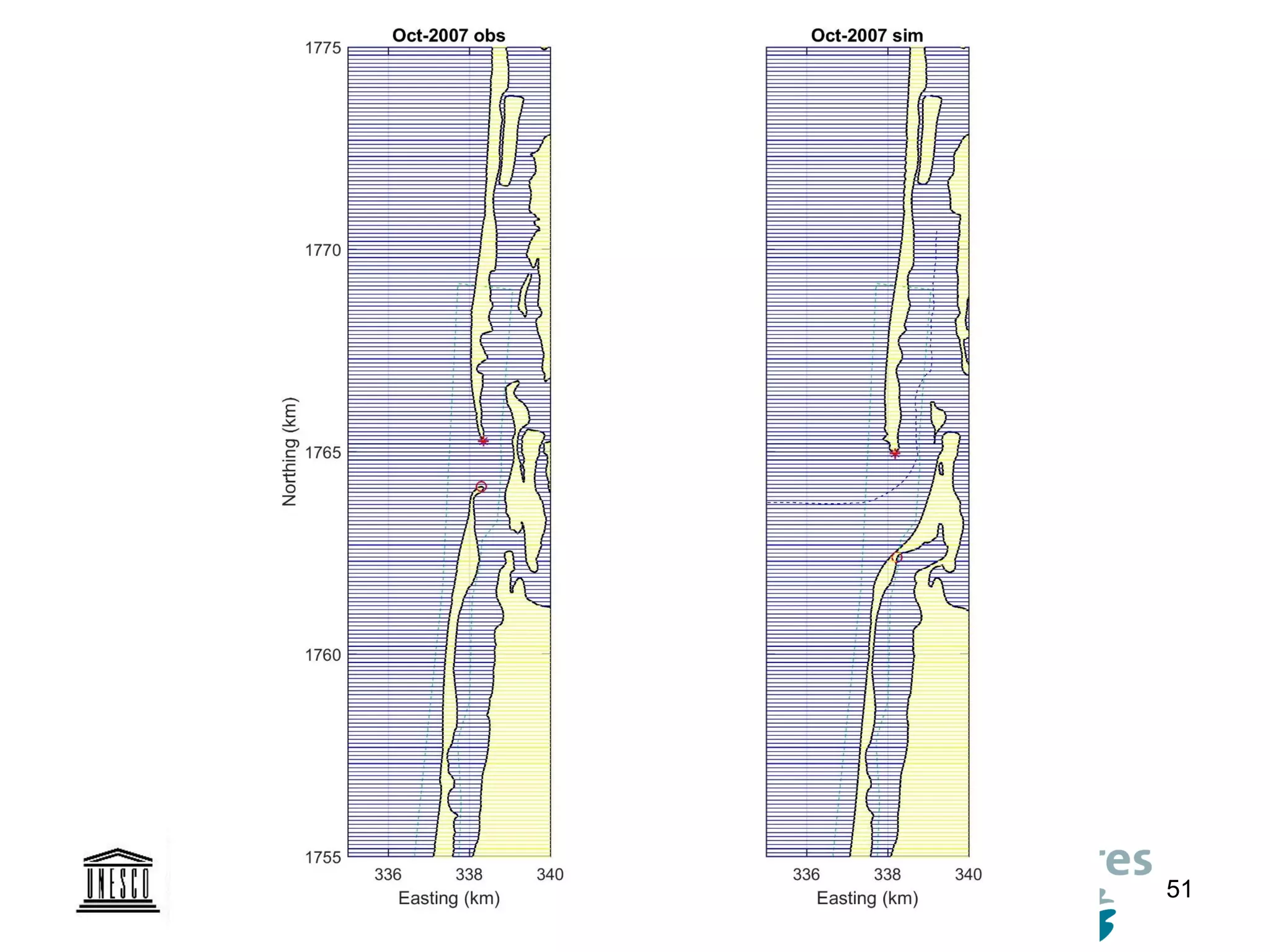
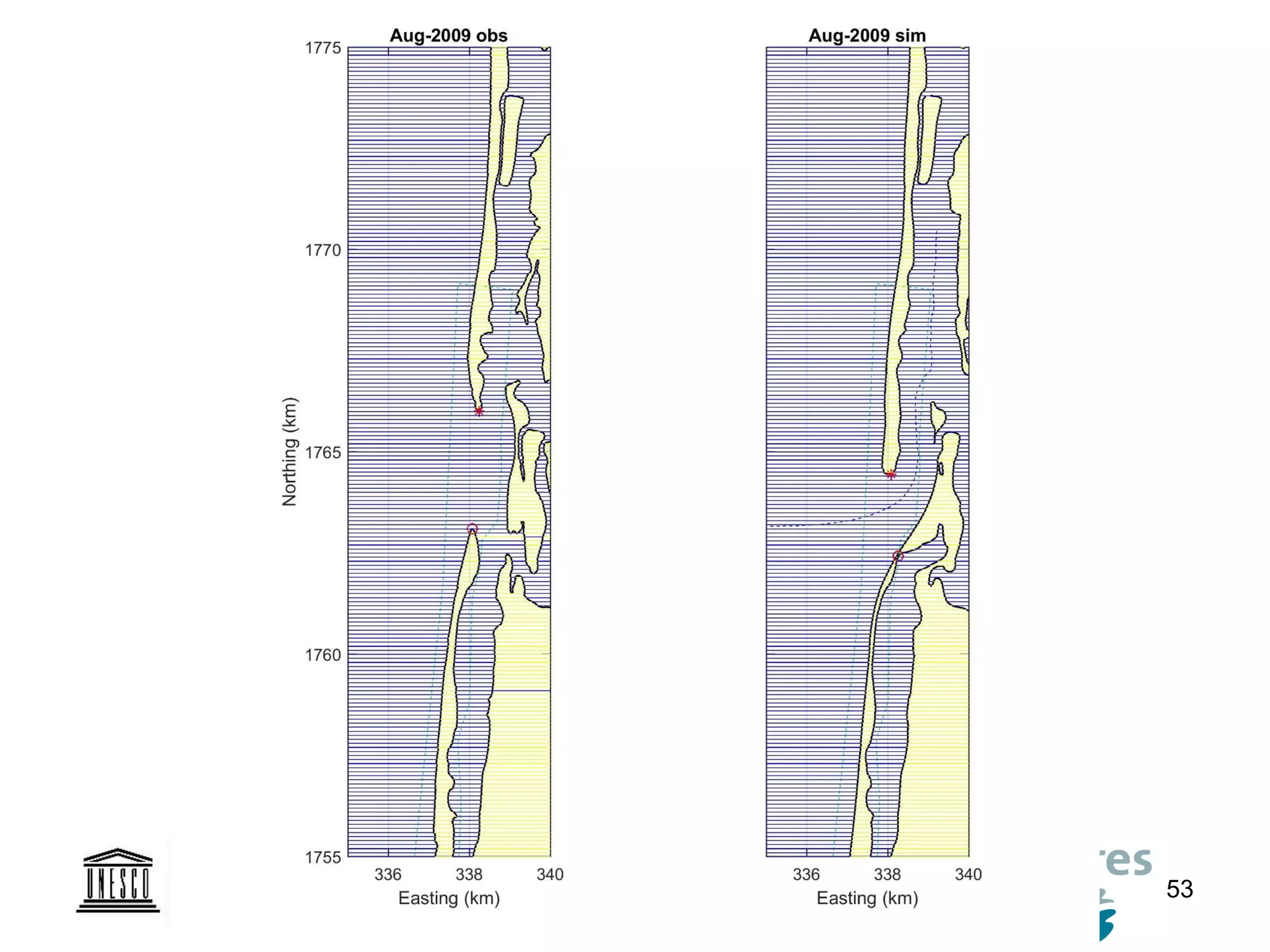
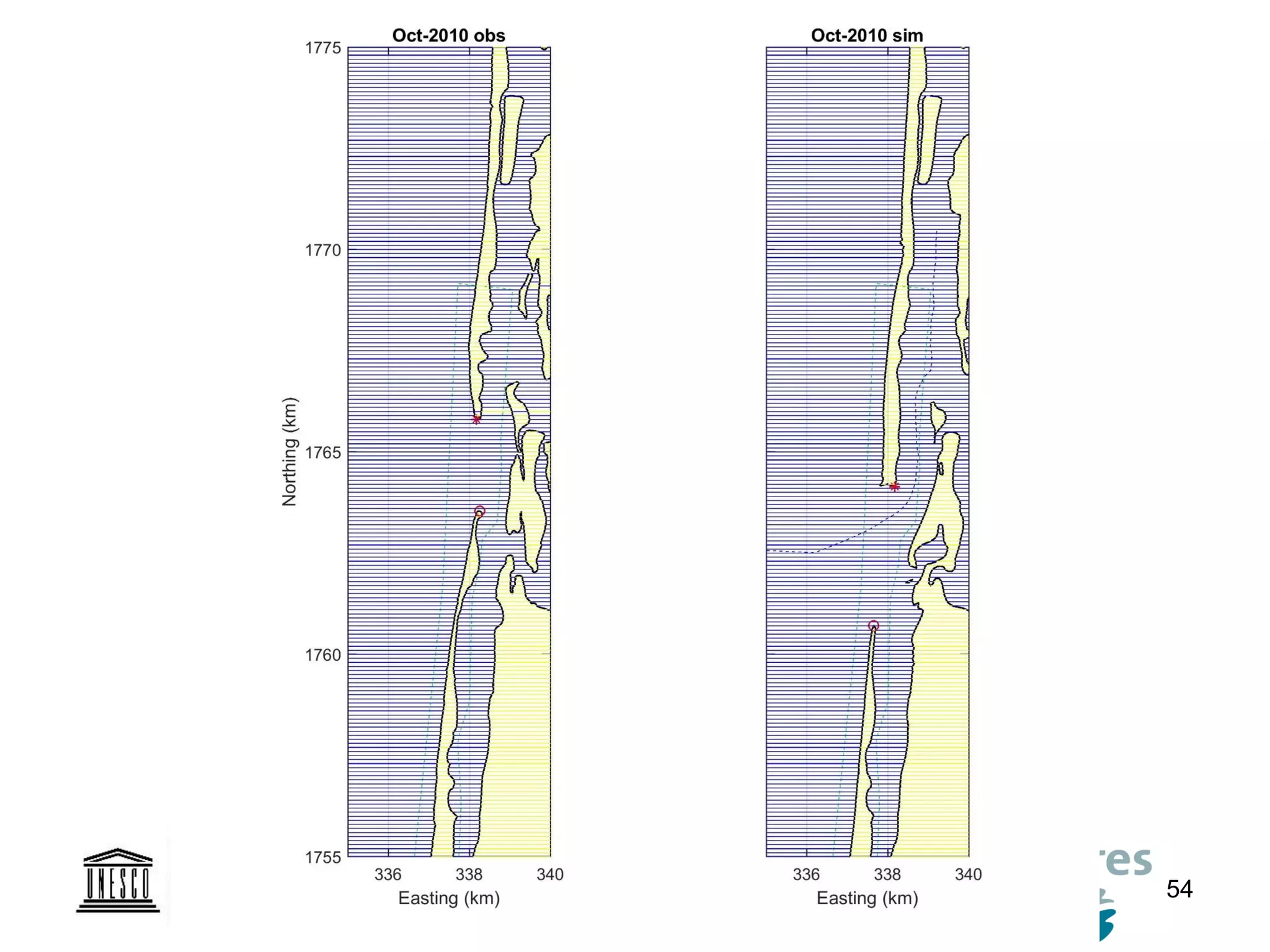
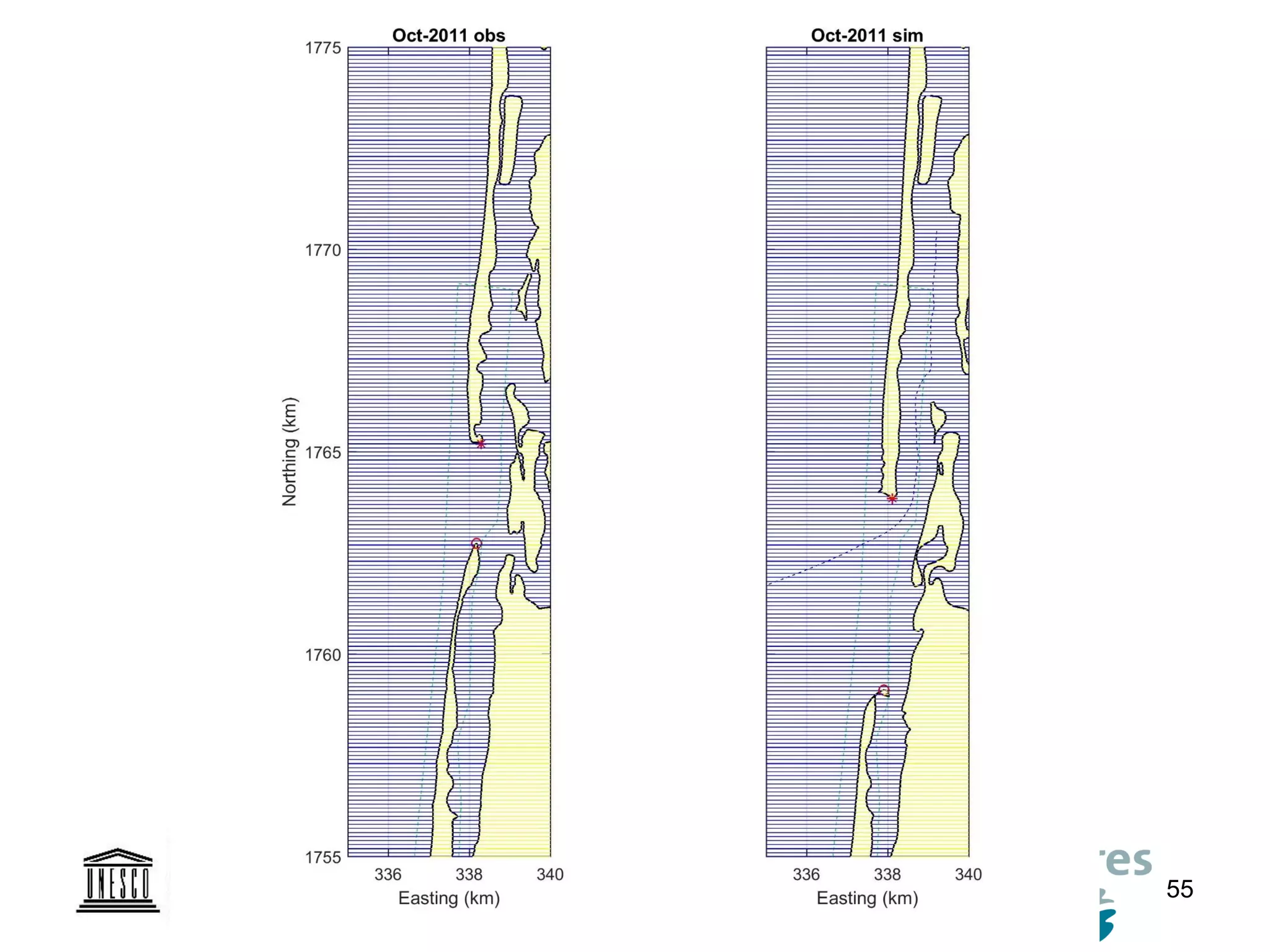
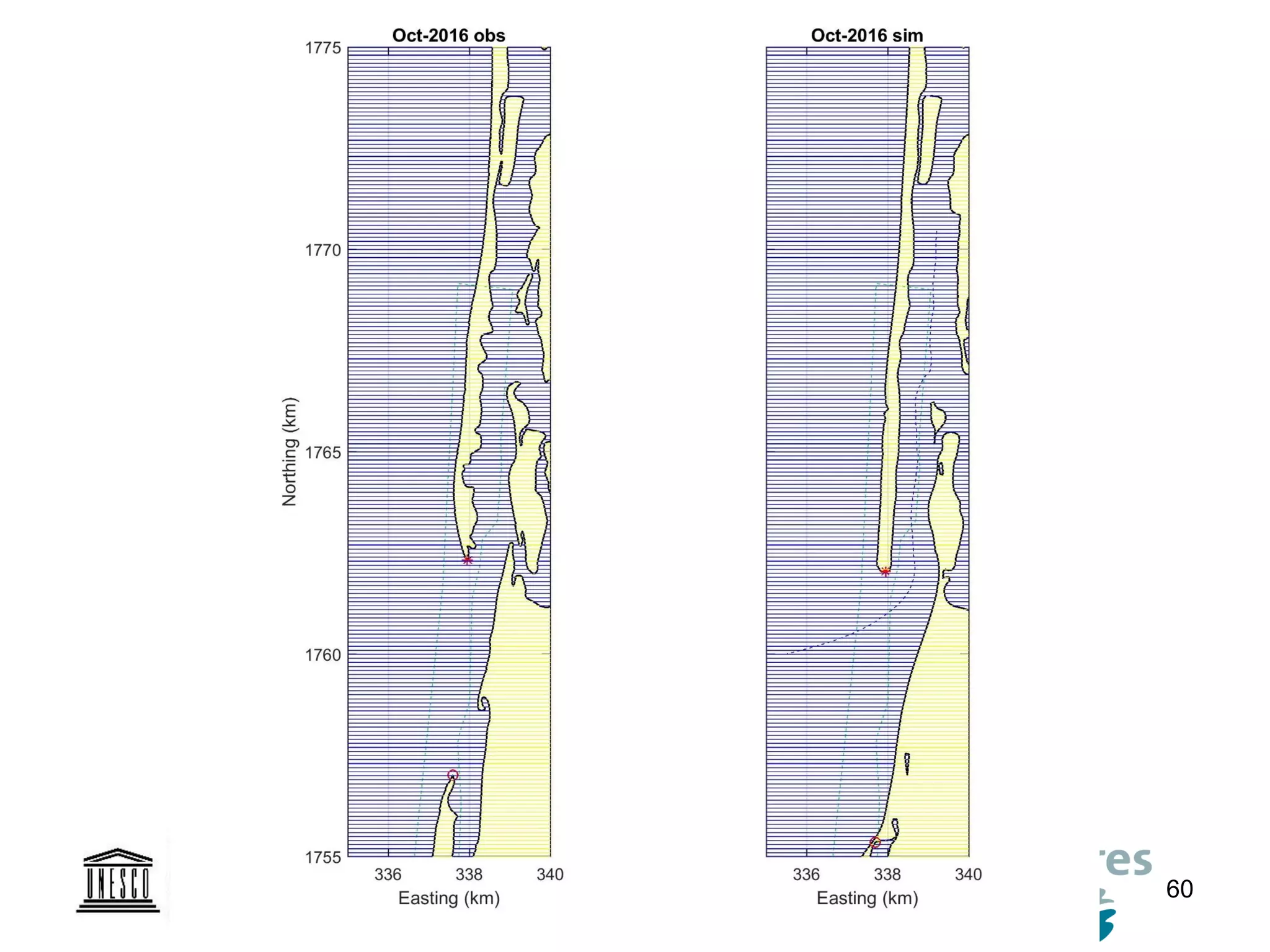
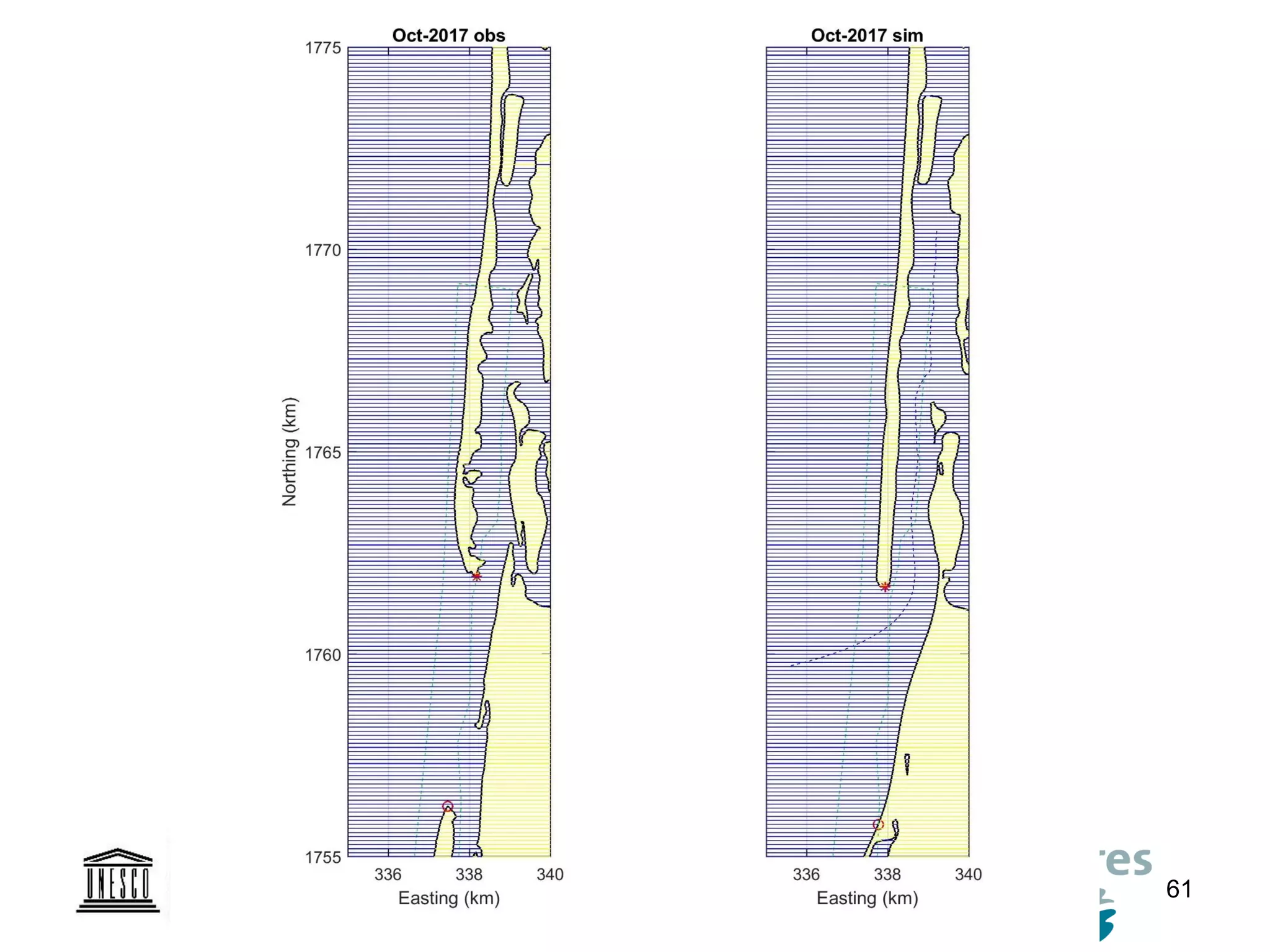
St Louis, Senegal
• Small breach to
reduce lagoon
water levels in
2003
• Grew to 5 km
width
27
• Coastlines extracted from LANDSAT imagery
• Long period of southward migration
• Until artificial opening in 2003
• Schematized wave climate
• Mean direction 310 deg N
• Hs = 1.4 m
• Spreading +/- 30 deg
• Simplest CERC formula
• Calibration factor adjusted in calibration
• Problem: inlet closes
Calibration 1984-2003
28
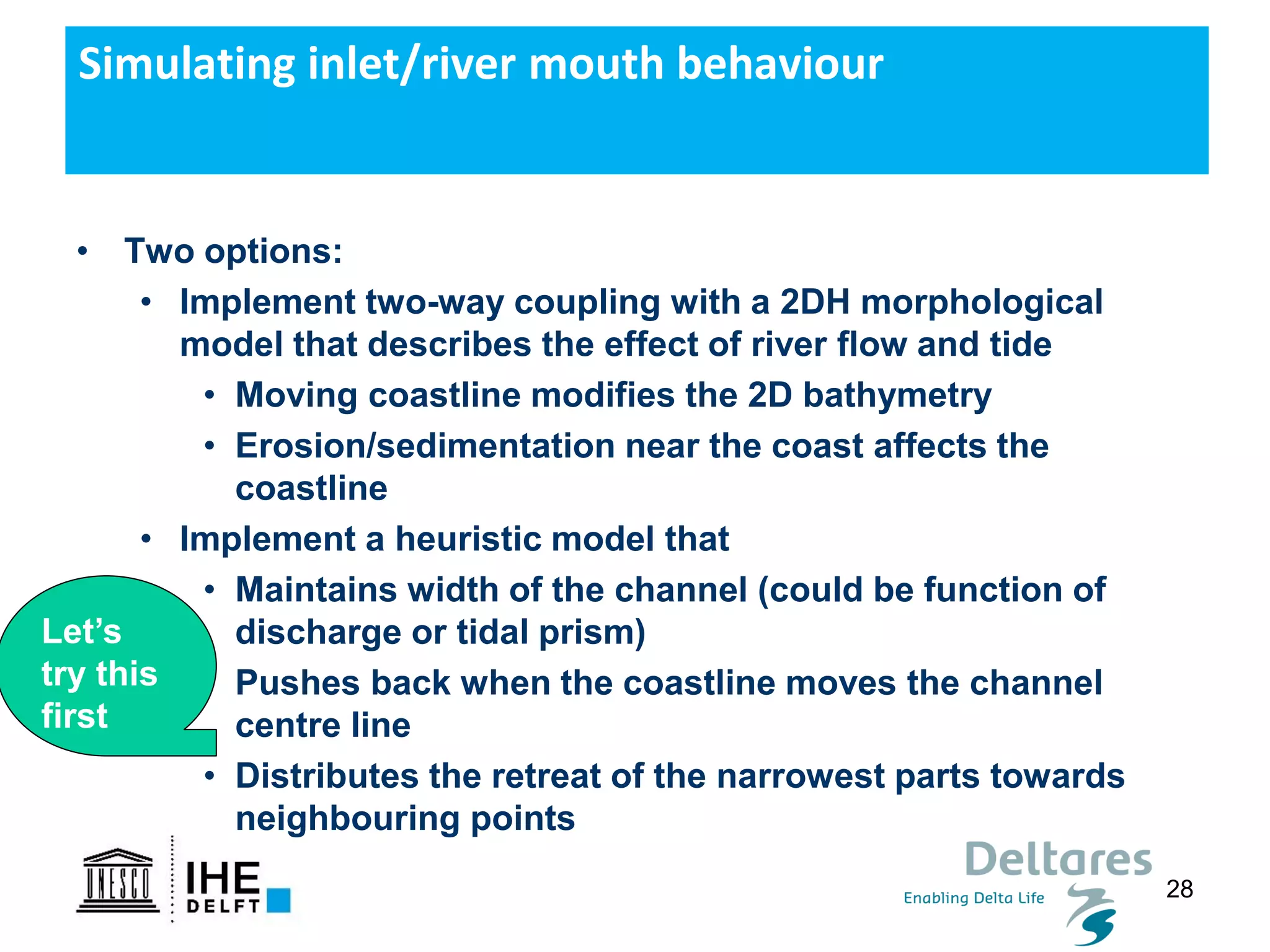
• Two options:
• Implement two-way coupling with a 2DH morphological
model that describes the effect of river flow and tide
• Moving coastline modifies the 2D bathymetry
• Erosion/sedimentation near the coast affects the
coastline
• Implement a heuristic model that
• Maintains width of the channel (could be function of
discharge or tidal prism)
• Pushes back when the coastline moves the channel
centre line
• Distributes the retreat of the narrowest parts towards
neighbouring points
Simulating inlet/river mouth behaviour
Let’s
try this
first
29
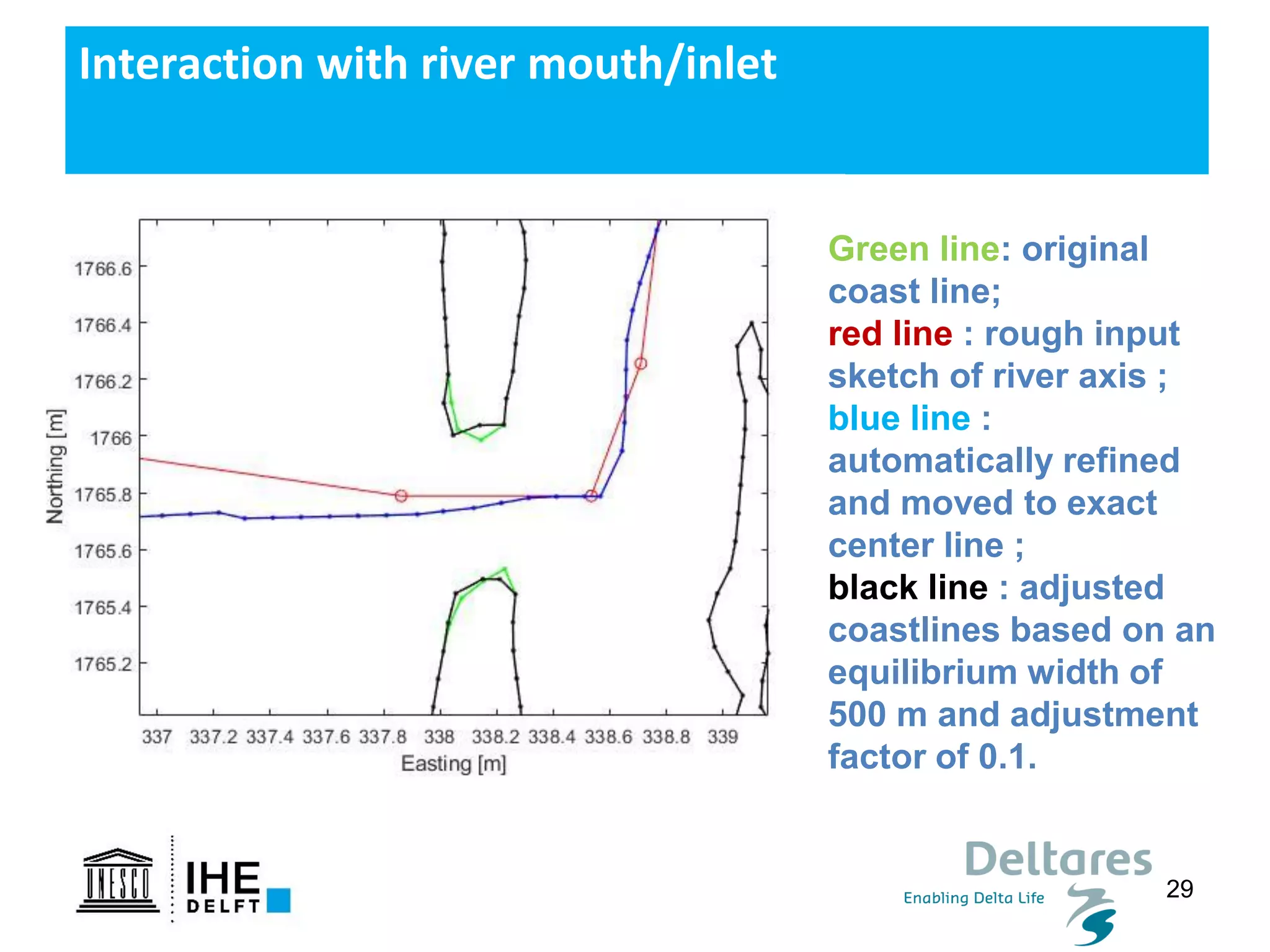
Interaction with river mouth/inlet
Green line: original
coast line;
red line : rough input
sketch of river axis ;
blue line :
automatically refined
and moved to exact
center line ;
black line : adjusted
coastlines based on an
equilibrium width of
500 m and adjustment
factor of 0.1.
30
31
32
33
34
35
36
37
38
39
40
41
42
43
44
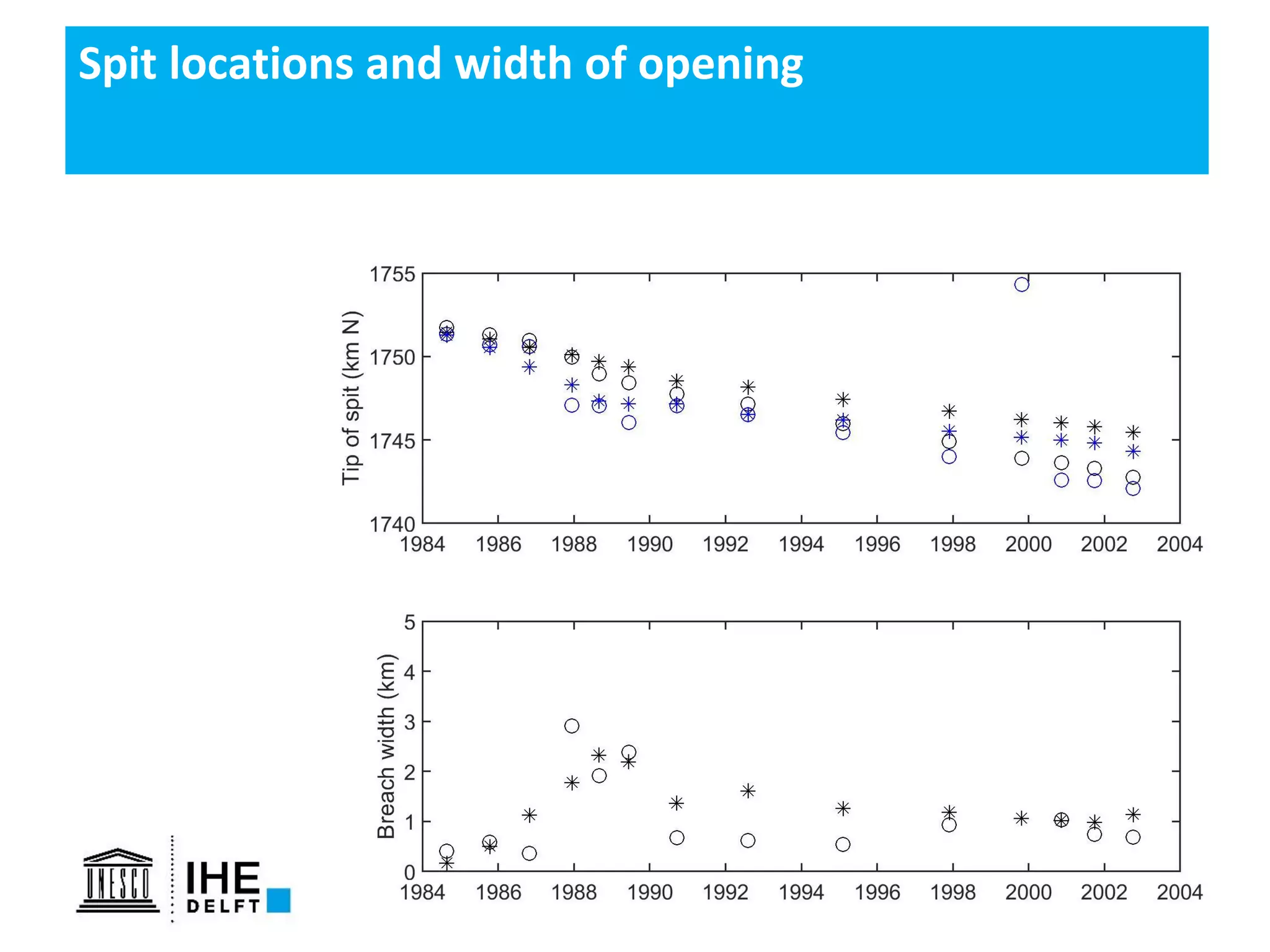
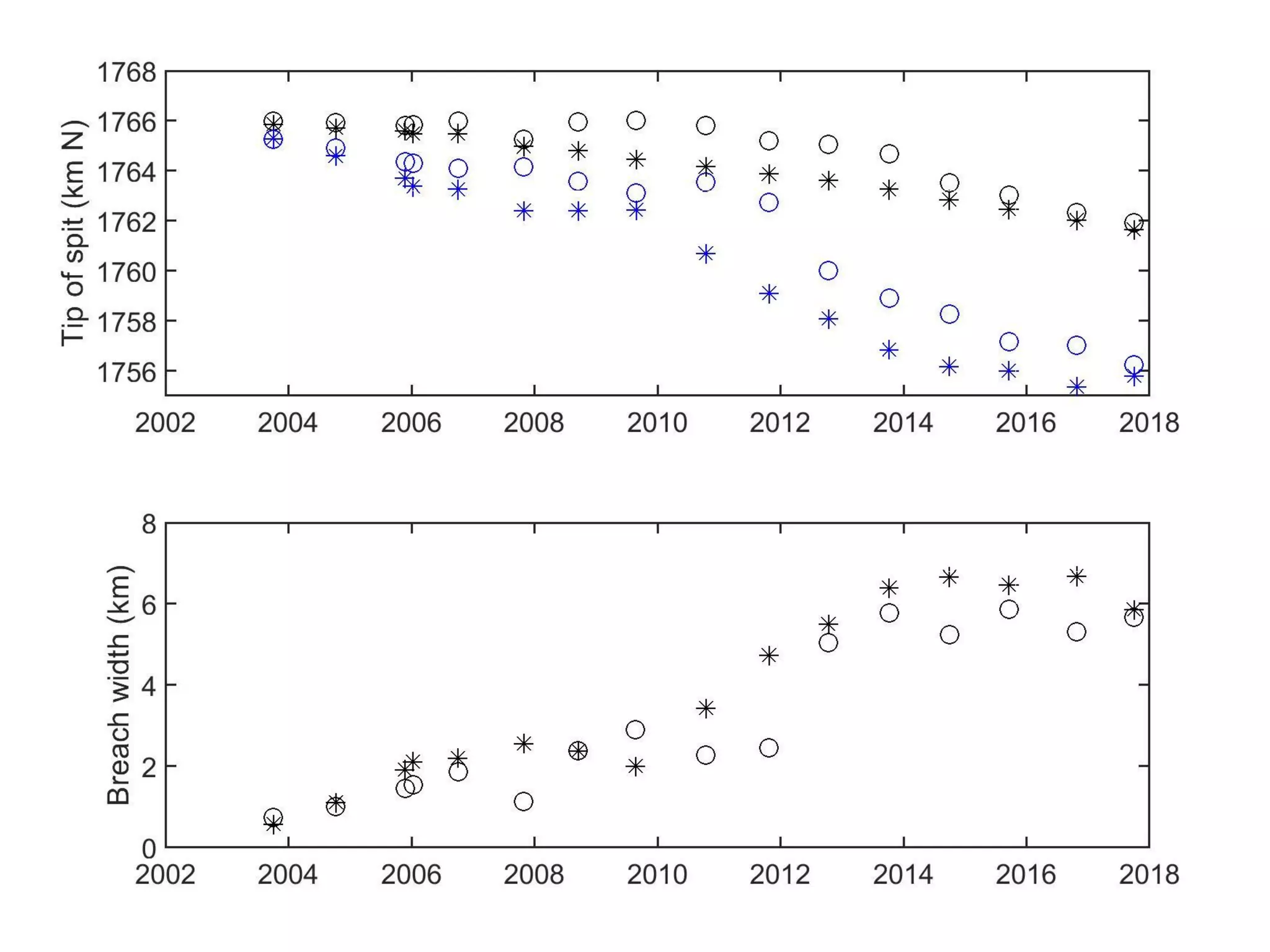
Spit locations and width of opening
45
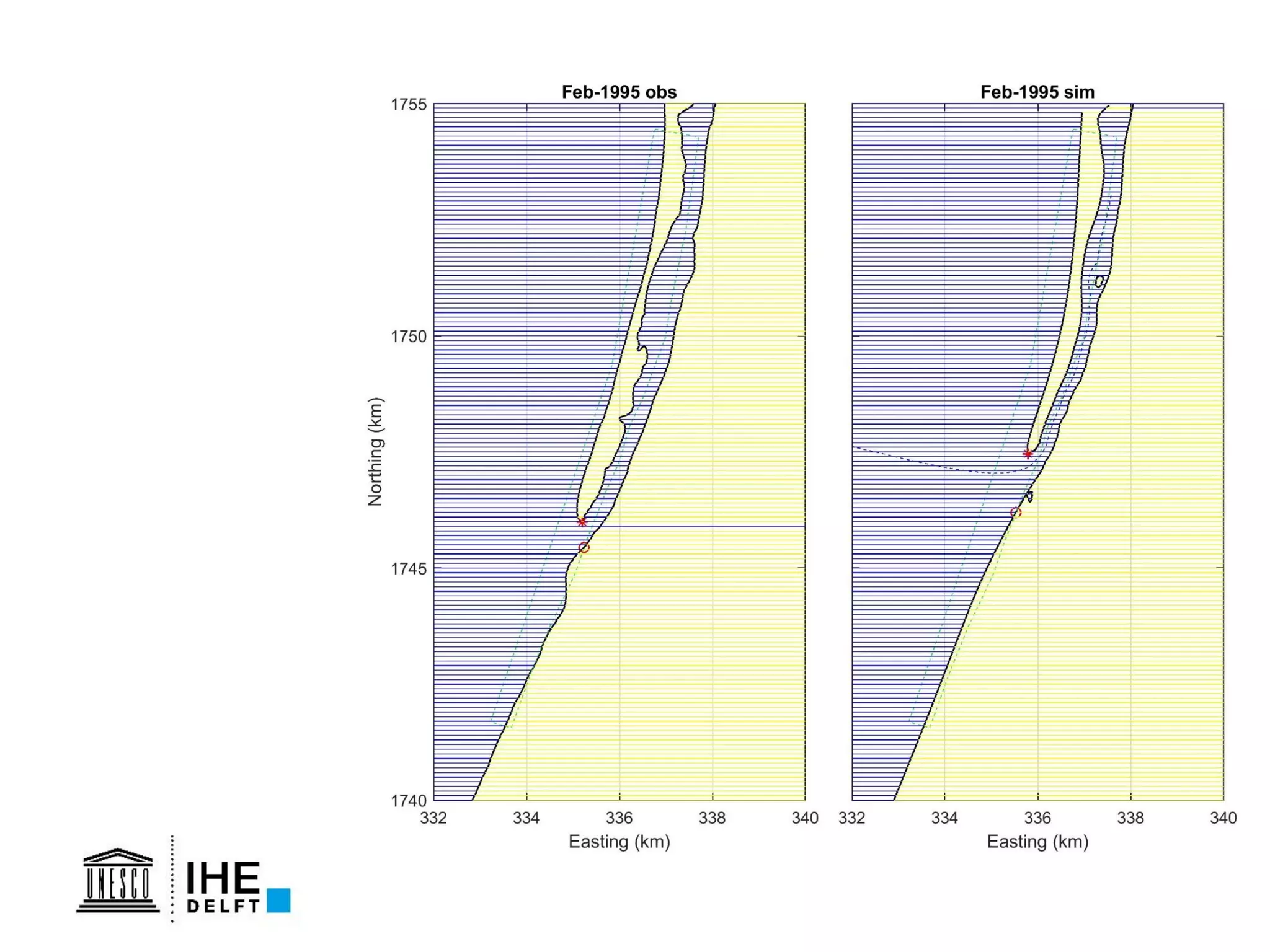
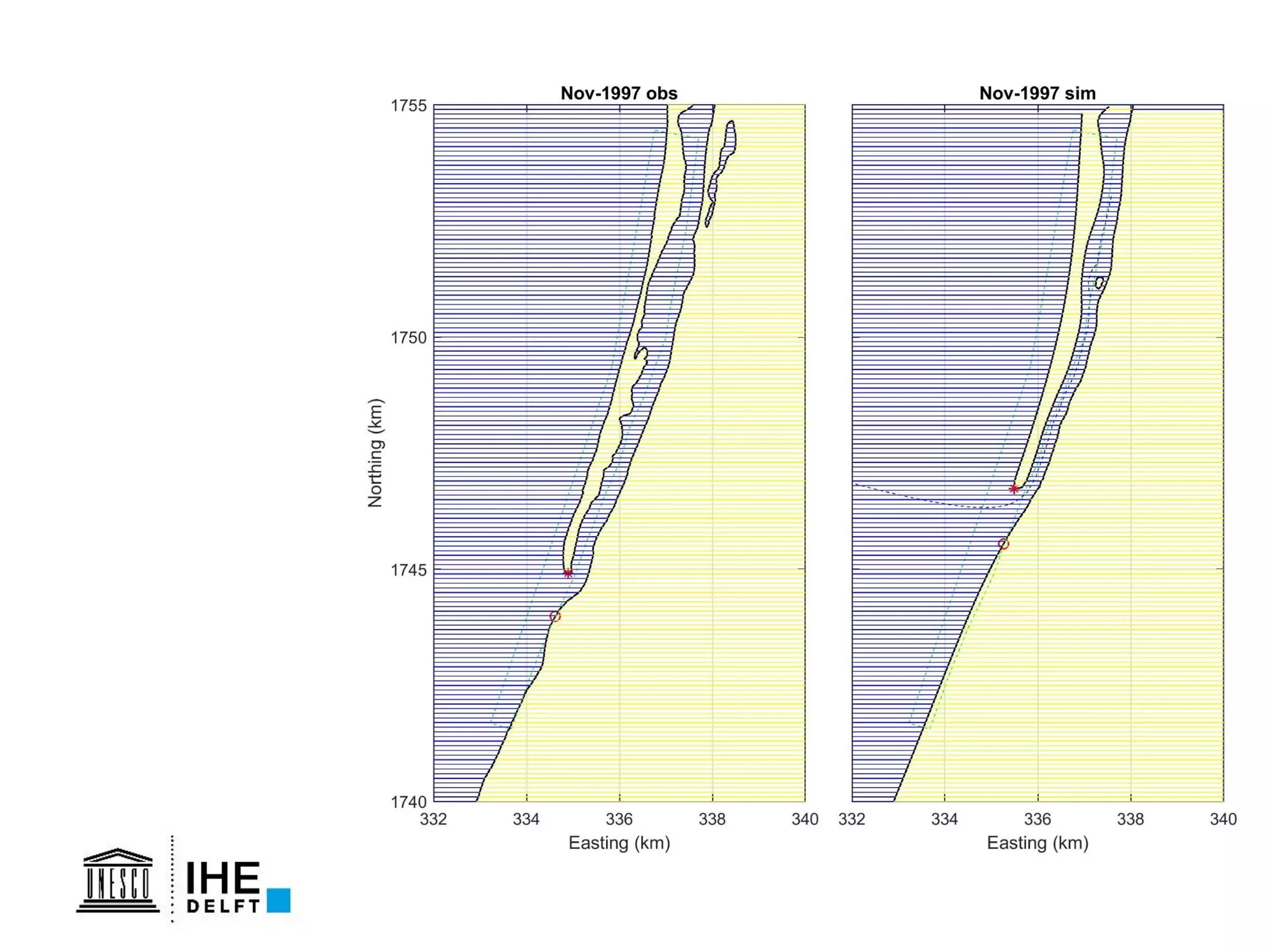
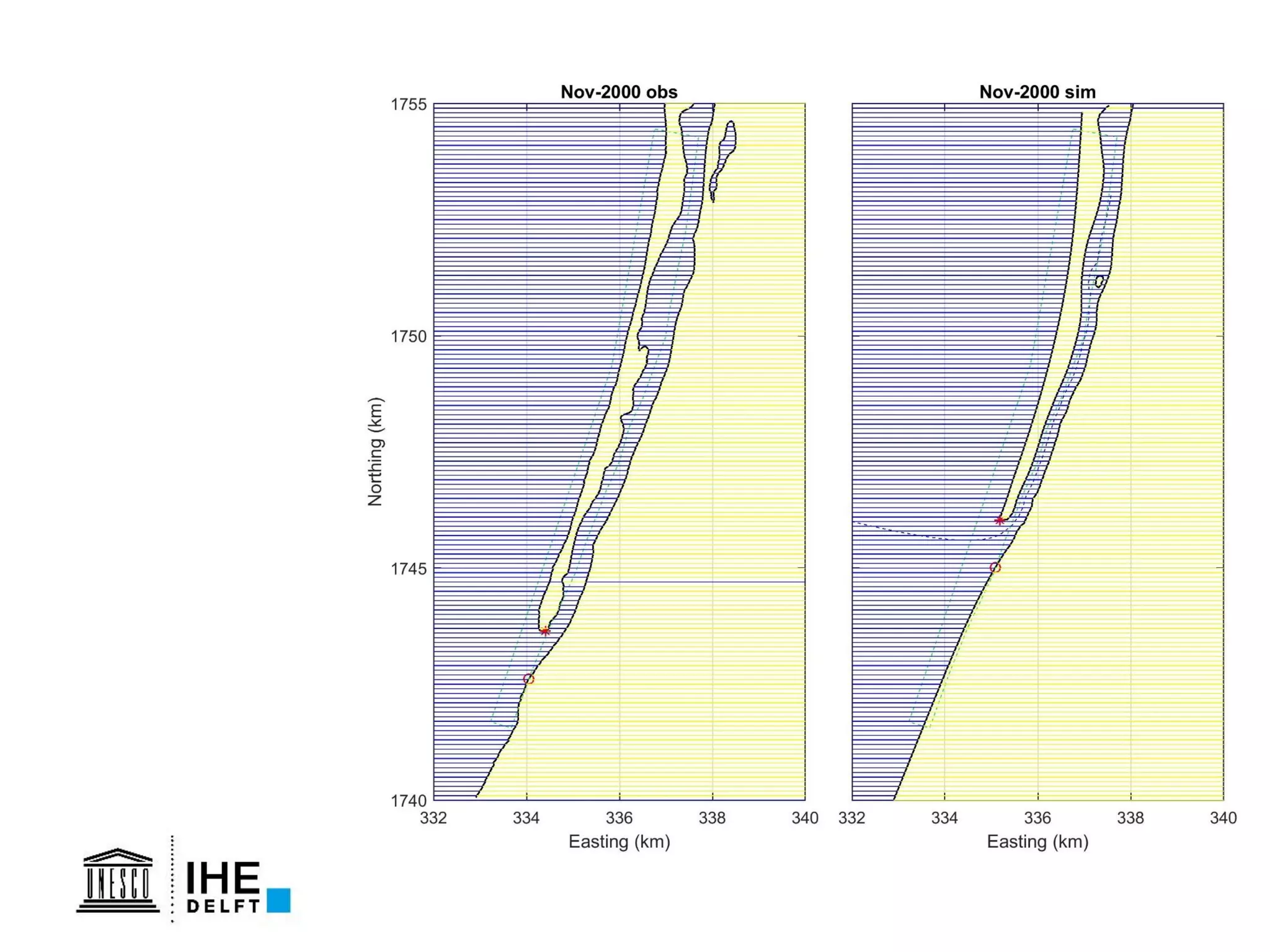
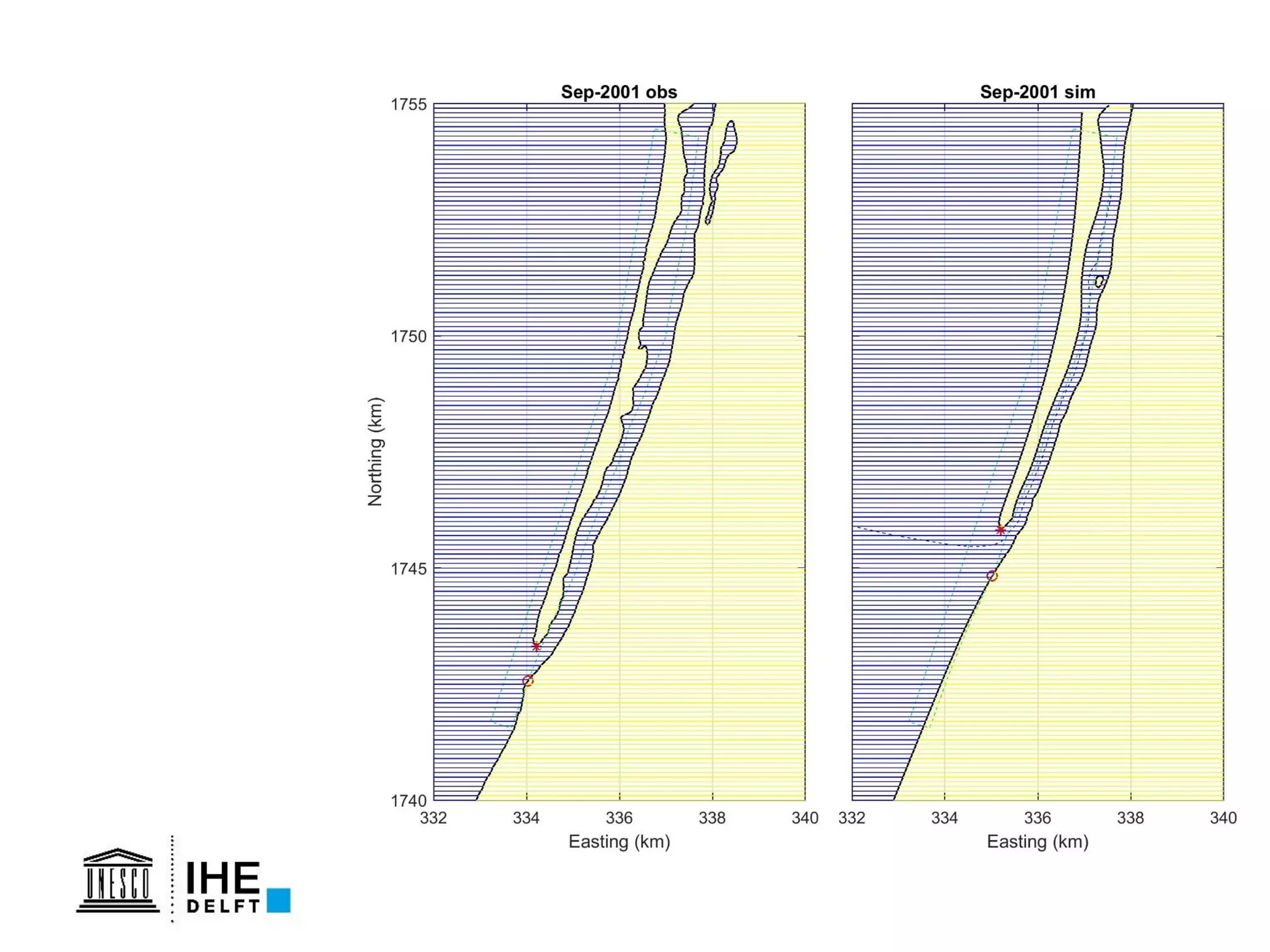
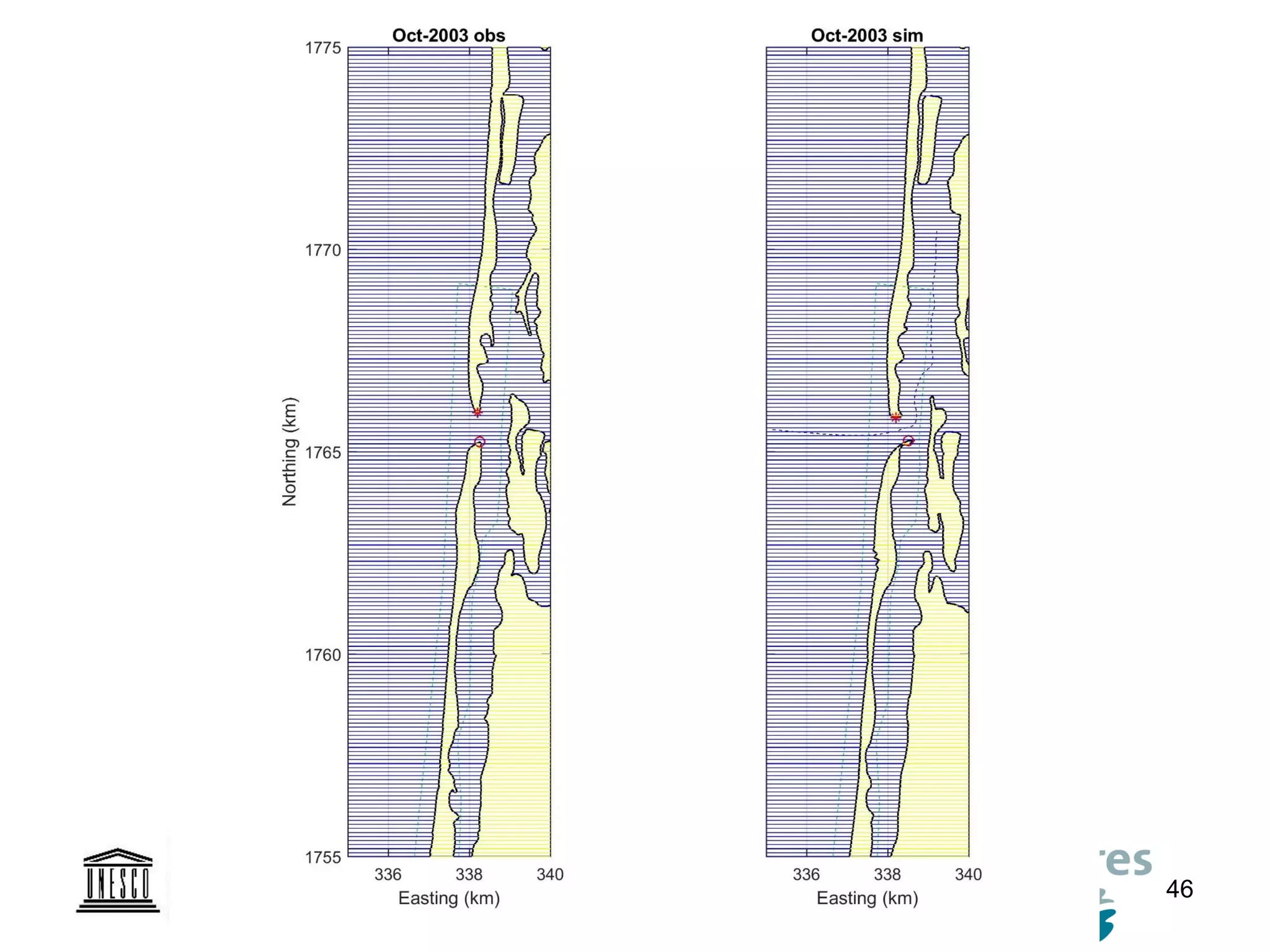
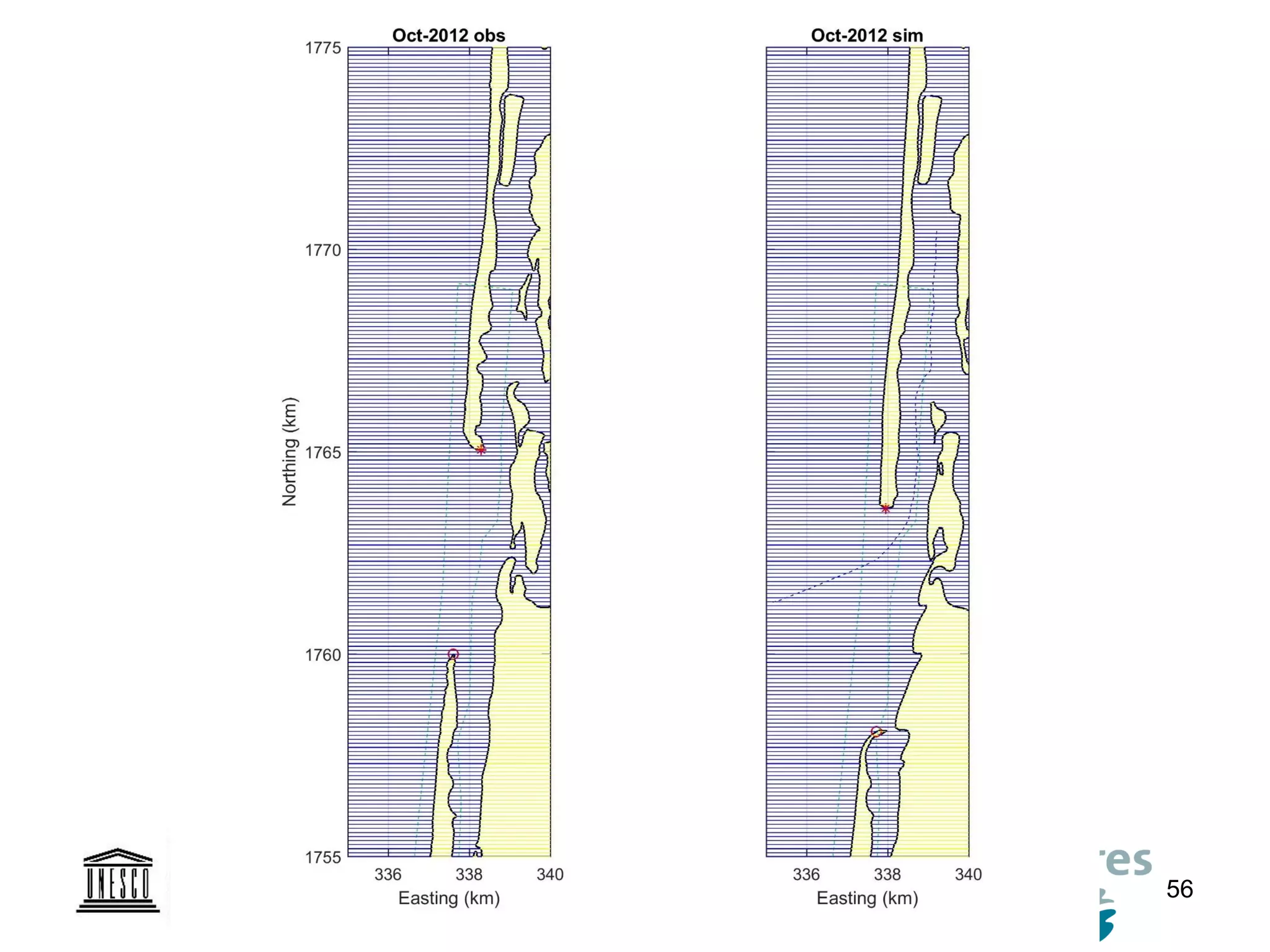
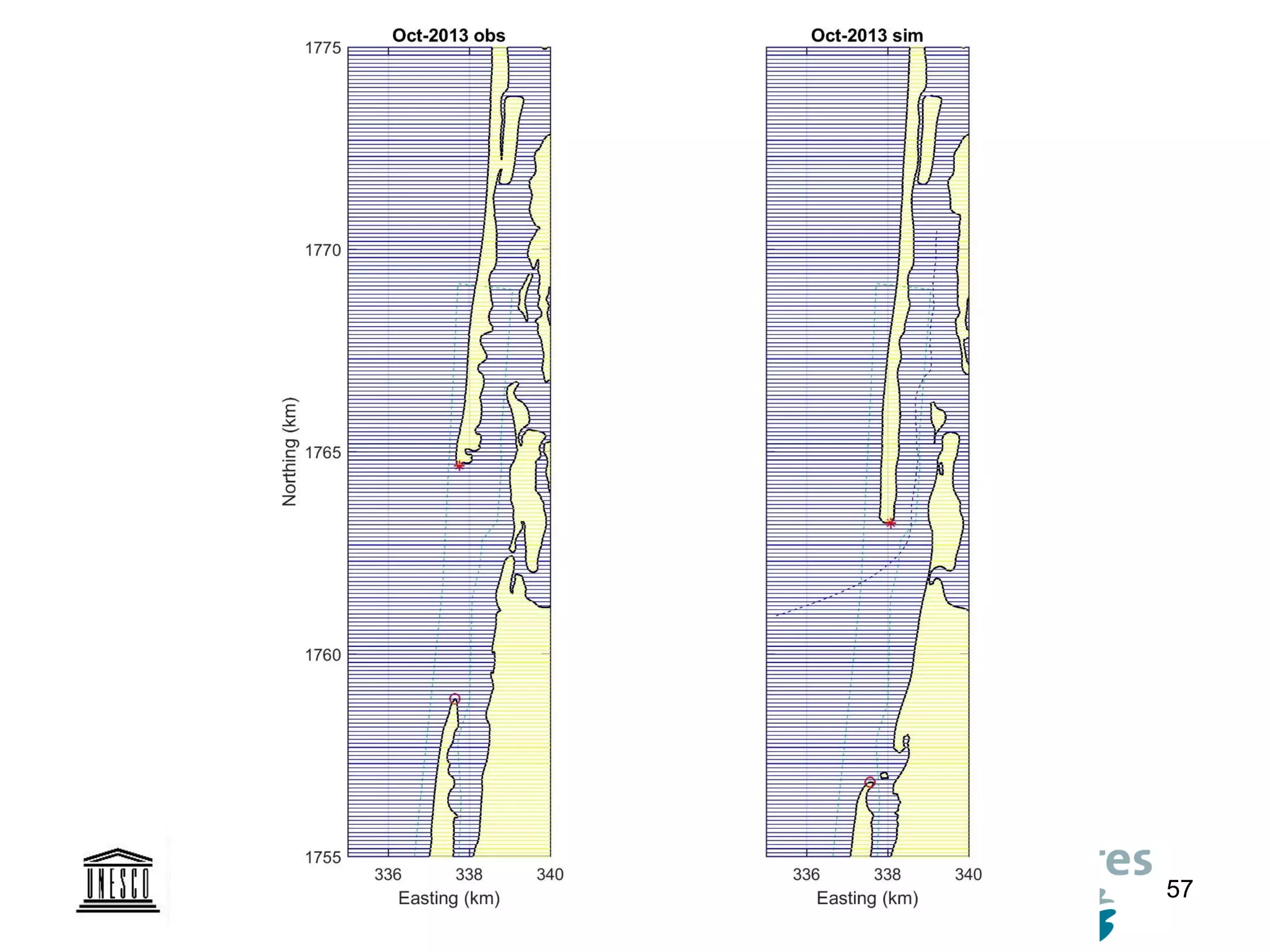
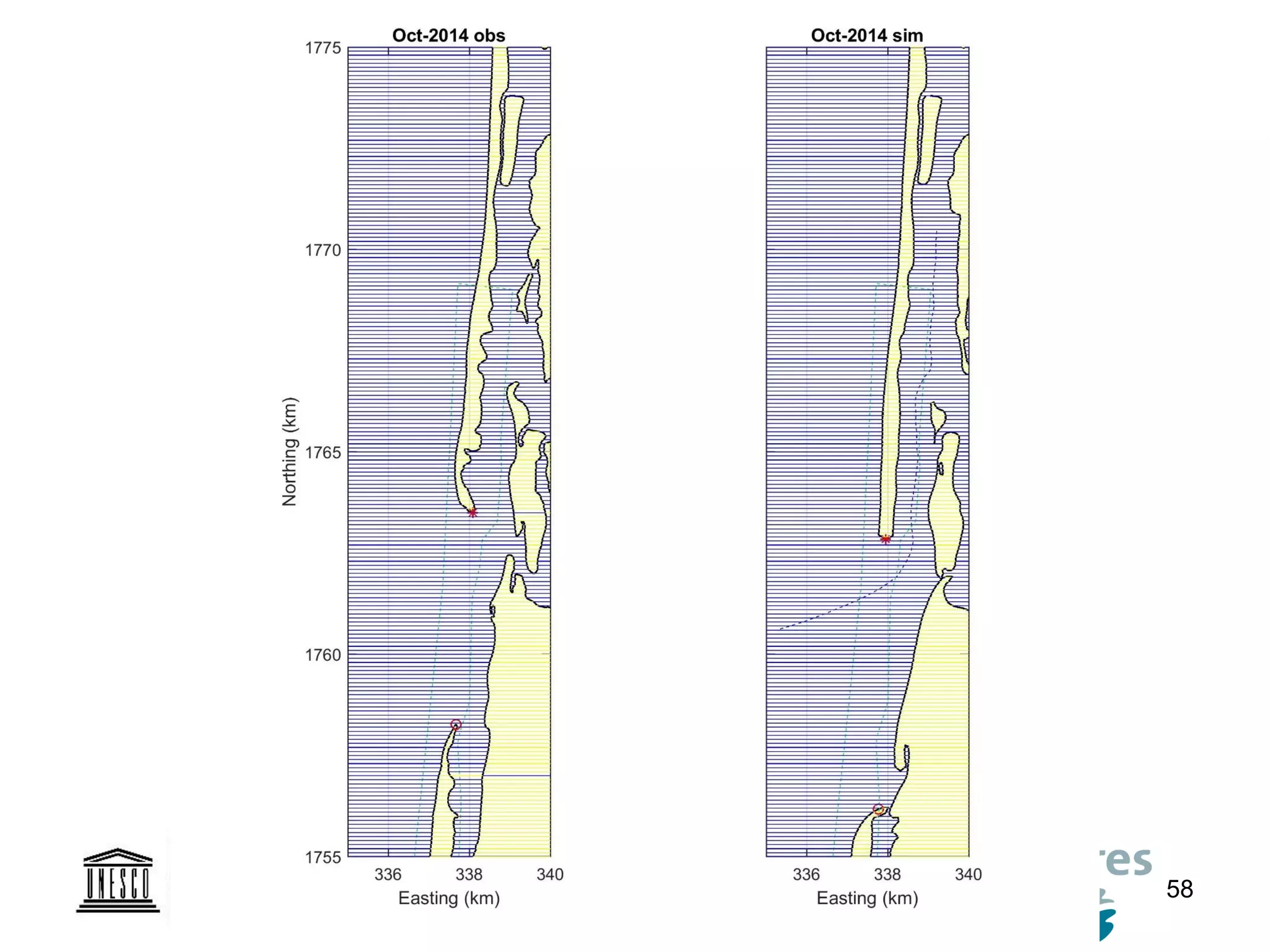
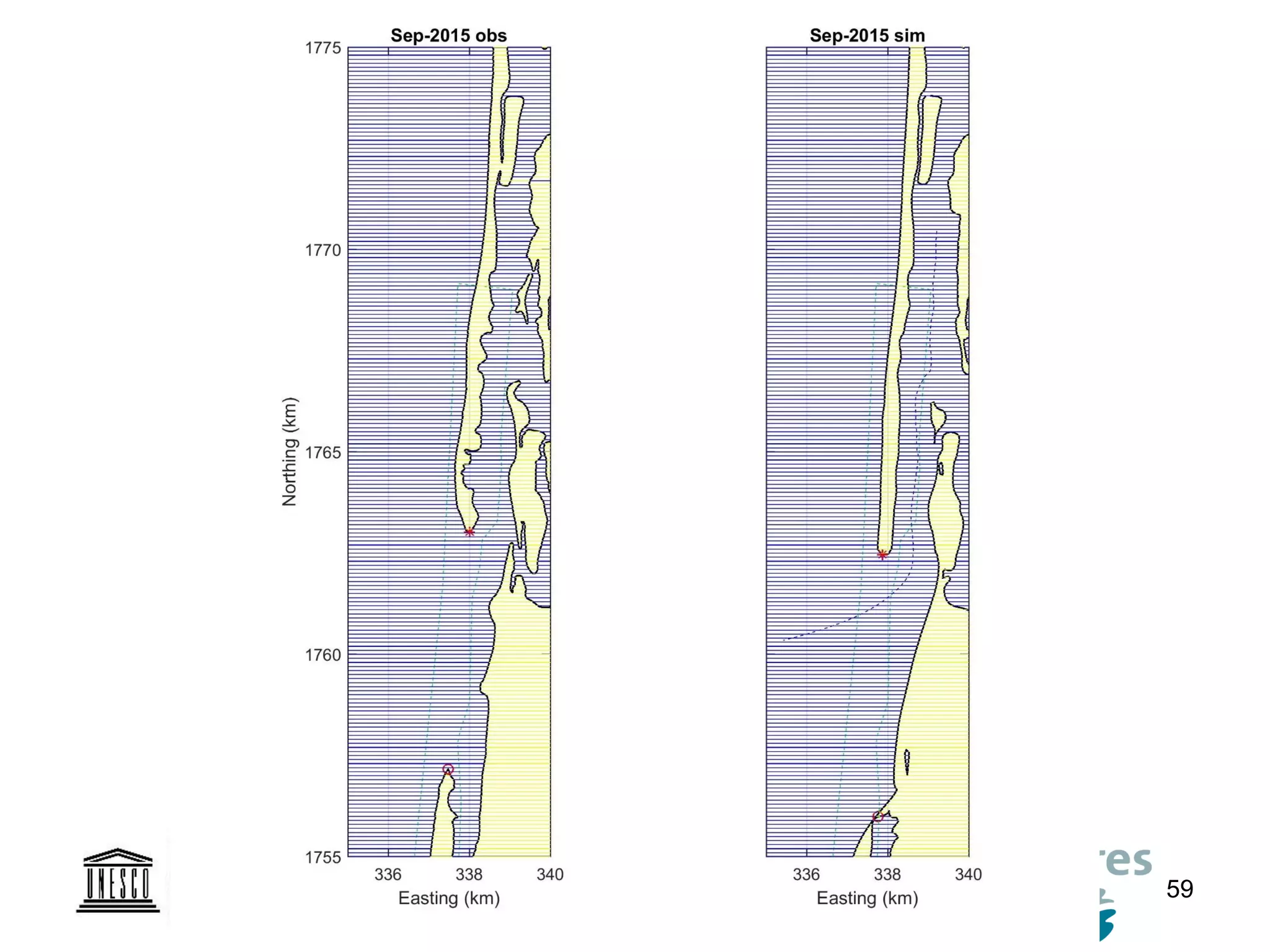
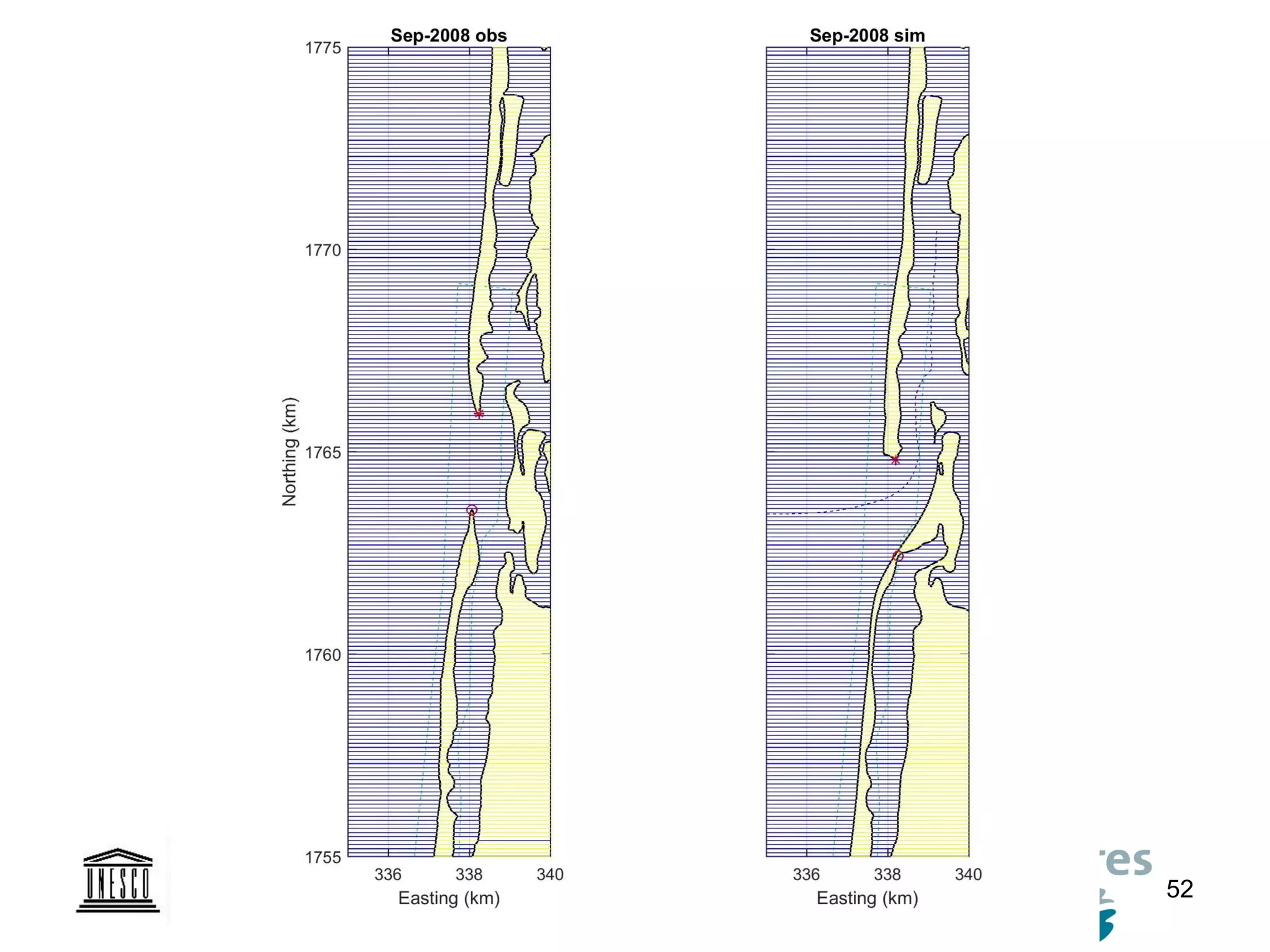
St Louis validation 2003-2018
• After artificial breaching
• Initial losses to new flood delta mimicked in heuristic
flood_delta function
• Explains the initial stalling of the migration of the northern spit
46
47
48
49
50
51
52
53
54
55
56
57
58
59
60
61
62
63
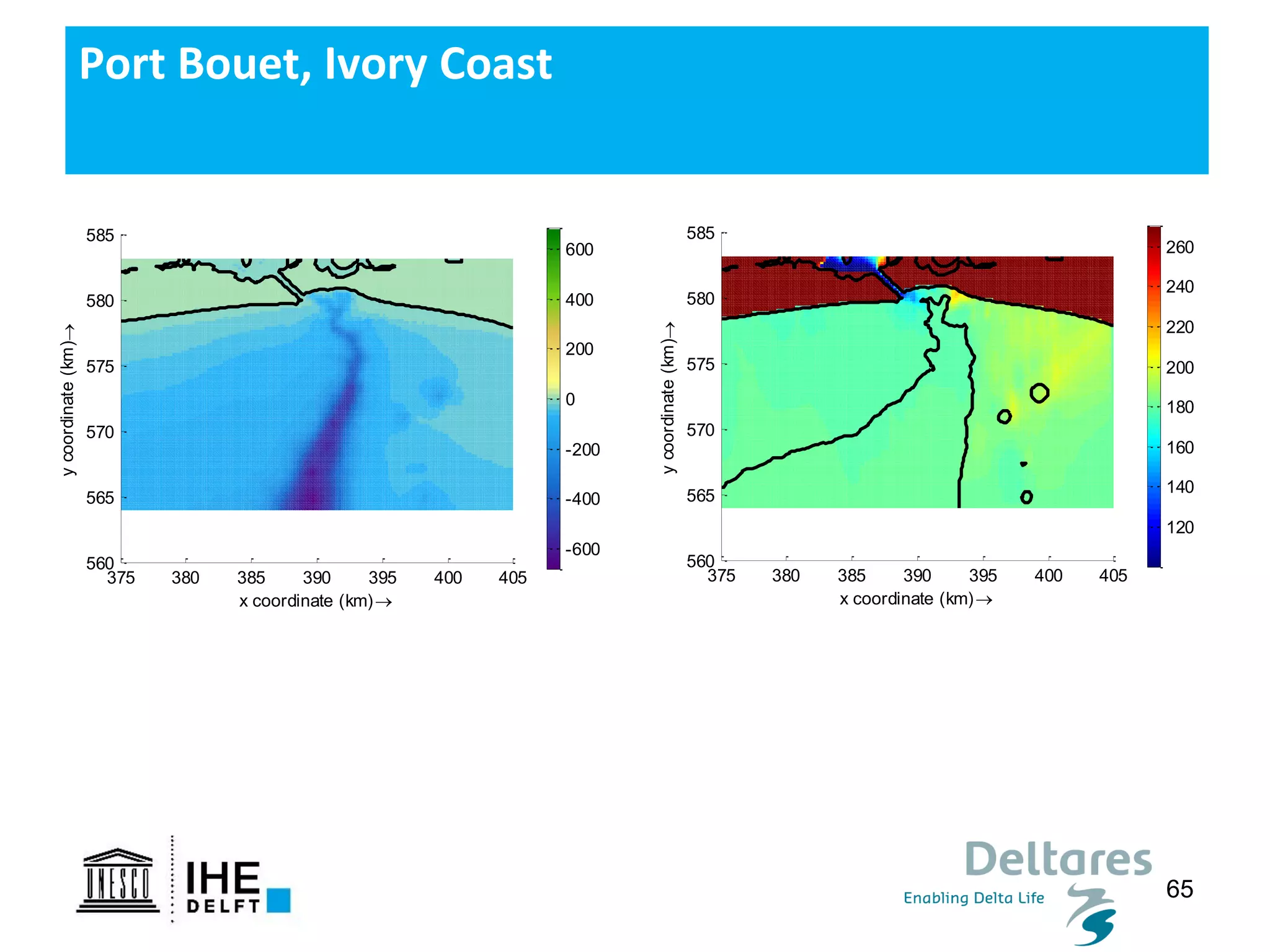
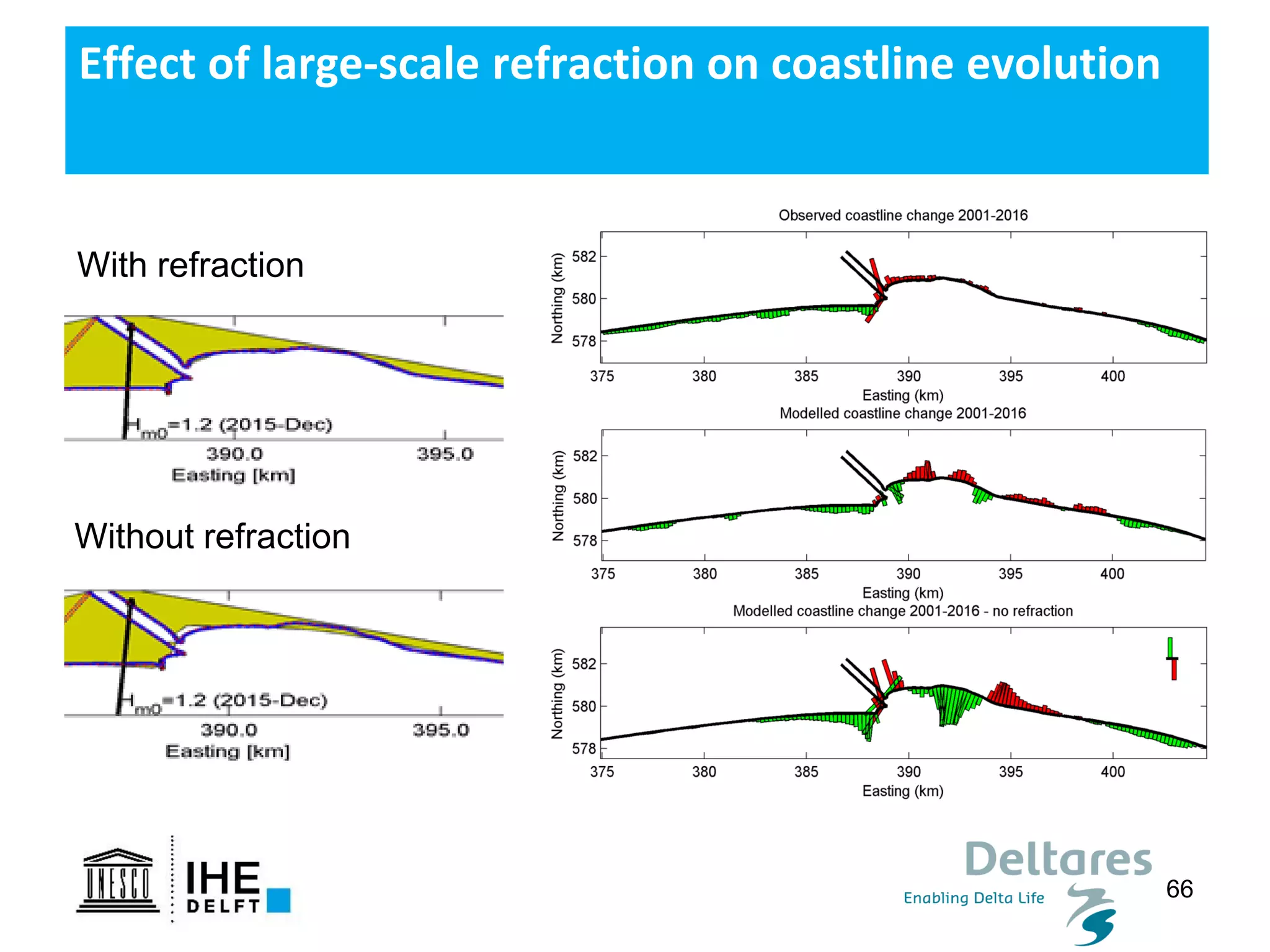
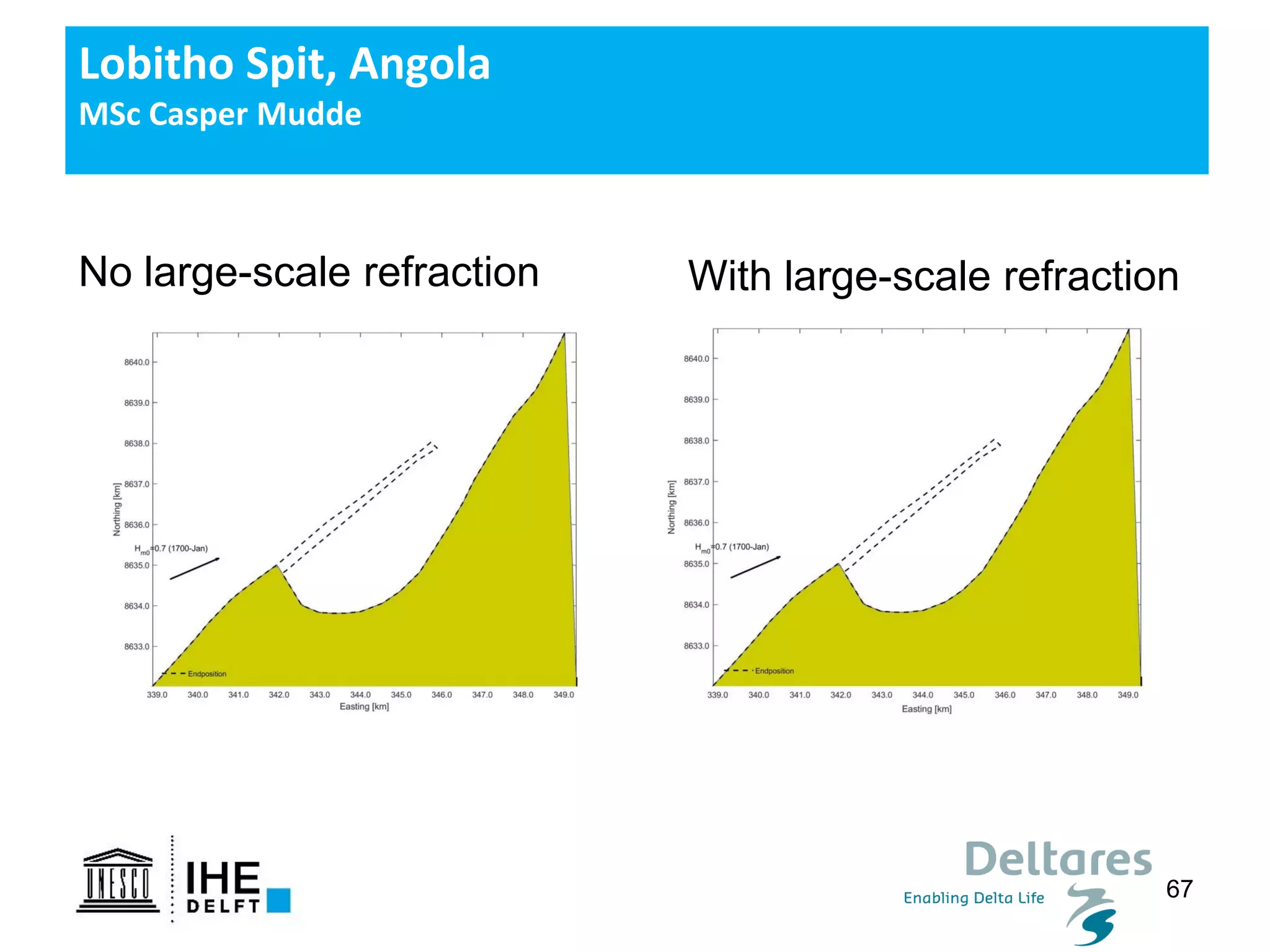
• Presence of large-scale features (headlands, shoals, canyons)
can significantly affect shoreline orientation.
• ShorelineS can use a ‘lookup table’ of nearshore wave
conditions defined on a 2D grid
• This can be generated by an offline model such as SWAn or
with an inline wave propagation model
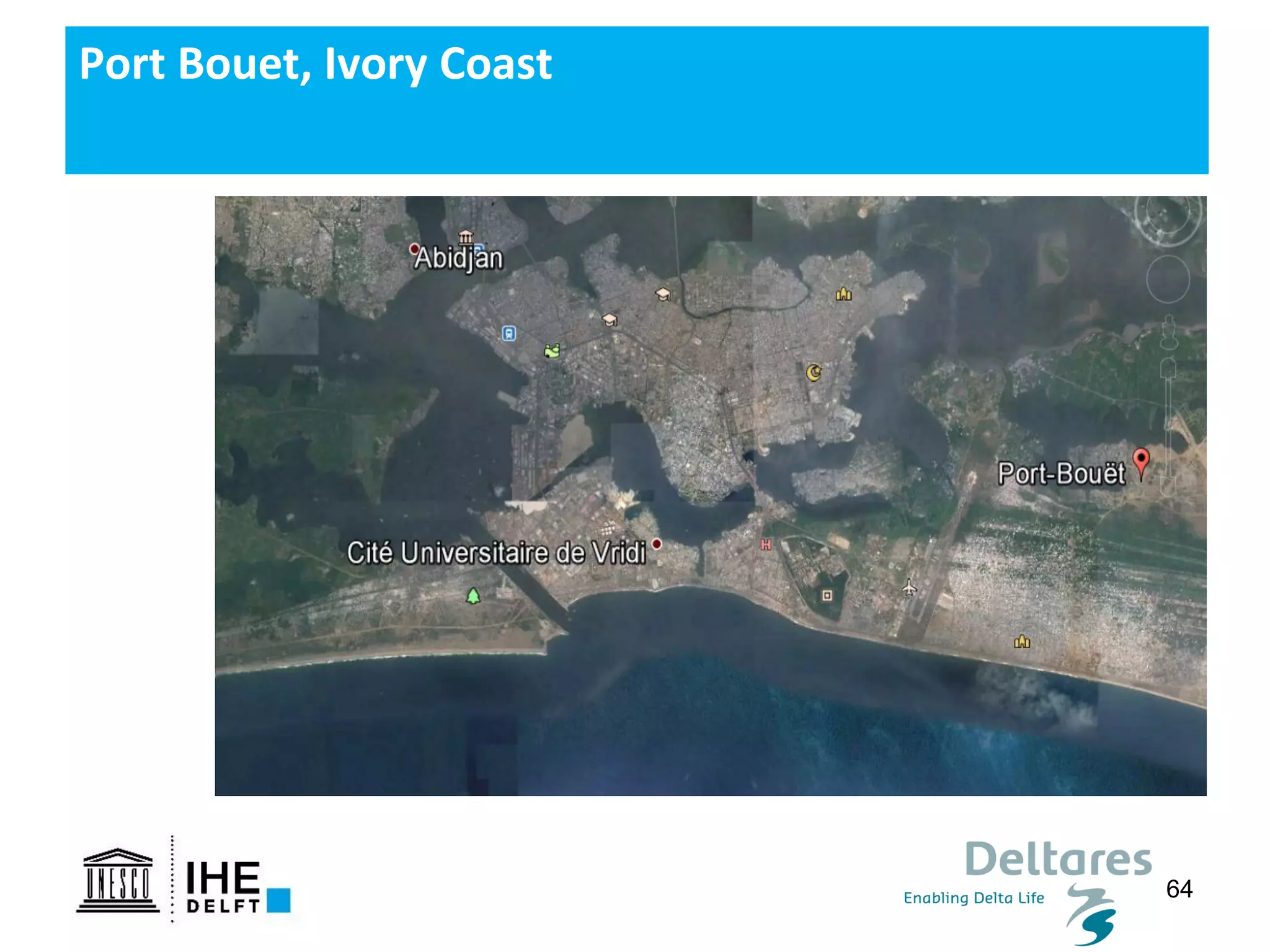
• Example: coastline near Port Bouet, Ivory Coast, which is
influenced by the Trou Sans Fond canyon
Effect of large-scale refraction
64
Port Bouet, Ivory Coast
65
Port Bouet, Ivory Coast
x coordinate (km)→
ycoordinate(km)→
bed level (m)
00-Jan-0000 00:07:10
375 380 385 390 395 400 405
560
565
570
575
580
585
-600
-400
-200
0
200
400
600
x coordinate (km)→
ycoordinate(km)→
bed level (m)
00-Jan-0000 00:03:10
375 380 385 390 395 400 405
560
565
570
575
580
585
120
140
160
180
200
220
240
260
66
Effect of large-scale refraction on coastline evolution
With refraction
Without refraction
67
Lobitho Spit, Angola
MSc Casper Mudde
No large-scale refraction With large-scale refraction
68
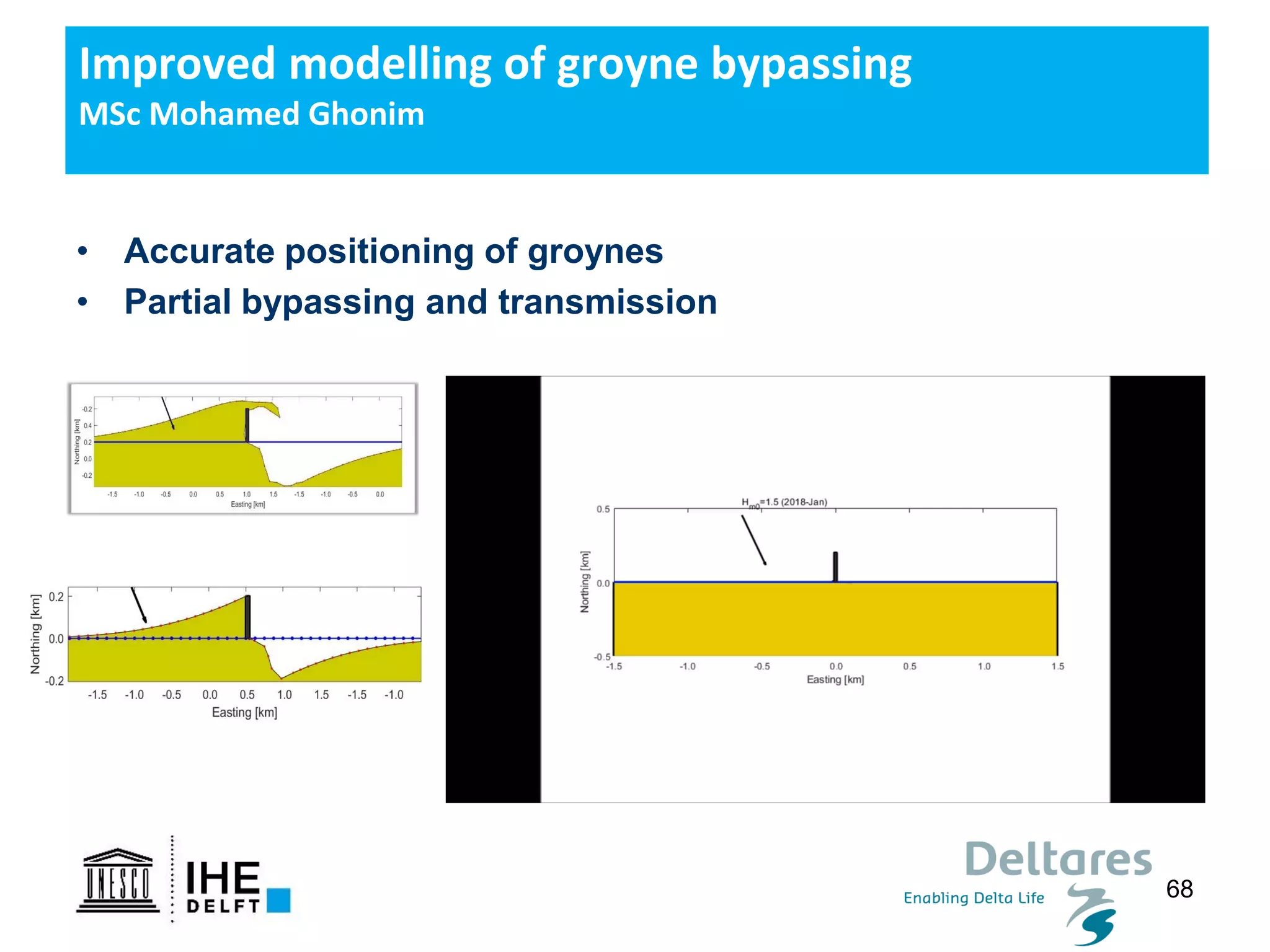
Improved modelling of groyne bypassing
MSc Mohamed Ghonim
• Accurate positioning of groynes
• Partial bypassing and transmission
69
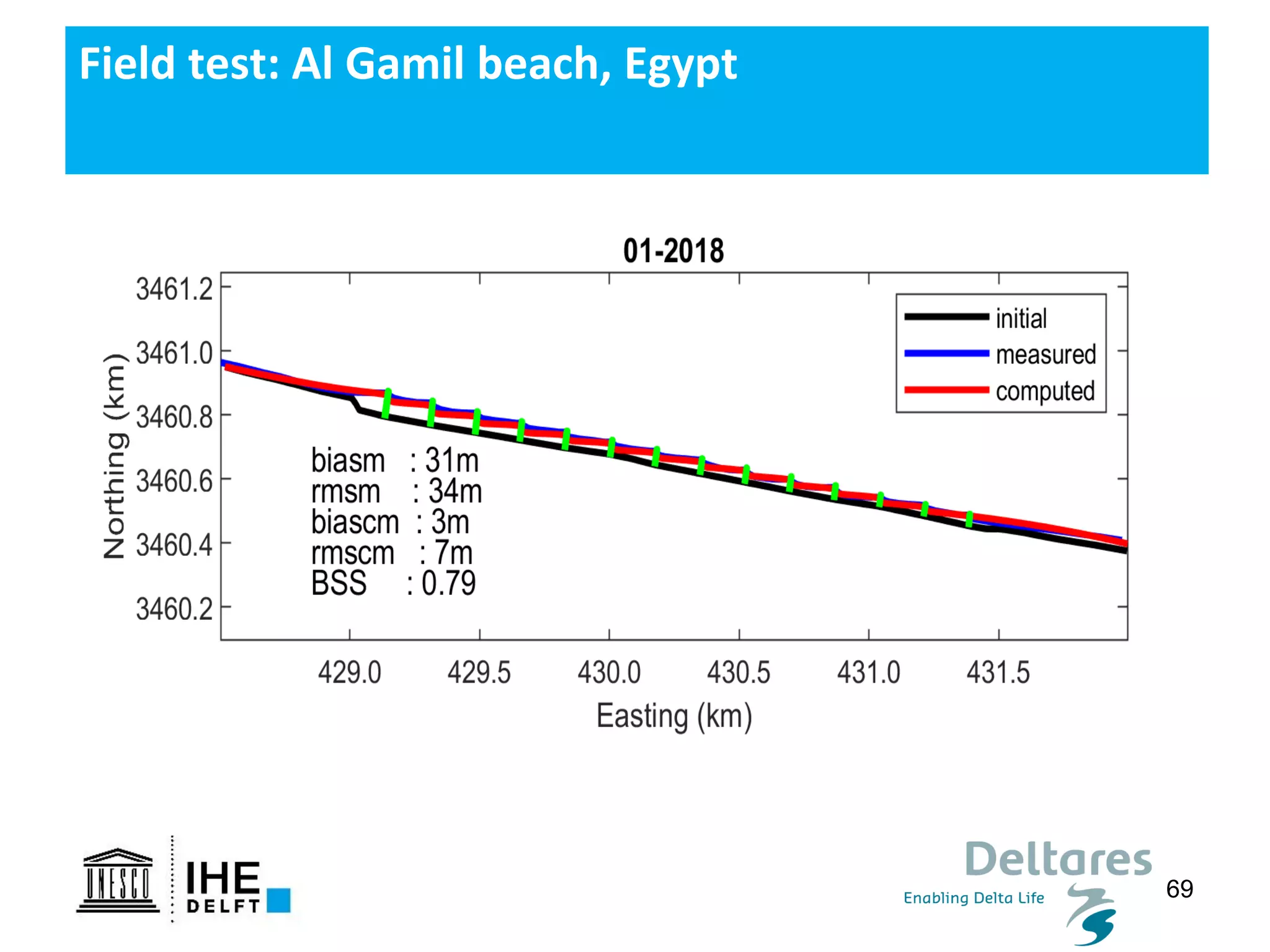
Field test: Al Gamil beach, Egypt
Shoreline 2011
Shoreline 2013
Shoreline 2015
Shoreline 2017
Shoreline 2018
1
2
3
4
5
6
7
8
9
10
11
12
13
14
100 m 300m200 m0 m
70
Conclusions ShorelineS
• Fun new model
• Prototype for next generation coastline model for engineering
purposes
• Is available in open source Matlab code
• Great for explaining coastal processes
• Easy to add more processes
• Needs very little input that is readily available:
• Initial coastline
• Rocky parts or structures
• Wave climate
71
• Coupling with dune foot (Mohamed)
• Barrier overwashing and rollover (Ahmed)
• Tidal inlet migration (Dano, Ahmed)
• Wave diffraction (Ahmed)
• Large-scale wave refraction (Bas, Casper, Dano)
• Ensemble Kalman Filter (Shadrack, Johan, Sean)
• Case studies in Portugal, Alaska, Senegal, Angola, NL
Current research
72
• What would you like to add
• What cases could you bring
• What could be the ambition
• How would you like to use it
• …
Over to you…
73
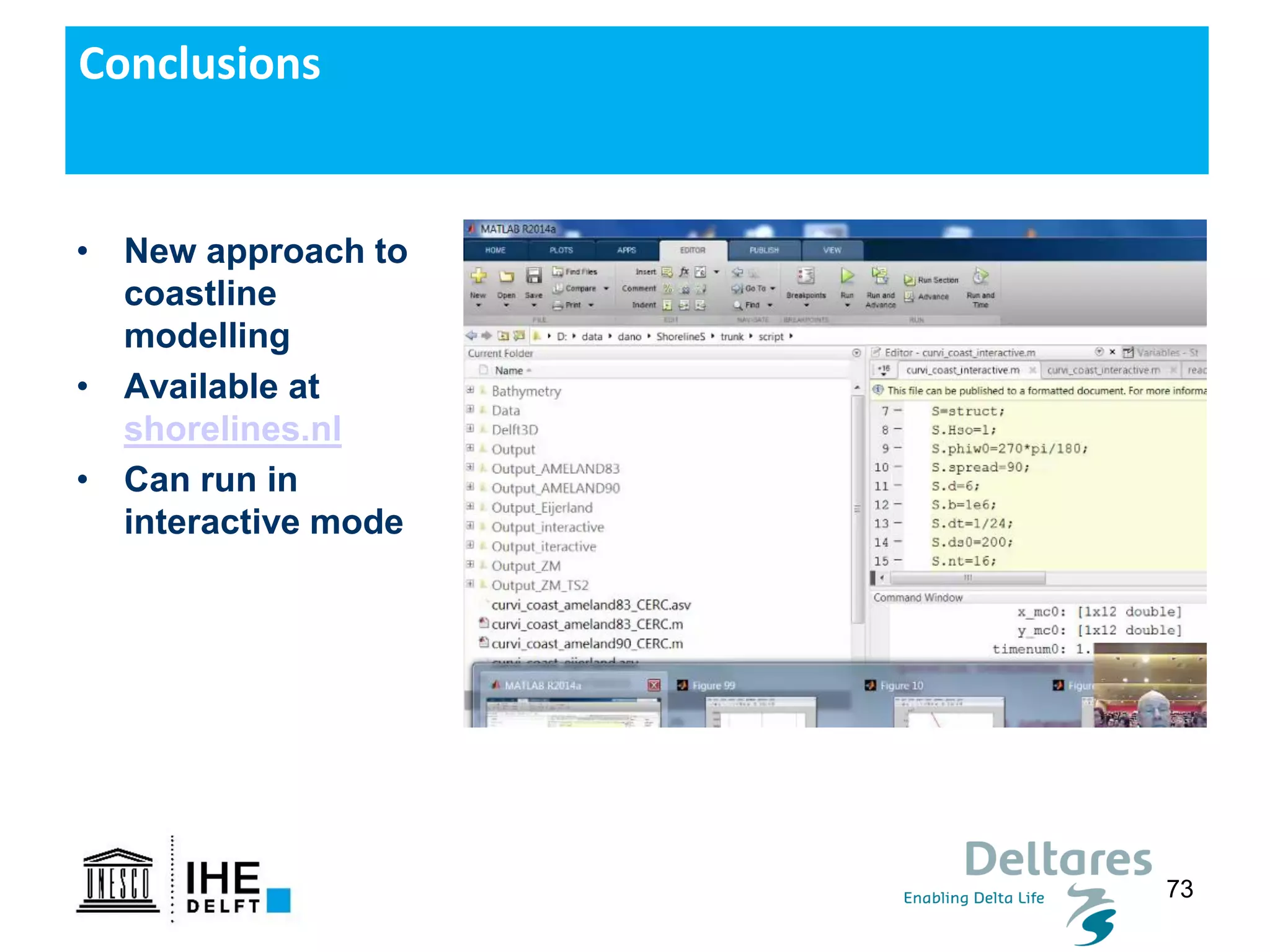
• New approach to
coastline
modelling
• Available at
shorelines.nl
• Can run in
interactive mode
Conclusions

DSD-INT 2019 ShorelineS and future coastline modelling - Roelvink

  • 1.
    1 Dano Roelvink IHE Delft& DELTARES, Netherlands ShorelineS and future coastline modelling Dano Roelvink1,2,3, Bas Huisman2,3 , Ahmed Elghandour1,4,5 , Johan Reyns1,3 and Mohamed Ghonim1 1IHE Delft Institute for Water Education, Delft, The Netherlands 2Deltares, Delft, The Netherlands 3Delft University of Technology, Delft, The Netherlands 4Department of Civil Engineering, Faculty of Engineering, Port Said University, Port Said, Egypt 5 CIMA, University of the Algarve, Faro, Portugal
  • 2.
    2 Motivation • In complexlarge-scale systems, resolving the surf zones is prohibitively expensive on longer timescales • Coastline modelling has long been a cheap alternative, but existing models have severe limitations. • Can we make a better, more flexible coastline model (and couple it with a 2DH tidal morphology model?)
  • 3.
    3 Existing model capabilities:‘standard’ models (UNIBEST LT/CL, Litpack, Genesis, CosMoS-COAST) • Capabilities: • Wave-driven longshore transport gradients • Sand mining and sediment delivery by rivers • Cross-shore transport contributions • Headlands and structures • Wide appication in engineering studies • Limitations: • Only relatively small changes relative to reference coastline possible • No fun processes like spits, islands, migrating inlets, barrier rollover
  • 4.
    4 Szmytkiewicz et al,Coastal Engineering 2000 Intercomparison of coastline models
  • 5.
    5 Vitousek et al,JGR-ESP 2017 coastline model of southern California
  • 6.
    6 Existing models: Ashton,Murray & Arnault (2001) and offspring • Mixture of grid and coastline • Simple transport formulas • Powerful in describing many types of features • High-angle instability important mechanism
  • 7.
    7 Pros and cons •Standard models: • much experience in engineering • too inflexible • not enough processes represented • CEM and similar models • beautiful processes represented in elegant way • relatively complex logic and structure • only used for schematic system studies • New, flexible engineering model needed
  • 8.
    8 Approach • Classical coastlinemodel approach: fixed reference line Example: IJmuiden
  • 9.
    9 New approach s n Qs,i-1 Qs,i xi,yi • Coastlineis like a ‘string’ of points • Flexible due to regular regridding 1 1 tan s i c c n Q c RSLR q t D s D   = − − +   
  • 10.
    10 • n isthe cross-shore coordinate • s the longshore coordinate • Dc the active profile height • c a coefficient • the profile slope • RSLR the relative sea level rise • qi source/sink terms (m3/m/yr) due to cross-shore transport, overwashing, nourishments, sand mining and exchanges with rivers and tidal inlets New approach 1 1 tan s i c c n Q c RSLR q t D s D   = − − +    tan𝛽
  • 11.
  • 12.
    12 • Simple transport formulas •Based on deep water wave conditions or conditions at breaker line • Similar behaviour as function of deep water wave angle Transport formulations Author Notation Formula USACE, 1984 (simplified) CERC1 5/2 0 sin 2( )s S locQ bH = Ashton & Murray, 2006 CERC2 12 1 6 5 5 5 2 0 cos ( )sin( )s S loc locQ K H T  = USACE, 1984 CERC3 5/2 1 sin2( )s sb locbQ b H = Kamphuis, 1992 KAMP 2 1.5 0.75 0.25 0.6 502.33 sin (2 )s sb b locbQ H T m D − = Where: b : calibration coefficient CERC1 1 / , ~ 0.1 0.2 16( )(1 )s k g k b k p    = − − − ( ) sin( ) arctan 2 cos( ) j j c w loc i c w i       − =   −  1 5 2 1( ) 2 g K K   = , 1/2 1 0.4 /K m s 0sH : offshore significant wave height sbH : significant breaking wave height T : peak wave period 50D : median grain diameter [m] bm : mean bed slope (beach slope in the breaking zone) b : breaking wave angle Author Notation Formula USACE, 1984 (simplified) CERC1 5/2 0 sin 2( )s S locQ bH = Ashton & Murray, 2006 CERC2 12 1 6 5 5 5 2 0 cos ( )sin( )s S loc locQ K H T  = USACE, 1984 CERC3 5/2 1 sin2( )s sb locbQ b H = Kamphuis, 1992 KAMP 2 1.5 0.75 0.25 0.6 502.33 sin (2 )s sb b locbQ H T m D − = Where: b : calibration coefficient CERC1 1 / , ~ 0.1 0.2 16( )(1 ) k g k b k p    = − − − Transport is a function of wave height and wave direction Maximum at around 45o relative to coast
  • 13.
    13 Representation of coastlineand structures • Coastline is represented as an arbitrary number of free-form polylines that can be open or closed (islands) 0 2000 4000 6000 8000 10000 0 1000 2000 3000 4000 5000 6000 7000 8000 9000 10000 Easting [m] Northing[m] Add coastline (LMB); Next segment (RMB); Exit (q) 0 2000 4000 6000 8000 10000 0 1000 2000 3000 4000 5000 6000 7000 8000 9000 10000 Easting [m] Northing[m] Add structure (LMB); Next structure (RMB); Exit (q)
  • 14.
    14 Wave shadowing • Wavescan be shielded • by other parts of the same or other coast sections or • by structures, also represented by polylines • Sediment transport along the coastlines is driven by a CERC- like transport formula (based on deep water conditions) -4000 -2000 0 2000 4000 6000 8000 0 2000 4000 6000 8000 10000 0 1000 2000 3000 4000 5000 6000 7000 8000 9000 0 1000 2000 3000 4000 5000 6000 7000
  • 15.
  • 16.
    16 • Central schemebecomes unstable when angle >45º • Upwind scheme creates propagating front as in spit Upwind correction Central scheme Upwind scheme
  • 17.
    17 Other features • Coastlinechanges are computed based on the transport gradients, with modifications to deal with high-angle instabilities. • Regridding takes place continuously to allow the growing of spits and other forms.
  • 18.
    18 Overwashing, merging, splittingup • A set of routines is called every time step to check whether overwashing takes place, spits get too narrow and break up, or sections merge.
  • 19.
    19 • No spreading •Spreading 90o • Spreading 180o Island merging tests 0 yr 1 yr 2 yr 4 yr3 yr 5 yr 6 yr
  • 20.
    20 Van Rijn’s bestiaryof coastal forms
  • 21.
  • 22.
  • 23.
    23 Sand Motor modelledwith ShorelineS
  • 24.
  • 25.
  • 26.
    26 St Louis, Senegal •Small breach to reduce lagoon water levels in 2003 • Grew to 5 km width
  • 27.
    27 • Coastlines extractedfrom LANDSAT imagery • Long period of southward migration • Until artificial opening in 2003 • Schematized wave climate • Mean direction 310 deg N • Hs = 1.4 m • Spreading +/- 30 deg • Simplest CERC formula • Calibration factor adjusted in calibration • Problem: inlet closes Calibration 1984-2003
  • 28.
    28 • Two options: •Implement two-way coupling with a 2DH morphological model that describes the effect of river flow and tide • Moving coastline modifies the 2D bathymetry • Erosion/sedimentation near the coast affects the coastline • Implement a heuristic model that • Maintains width of the channel (could be function of discharge or tidal prism) • Pushes back when the coastline moves the channel centre line • Distributes the retreat of the narrowest parts towards neighbouring points Simulating inlet/river mouth behaviour Let’s try this first
  • 29.
    29 Interaction with rivermouth/inlet Green line: original coast line; red line : rough input sketch of river axis ; blue line : automatically refined and moved to exact center line ; black line : adjusted coastlines based on an equilibrium width of 500 m and adjustment factor of 0.1.
  • 30.
  • 31.
  • 32.
  • 33.
  • 34.
  • 35.
  • 36.
  • 37.
  • 38.
  • 39.
  • 40.
  • 41.
  • 42.
  • 43.
  • 44.
    44 Spit locations andwidth of opening
  • 45.
    45 St Louis validation2003-2018 • After artificial breaching • Initial losses to new flood delta mimicked in heuristic flood_delta function • Explains the initial stalling of the migration of the northern spit
  • 46.
  • 47.
  • 48.
  • 49.
  • 50.
  • 51.
  • 52.
  • 53.
  • 54.
  • 55.
  • 56.
  • 57.
  • 58.
  • 59.
  • 60.
  • 61.
  • 62.
  • 63.
    63 • Presence oflarge-scale features (headlands, shoals, canyons) can significantly affect shoreline orientation. • ShorelineS can use a ‘lookup table’ of nearshore wave conditions defined on a 2D grid • This can be generated by an offline model such as SWAn or with an inline wave propagation model • Example: coastline near Port Bouet, Ivory Coast, which is influenced by the Trou Sans Fond canyon Effect of large-scale refraction
  • 64.
  • 65.
    65 Port Bouet, IvoryCoast x coordinate (km)→ ycoordinate(km)→ bed level (m) 00-Jan-0000 00:07:10 375 380 385 390 395 400 405 560 565 570 575 580 585 -600 -400 -200 0 200 400 600 x coordinate (km)→ ycoordinate(km)→ bed level (m) 00-Jan-0000 00:03:10 375 380 385 390 395 400 405 560 565 570 575 580 585 120 140 160 180 200 220 240 260
  • 66.
    66 Effect of large-scalerefraction on coastline evolution With refraction Without refraction
  • 67.
    67 Lobitho Spit, Angola MScCasper Mudde No large-scale refraction With large-scale refraction
  • 68.
    68 Improved modelling ofgroyne bypassing MSc Mohamed Ghonim • Accurate positioning of groynes • Partial bypassing and transmission
  • 69.
    69 Field test: AlGamil beach, Egypt Shoreline 2011 Shoreline 2013 Shoreline 2015 Shoreline 2017 Shoreline 2018 1 2 3 4 5 6 7 8 9 10 11 12 13 14 100 m 300m200 m0 m
  • 70.
    70 Conclusions ShorelineS • Funnew model • Prototype for next generation coastline model for engineering purposes • Is available in open source Matlab code • Great for explaining coastal processes • Easy to add more processes • Needs very little input that is readily available: • Initial coastline • Rocky parts or structures • Wave climate
  • 71.
    71 • Coupling withdune foot (Mohamed) • Barrier overwashing and rollover (Ahmed) • Tidal inlet migration (Dano, Ahmed) • Wave diffraction (Ahmed) • Large-scale wave refraction (Bas, Casper, Dano) • Ensemble Kalman Filter (Shadrack, Johan, Sean) • Case studies in Portugal, Alaska, Senegal, Angola, NL Current research
  • 72.
    72 • What wouldyou like to add • What cases could you bring • What could be the ambition • How would you like to use it • … Over to you…
  • 73.
    73 • New approachto coastline modelling • Available at shorelines.nl • Can run in interactive mode Conclusions