To Share or not to Share?  Dryad Workshop 27 April 2010
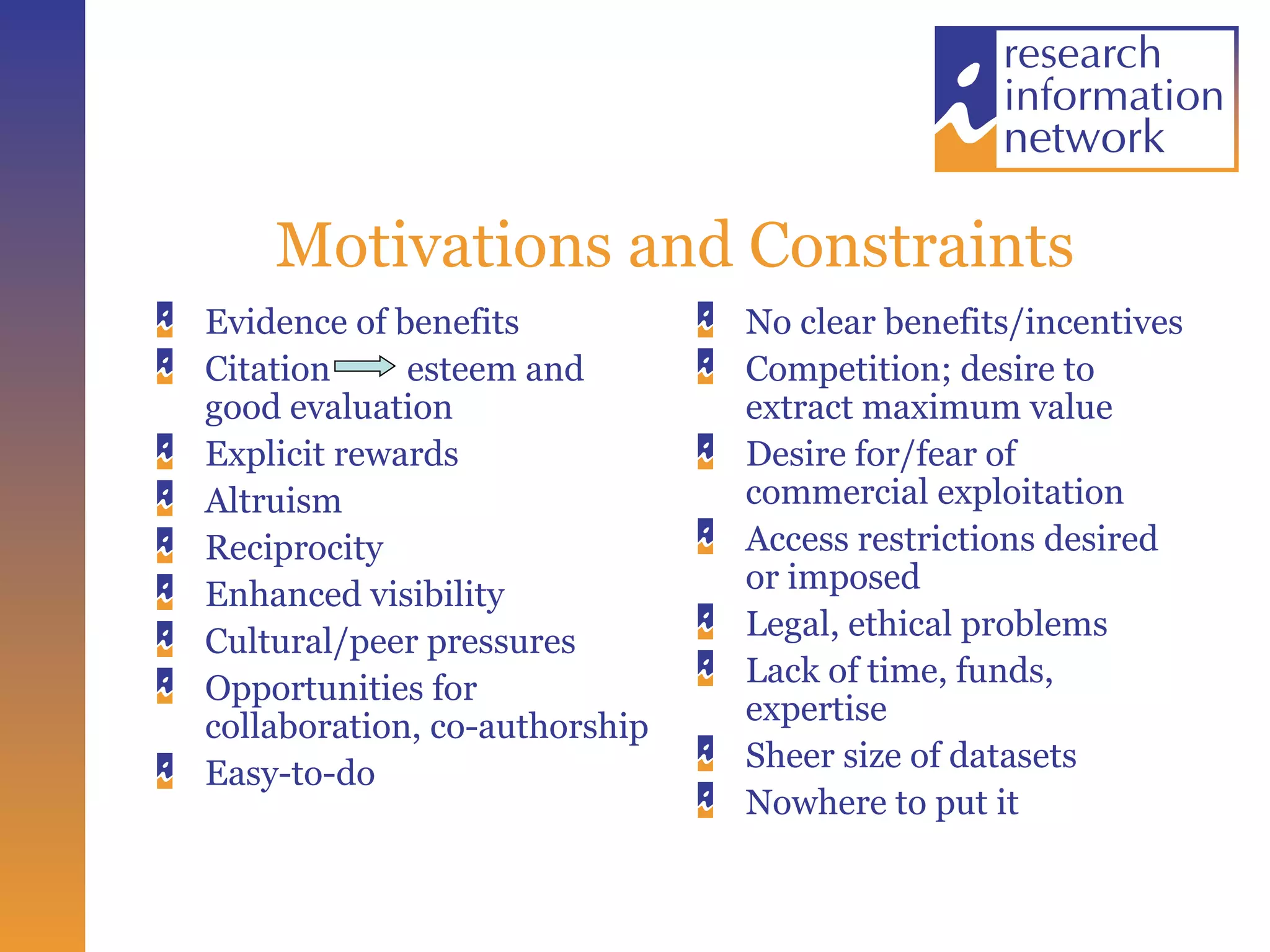
Motivations and Constraints Evidence of benefits Citation  esteem and good evaluation Explicit rewards  Altruism Reciprocity Enhanced visibility Cultural/peer pressures Opportunities for collaboration, co-authorship Easy-to-do No clear benefits/incentives Competition; desire to extract maximum value Desire for/fear of commercial exploitation  Access restrictions desired or imposed  Legal, ethical problems Lack of time, funds, expertise  Sheer size of datasets Nowhere to put it
More constraints large-scale collaborative projects and teams not the norm confusions over terminology data, datasets, databases, digital objects, information creation, collection/gathering of data  not  usually the primary objective of research career rewards don’t come from sharing data resistance to open sharing of ‘intellectual capital’
Ownership, protection and trust responsibility, protectiveness and desire for control over data concerns about inappropriate use  preference for co-operative arrangements and direct contact with potential users decisions on when and how to share commercial, ethical, legal issues lack of trust in other researchers’ data “ i don’t know if they have done it to the same standards i would have done it” lack of standardisation intricacies of experimental design and processes
Curation and sharing little sign that data management or curation yet adopted as standard practice  except in areas such as astronomy, bioinformatics, genomics etc other kinds of information more readily shared software, code, tools, protocols etc  challenges for service providers in meeting diverse needs of wide range of research groups disciplinary and subject differences subject knowledge local, national and international  relationships and engagement between researchers and information specialists
Take-home messages different kinds of data, different values attached to them, different user needs the sustainability challenge: co-operation needed between researchers, funders, institutions  scope for publishers to promote access and need for clarity on text mining and monitoring of Web 2.0 need for incentives for researchers: support and reward for good practice benefits and evidence of value scholarly record re-use and aggregation

To share or not to share?

  • 1.
    To Share ornot to Share? Dryad Workshop 27 April 2010
  • 2.
    Motivations and ConstraintsEvidence of benefits Citation esteem and good evaluation Explicit rewards Altruism Reciprocity Enhanced visibility Cultural/peer pressures Opportunities for collaboration, co-authorship Easy-to-do No clear benefits/incentives Competition; desire to extract maximum value Desire for/fear of commercial exploitation Access restrictions desired or imposed Legal, ethical problems Lack of time, funds, expertise Sheer size of datasets Nowhere to put it
  • 3.
    More constraints large-scalecollaborative projects and teams not the norm confusions over terminology data, datasets, databases, digital objects, information creation, collection/gathering of data not usually the primary objective of research career rewards don’t come from sharing data resistance to open sharing of ‘intellectual capital’
  • 4.
    Ownership, protection andtrust responsibility, protectiveness and desire for control over data concerns about inappropriate use preference for co-operative arrangements and direct contact with potential users decisions on when and how to share commercial, ethical, legal issues lack of trust in other researchers’ data “ i don’t know if they have done it to the same standards i would have done it” lack of standardisation intricacies of experimental design and processes
  • 5.
    Curation and sharinglittle sign that data management or curation yet adopted as standard practice except in areas such as astronomy, bioinformatics, genomics etc other kinds of information more readily shared software, code, tools, protocols etc challenges for service providers in meeting diverse needs of wide range of research groups disciplinary and subject differences subject knowledge local, national and international relationships and engagement between researchers and information specialists
  • 6.
    Take-home messages differentkinds of data, different values attached to them, different user needs the sustainability challenge: co-operation needed between researchers, funders, institutions scope for publishers to promote access and need for clarity on text mining and monitoring of Web 2.0 need for incentives for researchers: support and reward for good practice benefits and evidence of value scholarly record re-use and aggregation