The DAF methodology: addressing institutional data management Sarah Jones Digital Curation Centre [email_address] Funded by: This work is licensed under the Creative Commons Attribution-NonCommercial-ShareAlike 2.5 UK: Scotland License. To view a copy of this license, visit  http://creativecommons.org/licenses/by-nc-sa/2.5/scotland/  ; or, (b) send a letter to Creative Commons, 543 Howard Street, 5th Floor, San Francisco, California, 94105, USA.
Outline Background to DCC What is DAF? Using DAF Case studies
What is the DCC? JISC funded centre specialising in data management and curation  Develop tools DAF, DMP Online, CARDIO Offer guidance Helpdesk, briefing papers, how-to guides Run advocacy and training events data management roadshow, DC101, IDCC Support the JISC MRD programmes www.dcc.ac.uk
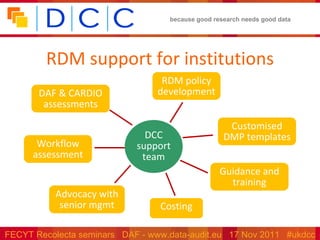
RDM support for institutions RDM policy development Customised DMP templates DAF & CARDIO assessments Guidance and training Workflow assessment DCC support team Advocacy with senior mgmt Costing
Outline Background to DCC What is DAF? Using DAF Case studies
What is DAF? A methodology to investigate / assess research data management Created in a 6-month JISC project in 2008 The name has changed!
What is the problem? Do you know: what research data you hold? where those data are located? how they are being stored / backed up? which data need to be kept? who can access & use the data? If not, how can you manage your data?
It started with a recommendation “ JISC should develop a Data Audit Framework to enable all universities and colleges to carry out an audit of departmental data collections, awareness, policies and practice for data curation and preservation” Liz Lyon, Dealing with Data: Roles, Rights,  Responsibilities and Relationships, (2007) www.jisc.ac.uk/publications/reports/2007/dealingwithdatareportfinal.aspx
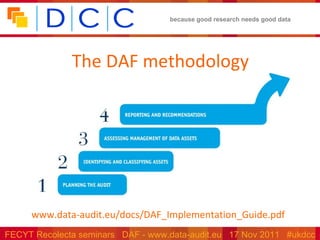
The DAF methodology www.data-audit.eu/docs/DAF_Implementation_Guide.pdf
Testing the method: pilot projects University of Edinburgh physiology, divinity, history, brain imaging, astronomy King’s College London humanities, social science, physical science, engineering, medical Imperial College London Chemical engineering, physics & business school University College London Scandanavian studies, archaeology, physics/astronomy, language and communication, phonetic sciences, interdisciplinary www.data-audit.eu/users.html
What we found Lots of data being created Few policies for data creation, storage & management Researchers unsure where to begin Unaware of available support Often no place of deposit or funds for preservation International Journal of Digital Curation http://www.ijdc.net/ijdc/article/view/91/109
Key conclusion for using DAF Most unis are in the very early stages Infrastructure is lacking    emphasis on scoping needs
Subsequent usage DataShare project – Oxford and Southampton  www.disc-uk.org/docs/DAF-Oxford.pdf   www.disc-uk.org/docs/SouthamptonDAF.pdf   University of Oregon   www.ariadne.ac.uk/issue64/westra/    University of Northampton http://nectar.northampton.ac.uk/2736/   Various JISC MRD projects… www.jisc.ac.uk/whatwedo/programmes/mrd.aspx
Outline Background to DCC What is DAF? Using DAF Case studies
How to gather information? Desk-research policies / guidelines, available services, websites Questionnaires Interviews Focus groups Shadowing / observational approach
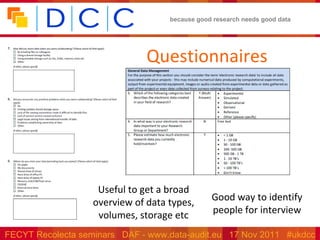
Questionnaires Good way to identify people for interview Useful to get a broad overview of data types, volumes, storage etc
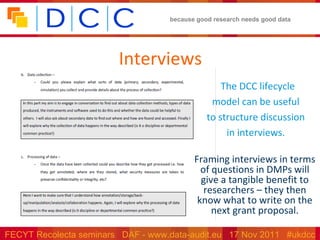
Interviews Framing interviews in terms of questions in DMPs will give a tangible benefit to researchers – they then know what to write on the next grant proposal. = The DCC lifecycle model can be useful to structure discussion in interviews.
Who to speak to? PhD students / Research Assistants Principal Investigators (lead researchers) Local IT / research support Administrators Service staff
Implementation tips Scope the audit carefully  Timing needs to be appropriate  Find an advocate in the department The process is valuable in itself Lessons learned:  www.data-audit.eu/docs/DAF_lessons_learned.pdf
Useful reading DAF implementation guide www.data-audit.eu/docs/DAF_Implementation_Guide.pdf DAFD lessons learned www.data-audit.eu/docs/ DAF_lessons_learned.pdf Jones, Sarah, Ball, Alex & Ekmekcioglu, Çuna, The Data Audit Framework: a first step in the data management challenge  www.ijdc.net/ijdc/article/view/91/109 DAF website -  www.data-audit.eu
Outline Background to DCC What is DAF? Using DAF Case studies
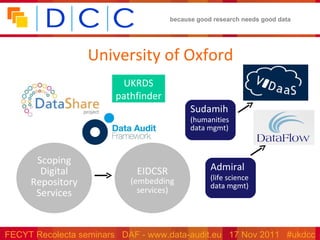
University of Oxford Scoping Digital Repository Services EIDCSR (embedding services) Sudamih (humanities data mgmt) Admiral (life science data mgmt) UKRDS pathfinder
DAF at Oxford Briefly explain your area of research / types of research questions Discuss research tasks that involve data management at: Funding application e.g. planning data creation / management Data collection e.g. data types, standards, methods Processing of data e.g. annotation, storage, security Publishing e.g. plans, data sharing, deposit Support at local / institutional level for this management of data Challenges when managing data / service requirements Final questions / de-brief Report at:  http://www.disc-uk.org/docs/DAF-Oxford.pdf
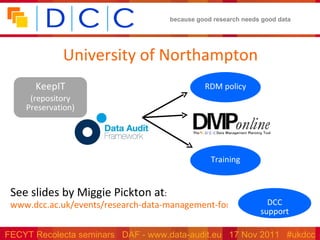
University of Northampton KeepIT (repository Preservation) See slides by Miggie Pickton at : www.dcc.ac.uk/events/research-data-management-forum/rdmf7-incentivising-data-management-sharing   RDM policy DCC support Training
DAF at Northampton Data collection in  three stages initial interviews with research leaders in each School online survey of researchers one-to-one interviews with researchers Topics covered: types, sizes and formats of research data data ownership storage security  sharing and access (short and long term) funders’ requirements
Recommendations Draft & approve a Research Data Policy Clarify the Uni position on data ownership Promote training sessions and guides to RDM Assist researchers with preservation planning Disseminate findings, guidance and new policy Report:  http://nectar.northampton.ac.uk/2736/
Thanks Any questions?

DAF methodology

  • 1.
    The DAF methodology:addressing institutional data management Sarah Jones Digital Curation Centre [email_address] Funded by: This work is licensed under the Creative Commons Attribution-NonCommercial-ShareAlike 2.5 UK: Scotland License. To view a copy of this license, visit http://creativecommons.org/licenses/by-nc-sa/2.5/scotland/ ; or, (b) send a letter to Creative Commons, 543 Howard Street, 5th Floor, San Francisco, California, 94105, USA.
  • 2.
    Outline Background toDCC What is DAF? Using DAF Case studies
  • 3.
    What is theDCC? JISC funded centre specialising in data management and curation Develop tools DAF, DMP Online, CARDIO Offer guidance Helpdesk, briefing papers, how-to guides Run advocacy and training events data management roadshow, DC101, IDCC Support the JISC MRD programmes www.dcc.ac.uk
  • 4.
    RDM support forinstitutions RDM policy development Customised DMP templates DAF & CARDIO assessments Guidance and training Workflow assessment DCC support team Advocacy with senior mgmt Costing
  • 5.
    Outline Background toDCC What is DAF? Using DAF Case studies
  • 6.
    What is DAF?A methodology to investigate / assess research data management Created in a 6-month JISC project in 2008 The name has changed!
  • 7.
    What is theproblem? Do you know: what research data you hold? where those data are located? how they are being stored / backed up? which data need to be kept? who can access & use the data? If not, how can you manage your data?
  • 8.
    It started witha recommendation “ JISC should develop a Data Audit Framework to enable all universities and colleges to carry out an audit of departmental data collections, awareness, policies and practice for data curation and preservation” Liz Lyon, Dealing with Data: Roles, Rights, Responsibilities and Relationships, (2007) www.jisc.ac.uk/publications/reports/2007/dealingwithdatareportfinal.aspx
  • 9.
    The DAF methodologywww.data-audit.eu/docs/DAF_Implementation_Guide.pdf
  • 10.
    Testing the method:pilot projects University of Edinburgh physiology, divinity, history, brain imaging, astronomy King’s College London humanities, social science, physical science, engineering, medical Imperial College London Chemical engineering, physics & business school University College London Scandanavian studies, archaeology, physics/astronomy, language and communication, phonetic sciences, interdisciplinary www.data-audit.eu/users.html
  • 11.
    What we foundLots of data being created Few policies for data creation, storage & management Researchers unsure where to begin Unaware of available support Often no place of deposit or funds for preservation International Journal of Digital Curation http://www.ijdc.net/ijdc/article/view/91/109
  • 12.
    Key conclusion forusing DAF Most unis are in the very early stages Infrastructure is lacking  emphasis on scoping needs
  • 13.
    Subsequent usage DataShareproject – Oxford and Southampton www.disc-uk.org/docs/DAF-Oxford.pdf www.disc-uk.org/docs/SouthamptonDAF.pdf University of Oregon www.ariadne.ac.uk/issue64/westra/ University of Northampton http://nectar.northampton.ac.uk/2736/ Various JISC MRD projects… www.jisc.ac.uk/whatwedo/programmes/mrd.aspx
  • 14.
    Outline Background toDCC What is DAF? Using DAF Case studies
  • 15.
    How to gatherinformation? Desk-research policies / guidelines, available services, websites Questionnaires Interviews Focus groups Shadowing / observational approach
  • 16.
    Questionnaires Good wayto identify people for interview Useful to get a broad overview of data types, volumes, storage etc
  • 17.
    Interviews Framing interviewsin terms of questions in DMPs will give a tangible benefit to researchers – they then know what to write on the next grant proposal. = The DCC lifecycle model can be useful to structure discussion in interviews.
  • 18.
    Who to speakto? PhD students / Research Assistants Principal Investigators (lead researchers) Local IT / research support Administrators Service staff
  • 19.
    Implementation tips Scopethe audit carefully Timing needs to be appropriate Find an advocate in the department The process is valuable in itself Lessons learned: www.data-audit.eu/docs/DAF_lessons_learned.pdf
  • 20.
    Useful reading DAFimplementation guide www.data-audit.eu/docs/DAF_Implementation_Guide.pdf DAFD lessons learned www.data-audit.eu/docs/ DAF_lessons_learned.pdf Jones, Sarah, Ball, Alex & Ekmekcioglu, Çuna, The Data Audit Framework: a first step in the data management challenge www.ijdc.net/ijdc/article/view/91/109 DAF website - www.data-audit.eu
  • 21.
    Outline Background toDCC What is DAF? Using DAF Case studies
  • 22.
    University of OxfordScoping Digital Repository Services EIDCSR (embedding services) Sudamih (humanities data mgmt) Admiral (life science data mgmt) UKRDS pathfinder
  • 23.
    DAF at OxfordBriefly explain your area of research / types of research questions Discuss research tasks that involve data management at: Funding application e.g. planning data creation / management Data collection e.g. data types, standards, methods Processing of data e.g. annotation, storage, security Publishing e.g. plans, data sharing, deposit Support at local / institutional level for this management of data Challenges when managing data / service requirements Final questions / de-brief Report at: http://www.disc-uk.org/docs/DAF-Oxford.pdf
  • 24.
    University of NorthamptonKeepIT (repository Preservation) See slides by Miggie Pickton at : www.dcc.ac.uk/events/research-data-management-forum/rdmf7-incentivising-data-management-sharing RDM policy DCC support Training
  • 25.
    DAF at NorthamptonData collection in three stages initial interviews with research leaders in each School online survey of researchers one-to-one interviews with researchers Topics covered: types, sizes and formats of research data data ownership storage security sharing and access (short and long term) funders’ requirements
  • 26.
    Recommendations Draft &approve a Research Data Policy Clarify the Uni position on data ownership Promote training sessions and guides to RDM Assist researchers with preservation planning Disseminate findings, guidance and new policy Report: http://nectar.northampton.ac.uk/2736/
  • 27.