Basmati Rice: Past, Present & 
Future 
1 
V.P. Singh 
Director-(Crop & Research)
The All India Rice Exporters Association 
(AIREA) 
• The All India Rice Exporters Association (AIREA) is the Apex body 
of Indian Rice Exporters in India. Established in 1989, AIREA is 
recognized by the Government of India and works closely with 
the Ministry of Commerce, Ministry of Agriculture and 
Agricultural and Processed Food Products Export Development 
Authority (APEDA). 
• We have over 130 accredited members who together account for 
90% of India's rice exports. In 2013-14, India exported 10.5 
Million tonnes worth over Rs 42,669 Crore ($ 6.6 Billion) and 
retained its leading position in the world rice market. 
• Although AIREA’s mandate is to represent the Indian rice industry, 
we have over the years made a conscious effort to bridge the gap 
between farmers, science and industry – and have adopted the 
motto “Dhan, Kisan, Vigyaan aur Udyog”. 2
INTERFACE MEETING OF ICAR, APEDA 
AND AIREA 
• AIREA has organized an interactive meeting with IARI, APEDA and AIREA 
on 23rd April, 2012 at IARI, Pusa. Some salient information of the meeting 
are:- 
• Pusa Basmati 1509 is a modified version of Pusa Basmati 1121. It matures 
25 days earlier permitting it to be sown late will require less irrigation. It 
will be released as a notified Basmati variety. 
• The Rice Breeding Section is working on introducing disease, insect and 
salinity resistance in both Pusa basmati 1121 and Pusa Basmati 1509. 
These resistant Pusa Basmati varieties will reduce use of pesticides, 
therefore reduce residue problem. 
• The Director of IARI stated that all measures will be taken to see that there 
is no GMO research on Basmati. Also no testing of any GMO will be done 
in Basmati growing area. 
• Exporters were requested to keep the interests of farmers also in mind. If 
farmers do not get a good price, they may stop cultivating Basmati.
WORLD RICE TRADE 
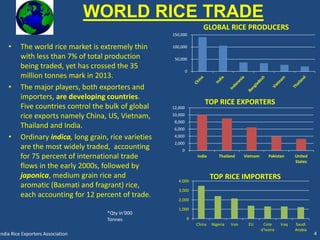
• The world rice market is extremely thin 
with less than 7% of total production 
being traded, yet has crossed the 35 
million tonnes mark in 2013. 
• The major players, both exporters and 
importers, are developing countries. 
Five countries control the bulk of global 
rice exports namely China, US, Vietnam, 
Thailand and India. 
• Ordinary indica, long grain, rice varieties 
are the most widely traded, accounting 
for 75 percent of international trade 
flows in the early 2000s, followed by 
japonica, medium grain rice and 
aromatic (Basmati and fragrant) rice, 
each accounting for 12 percent of trade. 
150,000 
100,000 
50,000 
0 
GLOBAL RICE PRODUCERS 
12,000 
10,000 
8,000 
6,000 
4,000 
2,000 
0 
TOP RICE EXPORTERS 
India Thailand Vietnam Pakistan United 
States 
4,000 
3,000 
2,000 
1,000 
0 
TOP RICE IMPORTERS 
China Nigeria Iran EU Cote 
d'Ivoire 
Iraq Saudi 
Arabia 
*Qty in‘000 
Tonnes 
India Rice Exporters Association 4
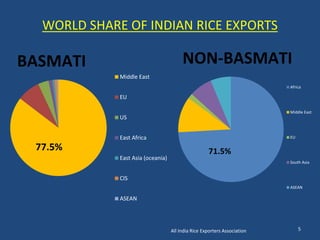
WORLD SHARE OF INDIAN RICE EXPORTS 
NON-BASMATI 
All India Rice Exporters Association 5 
Middle East 
EU 
US 
East Africa 
East Asia (oceania) 
CIS 
ASEAN 
BASMATI 
77.5% 
Africa 
Middle East 
EU 
South Asia 
ASEAN 
71.5%
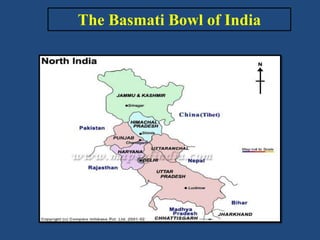
The Basmati Bowl of India
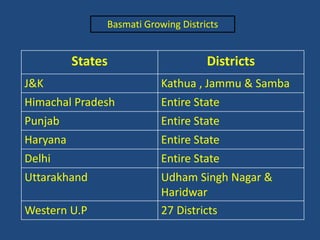
Basmati Growing Districts 
States Districts 
J&K Kathua , Jammu & Samba 
Himachal Pradesh Entire State 
Punjab Entire State 
Haryana Entire State 
Delhi Entire State 
Uttarakhand Udham Singh Nagar & 
Haridwar 
Western U.P 27 Districts
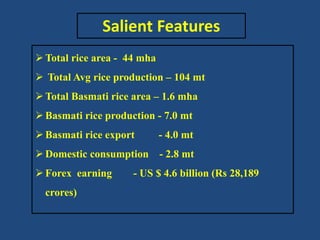
Total rice area - 44 mha 
 Total Avg rice production – 104 mt 
Total Basmati rice area – 1.6 mha 
 Basmati rice production - 7.0 mt 
 Basmati rice export - 4.0 mt 
 Domestic consumption - 2.8 mt 
 Forex earning - US $ 4.6 billion (Rs 28,189 
crores) 
Salient Features
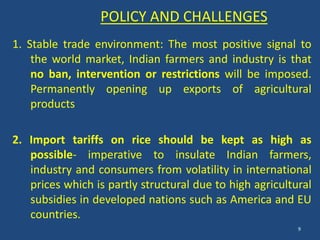
1. Stable trade environment: The most positive signal to 
the world market, Indian farmers and industry is that 
no ban, intervention or restrictions will be imposed. 
Permanently opening up exports of agricultural 
products 
2. Import tariffs on rice should be kept as high as 
possible- imperative to insulate Indian farmers, 
industry and consumers from volatility in international 
prices which is partly structural due to high agricultural 
subsidies in developed nations such as America and EU 
countries. 
9 
POLICY AND CHALLENGES
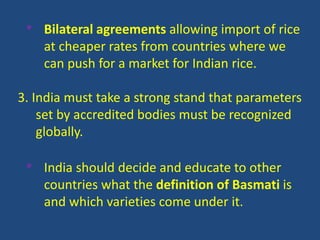
• Bilateral agreements allowing import of rice 
at cheaper rates from countries where we 
can push for a market for Indian rice. 
3. India must take a strong stand that parameters 
set by accredited bodies must be recognized 
globally. 
• India should decide and educate to other 
countries what the definition of Basmati is 
and which varieties come under it.
All India Rice Exporters Association 
11 
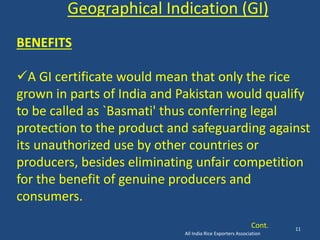
Geographical Indication (GI) 
BENEFITS 
A GI certificate would mean that only the rice 
grown in parts of India and Pakistan would qualify 
to be called as `Basmati' thus conferring legal 
protection to the product and safeguarding against 
its unauthorized use by other countries or 
producers, besides eliminating unfair competition 
for the benefit of genuine producers and 
consumers. 
Cont.
International markets seek special, exotic Indian 
goods and these fetch premium prices. 
Basmati being a premium Indian product, legal 
protection will boost Basmati exports. 
Would do wonders for marketing & branding 
which is key to Basmati market expansion 
Will promote economic prosperity of Basmati 
farmers, millers, traders & exporters.
WITHOUT GI FOR BASMATI… 
Promote theft of Indian biodiversity, 
intellectual, scientific and cultural heritage. 
Most unfair to Indian farmers who have 
cultivated Basmati for centuries. 
Authentic Basmati from India will stop 
fetching premium prices that it currently 
enjoys
Indian exporters will be vulnerable to losing their 
market. Eg RiceTec patent issue. Other countries will be 
free to develop varieties of Basmati which will not be 
true Basmati as they are being bred under different 
agro-climatic conditions. Economic cost of such rice 
could be cheaper in other parts of the world and India 
will not be able to compete. 
Others will randomly use “Basmati” for any fragrant 
rice grown outside the GI zone. 
Global consumers will be cheated as authentic 
Basmati is only grown in the GI zone
STATE 
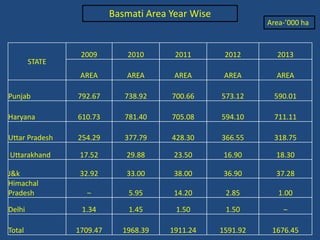
Basmati Area Year Wise 
Area-’000 ha 
2009 2010 2011 2012 2013 
AREA AREA AREA AREA AREA 
Punjab 792.67 738.92 700.66 573.12 590.01 
Haryana 610.73 781.40 705.08 594.10 711.11 
Uttar Pradesh 254.29 377.79 428.30 366.55 318.75 
Uttarakhand 17.52 29.88 23.50 16.90 18.30 
J&k 32.92 33.00 38.00 36.90 37.28 
Himachal 
Pradesh ‒ 5.95 14.20 2.85 1.00 
Delhi 1.34 1.45 1.50 1.50 ‒ 
Total 1709.47 1968.39 1911.24 1591.92 1676.45
STATE 
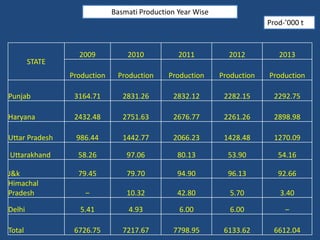
Basmati Production Year Wise 
Prod-’000 t 
2009 2010 2011 2012 2013 
Production Production Production Production Production 
Punjab 3164.71 2831.26 2832.12 2282.15 2292.75 
Haryana 2432.48 2751.63 2676.77 2261.26 2898.98 
Uttar Pradesh 986.44 1442.77 2066.23 1428.48 1270.09 
Uttarakhand 58.26 97.06 80.13 53.90 54.16 
J&k 79.45 79.70 94.90 96.13 92.66 
Himachal 
Pradesh ‒ 10.32 42.80 5.70 3.40 
Delhi 5.41 4.93 6.00 6.00 ‒ 
Total 6726.75 7217.67 7798.95 6133.62 6612.04
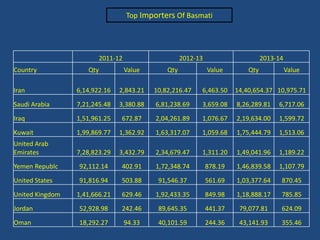
Top Importers Of Basmati 
2011-12 2012-13 2013-14 
Country Qty Value Qty Value Qty Value 
Iran 6,14,922.16 2,843.21 10,82,216.47 6,463.50 14,40,654.37 10,975.71 
Saudi Arabia 7,21,245.48 3,380.88 6,81,238.69 3,659.08 8,26,289.81 6,717.06 
Iraq 1,51,961.25 672.87 2,04,261.89 1,076.67 2,19,634.00 1,599.72 
Kuwait 1,99,869.77 1,362.92 1,63,317.07 1,059.68 1,75,444.79 1,513.06 
United Arab 
Emirates 7,28,823.29 3,432.79 2,34,679.47 1,311.20 1,49,041.96 1,189.22 
Yemen Republc 92,112.14 402.91 1,72,348.74 878.19 1,46,839.58 1,107.79 
United States 91,816.94 503.88 91,546.37 561.69 1,03,377.64 870.45 
United Kingdom 1,41,666.21 629.46 1,92,433.35 849.98 1,18,888.17 785.85 
Jordan 52,928.98 242.46 89,645.35 441.37 79,077.81 624.09 
Oman 18,292.27 94.33 40,101.59 244.36 43,141.93 355.46
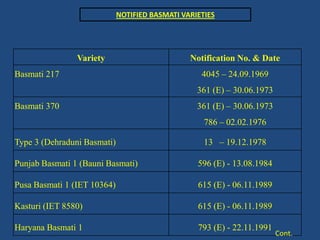
NOTIFIED BASMATI VARIETIES 
Variety Notification No. & Date 
Basmati 217 4045 – 24.09.1969 
361 (E) – 30.06.1973 
Basmati 370 361 (E) – 30.06.1973 
786 – 02.02.1976 
Type 3 (Dehraduni Basmati) 13 – 19.12.1978 
Punjab Basmati 1 (Bauni Basmati) 596 (E) - 13.08.1984 
Pusa Basmati 1 (IET 10364) 615 (E) - 06.11.1989 
Kasturi (IET 8580) 615 (E) - 06.11.1989 
Haryana Basmati 1 793 (E) - 22.11.1991 
Cont.
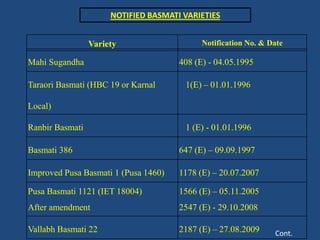
NOTIFIED BASMATI VARIETIES 
Variety Notification No. & Date 
Mahi Sugandha 408 (E) - 04.05.1995 
Taraori Basmati (HBC 19 or Karnal 
Local) 
1(E) – 01.01.1996 
Ranbir Basmati 1 (E) - 01.01.1996 
Basmati 386 647 (E) – 09.09.1997 
Improved Pusa Basmati 1 (Pusa 1460) 1178 (E) – 20.07.2007 
Pusa Basmati 1121 (IET 18004) 
After amendment 
1566 (E) – 05.11.2005 
2547 (E) - 29.10.2008 
Vallabh Basmati 22 2187 (E) – 27.08.2009 
Cont.
NOTIFIED BASMATI VARIETIES 
Variety Notification No. & Date 
Pusa Basmati 6 (Pusa 1401) (IET 
18005) 
733 (E) – 01.04.2010 
Punjab Basmati 2 1708 (E) – 26.07.2012 
Basmati CSR 30 
After amendment 
1134(E) – 25.11.2001 
2126 (E) – 10.09.2012 
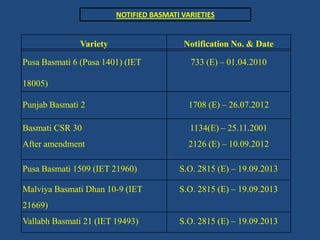
Pusa Basmati 1509 (IET 21960) S.O. 2815 (E) – 19.09.2013 
Malviya Basmati Dhan 10-9 (IET 
21669) 
S.O. 2815 (E) – 19.09.2013 
Vallabh Basmati 21 (IET 19493) S.O. 2815 (E) – 19.09.2013
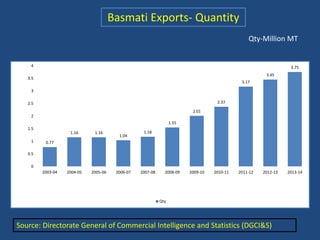
Basmati Exports- Quantity 
Qty-Million MT 
0.77 
1.16 1.16 
1.04 
1.18 
1.55 
2.01 
2.37 
3.17 
3.45 
3.75 
4 
3.5 
3 
2.5 
2 
1.5 
1 
0.5 
0 
2003-04 2004-05 2005-06 2006-07 2007-08 2008-09 2009-10 2010-11 2011-12 2012-13 2013-14 
Qty 
Source: Directorate General of Commercial Intelligence and Statistics (DGCI&S)
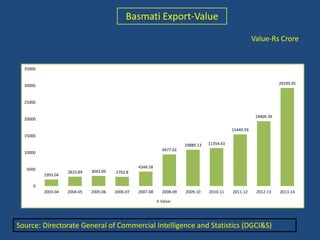
Basmati Export-Value 
Value-Rs Crore 
1993.04 
2823.89 3043.09 2792.8 
4344.58 
9477.02 
10889.13 11354.63 
15449.59 
19409.39 
29299.95 
35000 
30000 
25000 
20000 
15000 
10000 
5000 
0 
2003-04 2004-05 2005-06 2006-07 2007-08 2008-09 2009-10 2010-11 2011-12 2012-13 2013-14 
Value 
Source: Directorate General of Commercial Intelligence and Statistics (DGCI&S)
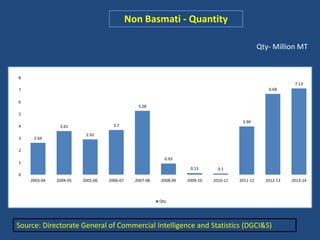
Non Basmati - Quantity 
Qty- Million MT 
2.64 
3.61 
2.92 
3.7 
5.28 
0.93 
0.13 0.1 
3.99 
6.68 
7.13 
8 
7 
6 
5 
4 
3 
2 
1 
0 
2003-04 2004-05 2005-06 2006-07 2007-08 2008-09 2009-10 2010-11 2011-12 2012-13 2013-14 
Qty 
Source: Directorate General of Commercial Intelligence and Statistics (DGCI&S)
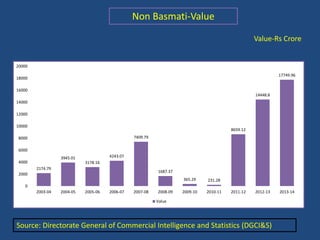
Non Basmati-Value 
Value-Rs Crore 
2174.79 
3945.01 
3178.16 
4243.07 
7409.79 
1687.37 
365.29 231.28 
8659.12 
14448.8 
17749.96 
20000 
18000 
16000 
14000 
12000 
10000 
8000 
6000 
4000 
2000 
0 
2003-04 2004-05 2005-06 2006-07 2007-08 2008-09 2009-10 2010-11 2011-12 2012-13 2013-14 
Value 
Source: Directorate General of Commercial Intelligence and Statistics (DGCI&S)
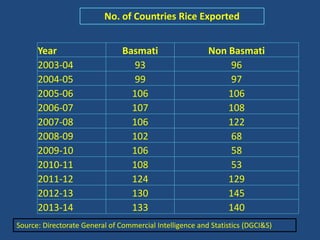
No. of Countries Rice Exported 
Year Basmati Non Basmati 
2003-04 93 96 
2004-05 99 97 
2005-06 106 106 
2006-07 107 108 
2007-08 106 122 
2008-09 102 68 
2009-10 106 58 
2010-11 108 53 
2011-12 124 129 
2012-13 130 145 
2013-14 133 140 
Source: Directorate General of Commercial Intelligence and Statistics (DGCI&S)
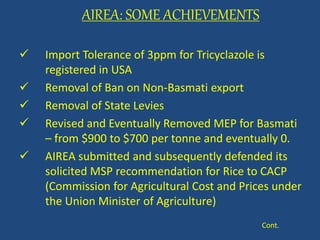
AIREA: SOME ACHIEVEMENTS 
 Import Tolerance of 3ppm for Tricyclazole is 
registered in USA 
 Removal of Ban on Non-Basmati export 
 Removal of State Levies 
 Revised and Eventually Removed MEP for Basmati 
– from $900 to $700 per tonne and eventually 0. 
 AIREA submitted and subsequently defended its 
solicited MSP recommendation for Rice to CACP 
(Commission for Agricultural Cost and Prices under 
the Union Minister of Agriculture) 
Cont.
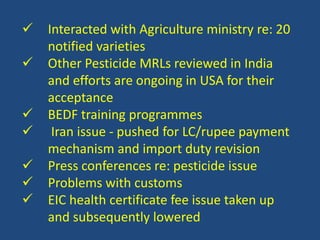
 Interacted with Agriculture ministry re: 20 
notified varieties 
 Other Pesticide MRLs reviewed in India 
and efforts are ongoing in USA for their 
acceptance 
 BEDF training programmes 
 Iran issue - pushed for LC/rupee payment 
mechanism and import duty revision 
 Press conferences re: pesticide issue 
 Problems with customs 
 EIC health certificate fee issue taken up 
and subsequently lowered
AIREA: SOME ACHIEVEMENTS 
 FSSAI - organised a training programme for 
members on food security guidelines 
 Preparing a Policy Paper on long-term prospects for 
Indian rice Industry to be presented to Govt of 
India. 
 Issue of export norms taken up with Mauritius 
 Visit of Mexican Press delegation to AIREA office 
 International Food and Trade Shows – China, 
France, Dubai 
Cont.
 Organized a Chef’s Conference 
 Phasing out of PP Bags 
 Harmonizing Basmati Rice Varieties & 
Standards 
 NPPO Registration – regular updates and 
advisory to members on requirements. 
Successfully pushed China to open up rice 
imports from India. 
 Established direct communication channel 
with Embassies regarding Rice Trade 
 30+ new members have joined AIREA
MAJOR POLICY ISSUES HANDLED 
• EIC health certificate, lowered price 
• Interacted with Agriculture ministry: 20 
notified varieties 
• Removal of MEP for rice 
• Revision of Indian MRL 
• Recommended MSP to CACP, solicited by 
Govt of India 
Cont.
•Reduction and removal of State levies and 
other taxes 
•Iran issue - pushed for LC/rupee payment 
mechanism and import duty revision 
•Interacted with DGFT to stop export of 
Basmati paddy in husk 
•Currently working on a Policy paper to be 
presented to GoI re: medium to long-term 
prospects and demands of rice industry

Dr.v.p.singh 1

  • 1.
    Basmati Rice: Past,Present & Future 1 V.P. Singh Director-(Crop & Research)
  • 2.
    The All IndiaRice Exporters Association (AIREA) • The All India Rice Exporters Association (AIREA) is the Apex body of Indian Rice Exporters in India. Established in 1989, AIREA is recognized by the Government of India and works closely with the Ministry of Commerce, Ministry of Agriculture and Agricultural and Processed Food Products Export Development Authority (APEDA). • We have over 130 accredited members who together account for 90% of India's rice exports. In 2013-14, India exported 10.5 Million tonnes worth over Rs 42,669 Crore ($ 6.6 Billion) and retained its leading position in the world rice market. • Although AIREA’s mandate is to represent the Indian rice industry, we have over the years made a conscious effort to bridge the gap between farmers, science and industry – and have adopted the motto “Dhan, Kisan, Vigyaan aur Udyog”. 2
  • 3.
    INTERFACE MEETING OFICAR, APEDA AND AIREA • AIREA has organized an interactive meeting with IARI, APEDA and AIREA on 23rd April, 2012 at IARI, Pusa. Some salient information of the meeting are:- • Pusa Basmati 1509 is a modified version of Pusa Basmati 1121. It matures 25 days earlier permitting it to be sown late will require less irrigation. It will be released as a notified Basmati variety. • The Rice Breeding Section is working on introducing disease, insect and salinity resistance in both Pusa basmati 1121 and Pusa Basmati 1509. These resistant Pusa Basmati varieties will reduce use of pesticides, therefore reduce residue problem. • The Director of IARI stated that all measures will be taken to see that there is no GMO research on Basmati. Also no testing of any GMO will be done in Basmati growing area. • Exporters were requested to keep the interests of farmers also in mind. If farmers do not get a good price, they may stop cultivating Basmati.
  • 4.
    WORLD RICE TRADE • The world rice market is extremely thin with less than 7% of total production being traded, yet has crossed the 35 million tonnes mark in 2013. • The major players, both exporters and importers, are developing countries. Five countries control the bulk of global rice exports namely China, US, Vietnam, Thailand and India. • Ordinary indica, long grain, rice varieties are the most widely traded, accounting for 75 percent of international trade flows in the early 2000s, followed by japonica, medium grain rice and aromatic (Basmati and fragrant) rice, each accounting for 12 percent of trade. 150,000 100,000 50,000 0 GLOBAL RICE PRODUCERS 12,000 10,000 8,000 6,000 4,000 2,000 0 TOP RICE EXPORTERS India Thailand Vietnam Pakistan United States 4,000 3,000 2,000 1,000 0 TOP RICE IMPORTERS China Nigeria Iran EU Cote d'Ivoire Iraq Saudi Arabia *Qty in‘000 Tonnes India Rice Exporters Association 4
  • 5.
    WORLD SHARE OFINDIAN RICE EXPORTS NON-BASMATI All India Rice Exporters Association 5 Middle East EU US East Africa East Asia (oceania) CIS ASEAN BASMATI 77.5% Africa Middle East EU South Asia ASEAN 71.5%
  • 6.
  • 7.
    Basmati Growing Districts States Districts J&K Kathua , Jammu & Samba Himachal Pradesh Entire State Punjab Entire State Haryana Entire State Delhi Entire State Uttarakhand Udham Singh Nagar & Haridwar Western U.P 27 Districts
  • 8.
    Total rice area- 44 mha  Total Avg rice production – 104 mt Total Basmati rice area – 1.6 mha  Basmati rice production - 7.0 mt  Basmati rice export - 4.0 mt  Domestic consumption - 2.8 mt  Forex earning - US $ 4.6 billion (Rs 28,189 crores) Salient Features
  • 9.
    1. Stable tradeenvironment: The most positive signal to the world market, Indian farmers and industry is that no ban, intervention or restrictions will be imposed. Permanently opening up exports of agricultural products 2. Import tariffs on rice should be kept as high as possible- imperative to insulate Indian farmers, industry and consumers from volatility in international prices which is partly structural due to high agricultural subsidies in developed nations such as America and EU countries. 9 POLICY AND CHALLENGES
  • 10.
    • Bilateral agreementsallowing import of rice at cheaper rates from countries where we can push for a market for Indian rice. 3. India must take a strong stand that parameters set by accredited bodies must be recognized globally. • India should decide and educate to other countries what the definition of Basmati is and which varieties come under it.
  • 11.
    All India RiceExporters Association 11 Geographical Indication (GI) BENEFITS A GI certificate would mean that only the rice grown in parts of India and Pakistan would qualify to be called as `Basmati' thus conferring legal protection to the product and safeguarding against its unauthorized use by other countries or producers, besides eliminating unfair competition for the benefit of genuine producers and consumers. Cont.
  • 12.
    International markets seekspecial, exotic Indian goods and these fetch premium prices. Basmati being a premium Indian product, legal protection will boost Basmati exports. Would do wonders for marketing & branding which is key to Basmati market expansion Will promote economic prosperity of Basmati farmers, millers, traders & exporters.
  • 13.
    WITHOUT GI FORBASMATI… Promote theft of Indian biodiversity, intellectual, scientific and cultural heritage. Most unfair to Indian farmers who have cultivated Basmati for centuries. Authentic Basmati from India will stop fetching premium prices that it currently enjoys
  • 14.
    Indian exporters willbe vulnerable to losing their market. Eg RiceTec patent issue. Other countries will be free to develop varieties of Basmati which will not be true Basmati as they are being bred under different agro-climatic conditions. Economic cost of such rice could be cheaper in other parts of the world and India will not be able to compete. Others will randomly use “Basmati” for any fragrant rice grown outside the GI zone. Global consumers will be cheated as authentic Basmati is only grown in the GI zone
  • 15.
    STATE Basmati AreaYear Wise Area-’000 ha 2009 2010 2011 2012 2013 AREA AREA AREA AREA AREA Punjab 792.67 738.92 700.66 573.12 590.01 Haryana 610.73 781.40 705.08 594.10 711.11 Uttar Pradesh 254.29 377.79 428.30 366.55 318.75 Uttarakhand 17.52 29.88 23.50 16.90 18.30 J&k 32.92 33.00 38.00 36.90 37.28 Himachal Pradesh ‒ 5.95 14.20 2.85 1.00 Delhi 1.34 1.45 1.50 1.50 ‒ Total 1709.47 1968.39 1911.24 1591.92 1676.45
  • 16.
    STATE Basmati ProductionYear Wise Prod-’000 t 2009 2010 2011 2012 2013 Production Production Production Production Production Punjab 3164.71 2831.26 2832.12 2282.15 2292.75 Haryana 2432.48 2751.63 2676.77 2261.26 2898.98 Uttar Pradesh 986.44 1442.77 2066.23 1428.48 1270.09 Uttarakhand 58.26 97.06 80.13 53.90 54.16 J&k 79.45 79.70 94.90 96.13 92.66 Himachal Pradesh ‒ 10.32 42.80 5.70 3.40 Delhi 5.41 4.93 6.00 6.00 ‒ Total 6726.75 7217.67 7798.95 6133.62 6612.04
  • 17.
    Top Importers OfBasmati 2011-12 2012-13 2013-14 Country Qty Value Qty Value Qty Value Iran 6,14,922.16 2,843.21 10,82,216.47 6,463.50 14,40,654.37 10,975.71 Saudi Arabia 7,21,245.48 3,380.88 6,81,238.69 3,659.08 8,26,289.81 6,717.06 Iraq 1,51,961.25 672.87 2,04,261.89 1,076.67 2,19,634.00 1,599.72 Kuwait 1,99,869.77 1,362.92 1,63,317.07 1,059.68 1,75,444.79 1,513.06 United Arab Emirates 7,28,823.29 3,432.79 2,34,679.47 1,311.20 1,49,041.96 1,189.22 Yemen Republc 92,112.14 402.91 1,72,348.74 878.19 1,46,839.58 1,107.79 United States 91,816.94 503.88 91,546.37 561.69 1,03,377.64 870.45 United Kingdom 1,41,666.21 629.46 1,92,433.35 849.98 1,18,888.17 785.85 Jordan 52,928.98 242.46 89,645.35 441.37 79,077.81 624.09 Oman 18,292.27 94.33 40,101.59 244.36 43,141.93 355.46
  • 18.
    NOTIFIED BASMATI VARIETIES Variety Notification No. & Date Basmati 217 4045 – 24.09.1969 361 (E) – 30.06.1973 Basmati 370 361 (E) – 30.06.1973 786 – 02.02.1976 Type 3 (Dehraduni Basmati) 13 – 19.12.1978 Punjab Basmati 1 (Bauni Basmati) 596 (E) - 13.08.1984 Pusa Basmati 1 (IET 10364) 615 (E) - 06.11.1989 Kasturi (IET 8580) 615 (E) - 06.11.1989 Haryana Basmati 1 793 (E) - 22.11.1991 Cont.
  • 19.
    NOTIFIED BASMATI VARIETIES Variety Notification No. & Date Mahi Sugandha 408 (E) - 04.05.1995 Taraori Basmati (HBC 19 or Karnal Local) 1(E) – 01.01.1996 Ranbir Basmati 1 (E) - 01.01.1996 Basmati 386 647 (E) – 09.09.1997 Improved Pusa Basmati 1 (Pusa 1460) 1178 (E) – 20.07.2007 Pusa Basmati 1121 (IET 18004) After amendment 1566 (E) – 05.11.2005 2547 (E) - 29.10.2008 Vallabh Basmati 22 2187 (E) – 27.08.2009 Cont.
  • 20.
    NOTIFIED BASMATI VARIETIES Variety Notification No. & Date Pusa Basmati 6 (Pusa 1401) (IET 18005) 733 (E) – 01.04.2010 Punjab Basmati 2 1708 (E) – 26.07.2012 Basmati CSR 30 After amendment 1134(E) – 25.11.2001 2126 (E) – 10.09.2012 Pusa Basmati 1509 (IET 21960) S.O. 2815 (E) – 19.09.2013 Malviya Basmati Dhan 10-9 (IET 21669) S.O. 2815 (E) – 19.09.2013 Vallabh Basmati 21 (IET 19493) S.O. 2815 (E) – 19.09.2013
  • 21.
    Basmati Exports- Quantity Qty-Million MT 0.77 1.16 1.16 1.04 1.18 1.55 2.01 2.37 3.17 3.45 3.75 4 3.5 3 2.5 2 1.5 1 0.5 0 2003-04 2004-05 2005-06 2006-07 2007-08 2008-09 2009-10 2010-11 2011-12 2012-13 2013-14 Qty Source: Directorate General of Commercial Intelligence and Statistics (DGCI&S)
  • 22.
    Basmati Export-Value Value-RsCrore 1993.04 2823.89 3043.09 2792.8 4344.58 9477.02 10889.13 11354.63 15449.59 19409.39 29299.95 35000 30000 25000 20000 15000 10000 5000 0 2003-04 2004-05 2005-06 2006-07 2007-08 2008-09 2009-10 2010-11 2011-12 2012-13 2013-14 Value Source: Directorate General of Commercial Intelligence and Statistics (DGCI&S)
  • 23.
    Non Basmati -Quantity Qty- Million MT 2.64 3.61 2.92 3.7 5.28 0.93 0.13 0.1 3.99 6.68 7.13 8 7 6 5 4 3 2 1 0 2003-04 2004-05 2005-06 2006-07 2007-08 2008-09 2009-10 2010-11 2011-12 2012-13 2013-14 Qty Source: Directorate General of Commercial Intelligence and Statistics (DGCI&S)
  • 24.
    Non Basmati-Value Value-RsCrore 2174.79 3945.01 3178.16 4243.07 7409.79 1687.37 365.29 231.28 8659.12 14448.8 17749.96 20000 18000 16000 14000 12000 10000 8000 6000 4000 2000 0 2003-04 2004-05 2005-06 2006-07 2007-08 2008-09 2009-10 2010-11 2011-12 2012-13 2013-14 Value Source: Directorate General of Commercial Intelligence and Statistics (DGCI&S)
  • 25.
    No. of CountriesRice Exported Year Basmati Non Basmati 2003-04 93 96 2004-05 99 97 2005-06 106 106 2006-07 107 108 2007-08 106 122 2008-09 102 68 2009-10 106 58 2010-11 108 53 2011-12 124 129 2012-13 130 145 2013-14 133 140 Source: Directorate General of Commercial Intelligence and Statistics (DGCI&S)
  • 26.
    AIREA: SOME ACHIEVEMENTS  Import Tolerance of 3ppm for Tricyclazole is registered in USA  Removal of Ban on Non-Basmati export  Removal of State Levies  Revised and Eventually Removed MEP for Basmati – from $900 to $700 per tonne and eventually 0.  AIREA submitted and subsequently defended its solicited MSP recommendation for Rice to CACP (Commission for Agricultural Cost and Prices under the Union Minister of Agriculture) Cont.
  • 27.
     Interacted withAgriculture ministry re: 20 notified varieties  Other Pesticide MRLs reviewed in India and efforts are ongoing in USA for their acceptance  BEDF training programmes  Iran issue - pushed for LC/rupee payment mechanism and import duty revision  Press conferences re: pesticide issue  Problems with customs  EIC health certificate fee issue taken up and subsequently lowered
  • 28.
    AIREA: SOME ACHIEVEMENTS  FSSAI - organised a training programme for members on food security guidelines  Preparing a Policy Paper on long-term prospects for Indian rice Industry to be presented to Govt of India.  Issue of export norms taken up with Mauritius  Visit of Mexican Press delegation to AIREA office  International Food and Trade Shows – China, France, Dubai Cont.
  • 29.
     Organized aChef’s Conference  Phasing out of PP Bags  Harmonizing Basmati Rice Varieties & Standards  NPPO Registration – regular updates and advisory to members on requirements. Successfully pushed China to open up rice imports from India.  Established direct communication channel with Embassies regarding Rice Trade  30+ new members have joined AIREA
  • 30.
    MAJOR POLICY ISSUESHANDLED • EIC health certificate, lowered price • Interacted with Agriculture ministry: 20 notified varieties • Removal of MEP for rice • Revision of Indian MRL • Recommended MSP to CACP, solicited by Govt of India Cont.
  • 31.
    •Reduction and removalof State levies and other taxes •Iran issue - pushed for LC/rupee payment mechanism and import duty revision •Interacted with DGFT to stop export of Basmati paddy in husk •Currently working on a Policy paper to be presented to GoI re: medium to long-term prospects and demands of rice industry

Editor's Notes

  • #16 Source: Agrinet Field Survey Report
  • #17 Source: Agrinet Field Survey Report