

13th October, 2012
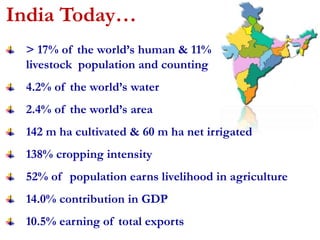
India Today… 
> 17% of the world’s human & 11% 
livestock population and counting 
4.2% of the world’s water 
2.4% of the world’s area 
142 m ha cultivated & 60 m ha net irrigated 
138% cropping intensity 
52% of population earns livelihood in agriculture 
14.0% contribution in GDP 
10.5% earning of total exports
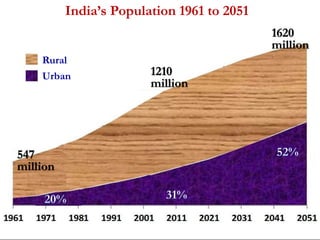
India’s Population 1961 to 2051 
Total and Urban 
Rural 
Urban 
547 
million 
1210 
million 
1620 
million
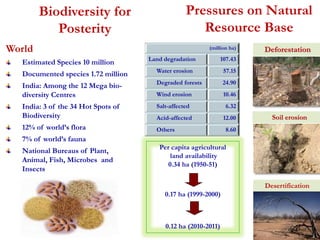
Pressures on Natural 
Resource Base 
Deforestation 
Soil erosion 
Desertification 
(million ha) 
Land degradation 107.43 
Water erosion 57.15 
Degraded forests 24.90 
Wind erosion 10.46 
Salt-affected 6.32 
Acid-affected 12.00 
Others 8.60 
Per capita agricultural 
land availability 
0.34 ha (1950-51) 
0.17 ha (1999-2000) 
0.12 ha (2010-2011) 
Biodiversity for 
Posterity 
World 
Estimated Species 10 million 
Documented species 1.72 million 
India: Among the 12 Mega bio-diversity 
Centres 
India: 3 of the 34 Hot Spots of 
Biodiversity 
12% of world’s flora 
7% of world’s fauna 
National Bureaus of Plant, 
Animal, Fish, Microbes and 
Insects
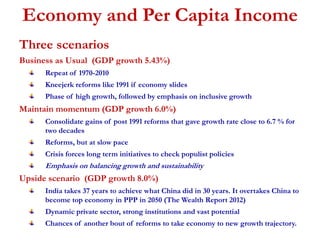
Economy and Per Capita Income 
Three scenarios 
Business as Usual (GDP growth 5.43%) 
Repeat of 1970-2010 
Kneejerk reforms like 1991 if economy slides 
Phase of high growth, followed by emphasis on inclusive growth 
Maintain momentum (GDP growth 6.0%) 
Consolidate gains of post 1991 reforms that gave growth rate close to 6.7 % for 
two decades 
Reforms, but at slow pace 
Crisis forces long term initiatives to check populist policies 
Emphasis on balancing growth and sustainability 
Upside scenario (GDP growth 8.0%) 
India takes 37 years to achieve what China did in 30 years. It overtakes China to 
become top economy in PPP in 2050 (The Wealth Report 2012) 
Dynamic private sector, strong institutions and vast potential 
Chances of another bout of reforms to take economy to new growth trajectory.
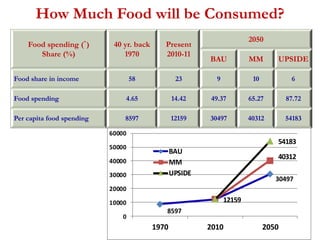
How Much Food will be Consumed? 
BAU 
MM 
UPSIDE 
8597 
54183 
30497 
12159 
40312 
60000 
50000 
40000 
30000 
20000 
10000 
0 
1970 2010 2050 
Food spending (`) 
Share (%) 
40 yr. back 
1970 
Present 
2010-11 
2050 
BAU MM UPSIDE 
Food share in income 58 23 9 10 6 
Food spending 4.65 14.42 49.37 65.27 87.72 
Per capita food spending 8597 12159 30497 40312 54183
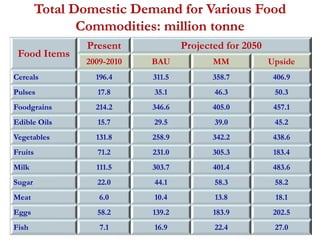
Total Domestic Demand for Various Food 
Commodities: million tonne 
Food Items 
Present Projected for 2050 
2009-2010 BAU MM Upside 
Cereals 196.4 311.5 358.7 406.9 
Pulses 17.8 35.1 46.3 50.3 
Foodgrains 214.2 346.6 405.0 457.1 
Edible Oils 15.7 29.5 39.0 45.2 
Vegetables 131.8 258.9 342.2 438.6 
Fruits 71.2 231.0 305.3 183.4 
Milk 111.5 303.7 401.4 483.6 
Sugar 22.0 44.1 58.3 58.2 
Meat 6.0 10.4 13.8 18.1 
Eggs 58.2 139.2 183.9 202.5 
Fish 7.1 16.9 22.4 27.0
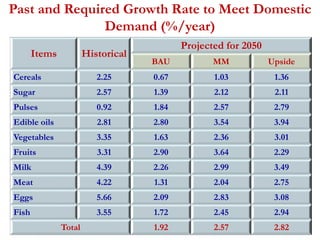
Past and Required Growth Rate to Meet Domestic 
Demand (%/year) 
Items Historical 
Projected for 2050 
BAU MM Upside 
Cereals 2.25 0.67 1.03 1.36 
Sugar 2.57 1.39 2.12 2.11 
Pulses 0.92 1.84 2.57 2.79 
Edible oils 2.81 2.80 3.54 3.94 
Vegetables 3.35 1.63 2.36 3.01 
Fruits 3.31 2.90 3.64 2.29 
Milk 4.39 2.26 2.99 3.49 
Meat 4.22 1.31 2.04 2.75 
Eggs 5.66 2.09 2.83 3.08 
Fish 3.55 1.72 2.45 2.94 
Total 1.92 2.57 2.82
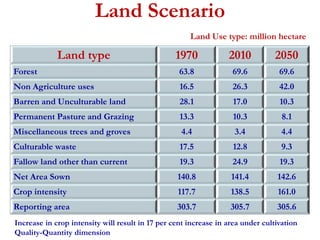
Land Scenario 
Land Use type: million hectare 
Land type 1970 2010 2050 
Forest 63.8 69.6 69.6 
Non Agriculture uses 16.5 26.3 42.0 
Barren and Unculturable land 28.1 17.0 10.3 
Permanent Pasture and Grazing 13.3 10.3 8.1 
Miscellaneous trees and groves 4.4 3.4 4.4 
Culturable waste 17.5 12.8 9.3 
Fallow land other than current 19.3 24.9 19.3 
Net Area Sown 140.8 141.4 142.6 
Crop intensity 117.7 138.5 161.0 
Reporting area 303.7 305.7 305.6 
Increase in crop intensity will result in 17 per cent increase in area under cultivation 
Quality-Quantity dimension
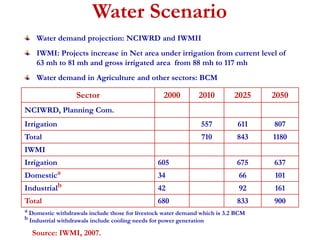
Water Scenario 
Water demand projection: NCIWRD and IWMII 
IWMI: Projects increase in Net area under irrigation from current level of 
63 mh to 81 mh and gross irrigated area from 88 mh to 117 mh 
Water demand in Agriculture and other sectors: BCM 
Sector 2000 2010 2025 2050 
NCIWRD, Planning Com. 
Irrigation 557 611 807 
Total 710 843 1180 
IWMI 
Irrigation 605 675 637 
Domestica 34 66 101 
Industrialb 42 92 161 
Total 680 833 900 
a Domestic withdrawals include those for livestock water demand which is 3.2 BCM 
b Industrial withdrawals include cooling needs for power generation 
Source: IWMI, 2007.
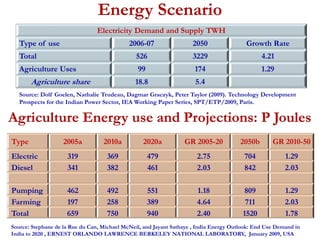
Energy Scenario 
Electricity Demand and Supply TWH 
Type of use 2006-07 2050 Growth Rate 
Total 526 3229 4.21 
Agriculture Uses 99 174 1.29 
Agriculture share 18.8 5.4 
Source: Dolf Goelen, Nathalie Trudeau, Dagmar Graczyk, Peter Taylor (2009). Technology Development 
Prospects for the Indian Power Sector, IEA Working Paper Series, SPT/ETP/2009, Paris. 
Agriculture Energy use and Projections: P Joules 
Type 2005a 2010a 2020a GR 2005-20 2050b GR 2010-50 
Electric 319 369 479 2.75 704 1.29 
Diesel 341 382 461 2.03 842 2.03 
Pumping 462 492 551 1.18 809 1.29 
Farming 197 258 389 4.64 711 2.03 
Total 659 750 940 2.40 1520 1.78 
Source: Stephane de la Rue du Can, Michael McNeil, and Jayant Sathaye , India Energy Outlook: End Use Demand in 
India to 2020 , ERNEST ORLANDO LAWRENCE BERKELEY NATIONAL LABORATORY, January 2009, USA
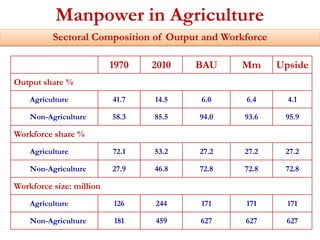
Manpower in Agriculture 
Sectoral Composition of Output and Workforce 
1970 2010 BAU Mm Upside 
Output share % 
Agriculture 41.7 14.5 6.0 6.4 4.1 
Non-Agriculture 58.3 85.5 94.0 93.6 95.9 
Workforce share % 
Agriculture 72.1 53.2 27.2 27.2 27.2 
Non-Agriculture 27.9 46.8 72.8 72.8 72.8 
Workforce size: million 
Agriculture 126 244 171 171 171 
Non-Agriculture 181 459 627 627 627
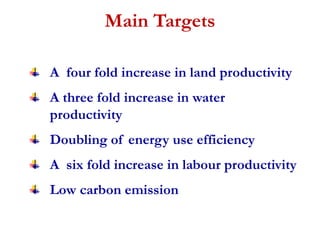
Main Targets 
A four fold increase in land productivity 
A three fold increase in water 
productivity 
Doubling of energy use efficiency 
A six fold increase in labour productivity 
Low carbon emission
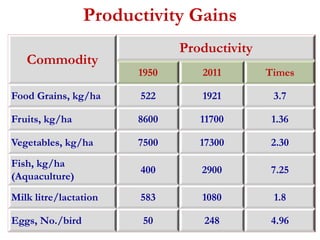
Productivity Gains 
Commodity 
Productivity 
1950 2011 Times 
Food Grains, kg/ha 522 1921 3.7 
Fruits, kg/ha 8600 11700 1.36 
Vegetables, kg/ha 7500 17300 2.30 
Fish, kg/ha 
(Aquaculture) 
400 2900 7.25 
Milk litre/lactation 583 1080 1.8 
Eggs, No./bird 50 248 4.96
Towards Knowledge Management 
Resources to Decisions 
Ideas - Innovations 
Insight - Vision 
Information - Knowledge 
Skills - Technologies
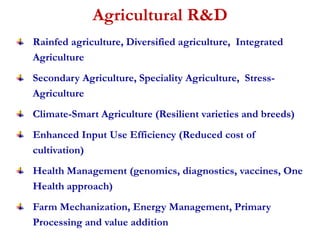
Agricultural R&D 
Rainfed agriculture, Diversified agriculture, Integrated 
Agriculture 
Secondary Agriculture, Speciality Agriculture, Stress- 
Agriculture 
Climate-Smart Agriculture (Resilient varieties and breeds) 
Enhanced Input Use Efficiency (Reduced cost of 
cultivation) 
Health Management (genomics, diagnostics, vaccines, One 
Health approach) 
Farm Mechanization, Energy Management, Primary 
Processing and value addition
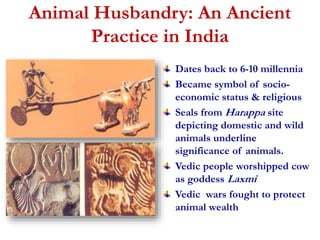
Animal Husbandry: An Ancient 
Practice in India 
Dates back to 6-10 millennia 
Became symbol of socio-economic 
status & religious 
Seals from Harappa site 
depicting domestic and wild 
animals underline 
significance of animals. 
Vedic people worshipped cow 
as goddess Laxmi 
Vedic wars fought to protect 
animal wealth
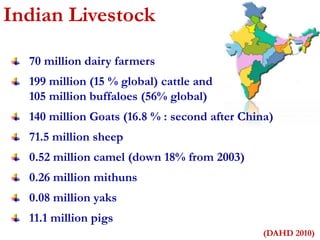
Indian Livestock 
70 million dairy farmers 
199 million (15 % global) cattle and 
105 million buffaloes (56% global) 
140 million Goats (16.8 % : second after China) 
71.5 million sheep 
0.52 million camel (down 18% from 2003) 
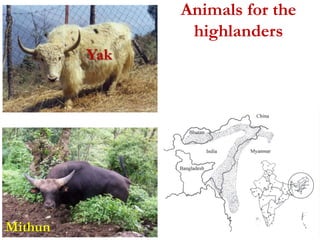
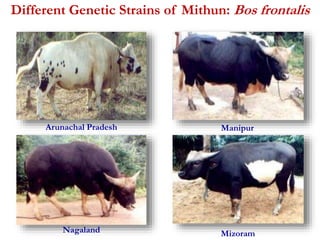
0.26 million mithuns 
0.08 million yaks 
11.1 million pigs 
(DAHD 2010)
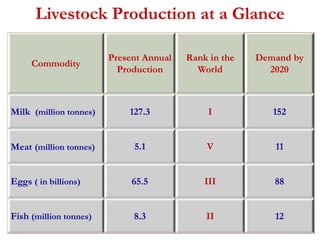
Livestock Production at a Glance 
Commodity 
Present Annual 
Production 
Rank in the 
World 
Demand by 
2020 
Milk (million tonnes) 127.3 I 152 
Meat (million tonnes) 5.1 V 11 
Eggs ( in billions) 65.5 III 88 
Fish (million tonnes) 8.3 II 12
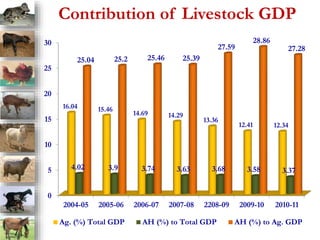
Contribution of Livestock GDP 
30 
25 
20 
15 
10 
5 
0 
25.04 25.2 25.46 25.39 
16.04 15.46 
14.69 14.29 
27.59 
13.36 
28.86 
27.28 
12.41 12.34 
4.02 3.9 3.74 3.63 3.68 3.58 3.37 
2004-05 2005-06 2006-07 2007-08 2208-09 2009-10 2010-11 
Ag. (%) Total GDP AH (%) to Total GDP AH (%) to Ag. GDP
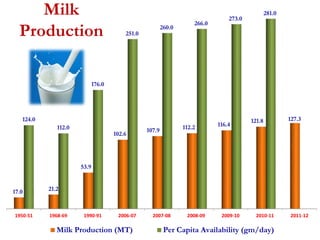
Production 
176.0 
251.0 
260.0 
266.0 
273.0 
281.0 
Milk 
124.0 121.8 127.3 
112.0 
17.0 21.2 
53.9 
102.6 
107.9 
112.2 116.4 
1950-51 1968-69 1990-91 2006-07 2007-08 2008-09 2009-10 2010-11 2011-12 
Milk Production (MT) Per Capita Availability (gm/day)
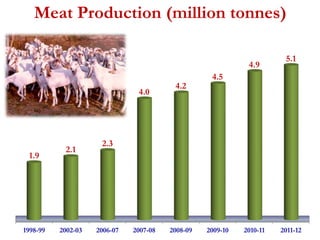
Meat Production (million tonnes) 
1.9 
2.1 
2.3 
4.0 
4.2 
4.5 
4.9 
5.1 
1998-99 2002-03 2006-07 2007-08 2008-09 2009-10 2010-11 2011-12
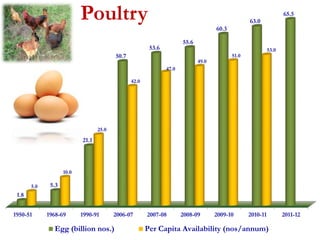
1.8 
5.3 
Poultry 
21.1 
50.7 
53.6 
55.6 
60.3 
63.0 
65.5 
5.0 
10.0 
25.0 
42.0 
47.0 
49.0 
51.0 
53.0 
1950-51 1968-69 1990-91 2006-07 2007-08 2008-09 2009-10 2010-11 2011-12 
Egg (billion nos.) Per Capita Availability (nos/annum)
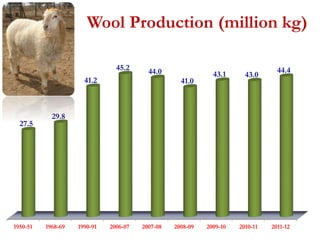
Wool Production (million kg) 
27.5 
29.8 
41.2 
45.2 
44.0 
41.0 
43.1 43.0 
44.4 
1950-51 1968-69 1990-91 2006-07 2007-08 2008-09 2009-10 2010-11 2011-12
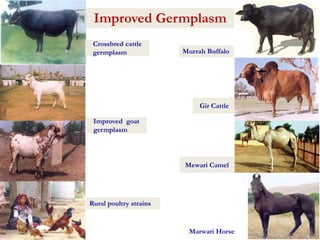
Improved Germplasm 
Rural poultry strains 
Murrah Buffalo 
Gir Cattle 
Improved goat 
germplasm 
Mewari Camel 
Marwari Horse 
Crossbred cattle 
germplasm
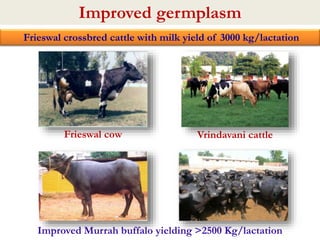
Improved germplasm 
Frieswal crossbred cattle with milk yield of 3000 kg/lactation 
Frieswal cow Vrindavani cattle 
Improved Murrah buffalo yielding >2500 Kg/lactation
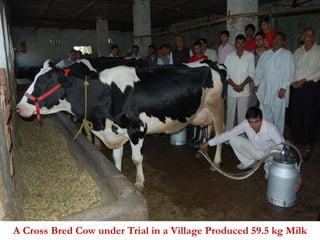
A Cross Bred Cow under Trial in a Village Produced 59.5 kg Milk
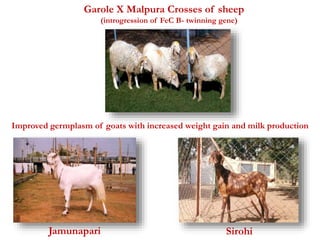
Garole X Malpura Crosses of sheep 
(introgression of FeC B- twinning gene) 
Improved germplasm of goats with increased weight gain and milk production 
Jamunapari Sirohi
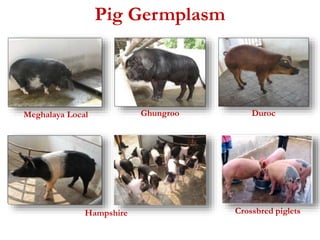
Pig Germplasm 
Meghalaya Local Ghungroo Duroc 
Hampshire Crossbred piglets
Animals for the 
highlanders 
Yak 
Mithun
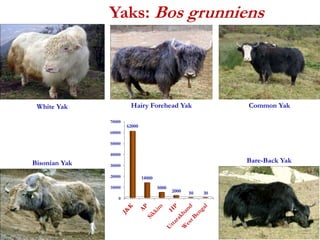
Yaks: Bos grunniens 
White Yak Hairy Forehead Yak Common Yak 
70000 
60000 
50000 
40000 
Bisonian Yak Bare-Back Yak 
30000 
20000 
10000 
0 
62000 
14000 
5000 
2000 50 30
Different Genetic Strains of Mithun: Bos frontalis 
Arunachal Pradesh Manipur 
Nagaland Mizoram
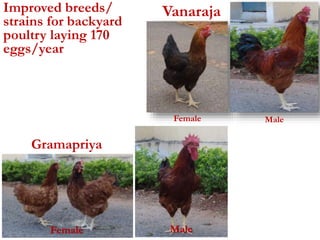
Improved breeds/ 
strains for backyard 
poultry laying 170 
eggs/year 
Female 
Gramapriya 
Vanaraja 
Male 
Female Male
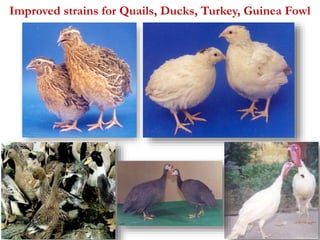
Improved strains for Quails, Ducks, Turkey, Guinea Fowl 
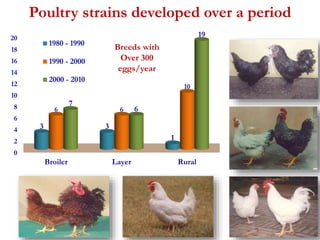
34
20 
18 
16 
14 
12 
10 
8 
6 
4 
2 
0 
Poultry strains developed over a period 
7 
6 6 
3 3 
1 
10 
6 
Broiler Layer Rural 
19 
1980 - 1990 
1990 - 2000 
2000 - 2010 
Breeds with 
Over 300 
eggs/year
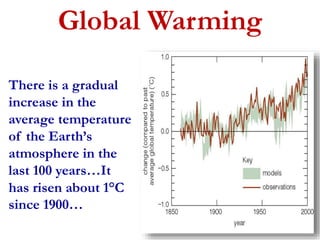
Global Warming 
There is a gradual 
increase in the 
average temperature 
of the Earth’s 
atmosphere in the 
last 100 years…It 
has risen about 1°C 
since 1900…
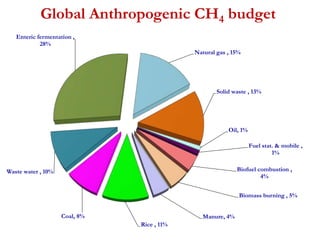
Global Anthropogenic CH4 budget 
Enteric fermentation , 
28% 
Natural gas , 15% 
Solid waste , 13% 
Oil, 1% 
Fuel stat. & mobile , 
1% 
Biofuel combustion , 
4% 
Biomass burning , 5% 
Manure, 4% 
Rice , 11% 
Coal, 8% 
Waste water , 10%
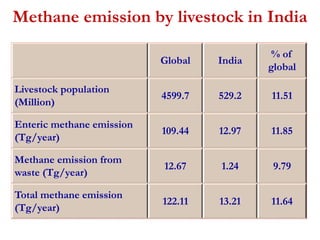
Methane emission by livestock in India 
Global India 
% of 
global 
Livestock population 
(Million) 
4599.7 529.2 11.51 
Enteric methane emission 
(Tg/year) 
109.44 12.97 11.85 
Methane emission from 
waste (Tg/year) 
12.67 1.24 9.79 
Total methane emission 
(Tg/year) 
122.11 13.21 11.64
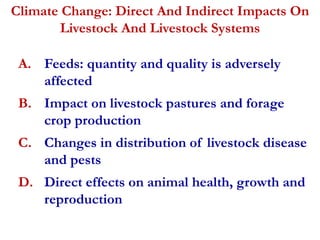
Climate Change: Direct And Indirect Impacts On 
Livestock And Livestock Systems 
A. Feeds: quantity and quality is adversely 
affected 
B. Impact on livestock pastures and forage 
crop production 
C. Changes in distribution of livestock disease 
and pests 
D. Direct effects on animal health, growth and 
reproduction
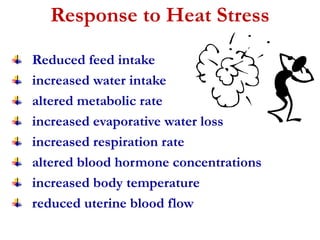
Response to Heat Stress 
Reduced feed intake 
increased water intake 
altered metabolic rate 
increased evaporative water loss 
increased respiration rate 
altered blood hormone concentrations 
increased body temperature 
reduced uterine blood flow
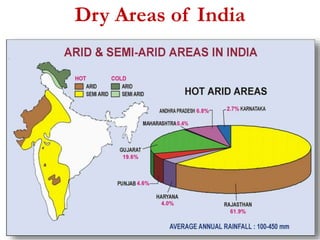
Dry Areas of India
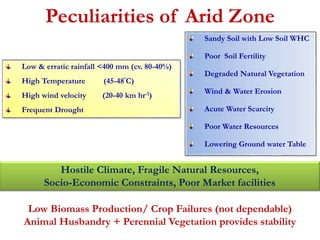
Peculiarities of Arid Zone 
Low & erratic rainfall <400 mm (cv. 80-40%) 
High Temperature (45-48ºC) 
High wind velocity (20-40 km hr-1) 
Frequent Drought 
Sandy Soil with Low Soil WHC 
Poor Soil Fertility 
Degraded Natural Vegetation 
Wind & Water Erosion 
Acute Water Scarcity 
Poor Water Resources 
Lowering Ground water Table 
Hostile Climate, Fragile Natural Resources, 
Socio-Economic Constraints, Poor Market facilities 
Low Biomass Production/ Crop Failures (not dependable) 
Animal Husbandry + Perennial Vegetation provides stability
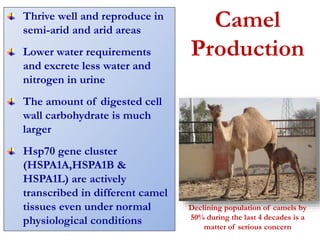
Camel 
Production 
Thrive well and reproduce in 
semi-arid and arid areas 
Lower water requirements 
and excrete less water and 
nitrogen in urine 
The amount of digested cell 
wall carbohydrate is much 
larger 
Hsp70 gene cluster 
(HSPA1A,HSPA1B & 
HSPA1L) are actively 
transcribed in different camel 
tissues even under normal 
physiological conditions 
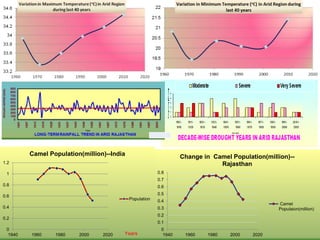
Declining population of camels by 
50% during the last 4 decades is a 
matter of serious concern
0.8 
0.7 
0.6 
0.5 
0.4 
0.3 
0.2 
0.1 
0 
Change in Camel Population(million)-- 
Rajasthan 
1940 1960 1980 2000 2020 
Camel 
Populaion(million) 
1.2 
1 
0.8 
0.6 
0.4 
0.2 
0 
Camel Population(million)--India 
1940 1960 1980 2000 2020 
Population 
Years
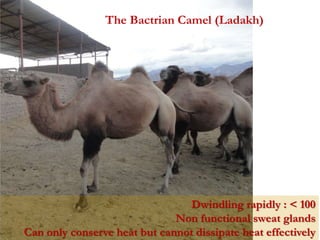
The Bactrian Camel (Ladakh) 
Dwindling rapidly : < 100 
Non functional sweat glands 
Can only conserve heat but cannot dissipate heat effectively
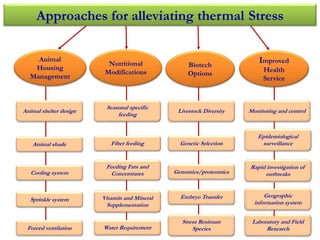
Approaches for alleviating thermal Stress 
Animal 
Housing 
Management 
Nutritional 
Modifications 
Biotech 
Options 
Improved 
Health 
Service 
Animal shelter design 
Animal shade 
Cooling system 
Sprinkle system 
Forced ventilation 
Seasonal specific 
feeding 
Fiber feeding 
Feeding Fats and 
Concentrates 
Vitamin and Mineral 
Supplementation 
Water Requirement 
Livestock Diversity 
Genetic Selection 
Genomics/proteomics 
Embryo Transfer 
Stress Resistant 
Species 
Monitoring and control 
Epidemiological 
surveillance 
Rapid investigation of 
outbreaks 
Geographic 
information system 
Laboratory and Field 
Research
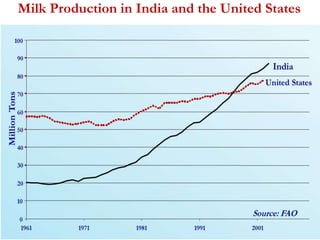
Milk Production in India and the United States
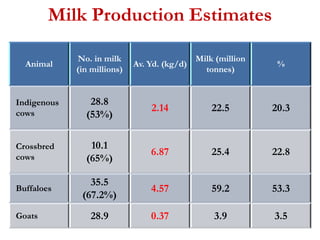
Milk Production Estimates 
Animal 
No. in milk 
(in millions) 
Av. Yd. (kg/d) 
Milk (million 
tonnes) 
% 
Indigenous 
cows 
28.8 
(53%) 
2.14 22.5 20.3 
Crossbred 
cows 
10.1 
(65%) 
6.87 25.4 22.8 
Buffaloes 
35.5 
(67.2%) 
4.57 59.2 53.3 
Goats 28.9 0.37 3.9 3.5
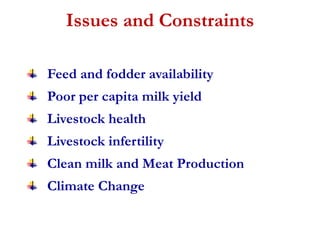
Issues and Constraints 
Feed and fodder availability 
Poor per capita milk yield 
Livestock health 
Livestock infertility 
Clean milk and Meat Production 
Climate Change
Estrus Synchronization Kit for Sheep and Goat 
Application Estrus induction and synchronization in 
small ruminants Useful in getting 3 
lambings/ewe in 2 years 
Features Controls cyclicity of animals 
Status State Animal Husbandry Deptts./Extension 
Units at Transfer Block level 
Cost Rs. 10.60 for one dose 
Cost of Kit: Rs 260=00 
Kit consists of 
Sponge 25 
Speculum 1 
Plunger 1
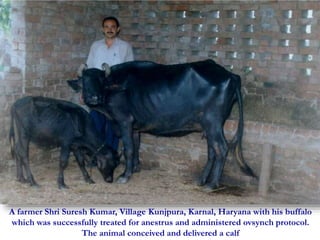
A farmer Shri Suresh Kumar, Village Kunjpura, Karnal, Haryana with his buffalo 
which was successfully treated for anestrus and administered ovsynch protocol. 
The animal conceived and delivered a calf
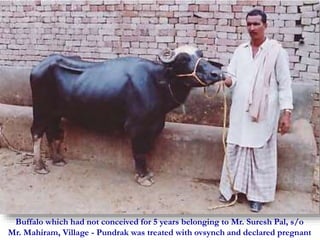
Buffalo which had not conceived for 5 years belonging to Mr. Suresh Pal, s/o 
Mr. Mahiram, Village - Pundrak was treated with ovsynch and declared pregnant
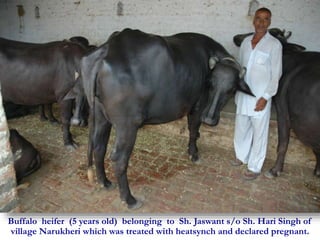
Buffalo heifer (5 years old) belonging to Sh. Jaswant s/o Sh. Hari Singh of 
village Narukheri which was treated with heatsynch and declared pregnant.
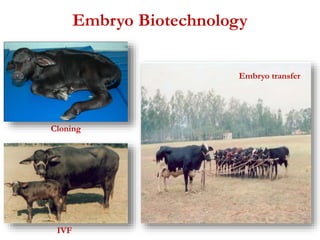
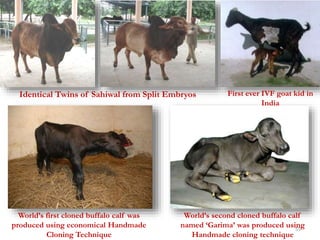
Embryo Biotechnology 
Cloning 
Embryo transfer 
IVF
Identical Twins of Sahiwal from Split Embryos First ever IVF goat kid in 
55 
India 
World’s first cloned buffalo calf was 
produced using economical Handmade 
Cloning Technique 
World’s second cloned buffalo calf 
named ‘Garima’ was produced using 
Handmade cloning technique
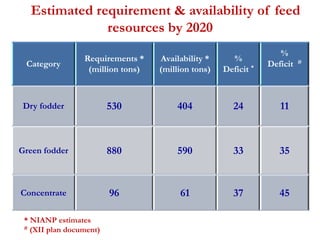
Estimated requirement & availability of feed 
resources by 2020 
Category 
Requirements * 
(million tons) 
Availability * 
(million tons) 
% 
Deficit * 
% 
Deficit # 
Dry fodder 530 404 24 11 
Green fodder 880 590 33 35 
Concentrate 96 61 37 45 
* NIANP estimates 
# (XII plan document)
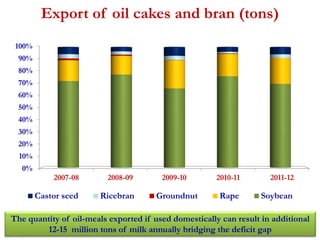
Export of oil cakes and bran (tons) 
100% 
90% 
80% 
70% 
60% 
50% 
40% 
30% 
20% 
10% 
The quantity of oil-meals exported if used domestically can result in additional 
12-15 million tons of milk annually bridging the deficit gap 
0% 
2007-08 2008-09 2009-10 2010-11 2011-12 
Castor seed Ricebran Groundnut Rape Soybean
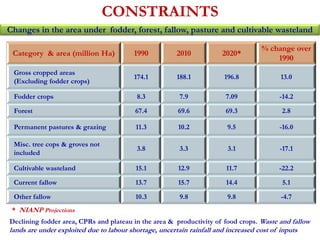
CONSTRAINTS 
Changes in the area under fodder, forest, fallow, pasture and cultivable wasteland 
Category & area (million Ha) 1990 2010 2020* 
% change over 
1990 
Gross cropped areas 
(Excluding fodder crops) 
174.1 188.1 196.8 13.0 
Fodder crops 8.3 7.9 7.09 -14.2 
Forest 67.4 69.6 69.3 2.8 
Permanent pastures & grazing 11.3 10.2 9.5 -16.0 
Misc. tree cops & groves not 
included 
3.8 3.3 3.1 -17.1 
Cultivable wasteland 15.1 12.9 11.7 -22.2 
Current fallow 13.7 15.7 14.4 5.1 
Other fallow 10.3 9.8 9.8 -4.7 
* NIANP Projections 
Declining fodder area, CPRs and plateau in the area & productivity of food crops. Waste and fallow 
lands are under exploited due to labour shortage, uncertain rainfall and increased cost of inputs
APPROACHES 
Concentrate Feed 
Technology options 
Strategic supplementation of limiting nutrients 
Ration balancing with local feed resources 
Alternate feed resources 
Researchable issues 
Precision feeding 
Exploring newer unconventional feeds 
Enhancing bio-availability of nutrients 
Policy issues 
Export of oil cakes and by products 
Quality and safety assurance of animal feeds 
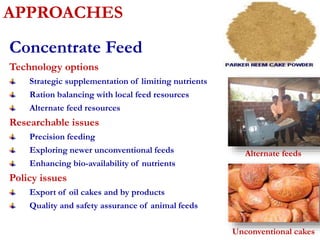
Alternate feeds 
Unconventional cakes
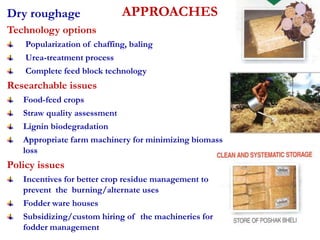
Dry roughage 
Technology options 
APPROACHES 
Popularization of chaffing, baling 
Urea-treatment process 
Complete feed block technology 
Researchable issues 
Food-feed crops 
Straw quality assessment 
Lignin biodegradation 
Appropriate farm machinery for minimizing biomass 
loss 
Policy issues 
Incentives for better crop residue management to 
prevent the burning/alternate uses 
Fodder ware houses 
Subsidizing/custom hiring of the machineries for better 
fodder management
APPROACHES 
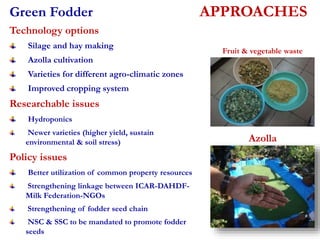
Fruit & vegetable waste 
Azolla 
Green Fodder 
Technology options 
Silage and hay making 
Azolla cultivation 
Varieties for different agro-climatic zones 
Improved cropping system 
Researchable issues 
Hydroponics 
Newer varieties (higher yield, sustain 
environmental & soil stress) 
Policy issues 
Better utilization of common property resources 
Strengthening linkage between ICAR-DAHDF-Milk 
Federation-NGOs 
Strengthening of fodder seed chain 
NSC & SSC to be mandated to promote fodder 
seeds
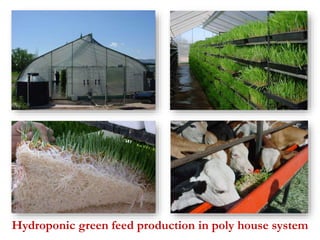
Hydroponic green feed production in poly house system
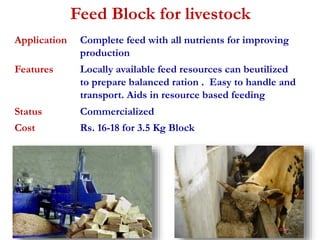
Feed Block for livestock 
Application Complete feed with all nutrients for improving 
production 
Features Locally available feed resources can beutilized 
to prepare balanced ration . Easy to handle and 
transport. Aids in resource based feeding 
Status Commercialized 
Cost Rs. 16-18 for 3.5 Kg Block
Bypass Protein (UDP) Feed 
Application By incorporating 50% of total protein as by-pass 
protein in concentrate mixture/ compound feed 
Features Useful for high producing animals (>10 litres) 
Status Available commercially 
Cost Treatment cost Rs. 60 to 80 per 100 kg 
protein supplement
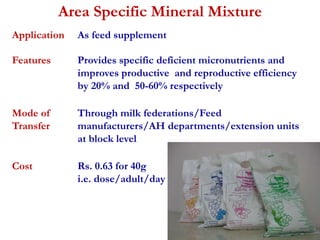
Area Specific Mineral Mixture 
Application As feed supplement 
Features Provides specific deficient micronutrients and 
improves productive and reproductive efficiency 
by 20% and 50-60% respectively 
Mode of 
Transfer 
Through milk federations/Feed 
manufacturers/AH departments/extension units 
at block level 
Cost Rs. 0.63 for 40g 
i.e. dose/adult/day
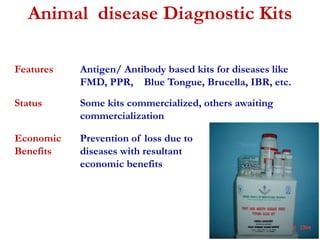
Animal disease Diagnostic Kits 
Features Antigen/ Antibody based kits for diseases like 
FMD, PPR, Blue Tongue, Brucella, IBR, etc. 
Status Some kits commercialized, others awaiting 
commercialization 
Economic 
Benefits 
Prevention of loss due to 
diseases with resultant 
economic benefits
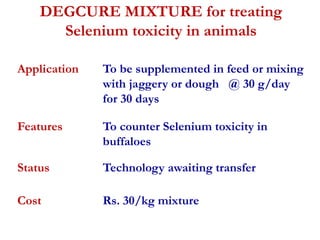
DEGCURE MIXTURE for treating 
Selenium toxicity in animals 
Application To be supplemented in feed or mixing 
with jaggery or dough @ 30 g/day 
for 30 days 
Features To counter Selenium toxicity in 
buffaloes 
Status Technology awaiting transfer 
Cost Rs. 30/kg mixture
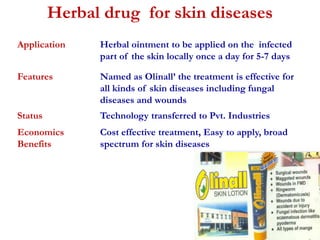
Herbal drug for skin diseases 
Application Herbal ointment to be applied on the infected 
part of the skin locally once a day for 5-7 days 
Features Named as Olinall’ the treatment is effective for 
all kinds of skin diseases including fungal 
diseases and wounds 
Status Technology transferred to Pvt. Industries 
Economics 
Benefits 
Cost effective treatment, Easy to apply, broad 
spectrum for skin diseases
Animal Products 
Animal Products Technology 
Low cholesterol ghee, Mango Lassi with 
extended shelf life, Ghee, fortified with herbs 
developed. 
Indigenous technology for production of 
Rasmalai, kulfi, kheer mix, gulab jamun mix 
with longer shelf life 
Arjuna Ghee 
Low Cholesterol 
Ghee 
Instant Rasmalai Mix
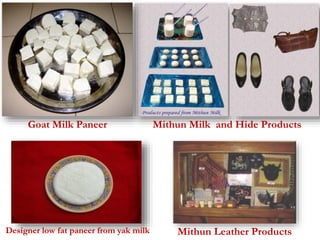
Goat Milk Paneer Mithun Milk and Hide Products 
Mithun Leather Products 
Designer low fat paneer from yak milk
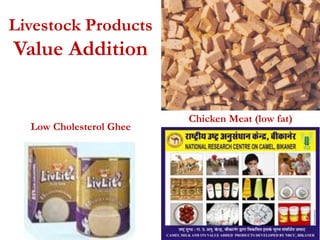
Livestock Products 
Value Addition 
Low Cholesterol Ghee 
Chicken Meat (low fat)
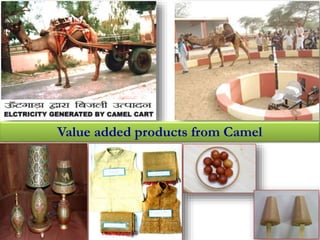
Value added products from Camel
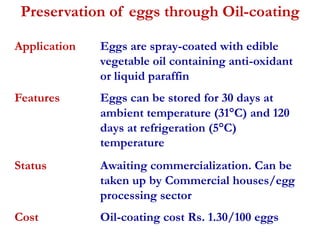
Preservation of eggs through Oil-coating 
Application Eggs are spray-coated with edible 
vegetable oil containing anti-oxidant 
or liquid paraffin 
Features Eggs can be stored for 30 days at 
ambient temperature (31C) and 120 
days at refrigeration (5C) 
temperature 
Status Awaiting commercialization. Can be 
taken up by Commercial houses/egg 
processing sector 
Cost Oil-coating cost Rs. 1.30/100 eggs
Pickled Eggs 
Application Simple method for pickling of quail/chicken eggs 
increased shelf life 
Features Process can be easily practiced in rural areas much 
investment, special skill and dependence on 
refrigeration 
Status Awaiting commercialization. Can be taken up by 
Commercial entrepreneurship/ egg processing 
sector 
Cost Rs. 10/10 pickled quail eggs 
Rs. 30/10 pickled chicken eggs
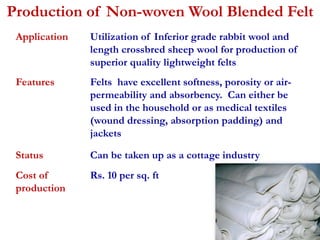
Production of Non-woven Wool Blended Felt 
Application Utilization of Inferior grade rabbit wool and 
length crossbred sheep wool for production of 
superior quality lightweight felts 
Features Felts have excellent softness, porosity or air-permeability 
and absorbency. Can either be 
used in the household or as medical textiles 
(wound dressing, absorption padding) and 
jackets 
Status Can be taken up as a cottage industry 
Cost of 
production 
Rs. 10 per sq. ft
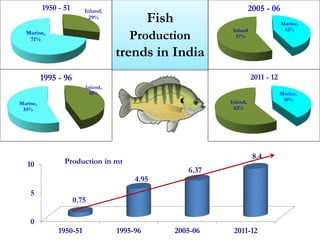
10 
5 
0 
Inland, 
29% 
0.75 
Fish 
Production 
trends in India 
4.95 
6.37 
2005 - 06 
2011 - 12 
8.4 
1950 - 51 
1950-51 1995-96 2005-06 2011-12 
Marine, 
71% 
Inland, 
45% 
Marine, 
55% 
1995 - 96 
Marine, 
Inland 43% 
57% 
Marine, 
Inland, 38% 
62% 
Production in mt
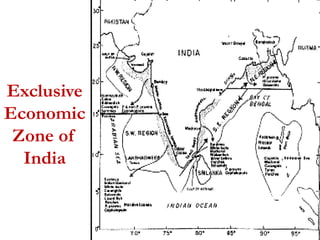
Exclusive 
Economic 
Zone of 
India
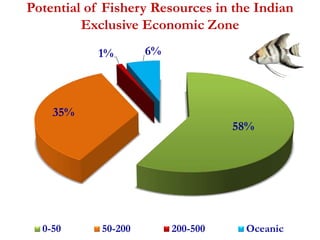
Potential of Fishery Resources in the Indian 
Exclusive Economic Zone 
58% 
35% 
1% 6% 
0-50 50-200 200-500 Oceanic
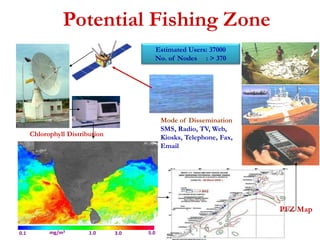
Potential Fishing Zone 
Chlorophyll Distribution 
PFZ Map 
Estimated Users: 37000 
No. of Nodes : > 370 
0.1 mg/m3 1.0 3.0 5.0 
Mode of Dissemination 
SMS, Radio, TV, Web, 
Kiosks, Telephone, Fax, 
Email
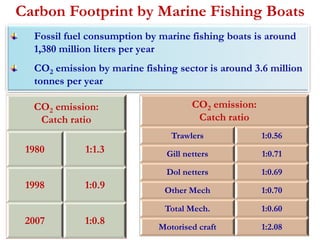
Carbon Footprint by Marine Fishing Boats 
Fossil fuel consumption by marine fishing boats is around 
1,380 million liters per year 
CO2 emission by marine fishing sector is around 3.6 million 
tonnes per year 
CO2 emission: 
Catch ratio 
1980 1:1.3 
1998 1:0.9 
2007 1:0.8 
CO2 emission: 
Catch ratio 
Trawlers 1:0.56 
Gill netters 1:0.71 
Dol netters 1:0.69 
Other Mech 1:0.70 
Total Mech. 1:0.60 
Motorised craft 1:2.08
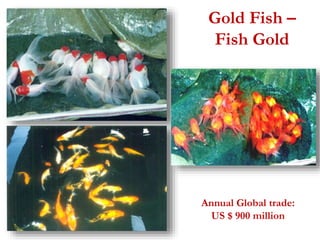
Gold Fish – 
Fish Gold 
Annual Global trade: 
US $ 900 million
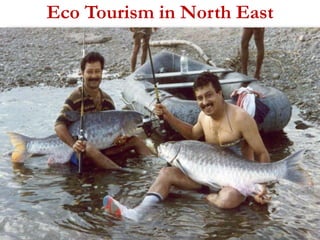
AQUA TOURISM
Eco Tourism in North East
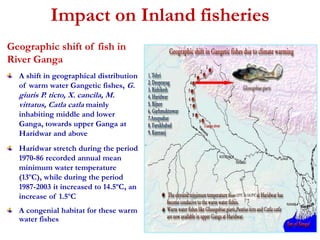
Impact on Inland fisheries 
Geographic shift of fish in 
River Ganga 
A shift in geographical distribution 
of warm water Gangetic fishes, G. 
giuris P. ticto, X. cancila, M. 
vittatus, Catla catla mainly 
inhabiting middle and lower 
Ganga, towards upper Ganga at 
Haridwar and above 
Haridwar stretch during the period 
1970-86 recorded annual mean 
minimum water temperature 
(13ºC), while during the period 
1987-2003 it increased to 14.5ºC, an 
increase of 1.5ºC 
A congenial habitat for these warm 
water fishes
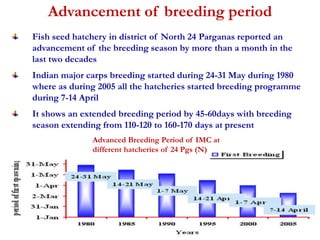
Advancement of breeding period 
Fish seed hatchery in district of North 24 Parganas reported an 
advancement of the breeding season by more than a month in the 
last two decades 
Indian major carps breeding started during 24-31 May during 1980 
where as during 2005 all the hatcheries started breeding programme 
during 7-14 April 
It shows an extended breeding period by 45-60days with breeding 
season extending from 110-120 to 160-170 days at present 
Advanced Breeding Period of IMC at 
different hatcheries of 24 Pgs (N)
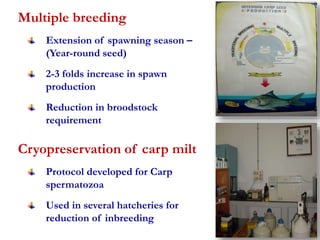
Multiple breeding 
Extension of spawning season – 
(Year-round seed) 
2-3 folds increase in spawn 
production 
Reduction in broodstock 
requirement 
Cryopreservation of carp milt 
Protocol developed for Carp 
spermatozoa 
Used in several hatcheries for 
reduction of inbreeding
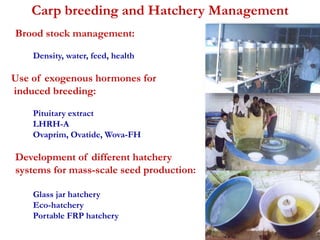
Carp breeding and Hatchery Management 
Brood stock management: 
Density, water, feed, health 
Use of exogenous hormones for 
induced breeding: 
Pituitary extract 
LHRH-A 
Ovaprim, Ovatide, Wova-FH 
Development of different hatchery 
systems for mass-scale seed production: 
Glass jar hatchery 
Eco-hatchery 
Portable FRP hatchery
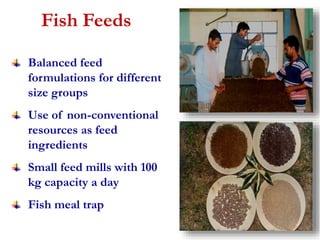
Fish Feeds 
Balanced feed 
formulations for different 
size groups 
Use of non-conventional 
resources as feed 
ingredients 
Small feed mills with 100 
kg capacity a day 
Fish meal trap
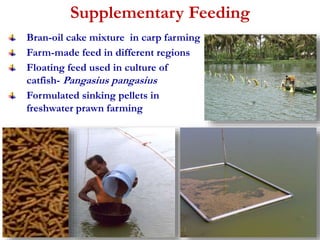
Supplementary Feeding 
Bran-oil cake mixture in carp farming 
Farm-made feed in different regions 
Floating feed used in culture of 
catfish- Pangasius pangasius 
Formulated sinking pellets in 
freshwater prawn farming
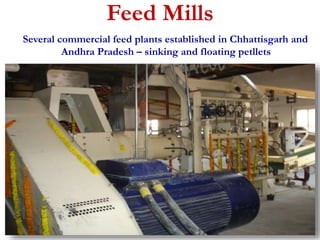
Feed Mills 
Several commercial feed plants established in Chhattisgarh and 
Andhra Pradesh – sinking and floating petllets
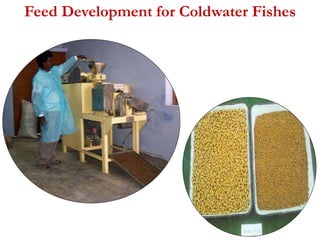
Feed Development for Coldwater Fishes
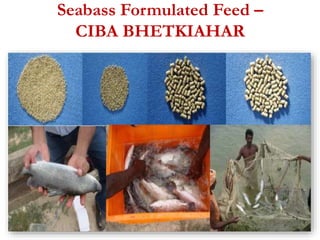
Seabass Formulated Feed – 
CIBA BHETKIAHAR
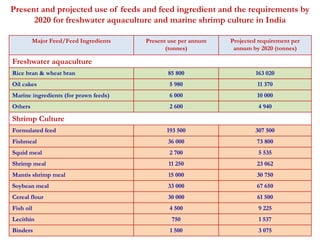
Present and projected use of feeds and feed ingredient and the requirements by 
2020 for freshwater aquaculture and marine shrimp culture in India 
Major Feed/Feed Ingredients Present use per annum 
(tonnes) 
Projected requirement per 
annum by 2020 (tonnes) 
Freshwater aquaculture 
Rice bran & wheat bran 85 800 163 020 
Oil cakes 5 980 11 370 
Marine ingredients (for prawn feeds) 6 000 10 000 
Others 2 600 4 940 
Shrimp Culture 
Formulated feed 193 500 307 500 
Fishmeal 36 000 73 800 
Squid meal 2 700 5 535 
Shrimp meal 11 250 23 062 
Mantis shrimp meal 15 000 30 750 
Soybean meal 33 000 67 650 
Cereal flour 30 000 61 500 
Fish oil 4 500 9 225 
Lecithin 750 1 537 
Binders 1 500 3 075
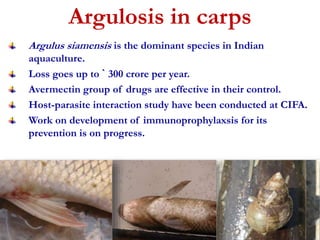
Argulosis in carps 
Argulus siamensis is the dominant species in Indian 
aquaculture. 
Loss goes up to ` 300 crore per year. 
Avermectin group of drugs are effective in their control. 
Host-parasite interaction study have been conducted at CIFA. 
Work on development of immunoprophylaxsis for its 
prevention is on progress.
Epizootic Ulcerative Syndrome 
It was first reported in May, 1988 in India. 
More than 30 species of fish are recorded to be 
infected. 
Causative agent: Oomycetes Aphanomyces invadans 
Recurrence of this disease has been reported again in 
northern parts of India.
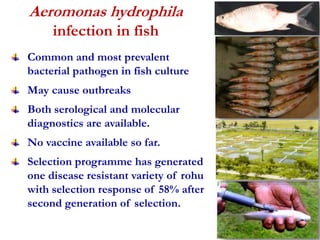
Aeromonas hydrophila 
infection in fish 
Common and most prevalent 
bacterial pathogen in fish culture 
May cause outbreaks 
Both serological and molecular 
diagnostics are available. 
No vaccine available so far. 
Selection programme has generated 
one disease resistant variety of rohu 
with selection response of 58% after 
second generation of selection.
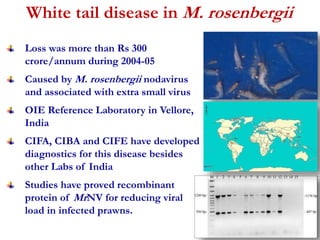
White tail disease in M. rosenbergii 
Loss was more than Rs 300 
crore/annum during 2004-05 
Caused by M. rosenbergii nodavirus 
and associated with extra small virus 
OIE Reference Laboratory in Vellore, 
India 
CIFA, CIBA and CIFE have developed 
diagnostics for this disease besides 
other Labs of India 
Studies have proved recombinant 
protein of MrNV for reducing viral 
load in infected prawns.
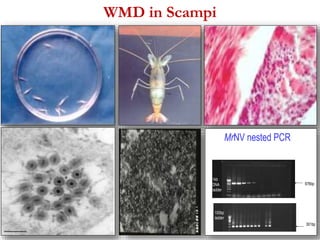
WMD in Scampi 
MrNV nested PCR 
676bp 
301bp 
1kb 
DNA 
ladder 
100bp 
ladder
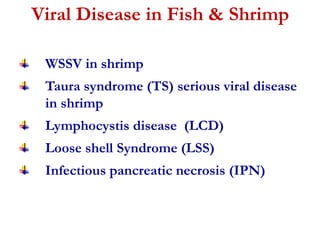
Viral Disease in Fish & Shrimp 
WSSV in shrimp 
Taura syndrome (TS) serious viral disease 
in shrimp 
Lymphocystis disease (LCD) 
Loose shell Syndrome (LSS) 
Infectious pancreatic necrosis (IPN)
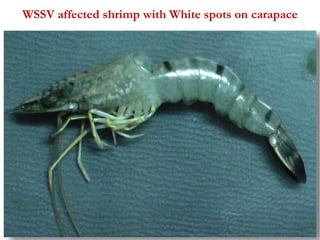
WSSV affected shrimp with White spots on carapace
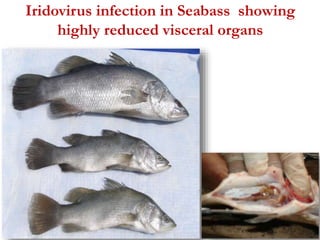
Iridovirus infection in Seabass showing 
highly reduced visceral organs
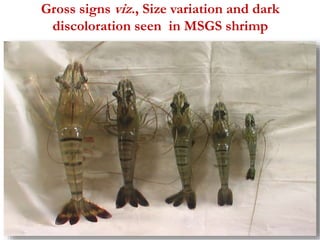
Gross signs viz., Size variation and dark 
discoloration seen in MSGS shrimp
Fish Health Management 
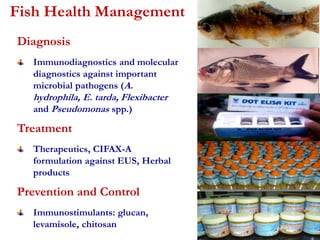
Diagnosis 
Immunodiagnostics and molecular 
diagnostics against important 
microbial pathogens (A. 
hydrophila, E. tarda, Flexibacter 
and Pseudomonas spp.) 
Treatment 
Therapeutics, CIFAX-A 
formulation against EUS, Herbal 
products 
Prevention and Control 
Immunostimulants: glucan, 
levamisole, chitosan
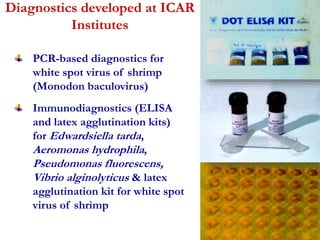
Diagnostics developed at ICAR 
Institutes 
PCR-based diagnostics for 
white spot virus of shrimp 
(Monodon baculovirus) 
Immunodiagnostics (ELISA 
and latex agglutination kits) 
for Edwardsiella tarda, 
Aeromonas hydrophila, 
Pseudomonas fluorescens, 
Vibrio alginolyticus & latex 
agglutination kit for white spot 
virus of shrimp
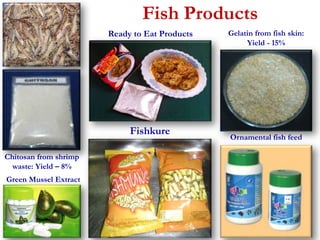
Fish Products 
Gelatin from fish skin: 
Yield - 15% 
Chitosan from shrimp 
waste: Yield – 8% 
Green Mussel Extract 
Ready to Eat Products 
Ornamental fish feed 
Fishkure
THANK YOU

Ayapan aquavet (13.10.2012)

  • 1.
  • 2.
    India Today… >17% of the world’s human & 11% livestock population and counting 4.2% of the world’s water 2.4% of the world’s area 142 m ha cultivated & 60 m ha net irrigated 138% cropping intensity 52% of population earns livelihood in agriculture 14.0% contribution in GDP 10.5% earning of total exports
  • 3.
    India’s Population 1961to 2051 Total and Urban Rural Urban 547 million 1210 million 1620 million
  • 4.
    Pressures on Natural Resource Base Deforestation Soil erosion Desertification (million ha) Land degradation 107.43 Water erosion 57.15 Degraded forests 24.90 Wind erosion 10.46 Salt-affected 6.32 Acid-affected 12.00 Others 8.60 Per capita agricultural land availability 0.34 ha (1950-51) 0.17 ha (1999-2000) 0.12 ha (2010-2011) Biodiversity for Posterity World Estimated Species 10 million Documented species 1.72 million India: Among the 12 Mega bio-diversity Centres India: 3 of the 34 Hot Spots of Biodiversity 12% of world’s flora 7% of world’s fauna National Bureaus of Plant, Animal, Fish, Microbes and Insects
  • 5.
    Economy and PerCapita Income Three scenarios Business as Usual (GDP growth 5.43%) Repeat of 1970-2010 Kneejerk reforms like 1991 if economy slides Phase of high growth, followed by emphasis on inclusive growth Maintain momentum (GDP growth 6.0%) Consolidate gains of post 1991 reforms that gave growth rate close to 6.7 % for two decades Reforms, but at slow pace Crisis forces long term initiatives to check populist policies Emphasis on balancing growth and sustainability Upside scenario (GDP growth 8.0%) India takes 37 years to achieve what China did in 30 years. It overtakes China to become top economy in PPP in 2050 (The Wealth Report 2012) Dynamic private sector, strong institutions and vast potential Chances of another bout of reforms to take economy to new growth trajectory.
  • 6.
    How Much Foodwill be Consumed? BAU MM UPSIDE 8597 54183 30497 12159 40312 60000 50000 40000 30000 20000 10000 0 1970 2010 2050 Food spending (`) Share (%) 40 yr. back 1970 Present 2010-11 2050 BAU MM UPSIDE Food share in income 58 23 9 10 6 Food spending 4.65 14.42 49.37 65.27 87.72 Per capita food spending 8597 12159 30497 40312 54183
  • 7.
    Total Domestic Demandfor Various Food Commodities: million tonne Food Items Present Projected for 2050 2009-2010 BAU MM Upside Cereals 196.4 311.5 358.7 406.9 Pulses 17.8 35.1 46.3 50.3 Foodgrains 214.2 346.6 405.0 457.1 Edible Oils 15.7 29.5 39.0 45.2 Vegetables 131.8 258.9 342.2 438.6 Fruits 71.2 231.0 305.3 183.4 Milk 111.5 303.7 401.4 483.6 Sugar 22.0 44.1 58.3 58.2 Meat 6.0 10.4 13.8 18.1 Eggs 58.2 139.2 183.9 202.5 Fish 7.1 16.9 22.4 27.0
  • 8.
    Past and RequiredGrowth Rate to Meet Domestic Demand (%/year) Items Historical Projected for 2050 BAU MM Upside Cereals 2.25 0.67 1.03 1.36 Sugar 2.57 1.39 2.12 2.11 Pulses 0.92 1.84 2.57 2.79 Edible oils 2.81 2.80 3.54 3.94 Vegetables 3.35 1.63 2.36 3.01 Fruits 3.31 2.90 3.64 2.29 Milk 4.39 2.26 2.99 3.49 Meat 4.22 1.31 2.04 2.75 Eggs 5.66 2.09 2.83 3.08 Fish 3.55 1.72 2.45 2.94 Total 1.92 2.57 2.82
  • 9.
    Land Scenario LandUse type: million hectare Land type 1970 2010 2050 Forest 63.8 69.6 69.6 Non Agriculture uses 16.5 26.3 42.0 Barren and Unculturable land 28.1 17.0 10.3 Permanent Pasture and Grazing 13.3 10.3 8.1 Miscellaneous trees and groves 4.4 3.4 4.4 Culturable waste 17.5 12.8 9.3 Fallow land other than current 19.3 24.9 19.3 Net Area Sown 140.8 141.4 142.6 Crop intensity 117.7 138.5 161.0 Reporting area 303.7 305.7 305.6 Increase in crop intensity will result in 17 per cent increase in area under cultivation Quality-Quantity dimension
  • 10.
    Water Scenario Waterdemand projection: NCIWRD and IWMII IWMI: Projects increase in Net area under irrigation from current level of 63 mh to 81 mh and gross irrigated area from 88 mh to 117 mh Water demand in Agriculture and other sectors: BCM Sector 2000 2010 2025 2050 NCIWRD, Planning Com. Irrigation 557 611 807 Total 710 843 1180 IWMI Irrigation 605 675 637 Domestica 34 66 101 Industrialb 42 92 161 Total 680 833 900 a Domestic withdrawals include those for livestock water demand which is 3.2 BCM b Industrial withdrawals include cooling needs for power generation Source: IWMI, 2007.
  • 11.
    Energy Scenario ElectricityDemand and Supply TWH Type of use 2006-07 2050 Growth Rate Total 526 3229 4.21 Agriculture Uses 99 174 1.29 Agriculture share 18.8 5.4 Source: Dolf Goelen, Nathalie Trudeau, Dagmar Graczyk, Peter Taylor (2009). Technology Development Prospects for the Indian Power Sector, IEA Working Paper Series, SPT/ETP/2009, Paris. Agriculture Energy use and Projections: P Joules Type 2005a 2010a 2020a GR 2005-20 2050b GR 2010-50 Electric 319 369 479 2.75 704 1.29 Diesel 341 382 461 2.03 842 2.03 Pumping 462 492 551 1.18 809 1.29 Farming 197 258 389 4.64 711 2.03 Total 659 750 940 2.40 1520 1.78 Source: Stephane de la Rue du Can, Michael McNeil, and Jayant Sathaye , India Energy Outlook: End Use Demand in India to 2020 , ERNEST ORLANDO LAWRENCE BERKELEY NATIONAL LABORATORY, January 2009, USA
  • 12.
    Manpower in Agriculture Sectoral Composition of Output and Workforce 1970 2010 BAU Mm Upside Output share % Agriculture 41.7 14.5 6.0 6.4 4.1 Non-Agriculture 58.3 85.5 94.0 93.6 95.9 Workforce share % Agriculture 72.1 53.2 27.2 27.2 27.2 Non-Agriculture 27.9 46.8 72.8 72.8 72.8 Workforce size: million Agriculture 126 244 171 171 171 Non-Agriculture 181 459 627 627 627
  • 13.
    Main Targets Afour fold increase in land productivity A three fold increase in water productivity Doubling of energy use efficiency A six fold increase in labour productivity Low carbon emission
  • 14.
    Productivity Gains Commodity Productivity 1950 2011 Times Food Grains, kg/ha 522 1921 3.7 Fruits, kg/ha 8600 11700 1.36 Vegetables, kg/ha 7500 17300 2.30 Fish, kg/ha (Aquaculture) 400 2900 7.25 Milk litre/lactation 583 1080 1.8 Eggs, No./bird 50 248 4.96
  • 15.
    Towards Knowledge Management Resources to Decisions Ideas - Innovations Insight - Vision Information - Knowledge Skills - Technologies
  • 16.
    Agricultural R&D Rainfedagriculture, Diversified agriculture, Integrated Agriculture Secondary Agriculture, Speciality Agriculture, Stress- Agriculture Climate-Smart Agriculture (Resilient varieties and breeds) Enhanced Input Use Efficiency (Reduced cost of cultivation) Health Management (genomics, diagnostics, vaccines, One Health approach) Farm Mechanization, Energy Management, Primary Processing and value addition
  • 17.
    Animal Husbandry: AnAncient Practice in India Dates back to 6-10 millennia Became symbol of socio-economic status & religious Seals from Harappa site depicting domestic and wild animals underline significance of animals. Vedic people worshipped cow as goddess Laxmi Vedic wars fought to protect animal wealth
  • 18.
    Indian Livestock 70million dairy farmers 199 million (15 % global) cattle and 105 million buffaloes (56% global) 140 million Goats (16.8 % : second after China) 71.5 million sheep 0.52 million camel (down 18% from 2003) 0.26 million mithuns 0.08 million yaks 11.1 million pigs (DAHD 2010)
  • 19.
    Livestock Production ata Glance Commodity Present Annual Production Rank in the World Demand by 2020 Milk (million tonnes) 127.3 I 152 Meat (million tonnes) 5.1 V 11 Eggs ( in billions) 65.5 III 88 Fish (million tonnes) 8.3 II 12
  • 20.
    Contribution of LivestockGDP 30 25 20 15 10 5 0 25.04 25.2 25.46 25.39 16.04 15.46 14.69 14.29 27.59 13.36 28.86 27.28 12.41 12.34 4.02 3.9 3.74 3.63 3.68 3.58 3.37 2004-05 2005-06 2006-07 2007-08 2208-09 2009-10 2010-11 Ag. (%) Total GDP AH (%) to Total GDP AH (%) to Ag. GDP
  • 21.
    Production 176.0 251.0 260.0 266.0 273.0 281.0 Milk 124.0 121.8 127.3 112.0 17.0 21.2 53.9 102.6 107.9 112.2 116.4 1950-51 1968-69 1990-91 2006-07 2007-08 2008-09 2009-10 2010-11 2011-12 Milk Production (MT) Per Capita Availability (gm/day)
  • 22.
    Meat Production (milliontonnes) 1.9 2.1 2.3 4.0 4.2 4.5 4.9 5.1 1998-99 2002-03 2006-07 2007-08 2008-09 2009-10 2010-11 2011-12
  • 23.
    1.8 5.3 Poultry 21.1 50.7 53.6 55.6 60.3 63.0 65.5 5.0 10.0 25.0 42.0 47.0 49.0 51.0 53.0 1950-51 1968-69 1990-91 2006-07 2007-08 2008-09 2009-10 2010-11 2011-12 Egg (billion nos.) Per Capita Availability (nos/annum)
  • 24.
    Wool Production (millionkg) 27.5 29.8 41.2 45.2 44.0 41.0 43.1 43.0 44.4 1950-51 1968-69 1990-91 2006-07 2007-08 2008-09 2009-10 2010-11 2011-12
  • 25.
    Improved Germplasm Ruralpoultry strains Murrah Buffalo Gir Cattle Improved goat germplasm Mewari Camel Marwari Horse Crossbred cattle germplasm
  • 26.
    Improved germplasm Frieswalcrossbred cattle with milk yield of 3000 kg/lactation Frieswal cow Vrindavani cattle Improved Murrah buffalo yielding >2500 Kg/lactation
  • 27.
    A Cross BredCow under Trial in a Village Produced 59.5 kg Milk
  • 28.
    Garole X MalpuraCrosses of sheep (introgression of FeC B- twinning gene) Improved germplasm of goats with increased weight gain and milk production Jamunapari Sirohi
  • 29.
    Pig Germplasm MeghalayaLocal Ghungroo Duroc Hampshire Crossbred piglets
  • 30.
    Animals for the highlanders Yak Mithun
  • 31.
    Yaks: Bos grunniens White Yak Hairy Forehead Yak Common Yak 70000 60000 50000 40000 Bisonian Yak Bare-Back Yak 30000 20000 10000 0 62000 14000 5000 2000 50 30
  • 32.
    Different Genetic Strainsof Mithun: Bos frontalis Arunachal Pradesh Manipur Nagaland Mizoram
  • 33.
    Improved breeds/ strainsfor backyard poultry laying 170 eggs/year Female Gramapriya Vanaraja Male Female Male
  • 34.
    Improved strains forQuails, Ducks, Turkey, Guinea Fowl 34
  • 35.
    20 18 16 14 12 10 8 6 4 2 0 Poultry strains developed over a period 7 6 6 3 3 1 10 6 Broiler Layer Rural 19 1980 - 1990 1990 - 2000 2000 - 2010 Breeds with Over 300 eggs/year
  • 36.
    Global Warming Thereis a gradual increase in the average temperature of the Earth’s atmosphere in the last 100 years…It has risen about 1°C since 1900…
  • 37.
    Global Anthropogenic CH4budget Enteric fermentation , 28% Natural gas , 15% Solid waste , 13% Oil, 1% Fuel stat. & mobile , 1% Biofuel combustion , 4% Biomass burning , 5% Manure, 4% Rice , 11% Coal, 8% Waste water , 10%
  • 38.
    Methane emission bylivestock in India Global India % of global Livestock population (Million) 4599.7 529.2 11.51 Enteric methane emission (Tg/year) 109.44 12.97 11.85 Methane emission from waste (Tg/year) 12.67 1.24 9.79 Total methane emission (Tg/year) 122.11 13.21 11.64
  • 39.
    Climate Change: DirectAnd Indirect Impacts On Livestock And Livestock Systems A. Feeds: quantity and quality is adversely affected B. Impact on livestock pastures and forage crop production C. Changes in distribution of livestock disease and pests D. Direct effects on animal health, growth and reproduction
  • 40.
    Response to HeatStress Reduced feed intake increased water intake altered metabolic rate increased evaporative water loss increased respiration rate altered blood hormone concentrations increased body temperature reduced uterine blood flow
  • 41.
  • 42.
    Peculiarities of AridZone Low & erratic rainfall <400 mm (cv. 80-40%) High Temperature (45-48ºC) High wind velocity (20-40 km hr-1) Frequent Drought Sandy Soil with Low Soil WHC Poor Soil Fertility Degraded Natural Vegetation Wind & Water Erosion Acute Water Scarcity Poor Water Resources Lowering Ground water Table Hostile Climate, Fragile Natural Resources, Socio-Economic Constraints, Poor Market facilities Low Biomass Production/ Crop Failures (not dependable) Animal Husbandry + Perennial Vegetation provides stability
  • 43.
    Camel Production Thrivewell and reproduce in semi-arid and arid areas Lower water requirements and excrete less water and nitrogen in urine The amount of digested cell wall carbohydrate is much larger Hsp70 gene cluster (HSPA1A,HSPA1B & HSPA1L) are actively transcribed in different camel tissues even under normal physiological conditions Declining population of camels by 50% during the last 4 decades is a matter of serious concern
  • 44.
    0.8 0.7 0.6 0.5 0.4 0.3 0.2 0.1 0 Change in Camel Population(million)-- Rajasthan 1940 1960 1980 2000 2020 Camel Populaion(million) 1.2 1 0.8 0.6 0.4 0.2 0 Camel Population(million)--India 1940 1960 1980 2000 2020 Population Years
  • 45.
    The Bactrian Camel(Ladakh) Dwindling rapidly : < 100 Non functional sweat glands Can only conserve heat but cannot dissipate heat effectively
  • 46.
    Approaches for alleviatingthermal Stress Animal Housing Management Nutritional Modifications Biotech Options Improved Health Service Animal shelter design Animal shade Cooling system Sprinkle system Forced ventilation Seasonal specific feeding Fiber feeding Feeding Fats and Concentrates Vitamin and Mineral Supplementation Water Requirement Livestock Diversity Genetic Selection Genomics/proteomics Embryo Transfer Stress Resistant Species Monitoring and control Epidemiological surveillance Rapid investigation of outbreaks Geographic information system Laboratory and Field Research
  • 47.
    Milk Production inIndia and the United States
  • 48.
    Milk Production Estimates Animal No. in milk (in millions) Av. Yd. (kg/d) Milk (million tonnes) % Indigenous cows 28.8 (53%) 2.14 22.5 20.3 Crossbred cows 10.1 (65%) 6.87 25.4 22.8 Buffaloes 35.5 (67.2%) 4.57 59.2 53.3 Goats 28.9 0.37 3.9 3.5
  • 49.
    Issues and Constraints Feed and fodder availability Poor per capita milk yield Livestock health Livestock infertility Clean milk and Meat Production Climate Change
  • 50.
    Estrus Synchronization Kitfor Sheep and Goat Application Estrus induction and synchronization in small ruminants Useful in getting 3 lambings/ewe in 2 years Features Controls cyclicity of animals Status State Animal Husbandry Deptts./Extension Units at Transfer Block level Cost Rs. 10.60 for one dose Cost of Kit: Rs 260=00 Kit consists of Sponge 25 Speculum 1 Plunger 1
  • 51.
    A farmer ShriSuresh Kumar, Village Kunjpura, Karnal, Haryana with his buffalo which was successfully treated for anestrus and administered ovsynch protocol. The animal conceived and delivered a calf
  • 52.
    Buffalo which hadnot conceived for 5 years belonging to Mr. Suresh Pal, s/o Mr. Mahiram, Village - Pundrak was treated with ovsynch and declared pregnant
  • 53.
    Buffalo heifer (5years old) belonging to Sh. Jaswant s/o Sh. Hari Singh of village Narukheri which was treated with heatsynch and declared pregnant.
  • 54.
    Embryo Biotechnology Cloning Embryo transfer IVF
  • 55.
    Identical Twins ofSahiwal from Split Embryos First ever IVF goat kid in 55 India World’s first cloned buffalo calf was produced using economical Handmade Cloning Technique World’s second cloned buffalo calf named ‘Garima’ was produced using Handmade cloning technique
  • 56.
    Estimated requirement &availability of feed resources by 2020 Category Requirements * (million tons) Availability * (million tons) % Deficit * % Deficit # Dry fodder 530 404 24 11 Green fodder 880 590 33 35 Concentrate 96 61 37 45 * NIANP estimates # (XII plan document)
  • 57.
    Export of oilcakes and bran (tons) 100% 90% 80% 70% 60% 50% 40% 30% 20% 10% The quantity of oil-meals exported if used domestically can result in additional 12-15 million tons of milk annually bridging the deficit gap 0% 2007-08 2008-09 2009-10 2010-11 2011-12 Castor seed Ricebran Groundnut Rape Soybean
  • 58.
    CONSTRAINTS Changes inthe area under fodder, forest, fallow, pasture and cultivable wasteland Category & area (million Ha) 1990 2010 2020* % change over 1990 Gross cropped areas (Excluding fodder crops) 174.1 188.1 196.8 13.0 Fodder crops 8.3 7.9 7.09 -14.2 Forest 67.4 69.6 69.3 2.8 Permanent pastures & grazing 11.3 10.2 9.5 -16.0 Misc. tree cops & groves not included 3.8 3.3 3.1 -17.1 Cultivable wasteland 15.1 12.9 11.7 -22.2 Current fallow 13.7 15.7 14.4 5.1 Other fallow 10.3 9.8 9.8 -4.7 * NIANP Projections Declining fodder area, CPRs and plateau in the area & productivity of food crops. Waste and fallow lands are under exploited due to labour shortage, uncertain rainfall and increased cost of inputs
  • 59.
    APPROACHES Concentrate Feed Technology options Strategic supplementation of limiting nutrients Ration balancing with local feed resources Alternate feed resources Researchable issues Precision feeding Exploring newer unconventional feeds Enhancing bio-availability of nutrients Policy issues Export of oil cakes and by products Quality and safety assurance of animal feeds Alternate feeds Unconventional cakes
  • 60.
    Dry roughage Technologyoptions APPROACHES Popularization of chaffing, baling Urea-treatment process Complete feed block technology Researchable issues Food-feed crops Straw quality assessment Lignin biodegradation Appropriate farm machinery for minimizing biomass loss Policy issues Incentives for better crop residue management to prevent the burning/alternate uses Fodder ware houses Subsidizing/custom hiring of the machineries for better fodder management
  • 61.
    APPROACHES Fruit &vegetable waste Azolla Green Fodder Technology options Silage and hay making Azolla cultivation Varieties for different agro-climatic zones Improved cropping system Researchable issues Hydroponics Newer varieties (higher yield, sustain environmental & soil stress) Policy issues Better utilization of common property resources Strengthening linkage between ICAR-DAHDF-Milk Federation-NGOs Strengthening of fodder seed chain NSC & SSC to be mandated to promote fodder seeds
  • 62.
    Hydroponic green feedproduction in poly house system
  • 63.
    Feed Block forlivestock Application Complete feed with all nutrients for improving production Features Locally available feed resources can beutilized to prepare balanced ration . Easy to handle and transport. Aids in resource based feeding Status Commercialized Cost Rs. 16-18 for 3.5 Kg Block
  • 64.
    Bypass Protein (UDP)Feed Application By incorporating 50% of total protein as by-pass protein in concentrate mixture/ compound feed Features Useful for high producing animals (>10 litres) Status Available commercially Cost Treatment cost Rs. 60 to 80 per 100 kg protein supplement
  • 65.
    Area Specific MineralMixture Application As feed supplement Features Provides specific deficient micronutrients and improves productive and reproductive efficiency by 20% and 50-60% respectively Mode of Transfer Through milk federations/Feed manufacturers/AH departments/extension units at block level Cost Rs. 0.63 for 40g i.e. dose/adult/day
  • 66.
    Animal disease DiagnosticKits Features Antigen/ Antibody based kits for diseases like FMD, PPR, Blue Tongue, Brucella, IBR, etc. Status Some kits commercialized, others awaiting commercialization Economic Benefits Prevention of loss due to diseases with resultant economic benefits
  • 67.
    DEGCURE MIXTURE fortreating Selenium toxicity in animals Application To be supplemented in feed or mixing with jaggery or dough @ 30 g/day for 30 days Features To counter Selenium toxicity in buffaloes Status Technology awaiting transfer Cost Rs. 30/kg mixture
  • 68.
    Herbal drug forskin diseases Application Herbal ointment to be applied on the infected part of the skin locally once a day for 5-7 days Features Named as Olinall’ the treatment is effective for all kinds of skin diseases including fungal diseases and wounds Status Technology transferred to Pvt. Industries Economics Benefits Cost effective treatment, Easy to apply, broad spectrum for skin diseases
  • 69.
    Animal Products AnimalProducts Technology Low cholesterol ghee, Mango Lassi with extended shelf life, Ghee, fortified with herbs developed. Indigenous technology for production of Rasmalai, kulfi, kheer mix, gulab jamun mix with longer shelf life Arjuna Ghee Low Cholesterol Ghee Instant Rasmalai Mix
  • 70.
    Goat Milk PaneerMithun Milk and Hide Products Mithun Leather Products Designer low fat paneer from yak milk
  • 71.
    Livestock Products ValueAddition Low Cholesterol Ghee Chicken Meat (low fat)
  • 72.
  • 73.
    Preservation of eggsthrough Oil-coating Application Eggs are spray-coated with edible vegetable oil containing anti-oxidant or liquid paraffin Features Eggs can be stored for 30 days at ambient temperature (31C) and 120 days at refrigeration (5C) temperature Status Awaiting commercialization. Can be taken up by Commercial houses/egg processing sector Cost Oil-coating cost Rs. 1.30/100 eggs
  • 74.
    Pickled Eggs ApplicationSimple method for pickling of quail/chicken eggs increased shelf life Features Process can be easily practiced in rural areas much investment, special skill and dependence on refrigeration Status Awaiting commercialization. Can be taken up by Commercial entrepreneurship/ egg processing sector Cost Rs. 10/10 pickled quail eggs Rs. 30/10 pickled chicken eggs
  • 75.
    Production of Non-wovenWool Blended Felt Application Utilization of Inferior grade rabbit wool and length crossbred sheep wool for production of superior quality lightweight felts Features Felts have excellent softness, porosity or air-permeability and absorbency. Can either be used in the household or as medical textiles (wound dressing, absorption padding) and jackets Status Can be taken up as a cottage industry Cost of production Rs. 10 per sq. ft
  • 76.
    10 5 0 Inland, 29% 0.75 Fish Production trends in India 4.95 6.37 2005 - 06 2011 - 12 8.4 1950 - 51 1950-51 1995-96 2005-06 2011-12 Marine, 71% Inland, 45% Marine, 55% 1995 - 96 Marine, Inland 43% 57% Marine, Inland, 38% 62% Production in mt
  • 77.
  • 78.
    Potential of FisheryResources in the Indian Exclusive Economic Zone 58% 35% 1% 6% 0-50 50-200 200-500 Oceanic
  • 79.
    Potential Fishing Zone Chlorophyll Distribution PFZ Map Estimated Users: 37000 No. of Nodes : > 370 0.1 mg/m3 1.0 3.0 5.0 Mode of Dissemination SMS, Radio, TV, Web, Kiosks, Telephone, Fax, Email
  • 80.
    Carbon Footprint byMarine Fishing Boats Fossil fuel consumption by marine fishing boats is around 1,380 million liters per year CO2 emission by marine fishing sector is around 3.6 million tonnes per year CO2 emission: Catch ratio 1980 1:1.3 1998 1:0.9 2007 1:0.8 CO2 emission: Catch ratio Trawlers 1:0.56 Gill netters 1:0.71 Dol netters 1:0.69 Other Mech 1:0.70 Total Mech. 1:0.60 Motorised craft 1:2.08
  • 81.
    Gold Fish – Fish Gold Annual Global trade: US $ 900 million
  • 82.
  • 83.
    Eco Tourism inNorth East
  • 84.
    Impact on Inlandfisheries Geographic shift of fish in River Ganga A shift in geographical distribution of warm water Gangetic fishes, G. giuris P. ticto, X. cancila, M. vittatus, Catla catla mainly inhabiting middle and lower Ganga, towards upper Ganga at Haridwar and above Haridwar stretch during the period 1970-86 recorded annual mean minimum water temperature (13ºC), while during the period 1987-2003 it increased to 14.5ºC, an increase of 1.5ºC A congenial habitat for these warm water fishes
  • 85.
    Advancement of breedingperiod Fish seed hatchery in district of North 24 Parganas reported an advancement of the breeding season by more than a month in the last two decades Indian major carps breeding started during 24-31 May during 1980 where as during 2005 all the hatcheries started breeding programme during 7-14 April It shows an extended breeding period by 45-60days with breeding season extending from 110-120 to 160-170 days at present Advanced Breeding Period of IMC at different hatcheries of 24 Pgs (N)
  • 86.
    Multiple breeding Extensionof spawning season – (Year-round seed) 2-3 folds increase in spawn production Reduction in broodstock requirement Cryopreservation of carp milt Protocol developed for Carp spermatozoa Used in several hatcheries for reduction of inbreeding
  • 87.
    Carp breeding andHatchery Management Brood stock management: Density, water, feed, health Use of exogenous hormones for induced breeding: Pituitary extract LHRH-A Ovaprim, Ovatide, Wova-FH Development of different hatchery systems for mass-scale seed production: Glass jar hatchery Eco-hatchery Portable FRP hatchery
  • 88.
    Fish Feeds Balancedfeed formulations for different size groups Use of non-conventional resources as feed ingredients Small feed mills with 100 kg capacity a day Fish meal trap
  • 89.
    Supplementary Feeding Bran-oilcake mixture in carp farming Farm-made feed in different regions Floating feed used in culture of catfish- Pangasius pangasius Formulated sinking pellets in freshwater prawn farming
  • 90.
    Feed Mills Severalcommercial feed plants established in Chhattisgarh and Andhra Pradesh – sinking and floating petllets
  • 91.
    Feed Development forColdwater Fishes
  • 92.
    Seabass Formulated Feed– CIBA BHETKIAHAR
  • 93.
    Present and projecteduse of feeds and feed ingredient and the requirements by 2020 for freshwater aquaculture and marine shrimp culture in India Major Feed/Feed Ingredients Present use per annum (tonnes) Projected requirement per annum by 2020 (tonnes) Freshwater aquaculture Rice bran & wheat bran 85 800 163 020 Oil cakes 5 980 11 370 Marine ingredients (for prawn feeds) 6 000 10 000 Others 2 600 4 940 Shrimp Culture Formulated feed 193 500 307 500 Fishmeal 36 000 73 800 Squid meal 2 700 5 535 Shrimp meal 11 250 23 062 Mantis shrimp meal 15 000 30 750 Soybean meal 33 000 67 650 Cereal flour 30 000 61 500 Fish oil 4 500 9 225 Lecithin 750 1 537 Binders 1 500 3 075
  • 94.
    Argulosis in carps Argulus siamensis is the dominant species in Indian aquaculture. Loss goes up to ` 300 crore per year. Avermectin group of drugs are effective in their control. Host-parasite interaction study have been conducted at CIFA. Work on development of immunoprophylaxsis for its prevention is on progress.
  • 95.
    Epizootic Ulcerative Syndrome It was first reported in May, 1988 in India. More than 30 species of fish are recorded to be infected. Causative agent: Oomycetes Aphanomyces invadans Recurrence of this disease has been reported again in northern parts of India.
  • 96.
    Aeromonas hydrophila infectionin fish Common and most prevalent bacterial pathogen in fish culture May cause outbreaks Both serological and molecular diagnostics are available. No vaccine available so far. Selection programme has generated one disease resistant variety of rohu with selection response of 58% after second generation of selection.
  • 97.
    White tail diseasein M. rosenbergii Loss was more than Rs 300 crore/annum during 2004-05 Caused by M. rosenbergii nodavirus and associated with extra small virus OIE Reference Laboratory in Vellore, India CIFA, CIBA and CIFE have developed diagnostics for this disease besides other Labs of India Studies have proved recombinant protein of MrNV for reducing viral load in infected prawns.
  • 98.
    WMD in Scampi MrNV nested PCR 676bp 301bp 1kb DNA ladder 100bp ladder
  • 99.
    Viral Disease inFish & Shrimp WSSV in shrimp Taura syndrome (TS) serious viral disease in shrimp Lymphocystis disease (LCD) Loose shell Syndrome (LSS) Infectious pancreatic necrosis (IPN)
  • 100.
    WSSV affected shrimpwith White spots on carapace
  • 101.
    Iridovirus infection inSeabass showing highly reduced visceral organs
  • 102.
    Gross signs viz.,Size variation and dark discoloration seen in MSGS shrimp
  • 103.
    Fish Health Management Diagnosis Immunodiagnostics and molecular diagnostics against important microbial pathogens (A. hydrophila, E. tarda, Flexibacter and Pseudomonas spp.) Treatment Therapeutics, CIFAX-A formulation against EUS, Herbal products Prevention and Control Immunostimulants: glucan, levamisole, chitosan
  • 104.
    Diagnostics developed atICAR Institutes PCR-based diagnostics for white spot virus of shrimp (Monodon baculovirus) Immunodiagnostics (ELISA and latex agglutination kits) for Edwardsiella tarda, Aeromonas hydrophila, Pseudomonas fluorescens, Vibrio alginolyticus & latex agglutination kit for white spot virus of shrimp
  • 105.
    Fish Products Gelatinfrom fish skin: Yield - 15% Chitosan from shrimp waste: Yield – 8% Green Mussel Extract Ready to Eat Products Ornamental fish feed Fishkure
  • 106.