Drug Purchasing & Pricing 
The Pharmaceutical Industry Perspective 
David Lin 
Head of Market Access 
Novartis Oncology 
National Cancer Institute, Putrajaya 
24 Nov 2014
Disclaimer 
 Full-time employee of Novartis Corporation. 
 Information shared in this presentation does not 
necessarily represents the sole position of 
Novartis Corporation. 
 Previous employment includes Pfizer, 
AstraZeneca, Bayer Healthcare, Genzyme and 
Sanofi.
Contents 
Introduction 
Pricing Context in Malaysia 
National Medicine Policy (DuNAS) 
Pharmaceutical Pricing 
External Reference Pricing 
Drugs availability – patients access 
Access of the Future & Conclusion
Introduction
Introduction 
 Demand for more and better healthcare grows faster 
than resources available to meet the demand 
 Facing growing ageing population 
 More chronic diseases developed and diagnosed 
 More new innovative treatments 
 Healthcare is a great political topic 
 More countries recognize good health is an economic 
asset and are finding ways to improve the healthcare 
system (e.g., designing and implementing Universal 
Coverage)
Introduction 
 Payers face increasingly complex decision-making 
challenges in the oncology treatment due to the pace 
of groundbreaking scientific advances e.g. targeted 
therapy, cell therapy. 
 Such challenges requires: 
 Systematic understanding of value of clinical endpoints 
 Incorporating valuable endpoints in reimbursement 
 Evidence to demonstrate valuable endpoints 
The pace of new treatment discoveries and increasing number of 
therapeutic options requires new frameworks for payers to evaluate 
for reimbursement
Pricing Context in Malaysia
Medicine Pricing 
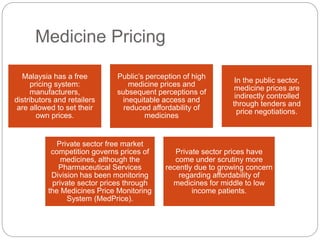
Malaysia has a free 
pricing system: 
manufacturers, 
distributors and retailers 
are allowed to set their 
own prices. 
Public’s perception of high 
medicine prices and 
subsequent perceptions of 
inequitable access and 
reduced affordability of 
medicines 
In the public sector, 
medicine prices are 
indirectly controlled 
through tenders and 
price negotiations. 
Private sector free market 
competition governs prices of 
medicines, although the 
Pharmaceutical Services 
Division has been monitoring 
private sector prices through 
the Medicines Price Monitoring 
System (MedPrice). 
Private sector prices have 
come under scrutiny more 
recently due to growing concern 
regarding affordability of 
medicines for middle to low 
income patients.
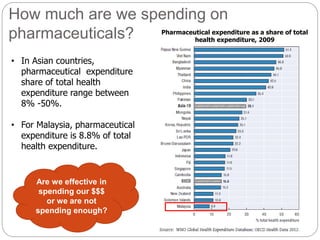
How much are we spending on 
pharmaceuticals? Pharmaceutical expenditure as a share of total 
health expenditure, 2009 
• In Asian countries, 
pharmaceutical expenditure 
share of total health 
expenditure range between 
8% -50%. 
• For Malaysia, pharmaceutical 
expenditure is 8.8% of total 
health expenditure. 
Are we effective in 
spending our $$$ 
or we are not 
spending enough?
National Medicine Policy (DuNAS)
Industry collaborating with MOH to achieve 
goals of National Medicine Policy
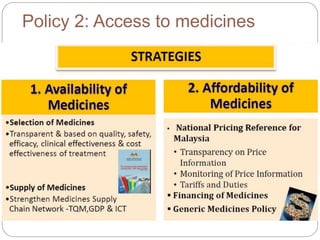
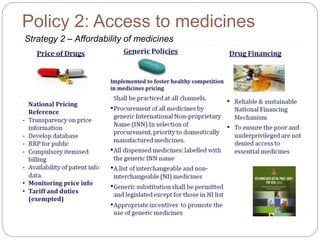
Policy 2: Access to medicines
Policy 2: Access to medicines 
Strategy 2 – Affordability of medicines
Pharmaceutical Pricing
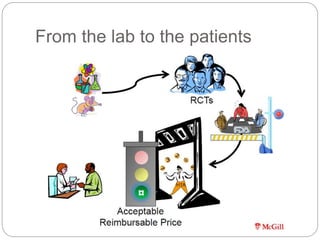
From the lab to the patients
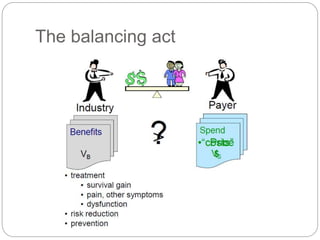
The balancing act
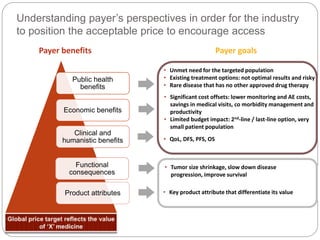
Understanding payer’s perspectives in order for the industry 
to position the acceptable price to encourage access 
Payer benefits 
Public health 
benefits 
Economic benefits 
Clinical and 
humanistic benefits 
Functional 
consequences 
Product attributes 
Payer goals 
• Unmet need for the targeted population 
• Existing treatment options: not optimal results and risky 
• Rare disease that has no other approved drug therapy 
• Significant cost offsets: lower monitoring and AE costs, 
savings in medical visits, co morbidity management and 
productivity 
• Limited budget impact: 2nd-line / last-line option, very 
small patient population 
• QoL, DFS, PFS, OS 
• Tumor size shrinkage, slow down disease 
progression, improve survival 
• Key product attribute that differentiate its value
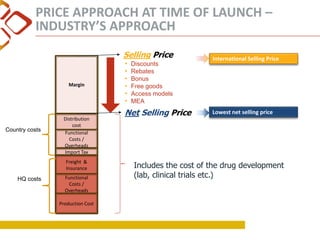
PRICE APPROACH AT TIME OF LAUNCH – 
INDUSTRY’S APPROACH 
Margin 
Distribution 
cost 
Functional 
Costs / 
Overheads 
Import Tax 
Freight & 
Insurance 
Functional 
Costs / 
Overheads 
Production Cost 
Country costs 
HQ costs 
Selling Price 
• Discounts 
• Rebates 
• Bonus 
• Free goods 
• Access models 
• MEA 
Net Selling Price 
International Selling Price 
Lowest net selling price 
Includes the cost of the drug development 
(lab, clinical trials etc.)
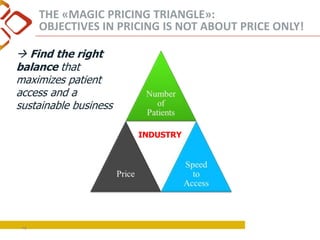
THE «MAGIC PRICING TRIANGLE»: 
OBJECTIVES IN PRICING IS NOT ABOUT PRICE ONLY! 
 Find the right 
balance that 
maximizes patient 
access and a 
sustainable business 
19 
INDUSTRY
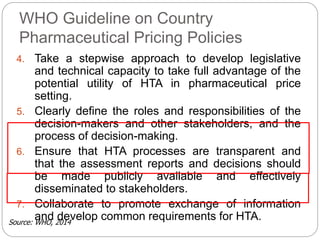
WHO Guideline on Country 
Pharmaceutical Pricing Policies 
1. Use health technology assessment (HTA) as a tool 
to support reimbursement decision-making as well 
as price setting/negotiation. 
2. Combine HTA with other policies. 
3. Using HTA: review of reports from other countries; 
review of reports submitted by industry; conduct 
assessments based on local information and local 
data. 
Source: WHO, 2014
WHO Guideline on Country 
Pharmaceutical Pricing Policies 
4. Take a stepwise approach to develop legislative 
and technical capacity to take full advantage of the 
potential utility of HTA in pharmaceutical price 
setting. 
5. Clearly define the roles and responsibilities of the 
decision-makers and other stakeholders, and the 
process of decision-making. 
6. Ensure that HTA processes are transparent and 
that the assessment reports and decisions should 
be made publicly available and effectively 
disseminated to stakeholders. 
7. Collaborate to promote exchange of information 
and develop common requirements for HTA. 
Source: WHO, 2014
External Reference Pricing
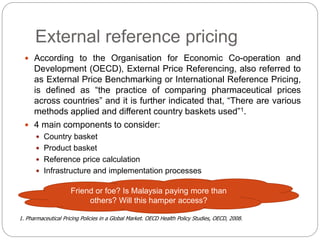
External reference pricing 
 According to the Organisation for Economic Co-operation and 
Development (OECD), External Price Referencing, also referred to 
as External Price Benchmarking or International Reference Pricing, 
is defined as “the practice of comparing pharmaceutical prices 
across countries” and it is further indicated that, “There are various 
methods applied and different country baskets used”1. 
 4 main components to consider: 
 Country basket 
 Product basket 
 Reference price calculation 
 Infrastructure and implementation processes 
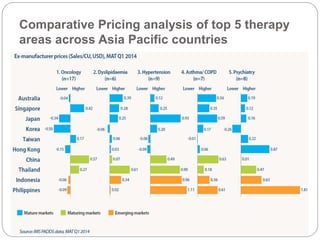
Friend or foe? Is Malaysia paying more than 
others? Will this hamper access? 
1. Pharmaceutical Pricing Policies in a Global Market. OECD Health Policy Studies, OECD, 2008.
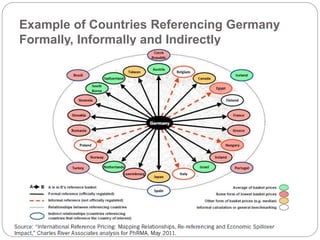
Example of Countries Referencing Germany 
Formally, Informally and Indirectly
Comparative Pricing analysis of top 5 therapy 
areas across Asia Pacific countries
Drug availability – patients access
Drug Availability 
 There is evidence that availability of medicines may be 
a challenge, with patients not receiving treatments 
despite reimbursement on the MoH formulary 1. 
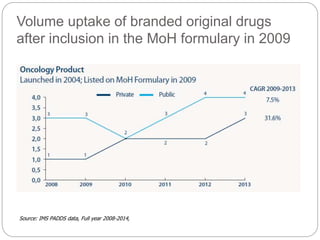
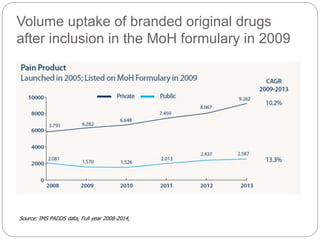
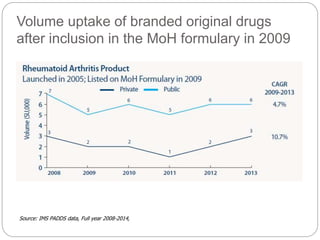
 The public sector uptake showed limited growth, despite 
listing on the MoH Formulary in 2009. 
 In the case of the oncology product, the growth in public 
sector uptake over the 4 years since 2009 had been 
about 7.5%. 
 This analysis tends to suggest that despite MoH 
Formulary listing status, access to certain medicines 
through public channels remains unchanged or low. 
1. Babar ZU, Ibrahim MI, Singh H, Bukahri NI, Creese A. Evaluating drug prices, availability, affordability, and price 
components: implications for access to drugs in Malaysia. PLoS medicine. 2007;4(3):e82.
Volume uptake of branded original drugs 
after inclusion in the MoH formulary in 2009 
Source: IMS PADDS data, Full year 2008-2014,
Volume uptake of branded original drugs 
after inclusion in the MoH formulary in 2009 
Source: IMS PADDS data, Full year 2008-2014,
Volume uptake of branded original drugs 
after inclusion in the MoH formulary in 2009 
Source: IMS PADDS data, Full year 2008-2014,
Drugs availability – patients 
access
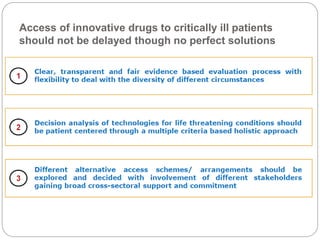
Access of innovative drugs to critically ill patients 
should not be delayed though no perfect solutions
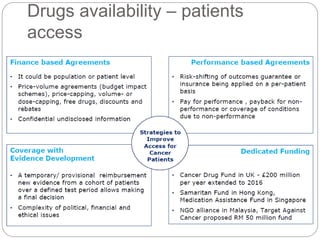
Access Models 
 Broadly speaking there are three types of drug 
reimbursement listing models depending on how 
clinical and cost factors are used in decision 
making. 
 Clinical effectiveness evaluation alone 
 Clinical effectiveness evaluation and budget impact 
analysis 
 Cost effectiveness and budget impact analyses
Solving access through innovative 
access program 
 Industry introduced Patients Assistant Program 
(PAP) and other form of access program to help 
patients gain early access to innovative medicines, 
ultimately increase affordability. 
 Example: 
 Imatinib for CML was introduced in Malaysia in 2002 
through GIPAP (Glivec International Patients Assistant 
Program) and later transition to MYPAP (Malaysia 
Patients Assistant Program) since 2008. 
 MYPAP is an example of Budget Impact Access Model 
where it is based on cost capitation model. 
 Since then, many other pharmaceutical 
companies had introduce access program, 
some successful, some not.
Access strategies 
 Various pricing policies and strategies exist, however, 
it’s challenging to determine which to implement. 
 All have strengths and weaknesses, just as all 
countries have unique medicine needs and 
challenges. 
 Each country must assess its own medicines situation 
and implement different combinations of policies and 
interventions. 
 Industry is open to collaborate.
Access of the Future
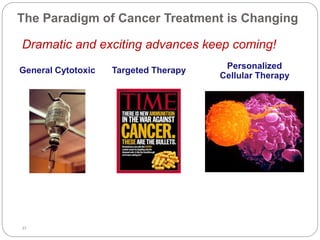
The Paradigm of Cancer Treatment is Changing 
Dramatic and exciting advances keep coming! 
General Cytotoxic Targeted Therapy 
Personalized 
Cellular Therapy 
37
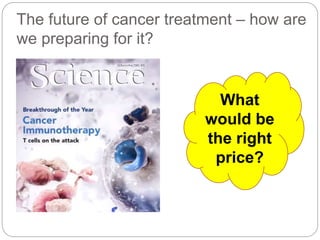
The future of cancer treatment – how are 
we preparing for it? 
What 
would be 
the right 
price?
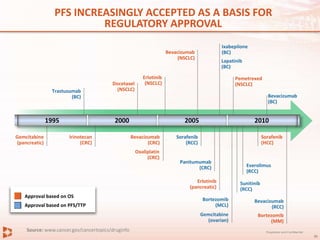
PFS INCREASINGLY ACCEPTED AS A BASIS FOR 
1995 2000 2005 2010 
Proprietary and Confidential 
Sunitinib 
(RCC) 
Bevacizumab 
(RCC) 
REGULATORY APPROVAL 
Lapatinib 
(BC) 
Trastuzumab 
(BC) 
Ixabepilone 
(BC) 
Bevacizumab 
(BC) 
Everolimus 
(RCC) 
Panitumumab 
(CRC) 
Sorafenib 
(RCC) 
Bortezomib 
(MCL) 
Gemcitabine 
(ovarian) 
Pemetrexed 
(NSCLC) 
Bevacizumab 
(NSCLC) 
Docetaxel 
(NSCLC) 
Bevacizumab 
(CRC) 
Bortezomib 
(MM) 
Erlotinib 
(pancreatic) 
Sorafenib 
(HCC) 
Irinotecan 
(CRC) 
Gemcitabine 
(pancreatic) 
Erlotinib 
(NSCLC) 
Oxaliplatin 
(CRC) 
39 
Approval based on OS 
Approval based on PFS/TTP 
Source: www.cancer.gov/cancertopics/druginfo
What are the views of the regulatory agencies 
on clinical trial endpoints? 
“Acceptable primary endpoints 
include OS and PFS/disease free 
survival […] While it is generally 
acknowledged that the aim of 
treatment is to improve quality of life 
and survival, restraints on the 
conduct of clinical trials may make 
these goals unattainable.” 
EMA Guideline on the Evaluation of 
Anticancer Medicinal Products in Man 
“The analysis of OS may be 
confounded by crossover and/or 
subsequent therapies. 
PFS, measured prior to the 
introduction of other therapies, 
may more accurately depict a 
treatment’s therapeutic effect.” 
FDA Oncology Head 
Richard Pazdur 
“PFS can reflect tumour growth and be assessed before the 
determination of a survival benefit. Its determination is not 
confounded by subsequent therapy.” 
FDA Guidance for Industry: Clinical Trial Endpoints for the 
Approval of Cancer Drugs and Biologics 
EMA Guideline 2009; FDA Guidance For Industry 2009
Conclusion
Conclusion 
There are future challenges to address as public financing and quality of care 
needs to be in pace with population growth, disease and lifestyle trends. 
Hence, availability or access to medicines in the public sector has become 
increasingly difficult leading to an affordability challenge for low and middle 
income patients who do not have access to medicines through the public 
sector and cannot afford private sector prices. 
This undermines the fundamental principle upon which Malaysia’s health care 
system has been based – that access to quality health care should not depend 
upon ability to pay. 
Low prices can reduce the attractiveness of certain countries to manufacturers 
and importers which might result in important products not being produced and 
marketed in a particular country or at least, being marketed with substantial 
delays.
Drug Purchasing & Pricing : industry perspective

Drug Purchasing & Pricing : industry perspective

  • 1.
    Drug Purchasing &Pricing The Pharmaceutical Industry Perspective David Lin Head of Market Access Novartis Oncology National Cancer Institute, Putrajaya 24 Nov 2014
  • 2.
    Disclaimer  Full-timeemployee of Novartis Corporation.  Information shared in this presentation does not necessarily represents the sole position of Novartis Corporation.  Previous employment includes Pfizer, AstraZeneca, Bayer Healthcare, Genzyme and Sanofi.
  • 3.
    Contents Introduction PricingContext in Malaysia National Medicine Policy (DuNAS) Pharmaceutical Pricing External Reference Pricing Drugs availability – patients access Access of the Future & Conclusion
  • 4.
  • 5.
    Introduction  Demandfor more and better healthcare grows faster than resources available to meet the demand  Facing growing ageing population  More chronic diseases developed and diagnosed  More new innovative treatments  Healthcare is a great political topic  More countries recognize good health is an economic asset and are finding ways to improve the healthcare system (e.g., designing and implementing Universal Coverage)
  • 6.
    Introduction  Payersface increasingly complex decision-making challenges in the oncology treatment due to the pace of groundbreaking scientific advances e.g. targeted therapy, cell therapy.  Such challenges requires:  Systematic understanding of value of clinical endpoints  Incorporating valuable endpoints in reimbursement  Evidence to demonstrate valuable endpoints The pace of new treatment discoveries and increasing number of therapeutic options requires new frameworks for payers to evaluate for reimbursement
  • 7.
  • 8.
    Medicine Pricing Malaysiahas a free pricing system: manufacturers, distributors and retailers are allowed to set their own prices. Public’s perception of high medicine prices and subsequent perceptions of inequitable access and reduced affordability of medicines In the public sector, medicine prices are indirectly controlled through tenders and price negotiations. Private sector free market competition governs prices of medicines, although the Pharmaceutical Services Division has been monitoring private sector prices through the Medicines Price Monitoring System (MedPrice). Private sector prices have come under scrutiny more recently due to growing concern regarding affordability of medicines for middle to low income patients.
  • 9.
    How much arewe spending on pharmaceuticals? Pharmaceutical expenditure as a share of total health expenditure, 2009 • In Asian countries, pharmaceutical expenditure share of total health expenditure range between 8% -50%. • For Malaysia, pharmaceutical expenditure is 8.8% of total health expenditure. Are we effective in spending our $$$ or we are not spending enough?
  • 10.
  • 11.
    Industry collaborating withMOH to achieve goals of National Medicine Policy
  • 12.
    Policy 2: Accessto medicines
  • 13.
    Policy 2: Accessto medicines Strategy 2 – Affordability of medicines
  • 14.
  • 15.
    From the labto the patients
  • 16.
  • 17.
    Understanding payer’s perspectivesin order for the industry to position the acceptable price to encourage access Payer benefits Public health benefits Economic benefits Clinical and humanistic benefits Functional consequences Product attributes Payer goals • Unmet need for the targeted population • Existing treatment options: not optimal results and risky • Rare disease that has no other approved drug therapy • Significant cost offsets: lower monitoring and AE costs, savings in medical visits, co morbidity management and productivity • Limited budget impact: 2nd-line / last-line option, very small patient population • QoL, DFS, PFS, OS • Tumor size shrinkage, slow down disease progression, improve survival • Key product attribute that differentiate its value
  • 18.
    PRICE APPROACH ATTIME OF LAUNCH – INDUSTRY’S APPROACH Margin Distribution cost Functional Costs / Overheads Import Tax Freight & Insurance Functional Costs / Overheads Production Cost Country costs HQ costs Selling Price • Discounts • Rebates • Bonus • Free goods • Access models • MEA Net Selling Price International Selling Price Lowest net selling price Includes the cost of the drug development (lab, clinical trials etc.)
  • 19.
    THE «MAGIC PRICINGTRIANGLE»: OBJECTIVES IN PRICING IS NOT ABOUT PRICE ONLY!  Find the right balance that maximizes patient access and a sustainable business 19 INDUSTRY
  • 20.
    WHO Guideline onCountry Pharmaceutical Pricing Policies 1. Use health technology assessment (HTA) as a tool to support reimbursement decision-making as well as price setting/negotiation. 2. Combine HTA with other policies. 3. Using HTA: review of reports from other countries; review of reports submitted by industry; conduct assessments based on local information and local data. Source: WHO, 2014
  • 21.
    WHO Guideline onCountry Pharmaceutical Pricing Policies 4. Take a stepwise approach to develop legislative and technical capacity to take full advantage of the potential utility of HTA in pharmaceutical price setting. 5. Clearly define the roles and responsibilities of the decision-makers and other stakeholders, and the process of decision-making. 6. Ensure that HTA processes are transparent and that the assessment reports and decisions should be made publicly available and effectively disseminated to stakeholders. 7. Collaborate to promote exchange of information and develop common requirements for HTA. Source: WHO, 2014
  • 22.
  • 23.
    External reference pricing  According to the Organisation for Economic Co-operation and Development (OECD), External Price Referencing, also referred to as External Price Benchmarking or International Reference Pricing, is defined as “the practice of comparing pharmaceutical prices across countries” and it is further indicated that, “There are various methods applied and different country baskets used”1.  4 main components to consider:  Country basket  Product basket  Reference price calculation  Infrastructure and implementation processes Friend or foe? Is Malaysia paying more than others? Will this hamper access? 1. Pharmaceutical Pricing Policies in a Global Market. OECD Health Policy Studies, OECD, 2008.
  • 24.
    Example of CountriesReferencing Germany Formally, Informally and Indirectly
  • 25.
    Comparative Pricing analysisof top 5 therapy areas across Asia Pacific countries
  • 26.
    Drug availability –patients access
  • 27.
    Drug Availability There is evidence that availability of medicines may be a challenge, with patients not receiving treatments despite reimbursement on the MoH formulary 1.  The public sector uptake showed limited growth, despite listing on the MoH Formulary in 2009.  In the case of the oncology product, the growth in public sector uptake over the 4 years since 2009 had been about 7.5%.  This analysis tends to suggest that despite MoH Formulary listing status, access to certain medicines through public channels remains unchanged or low. 1. Babar ZU, Ibrahim MI, Singh H, Bukahri NI, Creese A. Evaluating drug prices, availability, affordability, and price components: implications for access to drugs in Malaysia. PLoS medicine. 2007;4(3):e82.
  • 28.
    Volume uptake ofbranded original drugs after inclusion in the MoH formulary in 2009 Source: IMS PADDS data, Full year 2008-2014,
  • 29.
    Volume uptake ofbranded original drugs after inclusion in the MoH formulary in 2009 Source: IMS PADDS data, Full year 2008-2014,
  • 30.
    Volume uptake ofbranded original drugs after inclusion in the MoH formulary in 2009 Source: IMS PADDS data, Full year 2008-2014,
  • 31.
    Drugs availability –patients access
  • 32.
    Access of innovativedrugs to critically ill patients should not be delayed though no perfect solutions
  • 33.
    Access Models Broadly speaking there are three types of drug reimbursement listing models depending on how clinical and cost factors are used in decision making.  Clinical effectiveness evaluation alone  Clinical effectiveness evaluation and budget impact analysis  Cost effectiveness and budget impact analyses
  • 34.
    Solving access throughinnovative access program  Industry introduced Patients Assistant Program (PAP) and other form of access program to help patients gain early access to innovative medicines, ultimately increase affordability.  Example:  Imatinib for CML was introduced in Malaysia in 2002 through GIPAP (Glivec International Patients Assistant Program) and later transition to MYPAP (Malaysia Patients Assistant Program) since 2008.  MYPAP is an example of Budget Impact Access Model where it is based on cost capitation model.  Since then, many other pharmaceutical companies had introduce access program, some successful, some not.
  • 35.
    Access strategies Various pricing policies and strategies exist, however, it’s challenging to determine which to implement.  All have strengths and weaknesses, just as all countries have unique medicine needs and challenges.  Each country must assess its own medicines situation and implement different combinations of policies and interventions.  Industry is open to collaborate.
  • 36.
  • 37.
    The Paradigm ofCancer Treatment is Changing Dramatic and exciting advances keep coming! General Cytotoxic Targeted Therapy Personalized Cellular Therapy 37
  • 38.
    The future ofcancer treatment – how are we preparing for it? What would be the right price?
  • 39.
    PFS INCREASINGLY ACCEPTEDAS A BASIS FOR 1995 2000 2005 2010 Proprietary and Confidential Sunitinib (RCC) Bevacizumab (RCC) REGULATORY APPROVAL Lapatinib (BC) Trastuzumab (BC) Ixabepilone (BC) Bevacizumab (BC) Everolimus (RCC) Panitumumab (CRC) Sorafenib (RCC) Bortezomib (MCL) Gemcitabine (ovarian) Pemetrexed (NSCLC) Bevacizumab (NSCLC) Docetaxel (NSCLC) Bevacizumab (CRC) Bortezomib (MM) Erlotinib (pancreatic) Sorafenib (HCC) Irinotecan (CRC) Gemcitabine (pancreatic) Erlotinib (NSCLC) Oxaliplatin (CRC) 39 Approval based on OS Approval based on PFS/TTP Source: www.cancer.gov/cancertopics/druginfo
  • 40.
    What are theviews of the regulatory agencies on clinical trial endpoints? “Acceptable primary endpoints include OS and PFS/disease free survival […] While it is generally acknowledged that the aim of treatment is to improve quality of life and survival, restraints on the conduct of clinical trials may make these goals unattainable.” EMA Guideline on the Evaluation of Anticancer Medicinal Products in Man “The analysis of OS may be confounded by crossover and/or subsequent therapies. PFS, measured prior to the introduction of other therapies, may more accurately depict a treatment’s therapeutic effect.” FDA Oncology Head Richard Pazdur “PFS can reflect tumour growth and be assessed before the determination of a survival benefit. Its determination is not confounded by subsequent therapy.” FDA Guidance for Industry: Clinical Trial Endpoints for the Approval of Cancer Drugs and Biologics EMA Guideline 2009; FDA Guidance For Industry 2009
  • 41.
  • 42.
    Conclusion There arefuture challenges to address as public financing and quality of care needs to be in pace with population growth, disease and lifestyle trends. Hence, availability or access to medicines in the public sector has become increasingly difficult leading to an affordability challenge for low and middle income patients who do not have access to medicines through the public sector and cannot afford private sector prices. This undermines the fundamental principle upon which Malaysia’s health care system has been based – that access to quality health care should not depend upon ability to pay. Low prices can reduce the attractiveness of certain countries to manufacturers and importers which might result in important products not being produced and marketed in a particular country or at least, being marketed with substantial delays.