Drug Promotion
For BPH 1st Year
Dr. Pravin Prasad
Resident 3rd Year, MD Clinical Pharmacology
Maharajgunj Medical Campus
23rd May, 2017 (9th Jestha, 2074) Tuesday
Endorsed by the thirty-third world health
assembly in May 1986 in resolution
WHA39.27
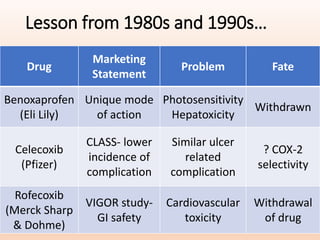
Lesson from 1980s and 1990s…
Drug
Marketing
Statement
Problem Fate
Benoxaprofen
(Eli Lily)
Unique mode
of action
Photosensitivity
Hepatoxicity
Withdrawn
Celecoxib
(Pfizer)
CLASS- lower
incidence of
complication
Similar ulcer
related
complication
? COX-2
selectivity
Rofecoxib
(Merck Sharp
& Dohme)
VIGOR study-
GI safety
Cardiovascular
toxicity
Withdrawal
of drug
Introduction
• Promotion
• Refers to all informational and persuasive
activities by manufacturers and
distributors,
• the effect of which is to induce the
prescription, supply, purchase and/or use
of medicinal drugs
Drug Promotion: Characteristics
• Should be reliable, accurate, truthful,
informative, balanced, up-to-date, capable of
substantiation and in good taste
• Comparison of products should be factual,
fair and capable of substantiation
• Should not contain misleading or unverifiable
statements or omissions
• Should not be designed so as to disguise its
real nature
Standards of Promotional Information
Consistent
Standard Promotional Information
Accurate Substantiable
Advertising
• Consistent with the approved scientific data
sheet for the drug concerned or other source
of information with similar content
• Advertisements that make a promotional
claim should at least contain summary
scientific information
Advertisements: Basic Requirements
• The brand name
• The name(s) and content per dosage form of the
active ingredient(s)
• Name of other ingredients known to cause
problems
• Approved therapeutic uses
• Dosage form or regimen
Advertisements: Basic Requirements
• Major adverse drug reactions and side effects
• Precautions, contra-indications and warnings
• Major interactions
• Name and address of manufacturer or distributor
• Reference to scientific literature as appropriate
Reminder Advertisements
• Ought to include at least:
• The brand name
• The INN or approved generic name
• The name of each active ingredient
• The name and address of the
manufacturer or distributor
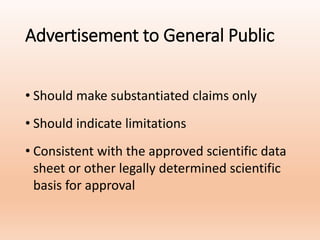
Advertisement to General Public
• Should make substantiated claims only
• Should indicate limitations
• Consistent with the approved scientific data
sheet or other legally determined scientific
basis for approval
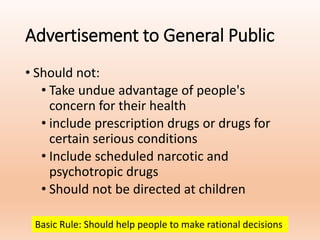
Advertisement to General Public
• Should not:
• Take undue advantage of people's
concern for their health
• include prescription drugs or drugs for
certain serious conditions
• Include scheduled narcotic and
psychotropic drugs
• Should not be directed at children
Basic Rule: Should help people to make rational decisions
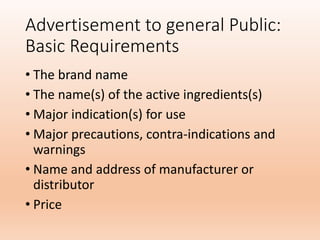
Advertisement to general Public:
Basic Requirements
• The brand name
• The name(s) of the active ingredients(s)
• Major indication(s) for use
• Major precautions, contra-indications and
warnings
• Name and address of manufacturer or
distributor
• Price
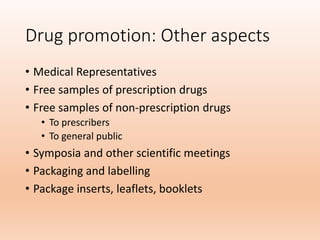
Drug promotion: Other aspects
• Medical Representatives
• Free samples of prescription drugs
• Free samples of non-prescription drugs
• To prescribers
• To general public
• Symposia and other scientific meetings
• Packaging and labelling
• Package inserts, leaflets, booklets
To Conclude….
• Cautious use of words like “safe” and “new” in
drug promotional activities
• Vulnerable populations:
• Children
• Pregnant
• Elderly
• Person with chronic disease
Thank you….

Drug promotion 2017

  • 1.
    Drug Promotion For BPH1st Year Dr. Pravin Prasad Resident 3rd Year, MD Clinical Pharmacology Maharajgunj Medical Campus 23rd May, 2017 (9th Jestha, 2074) Tuesday Endorsed by the thirty-third world health assembly in May 1986 in resolution WHA39.27
  • 2.
    Lesson from 1980sand 1990s… Drug Marketing Statement Problem Fate Benoxaprofen (Eli Lily) Unique mode of action Photosensitivity Hepatoxicity Withdrawn Celecoxib (Pfizer) CLASS- lower incidence of complication Similar ulcer related complication ? COX-2 selectivity Rofecoxib (Merck Sharp & Dohme) VIGOR study- GI safety Cardiovascular toxicity Withdrawal of drug
  • 3.
    Introduction • Promotion • Refersto all informational and persuasive activities by manufacturers and distributors, • the effect of which is to induce the prescription, supply, purchase and/or use of medicinal drugs
  • 4.
    Drug Promotion: Characteristics •Should be reliable, accurate, truthful, informative, balanced, up-to-date, capable of substantiation and in good taste • Comparison of products should be factual, fair and capable of substantiation • Should not contain misleading or unverifiable statements or omissions • Should not be designed so as to disguise its real nature
  • 5.
    Standards of PromotionalInformation Consistent Standard Promotional Information Accurate Substantiable
  • 6.
    Advertising • Consistent withthe approved scientific data sheet for the drug concerned or other source of information with similar content • Advertisements that make a promotional claim should at least contain summary scientific information
  • 7.
    Advertisements: Basic Requirements •The brand name • The name(s) and content per dosage form of the active ingredient(s) • Name of other ingredients known to cause problems • Approved therapeutic uses • Dosage form or regimen
  • 8.
    Advertisements: Basic Requirements •Major adverse drug reactions and side effects • Precautions, contra-indications and warnings • Major interactions • Name and address of manufacturer or distributor • Reference to scientific literature as appropriate
  • 9.
    Reminder Advertisements • Oughtto include at least: • The brand name • The INN or approved generic name • The name of each active ingredient • The name and address of the manufacturer or distributor
  • 10.
    Advertisement to GeneralPublic • Should make substantiated claims only • Should indicate limitations • Consistent with the approved scientific data sheet or other legally determined scientific basis for approval
  • 11.
    Advertisement to GeneralPublic • Should not: • Take undue advantage of people's concern for their health • include prescription drugs or drugs for certain serious conditions • Include scheduled narcotic and psychotropic drugs • Should not be directed at children Basic Rule: Should help people to make rational decisions
  • 12.
    Advertisement to generalPublic: Basic Requirements • The brand name • The name(s) of the active ingredients(s) • Major indication(s) for use • Major precautions, contra-indications and warnings • Name and address of manufacturer or distributor • Price
  • 13.
    Drug promotion: Otheraspects • Medical Representatives • Free samples of prescription drugs • Free samples of non-prescription drugs • To prescribers • To general public • Symposia and other scientific meetings • Packaging and labelling • Package inserts, leaflets, booklets
  • 14.
    To Conclude…. • Cautioususe of words like “safe” and “new” in drug promotional activities • Vulnerable populations: • Children • Pregnant • Elderly • Person with chronic disease Thank you….

Editor's Notes

  • #2 International Federation of Pharmaceutical Manufacturers and Associations (IFPMA) code of Practice 2012 European Federation of Pharmaceutical Industries and Associations (“EFPIA”) EFPIA Code on the Promotion of Prescription-Only Medicines to, and Interactions with, Healthcare Professionals (the “EFPIA Code”) 2007
  • #3 CLASS study- Celecoxib Long term Safety Study Vioxx Gastrointestinal Outcomes Research (VIGOR) study
  • #5 Should be reliable, accurate, truthful, informative, balanced, up-to-date, capable of substantiation and in good taste Should not contain misleading or unverifiable statements or omissions likely to induce medically unjustifiable drug use or to give rise to undue risks The word "safe" should only be used if properly qualified Comparison of products should be factual, fair and capable of substantiation Promotional material should not be designed so as to disguise its real nature
  • #7 Some countries require that advertisements should contain full product information, as defined by the approved scientific data sheet or similar document, for a given period from the date of first promotion or for the full product life.
  • #11 Advertisements to the general public should help people to make rational decisions on the use of drugs determined to be legally available without a prescription. While they should take account of people's legitimate desire for information regarding their health, they should not take undue advantage of people's concern for their health. They should not generally be permitted for prescription drugs or to promote drugs for certain serious conditions that can be treated only by qualified health practitioners, for which certain countries have established lists. To fight drug addiction and dependency, scheduled narcotic and psychotropic drugs should not be advertised to the general public. While health education aimed at children is highly desirable, drug advertisements should not be directed at children. Advertisements may claim that a drug can cure, prevent, or relieve an ailment only if this can be substantiated. They should also indicate, where applicable, appropriate limitations to the use of the drug. 15. When lay language is used, the information should be consistent with the approved scientific data sheet or other legally determined scientific basis for approval. Language which brings about fear or distress should not be used.
  • #12 Advertisements to the general public should help people to make rational decisions on the use of drugs determined to be legally available without a prescription. While they should take account of people's legitimate desire for information regarding their health, they should not take undue advantage of people's concern for their health. They should not generally be permitted for prescription drugs or to promote drugs for certain serious conditions that can be treated only by qualified health practitioners, for which certain countries have established lists. To fight drug addiction and dependency, scheduled narcotic and psychotropic drugs should not be advertised to the general public. While health education aimed at children is highly desirable, drug advertisements should not be directed at children. Advertisements may claim that a drug can cure, prevent, or relieve an ailment only if this can be substantiated. They should also indicate, where applicable, appropriate limitations to the use of the drug. 15. When lay language is used, the information should be consistent with the approved scientific data sheet or other legally determined scientific basis for approval. Language which brings about fear or distress should not be used.