Drools
Allan Huang @ Delta DRC
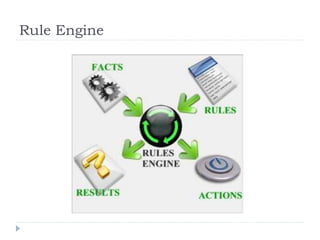
Rule Engine
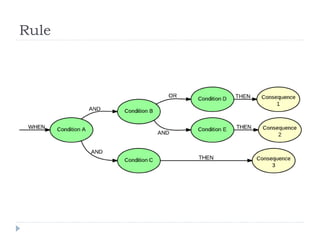
Rule
Why Rules Engine?
 Rules are independent and each rule doesn’t know if
another rule even exists.
 A complex rule can be divided into simpler rules that
infer parts of information of a complex scenario and
feed it to the working memory, and other rules might
depend on that data to get activated.
Drools Rule Engine
 A rule engine is a piece of software, which having
some knowledge is able to perform conclusions.
 Knowledge and inferences are stored in rules, which
are called production rules.
 Production rules consist of conditions and actions,
which are executed when their conditions are true.
 A working memory, which stores all objects we may
want to use while making a decision.
 Then conflict resolution is provided by the agenda. It
arranges the order of actions, which has been
selected to be run.
Rule Engine
Hybrid Reasoning System
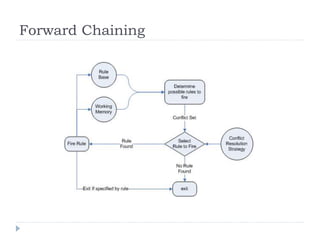
 Forward Chaining Engine – Data-driven
 Facts are asserted into working memory, which results in
one or more rules being concurrently true and scheduled
for execution by the Agenda.
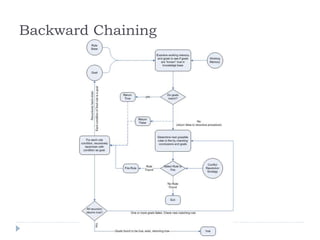
 Backward Chaining Engine – Goal-driven
 We start with a conclusion which the engine tries to satisfy.
If it can't, then it searches for conclusions that it can
satisfy.
 It continues this process until either the initial conclusion
is proven or there are no more sub goals.
 Prolog is an example of a Backward Chaining engine.
Forward Chaining
Backward Chaining
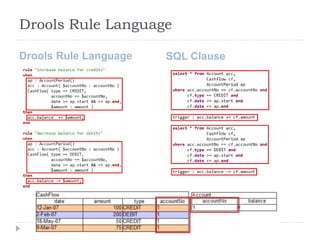
Drools Rule Language
Drools Rule Language SQL Clause
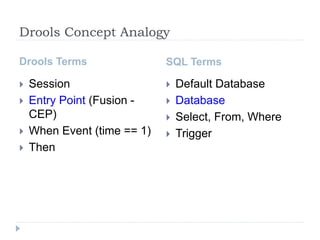
Drools Concept Analogy
Drools Terms SQL Terms
 Session
 Entry Point (Fusion -
CEP)
 When Event (time == 1)
 Then
 Default Database
 Database
 Select, From, Where
 Trigger
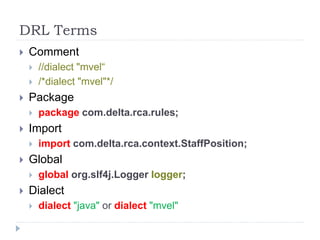
DRL Terms
 Comment
 //dialect "mvel“
 /*dialect "mvel"*/
 Package
 package com.delta.rca.rules;
 Import
 import com.delta.rca.context.StaffPosition;
 Global
 global org.slf4j.Logger logger;
 Dialect
 dialect "java" or dialect "mvel"
DRL Attributes
 no-loop
 Setting no-loop to true will skip the creation of another Activation
for the rule with the current set of facts.
 salience
 Salience is a form of priority where rules with higher salience
values are given higher priority when ordered in the Activation
queue.
 Drools also supports dynamic salience.
 date-effective
 A rule can only activate after the date and time of the date-
effective attribute.
 date-expires
 A rule cannot activate if the current date and time is after the date-
expires attribute.
 duration
 The duration dictates that the rule will fire after a specified duration
if it is still true.
When (LHS) Syntax
 Pattern
 It can potentially match on each fact that is inserted in the
working memory.
 Pattern1( ) Pattern2( ) = Pattern1( ) and Pattern2( )
 Object( )
 matches all objects in the working memory
 Pattern Binding
 Person( $firstAge : age )
 The prefixed dollar symbol ($) is a convention.
 Property Access
 Person( age > 30 && < 40 )
 Person( name== "mark", address.( city == "london", country ==
"uk") )
 Person( $streetName : address!.street )
 Cheese( type matches "(Buffalo)?S*Mozarella" )
Advanced Conditional Elements
 Timers and Calendars
 Rules now support both interval and cron based timers, which replace the now
deprecated duration attribute.
 forall
 Evaluates to true when all facts that match the first pattern match all the remaining
patterns.
 from
 Enables users to specify an arbitrary source for data to be matched by LHS
patterns.
 collect
 Allows rules to reason over a collection of objects obtained from the given source
or from the working memory.
 accumulate
 accumulate is a more flexible and powerful form of collect.
 built-in accumulate functions
 average, min, max, count, sum, collectList, collectSet
 eval
 allows any semantic code (that returns a primitive boolean) to be executed.
Then (RHS) Syntax
 update(fact, facthandle)
 Informs the engine that an event or fact has changed and rules need to be
reconsidered.
 update(object)
 Is similar to above update method, the engine will look up the facthandle for you,
via an identity check.
 modify(facthandle) {propertyX=1, propertyY=2…}
 Is similar to above update method, not only update object itself, also its properties
be updated.
 insert(new Something())
 Inserts a new object into the Working Memory.
 insertLogical(new Something())
 Is similar to above insert method, but the object will be automatically retracted
when there are no more facts to support the truth of the currently firing rule.
 delete(facthandle)
 Removes an object from the Working Memory.
 retract(facthandle)
 Is similar to above delete method, but it deprecated!
Complex Event Processing
 Event Processing
 It is a method of tracking and analyzing (processing)
streams of information (data) about things that happen
(events),[1] and deriving a conclusion from them.
 Complex Event Processing (CEP)
 Combines data from multiple sources to infer events or
patterns that suggest more complicated circumstances.
 Its goal is to identifying the Meaningful Events and
respond to them as quickly as possible.
Event Stream Processing
 Event Stream Processing (ESP)
 Deals with the task of processing streams of event data
with the goal of identifying the meaningful pattern within
those streams
 Employs techniques such as detection of relationships
between multiple events, event correlation, event
hierarchies, and other aspects such as causality,
membership and timing.
 Semantic Events = Meaningful Events.
Drools Fusion
 It is the module responsible for adding Event Processing
Capabilities into the Drools platform for CEP / ESP.
 Support Events, with their proper semantics.
 Allow detection, correlation, aggregation and composition of
events.
 Support Temporal Constraints in order to model the temporal
relationships between events.
 Support Sliding Windows of interesting events.
 Sliding Time Windows
 Sliding Length Windows
 Support a session scoped unified clock.
 Real Time clock
 Pseudo clock
 …
Temporal Reasoning
 $eventA : EventA( this after[ 3m30s, 4m ] $eventB )
 3m30s <= $eventA.start - $eventB.end <= 4m
 $eventA : EventA( this during[ 5s, 10s ] $eventB )
 5s <= $eventA.start - $eventB.start <= 10s && 5s <= $eventB.end
- $eventA.end <= 10s
 $eventA : EventA( this meets[ 5s ] $eventB )
 abs( $eventB.start - $eventA.end) <= 5s
 $eventA : EventA( this overlaps[ 5s, 10s ] $eventB )
 $eventA.start < $eventB.start < $eventA.end < $eventB.end && 5s
<= $eventA.end - $eventB.start <= 10s
 $eventA : EventA( this starts[ 5s ] $eventB )
 abs( $eventA.start - $eventB.start ) <= 5s && $eventA.end <
$eventB.end
 Other Temporal Operators
 Before, Coincides, Finishes, Finished By, Includes, Met By,
Overlapped, Started By.
Java Notes
 Model Classes
 Add serialVersionUID
 Override the equals, hashCode, toString methods
 Use EqualsBuilder, HashCodeBuilder, ToStringBuilder classes
in Apache Commons Lang to override above methods
 Service
 Singleton or Static method
 AOP, e.g. Spring-based application
Reference
 Why Rules?
 Drools ~ Basic concepts
 Introduction to Drools: Rules fall from your eyes
 (PROCESSES%20&%20RULES)%20OR%20(RULES%
20&%20PROCESSES)%203/X
 Complex event processing
 Event stream processing
 Drools Documentation
 Chapter 5. Hybrid Reasoning
 Chapter 6: User Guide
 Chapter 7: Rule Language Reference
 Chapter 8. Complex Event Processing
 Chapter 20: Examples
Q&A

Drools

  • 1.
  • 2.
  • 3.
  • 4.
    Why Rules Engine? Rules are independent and each rule doesn’t know if another rule even exists.  A complex rule can be divided into simpler rules that infer parts of information of a complex scenario and feed it to the working memory, and other rules might depend on that data to get activated.
  • 5.
    Drools Rule Engine A rule engine is a piece of software, which having some knowledge is able to perform conclusions.  Knowledge and inferences are stored in rules, which are called production rules.  Production rules consist of conditions and actions, which are executed when their conditions are true.  A working memory, which stores all objects we may want to use while making a decision.  Then conflict resolution is provided by the agenda. It arranges the order of actions, which has been selected to be run.
  • 6.
  • 7.
    Hybrid Reasoning System Forward Chaining Engine – Data-driven  Facts are asserted into working memory, which results in one or more rules being concurrently true and scheduled for execution by the Agenda.  Backward Chaining Engine – Goal-driven  We start with a conclusion which the engine tries to satisfy. If it can't, then it searches for conclusions that it can satisfy.  It continues this process until either the initial conclusion is proven or there are no more sub goals.  Prolog is an example of a Backward Chaining engine.
  • 8.
  • 9.
  • 10.
    Drools Rule Language DroolsRule Language SQL Clause
  • 11.
    Drools Concept Analogy DroolsTerms SQL Terms  Session  Entry Point (Fusion - CEP)  When Event (time == 1)  Then  Default Database  Database  Select, From, Where  Trigger
  • 12.
    DRL Terms  Comment //dialect "mvel“  /*dialect "mvel"*/  Package  package com.delta.rca.rules;  Import  import com.delta.rca.context.StaffPosition;  Global  global org.slf4j.Logger logger;  Dialect  dialect "java" or dialect "mvel"
  • 13.
    DRL Attributes  no-loop Setting no-loop to true will skip the creation of another Activation for the rule with the current set of facts.  salience  Salience is a form of priority where rules with higher salience values are given higher priority when ordered in the Activation queue.  Drools also supports dynamic salience.  date-effective  A rule can only activate after the date and time of the date- effective attribute.  date-expires  A rule cannot activate if the current date and time is after the date- expires attribute.  duration  The duration dictates that the rule will fire after a specified duration if it is still true.
  • 14.
    When (LHS) Syntax Pattern  It can potentially match on each fact that is inserted in the working memory.  Pattern1( ) Pattern2( ) = Pattern1( ) and Pattern2( )  Object( )  matches all objects in the working memory  Pattern Binding  Person( $firstAge : age )  The prefixed dollar symbol ($) is a convention.  Property Access  Person( age > 30 && < 40 )  Person( name== "mark", address.( city == "london", country == "uk") )  Person( $streetName : address!.street )  Cheese( type matches "(Buffalo)?S*Mozarella" )
  • 15.
    Advanced Conditional Elements Timers and Calendars  Rules now support both interval and cron based timers, which replace the now deprecated duration attribute.  forall  Evaluates to true when all facts that match the first pattern match all the remaining patterns.  from  Enables users to specify an arbitrary source for data to be matched by LHS patterns.  collect  Allows rules to reason over a collection of objects obtained from the given source or from the working memory.  accumulate  accumulate is a more flexible and powerful form of collect.  built-in accumulate functions  average, min, max, count, sum, collectList, collectSet  eval  allows any semantic code (that returns a primitive boolean) to be executed.
  • 16.
    Then (RHS) Syntax update(fact, facthandle)  Informs the engine that an event or fact has changed and rules need to be reconsidered.  update(object)  Is similar to above update method, the engine will look up the facthandle for you, via an identity check.  modify(facthandle) {propertyX=1, propertyY=2…}  Is similar to above update method, not only update object itself, also its properties be updated.  insert(new Something())  Inserts a new object into the Working Memory.  insertLogical(new Something())  Is similar to above insert method, but the object will be automatically retracted when there are no more facts to support the truth of the currently firing rule.  delete(facthandle)  Removes an object from the Working Memory.  retract(facthandle)  Is similar to above delete method, but it deprecated!
  • 17.
    Complex Event Processing Event Processing  It is a method of tracking and analyzing (processing) streams of information (data) about things that happen (events),[1] and deriving a conclusion from them.  Complex Event Processing (CEP)  Combines data from multiple sources to infer events or patterns that suggest more complicated circumstances.  Its goal is to identifying the Meaningful Events and respond to them as quickly as possible.
  • 18.
    Event Stream Processing Event Stream Processing (ESP)  Deals with the task of processing streams of event data with the goal of identifying the meaningful pattern within those streams  Employs techniques such as detection of relationships between multiple events, event correlation, event hierarchies, and other aspects such as causality, membership and timing.  Semantic Events = Meaningful Events.
  • 19.
    Drools Fusion  Itis the module responsible for adding Event Processing Capabilities into the Drools platform for CEP / ESP.  Support Events, with their proper semantics.  Allow detection, correlation, aggregation and composition of events.  Support Temporal Constraints in order to model the temporal relationships between events.  Support Sliding Windows of interesting events.  Sliding Time Windows  Sliding Length Windows  Support a session scoped unified clock.  Real Time clock  Pseudo clock  …
  • 20.
    Temporal Reasoning  $eventA: EventA( this after[ 3m30s, 4m ] $eventB )  3m30s <= $eventA.start - $eventB.end <= 4m  $eventA : EventA( this during[ 5s, 10s ] $eventB )  5s <= $eventA.start - $eventB.start <= 10s && 5s <= $eventB.end - $eventA.end <= 10s  $eventA : EventA( this meets[ 5s ] $eventB )  abs( $eventB.start - $eventA.end) <= 5s  $eventA : EventA( this overlaps[ 5s, 10s ] $eventB )  $eventA.start < $eventB.start < $eventA.end < $eventB.end && 5s <= $eventA.end - $eventB.start <= 10s  $eventA : EventA( this starts[ 5s ] $eventB )  abs( $eventA.start - $eventB.start ) <= 5s && $eventA.end < $eventB.end  Other Temporal Operators  Before, Coincides, Finishes, Finished By, Includes, Met By, Overlapped, Started By.
  • 21.
    Java Notes  ModelClasses  Add serialVersionUID  Override the equals, hashCode, toString methods  Use EqualsBuilder, HashCodeBuilder, ToStringBuilder classes in Apache Commons Lang to override above methods  Service  Singleton or Static method  AOP, e.g. Spring-based application
  • 22.
    Reference  Why Rules? Drools ~ Basic concepts  Introduction to Drools: Rules fall from your eyes  (PROCESSES%20&%20RULES)%20OR%20(RULES% 20&%20PROCESSES)%203/X  Complex event processing  Event stream processing  Drools Documentation  Chapter 5. Hybrid Reasoning  Chapter 6: User Guide  Chapter 7: Rule Language Reference  Chapter 8. Complex Event Processing  Chapter 20: Examples
  • 23.