VSAT Installation Course

Introduction
Although it isn’t difficult to install VSAT systems, it does need to be done profession-
ally and carefully in order to maximize the performance of the systems and to ensure
that we do not interfere with other communications systems.

DRASTIC runs training courses for installers on a regular basis, covering the Global
VSAT Forum (www.gvf.org) syllabus, which is recognized across the industry, with
additional material relating to the iDirect modem equipment which we use.

Courses are generally 4-5 days long and include a mix of theory and practical, hands
on work. Course dates will be posted on the DRASTIC website, or email us at
info@drasticom.org


In Pictures…

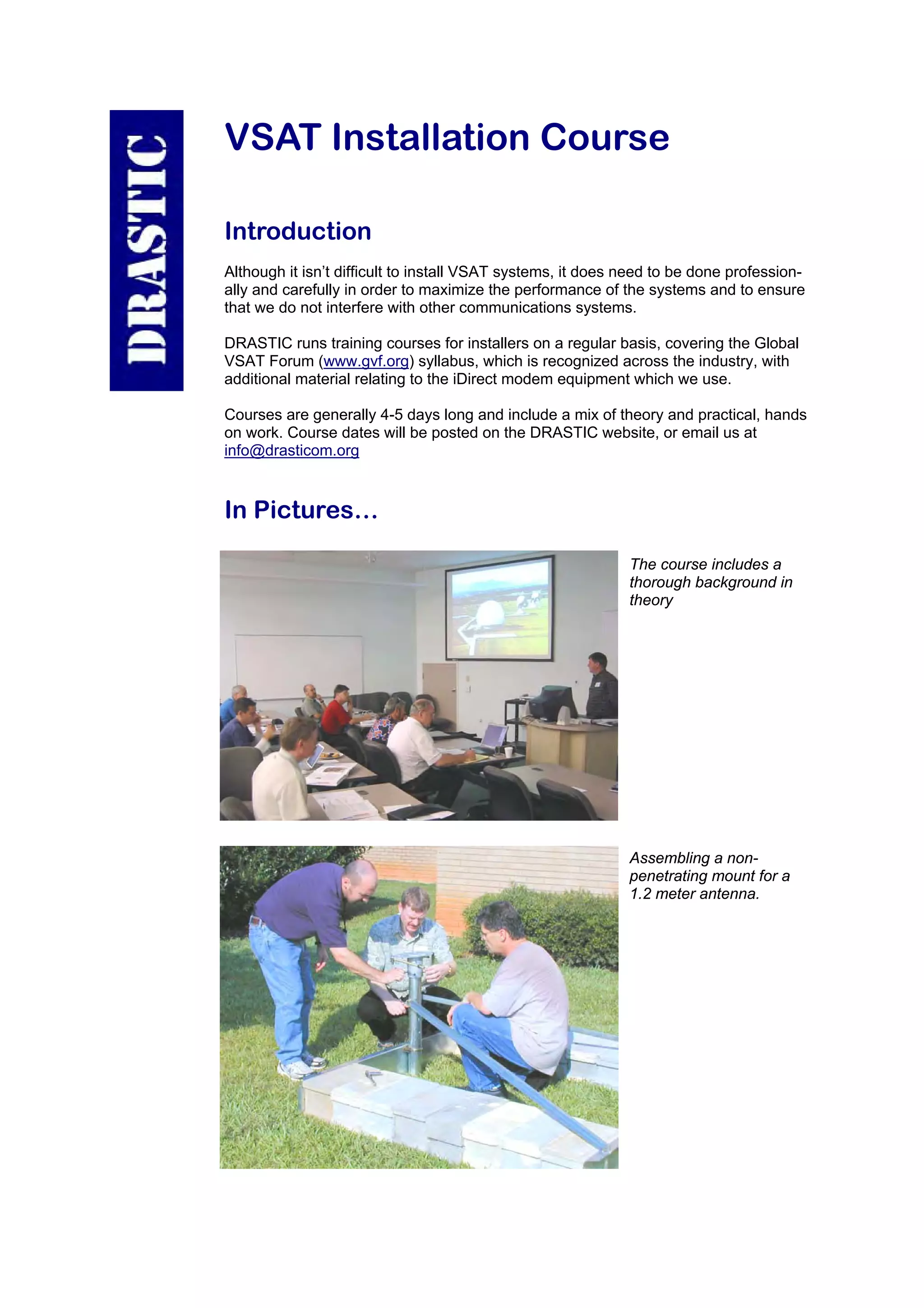
                                                             The course includes a
                                                             thorough background in
                                                             theory


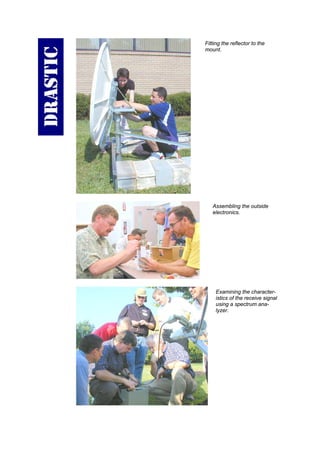
                                                             Assembling a non-
                                                             penetrating mount for a
                                                             1.2 meter antenna.
Fitting the reflector to the
mount.


   Assembling the outside
   electronics.


     Examining the character-
     istics of the receive signal
     using a spectrum ana-
     lyzer.
Configuring the iDirect modem


         Visiting our Network
         Operations Center


Visiting our Network Operations
Center
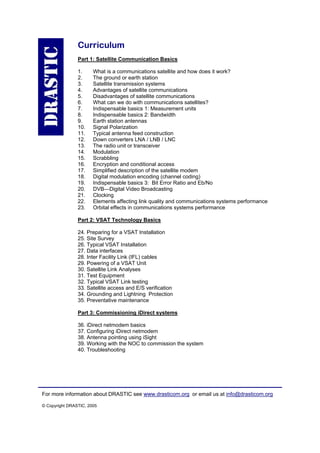
Curriculum
                Part 1: Satellite Communication Basics

                1.     What is a communications satellite and how does it work?
                2.     The ground or earth station
                3.     Satellite transmission systems
                4.     Advantages of satellite communications
                5.     Disadvantages of satellite communications
                6.     What can we do with communications satellites?
                7.     Indispensable basics 1: Measurement units
                8.     Indispensable basics 2: Bandwidth
                9.     Earth station antennas
                10.    Signal Polarization
                11.    Typical antenna feed construction
                12.    Down converters LNA / LNB / LNC
                13.    The radio unit or transceiver
                14.    Modulation
                15.    Scrabbling
                16.    Encryption and conditional access
                17.    Simplified description of the satellite modem
                18.    Digital modulation encoding (channel coding)
                19.    Indispensable basics 3: Bit Error Ratio and Eb/No
                20.    DVB—Digital Video Broadcasting
                21.    Clocking
                22.    Elements affecting link quality and communications systems performance
                23.    Orbital effects in communications systems performance

                Part 2: VSAT Technology Basics

                24. Preparing for a VSAT Installation
                25. Site Survey
                26. Typical VSAT Installation
                27. Data interfaces
                28. Inter Facility Link (IFL) cables
                29. Powering of a VSAT Unit
                30. Satellite Link Analyses
                31. Test Equipment
                32. Typical VSAT Link testing
                33. Satellite access and E/S verification
                34. Grounding and Lightning Protection
                35. Preventative maintenance

                Part 3: Commissioning iDirect systems

                36. iDirect netmodem basics
                37. Configuring iDirect netmodem
                38. Antenna pointing using iSight
                39. Working with the NOC to commission the system
                40. Troubleshooting


For more information about DRASTIC see www.drasticom.org or email us at info@drasticom.org

© Copyright DRASTIC, 2005

Drastic vsat installer_course

  • 1.
    VSAT Installation Course Introduction Althoughit isn’t difficult to install VSAT systems, it does need to be done profession- ally and carefully in order to maximize the performance of the systems and to ensure that we do not interfere with other communications systems. DRASTIC runs training courses for installers on a regular basis, covering the Global VSAT Forum (www.gvf.org) syllabus, which is recognized across the industry, with additional material relating to the iDirect modem equipment which we use. Courses are generally 4-5 days long and include a mix of theory and practical, hands on work. Course dates will be posted on the DRASTIC website, or email us at info@drasticom.org In Pictures… The course includes a thorough background in theory Assembling a non- penetrating mount for a 1.2 meter antenna.
  • 2.
    Fitting the reflectorto the mount. Assembling the outside electronics. Examining the character- istics of the receive signal using a spectrum ana- lyzer.
  • 3.
    Configuring the iDirectmodem Visiting our Network Operations Center Visiting our Network Operations Center
  • 4.
    Curriculum Part 1: Satellite Communication Basics 1. What is a communications satellite and how does it work? 2. The ground or earth station 3. Satellite transmission systems 4. Advantages of satellite communications 5. Disadvantages of satellite communications 6. What can we do with communications satellites? 7. Indispensable basics 1: Measurement units 8. Indispensable basics 2: Bandwidth 9. Earth station antennas 10. Signal Polarization 11. Typical antenna feed construction 12. Down converters LNA / LNB / LNC 13. The radio unit or transceiver 14. Modulation 15. Scrabbling 16. Encryption and conditional access 17. Simplified description of the satellite modem 18. Digital modulation encoding (channel coding) 19. Indispensable basics 3: Bit Error Ratio and Eb/No 20. DVB—Digital Video Broadcasting 21. Clocking 22. Elements affecting link quality and communications systems performance 23. Orbital effects in communications systems performance Part 2: VSAT Technology Basics 24. Preparing for a VSAT Installation 25. Site Survey 26. Typical VSAT Installation 27. Data interfaces 28. Inter Facility Link (IFL) cables 29. Powering of a VSAT Unit 30. Satellite Link Analyses 31. Test Equipment 32. Typical VSAT Link testing 33. Satellite access and E/S verification 34. Grounding and Lightning Protection 35. Preventative maintenance Part 3: Commissioning iDirect systems 36. iDirect netmodem basics 37. Configuring iDirect netmodem 38. Antenna pointing using iSight 39. Working with the NOC to commission the system 40. Troubleshooting For more information about DRASTIC see www.drasticom.org or email us at info@drasticom.org © Copyright DRASTIC, 2005