Kindergarten Language Arts Program
“The more
that you read,
the more things
you will know.
The more you
learn,
the more places
you’ll go.”
Dr. Seuss, I Can Read with My Eyes Shut!
The stories are true…
 Year after year, we graduate many
successful readers from kindergarten.
 From 2009-2014, 56% children were
reading at the 1st
grade level, 16% at the
2nd
grade level, 4% at the 3rd
grade level,
and 5% at or above the 4th
grade level.
 A class of 15 children typically reads over
1800 books independently.
What’s our recipe for success?
Our program is rooted in:
 Concrete, up to date
information about literacy
 Kiddie Country’s excellent
literacy traditions
 Teacher expertise
And features:
 Three key ingredients
 Differentiated instruction
The 3 ingredients are…
 Phonics, reading instruction, and writing experiences are
offered on a daily basis during our 45 minute literacy period
 Systematic direct instruction is blended with authentic reading
and writing tasks
 Each component is tailored to meet individual needs
TheAlphabetic Principle(letters andphonetic sounds)
DailyWritingExperiencesLiterature/ReadingInstruction
Three key ingredients and differentiated instruction
make the difference.
But what IS differentiated instruction ?
“Differentiation can be defined as a way of teaching in which teachers
proactively modify curriculum, teaching methods, resources, learning
activities, and student products. The needs of individual students
and/or small groups of students are addressed to maximize the
learning opportunity for each student in the classroom.”
Carol Tomlinson
How does differentiated instruction
help my child?
 Differentiated instruction enables us to offer
appropriate instruction for your child
whether s/he is an advanced reader or
mastering letter names.
 Every child deserves a perfect fit with regard
to literacy instruction. Not too hard and not
too easy…because one size doesn’t fit all.
Ingredient 1: Literature/Reading
Instruction
 Quality books are read to
the children multiple times
each day
 Children read independently
using a wide range of
leveled texts
 Guided reading instruction is
conducted in small groups
 Comprehension strategies
are both modeled and
intentionally developed
How do we differentiate reading
instruction?
 Small group and individual instruction
 Insightful, frequent, and personalized
assessment
 Student/teacher ratios that allow for these
types of instruction and assessment
 Materials on many levels, from preschool
through grade 6
 Flexible grouping
Ingredient 2: Writing
 Given the opportunity, writing develops naturally like language.
 Children are encouraged to write using letters or phonetic sounds.
Spacing, punctuation, etc. are modeled and reinforced as is
appropriate.
 Students learn to spell common sight words.
 Daily writing experiences build on our phonics program.
How do we differentiate writing?
 Open ended activities
 Mini lessons for small groups or individuals
on spacing, punctuation, applying letter
sound knowledge, capitalization, etc.
 Personal attention
It works!
Sept
.
Mar.
Sept.
Mar.
Ingredient 3: Alphabet & Phonics
 Goals include:
– Rapidly naming letters
– Discerning beginning, ending, and medial sounds
– Mastering consonants and digraphs
– Mastering short vowels as well as long vowels
and other vowels when appropriate
– Using these phonetic skills to spell words and
decode unknown words
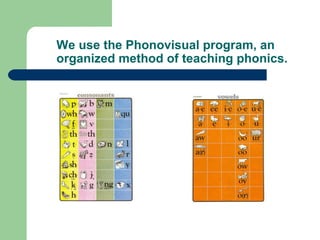
We use the Phonovisual program, an
organized method of teaching phonics.
How do we differentiate?
 By adjusting the content…there is no need to learn
sounds that you already know!
 Reviewing phonetic sounds though games in small
groups. The content can then be tailored.
 Through open ended writing experiences
 Individual attention when coaching your child to use
phonetic sounds to decode unknown words
“Oh magic hour, when a child first knows she can
read printed words!”
A Tree Grows in Brooklyn by Betty Smith, 1943
 Blend reading instruction, writing instruction, and
phonics instruction on a daily basis
 Add differentiated lessons for that “just right” fit
 Mix thoroughly in a language rich classroom
environment
 Sprinkle in scores of bright, engaging books
 Drizzle with fun
 That’s our recipe for creating successful readers and
writers!

Kindergarten Language Arts Program

  • 1.
    Kindergarten Language ArtsProgram “The more that you read, the more things you will know. The more you learn, the more places you’ll go.” Dr. Seuss, I Can Read with My Eyes Shut!
  • 2.
    The stories aretrue…  Year after year, we graduate many successful readers from kindergarten.  From 2009-2014, 56% children were reading at the 1st grade level, 16% at the 2nd grade level, 4% at the 3rd grade level, and 5% at or above the 4th grade level.  A class of 15 children typically reads over 1800 books independently.
  • 3.
    What’s our recipefor success? Our program is rooted in:  Concrete, up to date information about literacy  Kiddie Country’s excellent literacy traditions  Teacher expertise And features:  Three key ingredients  Differentiated instruction
  • 4.
    The 3 ingredientsare…  Phonics, reading instruction, and writing experiences are offered on a daily basis during our 45 minute literacy period  Systematic direct instruction is blended with authentic reading and writing tasks  Each component is tailored to meet individual needs TheAlphabetic Principle(letters andphonetic sounds) DailyWritingExperiencesLiterature/ReadingInstruction
  • 5.
    Three key ingredientsand differentiated instruction make the difference. But what IS differentiated instruction ? “Differentiation can be defined as a way of teaching in which teachers proactively modify curriculum, teaching methods, resources, learning activities, and student products. The needs of individual students and/or small groups of students are addressed to maximize the learning opportunity for each student in the classroom.” Carol Tomlinson
  • 6.
    How does differentiatedinstruction help my child?  Differentiated instruction enables us to offer appropriate instruction for your child whether s/he is an advanced reader or mastering letter names.  Every child deserves a perfect fit with regard to literacy instruction. Not too hard and not too easy…because one size doesn’t fit all.
  • 7.
    Ingredient 1: Literature/Reading Instruction Quality books are read to the children multiple times each day  Children read independently using a wide range of leveled texts  Guided reading instruction is conducted in small groups  Comprehension strategies are both modeled and intentionally developed
  • 8.
    How do wedifferentiate reading instruction?  Small group and individual instruction  Insightful, frequent, and personalized assessment  Student/teacher ratios that allow for these types of instruction and assessment  Materials on many levels, from preschool through grade 6  Flexible grouping
  • 9.
    Ingredient 2: Writing Given the opportunity, writing develops naturally like language.  Children are encouraged to write using letters or phonetic sounds. Spacing, punctuation, etc. are modeled and reinforced as is appropriate.  Students learn to spell common sight words.  Daily writing experiences build on our phonics program.
  • 10.
    How do wedifferentiate writing?  Open ended activities  Mini lessons for small groups or individuals on spacing, punctuation, applying letter sound knowledge, capitalization, etc.  Personal attention
  • 11.
  • 12.
    Ingredient 3: Alphabet& Phonics  Goals include: – Rapidly naming letters – Discerning beginning, ending, and medial sounds – Mastering consonants and digraphs – Mastering short vowels as well as long vowels and other vowels when appropriate – Using these phonetic skills to spell words and decode unknown words
  • 13.
    We use thePhonovisual program, an organized method of teaching phonics.
  • 14.
    How do wedifferentiate?  By adjusting the content…there is no need to learn sounds that you already know!  Reviewing phonetic sounds though games in small groups. The content can then be tailored.  Through open ended writing experiences  Individual attention when coaching your child to use phonetic sounds to decode unknown words
  • 15.
    “Oh magic hour,when a child first knows she can read printed words!” A Tree Grows in Brooklyn by Betty Smith, 1943  Blend reading instruction, writing instruction, and phonics instruction on a daily basis  Add differentiated lessons for that “just right” fit  Mix thoroughly in a language rich classroom environment  Sprinkle in scores of bright, engaging books  Drizzle with fun  That’s our recipe for creating successful readers and writers!