CLIL 
Content and Language Integrated Learning 
“Learn to use a language 
and 
use the language to learn”
CLIL AND PRIMARY SCHOOL 
• Less spread than in Secondary Schools. 
• Inputs needs to be understandable (Krashen) 
• Use of extra-linguistic inputs: visual 
( photos, drawings, time-lines, maps, posters, 
word banks,..) and gestures, role-play, hands-out, 
use of realia, games,demonstration,..
LEARNING BY DOING! 
Helping learning: 
• Starting from known vocabulary, structures and contents 
• Vocabulary and structures adequates to age 
• Friendly-reassuring enviroment 
• Pre-teaching vocabulary 
• Code-switching allowed (L1  L2) 
• Good scaffolding for learning 
Helping production: 
• Allow different kind of answers (not verbal L1 English L2 Italian) 
• Role-play 
• Pair and team-work 
• Making of posters, drawings, booklets…
CONTENT: WHY CHOOSE ART? 
• Teaching love for beauty at early age 
• In CLIL visual inputs help understanding 
• Italian art to re-establish bonds with Italian 
culture 
• Italian modern art: vivid and easy for children
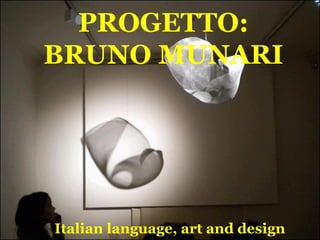
PROGETTO: 
BRUNO MUNARI 
Italian language, art and design
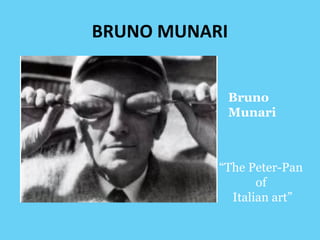
BRUNO MUNARI 
Bruno 
Munari 
“The Peter-Pan 
of 
Italian art”
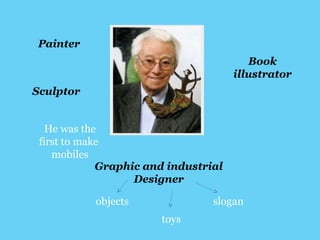
Painter 
Sculptor 
He was the 
first to make 
mobiles 
Graphic and industrial 
Designer 
objects slogan 
toys 
Book 
illustrator
ART- L.O. NATIONAL CURRICULUM KS2 
• Exploring and developing to select and record from first-hand 
observation 
• Investigating art and design and use a variety of methods to 
communicate observations, ideas, feelings and to design and 
make images and art works. 
• Comparing methods and approaches in others’ work by 
identify different ideas and approaches and say what they 
think about them 
• Collaborating with other on projects on 2 dimensions 
• Understanding the roles and purpose of an artist (Munari) 
working in different times.
PRIOR KNOWLEDGE 
• Italian alphabet 
• Numbers up to 20 
• Colours 
• Basic shapes (circle,square,triangle,rectangle) 
• Body-parts 
• Describe dimension (grande/piccolo/lungo/corto) 
• There is/ there are; it has got
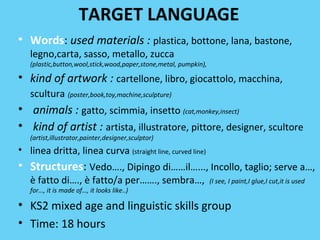
TARGET LANGUAGE 
• Words: used materials : plastica, bottone, lana, bastone, 
legno,carta, sasso, metallo, zucca 
(plastic,button,wool,stick,wood,paper,stone,metal, pumpkin), 
• kind of artwork : cartellone, libro, giocattolo, macchina, 
scultura (poster,book,toy,machine,sculpture) 
• animals : gatto, scimmia, insetto (cat,monkey,insect) 
• kind of artist : artista, illustratore, pittore, designer, scultore 
(artist,illustrator,painter,designer,sculptor) 
• linea dritta, linea curva (straight line, curved line) 
• Structures: Vedo…., Dipingo di……il…..., Incollo, taglio; serve a…, 
è fatto di…., è fatto/a per……., sembra…, (I see, I paint,I glue,I cut,it is used 
for…, it is made of…, it looks like..) 
• KS2 mixed age and linguistic skills group 
• Time: 18 hours
First stage 
Language and Art 
Preparation at school
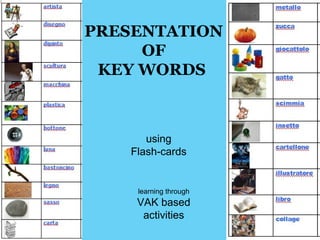
PRESENTATION 
OF 
KEY WORDS 
using 
Flash-cards 
learning through 
VAK based 
activities
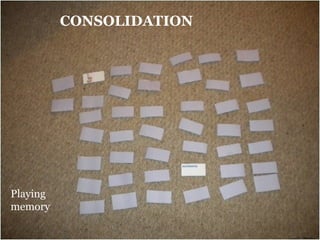
CONSOLIDATION 
Playing 
memory
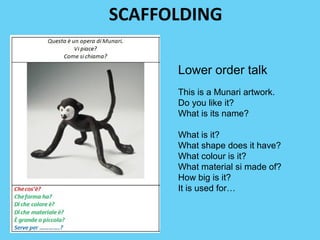
SCAFFOLDING 
Lower order talk 
This is a Munari artwork. 
Do you like it? 
What is its name? 
What is it? 
What shape does it have? 
What colour is it? 
What material si made of? 
How big is it? 
It is used for…
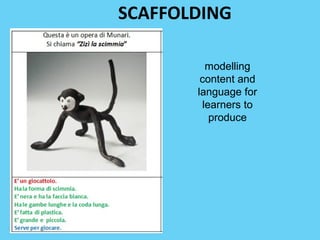
SCAFFOLDING 
modelling 
content and 
language for 
learners to 
produce
Second stage 
Learning about 
Italian art 
Visit at the Estorick Collection
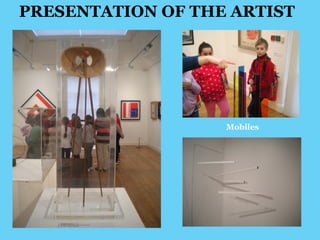
PRESENTATION OF THE ARTIST 
Mobiles
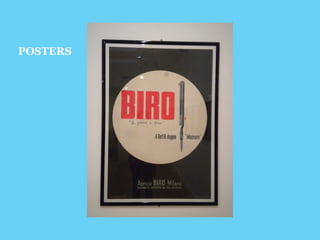
POSTERS
TOYS
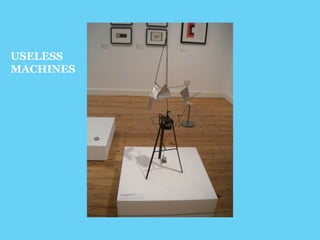
USELESS 
MACHINES
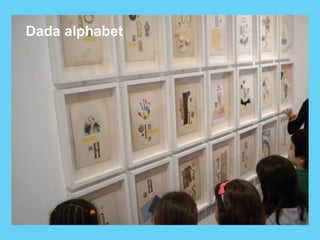
Dada alphabet
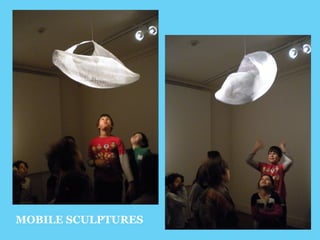
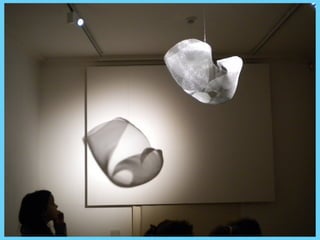
MOBILE SCULPTURES
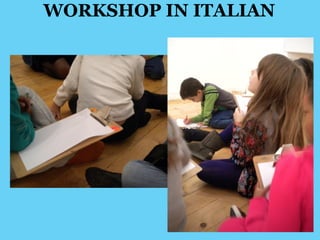
WORKSHOP IN ITALIAN
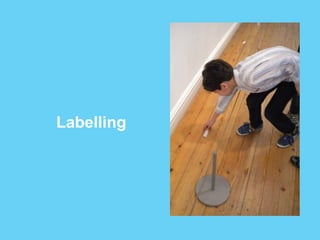
Labelling
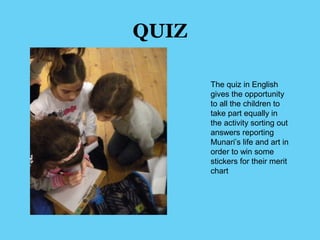
QUIZ 
The quiz in English 
gives the opportunity 
to all the children to 
take part equally in 
the activity sorting out 
answers reporting 
Munari’s life and art in 
order to win some 
stickers for their merit 
chart
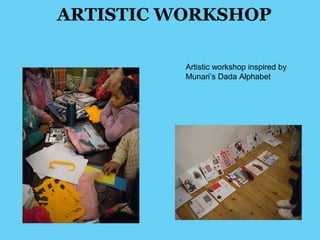
ARTISTIC WORKSHOP 
Artistic workshop inspired by 
Munari’s Dada Alphabet
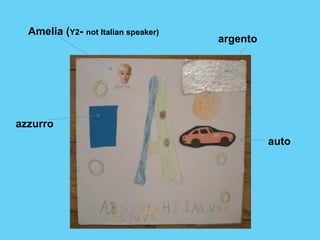
auto 
argento 
Amelia (Y2- not Italian speaker) 
azzurro
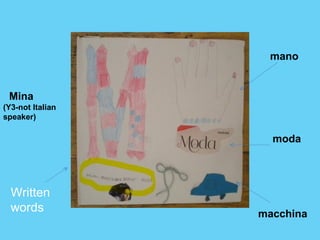
Mina 
(Y3-not Italian 
speaker) 
mano 
moda 
macchina 
Written 
words
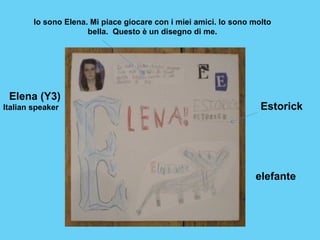
Io sono Elena. Mi piace giocare con i miei amici. Io sono molto 
Estorick 
elefante 
bella. Questo è un disegno di me. 
Elena (Y3) 
Italian speaker
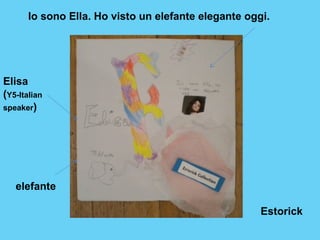
Io sono Ella. Ho visto un elefante elegante oggi. 
Elisa 
(Y5-Italian 
speaker) 
elefante 
Estorick
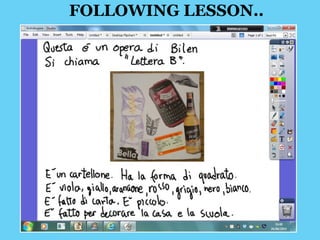
FOLLOWING LESSON..
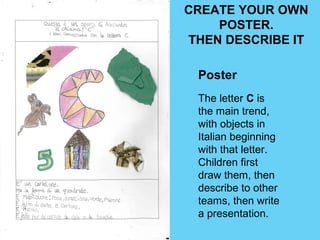
CREATE YOUR OWN 
POSTER. 
THEN DESCRIBE IT 
Poster 
The letter C is 
the main trend, 
with objects in 
Italian beginning 
with that letter. 
Children first 
draw them, then 
describe to other 
teams, then write 
a presentation.
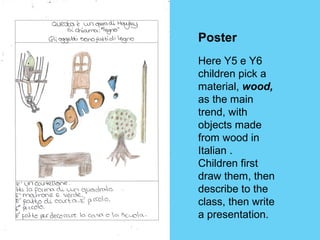
Poster 
Here Y5 e Y6 
children pick a 
material, wood, 
as the main 
trend, with 
objects made 
from wood in 
Italian . 
Children first 
draw them, then 
describe to the 
class, then write 
a presentation.
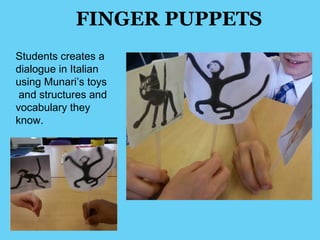
FINGER PUPPETS 
Students creates a 
dialogue in Italian 
using Munari’s toys 
and structures and 
vocabulary they 
know.
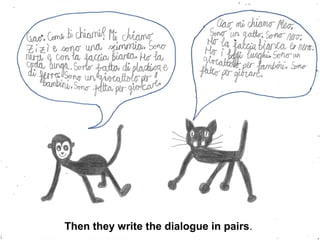
Then they write the dialogue in pairs.
Third stage 
Language and design 
workshop 
Workshop at school
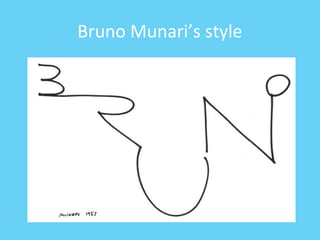
Bruno Munari’s style
Let’s get 
inspired 
by 
Munari
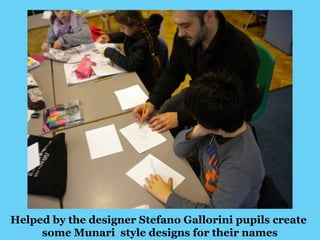
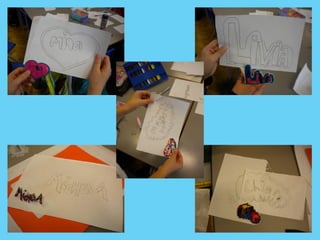
Helped by the designer Stefano Gallorini pupils create 
some Munari style designs for their names
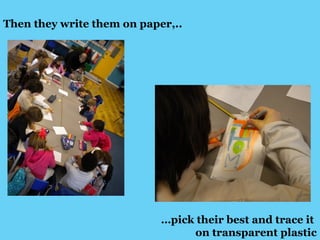
Then they write them on paper,.. 
…pick their best and trace it 
on transparent plastic
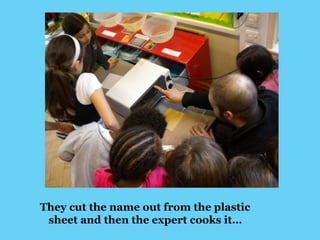
They cut the name out from the plastic 
sheet and then the expert cooks it…
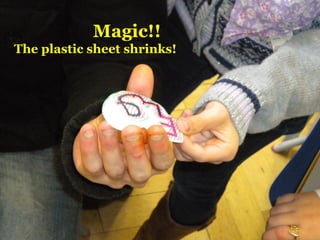
Magic!! 
The plastic sheet shrinks!
Add a safety-pin and glue and…
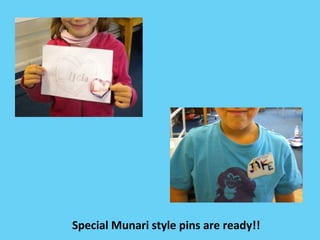
Special Munari style pins are ready!!
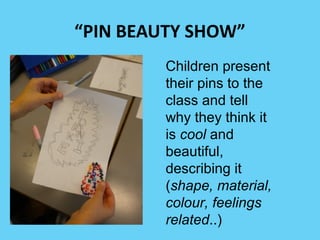
“PIN BEAUTY SHOW” 
Children present 
their pins to the 
class and tell 
why they think it 
is cool and 
beautiful, 
describing it 
(shape, material, 
colour, feelings 
related..)
Children are as good as Munari!!
How to use CLIL based activities to teach art and Italian in Primary Education.

How to use CLIL based activities to teach art and Italian in Primary Education.

  • 2.
    CLIL Content andLanguage Integrated Learning “Learn to use a language and use the language to learn”
  • 3.
    CLIL AND PRIMARYSCHOOL • Less spread than in Secondary Schools. • Inputs needs to be understandable (Krashen) • Use of extra-linguistic inputs: visual ( photos, drawings, time-lines, maps, posters, word banks,..) and gestures, role-play, hands-out, use of realia, games,demonstration,..
  • 4.
    LEARNING BY DOING! Helping learning: • Starting from known vocabulary, structures and contents • Vocabulary and structures adequates to age • Friendly-reassuring enviroment • Pre-teaching vocabulary • Code-switching allowed (L1  L2) • Good scaffolding for learning Helping production: • Allow different kind of answers (not verbal L1 English L2 Italian) • Role-play • Pair and team-work • Making of posters, drawings, booklets…
  • 5.
    CONTENT: WHY CHOOSEART? • Teaching love for beauty at early age • In CLIL visual inputs help understanding • Italian art to re-establish bonds with Italian culture • Italian modern art: vivid and easy for children
  • 6.
    PROGETTO: BRUNO MUNARI Italian language, art and design
  • 7.
    BRUNO MUNARI Bruno Munari “The Peter-Pan of Italian art”
  • 8.
    Painter Sculptor Hewas the first to make mobiles Graphic and industrial Designer objects slogan toys Book illustrator
  • 9.
    ART- L.O. NATIONALCURRICULUM KS2 • Exploring and developing to select and record from first-hand observation • Investigating art and design and use a variety of methods to communicate observations, ideas, feelings and to design and make images and art works. • Comparing methods and approaches in others’ work by identify different ideas and approaches and say what they think about them • Collaborating with other on projects on 2 dimensions • Understanding the roles and purpose of an artist (Munari) working in different times.
  • 10.
    PRIOR KNOWLEDGE •Italian alphabet • Numbers up to 20 • Colours • Basic shapes (circle,square,triangle,rectangle) • Body-parts • Describe dimension (grande/piccolo/lungo/corto) • There is/ there are; it has got
  • 11.
    TARGET LANGUAGE •Words: used materials : plastica, bottone, lana, bastone, legno,carta, sasso, metallo, zucca (plastic,button,wool,stick,wood,paper,stone,metal, pumpkin), • kind of artwork : cartellone, libro, giocattolo, macchina, scultura (poster,book,toy,machine,sculpture) • animals : gatto, scimmia, insetto (cat,monkey,insect) • kind of artist : artista, illustratore, pittore, designer, scultore (artist,illustrator,painter,designer,sculptor) • linea dritta, linea curva (straight line, curved line) • Structures: Vedo…., Dipingo di……il…..., Incollo, taglio; serve a…, è fatto di…., è fatto/a per……., sembra…, (I see, I paint,I glue,I cut,it is used for…, it is made of…, it looks like..) • KS2 mixed age and linguistic skills group • Time: 18 hours
  • 12.
    First stage Languageand Art Preparation at school
  • 13.
    PRESENTATION OF KEYWORDS using Flash-cards learning through VAK based activities
  • 14.
  • 15.
    SCAFFOLDING Lower ordertalk This is a Munari artwork. Do you like it? What is its name? What is it? What shape does it have? What colour is it? What material si made of? How big is it? It is used for…
  • 16.
    SCAFFOLDING modelling contentand language for learners to produce
  • 17.
    Second stage Learningabout Italian art Visit at the Estorick Collection
  • 18.
    PRESENTATION OF THEARTIST Mobiles
  • 19.
  • 20.
  • 21.
  • 22.
  • 23.
  • 25.
  • 26.
  • 27.
    QUIZ The quizin English gives the opportunity to all the children to take part equally in the activity sorting out answers reporting Munari’s life and art in order to win some stickers for their merit chart
  • 28.
    ARTISTIC WORKSHOP Artisticworkshop inspired by Munari’s Dada Alphabet
  • 29.
    auto argento Amelia(Y2- not Italian speaker) azzurro
  • 30.
    Mina (Y3-not Italian speaker) mano moda macchina Written words
  • 31.
    Io sono Elena.Mi piace giocare con i miei amici. Io sono molto Estorick elefante bella. Questo è un disegno di me. Elena (Y3) Italian speaker
  • 32.
    Io sono Ella.Ho visto un elefante elegante oggi. Elisa (Y5-Italian speaker) elefante Estorick
  • 33.
  • 34.
    CREATE YOUR OWN POSTER. THEN DESCRIBE IT Poster The letter C is the main trend, with objects in Italian beginning with that letter. Children first draw them, then describe to other teams, then write a presentation.
  • 35.
    Poster Here Y5e Y6 children pick a material, wood, as the main trend, with objects made from wood in Italian . Children first draw them, then describe to the class, then write a presentation.
  • 36.
    FINGER PUPPETS Studentscreates a dialogue in Italian using Munari’s toys and structures and vocabulary they know.
  • 37.
    Then they writethe dialogue in pairs.
  • 38.
    Third stage Languageand design workshop Workshop at school
  • 39.
  • 40.
  • 41.
    Helped by thedesigner Stefano Gallorini pupils create some Munari style designs for their names
  • 42.
    Then they writethem on paper,.. …pick their best and trace it on transparent plastic
  • 43.
    They cut thename out from the plastic sheet and then the expert cooks it…
  • 44.
    Magic!! The plasticsheet shrinks!
  • 46.
    Add a safety-pinand glue and…
  • 47.
    Special Munari stylepins are ready!!
  • 48.
    “PIN BEAUTY SHOW” Children present their pins to the class and tell why they think it is cool and beautiful, describing it (shape, material, colour, feelings related..)
  • 49.
    Children are asgood as Munari!!