Thomas W. Peterson
Provost and Executive Vice Chancellor
University of California, Merced
Stimulating Innovation in Academia:
The Role of
Public-Private Partnerships
Acknowledgements
• Critical support and information from
– Steven Konsek, National Science Foundation
Program Director, Industrial Innovation and Partnerships
SBIR/STTR and Innovation Corps Teams
– Lydia McClure, National Science Foundation
Program Director, Industrial Innovation and Partnerships
Innovation Corps Teams, Nodes and Sites
• The presenter (Thomas Peterson) does NOT represent the
National Science Foundation
2
US Trade Balance in Advanced Technology
Includes
• Advanced materials
• Aerospace
• Biotechnology and life sciences
• Electronics, optoelectonics
• Flexible manufacturing
• IT and Communications
• Nuclear Energy
• Weapons
https://www.census.gov/foreign-trade/balance/c0007.html#questions
-150,000
-100,000
-50,000
0
50,000
US Trade Balance in Advanced
Technology
1989 - 2016
($M)
• University research is key, often driven by industrial needs.
• Faculty are involved along the innovation continuum, working with
industry at all stages.
• A focus on translational research facilitates the handoff of
technology from universities to industry—resulting in rapid,
efficient innovation.
• Open environment to experiment, fail, iterate and try again.
• Open access to sources of investment capital
How to Stimulate New & Innovative Industry:
Characteristics of the Innovation Ecosystem
5
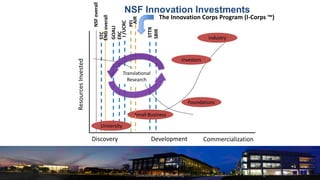
NSF Programs for Translational
Research
• Science and Technology Centers (STC)
• Engineering Research Centers (ERC)
• Materials Research Science and Engineering Centers (MRSEC)
• Grant Opportunities for Academic Liaison with Industry (GOALI)
• Industry/University Cooperative Research Centers (I/UCRC)
• Partnerships for Innovation (PFI)
• Small Business Technology Transfer (STTR)
• Small Business Innovation Research (SBIR)
• Nanoscale Science and Engineering Center (NSEC)
• Nanoscale Interdisciplinary Research Teams (NIRT)
• Emerging Frontiers of Research and Innovation (EFRI)
• Innovation Corps (I-Corps ™)
• Other ENG programs
University
Small Business
Investors
Industry
ENGoverall
NSFoverall
GOALI
I/UCRC
PFI
ERC
The Innovation Corps Program (I-Corps ™)
SBIR
STC
ResourcesInvested
Discovery Development Commercialization
Foundations
NSF Innovation Investments
AIR
Translational
Research
6Directorate for Engineering
STTR
Multi-University Centers Foster Innovation
(representative examples only)
• National Science Foundation
– Science and Technology Centers (STC)
– Engineering Research Centers (ERC)
– Industry/University Cooperative Research Centers (I/UCRC)
• National Institutes of Health
– Centers for Accelerated Innovations (NCAI)
• Department of Energy
– Energy Frontier Research Centers (EFRC)
• Department of Defense
– University Affiliated Research Centers (UARC)
Industry University Cooperative Research Centers
(I/UCRC)
Basic Facts
• Initiated in 1973
• Base funding from NSF
• Single- and Multi-University Models
• Financial and Technical support from Industry Consortium
• Systemwide program analysis and audit provided by NSF
• Currently over 73 Centers, including 5 International partnerships
• Website: IUCRC.org
8
Locations of Current NSF I/UCRCs 2016
Engineering Research Centers
(ERC)
Basic Facts
• Initiated in 1984
• Fixed 10 year Award Period from NSF
– Contingent on satisfactory periodic reviews
– Can be supplemented with Industry support
• All involve multiple institutional partnerships
• Currently 19 Centers, many with International partnerships
• Direct evidence of multi-billion dollar economic impact since inception
• Website: http://erc-assoc.org/
10
• 67 Centers funded over
life of Program
• Many still operational and
‘self-supported’
• Industry consortia
• Other federal
agencies
• State and local funds
High Impact Achievements from ERCs
http://erc-assoc.org/high-impact-erc-achievements
• Development of the NiAl Underlayer for memory devices
– Data Storage Systems Center, Carnegie Mellon University
• Real-time 3D Video Imaging
– Center for Integrated Access Networks, University of Arizona
• Tornado Early-warning systems
– Collaborative Adaptive Sensing of the Atmosphere, UMass Amherst
• Synthetic pathways to anti-malarial drugs
– Synthetic Biology ERC, University of California, Berkeley
• Satellite-based broadband internet access
– Systems Research Center, University of Maryland
12
SBIR/STTR
Small Business Innovation Research
Small Business Technology Transfer
• SBIR - encourages domestic small businesses to engage in Federal
Research/Research and Development (R/R&D) that has the potential
for commercialization.
• STTR - bridges the gap between performance of basic science and
commercialization of resulting innovations.
• Websites - https://www.sbir.gov/ and https://www.nsf.gov/eng/iip/sbir/
13
SBIR/STTR Programs throughout Federal Government
Program
• Created by National Science Foundation and signed as a
Federal wide program in 1982
• SBIR programs have awarded over $40 billion to
research-intensive American small businesses
• 11 Federal Agencies participate annually in program
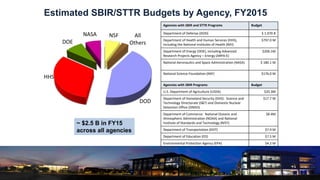
DOD
HHS
DOE
NASA NSF All
Others
Agencies with SBIR and STTR Programs Budget
Department of Defense (DOD) $ 1.070 B
Department of Health and Human Services (HHS),
including the National Institutes of Health (NIH)
$797.0 M
Department of Energy (DOE), including Advanced
Research Projects Agency – Energy (ARPA-E)
$206.1M
National Aeronautics and Space Administration (NASA) $ 180.1 M
National Science Foundation (NSF) $176.0 M
Agencies with SBIR Programs Budget
U.S. Department of Agriculture (USDA) $20.3M
Department of Homeland Security (DHS): Science and
Technology Directorate (S&T) and Domestic Nuclear
Detection Office (DNDO)
$17.7 M
Department of Commerce: National Oceanic and
Atmospheric Administration (NOAA) and National
Institute of Standards and Technology (NIST)
$8.4M
Department of Transportation (DOT) $7.9 M
Department of Education (ED) $7.5 M
Environmental Protection Agency (EPA) $4.2 M
Estimated SBIR/STTR Budgets by Agency, FY2015
~ $2.5 B in FY15
across all agencies
23 Sept 2015
What’s Unique about NSF SBIR
• NSF won’t buy anything
from you
• NSF doesn’t identify the
application or technology
• The PI identifies the
market need and a tech-
based solution
Broad program topics cover almost
every area of technology:
• Educational Technologies & Applications
• Information Technologies
• Semiconductors and Photonic Devices & Materials
• Internet of Things
• Electronic Hardware, Robotics & Wireless Technologies
• Advanced Manufacturing & Nanotechnology
• Advanced Materials & Instrumentation
• Chemical & Environmental Technologies
• Biological Technologies
• Smart Health and Biomedical TechnologiesCourtesy NSF.GOV
Steven Konsek, PD
Who/What NSF Funds
• High technical risk innovations with potential for high commercial /
societal impact
• R&D only – you will need to raise money for other activities
• Focus on start-ups and early stage companies
• Typical program profile (2014 stats):
• 72% of funded companies <5 years old
• 90% of funded companies <10 employees
• 80% of funded companies had not received a prior Phase II award
Courtesy NSF.GOV
Steven Konsek, PD
The Innovation Corps (I-Corps ™) Program
18
• Initiated at NSF in 2011
• Tried to answer this basic question:
– Does some fraction of the $7B annual NSF investment in basic
research lead to potentially commercializable products/processes?
• Key elements of program:
– Modest seed funding
– Educational component on how to launch a start-up
– Cohort based program (so you can learn from your peers)
I-Corps: The Beginning
• Team Composition:
– Entrepreneurial Lead: Post-doc or Student to move it
forward
– I-Corps Mentor: Domain-relevant volunteer guide
– PI: Researcher with current or previous award
• Program Outcomes
– Functioning network of Mentors/Advisors
– Scientist and Engineers trained as Entrepreneurs
– Increased impact of NSF-funded basic research
19
Credit: © 2011 JupiterImages Corp.
•30 Hours of Curriculum
•$50,000 per award
• F&A $5,000 maximum
• 25 awards in FY2011
• 100 awards in FY2012
I-CORPSTM THREE (3) PERSON TEAM:
• Entrepreneurial Lead - typically the postdoc or grad student, or
recent graduate – LEADER of the team
• Technical Lead - typically the faculty member
• I-Corps Mentor - volunteer guide to your target industry who
has experience with startups
20
Courtesy NSF.GOV
Lydia McClure, PD
I-Corps™ Now – Three Components
• I-Corps™ Teams – The original construct; a three person team
with an entrepreneurial lead, a mentor and the primary
researcher.
• I-Corps™ Nodes – provides regional support for basic I-Corps
needs for innovation education, infrastructure and research.
• I-Corps™ Sites – provides an individual academic institution the
tools and support to catalyze campus teams whose ideas are
likely to lead to commercialization.
I – Corps Now: A broad and extensive Network of Universities
Courtesy NSF.GOV
Lydia McClure, PD
I-CorpsTM Learning
4 courses; 73 teams
I-CorpsTM@NIH
4 courses; 59 teams
Lab-Corps
9 Labs; 3
courses; 36
teams
2013 2014 2015 2016
I-CorpsTM@DoD
pilot and
USDA I-FAST
pilot
2017
2011 2012
NSF I-CorpsTM
39 courses; 823 teams
I – Corps Now a Multi-Agency Program
Courtesy NSF.GOV
Lydia McClure, PD
As of Sep 2016:
823 national I-CorpsTM Teams
11 Federal Agencies
324 companies formed
$83M raised
3 acquisitions
30%
22%10%
1%
3%
2%
18%
12%
2%
SBIR/STTR Phase 2
SBIR/STTR Phase 1
Other Government
Awards
Awards & Competitions
Grants
Angel Investment
VC Investment
Unspecified Investment
Revenue
Courtesy NSF.GOV
Lydia McClure, PD
Acknowledgements
• Critical support and information from
– Steven Konsek, National Science Foundation
Program Director, Industrial Innovation and Partnerships
SBIR/STTR and Innovation Corps Teams
– Lydia McClure, National Science Foundation
Program Director, Industrial Innovation and Partnerships
Innovation Corps Teams, Nodes and Sites
• The presenter (Thomas Peterson) does NOT represent the
National Science Foundation
25

Dr. Thomas Peterson (Provost and Executive Vice Chancellor, University of California, Merced): Stimulating Innovation in Academia: The Role ofPublic-Private Partnerships

  • 1.
    Thomas W. Peterson Provostand Executive Vice Chancellor University of California, Merced Stimulating Innovation in Academia: The Role of Public-Private Partnerships
  • 2.
    Acknowledgements • Critical supportand information from – Steven Konsek, National Science Foundation Program Director, Industrial Innovation and Partnerships SBIR/STTR and Innovation Corps Teams – Lydia McClure, National Science Foundation Program Director, Industrial Innovation and Partnerships Innovation Corps Teams, Nodes and Sites • The presenter (Thomas Peterson) does NOT represent the National Science Foundation 2
  • 3.
    US Trade Balancein Advanced Technology Includes • Advanced materials • Aerospace • Biotechnology and life sciences • Electronics, optoelectonics • Flexible manufacturing • IT and Communications • Nuclear Energy • Weapons https://www.census.gov/foreign-trade/balance/c0007.html#questions -150,000 -100,000 -50,000 0 50,000 US Trade Balance in Advanced Technology 1989 - 2016 ($M)
  • 4.
    • University researchis key, often driven by industrial needs. • Faculty are involved along the innovation continuum, working with industry at all stages. • A focus on translational research facilitates the handoff of technology from universities to industry—resulting in rapid, efficient innovation. • Open environment to experiment, fail, iterate and try again. • Open access to sources of investment capital How to Stimulate New & Innovative Industry: Characteristics of the Innovation Ecosystem
  • 5.
    5 NSF Programs forTranslational Research • Science and Technology Centers (STC) • Engineering Research Centers (ERC) • Materials Research Science and Engineering Centers (MRSEC) • Grant Opportunities for Academic Liaison with Industry (GOALI) • Industry/University Cooperative Research Centers (I/UCRC) • Partnerships for Innovation (PFI) • Small Business Technology Transfer (STTR) • Small Business Innovation Research (SBIR) • Nanoscale Science and Engineering Center (NSEC) • Nanoscale Interdisciplinary Research Teams (NIRT) • Emerging Frontiers of Research and Innovation (EFRI) • Innovation Corps (I-Corps ™) • Other ENG programs
  • 6.
    University Small Business Investors Industry ENGoverall NSFoverall GOALI I/UCRC PFI ERC The InnovationCorps Program (I-Corps ™) SBIR STC ResourcesInvested Discovery Development Commercialization Foundations NSF Innovation Investments AIR Translational Research 6Directorate for Engineering STTR
  • 7.
    Multi-University Centers FosterInnovation (representative examples only) • National Science Foundation – Science and Technology Centers (STC) – Engineering Research Centers (ERC) – Industry/University Cooperative Research Centers (I/UCRC) • National Institutes of Health – Centers for Accelerated Innovations (NCAI) • Department of Energy – Energy Frontier Research Centers (EFRC) • Department of Defense – University Affiliated Research Centers (UARC)
  • 8.
    Industry University CooperativeResearch Centers (I/UCRC) Basic Facts • Initiated in 1973 • Base funding from NSF • Single- and Multi-University Models • Financial and Technical support from Industry Consortium • Systemwide program analysis and audit provided by NSF • Currently over 73 Centers, including 5 International partnerships • Website: IUCRC.org 8
  • 9.
    Locations of CurrentNSF I/UCRCs 2016
  • 10.
    Engineering Research Centers (ERC) BasicFacts • Initiated in 1984 • Fixed 10 year Award Period from NSF – Contingent on satisfactory periodic reviews – Can be supplemented with Industry support • All involve multiple institutional partnerships • Currently 19 Centers, many with International partnerships • Direct evidence of multi-billion dollar economic impact since inception • Website: http://erc-assoc.org/ 10
  • 11.
    • 67 Centersfunded over life of Program • Many still operational and ‘self-supported’ • Industry consortia • Other federal agencies • State and local funds
  • 12.
    High Impact Achievementsfrom ERCs http://erc-assoc.org/high-impact-erc-achievements • Development of the NiAl Underlayer for memory devices – Data Storage Systems Center, Carnegie Mellon University • Real-time 3D Video Imaging – Center for Integrated Access Networks, University of Arizona • Tornado Early-warning systems – Collaborative Adaptive Sensing of the Atmosphere, UMass Amherst • Synthetic pathways to anti-malarial drugs – Synthetic Biology ERC, University of California, Berkeley • Satellite-based broadband internet access – Systems Research Center, University of Maryland 12
  • 13.
    SBIR/STTR Small Business InnovationResearch Small Business Technology Transfer • SBIR - encourages domestic small businesses to engage in Federal Research/Research and Development (R/R&D) that has the potential for commercialization. • STTR - bridges the gap between performance of basic science and commercialization of resulting innovations. • Websites - https://www.sbir.gov/ and https://www.nsf.gov/eng/iip/sbir/ 13
  • 14.
    SBIR/STTR Programs throughoutFederal Government Program • Created by National Science Foundation and signed as a Federal wide program in 1982 • SBIR programs have awarded over $40 billion to research-intensive American small businesses • 11 Federal Agencies participate annually in program
  • 15.
    DOD HHS DOE NASA NSF All Others Agencieswith SBIR and STTR Programs Budget Department of Defense (DOD) $ 1.070 B Department of Health and Human Services (HHS), including the National Institutes of Health (NIH) $797.0 M Department of Energy (DOE), including Advanced Research Projects Agency – Energy (ARPA-E) $206.1M National Aeronautics and Space Administration (NASA) $ 180.1 M National Science Foundation (NSF) $176.0 M Agencies with SBIR Programs Budget U.S. Department of Agriculture (USDA) $20.3M Department of Homeland Security (DHS): Science and Technology Directorate (S&T) and Domestic Nuclear Detection Office (DNDO) $17.7 M Department of Commerce: National Oceanic and Atmospheric Administration (NOAA) and National Institute of Standards and Technology (NIST) $8.4M Department of Transportation (DOT) $7.9 M Department of Education (ED) $7.5 M Environmental Protection Agency (EPA) $4.2 M Estimated SBIR/STTR Budgets by Agency, FY2015 ~ $2.5 B in FY15 across all agencies 23 Sept 2015
  • 16.
    What’s Unique aboutNSF SBIR • NSF won’t buy anything from you • NSF doesn’t identify the application or technology • The PI identifies the market need and a tech- based solution Broad program topics cover almost every area of technology: • Educational Technologies & Applications • Information Technologies • Semiconductors and Photonic Devices & Materials • Internet of Things • Electronic Hardware, Robotics & Wireless Technologies • Advanced Manufacturing & Nanotechnology • Advanced Materials & Instrumentation • Chemical & Environmental Technologies • Biological Technologies • Smart Health and Biomedical TechnologiesCourtesy NSF.GOV Steven Konsek, PD
  • 17.
    Who/What NSF Funds •High technical risk innovations with potential for high commercial / societal impact • R&D only – you will need to raise money for other activities • Focus on start-ups and early stage companies • Typical program profile (2014 stats): • 72% of funded companies <5 years old • 90% of funded companies <10 employees • 80% of funded companies had not received a prior Phase II award Courtesy NSF.GOV Steven Konsek, PD
  • 18.
    The Innovation Corps(I-Corps ™) Program 18 • Initiated at NSF in 2011 • Tried to answer this basic question: – Does some fraction of the $7B annual NSF investment in basic research lead to potentially commercializable products/processes? • Key elements of program: – Modest seed funding – Educational component on how to launch a start-up – Cohort based program (so you can learn from your peers)
  • 19.
    I-Corps: The Beginning •Team Composition: – Entrepreneurial Lead: Post-doc or Student to move it forward – I-Corps Mentor: Domain-relevant volunteer guide – PI: Researcher with current or previous award • Program Outcomes – Functioning network of Mentors/Advisors – Scientist and Engineers trained as Entrepreneurs – Increased impact of NSF-funded basic research 19 Credit: © 2011 JupiterImages Corp. •30 Hours of Curriculum •$50,000 per award • F&A $5,000 maximum • 25 awards in FY2011 • 100 awards in FY2012
  • 20.
    I-CORPSTM THREE (3)PERSON TEAM: • Entrepreneurial Lead - typically the postdoc or grad student, or recent graduate – LEADER of the team • Technical Lead - typically the faculty member • I-Corps Mentor - volunteer guide to your target industry who has experience with startups 20 Courtesy NSF.GOV Lydia McClure, PD
  • 21.
    I-Corps™ Now –Three Components • I-Corps™ Teams – The original construct; a three person team with an entrepreneurial lead, a mentor and the primary researcher. • I-Corps™ Nodes – provides regional support for basic I-Corps needs for innovation education, infrastructure and research. • I-Corps™ Sites – provides an individual academic institution the tools and support to catalyze campus teams whose ideas are likely to lead to commercialization.
  • 22.
    I – CorpsNow: A broad and extensive Network of Universities Courtesy NSF.GOV Lydia McClure, PD
  • 23.
    I-CorpsTM Learning 4 courses;73 teams I-CorpsTM@NIH 4 courses; 59 teams Lab-Corps 9 Labs; 3 courses; 36 teams 2013 2014 2015 2016 I-CorpsTM@DoD pilot and USDA I-FAST pilot 2017 2011 2012 NSF I-CorpsTM 39 courses; 823 teams I – Corps Now a Multi-Agency Program Courtesy NSF.GOV Lydia McClure, PD
  • 24.
    As of Sep2016: 823 national I-CorpsTM Teams 11 Federal Agencies 324 companies formed $83M raised 3 acquisitions 30% 22%10% 1% 3% 2% 18% 12% 2% SBIR/STTR Phase 2 SBIR/STTR Phase 1 Other Government Awards Awards & Competitions Grants Angel Investment VC Investment Unspecified Investment Revenue Courtesy NSF.GOV Lydia McClure, PD
  • 25.
    Acknowledgements • Critical supportand information from – Steven Konsek, National Science Foundation Program Director, Industrial Innovation and Partnerships SBIR/STTR and Innovation Corps Teams – Lydia McClure, National Science Foundation Program Director, Industrial Innovation and Partnerships Innovation Corps Teams, Nodes and Sites • The presenter (Thomas Peterson) does NOT represent the National Science Foundation 25