MIT, the ILP and R&D
                   Pablo Delgado deTorres
                   MIT Senior Industrial Liaison Officer


COEPA
21 de Julio 2009
Why Industry Comes to Academia

•   Expose management to leading-edge thinking,
    technology
•   Gain insight from internationally-recognized experts
•   Strengthen strategic decision-making:
    – development of new products and processes
    – implementation of innovative management practices
    – achievement of effective growth strategies
    – New market and social ideas

•   Create research synergies
•   Recruit future company leaders
•   Maintain Technological awareness


                                           2
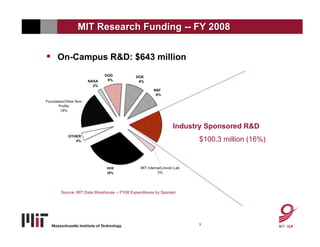
MIT Research Funding -- FY 2008


•   On-Campus R&D: $643 million


                                                            Industry Sponsored R&D
                                                                  $100.3 million (16%)


                           HHS
                           30%


    Source: MIT Data Warehouse -- FY08 Expenditures by Sponsor


                                                                  3
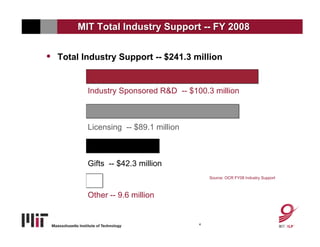
MIT Total Industry Support -- FY 2008


•   Total Industry Support -- $241.3 million


           Industry Sponsored R&D -- $100.3 million


           Licensing -- $89.1 million


           Gifts -- $42.3 million
                                            Source: OCR FY08 Industry Support


           Other -- 9.6 million


                                        4
Solving Real-World Problems

•   MIT Industry Alliances
    – Amgen, Merck, Ford Motor Company, Nippon Telephone and
      Telegraph, Merrill Lynch, DuPont, Microsoft, Hewlett-Packard

•   708 companies provided R&D/gift support in FY 2008
    – 30 companies funded $1M+
    – 158 companies funded $100K - $1M


                                                 Source: OCR FY08 Industry Support


                                             5
MIT - functional organization

•   71 MIT-related Nobel Prize winners
     –   Including 7 current faculty members

•   5 schools, 34 departments/divisions/sections/other programs
     –   57 interdisciplinary research units


                                               Computer
                         Chemical               Science     Electrical
                        Engineering                        Engineering


                 Biology                       Research             Mathematics
                                                Center


                       Economics                               Management
                                               Materials
                                               Science

                                                                    Source: MIT Facts 2008


                                                           6
MIT Organization


                   7
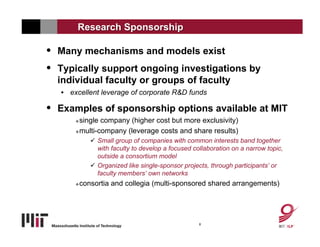
Research Sponsorship

• Many mechanisms and models exist
• Typically support ongoing investigations by
  individual faculty or groups of faculty
   • excellent leverage of corporate R&D funds

• Examples of sponsorship options available at MIT
        single company (higher cost but more exclusivity)
        multi-company (leverage costs and share results)

               Small group of companies with common interests band together
                with faculty to develop a focused collaboration on a narrow topic,
                outside a consortium model
               Organized like single-sponsor projects, through participants’ or
                faculty members’ own networks
          consortia and collegia (multi-sponsored shared arrangements)


                                                    8
Consortia

• Bring multiple companies together to sponsor research
    in a field of inquiry
•   Examples at MIT:
    – closed consortia
         fixed number of members define and share all research and

          administrative expenses and share all pre-publication results
          and licensing opportunities
         example: Consortium for Advancement of Manufacturing in

          Pharmaceuticals (8 companies)
    – open consortia
         open membership

         current members pay annual fee and share all pre-publication

          results and licensing opportunities, with right to sponsor
          additional projects
         example: Media Laboratory (>100 companies)


                                              9
Confidentiality in University/Industry Relationships

•   NDA’s
    – Single Faculty or University
    – Normal Protocols
    – Caution on Both Sides
    – Short term
    – Specific and event driven.

•   Research Publication
    – Essential to Faculty/Mission of University
    – Review Period for Sponsor Prior to Publication


                                             10
Exchanging Personnel

•   Usually arranged as part of sponsored research
•   Company sponsors a senior scientist to participate in the
    research at the university as a “visiting fellow”
•   Allows company scientist:
    – to participate directly in the research to enhance transfer of learning back to
      the company
    – to participate in other university activities and develop a broad network at
      the university

•   Provides a prestigious benefit to top corporate researchers


                                                     11
Consulting

•   Most faculty seek private consulting
    relationships with industry
    –   at MIT: 20% of faculty time for consulting
    –   helps faculty be aware of real-world challenges
    –   helps keep research current, meeting needs
    –   broadens faculty professional networks
    –   helps develop placement opportunities for
        students and graduates


                                     12
Consulting

•   Benefits for companies:
    – brings in valuable outside expertise to solve current, short-
      and long-term problems
    – helps broaden corporate vision for planning
    – allows company to protect confidentiality and ownership of
      intellectual property
    – usually negotiated as personal services contracts with
      individual faculty


                                           13
The Environment

•   Venture capital firms, investment bankers, law firms and
    others.

• Collaborative Science-
     Across disciplines
     Across institutions
     Across borders
• Most research intensive area in the country
  (6% of state product)
     “Academic research is especially effective as an engine of
      economic growth
     in the Boston area precisely because it takes place not in an ivory
      tower, but in a complex network of relationships among
      universities, hospitals, other affiliated institutions, corporations and
      Entrepreneurs”
       Appleseed Report


                                                 14
Culture

• MIT culture supports innovation
  • Organizational boundaries are very permeable
  • Intra/inter linkages easy to form and numerous
  • Environment forces random interactions
  • Cost of failure is low
  • Entrepreneurship is holographic at M.I.T.


                                 15
MIT ECOSYSTEM


                Supporting environment with complimentary assets
     ECOSYSTEM                                                  EL
 TECHLINK
                                         ENTREPRENEURSHIP
     Supporting environment with complimentary assets        OD
                         VCPE                    CENTER   SM
                                                     N ES
INNOVATION X-Prize SEBC                   MIT VMS SI
   CLUB                                        BU           MIT SLOAN
     D-Lab Lab                  $100K BP    ED                SCHOOL
                            COMPETITION  AT           MIT
            I-Teams                   ID
                                 V AL           ENTERPRISE
                                   MIT TLO         FORUM

                             DESHPANDE                                                   Legatum Center
                             CENTER
                                                                           Industrial Liaison Program

                             Idea for                     Business                     Customers
   Innovation                                                                                              Growth
                            a company                       Plan                        Funding
Copyright 2002-2005 Deshpande Center for Technological Innovation, Massachusetts Institute of Technology

                                                                Slide courtesy of Prof. Charles Cooney
                                                                                            16
Many forms of “Technology Transfer” from Academia to Industry


•   The graduating student
•   Publication
•   The consulting professor
•   Collaborative/sponsored research with industry
•   University seminars/courses for industry
•   Intellectual Property licensing to
    – Existing companies
    – Spin-Outs


                                            17
What is the Industrial Liaison Program?

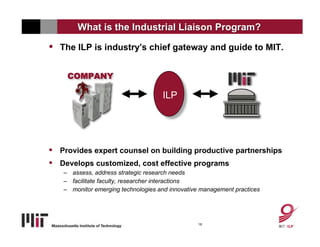
•   The ILP is industry’s chief gateway and guide to MIT.


      COMPANY

           Company                   ILP
                                       ILP


•   Provides expert counsel on building productive partnerships
•   Develops customized, cost effective programs
    – assess, address strategic research needs
    – facilitate faculty, researcher interactions
    – monitor emerging technologies and innovative management practices


                                                 18
ILP Facts

•   Founded in 1948
•   Largest program of its kind in the world
•   Worldwide industry membership
    – 33% N. America, 33% Asia, 30% Europe, 4% Other
    – broad range of industrial sectors, both traditional and high-tech

•   20 Industrial Liaison Officers*
    – average 15 years of industry experience
    – most with advanced degrees


                                                    *as of January 23, 2008


                                               19
Typical ILP Services and Deliverables

•   On-campus sessions with faculty and research staff
•   Faculty visits to company sites
•   Executive research briefings
•   Video/Web sessions with faculty and research staff
•   Customized research reports
•   Symposia and conferences
•   Publications
    – ILP edition of Technology Insider
    – Web reports and digital presentation archive
    – Technology Review

•   Facilitated access to MIT people, resources
•   News and details of relevant MIT activities and programs


                                                     20
Typical Benefits Companies Receive

•   Monitor emerging/disruptive technologies
•   Discover new technologies to strengthen existing businesses
•   Validate or invalidate key investment decisions/ new product
    development
•   Solve short term technical problems
•   Identify new industry partners
•   Use faculty for consulting/ advice
•   Participate in new industry standards setting
•   Train employees
•   Recruit new employees


                                            21
Deshpande Center for Technical Innovation

Launched with a initial $20 million gift

•   Nurtures marketable inventions by:
     – Engaging established industry to spark inventions that solve existing needs
     – Funding proof-of-concept explorations with Ignition Grants
•   Fuels market-driven innovation by:
     – Funding research with Innovation Program Grants
     – Getting the business community involved at an early
     – stage to help shape the direction of research
     – Educating the research community about
     – commercialization to focus efforts in the right areas
•   Implements innovation in the marketplace by:
     – Catalyzing collaborations with partner companies and entrepreneurs
     – Directing researchers to appropriate business and entrepreneurial
        resources
     – Serving as a liaison between MIT and the local business community
     – Showcasing MIT technologies via symposia and workshops
•   Expanding to Singapore and Portugal

                                                    22
MIT Deshpande Center


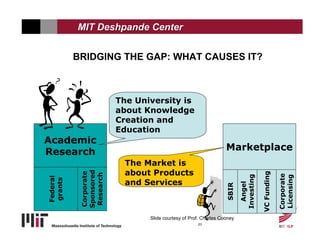
          BRIDGING THE GAP: WHAT CAUSES IT?


                       The University is
                       about Knowledge
                       Creation and
                       Education
Academic
Research                                                        Marketplace
                         The Market is
                         about Products
           Sponsored


                                                                                   VC Funding
           Corporate

            Research


                                                                                                Corporate
                                                                       Investing


                                                                                                Licensing
Federal


                         and Services
grants


                                                                         Angel
                                                                SBIR
                              Slide courtesy of Prof. Charles Cooney
                                                   23
MIT Deshpande Center

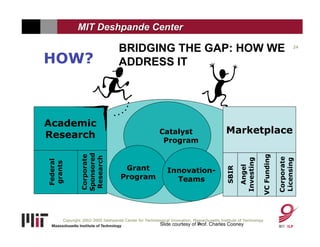
                                  BRIDGING THE GAP: HOW WE                                                                        24


HOW?                              ADDRESS IT


Academic
Research                                                Catalyst                          Marketplace
                                                         Program
              Sponsored


                                                                                                             VC Funding
              Corporate

               Research


                                                                                                                          Corporate
                                                                                                 Investing


                                                                                                                          Licensing
Federal
grants


                                    Grant


                                                                                                   Angel
                                                                                          SBIR
                                                            Innovation-
                                   Program                    Teams
                                                                Events


      Copyright 2002-2005 Deshpande Center for Technological Innovation, Massachusetts Institute of Technology
                                                        Slide courtesy of Prof. Charles Cooney
                                                                          24
TLO’s Mission

     Bring about commercial investment to
develop inventions from MIT research
  –To bring therapies and other products into
  public use
  –To show the public, Congress, and funding
  agencies tangible results of basic research
  –To allow faculty and students to see real-
  world results of their research
  –For economic development—in
  Massachusetts and nationally


           Content courtesy of Lita Nelsen director of the TLO
                                                       25
Technology Licensing Office Statistics
•   500 new invention disclosures/year
•   100 new technology licenses/year
•   15-30 new companies/year
•   Over 650 active licenses
•   About 300 spinout companies total
     Spinouts particularly important for “Break-through”
     technologies
    – Investments are large
    – Time-to-market long
    – Risk of success very high
    – Large, existing companies reluctant (or unable) to invest at such an
       early stage
          Effect on earnings

          Disruptive to their own R&D agendas

    – But ready to buy products/company at substantial price when spin-out
       reduces risk and time-to-market


                     Content courtesy of Lita Nelsen director of the TLO
                                                         26
MIT’s Patent and Licensing Goals


•   See that ideas are practiced broadly
•   Maximize benefits to general society
•   Enhance the educational process
•   Create companies and jobs
•   Provide funds to patent future ideas
•   Provide modest income to MIT


                    Content courtesy of Lita Nelsen director of the TLO

                                            27
The Tech Transfer Bargain

•   University research leads to patent—but technology is
    unproven and high risk
•   University is willing to grant exclusive patent license to
    Company who will commit to the risk of developing the
    technology
•   If development succeeds, the patent protects the Company
    from competitors
•   University benefits from product being developed and from
    royalties (shared with inventor)


                Content courtesy of Lita Nelsen director of the TLO
                                                        28
Strategy: do a lot!


The Volume Strategy
•   Aim to maximize the number of technologies being
    developed
     – Rather than try to pick a few “winners” and concentrate on them

•   100 license/year—20-30 startups

Why are we able to do so much?
•   LOTS of world-class technology—dependent on government
    support of basic research
•   Good IP protection
•   Consistent Tech Transfer policies throughout the university
     – It’s about Impact, not (primarily) Income
•   An experienced Technology Licensing Office

                         Content courtesy of Lita Nelsen director of the TLO
                                                       29
Advantages of the “Volume Strategy”

•   Maximizes participation of faculty and students in the
    technology transfer process
•   Maximizes number of technologies invested in by
    companies and VC’s
•   Maximizes probability of hitting a home run
•   Technology is probably too early to be able to pick the
    winners!


                     Content courtesy of Lita Nelsen director of the TLO


                                                  30
Helping Inventors


                    From the TLO Inventors guide

                                       31
Biotechnology Cluster, Cambridge Mass.


                       32
Emerging Energy Cluster in Greater Boston


                        33
100K Student Business Plan Contest

•   Over 100 entries/year
•   Volunteers from business community serve as
    mentors and judges
•   Over 500 people (mostly from business community)
    attend the final awards ceremony


                                    34
Venture Mentoring Service

•   Over 100 volunteers from the entrepreneurial, angel
    investing, venture capital and other businesses
    provide mentoring to entrepreneurs (including alums)
    associated with MIT.


                                    35
MIT Enterprise Forum

•   Founded and run by volunteers from the business
    community
•   Run separate monthly clinics for
    –   “concept companies”
    – Startup companies
    – Early growth-stage companies
•   Annual instructional and networking conference
•   Several hundred audience attendees per month


                                       36
And Many Others

•   Entrepreneurship Center: Matches MBA students with
    internships with entrepreneurial Company CEO’s
•   Student Venture Clubs at undergraduate, graduate
    levels in b-School, School of Engineering, etc.
•   …….


                                   37
Economic Engine


                  38
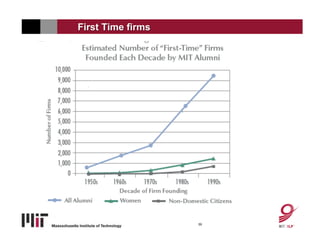
First Time firms


                   39
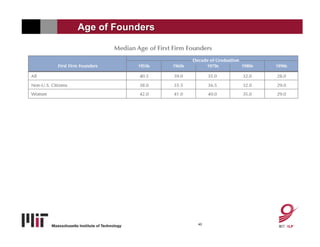
Age of Founders


                  40
Alumni Companies by Industry


                       41
Startup Funding


                  42
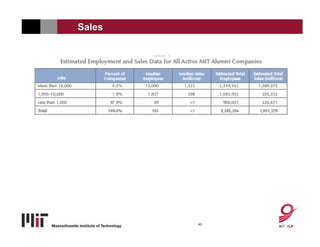
Sales


        43
Where


        44
Out of State Sales


                     45
MIT: References


Bank Boston Study (1997)
http://web.mit.edu/newsoffice/founders/

Multi-University Study (2003)
http://www.masscolleges.org/Economic/default.asp

Technology Licensing Office
http://web.mit.edu/tlo/www/

Industrial Liaison Program
http://ilp-www.mit.edu

$50 K Competition
    http://50k.mit.edu


                                            46
Remember
–
When
you
reach
the
summit                       Copyr


you
are
only
half
way
thru
your
journey                    ight
                                                           2002-
                                                           2005
                                                           Desh
                                                           pand
                                                           e
                                                           Cente
                                                           r for
                                                           Techn
                                                           ologic
                                                           al
                                                           Innov
                                                           ation,
                                                           Mass
                                                           achus
                                                           etts
                                                           Instit
                                                           ute of
                                                           Techn
                                                           ology


                                          47
                         47   Slide courtesy of Prof. Charles Cooney

Presentacion MIT COEPA CGCE

  • 1.
    MIT, the ILPand R&D Pablo Delgado deTorres MIT Senior Industrial Liaison Officer COEPA 21 de Julio 2009
  • 2.
    Why Industry Comesto Academia • Expose management to leading-edge thinking, technology • Gain insight from internationally-recognized experts • Strengthen strategic decision-making: – development of new products and processes – implementation of innovative management practices – achievement of effective growth strategies – New market and social ideas • Create research synergies • Recruit future company leaders • Maintain Technological awareness 2
  • 3.
    MIT Research Funding-- FY 2008 • On-Campus R&D: $643 million Industry Sponsored R&D $100.3 million (16%) HHS 30% Source: MIT Data Warehouse -- FY08 Expenditures by Sponsor 3
  • 4.
    MIT Total IndustrySupport -- FY 2008 • Total Industry Support -- $241.3 million Industry Sponsored R&D -- $100.3 million Licensing -- $89.1 million Gifts -- $42.3 million Source: OCR FY08 Industry Support Other -- 9.6 million 4
  • 5.
    Solving Real-World Problems • MIT Industry Alliances – Amgen, Merck, Ford Motor Company, Nippon Telephone and Telegraph, Merrill Lynch, DuPont, Microsoft, Hewlett-Packard • 708 companies provided R&D/gift support in FY 2008 – 30 companies funded $1M+ – 158 companies funded $100K - $1M Source: OCR FY08 Industry Support 5
  • 6.
    MIT - functionalorganization • 71 MIT-related Nobel Prize winners – Including 7 current faculty members • 5 schools, 34 departments/divisions/sections/other programs – 57 interdisciplinary research units Computer Chemical Science Electrical Engineering Engineering Biology Research Mathematics Center Economics Management Materials Science Source: MIT Facts 2008 6
  • 7.
  • 8.
    Research Sponsorship • Manymechanisms and models exist • Typically support ongoing investigations by individual faculty or groups of faculty • excellent leverage of corporate R&D funds • Examples of sponsorship options available at MIT  single company (higher cost but more exclusivity)  multi-company (leverage costs and share results)  Small group of companies with common interests band together with faculty to develop a focused collaboration on a narrow topic, outside a consortium model  Organized like single-sponsor projects, through participants’ or faculty members’ own networks  consortia and collegia (multi-sponsored shared arrangements) 8
  • 9.
    Consortia • Bring multiplecompanies together to sponsor research in a field of inquiry • Examples at MIT: – closed consortia  fixed number of members define and share all research and administrative expenses and share all pre-publication results and licensing opportunities  example: Consortium for Advancement of Manufacturing in Pharmaceuticals (8 companies) – open consortia  open membership  current members pay annual fee and share all pre-publication results and licensing opportunities, with right to sponsor additional projects  example: Media Laboratory (>100 companies) 9
  • 10.
    Confidentiality in University/IndustryRelationships • NDA’s – Single Faculty or University – Normal Protocols – Caution on Both Sides – Short term – Specific and event driven. • Research Publication – Essential to Faculty/Mission of University – Review Period for Sponsor Prior to Publication 10
  • 11.
    Exchanging Personnel • Usually arranged as part of sponsored research • Company sponsors a senior scientist to participate in the research at the university as a “visiting fellow” • Allows company scientist: – to participate directly in the research to enhance transfer of learning back to the company – to participate in other university activities and develop a broad network at the university • Provides a prestigious benefit to top corporate researchers 11
  • 12.
    Consulting • Most faculty seek private consulting relationships with industry – at MIT: 20% of faculty time for consulting – helps faculty be aware of real-world challenges – helps keep research current, meeting needs – broadens faculty professional networks – helps develop placement opportunities for students and graduates 12
  • 13.
    Consulting • Benefits for companies: – brings in valuable outside expertise to solve current, short- and long-term problems – helps broaden corporate vision for planning – allows company to protect confidentiality and ownership of intellectual property – usually negotiated as personal services contracts with individual faculty 13
  • 14.
    The Environment • Venture capital firms, investment bankers, law firms and others. • Collaborative Science-  Across disciplines  Across institutions  Across borders • Most research intensive area in the country (6% of state product)  “Academic research is especially effective as an engine of economic growth  in the Boston area precisely because it takes place not in an ivory tower, but in a complex network of relationships among universities, hospitals, other affiliated institutions, corporations and Entrepreneurs”  Appleseed Report 14
  • 15.
    Culture • MIT culturesupports innovation • Organizational boundaries are very permeable • Intra/inter linkages easy to form and numerous • Environment forces random interactions • Cost of failure is low • Entrepreneurship is holographic at M.I.T. 15
  • 16.
    MIT ECOSYSTEM Supporting environment with complimentary assets ECOSYSTEM EL TECHLINK ENTREPRENEURSHIP Supporting environment with complimentary assets OD VCPE CENTER SM N ES INNOVATION X-Prize SEBC MIT VMS SI CLUB BU MIT SLOAN D-Lab Lab $100K BP ED SCHOOL COMPETITION AT MIT I-Teams ID V AL ENTERPRISE MIT TLO FORUM DESHPANDE Legatum Center CENTER Industrial Liaison Program Idea for Business Customers Innovation Growth a company Plan Funding Copyright 2002-2005 Deshpande Center for Technological Innovation, Massachusetts Institute of Technology Slide courtesy of Prof. Charles Cooney 16
  • 17.
    Many forms of“Technology Transfer” from Academia to Industry • The graduating student • Publication • The consulting professor • Collaborative/sponsored research with industry • University seminars/courses for industry • Intellectual Property licensing to – Existing companies – Spin-Outs 17
  • 18.
    What is theIndustrial Liaison Program? • The ILP is industry’s chief gateway and guide to MIT. COMPANY Company ILP ILP • Provides expert counsel on building productive partnerships • Develops customized, cost effective programs – assess, address strategic research needs – facilitate faculty, researcher interactions – monitor emerging technologies and innovative management practices 18
  • 19.
    ILP Facts • Founded in 1948 • Largest program of its kind in the world • Worldwide industry membership – 33% N. America, 33% Asia, 30% Europe, 4% Other – broad range of industrial sectors, both traditional and high-tech • 20 Industrial Liaison Officers* – average 15 years of industry experience – most with advanced degrees *as of January 23, 2008 19
  • 20.
    Typical ILP Servicesand Deliverables • On-campus sessions with faculty and research staff • Faculty visits to company sites • Executive research briefings • Video/Web sessions with faculty and research staff • Customized research reports • Symposia and conferences • Publications – ILP edition of Technology Insider – Web reports and digital presentation archive – Technology Review • Facilitated access to MIT people, resources • News and details of relevant MIT activities and programs 20
  • 21.
    Typical Benefits CompaniesReceive • Monitor emerging/disruptive technologies • Discover new technologies to strengthen existing businesses • Validate or invalidate key investment decisions/ new product development • Solve short term technical problems • Identify new industry partners • Use faculty for consulting/ advice • Participate in new industry standards setting • Train employees • Recruit new employees 21
  • 22.
    Deshpande Center forTechnical Innovation Launched with a initial $20 million gift • Nurtures marketable inventions by: – Engaging established industry to spark inventions that solve existing needs – Funding proof-of-concept explorations with Ignition Grants • Fuels market-driven innovation by: – Funding research with Innovation Program Grants – Getting the business community involved at an early – stage to help shape the direction of research – Educating the research community about – commercialization to focus efforts in the right areas • Implements innovation in the marketplace by: – Catalyzing collaborations with partner companies and entrepreneurs – Directing researchers to appropriate business and entrepreneurial resources – Serving as a liaison between MIT and the local business community – Showcasing MIT technologies via symposia and workshops • Expanding to Singapore and Portugal 22
  • 23.
    MIT Deshpande Center BRIDGING THE GAP: WHAT CAUSES IT? The University is about Knowledge Creation and Education Academic Research Marketplace The Market is about Products Sponsored VC Funding Corporate Research Corporate Investing Licensing Federal and Services grants Angel SBIR Slide courtesy of Prof. Charles Cooney 23
  • 24.
    MIT Deshpande Center BRIDGING THE GAP: HOW WE 24 HOW? ADDRESS IT Academic Research Catalyst Marketplace Program Sponsored VC Funding Corporate Research Corporate Investing Licensing Federal grants Grant Angel SBIR Innovation- Program Teams Events Copyright 2002-2005 Deshpande Center for Technological Innovation, Massachusetts Institute of Technology Slide courtesy of Prof. Charles Cooney 24
  • 25.
    TLO’s Mission Bring about commercial investment to develop inventions from MIT research –To bring therapies and other products into public use –To show the public, Congress, and funding agencies tangible results of basic research –To allow faculty and students to see real- world results of their research –For economic development—in Massachusetts and nationally Content courtesy of Lita Nelsen director of the TLO 25
  • 26.
    Technology Licensing OfficeStatistics • 500 new invention disclosures/year • 100 new technology licenses/year • 15-30 new companies/year • Over 650 active licenses • About 300 spinout companies total Spinouts particularly important for “Break-through” technologies – Investments are large – Time-to-market long – Risk of success very high – Large, existing companies reluctant (or unable) to invest at such an early stage  Effect on earnings  Disruptive to their own R&D agendas – But ready to buy products/company at substantial price when spin-out reduces risk and time-to-market Content courtesy of Lita Nelsen director of the TLO 26
  • 27.
    MIT’s Patent andLicensing Goals • See that ideas are practiced broadly • Maximize benefits to general society • Enhance the educational process • Create companies and jobs • Provide funds to patent future ideas • Provide modest income to MIT Content courtesy of Lita Nelsen director of the TLO 27
  • 28.
    The Tech TransferBargain • University research leads to patent—but technology is unproven and high risk • University is willing to grant exclusive patent license to Company who will commit to the risk of developing the technology • If development succeeds, the patent protects the Company from competitors • University benefits from product being developed and from royalties (shared with inventor) Content courtesy of Lita Nelsen director of the TLO 28
  • 29.
    Strategy: do alot! The Volume Strategy • Aim to maximize the number of technologies being developed – Rather than try to pick a few “winners” and concentrate on them • 100 license/year—20-30 startups Why are we able to do so much? • LOTS of world-class technology—dependent on government support of basic research • Good IP protection • Consistent Tech Transfer policies throughout the university – It’s about Impact, not (primarily) Income • An experienced Technology Licensing Office Content courtesy of Lita Nelsen director of the TLO 29
  • 30.
    Advantages of the“Volume Strategy” • Maximizes participation of faculty and students in the technology transfer process • Maximizes number of technologies invested in by companies and VC’s • Maximizes probability of hitting a home run • Technology is probably too early to be able to pick the winners! Content courtesy of Lita Nelsen director of the TLO 30
  • 31.
    Helping Inventors From the TLO Inventors guide 31
  • 32.
  • 33.
    Emerging Energy Clusterin Greater Boston 33
  • 34.
    100K Student BusinessPlan Contest • Over 100 entries/year • Volunteers from business community serve as mentors and judges • Over 500 people (mostly from business community) attend the final awards ceremony 34
  • 35.
    Venture Mentoring Service • Over 100 volunteers from the entrepreneurial, angel investing, venture capital and other businesses provide mentoring to entrepreneurs (including alums) associated with MIT. 35
  • 36.
    MIT Enterprise Forum • Founded and run by volunteers from the business community • Run separate monthly clinics for – “concept companies” – Startup companies – Early growth-stage companies • Annual instructional and networking conference • Several hundred audience attendees per month 36
  • 37.
    And Many Others • Entrepreneurship Center: Matches MBA students with internships with entrepreneurial Company CEO’s • Student Venture Clubs at undergraduate, graduate levels in b-School, School of Engineering, etc. • ……. 37
  • 38.
  • 39.
  • 40.
  • 41.
  • 42.
  • 43.
  • 44.
  • 45.
    Out of StateSales 45
  • 46.
    MIT: References Bank BostonStudy (1997) http://web.mit.edu/newsoffice/founders/ Multi-University Study (2003) http://www.masscolleges.org/Economic/default.asp Technology Licensing Office http://web.mit.edu/tlo/www/ Industrial Liaison Program http://ilp-www.mit.edu $50 K Competition http://50k.mit.edu 46
  • 47.
    Remember
–
When
you
reach
the
summit Copyr you
are
only
half
way
thru
your
journey ight 2002- 2005 Desh pand e Cente r for Techn ologic al Innov ation, Mass achus etts Instit ute of Techn ology 47 47 Slide courtesy of Prof. Charles Cooney