
ENDORSING PARTNERS

Efficiency and equity
analysis of toll pricing on Sydney
Harbour Bridge with
heterogeneous travellers
www.isngi.org

The following are confirmed contributors to the business and policy dialogue in Sydney:
•

Rick Sawers (National Australia Bank)

•

Nick Greiner (Chairman (Infrastructure NSW)

Monday, 30th September 2013: Business & policy Dialogue

Tuesday 1 October to Thursday, 3rd October: Academic and Policy
Dialogue

Presented by: Dr Shuaian Wang, School of Mathematics and Applied
Statistics , University of Wollongong

www.isngi.org
Congestion Pricing:
Theory and Practice
Dr. Shuaian Wang

School of Mathematics and Applied Statistics
University of Wollongong
shuaian@uow.edu.au

Dr. Michelle Dunbar, Dr. Mark Harrison

SMART Infrastructure Facility, University of Wollongong
About my research
•
•
•
•
•
•

Container liner shipping
Port operations
Intermodal freight transportation
Public transportation
Congestion pricing
Highway operations

3
Outline
•
•
•
•

Theory of transport network modeling
Theory of congestion pricing
Congestion pricing practice
Research problems with toll pricing at Sydney
Harbour Bridge

4
5
6
How to alleviate congestion
• Aims to balance the travel demand and supply
• Approach 1: Increase supply (e.g. road
construction)
• Approach 2: Reduce demand (e.g. provide
public transport services)

7
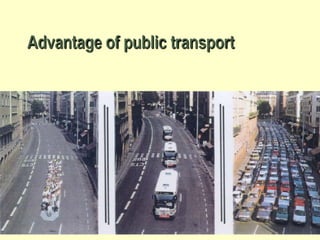
Advantage of public transport

8
Approach 3: Manage demand:
Congestion Pricing
• Rationale of Using Congestion Pricing
– Demand managing: to adjust travel behaviors
– Public transport usage
– invest toll revenue into public transport
infrastructures

9
Theory of transport
network modeling
A Two-Link Example
• How many people will travel on road a, and how
many travel on road b?
Road a, travel time = Number of travellers / 10

1

10 cars travel
from 1 to 2

2

Road b, travel time = 1
11
User Equilibrium (UE) Traffic
Assignment
• UE: No traveler can improve her travel time by
unilaterally changing routes
– Travelers are “selfish”
– All the used routes have the same travel time. The
travel time of unused routes is not shorter than that
of the used routes.
– This is what happens in practice.

12
User Equilibrium (UE) Traffic
Assignment
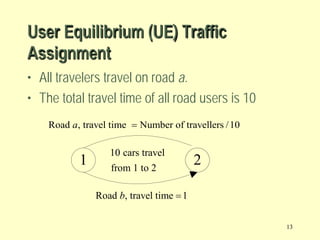
• All travelers travel on road a.
• The total travel time of all road users is 10
Road a, travel time = Number of travellers / 10

1

10 cars travel
from 1 to 2

2

Road b, travel time = 1
13
System Optimal (SO) Traffic Assignment
• SO traffic assignment: Determine the flow of
road users in the transportation network, so as to
minimize total travel time of all road users.
– This is the target of transport authority

14
System Optimal (SO) Traffic Assignment
• The transport authority hopes that 5 people
travel on road a, and 5 on road b.
• The total travel time would be 5*0.5+5*1=7.5
Road a, travel time = Number of travellers / 10

1

10 cars travel
from 1 to 2

2

Road b, travel time = 1
15
UE v.s. SO
• The total travel time, 7.5 time units, under SO
traffic assignment, is 25% shorter than that (10
time units) under UE traffic assignment.
• The transportation network is not efficient
because road users are selfish.
• The transport authority needs to take measures
to improve the efficiency. One of the tools is
congestion pricing.
16
Theory of congestion
pricing
Value of Time (VOT)
• Untolled urban roads: Travel time is 30 min
• Tolled highway: Travel time is 25 min, but $5
must be paid to access the roads.
• VOT transfers time unit to monetary unit. For
higher income population groups, the VOT is
generally higher.
• Unit of VOT: $/min
18
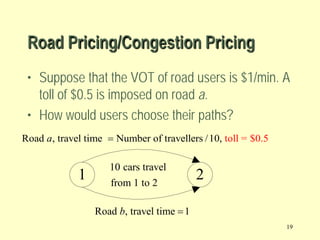
Road Pricing/Congestion Pricing
• Suppose that the VOT of road users is $1/min. A
toll of $0.5 is imposed on road a.
• How would users choose their paths?
Road a, travel time = Number of travellers / 10, toll = $0.5

1

10 cars travel
from 1 to 2

2

Road b, travel time = 1
19
Road Pricing/Congestion Pricing
• Users still choose their paths in the selfish manner (UE).
• Both roads a and b have 5 users (0.5 min + $0.5, or 1
min).
• The total travel time is reduced from 10 to 7.5
Road a, travel time = Number of travellers / 10, toll = $0.5

1

10 cars travel
from 1 to 2
Road b, travel time = 1

2
20
Practice of congestion
pricing
1st Best Pricing
• All links (roads) are tolled.
• It has been proven that the SO state can be achieved.

22
1st Best Pricing
• Resistance from commonwealth.
• Expensive to setup: one toll gantry may cost A$1 million.

23
2nd Best Pricing
• A subset of links (roads) are tolled
• Minimize the total travel time.

24
2nd Best Pricing-toll roads in NSW

25
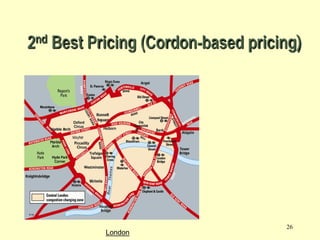
2nd Best Pricing (Cordon-based pricing)

London

26
Electronic Road Pricing in Singapore
(1998-)
1. Gantry

2. In-vehicle Unit
3. Central Computer System

27
Congestion Pricing Schemes
in North Europe

Trondheim, Norway

Stockholm, Sweden
A trial in 2006

28
Congestion pricing at
Sydney Harbour Bridge
Congestion pricing at Sydney
Harbour Bridge
• Traffic relocation effect

30
Congestion pricing at Sydney
Harbour Bridge
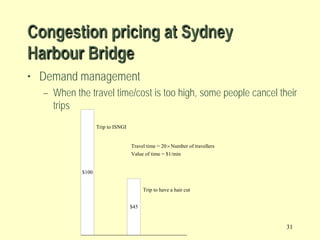
• Demand management
– When the travel time/cost is too high, some people cancel their
trips
Trip to ISNGI
Travel time = 20 × Number of travellers
Value of time = $1/min

$100
Trip to have a hair cut
$45

31
Congestion pricing at Sydney
Harbour Bridge
Total social benefit: $65
Trip to ISNGI

Benefit

$60

Travel time = 20 × Number of travellers
Value of time = $1/min

No toll,
Two persons
travel and
travel time = 40

Benefit $5
Trip to have a hair cut

$40

$40

32
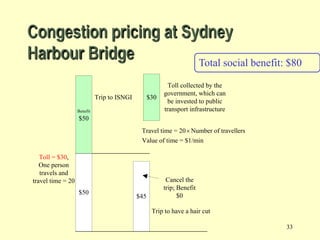
Congestion pricing at Sydney
Harbour Bridge
Total social benefit: $80
Trip to ISNGI

$30

Benefit

Toll collected by the
government, which can
be invested to public
transport infrastructure

$50
Travel time = 20 × Number of travellers
Value of time = $1/min

Toll = $30,
One person
travels and
travel time = 20
$50

$45

Cancel the
trip; Benefit
$0
Trip to have a hair cut
33
Congestion pricing at Sydney
Harbour Bridge
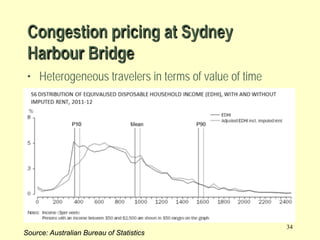
• Heterogeneous travelers in terms of value of time

Source: Australian Bureau of Statistics

34
Congestion pricing at Sydney
Harbour Bridge
• Other factors
– Rush issue
– Mood

35
References
•
•
•
•
•
•

Wang, S., Harrison, M., Dunbar, M., 2013. Toll pricing with elastic demand and
heterogeneous users, working paper.
Wang, S., Meng, Q., Yang, H., 2013. Global optimization methods for the discrete
network design problem. Transportation Research Part B, Vol. 50, pp. 42–60.
Liu, Z., Meng, Q., Wang, S., 2013. Speed-based toll design for cordon-based congestion
pricing scheme. Transportation Research Part C, Vol. 31, pp. 83–98.
Meng, Q., Liu, Z., Wang, S., 2012. Optimal distance tolls under congestion pricing and
continuously distributed value of time. Transportation Research Part E, Vol. 48, No. 5, pp.
937–957.
Liu, Z., Wang, S., Meng, Q., 2013. Toll pricing framework under logit-based stochastic
user equilibrium constraints. Journal of Advanced Transportation, accepted on 16
September 2013.
Liu, Z., Meng, Q., Wang, S., 2013. Variational inequality model for cordon-based
congestion pricing under side constrained stochastic user equilibrium conditions.
Transportmetrica A, doi: 10.1080/23249935.2013.821228.
36
37

SMART International Symposium for Next Generation Infrastructure: Efficiency and equity analysis of toll pricing on Sydney Harbour Bridge with heterogeneous travelers

  • 1.
    ENDORSING PARTNERS Efficiency andequity analysis of toll pricing on Sydney Harbour Bridge with heterogeneous travellers www.isngi.org The following are confirmed contributors to the business and policy dialogue in Sydney: • Rick Sawers (National Australia Bank) • Nick Greiner (Chairman (Infrastructure NSW) Monday, 30th September 2013: Business & policy Dialogue Tuesday 1 October to Thursday, 3rd October: Academic and Policy Dialogue Presented by: Dr Shuaian Wang, School of Mathematics and Applied Statistics , University of Wollongong www.isngi.org
  • 2.
    Congestion Pricing: Theory andPractice Dr. Shuaian Wang School of Mathematics and Applied Statistics University of Wollongong shuaian@uow.edu.au Dr. Michelle Dunbar, Dr. Mark Harrison SMART Infrastructure Facility, University of Wollongong
  • 3.
    About my research • • • • • • Containerliner shipping Port operations Intermodal freight transportation Public transportation Congestion pricing Highway operations 3
  • 4.
    Outline • • • • Theory of transportnetwork modeling Theory of congestion pricing Congestion pricing practice Research problems with toll pricing at Sydney Harbour Bridge 4
  • 5.
  • 6.
  • 7.
    How to alleviatecongestion • Aims to balance the travel demand and supply • Approach 1: Increase supply (e.g. road construction) • Approach 2: Reduce demand (e.g. provide public transport services) 7
  • 8.
  • 9.
    Approach 3: Managedemand: Congestion Pricing • Rationale of Using Congestion Pricing – Demand managing: to adjust travel behaviors – Public transport usage – invest toll revenue into public transport infrastructures 9
  • 10.
  • 11.
    A Two-Link Example •How many people will travel on road a, and how many travel on road b? Road a, travel time = Number of travellers / 10 1 10 cars travel from 1 to 2 2 Road b, travel time = 1 11
  • 12.
    User Equilibrium (UE)Traffic Assignment • UE: No traveler can improve her travel time by unilaterally changing routes – Travelers are “selfish” – All the used routes have the same travel time. The travel time of unused routes is not shorter than that of the used routes. – This is what happens in practice. 12
  • 13.
    User Equilibrium (UE)Traffic Assignment • All travelers travel on road a. • The total travel time of all road users is 10 Road a, travel time = Number of travellers / 10 1 10 cars travel from 1 to 2 2 Road b, travel time = 1 13
  • 14.
    System Optimal (SO)Traffic Assignment • SO traffic assignment: Determine the flow of road users in the transportation network, so as to minimize total travel time of all road users. – This is the target of transport authority 14
  • 15.
    System Optimal (SO)Traffic Assignment • The transport authority hopes that 5 people travel on road a, and 5 on road b. • The total travel time would be 5*0.5+5*1=7.5 Road a, travel time = Number of travellers / 10 1 10 cars travel from 1 to 2 2 Road b, travel time = 1 15
  • 16.
    UE v.s. SO •The total travel time, 7.5 time units, under SO traffic assignment, is 25% shorter than that (10 time units) under UE traffic assignment. • The transportation network is not efficient because road users are selfish. • The transport authority needs to take measures to improve the efficiency. One of the tools is congestion pricing. 16
  • 17.
  • 18.
    Value of Time(VOT) • Untolled urban roads: Travel time is 30 min • Tolled highway: Travel time is 25 min, but $5 must be paid to access the roads. • VOT transfers time unit to monetary unit. For higher income population groups, the VOT is generally higher. • Unit of VOT: $/min 18
  • 19.
    Road Pricing/Congestion Pricing •Suppose that the VOT of road users is $1/min. A toll of $0.5 is imposed on road a. • How would users choose their paths? Road a, travel time = Number of travellers / 10, toll = $0.5 1 10 cars travel from 1 to 2 2 Road b, travel time = 1 19
  • 20.
    Road Pricing/Congestion Pricing •Users still choose their paths in the selfish manner (UE). • Both roads a and b have 5 users (0.5 min + $0.5, or 1 min). • The total travel time is reduced from 10 to 7.5 Road a, travel time = Number of travellers / 10, toll = $0.5 1 10 cars travel from 1 to 2 Road b, travel time = 1 2 20
  • 21.
  • 22.
    1st Best Pricing •All links (roads) are tolled. • It has been proven that the SO state can be achieved. 22
  • 23.
    1st Best Pricing •Resistance from commonwealth. • Expensive to setup: one toll gantry may cost A$1 million. 23
  • 24.
    2nd Best Pricing •A subset of links (roads) are tolled • Minimize the total travel time. 24
  • 25.
    2nd Best Pricing-tollroads in NSW 25
  • 26.
    2nd Best Pricing(Cordon-based pricing) London 26
  • 27.
    Electronic Road Pricingin Singapore (1998-) 1. Gantry 2. In-vehicle Unit 3. Central Computer System 27
  • 28.
    Congestion Pricing Schemes inNorth Europe Trondheim, Norway Stockholm, Sweden A trial in 2006 28
  • 29.
  • 30.
    Congestion pricing atSydney Harbour Bridge • Traffic relocation effect 30
  • 31.
    Congestion pricing atSydney Harbour Bridge • Demand management – When the travel time/cost is too high, some people cancel their trips Trip to ISNGI Travel time = 20 × Number of travellers Value of time = $1/min $100 Trip to have a hair cut $45 31
  • 32.
    Congestion pricing atSydney Harbour Bridge Total social benefit: $65 Trip to ISNGI Benefit $60 Travel time = 20 × Number of travellers Value of time = $1/min No toll, Two persons travel and travel time = 40 Benefit $5 Trip to have a hair cut $40 $40 32
  • 33.
    Congestion pricing atSydney Harbour Bridge Total social benefit: $80 Trip to ISNGI $30 Benefit Toll collected by the government, which can be invested to public transport infrastructure $50 Travel time = 20 × Number of travellers Value of time = $1/min Toll = $30, One person travels and travel time = 20 $50 $45 Cancel the trip; Benefit $0 Trip to have a hair cut 33
  • 34.
    Congestion pricing atSydney Harbour Bridge • Heterogeneous travelers in terms of value of time Source: Australian Bureau of Statistics 34
  • 35.
    Congestion pricing atSydney Harbour Bridge • Other factors – Rush issue – Mood 35
  • 36.
    References • • • • • • Wang, S., Harrison,M., Dunbar, M., 2013. Toll pricing with elastic demand and heterogeneous users, working paper. Wang, S., Meng, Q., Yang, H., 2013. Global optimization methods for the discrete network design problem. Transportation Research Part B, Vol. 50, pp. 42–60. Liu, Z., Meng, Q., Wang, S., 2013. Speed-based toll design for cordon-based congestion pricing scheme. Transportation Research Part C, Vol. 31, pp. 83–98. Meng, Q., Liu, Z., Wang, S., 2012. Optimal distance tolls under congestion pricing and continuously distributed value of time. Transportation Research Part E, Vol. 48, No. 5, pp. 937–957. Liu, Z., Wang, S., Meng, Q., 2013. Toll pricing framework under logit-based stochastic user equilibrium constraints. Journal of Advanced Transportation, accepted on 16 September 2013. Liu, Z., Meng, Q., Wang, S., 2013. Variational inequality model for cordon-based congestion pricing under side constrained stochastic user equilibrium conditions. Transportmetrica A, doi: 10.1080/23249935.2013.821228. 36
  • 37.