
ENDORSING PARTNERS

The care of victims:
Implications of the
productivity commission’s
proposed no fault insurance
Monday, 30 September 2013: Business & policy Dialogue
scheme and Policy www.isngi.org
Tuesday 1 October to Thursday, 3 October: Academic

The following are confirmed contributors to the business and policy dialogue in Sydney:
•

Rick Sawers (National Australia Bank)

•

Nick Greiner (Chairman (Infrastructure NSW)

th

rd

Dialogue
Presented by: Dr Mark Harrison ,SMART Infrastructure Facility, University of
Wollongong

www.isngi.org
The care of victims:
implications of the
Productivity Commission’s
proposed no-fault
insurance scheme
Mark Harrison
The no-fault insurance proposal

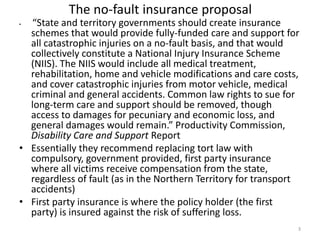
“State and territory governments should create insurance
schemes that would provide fully-funded care and support for
all catastrophic injuries on a no-fault basis, and that would
collectively constitute a National Injury Insurance Scheme
(NIIS). The NIIS would include all medical treatment,
rehabilitation, home and vehicle modifications and care costs,
and cover catastrophic injuries from motor vehicle, medical
criminal and general accidents. Common law rights to sue for
long-term care and support should be removed, though
access to damages for pecuniary and economic loss, and
general damages would remain.” Productivity Commission,
Disability Care and Support Report
• Essentially they recommend replacing tort law with
compulsory, government provided, first party insurance
where all victims receive compensation from the state,
regardless of fault (as in the Northern Territory for transport
accidents)
• First party insurance is where the policy holder (the first
party) is insured against the risk of suffering loss.
•

3
• Queensland, ACT, Western Australia and South Australia have
fault based tort liability and compulsory third party insurance.
• Third party insurance is liability insurance - where the policy
holder is insured against the risk of being held legally liable to
another (the ‘third party’)
• NSW, Victoria and Tasmania also have add-on no-fault
schemes.
• The PC assert “Nor is there evidence that the common law
right to sue for compensation for care costs increases
incentives for prudent behaviour by drivers, doctors and other
parties”
• Ignores and contradicts the vast theoretical and empirical
literature of law and economics, which examines tort law,
insurance and their interaction.
• Runs the risk of a large increase in accident costs.
• Traffic accidents impose large costs, with 1, 277 road deaths in
Australia in 2011. The total costs of road accidents were
estimated to be $17 billion in 2003, equivalent to 2.3 per cent
of that year’s GDP, averaging around 8.4 cents per vehicle
kilometre.
4
The law and economics analysis of accidents
• Will focus on motor vehicle accidents.
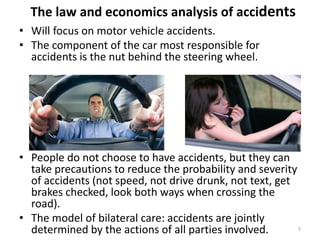
• The component of the car most responsible for
accidents is the nut behind the steering wheel.

• People do not choose to have accidents, but they can
take precautions to reduce the probability and severity
of accidents (not speed, not drive drunk, not text, get
brakes checked, look both ways when crossing the
road).
• The model of bilateral care: accidents are jointly
5
determined by the actions of all parties involved.
The law and economics analysis of accidents
• We want only efficient accidents, which means all cost
justified precautions be undertaken by all parties

• Each party should take those precautions

– That save more in expected accident costs
– Than the precaution costs
• If I face the full social costs of my actions, it is in my
interest to do that
• It is a complicated problem because we want the parties to
independently take the appropriate precautions, in
advance and the precautions each should take depends on
6
the care of the other.
A model of accidents and the role of tort law
• The main basis for liability for damage from accidents is the
tort of negligence
• Consider an accident between an injurer and a victim.
• Assumptions (all can be relaxed)
• Unilateral damage – only the victim
suffers damage (think of a car
running down a pedestrian)
• Risk neutrality
• Two levels of care: due care (not liable) or no care (negligent
and liable)
• Full compensation
• No mistakes. Courts set due care at the efficient level, observe
actual care taken and each party knows the required care.
7
• Fixed number of trips by each party.
Player 1:
Motorist
(injurer)

Due care

CI
L(D, N)

No care

(1 – b)L(N, N) L(N, D)
bL(N, N)
CV
No care

CI
CV+ L(D, D)

Due care

Player 2: Pedestrian (victim)
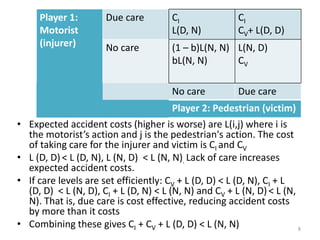
• Expected accident costs (higher is worse) are L(i,j) where i is
the motorist’s action and j is the pedestrian's action. The cost
of taking care for the injurer and victim is CI and CV
• L (D, D) < L (D, N), L (N, D) < L (N, N). Lack of care increases
expected accident costs.
• If care levels are set efficiently: CV + L (D, D) < L (D, N), CI + L
(D, D) < L (N, D), CI + L (D, N) < L (N, N) and CV + L (N, D) < L (N,
N). That is, due care is cost effective, reducing accident costs
by more than it costs
• Combining these gives CI + CV + L (D, D) < L (N, N)
8
How the law of negligence solves the bilateral care
problem Player 1:
Due care
CI
CI
Motorist
(injurer)

L(D, N)

No care

CV+ L(D, D)

(1 – b)L(N, N) L(N, D)
bL(N, N)
CV
No care

Due care

Player 2: Pedestrian
(victim)
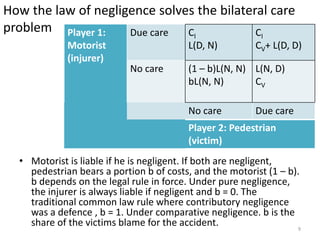
• Motorist is liable if he is negligent. If both are negligent,
pedestrian bears a portion b of costs, and the motorist (1 – b).
b depends on the legal rule in force. Under pure negligence,
the injurer is always liable if negligent and b = 0. The
traditional common law rule where contributory negligence
was a defence , b = 1. Under comparative negligence. b is the
share of the victims blame for the accident.
9
Player 1:
Motorist
(injurer)

•
•
•
•
•
•

Due care

CI
CI
L(D, N)
CV+ L(D, D)
No care
(1 – b)L(N, N) L(N, D)
bL(N, N)
CV
No care
Due care
Player 2: Pedestrian (victim)
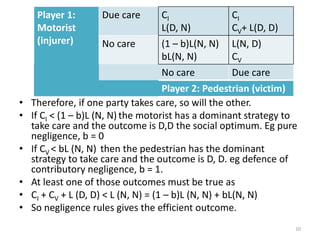
Therefore, if one party takes care, so will the other.
If CI < (1 – b)L (N, N) the motorist has a dominant strategy to
take care and the outcome is D,D the social optimum. Eg pure
negligence, b = 0
If CV < bL (N, N) then the pedestrian has the dominant
strategy to take care and the outcome is D, D. eg defence of
contributory negligence, b = 1.
At least one of those outcomes must be true as
CI + CV + L (D, D) < L (N, N) = (1 – b)L (N, N) + bL(N, N)
So negligence rules gives the efficient outcome.
10
The effects of no fault insurance
• Player 1:

Motorist
(injurer)

Due care
No care

CI + P
CI + P
0
CV
P
P
0
CV
No care
Due care
Player 2: Pedestrian
(victim)

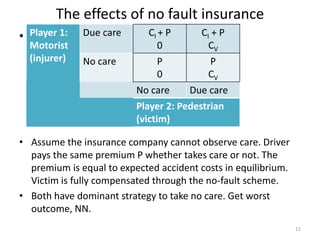
• Assume the insurance company cannot observe care. Driver
pays the same premium P whether takes care or not. The
premium is equal to expected accident costs in equilibrium.
Victim is fully compensated through the no-fault scheme.
• Both have dominant strategy to take no care. Get worst
outcome, NN.
11
Compulsory third party liability insurance
• There is a trade-off – better compensation and risk spreading,
but more accident costs (and more victims).
• The PC claims “in the presence of insurance, especially with
little focus on risk‐rating for some causes of injury, the
common law does not provide incentives for prudent
behaviour by motorists and other parties”; and that no‐fault
insurance would “currently perform no worse at deterring
excessively risky behaviour, as despite the appearance of the
common law, it is the insurer that pays” .
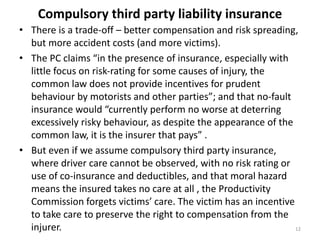
• But even if we assume compulsory third party insurance,
where driver care cannot be observed, with no risk rating or
use of co-insurance and deductibles, and that moral hazard
means the insured takes no care at all , the Productivity
Commission forgets victims’ care. The victim has an incentive
to take care to preserve the right to compensation from the
injurer.
12
Compulsory third party liability insurance
Player 1:
Motorist
(injurer)

Due care
No care

CI + P
CI + P
L(D, N)
CV+L(D, D)
P
P
bL(N, N)
CV
No care
Due care
Player 2: Pedestrian
(victim)

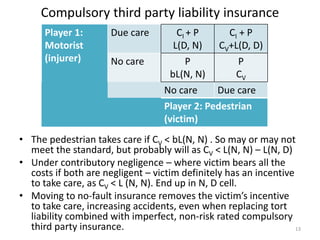
• The pedestrian takes care if CV < bL(N, N) . So may or may not
meet the standard, but probably will as CV < L(N, N) – L(N, D)
• Under contributory negligence – where victim bears all the
costs if both are negligent – victim definitely has an incentive
to take care, as CV < L (N, N). End up in N, D cell.
• Moving to no-fault insurance removes the victim’s incentive
to take care, increasing accidents, even when replacing tort
liability combined with imperfect, non-risk rated compulsory
third party insurance.
13
Compulsory third party liability insurance
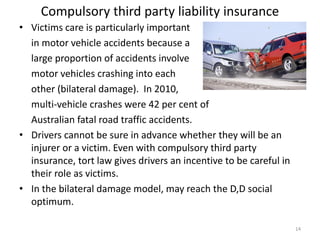
• Victims care is particularly important
in motor vehicle accidents because a
large proportion of accidents involve
motor vehicles crashing into each
other (bilateral damage). In 2010,
multi‐vehicle crashes were 42 per cent of
Australian fatal road traffic accidents.
• Drivers cannot be sure in advance whether they will be an
injurer or a victim. Even with compulsory third party
insurance, tort law gives drivers an incentive to be careful in
their role as victims.
• In the bilateral damage model, may reach the D,D social
optimum.
14
Empirical evidence on the effects of no-fault
insurance

• If we relax our other assumptions the law of negligence still
gives an incentive to take precautions – perhaps not the
optimal level (perhaps too much) but more than under nofault insurance.
• Exactly how much deterrence tort law provides is ultimately
an empirical question.
• The literature finds tort liability provides a significant amount
of deterrence, especially for automobile accidents. Not the
least is the evidence on no-fault insurance.
• Swan (1984) and McEwin (1989) present empirical evidence
on the switch to no-fault in New Zealand and the Northern
Territory, compared to other states of Australia and find it to
be associated with a substantial increase of 16 to 20 percent
in the number of road fatalities.
• The prospect of substantial increases in traffic accidents has
implications for the safety design of road infrastructure,
increasing the optimal amount of investment if driver care
and investment are substitutes.
15
Name Mark Harrison
Position Senior Research Fellow
Email harrison@uow.edu.au

SMART International Symposium for Next Generation Infrastructure: The care of victims: implications of the Productivity Commission’s proposed no fault insurance scheme

  • 1.
    ENDORSING PARTNERS The careof victims: Implications of the productivity commission’s proposed no fault insurance Monday, 30 September 2013: Business & policy Dialogue scheme and Policy www.isngi.org Tuesday 1 October to Thursday, 3 October: Academic The following are confirmed contributors to the business and policy dialogue in Sydney: • Rick Sawers (National Australia Bank) • Nick Greiner (Chairman (Infrastructure NSW) th rd Dialogue Presented by: Dr Mark Harrison ,SMART Infrastructure Facility, University of Wollongong www.isngi.org
  • 2.
    The care ofvictims: implications of the Productivity Commission’s proposed no-fault insurance scheme Mark Harrison
  • 3.
    The no-fault insuranceproposal “State and territory governments should create insurance schemes that would provide fully-funded care and support for all catastrophic injuries on a no-fault basis, and that would collectively constitute a National Injury Insurance Scheme (NIIS). The NIIS would include all medical treatment, rehabilitation, home and vehicle modifications and care costs, and cover catastrophic injuries from motor vehicle, medical criminal and general accidents. Common law rights to sue for long-term care and support should be removed, though access to damages for pecuniary and economic loss, and general damages would remain.” Productivity Commission, Disability Care and Support Report • Essentially they recommend replacing tort law with compulsory, government provided, first party insurance where all victims receive compensation from the state, regardless of fault (as in the Northern Territory for transport accidents) • First party insurance is where the policy holder (the first party) is insured against the risk of suffering loss. • 3
  • 4.
    • Queensland, ACT,Western Australia and South Australia have fault based tort liability and compulsory third party insurance. • Third party insurance is liability insurance - where the policy holder is insured against the risk of being held legally liable to another (the ‘third party’) • NSW, Victoria and Tasmania also have add-on no-fault schemes. • The PC assert “Nor is there evidence that the common law right to sue for compensation for care costs increases incentives for prudent behaviour by drivers, doctors and other parties” • Ignores and contradicts the vast theoretical and empirical literature of law and economics, which examines tort law, insurance and their interaction. • Runs the risk of a large increase in accident costs. • Traffic accidents impose large costs, with 1, 277 road deaths in Australia in 2011. The total costs of road accidents were estimated to be $17 billion in 2003, equivalent to 2.3 per cent of that year’s GDP, averaging around 8.4 cents per vehicle kilometre. 4
  • 5.
    The law andeconomics analysis of accidents • Will focus on motor vehicle accidents. • The component of the car most responsible for accidents is the nut behind the steering wheel. • People do not choose to have accidents, but they can take precautions to reduce the probability and severity of accidents (not speed, not drive drunk, not text, get brakes checked, look both ways when crossing the road). • The model of bilateral care: accidents are jointly 5 determined by the actions of all parties involved.
  • 6.
    The law andeconomics analysis of accidents • We want only efficient accidents, which means all cost justified precautions be undertaken by all parties • Each party should take those precautions – That save more in expected accident costs – Than the precaution costs • If I face the full social costs of my actions, it is in my interest to do that • It is a complicated problem because we want the parties to independently take the appropriate precautions, in advance and the precautions each should take depends on 6 the care of the other.
  • 7.
    A model ofaccidents and the role of tort law • The main basis for liability for damage from accidents is the tort of negligence • Consider an accident between an injurer and a victim. • Assumptions (all can be relaxed) • Unilateral damage – only the victim suffers damage (think of a car running down a pedestrian) • Risk neutrality • Two levels of care: due care (not liable) or no care (negligent and liable) • Full compensation • No mistakes. Courts set due care at the efficient level, observe actual care taken and each party knows the required care. 7 • Fixed number of trips by each party.
  • 8.
    Player 1: Motorist (injurer) Due care CI L(D,N) No care (1 – b)L(N, N) L(N, D) bL(N, N) CV No care CI CV+ L(D, D) Due care Player 2: Pedestrian (victim) • Expected accident costs (higher is worse) are L(i,j) where i is the motorist’s action and j is the pedestrian's action. The cost of taking care for the injurer and victim is CI and CV • L (D, D) < L (D, N), L (N, D) < L (N, N). Lack of care increases expected accident costs. • If care levels are set efficiently: CV + L (D, D) < L (D, N), CI + L (D, D) < L (N, D), CI + L (D, N) < L (N, N) and CV + L (N, D) < L (N, N). That is, due care is cost effective, reducing accident costs by more than it costs • Combining these gives CI + CV + L (D, D) < L (N, N) 8
  • 9.
    How the lawof negligence solves the bilateral care problem Player 1: Due care CI CI Motorist (injurer) L(D, N) No care CV+ L(D, D) (1 – b)L(N, N) L(N, D) bL(N, N) CV No care Due care Player 2: Pedestrian (victim) • Motorist is liable if he is negligent. If both are negligent, pedestrian bears a portion b of costs, and the motorist (1 – b). b depends on the legal rule in force. Under pure negligence, the injurer is always liable if negligent and b = 0. The traditional common law rule where contributory negligence was a defence , b = 1. Under comparative negligence. b is the share of the victims blame for the accident. 9
  • 10.
    Player 1: Motorist (injurer) • • • • • • Due care CI CI L(D,N) CV+ L(D, D) No care (1 – b)L(N, N) L(N, D) bL(N, N) CV No care Due care Player 2: Pedestrian (victim) Therefore, if one party takes care, so will the other. If CI < (1 – b)L (N, N) the motorist has a dominant strategy to take care and the outcome is D,D the social optimum. Eg pure negligence, b = 0 If CV < bL (N, N) then the pedestrian has the dominant strategy to take care and the outcome is D, D. eg defence of contributory negligence, b = 1. At least one of those outcomes must be true as CI + CV + L (D, D) < L (N, N) = (1 – b)L (N, N) + bL(N, N) So negligence rules gives the efficient outcome. 10
  • 11.
    The effects ofno fault insurance • Player 1: Motorist (injurer) Due care No care CI + P CI + P 0 CV P P 0 CV No care Due care Player 2: Pedestrian (victim) • Assume the insurance company cannot observe care. Driver pays the same premium P whether takes care or not. The premium is equal to expected accident costs in equilibrium. Victim is fully compensated through the no-fault scheme. • Both have dominant strategy to take no care. Get worst outcome, NN. 11
  • 12.
    Compulsory third partyliability insurance • There is a trade-off – better compensation and risk spreading, but more accident costs (and more victims). • The PC claims “in the presence of insurance, especially with little focus on risk‐rating for some causes of injury, the common law does not provide incentives for prudent behaviour by motorists and other parties”; and that no‐fault insurance would “currently perform no worse at deterring excessively risky behaviour, as despite the appearance of the common law, it is the insurer that pays” . • But even if we assume compulsory third party insurance, where driver care cannot be observed, with no risk rating or use of co-insurance and deductibles, and that moral hazard means the insured takes no care at all , the Productivity Commission forgets victims’ care. The victim has an incentive to take care to preserve the right to compensation from the injurer. 12
  • 13.
    Compulsory third partyliability insurance Player 1: Motorist (injurer) Due care No care CI + P CI + P L(D, N) CV+L(D, D) P P bL(N, N) CV No care Due care Player 2: Pedestrian (victim) • The pedestrian takes care if CV < bL(N, N) . So may or may not meet the standard, but probably will as CV < L(N, N) – L(N, D) • Under contributory negligence – where victim bears all the costs if both are negligent – victim definitely has an incentive to take care, as CV < L (N, N). End up in N, D cell. • Moving to no-fault insurance removes the victim’s incentive to take care, increasing accidents, even when replacing tort liability combined with imperfect, non-risk rated compulsory third party insurance. 13
  • 14.
    Compulsory third partyliability insurance • Victims care is particularly important in motor vehicle accidents because a large proportion of accidents involve motor vehicles crashing into each other (bilateral damage). In 2010, multi‐vehicle crashes were 42 per cent of Australian fatal road traffic accidents. • Drivers cannot be sure in advance whether they will be an injurer or a victim. Even with compulsory third party insurance, tort law gives drivers an incentive to be careful in their role as victims. • In the bilateral damage model, may reach the D,D social optimum. 14
  • 15.
    Empirical evidence onthe effects of no-fault insurance • If we relax our other assumptions the law of negligence still gives an incentive to take precautions – perhaps not the optimal level (perhaps too much) but more than under nofault insurance. • Exactly how much deterrence tort law provides is ultimately an empirical question. • The literature finds tort liability provides a significant amount of deterrence, especially for automobile accidents. Not the least is the evidence on no-fault insurance. • Swan (1984) and McEwin (1989) present empirical evidence on the switch to no-fault in New Zealand and the Northern Territory, compared to other states of Australia and find it to be associated with a substantial increase of 16 to 20 percent in the number of road fatalities. • The prospect of substantial increases in traffic accidents has implications for the safety design of road infrastructure, increasing the optimal amount of investment if driver care and investment are substitutes. 15
  • 16.
    Name Mark Harrison PositionSenior Research Fellow Email harrison@uow.edu.au