The Making of an
Indian Multinational
Atul Prajapati(19)
Lekha Shinde (25)
Jigar Patel(17)
Milan Dajjuka (35)
Yashmita Shetty()
Haridas Yadav
Rahul Yadav (30)
Chhayangi Revadekar (21)
Foundation of DRL
• Founded by Anji Reddy in 1984 after struggling for a
decade in difficult partnerships
• Initially took advantage of the process patent regime.
• Started by manufacturing APIs and later started
formulating its own branded generics.
• Also founded Cheminor in 1984
• DRL and Cheminor togeather generated $12.5 million
in sales by 1990
• Both companies merged in the year 2000
Current Identity of DRL
• Leading generic drug company.
• Ranked 16th in the IPM
• Aims at becoming 1 of the top 25 discovery-led
pharma companies in the world.
• Challenge is to maintain current profitability and
growth while undergoing the above transformation.
The Evolution of DRL
Four parallel evolutions in group strategy:-
 Product diversification
 International expansion with branded formulations
 Growth in the generics business
 Building of capabilities for discovering new drug
molecules
By 2000 industry leader within India in three
therapeutic segment:- Pain management,
gastroenterology, cardiovascular
• By 2000 company has:-
 1500 sales persons for international dealing network
 6 factories for manufacturing
 3 additional formulation plants
 Reachable to 2000 stockists and 100,000 retailer in india
 Export in 50 countries, eastern Europe, south east Asia,
Latin America were first target.
Dr Reddy’s Research Foundation was started in 1993 to
focus on drug discovery.
The DRF
• Fast, Flexible with around 200 employee
• Started hiring fresh PhD’s
• Provide “spirit of excellence” scholarship in selected Indian
universities.
• Money was raised in foreign capital to fund the company’s
diversification and new discovery.
• Through GDR Company issue $48 million in 1994 and
through ADR $115.5 million in 2001.
First non Japanese Asian pharma company listed in New York
Stock Exchange.
The post 2000 Era
• Founder brought DRL, DRF and Chemin or together
and introduce new corporate entity, Dr. Reddy’s
Laboratories.
• Two major segments:- Bulk actives and Branded
formulations
• Ranbaxy and Cipla were competitors in Bulk actives.
• Israeli Teva and Swiss Novartis Generics were
competitors in Generics
DRL-A Leading Generic Drug Company
DRLs strength is its manufacturing process and has
earned reputation as leading drug company.
THE GENERIC OPPORTUNITITY:-
• Reduced health care cost
• WAXMAN-HATCH Act of 1984
• By 2001 generics drugs represented growth of 10-
12% each year
Waxman-Hatch act of 1984
Drug Price Competition And Patent Registration
Act:-
The act allows patent holder/manufacturer-
• To file ANDAs
• To sue the applicant within 45 days of such filing
Waxman-Hatch act of 1984
Drug Price Competition And Patent Registration Act:-
The act allows Patent holder/manufacturer-
• To file registration applications before patent on
originator product expired
• Patents of $30 billion worth of drugs were due to
expire by 2005
ANDA Filing by DRL
• The first ANDA filing was in 1997 for Ranitidine
75mg tablet in US market.
• DRL spent several million dollars in 2001 fighting Eli-
Lilly Patent
• 11 ANDAs by DRL had been approved in 2013
• DRL was awaiting for 23 additional applications
DRL In Specialty Drugs
• In December 2002 DRL won court battle to launch a
specialty drug in US market
• DRL generated $50 million in free cash flow each
year
• In March 2004 DRL lost its filing
• Merck authorized DRL to sell generic copies of
PROSCAR
Drug Prices of Generics
• In exclusivity period prices were 60-70% of original
patent drug
• After exclusivity period prices dropped to 15-20%
• 57% cost advantage over patent holder for generic
manufacturer
• 76% Estimated cost advantage for Indian generic
manufacturer
New Drug Discovery
 Initial focus on therapeutic areas with less competition (eg: Diabetes care)
 Drug discovery process is expensive ; Dr. Reddy’s focuses on pre-clinical
research phase (less capital incentive & low risk) i.e $10 million budget it
could develop 10-14 new drug candidates
 DRL out-licensed 2 anti-diabetic molecules & developed a robust pipeline of
NCE’s for 4 therapeutic areas
 Perlecan Pharma ( ICICI+ Citigroup+ DRL venture formed Drug development
company)
 Risk of 4 NCE’s spread across 3 partners. To de-risk drug discovery further DRL
got into collaborative research (Argenta Discovery –COPD)
 Another Eg: Balaglitazone, with Denmark based Rheoscience
Managing a Global Company
• By 2002 offices present in 60 countries
• Subsidiary companies in US, Brazil, UK, France, Holland &
Singapore
• International revenues dominated domestic revenues by 2:1
factor in 2002
• US continued to be the biggest pharma market accounting
$245 B of $500 B global market
• India provided an advantage for manufacturing cost over US
(1/5th of US cost)
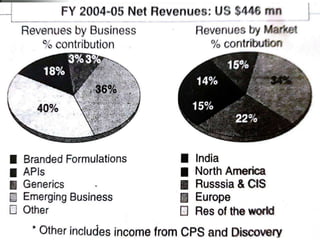
• The break up of revenue of DRL by business & by geography
for the year ending 2004-05 is given:
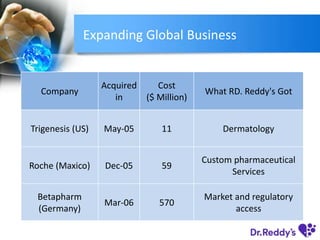
Expanding Global Business
Company
Acquired
in
Cost
($ Million)
What RD. Reddy's Got
Trigenesis (US) May-05 11 Dermatology
Roche (Maxico) Dec-05 59
Custom pharmaceutical
Services
Betapharm
(Germany)
Mar-06 570
Market and regulatory
access
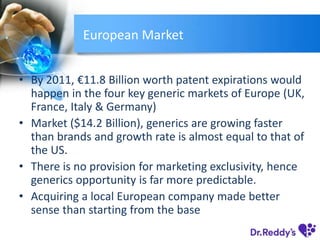
European Market
• By 2011, €11.8 Billion worth patent expirations would
happen in the four key generic markets of Europe (UK,
France, Italy & Germany)
• Market ($14.2 Billion), generics are growing faster
than brands and growth rate is almost equal to that of
the US.
• There is no provision for marketing exclusivity, hence
generics opportunity is far more predictable.
• Acquiring a local European company made better
sense than starting from the base
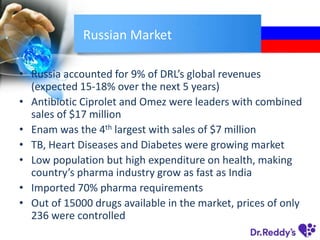
Russian Market
• Russia accounted for 9% of DRL’s global revenues
(expected 15-18% over the next 5 years)
• Antibiotic Ciprolet and Omez were leaders with combined
sales of $17 million
• Enam was the 4th largest with sales of $7 million
• TB, Heart Diseases and Diabetes were growing market
• Low population but high expenditure on health, making
country’s pharma industry grow as fast as India
• Imported 70% pharma requirements
• Out of 15000 drugs available in the market, prices of only
236 were controlled
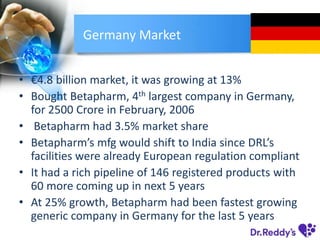
Germany Market
• €4.8 billion market, it was growing at 13%
• Bought Betapharm, 4th largest company in Germany,
for 2500 Crore in February, 2006
• Betapharm had 3.5% market share
• Betapharm’s mfg would shift to India since DRL’s
facilities were already European regulation compliant
• It had a rich pipeline of 146 registered products with
60 more coming up in next 5 years
• At 25% growth, Betapharm had been fastest growing
generic company in Germany for the last 5 years
Autonomy and Sharing
• DR .Reddy’s structured itself around seven strategic
business units (SBU)
• Bulk actives
• DR . Reddy’s Research Foundation (DRF)
• Seventh SBU Biotechnology
Critical Care
• SBU set of shared corporate service
• DRL had a create additional value
People Issues
• Build on 3 pillar
• Innovation, Entrepreneurship, globalization
• Relationship with research Institute & university
• Talent management become priority
• Changing business model caused problem.
• DRL use to chemical company than drug formulation , than
the generic player
• Move towards the discovery so show change in portfolio
• This lead to emotional issue with people.
• experienced and skilled people brought.
• Worldwide Nearly 10% of DRL employee are non
Indian. china >Russia> America
• Managing global workforce is was not easy.
• Example Indian move to US could make more there
than local hire
• HR policy focus on learning and development talent,
management and development a performance orientation
culture.
• Introduce individual key focus area KRA`S , regular revise
and feedback annual superior and self appraisal,
performance linked to compensation ,bonus
• Competency base development program to all level with
course of communication analytic and negotiation skills
• Employee with high potential were sponsored for degree
at reputed business school
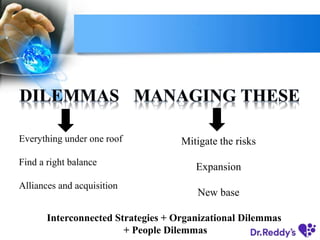
Everything under one roof
Find a right balance
Alliances and acquisition
Mitigate the risks
Expansion
New base
Interconnected Strategies + Organizational Dilemmas
+ People Dilemmas
Dr. Reddy's Laboratories

Dr. Reddy's Laboratories

  • 1.
    The Making ofan Indian Multinational Atul Prajapati(19) Lekha Shinde (25) Jigar Patel(17) Milan Dajjuka (35) Yashmita Shetty() Haridas Yadav Rahul Yadav (30) Chhayangi Revadekar (21)
  • 2.
    Foundation of DRL •Founded by Anji Reddy in 1984 after struggling for a decade in difficult partnerships • Initially took advantage of the process patent regime. • Started by manufacturing APIs and later started formulating its own branded generics. • Also founded Cheminor in 1984 • DRL and Cheminor togeather generated $12.5 million in sales by 1990 • Both companies merged in the year 2000
  • 3.
    Current Identity ofDRL • Leading generic drug company. • Ranked 16th in the IPM • Aims at becoming 1 of the top 25 discovery-led pharma companies in the world. • Challenge is to maintain current profitability and growth while undergoing the above transformation.
  • 4.
    The Evolution ofDRL Four parallel evolutions in group strategy:-  Product diversification  International expansion with branded formulations  Growth in the generics business  Building of capabilities for discovering new drug molecules By 2000 industry leader within India in three therapeutic segment:- Pain management, gastroenterology, cardiovascular
  • 5.
    • By 2000company has:-  1500 sales persons for international dealing network  6 factories for manufacturing  3 additional formulation plants  Reachable to 2000 stockists and 100,000 retailer in india  Export in 50 countries, eastern Europe, south east Asia, Latin America were first target. Dr Reddy’s Research Foundation was started in 1993 to focus on drug discovery.
  • 6.
    The DRF • Fast,Flexible with around 200 employee • Started hiring fresh PhD’s • Provide “spirit of excellence” scholarship in selected Indian universities. • Money was raised in foreign capital to fund the company’s diversification and new discovery. • Through GDR Company issue $48 million in 1994 and through ADR $115.5 million in 2001. First non Japanese Asian pharma company listed in New York Stock Exchange.
  • 7.
    The post 2000Era • Founder brought DRL, DRF and Chemin or together and introduce new corporate entity, Dr. Reddy’s Laboratories. • Two major segments:- Bulk actives and Branded formulations • Ranbaxy and Cipla were competitors in Bulk actives. • Israeli Teva and Swiss Novartis Generics were competitors in Generics
  • 8.
    DRL-A Leading GenericDrug Company DRLs strength is its manufacturing process and has earned reputation as leading drug company. THE GENERIC OPPORTUNITITY:- • Reduced health care cost • WAXMAN-HATCH Act of 1984 • By 2001 generics drugs represented growth of 10- 12% each year
  • 9.
    Waxman-Hatch act of1984 Drug Price Competition And Patent Registration Act:- The act allows patent holder/manufacturer- • To file ANDAs • To sue the applicant within 45 days of such filing
  • 10.
    Waxman-Hatch act of1984 Drug Price Competition And Patent Registration Act:- The act allows Patent holder/manufacturer- • To file registration applications before patent on originator product expired • Patents of $30 billion worth of drugs were due to expire by 2005
  • 11.
    ANDA Filing byDRL • The first ANDA filing was in 1997 for Ranitidine 75mg tablet in US market. • DRL spent several million dollars in 2001 fighting Eli- Lilly Patent • 11 ANDAs by DRL had been approved in 2013 • DRL was awaiting for 23 additional applications
  • 12.
    DRL In SpecialtyDrugs • In December 2002 DRL won court battle to launch a specialty drug in US market • DRL generated $50 million in free cash flow each year • In March 2004 DRL lost its filing • Merck authorized DRL to sell generic copies of PROSCAR
  • 13.
    Drug Prices ofGenerics • In exclusivity period prices were 60-70% of original patent drug • After exclusivity period prices dropped to 15-20% • 57% cost advantage over patent holder for generic manufacturer • 76% Estimated cost advantage for Indian generic manufacturer
  • 14.
    New Drug Discovery Initial focus on therapeutic areas with less competition (eg: Diabetes care)  Drug discovery process is expensive ; Dr. Reddy’s focuses on pre-clinical research phase (less capital incentive & low risk) i.e $10 million budget it could develop 10-14 new drug candidates  DRL out-licensed 2 anti-diabetic molecules & developed a robust pipeline of NCE’s for 4 therapeutic areas  Perlecan Pharma ( ICICI+ Citigroup+ DRL venture formed Drug development company)  Risk of 4 NCE’s spread across 3 partners. To de-risk drug discovery further DRL got into collaborative research (Argenta Discovery –COPD)  Another Eg: Balaglitazone, with Denmark based Rheoscience
  • 15.
    Managing a GlobalCompany • By 2002 offices present in 60 countries • Subsidiary companies in US, Brazil, UK, France, Holland & Singapore • International revenues dominated domestic revenues by 2:1 factor in 2002 • US continued to be the biggest pharma market accounting $245 B of $500 B global market • India provided an advantage for manufacturing cost over US (1/5th of US cost) • The break up of revenue of DRL by business & by geography for the year ending 2004-05 is given:
  • 17.
    Expanding Global Business Company Acquired in Cost ($Million) What RD. Reddy's Got Trigenesis (US) May-05 11 Dermatology Roche (Maxico) Dec-05 59 Custom pharmaceutical Services Betapharm (Germany) Mar-06 570 Market and regulatory access
  • 18.
    European Market • By2011, €11.8 Billion worth patent expirations would happen in the four key generic markets of Europe (UK, France, Italy & Germany) • Market ($14.2 Billion), generics are growing faster than brands and growth rate is almost equal to that of the US. • There is no provision for marketing exclusivity, hence generics opportunity is far more predictable. • Acquiring a local European company made better sense than starting from the base
  • 19.
    Russian Market • Russiaaccounted for 9% of DRL’s global revenues (expected 15-18% over the next 5 years) • Antibiotic Ciprolet and Omez were leaders with combined sales of $17 million • Enam was the 4th largest with sales of $7 million • TB, Heart Diseases and Diabetes were growing market • Low population but high expenditure on health, making country’s pharma industry grow as fast as India • Imported 70% pharma requirements • Out of 15000 drugs available in the market, prices of only 236 were controlled
  • 20.
    Germany Market • €4.8billion market, it was growing at 13% • Bought Betapharm, 4th largest company in Germany, for 2500 Crore in February, 2006 • Betapharm had 3.5% market share • Betapharm’s mfg would shift to India since DRL’s facilities were already European regulation compliant • It had a rich pipeline of 146 registered products with 60 more coming up in next 5 years • At 25% growth, Betapharm had been fastest growing generic company in Germany for the last 5 years
  • 21.
    Autonomy and Sharing •DR .Reddy’s structured itself around seven strategic business units (SBU) • Bulk actives • DR . Reddy’s Research Foundation (DRF) • Seventh SBU Biotechnology Critical Care • SBU set of shared corporate service • DRL had a create additional value
  • 22.
    People Issues • Buildon 3 pillar • Innovation, Entrepreneurship, globalization • Relationship with research Institute & university • Talent management become priority • Changing business model caused problem. • DRL use to chemical company than drug formulation , than the generic player • Move towards the discovery so show change in portfolio
  • 23.
    • This leadto emotional issue with people. • experienced and skilled people brought. • Worldwide Nearly 10% of DRL employee are non Indian. china >Russia> America • Managing global workforce is was not easy. • Example Indian move to US could make more there than local hire
  • 24.
    • HR policyfocus on learning and development talent, management and development a performance orientation culture. • Introduce individual key focus area KRA`S , regular revise and feedback annual superior and self appraisal, performance linked to compensation ,bonus • Competency base development program to all level with course of communication analytic and negotiation skills • Employee with high potential were sponsored for degree at reputed business school
  • 25.
    Everything under oneroof Find a right balance Alliances and acquisition Mitigate the risks Expansion New base Interconnected Strategies + Organizational Dilemmas + People Dilemmas