Dr Reddy’s Laboratory Vs Ranbaxy
Pharmaceuticals
Kshitij Pathak- U113091
Lalip Nanda- U113092
Mayank Tabeck- U113093
Rakesh Kumar Jha- U113101
Rashmi Kulkarni- U113102
Rashmi Ranjan Nath-U113103
Shounak – U113111
Srishti Sen -U113112
Siddharth Padhee- U!13113
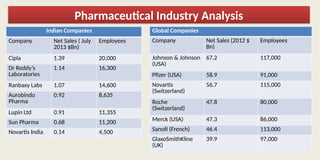
Pharmaceutical Industry Analysis
Indian Companies
Company Net Sales ( July
2013 $Bn)
Employees
Cipla 1.39 20,000
Dr Reddy’s
Laboratories
1.14 16,300
Ranbaxy Labs 1.07 14,600
Aurobindo
Pharma
0.92 8,635
Lupin Ltd 0.91 11,355
Sun Pharma 0.68 11,200
Novartis India 0.14 4,500
Global Companies
Company Net Sales (2012 $
Bn)
Employees
Johnson & Johnson
(USA)
67.2 117,000
Pfizer (USA) 58.9 91,000
Novartis
(Switzerland)
56.7 115,000
Roche
(Switzerland)
47.8 80,000
Merck (USA) 47.3 86,000
Sanofi (French) 46.4 113,000
GlaxoSmithKline
(UK)
39.9 97,000
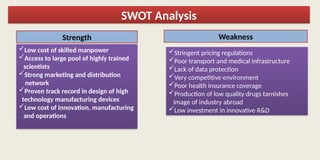
SWOT Analysis
Strength
Low cost of skilled manpower
Access to large pool of highly trained
scientists
Strong marketing and distribution
network
Proven track record in design of high
technology manufacturing devices
Low cost of innovation, manufacturing
and operations
Weakness
Stringent pricing regulations
Poor transport and medical infrastructure
Lack of data protection
Very competitive environment
Poor health insurance coverage
Production of low quality drugs tarnishes
image of industry abroad
Low investment in innovative R&D
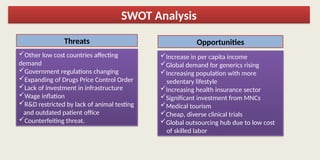
SWOT Analysis
Threats
Other low cost countries affecting
demand
Government regulations changing
Expanding of Drugs Price Control Order
Lack of investment in infrastructure
Wage inflation
R&D restricted by lack of animal testing
and outdated patient office
Counterfeiting threat.
Opportunities
Increase in per capita income
Global demand for generics rising
Increasing population with more
sedentary lifestyle
Increasing health insurance sector
Significant investment from MNCs
Medical tourism
Cheap, diverse clinical trials
Global outsourcing hub due to low cost
of skilled labor
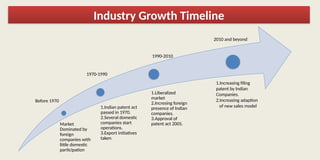
Market
Dominated by
foreign
companies with
little domestic
participation
1.Indian patent act
passed in 1970.
2.Several domestic
companies start
operations.
3.Export initiatives
taken
1.Liberalized
market
2.Incresing foreign
presence of Indian
companies.
3.Approval of
patent act 2005.
Before 1970
1970-1990
1990-2010
1.Increasing filing
patent by Indian
Companies.
2.Increasing adaption
of new sales model
Industry Growth Timeline
2010 and beyond
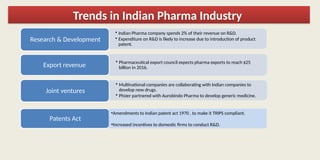
• Indian Pharma company spends 2% of their revenue on R&D.
• Expenditure on R&D is likely to increase due to introduction of product
patent.
Research & Development
• Pharmaceutical export council expects pharma exports to reach $25
billion in 2016.
Export revenue
• Multinational companies are collaborating with Indian companies to
develop new drugs.
• Phizer partnered with Aurobindo Pharma to develop generic medicine.
Joint ventures
Patents Act
Trends in Indian Pharma Industry
•Amendments to Indian patent act 1970 , to make it TRIPS compliant.
•Increased incentives to domestic firms to conduct R&D.
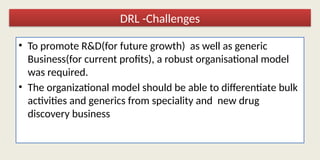
• To promote R&D(for future growth) as well as generic
Business(for current profits), a robust organisational model
was required.
• The organizational model should be able to differentiate bulk
activities and generics from speciality and new drug
discovery business
DRL -Challenges
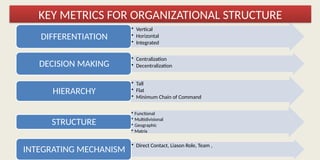
• Vertical
• Horizontal
• Integrated
DIFFERENTIATION
• Centralization
• Decentralization
DECISION MAKING
• Tall
• Flat
• Minimum Chain of Command
HIERARCHY
• Functional
• Multidivisional
• Geographic
• Matrix
STRUCTURE
• Direct Contact, Liason Role, Team ,
INTEGRATING MECHANISM
KEY METRICS FOR ORGANIZATIONAL STRUCTURE
• Incorporated in 1961, as a family-owned business
• Chairman – Dr.Tsutomu Une ; CEO & Managing Director – Arun Sawhney
• Ranbaxy was facing many issues such as
– poor financial position,
– no major R&D breakthroughs,
– increasing price wars
– stiff competition in the generics market.
• In order to maintain its growth and market position, Ranbaxy needed an influx of fresh funds
• Daiichi Sankyo wanted to manufacture low cost generics because of Japan government’s new policy
• In June 2008, Daiichi Sankyo acquired over 51% stake in Ranbaxy Laboratories Ltd at Rs. 737 per share.
• Malvinder Singh sold out his stake of 34.8% to Daiichi Sankyo .
• The new entity is a significant milestone in the Ranbaxy’s mission of becoming a research-based international
pharmaceutical company.
RANBAXY LABORATORIES
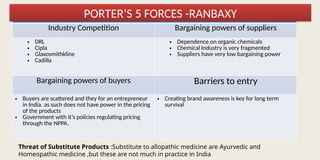
PORTER’S FIVE FORCES
Industry Competition Bargaining powers of suppliers
• DRL
• Cipla
• Glaxosmithkline
• Cadilla
• Dependence on organic chemicals
• Chemical Industry is very fragmented
• Suppliers have very low bargaining power
Bargaining powers of buyers Barriers to entry
• Buyers are scattered and they for an entrepreneur
in India. as such does not have power in the pricing
of the products
• Government with it’s policies regulating pricing
through the NPPA.
• Creating brand awareness is key for long term
survival
Threat of Substitute Products :Substitute to allopathic medicine are Ayurvedic and
Homeopathic medicine ,but these are not much in practice in India
PORTER’S 5 FORCES -RANBAXY
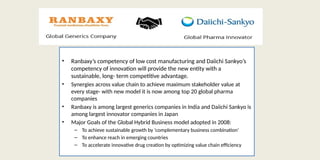
• Ranbaxy’s competency of low cost manufacturing and Daiichi Sankyo’s
competency of innovation will provide the new entity with a
sustainable, long- term competitive advantage.
• Synergies across value chain to achieve maximum stakeholder value at
every stage- with new model it is now among top 20 global pharma
companies
• Ranbaxy is among largest generics companies in India and Daiichi Sankyo is
among largest innovator companies in Japan
• Major Goals of the Global Hybrid Business model adopted in 2008:
– To achieve sustainable growth by ‘complementary business combination’
– To enhance reach in emerging countries
– To accelerate innovative drug creation by optimizing value chain efficiency
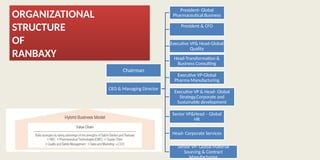
Chairman
CEO & Managing Director
President- Global
Pharmaceutical Business
President & CFO
Executive VP& Head-Global
Quality
Executive VP-Global
Pharma Manufacturing
Head-Transformation &
Business Consulting
Executive VP & Head- Global
Strategy,Corporate and
Sustainable development
Senior VP&Head – Global
HR
Head- Corporate Services
Senior VP- Global Material
Sourcing & Contract
Manufacturing
ORGANIZATIONAL
STRUCTURE
OF
RANBAXY
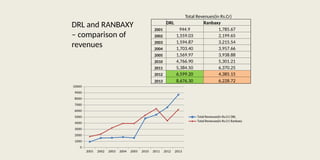
Total Revenues(in Rs.Cr)
DRL Ranbaxy
2001 944.9 1,785.67
2002 1,559.03 2,199.65
2003 1,594.87 3,215.54
2004 1,703.40 3,957.66
2005 1,569.97 3,938.88
2010 4,766.90 5,301.21
2011 5,384.50 6,370.25
2012 6,599.20 4,385.15
2013 8,676.30 6,228.72
2001 2002 2003 2004 2005 2010 2011 2012 2013
0
1000
2000
3000
4000
5000
6000
7000
8000
9000
10000
Total Revenues(in Rs.Cr) DRL
Total Revenues(in Rs.Cr) Ranbaxy
DRL and RANBAXY
– comparison of
revenues
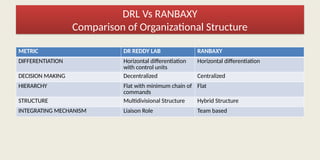
METRIC DR REDDY LAB RANBAXY
DIFFERENTIATION Horizontal differentiation
with control units
Horizontal differentiation
DECISION MAKING Decentralized Centralized
HIERARCHY Flat with minimum chain of
commands
Flat
STRUCTURE Multidivisional Structure Hybrid Structure
INTEGRATING MECHANISM Liaison Role Team based
DRL Vs RANBAXY
Comparison of Organizational Structure
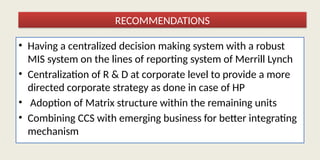
• Having a centralized decision making system with a robust
MIS system on the lines of reporting system of Merrill Lynch
• Centralization of R & D at corporate level to provide a more
directed corporate strategy as done in case of HP
• Adoption of Matrix structure within the remaining units
• Combining CCS with emerging business for better integrating
mechanism
RECOMMENDATIONS
THANK YOU

DRL Vs Ranbaxy Pharmaceutical Gaints.pptx

  • 1.
    Dr Reddy’s LaboratoryVs Ranbaxy Pharmaceuticals Kshitij Pathak- U113091 Lalip Nanda- U113092 Mayank Tabeck- U113093 Rakesh Kumar Jha- U113101 Rashmi Kulkarni- U113102 Rashmi Ranjan Nath-U113103 Shounak – U113111 Srishti Sen -U113112 Siddharth Padhee- U!13113
  • 2.
    Pharmaceutical Industry Analysis IndianCompanies Company Net Sales ( July 2013 $Bn) Employees Cipla 1.39 20,000 Dr Reddy’s Laboratories 1.14 16,300 Ranbaxy Labs 1.07 14,600 Aurobindo Pharma 0.92 8,635 Lupin Ltd 0.91 11,355 Sun Pharma 0.68 11,200 Novartis India 0.14 4,500 Global Companies Company Net Sales (2012 $ Bn) Employees Johnson & Johnson (USA) 67.2 117,000 Pfizer (USA) 58.9 91,000 Novartis (Switzerland) 56.7 115,000 Roche (Switzerland) 47.8 80,000 Merck (USA) 47.3 86,000 Sanofi (French) 46.4 113,000 GlaxoSmithKline (UK) 39.9 97,000
  • 3.
    SWOT Analysis Strength Low costof skilled manpower Access to large pool of highly trained scientists Strong marketing and distribution network Proven track record in design of high technology manufacturing devices Low cost of innovation, manufacturing and operations Weakness Stringent pricing regulations Poor transport and medical infrastructure Lack of data protection Very competitive environment Poor health insurance coverage Production of low quality drugs tarnishes image of industry abroad Low investment in innovative R&D
  • 4.
    SWOT Analysis Threats Other lowcost countries affecting demand Government regulations changing Expanding of Drugs Price Control Order Lack of investment in infrastructure Wage inflation R&D restricted by lack of animal testing and outdated patient office Counterfeiting threat. Opportunities Increase in per capita income Global demand for generics rising Increasing population with more sedentary lifestyle Increasing health insurance sector Significant investment from MNCs Medical tourism Cheap, diverse clinical trials Global outsourcing hub due to low cost of skilled labor
  • 5.
    Market Dominated by foreign companies with littledomestic participation 1.Indian patent act passed in 1970. 2.Several domestic companies start operations. 3.Export initiatives taken 1.Liberalized market 2.Incresing foreign presence of Indian companies. 3.Approval of patent act 2005. Before 1970 1970-1990 1990-2010 1.Increasing filing patent by Indian Companies. 2.Increasing adaption of new sales model Industry Growth Timeline 2010 and beyond
  • 6.
    • Indian Pharmacompany spends 2% of their revenue on R&D. • Expenditure on R&D is likely to increase due to introduction of product patent. Research & Development • Pharmaceutical export council expects pharma exports to reach $25 billion in 2016. Export revenue • Multinational companies are collaborating with Indian companies to develop new drugs. • Phizer partnered with Aurobindo Pharma to develop generic medicine. Joint ventures Patents Act Trends in Indian Pharma Industry •Amendments to Indian patent act 1970 , to make it TRIPS compliant. •Increased incentives to domestic firms to conduct R&D.
  • 7.
    • To promoteR&D(for future growth) as well as generic Business(for current profits), a robust organisational model was required. • The organizational model should be able to differentiate bulk activities and generics from speciality and new drug discovery business DRL -Challenges
  • 8.
    • Vertical • Horizontal •Integrated DIFFERENTIATION • Centralization • Decentralization DECISION MAKING • Tall • Flat • Minimum Chain of Command HIERARCHY • Functional • Multidivisional • Geographic • Matrix STRUCTURE • Direct Contact, Liason Role, Team , INTEGRATING MECHANISM KEY METRICS FOR ORGANIZATIONAL STRUCTURE
  • 10.
    • Incorporated in1961, as a family-owned business • Chairman – Dr.Tsutomu Une ; CEO & Managing Director – Arun Sawhney • Ranbaxy was facing many issues such as – poor financial position, – no major R&D breakthroughs, – increasing price wars – stiff competition in the generics market. • In order to maintain its growth and market position, Ranbaxy needed an influx of fresh funds • Daiichi Sankyo wanted to manufacture low cost generics because of Japan government’s new policy • In June 2008, Daiichi Sankyo acquired over 51% stake in Ranbaxy Laboratories Ltd at Rs. 737 per share. • Malvinder Singh sold out his stake of 34.8% to Daiichi Sankyo . • The new entity is a significant milestone in the Ranbaxy’s mission of becoming a research-based international pharmaceutical company. RANBAXY LABORATORIES
  • 11.
    PORTER’S FIVE FORCES IndustryCompetition Bargaining powers of suppliers • DRL • Cipla • Glaxosmithkline • Cadilla • Dependence on organic chemicals • Chemical Industry is very fragmented • Suppliers have very low bargaining power Bargaining powers of buyers Barriers to entry • Buyers are scattered and they for an entrepreneur in India. as such does not have power in the pricing of the products • Government with it’s policies regulating pricing through the NPPA. • Creating brand awareness is key for long term survival Threat of Substitute Products :Substitute to allopathic medicine are Ayurvedic and Homeopathic medicine ,but these are not much in practice in India PORTER’S 5 FORCES -RANBAXY
  • 12.
    • Ranbaxy’s competencyof low cost manufacturing and Daiichi Sankyo’s competency of innovation will provide the new entity with a sustainable, long- term competitive advantage. • Synergies across value chain to achieve maximum stakeholder value at every stage- with new model it is now among top 20 global pharma companies • Ranbaxy is among largest generics companies in India and Daiichi Sankyo is among largest innovator companies in Japan • Major Goals of the Global Hybrid Business model adopted in 2008: – To achieve sustainable growth by ‘complementary business combination’ – To enhance reach in emerging countries – To accelerate innovative drug creation by optimizing value chain efficiency
  • 13.
    Chairman CEO & ManagingDirector President- Global Pharmaceutical Business President & CFO Executive VP& Head-Global Quality Executive VP-Global Pharma Manufacturing Head-Transformation & Business Consulting Executive VP & Head- Global Strategy,Corporate and Sustainable development Senior VP&Head – Global HR Head- Corporate Services Senior VP- Global Material Sourcing & Contract Manufacturing ORGANIZATIONAL STRUCTURE OF RANBAXY
  • 14.
    Total Revenues(in Rs.Cr) DRLRanbaxy 2001 944.9 1,785.67 2002 1,559.03 2,199.65 2003 1,594.87 3,215.54 2004 1,703.40 3,957.66 2005 1,569.97 3,938.88 2010 4,766.90 5,301.21 2011 5,384.50 6,370.25 2012 6,599.20 4,385.15 2013 8,676.30 6,228.72 2001 2002 2003 2004 2005 2010 2011 2012 2013 0 1000 2000 3000 4000 5000 6000 7000 8000 9000 10000 Total Revenues(in Rs.Cr) DRL Total Revenues(in Rs.Cr) Ranbaxy DRL and RANBAXY – comparison of revenues
  • 15.
    METRIC DR REDDYLAB RANBAXY DIFFERENTIATION Horizontal differentiation with control units Horizontal differentiation DECISION MAKING Decentralized Centralized HIERARCHY Flat with minimum chain of commands Flat STRUCTURE Multidivisional Structure Hybrid Structure INTEGRATING MECHANISM Liaison Role Team based DRL Vs RANBAXY Comparison of Organizational Structure
  • 16.
    • Having acentralized decision making system with a robust MIS system on the lines of reporting system of Merrill Lynch • Centralization of R & D at corporate level to provide a more directed corporate strategy as done in case of HP • Adoption of Matrix structure within the remaining units • Combining CCS with emerging business for better integrating mechanism RECOMMENDATIONS
  • 17.