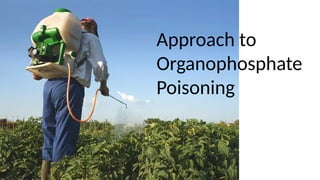
Approach to
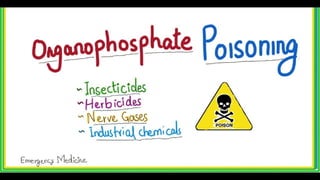
Organophosphate
Poisoning
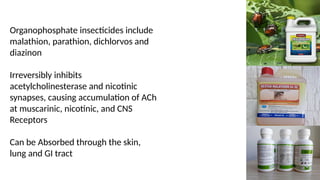
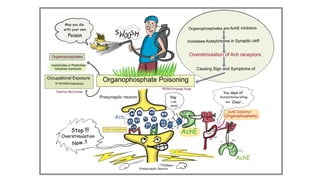
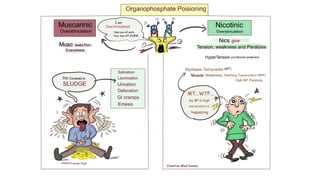
Organophosphate insecticides include
malathion, parathion, dichlorvos and
diazinon
Irreversibly inhibits
acetylcholinesterase and nicotinic
synapses, causing accumulation of ACh
at muscarinic, nicotinic, and CNS
Receptors
Can be Absorbed through the skin,
lung and GI tract
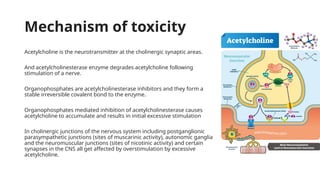
Mechanism of toxicity
Acetylcholine is the neurotransmitter at the cholinergic synaptic areas.
And acetylcholinesterase enzyme degrades acetylcholine following
stimulation of a nerve.
Organophosphates are acetylcholinesterase inhibitors and they form a
stable irreversible covalent bond to the enzyme.
Organophosphates mediated inhibition of acetylcholinesterase causes
acetylcholine to accumulate and results in initial excessive stimulation
In cholinergic junctions of the nervous system including postganglionic
parasympathetic junctions (sites of muscarinic activity), autonomic ganglia
and the neuromuscular junctions (sites of nicotinic activity) and certain
synapses in the CNS all get affected by overstimulation by excessive
acetylcholine.
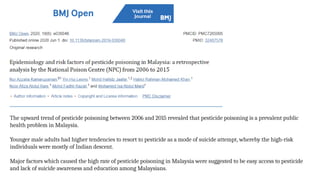
The upward trend of pesticide poisoning between 2006 and 2015 revealed that pesticide poisoning is a prevalent public
health problem in Malaysia.
Younger male adults had higher tendencies to resort to pesticide as a mode of suicide attempt, whereby the high-risk
individuals were mostly of Indian descent.
Major factors which caused the high rate of pesticide poisoning in Malaysia were suggested to be easy access to pesticide
and lack of suicide awareness and education among Malaysians.
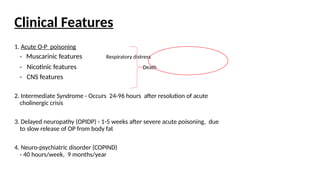
Clinical Features
1. Acute O-P poisoning
- Muscarinic features Respiratory distress
- Nicotinic features Death
- CNS features
2. Intermediate Syndrome - Occurs 24-96 hours after resolution of acute
cholinergic crisis
3. Delayed neuropathy (OPIDP) - 1-5 weeks after severe acute poisoning, due
to slow release of OP from body fat
4. Neuro-psychiatric disorder (COPIND)
- 40 hours/week, 9 months/year
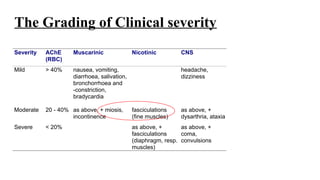
The Grading of Clinical severity
Severity AChE
(RBC)
Muscarinic Nicotinic CNS
Mild > 40% nausea, vomiting,
diarrhoea, salivation,
bronchorrhoea and
-constriction,
bradycardia
headache,
dizziness
Moderate 20 - 40% as above, + miosis,
incontinence
fasciculations
(fine muscles)
as above, +
dysarthria, ataxia
Severe < 20% as above, +
fasciculations
(diaphragm, resp.
muscles)
as above, +
coma,
convulsions
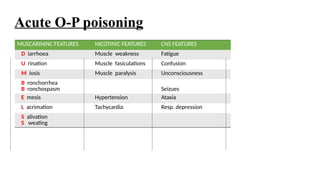
Acute O-P poisoning
MUSCARININC FEATURES NICOTINIC FEATURES CNS FEATURES
D iarrhoea Muscle weakness Fatigue
U rination Muscle fasiculations Confusion
M iosis Muscle paralysis Unconsciousness
B ronchorrhea
B ronchospasm Seizues
E mesis Hypertension Ataxia
L acrimation Tachycardia Resp. depression
S alivation
S weating
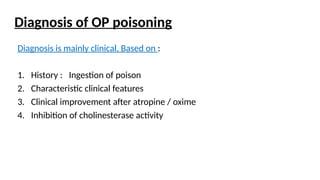
Diagnosis of OP poisoning
Diagnosis is mainly clinical, Based on :
1. History : Ingestion of poison
2. Characteristic clinical features
3. Clinical improvement after atropine / oxime
4. Inhibition of cholinesterase activity
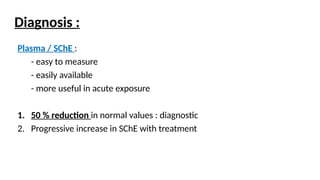
Diagnosis :
Plasma / SChE :
- easy to measure
- easily available
- more useful in acute exposure
1. 50 % reduction in normal values : diagnostic
2. Progressive increase in SChE with treatment
Other tests of prognostic value
a. Hyperglycemia
b. Neutrophilic leucocytosis
c. Proteinuria / glycosuria
d. ECG changes (QTc prolongation)
e. Blood pH (acidosis)
f. Hyper amylasemia
g. Serum CPK levels
Management
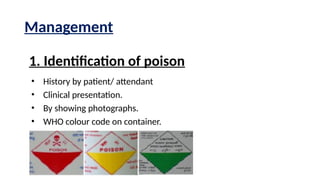
1. Identification of poison
• History by patient/ attendant
• Clinical presentation.
• By showing photographs.
• WHO colour code on container.
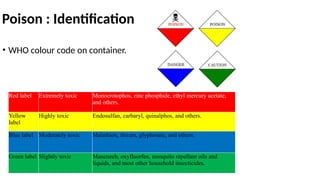
Poison : Identification
• WHO colour code on container.
Red label Extremely toxic Monocrotophos, zinc phosphide, ethyl mercury acetate,
and others.
Yellow
label
Highly toxic Endosulfan, carbaryl, quinalphos, and others.
Blue label Moderately toxic Malathion, thiram, glyphosate, and others.
Green label Slightly toxic Mancozeb, oxyfluorfen, mosquito repellant oils and
liquids, and most other household insecticides.
Identification of poison
• Signs of cholinergic excess or developing intermediate syndrome
• Disparity between history and clinical presentation, follow, clinical judgment.
• After identification classify as Organophosphorus and non-Organophosphorus.
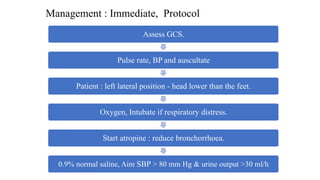
Management : Immediate, Protocol
Assess GCS.
Pulse rate, BP and auscultate
Patient : left lateral position - head lower than the feet.
Oxygen, Intubate if respiratory distress.
Start atropine : reduce bronchorrhoea.
0.9% normal saline, Aim SBP > 80 mm Hg & urine output >30 ml/h
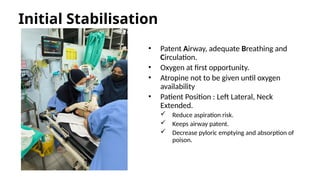
Initial Stabilisation
• Patent Airway, adequate Breathing and
Circulation.
• Oxygen at first opportunity.
• Atropine not to be given until oxygen
availability
• Patient Position : Left Lateral, Neck
Extended.
 Reduce aspiration risk.
 Keeps airway patent.
 Decrease pyloric emptying and absorption of
poison.
Management : Specific
General Principles of Therapy :
• Decontamination, Resuscitation, Stabilization.
• Muscarinic antagonists
• Fluids.
• Acetylcholinesterase reactivators.
• Gastric Decontamination.
• Miscellaneous.
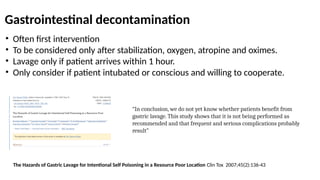
Gastrointestinal decontamination
• Often first intervention
• To be considered only after stabilization, oxygen, atropine and oximes.
• Lavage only if patient arrives within 1 hour.
• Only consider if patient intubated or conscious and willing to cooperate.
The Hazards of Gastric Lavage for Intentional Self Poisoning in a Resource Poor Location Clin Tox 2007;45(2):136-43
“In conclusion, we do not yet know whether patients benefit from
gastric lavage. This study shows that it is not being performed as
recommended and that frequent and serious complications probably
result”
Muscarinic antagonist
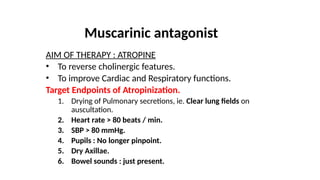
AIM OF THERAPY : ATROPINE
• To reverse cholinergic features.
• To improve Cardiac and Respiratory functions.
Target Endpoints of Atropinization.
1. Drying of Pulmonary secretions, ie. Clear lung fields on
auscultation.
2. Heart rate > 80 beats / min.
3. SBP > 80 mmHg.
4. Pupils : No longer pinpoint.
5. Dry Axillae.
6. Bowel sounds : just present.
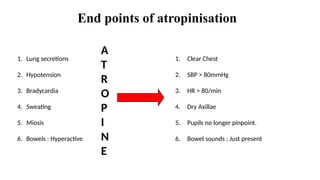
End points of atropinisation
1. Lung secretions
2. Hypotension
3. Bradycardia
4. Sweating
5. Miosis
6. Bowels : Hyperactive
A
T
R
O
P
I
N
E
1. Clear Chest
2. SBP > 80mmHg
3. HR > 80/min
4. Dry Axillae
5. Pupils no longer pinpoint.
6. Bowel sounds : Just present
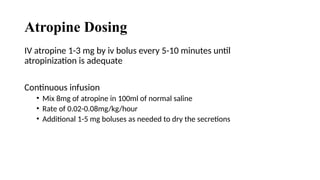
Atropine Dosing
IV atropine 1-3 mg by iv bolus every 5-10 minutes until
atropinization is adequate
Continuous infusion
• Mix 8mg of atropine in 100ml of normal saline
• Rate of 0.02-0.08mg/kg/hour
• Additional 1-5 mg boluses as needed to dry the secretions
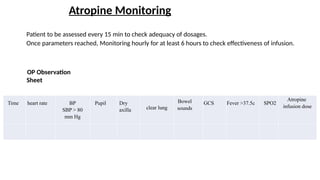
Atropine Monitoring
Patient to be assessed every 15 min to check adequacy of dosages.
Once parameters reached, Monitoring hourly for at least 6 hours to check effectiveness of infusion.
Time heart rate BP
SBP > 80
mm Hg
Pupil Dry
axilla clear lung
Bowel
sounds
GCS Fever >37.5c SPO2
Atropine
infusion dose
OP Observation
Sheet
Atropine : When to stop..??
• Bronchorrhoea : most important, for titrating dose.
• Atropine toxicity = absent bowel sounds + fever +
confusion.
• Stop infusion for 60 min, if toxicity.
• Re-start infusion at 80% of initial rate, once the temp.
comes down and patient calms.
• Most do not need >3-5 mg (5-9 ml) / hour of atropine
infusion.
• Reduce rate by 20% every 4 hourly once patient is
stable. STOP.
Oximes
• The consensus
• Oximes will not be effective in very severe (large
dose) poisoning.
• Treatment with oximes should be started as early as
possible, no role if started after 48 hours.
• Less effective in severe complications such as
aspiration pneumonia or hypoxic brain injury before
treatment.
• Less or no effectiveness with dimethyl compounds
and atypical organophosphates.
• Not effective in carbamates but are not
contraindicated either.
Pralidoxime
• An oxime that reactivates phosphorylated
cholinesterase.
• Effects mainly at the skeletal neuromuscular junctions
• Counteracts weakness, fasciculations amd respiratory
depression
• Also has antimuscarinic and possible CNS effects
How?
• 1-2g IV in 100ml of NS over 30 minutes
• Repeat in 1 hour if muscle weakness has not been
relieved
• 8-12 hours intervals if cholinergic signs recur
• Should only be started after maximal atropinization
• Contraindicated for certain organophosphate poisoning
• Carbamate
• Without anti cholinesterase activity
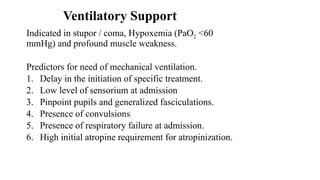
Ventilatory Support
Indicated in stupor / coma, Hypoxemia (PaO2 <60
mmHg) and profound muscle weakness.
Predictors for need of mechanical ventilation.
1. Delay in the initiation of specific treatment.
2. Low level of sensorium at admission
3. Pinpoint pupils and generalized fasciculations.
4. Presence of convulsions
5. Presence of respiratory failure at admission.
6. High initial atropine requirement for atropinization.

OP poisoning presentation in emergency setting

  • 1.
  • 3.
    Organophosphate insecticides include malathion,parathion, dichlorvos and diazinon Irreversibly inhibits acetylcholinesterase and nicotinic synapses, causing accumulation of ACh at muscarinic, nicotinic, and CNS Receptors Can be Absorbed through the skin, lung and GI tract
  • 4.
    Mechanism of toxicity Acetylcholineis the neurotransmitter at the cholinergic synaptic areas. And acetylcholinesterase enzyme degrades acetylcholine following stimulation of a nerve. Organophosphates are acetylcholinesterase inhibitors and they form a stable irreversible covalent bond to the enzyme. Organophosphates mediated inhibition of acetylcholinesterase causes acetylcholine to accumulate and results in initial excessive stimulation In cholinergic junctions of the nervous system including postganglionic parasympathetic junctions (sites of muscarinic activity), autonomic ganglia and the neuromuscular junctions (sites of nicotinic activity) and certain synapses in the CNS all get affected by overstimulation by excessive acetylcholine.
  • 6.
    The upward trendof pesticide poisoning between 2006 and 2015 revealed that pesticide poisoning is a prevalent public health problem in Malaysia. Younger male adults had higher tendencies to resort to pesticide as a mode of suicide attempt, whereby the high-risk individuals were mostly of Indian descent. Major factors which caused the high rate of pesticide poisoning in Malaysia were suggested to be easy access to pesticide and lack of suicide awareness and education among Malaysians.
  • 7.
    Clinical Features 1. AcuteO-P poisoning - Muscarinic features Respiratory distress - Nicotinic features Death - CNS features 2. Intermediate Syndrome - Occurs 24-96 hours after resolution of acute cholinergic crisis 3. Delayed neuropathy (OPIDP) - 1-5 weeks after severe acute poisoning, due to slow release of OP from body fat 4. Neuro-psychiatric disorder (COPIND) - 40 hours/week, 9 months/year
  • 8.
    The Grading ofClinical severity Severity AChE (RBC) Muscarinic Nicotinic CNS Mild > 40% nausea, vomiting, diarrhoea, salivation, bronchorrhoea and -constriction, bradycardia headache, dizziness Moderate 20 - 40% as above, + miosis, incontinence fasciculations (fine muscles) as above, + dysarthria, ataxia Severe < 20% as above, + fasciculations (diaphragm, resp. muscles) as above, + coma, convulsions
  • 10.
    Acute O-P poisoning MUSCARININCFEATURES NICOTINIC FEATURES CNS FEATURES D iarrhoea Muscle weakness Fatigue U rination Muscle fasiculations Confusion M iosis Muscle paralysis Unconsciousness B ronchorrhea B ronchospasm Seizues E mesis Hypertension Ataxia L acrimation Tachycardia Resp. depression S alivation S weating
  • 11.
    Diagnosis of OPpoisoning Diagnosis is mainly clinical, Based on : 1. History : Ingestion of poison 2. Characteristic clinical features 3. Clinical improvement after atropine / oxime 4. Inhibition of cholinesterase activity
  • 12.
    Diagnosis : Plasma /SChE : - easy to measure - easily available - more useful in acute exposure 1. 50 % reduction in normal values : diagnostic 2. Progressive increase in SChE with treatment
  • 13.
    Other tests ofprognostic value a. Hyperglycemia b. Neutrophilic leucocytosis c. Proteinuria / glycosuria d. ECG changes (QTc prolongation) e. Blood pH (acidosis) f. Hyper amylasemia g. Serum CPK levels
  • 14.
    Management 1. Identification ofpoison • History by patient/ attendant • Clinical presentation. • By showing photographs. • WHO colour code on container.
  • 15.
    Poison : Identification •WHO colour code on container. Red label Extremely toxic Monocrotophos, zinc phosphide, ethyl mercury acetate, and others. Yellow label Highly toxic Endosulfan, carbaryl, quinalphos, and others. Blue label Moderately toxic Malathion, thiram, glyphosate, and others. Green label Slightly toxic Mancozeb, oxyfluorfen, mosquito repellant oils and liquids, and most other household insecticides.
  • 16.
    Identification of poison •Signs of cholinergic excess or developing intermediate syndrome • Disparity between history and clinical presentation, follow, clinical judgment. • After identification classify as Organophosphorus and non-Organophosphorus.
  • 17.
    Management : Immediate,Protocol Assess GCS. Pulse rate, BP and auscultate Patient : left lateral position - head lower than the feet. Oxygen, Intubate if respiratory distress. Start atropine : reduce bronchorrhoea. 0.9% normal saline, Aim SBP > 80 mm Hg & urine output >30 ml/h
  • 18.
    Initial Stabilisation • PatentAirway, adequate Breathing and Circulation. • Oxygen at first opportunity. • Atropine not to be given until oxygen availability • Patient Position : Left Lateral, Neck Extended.  Reduce aspiration risk.  Keeps airway patent.  Decrease pyloric emptying and absorption of poison.
  • 19.
    Management : Specific GeneralPrinciples of Therapy : • Decontamination, Resuscitation, Stabilization. • Muscarinic antagonists • Fluids. • Acetylcholinesterase reactivators. • Gastric Decontamination. • Miscellaneous.
  • 20.
    Gastrointestinal decontamination • Oftenfirst intervention • To be considered only after stabilization, oxygen, atropine and oximes. • Lavage only if patient arrives within 1 hour. • Only consider if patient intubated or conscious and willing to cooperate. The Hazards of Gastric Lavage for Intentional Self Poisoning in a Resource Poor Location Clin Tox 2007;45(2):136-43 “In conclusion, we do not yet know whether patients benefit from gastric lavage. This study shows that it is not being performed as recommended and that frequent and serious complications probably result”
  • 21.
    Muscarinic antagonist AIM OFTHERAPY : ATROPINE • To reverse cholinergic features. • To improve Cardiac and Respiratory functions. Target Endpoints of Atropinization. 1. Drying of Pulmonary secretions, ie. Clear lung fields on auscultation. 2. Heart rate > 80 beats / min. 3. SBP > 80 mmHg. 4. Pupils : No longer pinpoint. 5. Dry Axillae. 6. Bowel sounds : just present.
  • 22.
    End points ofatropinisation 1. Lung secretions 2. Hypotension 3. Bradycardia 4. Sweating 5. Miosis 6. Bowels : Hyperactive A T R O P I N E 1. Clear Chest 2. SBP > 80mmHg 3. HR > 80/min 4. Dry Axillae 5. Pupils no longer pinpoint. 6. Bowel sounds : Just present
  • 23.
    Atropine Dosing IV atropine1-3 mg by iv bolus every 5-10 minutes until atropinization is adequate Continuous infusion • Mix 8mg of atropine in 100ml of normal saline • Rate of 0.02-0.08mg/kg/hour • Additional 1-5 mg boluses as needed to dry the secretions
  • 24.
    Atropine Monitoring Patient tobe assessed every 15 min to check adequacy of dosages. Once parameters reached, Monitoring hourly for at least 6 hours to check effectiveness of infusion. Time heart rate BP SBP > 80 mm Hg Pupil Dry axilla clear lung Bowel sounds GCS Fever >37.5c SPO2 Atropine infusion dose OP Observation Sheet
  • 25.
    Atropine : Whento stop..?? • Bronchorrhoea : most important, for titrating dose. • Atropine toxicity = absent bowel sounds + fever + confusion. • Stop infusion for 60 min, if toxicity. • Re-start infusion at 80% of initial rate, once the temp. comes down and patient calms. • Most do not need >3-5 mg (5-9 ml) / hour of atropine infusion. • Reduce rate by 20% every 4 hourly once patient is stable. STOP.
  • 26.
    Oximes • The consensus •Oximes will not be effective in very severe (large dose) poisoning. • Treatment with oximes should be started as early as possible, no role if started after 48 hours. • Less effective in severe complications such as aspiration pneumonia or hypoxic brain injury before treatment. • Less or no effectiveness with dimethyl compounds and atypical organophosphates. • Not effective in carbamates but are not contraindicated either.
  • 27.
    Pralidoxime • An oximethat reactivates phosphorylated cholinesterase. • Effects mainly at the skeletal neuromuscular junctions • Counteracts weakness, fasciculations amd respiratory depression • Also has antimuscarinic and possible CNS effects
  • 28.
    How? • 1-2g IVin 100ml of NS over 30 minutes • Repeat in 1 hour if muscle weakness has not been relieved • 8-12 hours intervals if cholinergic signs recur • Should only be started after maximal atropinization • Contraindicated for certain organophosphate poisoning • Carbamate • Without anti cholinesterase activity
  • 29.
    Ventilatory Support Indicated instupor / coma, Hypoxemia (PaO2 <60 mmHg) and profound muscle weakness. Predictors for need of mechanical ventilation. 1. Delay in the initiation of specific treatment. 2. Low level of sensorium at admission 3. Pinpoint pupils and generalized fasciculations. 4. Presence of convulsions 5. Presence of respiratory failure at admission. 6. High initial atropine requirement for atropinization.