YOGIC INTERVENTION
               IN ALZHEIMER’S
                   DISEASE


- Dr. Dhananjay Arankalle BNYS
  National Institute of Naturopathy, Pune
BACKGROUND
• Medline search (1966 - 1999) AD has become nearly twice
  as prevalent as vascular dementia (VaD) in Korea, Japan and
  China since transition in early 1990s.
• Indian studies  AD and Vad both prevalent, whereas,
  American and European studies AD to be more prevalent
  than Vad.
                                                 (Acta Psychiatr Scand, 2001)


• 2006 - 26.6 million people worldwide.
• 2050 - 26.6 million X 4.
• The largest increase will occur in Asia. (from 48% to 59%)
  (The number of Alzheimer's cases is expected to grow in Asia
  from 12.65 million in 2006 to 62.85 million in 2050).
           (Johns Hopkins University Bloomberg School of Public Health, 2007)
BACKGROUND                                  contd…
•   Mild to moderate AD (1 year treatment) – donepezil, galantamine,
    memantine & rivastigmine – cognitive function – but QoL of both patient
    & carer is not clear. (Cochrane Database Syst Rev, 2001, 2003, 2004)

•   Sahaj yoga & depression - manipulation of information in the verbal
    working memory; improvement in attention span and visuo-motor speed.
    (Indian J Physiol Pharmacol, 2006)

•   Mood improvement following yoga (state anxiety, depressive mood, and
    subjective well-being). (J Psychol, 2003)

•   IAYT & depression scores in older adults. (J Gerontol Nurs, 2007)

•   Yoga & breathing exercises - ‘invigorating’ effect on perceptions of both
    mental and physical energy and increased high positive mood. (J R Soc Med,
    1993)

•   Left nostril breathing - enhancement of spatial task performance (in both
    males and females). (Int J Neurosci, 1993)
AIM
• To study the effects of integrated approach of
  yoga therapy in patients suffering from AD on:
  –   Cognitive function
  –   Daily function
  –   Neuropsychiatric symptoms
  –   Functional health literacy
  –   Depression
METHOD                   Subjects

• Permission for recruitment of participants to be
  sought from appropriate old-age homes and
  clinical references from geriatric departments
  of suitable hospitals and/or OPDs.

• Stratification  Age (60-65, 65-70, 70-75, 75-
  80, 80-85, 85+), socio-economic (Poor,
  Moderate, Good), Gender (M, F)
METHOD            Subjects

• INCLUSION CRITERIA – based on the
  standard diagnostic criteria laid by the
  ‘National Institute for Neurological and
  Communicative Disorders and Stroke-
  Alzheimer's Disease and Related Disorder
  Association’ (NINDS - ADRDA)
                           (Lancet neurol, 2007)
METHOD                           Subjects
EXCLUSION CRITERIA
• History
   – Sudden onset
   – Early occurrence of : gait disturbances, seizures, behavioural changes

• Clinical features
   – Focal neurological features (hemiparesis, sensory loss, visual field
     deficits), Early extrapyramidal signs
   – Advanced AD

• Other medical disorders
   –   Non-AD dementia
   –   Major depression
   –   Cerebrovascular disease
   –   Toxic and metabolic abnormalities, all of which may require specific
       investigations
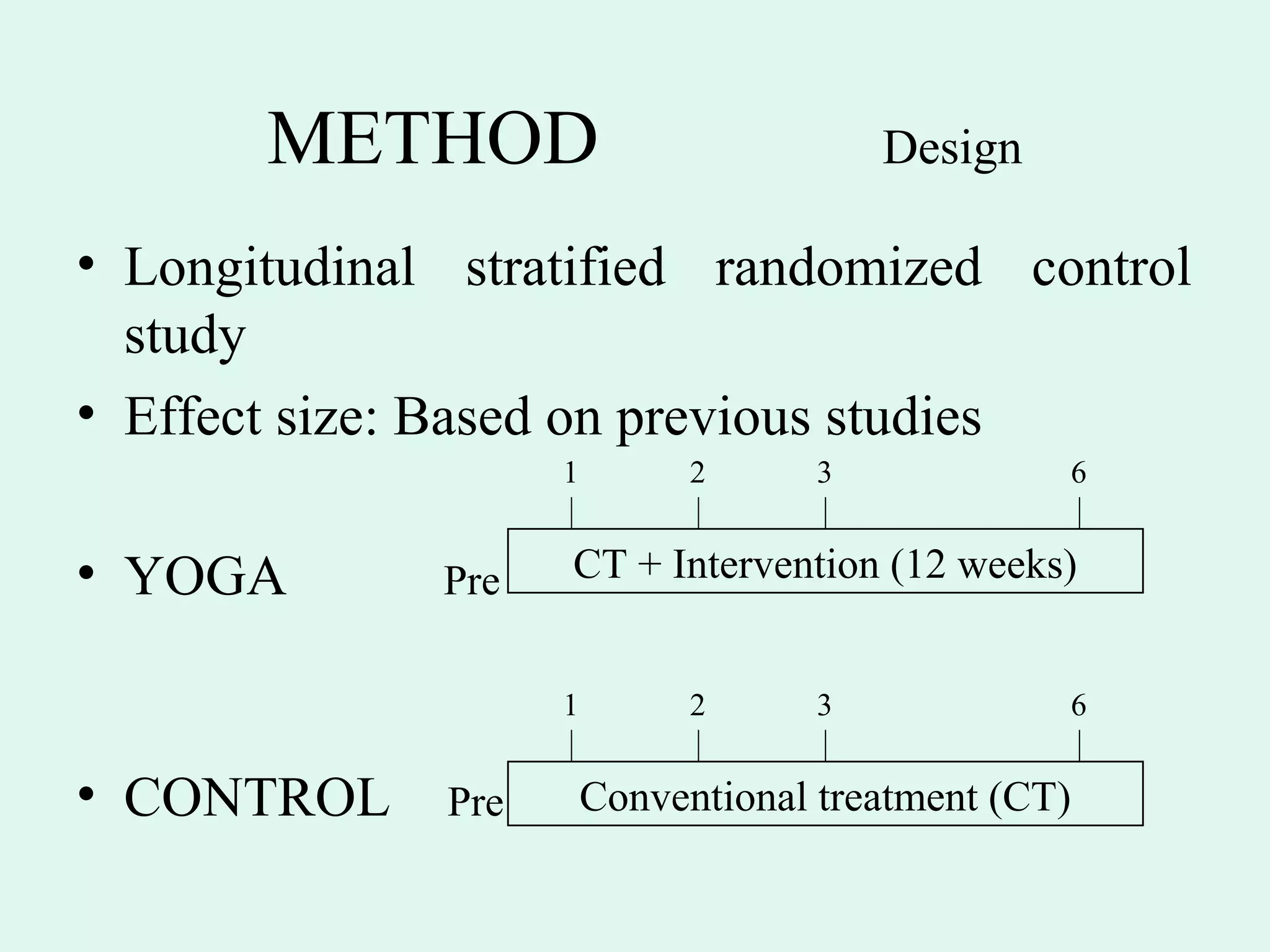
METHOD                            Design

• Longitudinal stratified randomized control
  study
• Effect size: Based on previous studies
                    1         2      3            6


• YOGA        Pre   CT + Intervention (12 weeks)


                    1         2      3            6


• CONTROL     Pre       Conventional treatment (CT)
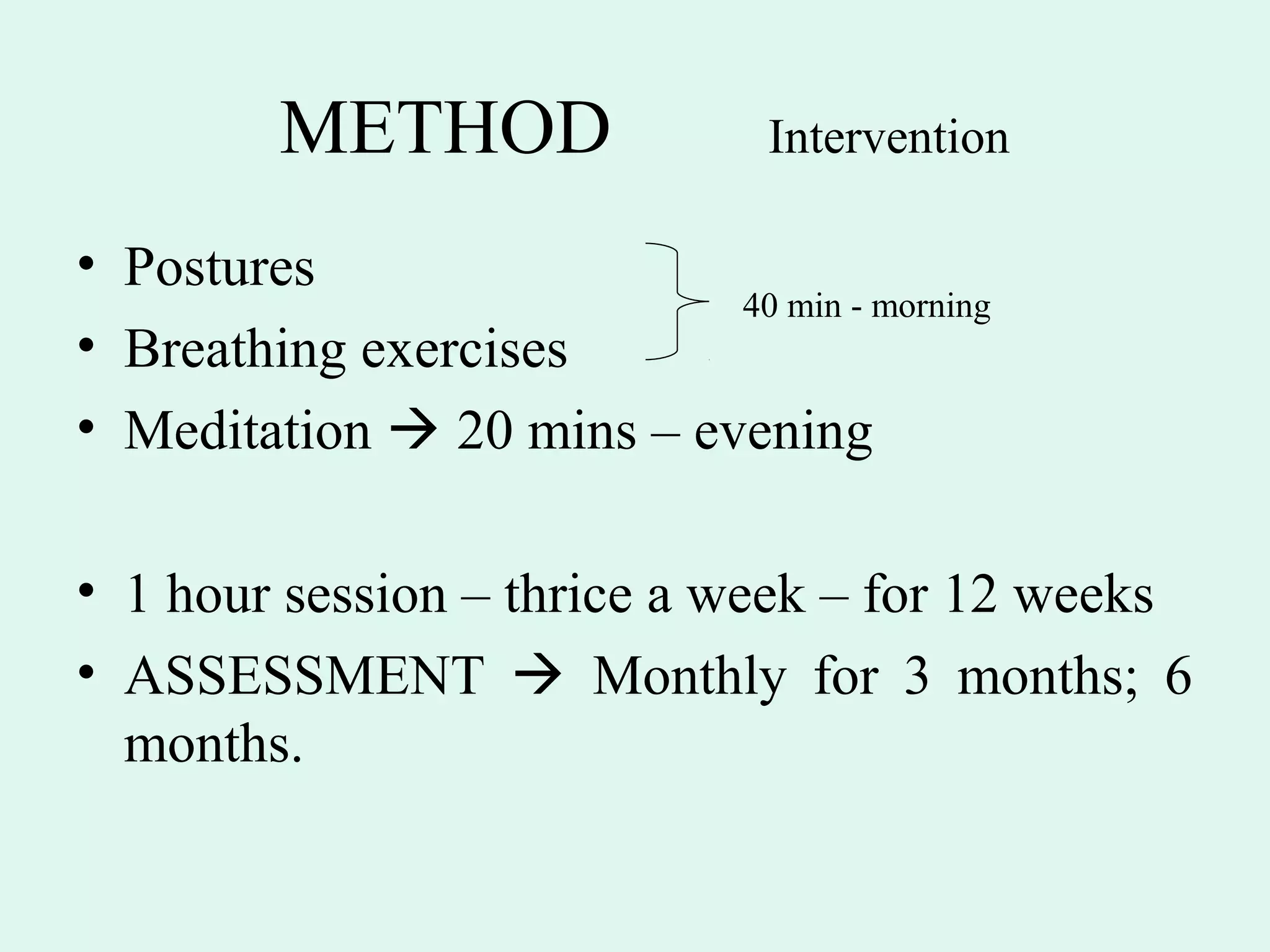
METHOD                 Intervention

• Postures
                           40 min - morning
• Breathing exercises
• Meditation  20 mins – evening

• 1 hour session – thrice a week – for 12 weeks
• ASSESSMENT  Monthly for 3 months; 6
  months.
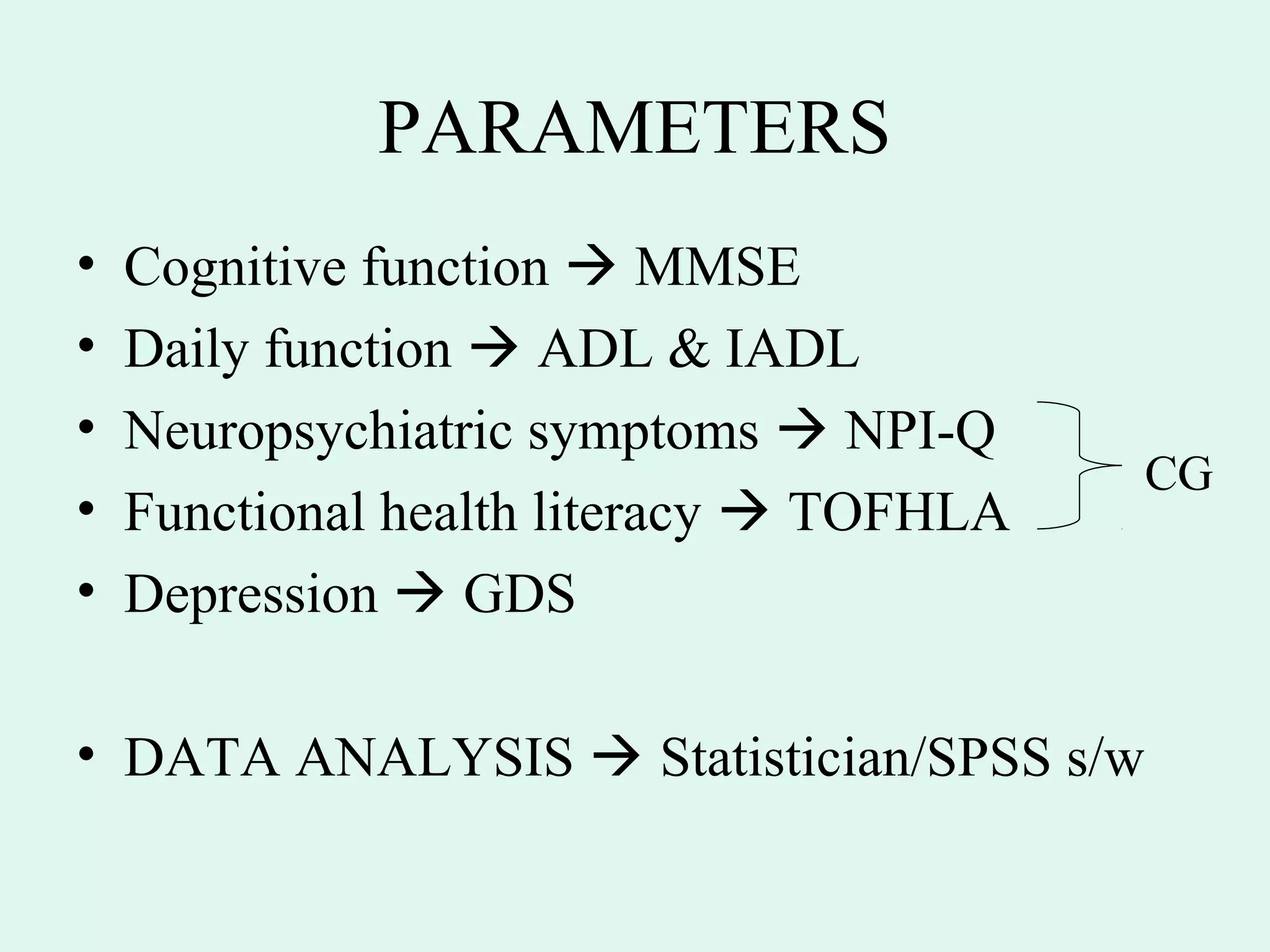
PARAMETERS
•   Cognitive function  MMSE
•   Daily function  ADL & IADL
•   Neuropsychiatric symptoms  NPI-Q
                                          CG
•   Functional health literacy  TOFHLA
•   Depression  GDS

• DATA ANALYSIS  Statistician/SPSS s/w
REFERENCES
• Suh GH, Shah A. “A review of the epidemiological
  transition in dementia - cross-national comparisons of the
  indices related to Alzheimer's disease and vascular
  dementia”. Acta Psychiatr Scand. 2001 Jul;104(1):4-11.
• Johns Hopkins University Bloomberg School of Public
  Health (2007, June 11). Alzheimer's Disease To Quadruple
  Worldwide By 2050. ScienceDaily Retrieved December 12,
  2008,from(http://www.sciencedaily.com/releases/2007/06/07
  0610104441.htm )
• JNetz Y, Lidor R. “Mood alterations in mindful versus
  aerobic exercise modes”. J Psychol. 2003 Sep;137(5):405-19
• Krishnamurthy MN, Telles S. “Assessing depression
  following two ancient Indian interventions: effects of yoga
  and ayurveda on older adults in a residential home”. J
  Gerontol Nurs. 2007 Feb;33(2):17-23
REFERENCES contd…
•   Wood C. “Mood change and perceptions of vitality: a comparison of the effects
    of relaxation, visualization and yoga”. J R Soc Med. 1993 May;86(5):254-8
•   Jella SA, Shannahoff-Khalsa DS. “The effects of unilateral forced nostril
    breathing on cognitive performance”. Int J Neurosci. 1993 Nov;73(1-2):61-8
•   Dubois B, Feldman HH, Jacova C, Dekosky ST, Barberger-Gateau P,
    Cummings J, Delacourte A, Galasko D, Gauthier S, Jicha G, Meguro K,
    O'brien J, Pasquier F, Robert P, Rossor M, Salloway S, Stern Y, Visser PJ,
    Scheltens P. Research criteria for the diagnosis of Alzheimer's disease: revising
    the NINCDS-ADRDA criteria. Lancet Neurol. 2007 Aug;6(8):734-46.
•   Areosa Sastre A., Sherriff F. “Memantine for Dementia”. Cochrane Database
    Syst Rev. 2003; (3):CD0003154.
•   Birks JS, Harvey R. “Donepezil for Dementia due to Alzheimer’s disease”.
    Cochrane Database Syst Rev. 2003; (3):CD001190.
•   Olin J, Schneider L. “Galantamine for Alzheimer’s disease”. Cochrane
    Database Syst Rev. 2001; (4):CD001747.
THANK YOU

Dr. dhananjay icmr ad

  • 1.
    YOGIC INTERVENTION IN ALZHEIMER’S DISEASE - Dr. Dhananjay Arankalle BNYS National Institute of Naturopathy, Pune
  • 2.
    BACKGROUND • Medline search(1966 - 1999) AD has become nearly twice as prevalent as vascular dementia (VaD) in Korea, Japan and China since transition in early 1990s. • Indian studies  AD and Vad both prevalent, whereas, American and European studies AD to be more prevalent than Vad. (Acta Psychiatr Scand, 2001) • 2006 - 26.6 million people worldwide. • 2050 - 26.6 million X 4. • The largest increase will occur in Asia. (from 48% to 59%) (The number of Alzheimer's cases is expected to grow in Asia from 12.65 million in 2006 to 62.85 million in 2050). (Johns Hopkins University Bloomberg School of Public Health, 2007)
  • 3.
    BACKGROUND contd… • Mild to moderate AD (1 year treatment) – donepezil, galantamine, memantine & rivastigmine – cognitive function – but QoL of both patient & carer is not clear. (Cochrane Database Syst Rev, 2001, 2003, 2004) • Sahaj yoga & depression - manipulation of information in the verbal working memory; improvement in attention span and visuo-motor speed. (Indian J Physiol Pharmacol, 2006) • Mood improvement following yoga (state anxiety, depressive mood, and subjective well-being). (J Psychol, 2003) • IAYT & depression scores in older adults. (J Gerontol Nurs, 2007) • Yoga & breathing exercises - ‘invigorating’ effect on perceptions of both mental and physical energy and increased high positive mood. (J R Soc Med, 1993) • Left nostril breathing - enhancement of spatial task performance (in both males and females). (Int J Neurosci, 1993)
  • 4.
    AIM • To studythe effects of integrated approach of yoga therapy in patients suffering from AD on: – Cognitive function – Daily function – Neuropsychiatric symptoms – Functional health literacy – Depression
  • 5.
    METHOD Subjects • Permission for recruitment of participants to be sought from appropriate old-age homes and clinical references from geriatric departments of suitable hospitals and/or OPDs. • Stratification  Age (60-65, 65-70, 70-75, 75- 80, 80-85, 85+), socio-economic (Poor, Moderate, Good), Gender (M, F)
  • 6.
    METHOD Subjects • INCLUSION CRITERIA – based on the standard diagnostic criteria laid by the ‘National Institute for Neurological and Communicative Disorders and Stroke- Alzheimer's Disease and Related Disorder Association’ (NINDS - ADRDA) (Lancet neurol, 2007)
  • 7.
    METHOD Subjects EXCLUSION CRITERIA • History – Sudden onset – Early occurrence of : gait disturbances, seizures, behavioural changes • Clinical features – Focal neurological features (hemiparesis, sensory loss, visual field deficits), Early extrapyramidal signs – Advanced AD • Other medical disorders – Non-AD dementia – Major depression – Cerebrovascular disease – Toxic and metabolic abnormalities, all of which may require specific investigations
  • 8.
    METHOD Design • Longitudinal stratified randomized control study • Effect size: Based on previous studies 1 2 3 6 • YOGA Pre CT + Intervention (12 weeks) 1 2 3 6 • CONTROL Pre Conventional treatment (CT)
  • 9.
    METHOD Intervention • Postures 40 min - morning • Breathing exercises • Meditation  20 mins – evening • 1 hour session – thrice a week – for 12 weeks • ASSESSMENT  Monthly for 3 months; 6 months.
  • 10.
    PARAMETERS • Cognitive function  MMSE • Daily function  ADL & IADL • Neuropsychiatric symptoms  NPI-Q CG • Functional health literacy  TOFHLA • Depression  GDS • DATA ANALYSIS  Statistician/SPSS s/w
  • 11.
    REFERENCES • Suh GH,Shah A. “A review of the epidemiological transition in dementia - cross-national comparisons of the indices related to Alzheimer's disease and vascular dementia”. Acta Psychiatr Scand. 2001 Jul;104(1):4-11. • Johns Hopkins University Bloomberg School of Public Health (2007, June 11). Alzheimer's Disease To Quadruple Worldwide By 2050. ScienceDaily Retrieved December 12, 2008,from(http://www.sciencedaily.com/releases/2007/06/07 0610104441.htm ) • JNetz Y, Lidor R. “Mood alterations in mindful versus aerobic exercise modes”. J Psychol. 2003 Sep;137(5):405-19 • Krishnamurthy MN, Telles S. “Assessing depression following two ancient Indian interventions: effects of yoga and ayurveda on older adults in a residential home”. J Gerontol Nurs. 2007 Feb;33(2):17-23
  • 12.
    REFERENCES contd… • Wood C. “Mood change and perceptions of vitality: a comparison of the effects of relaxation, visualization and yoga”. J R Soc Med. 1993 May;86(5):254-8 • Jella SA, Shannahoff-Khalsa DS. “The effects of unilateral forced nostril breathing on cognitive performance”. Int J Neurosci. 1993 Nov;73(1-2):61-8 • Dubois B, Feldman HH, Jacova C, Dekosky ST, Barberger-Gateau P, Cummings J, Delacourte A, Galasko D, Gauthier S, Jicha G, Meguro K, O'brien J, Pasquier F, Robert P, Rossor M, Salloway S, Stern Y, Visser PJ, Scheltens P. Research criteria for the diagnosis of Alzheimer's disease: revising the NINCDS-ADRDA criteria. Lancet Neurol. 2007 Aug;6(8):734-46. • Areosa Sastre A., Sherriff F. “Memantine for Dementia”. Cochrane Database Syst Rev. 2003; (3):CD0003154. • Birks JS, Harvey R. “Donepezil for Dementia due to Alzheimer’s disease”. Cochrane Database Syst Rev. 2003; (3):CD001190. • Olin J, Schneider L. “Galantamine for Alzheimer’s disease”. Cochrane Database Syst Rev. 2001; (4):CD001747.
  • 13.