






1
 Advancement in medical science
 Decline in mental health
 Thrust area - Mental health care
2
WHO predicts
 by 2025, about 75% population- people aged
60 years and older
 People with dementia will almost double every
20 years
 42.3 million in 2020 and 81.1 million in 2040.
 Prevalence of MCI in India is about 14.89%
3
 Ayurveda is a lifestyle
 Preventive domain
 Treatment domain
4
Scholar
Dr.NAYANA.S
MD Scholar
Mano vijnan avum manas roga
Dept of kayachikitsa
VPSV Ayurveda College
Kottakkal
Guide
Dr.JITHESH.M
Associate Professor
VPSV Ayurveda College
5
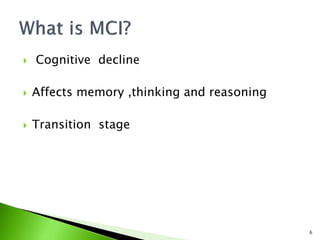
 Cognitive decline
 Affects memory ,thinking and reasoning
 Transition stage
6
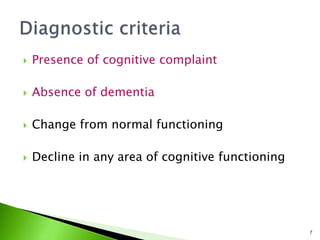
 Presence of cognitive complaint
 Absence of dementia
 Change from normal functioning
 Decline in any area of cognitive functioning
7
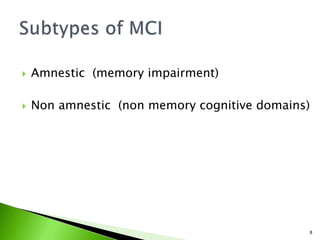
 Amnestic (memory impairment)
 Non amnestic (non memory cognitive domains)
8
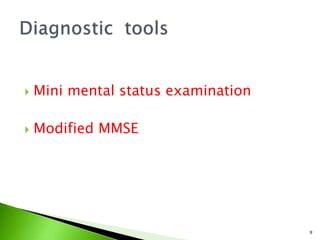
 Mini mental status examination
 Modified MMSE
9
 Apoptosis or programmed cell death of neurons
 Insufficient nootropic factors
 Failure to establish neuronal connections
10
 Increasing age
 Decreased mentally stimulating activities
 Other medical conditions
11
 Alzheimer's disease or other type of dementia.
 Studies suggest 6 to 15% develop dementia
every year
12
 Depression
 Irritability and aggression Affects QoL
 Anxiety
 Apathy
13
Treatments for Alzheimer’s disease
 Antioxidants
 Cholinesterase inhibitors
 Donepezil
 Adverse effects
14
NEED FOR AYURVEDIC
INTERVENTION
15
 Concept of Jnanotpathi-
Perception
Attention
Comprehension
 Concept of medha, budhi and smruthi
16
The highest form of budhi-acts at subtle levels.
 Grahana sakthi (grasping power)
 Dharana sakthi (retention power)
17
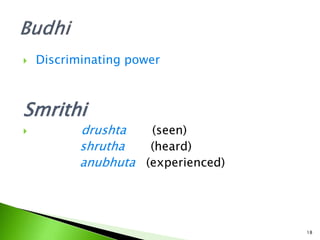
 Discriminating power
Smrithi
 drushta (seen)
shrutha (heard)
anubhuta (experienced)
18
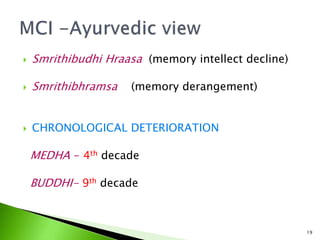
 Smrithibudhi Hraasa (memory intellect decline)
 Smrithibhramsa (memory derangement)
 CHRONOLOGICAL DETERIORATION
MEDHA - 4th decade
BUDDHI- 9th decade
19
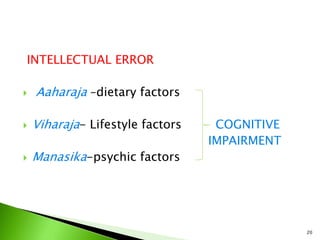
INTELLECTUAL ERROR
 Aaharaja –dietary factors
 Viharaja- Lifestyle factors COGNITIVE
IMPAIRMENT
 Manasika-psychic factors
20
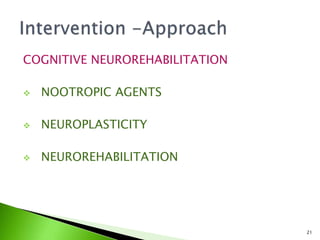
COGNITIVE NEUROREHABILITATION
 NOOTROPIC AGENTS
 NEUROPLASTICITY
 NEUROREHABILITATION
21
 Medhya rasayana
 Centella asiatica (Mandookaparni)-juice
 Glycirriza glabra (yashti madhu)-powder with milk
 Tinospora cordifolia (guduchi)-paste
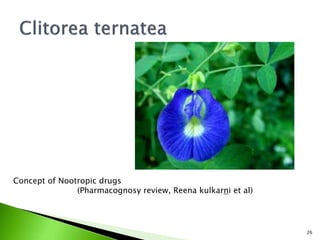
 Clitoria ternatea (sankhupushpi)-paste
22
23
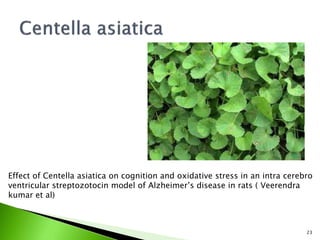
Effect of Centella asiatica on cognition and oxidative stress in an intra cerebro
ventricular streptozotocin model of Alzheimer’s disease in rats ( Veerendra
kumar et al)
24
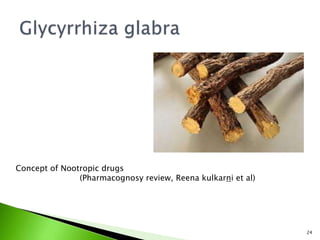
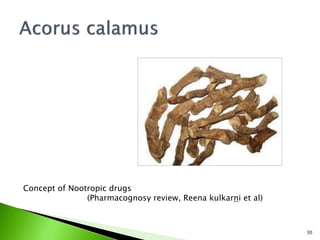
Concept of Nootropic drugs
(Pharmacognosy review, Reena kulkarni et al)
25
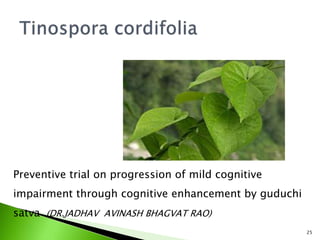
Preventive trial on progression of mild cognitive
impairment through cognitive enhancement by guduchi
satva (DR.JADHAV AVINASH BHAGVAT RAO)
26
Concept of Nootropic drugs
(Pharmacognosy review, Reena kulkarni et al)
27
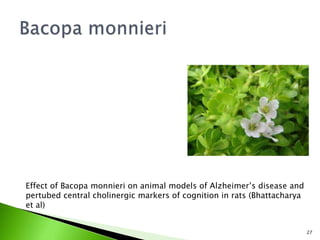
Effect of Bacopa monnieri on animal models of Alzheimer’s disease and
pertubed central cholinergic markers of cognition in rats (Bhattacharya
et al)
28
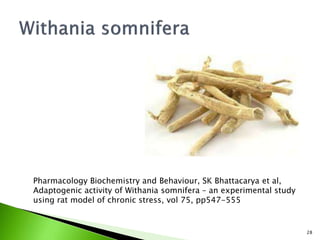
Pharmacology Biochemistry and Behaviour, SK Bhattacarya et al,
Adaptogenic activity of Withania somnifera – an experimental study
using rat model of chronic stress, vol 75, pp547-555
29
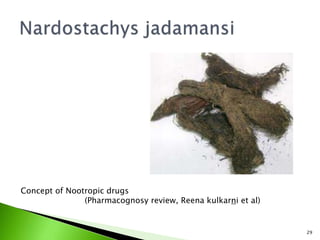
Concept of Nootropic drugs
(Pharmacognosy review, Reena kulkarni et al)
30
Concept of Nootropic drugs
(Pharmacognosy review, Reena kulkarni et al)
 Withania somnifera(aswagandha)
 Nardostachys jadamansi(jadamanchi)
 Acorus calamus(vacha)
 Bacopa monneiri(brahmi)
31
Preventive trial on progression of mild
cognitive impairment through cognitive
enhancement by guduchi satva
(DR.JADHAV AVINASH BHAGVAT RAO)
Clinical efficacy of Guduchyadi Medhya
Rasayana on Senile Memory Impairment
(DR.M S BAGHEAL et al)
32
 Polyherbal preparation of ghee
Naladadi ghritha
Kalyanaka ghritha
Ghee- Site specificity
33
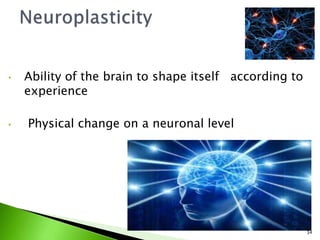
• Ability of the brain to shape itself according to
experience
• Physical change on a neuronal level
34
 Budhimedhakara gana- susrutha acharya
“Satataadhyayana vaada paratantra avalokanam
Tadvidya aacharya seva cha budhimedhakaro gana”
 Continuous learning
 Engaging in debates
 Studying other sciences
 Learning from experts
35
In a broader sense we can include the techniques
 Brain games
 Learning new languages
 Playing musical instruments
 Cross words
36
 Panchakarma therapy
Snehapana, Virechana, Sirovasthi, Sirodhara, Nasya
 Yoga
 Meditation
37
38
39
40
 Vitalizer of psyche and soma
 Socio-behavioural conducts for moral or mental
hygiene
 Effective preventive principles for psychological
disorders
41
Achara Rasayana in three dimensions:
 Personality
 Social Relationship
 Physical Health
42
 Need of promotion of mental health
 Early management of MCI
43
 Nootropic drugs-medhya rasayana
 Brain exercises
 Panchakarma procedures
44
 Adoption of good behavioral conducts
-achara rasayana
 Timely intervention of lifestyle diseases
 Periodic intake of medhya rasayana
 Active involvement in intellectually stimulating
activities
45
46

Mild cognitive impairment nayana

  • 1.
  • 2.
     Advancement inmedical science  Decline in mental health  Thrust area - Mental health care 2
  • 3.
    WHO predicts  by2025, about 75% population- people aged 60 years and older  People with dementia will almost double every 20 years  42.3 million in 2020 and 81.1 million in 2040.  Prevalence of MCI in India is about 14.89% 3
  • 4.
     Ayurveda isa lifestyle  Preventive domain  Treatment domain 4
  • 5.
    Scholar Dr.NAYANA.S MD Scholar Mano vijnanavum manas roga Dept of kayachikitsa VPSV Ayurveda College Kottakkal Guide Dr.JITHESH.M Associate Professor VPSV Ayurveda College 5
  • 6.
     Cognitive decline Affects memory ,thinking and reasoning  Transition stage 6
  • 7.
     Presence ofcognitive complaint  Absence of dementia  Change from normal functioning  Decline in any area of cognitive functioning 7
  • 8.
     Amnestic (memoryimpairment)  Non amnestic (non memory cognitive domains) 8
  • 9.
     Mini mentalstatus examination  Modified MMSE 9
  • 10.
     Apoptosis orprogrammed cell death of neurons  Insufficient nootropic factors  Failure to establish neuronal connections 10
  • 11.
     Increasing age Decreased mentally stimulating activities  Other medical conditions 11
  • 12.
     Alzheimer's diseaseor other type of dementia.  Studies suggest 6 to 15% develop dementia every year 12
  • 13.
     Depression  Irritabilityand aggression Affects QoL  Anxiety  Apathy 13
  • 14.
    Treatments for Alzheimer’sdisease  Antioxidants  Cholinesterase inhibitors  Donepezil  Adverse effects 14
  • 15.
  • 16.
     Concept ofJnanotpathi- Perception Attention Comprehension  Concept of medha, budhi and smruthi 16
  • 17.
    The highest formof budhi-acts at subtle levels.  Grahana sakthi (grasping power)  Dharana sakthi (retention power) 17
  • 18.
     Discriminating power Smrithi drushta (seen) shrutha (heard) anubhuta (experienced) 18
  • 19.
     Smrithibudhi Hraasa(memory intellect decline)  Smrithibhramsa (memory derangement)  CHRONOLOGICAL DETERIORATION MEDHA - 4th decade BUDDHI- 9th decade 19
  • 20.
    INTELLECTUAL ERROR  Aaharaja–dietary factors  Viharaja- Lifestyle factors COGNITIVE IMPAIRMENT  Manasika-psychic factors 20
  • 21.
    COGNITIVE NEUROREHABILITATION  NOOTROPICAGENTS  NEUROPLASTICITY  NEUROREHABILITATION 21
  • 22.
     Medhya rasayana Centella asiatica (Mandookaparni)-juice  Glycirriza glabra (yashti madhu)-powder with milk  Tinospora cordifolia (guduchi)-paste  Clitoria ternatea (sankhupushpi)-paste 22
  • 23.
    23 Effect of Centellaasiatica on cognition and oxidative stress in an intra cerebro ventricular streptozotocin model of Alzheimer’s disease in rats ( Veerendra kumar et al)
  • 24.
    24 Concept of Nootropicdrugs (Pharmacognosy review, Reena kulkarni et al)
  • 25.
    25 Preventive trial onprogression of mild cognitive impairment through cognitive enhancement by guduchi satva (DR.JADHAV AVINASH BHAGVAT RAO)
  • 26.
    26 Concept of Nootropicdrugs (Pharmacognosy review, Reena kulkarni et al)
  • 27.
    27 Effect of Bacopamonnieri on animal models of Alzheimer’s disease and pertubed central cholinergic markers of cognition in rats (Bhattacharya et al)
  • 28.
    28 Pharmacology Biochemistry andBehaviour, SK Bhattacarya et al, Adaptogenic activity of Withania somnifera – an experimental study using rat model of chronic stress, vol 75, pp547-555
  • 29.
    29 Concept of Nootropicdrugs (Pharmacognosy review, Reena kulkarni et al)
  • 30.
    30 Concept of Nootropicdrugs (Pharmacognosy review, Reena kulkarni et al)
  • 31.
     Withania somnifera(aswagandha) Nardostachys jadamansi(jadamanchi)  Acorus calamus(vacha)  Bacopa monneiri(brahmi) 31
  • 32.
    Preventive trial onprogression of mild cognitive impairment through cognitive enhancement by guduchi satva (DR.JADHAV AVINASH BHAGVAT RAO) Clinical efficacy of Guduchyadi Medhya Rasayana on Senile Memory Impairment (DR.M S BAGHEAL et al) 32
  • 33.
     Polyherbal preparationof ghee Naladadi ghritha Kalyanaka ghritha Ghee- Site specificity 33
  • 34.
    • Ability ofthe brain to shape itself according to experience • Physical change on a neuronal level 34
  • 35.
     Budhimedhakara gana-susrutha acharya “Satataadhyayana vaada paratantra avalokanam Tadvidya aacharya seva cha budhimedhakaro gana”  Continuous learning  Engaging in debates  Studying other sciences  Learning from experts 35
  • 36.
    In a broadersense we can include the techniques  Brain games  Learning new languages  Playing musical instruments  Cross words 36
  • 37.
     Panchakarma therapy Snehapana,Virechana, Sirovasthi, Sirodhara, Nasya  Yoga  Meditation 37
  • 38.
  • 39.
  • 40.
  • 41.
     Vitalizer ofpsyche and soma  Socio-behavioural conducts for moral or mental hygiene  Effective preventive principles for psychological disorders 41
  • 42.
    Achara Rasayana inthree dimensions:  Personality  Social Relationship  Physical Health 42
  • 43.
     Need ofpromotion of mental health  Early management of MCI 43
  • 44.
     Nootropic drugs-medhyarasayana  Brain exercises  Panchakarma procedures 44
  • 45.
     Adoption ofgood behavioral conducts -achara rasayana  Timely intervention of lifestyle diseases  Periodic intake of medhya rasayana  Active involvement in intellectually stimulating activities 45
  • 46.

Editor's Notes

  • #4 The World Health Organization (WHO) predicts that by 2025, about 75% of the estimated 1.2 billion people aged 60 years and older will reside in developing countries.  It is estimated that the number of people living with dementia will almost double every 20 years to 42.3 million in 2020 and 81.1 million in 2040
  • #10 Global deterioration scale Barthel ADL Index Six letter cancellation test Clock drawing test
  • #12 Other medical conditions and lifestyle factors have been linked to an increased risk of cognitive change, but the evidence for these risk factors is less clear Diabetes Smoking Depression High blood pressure Elevated cholesterol Lack of physical exercise
  • #13 People with MCI have a significantly Among older adults with MCI,
  • #15 In a two-year randomized trial of 168 people with MCI given either high-dose vitamins or placebo, vitamins cut the rate of brain shrinkage by up to half. The vitamins were the three B vitamins folic acid, vitamin B6, and vitamin B12, which inhibit production of the amino acid homocysteine. High blood levels of homocysteine are associated with increased risk of cognitive decline,[10] dementia, and cardiovascular disease.[1nausea, vomiting, diarrhea; loss of appetite; muscle cramps; tired feeling; or. sleep problems (insomnia)
  • #19  decisive power to discriminate between good, bad and act according to it.
  • #20 This condition is not met as a disease entity in separate chapters of Ayurvedic classics and considered as a natural phenomenon, but sign and symptoms of dementia can be understood in terms of Ayurvedic concepts. In order to understand the etiopathogenesis of dementia in the light of Ayurvedic literature it is necessary to review the general physiology of Manas andBuddhi. Before discussing the etiology and psychopathology of Smritibuddhihrass, it is worth considering the relation of Mana, Buddhi, Medha, Dhriti and Smriti with each other
  • #35 Neuroplasticity, also known as brain plasticity, is an umbrella term that encompasses both synaptic plasticity and non-synaptic plasticity—it refers to changes in neural pathways and synapses due to changes in behavior, environment, neural processes, thinking, emotions, as well as changes resulting from bodily injury.
  • #37 Intellectual stimulation may prevent cognitive decline. Studies have shown computer use, playing games, reading books and other intellectual activities may help preserve function and prevent cognitive decline. Social engagement may make life more satisfying, and help preserve mental function and slow mental decline. Memory training and other thinking (cognitive) training may help improve your function.
  • #42 especially at primordial and primary prevention levels
  • #43 Personal behavior – speaking always truth, not getting angry easily, avoiding alcohol intake etc… Social behavior - non-violence, speaking nicely and sweet words, respecting elders, teachers, Brahmans, and cows etc.. – daily consumption of ghee and milk and having proper sleep and not awakening in night unnecessarily.