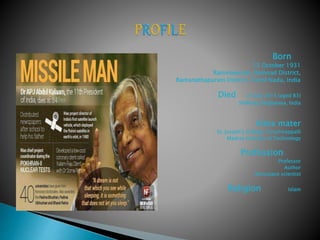
Born in 1931 in India, Abdul Kalam had a humble upbringing but went on to have an illustrious career as a scientist and the 11th President of India. As a scientist, he worked on development of ballistic missiles and launch vehicles for India's space program. He played a pivotal role in India's Pokhran-II nuclear tests. As President from 2002 to 2007, he was popularly known as the "People's President" for his friendly nature and commitment to public service. He received numerous honors and awards for his contribution to science and nation-building.

![Earlylife
Avul Pakir Jainulabdeen Abdul Kalam
was born on 15October 1931 to
aTamil Muslim family in the
pilgrimage centre
of Rameswaram on Pamban Island,
then in the Madras Presidency and
now in the State ofTamil Nadu. His
father Jainulabudeen was a boat
owner and imam of a local
mosque;[10] his motherAshiamma
was a housewife.[11][12][13][14] His
father owned a ferry that
took Hindu pilgrims back and forth
between Rameswaram and the now
uninhabited Dhanushkodi.[15][16] Kal
am was the youngest of four brothers
and one sister in his family.](https://image.slidesharecdn.com/drapjabdulkalam-161212034234/85/Dr-apj-abdul-kalam-6-320.jpg)
![ After graduating from
the Madras Institute of
Technology in 1960, Kalam
joined the Aeronautical
Development Establishment of
the Defence Research and
Development Organisationas a
scientist. He started his career
by designing a
small hovercraft, but remained
unconvinced by his choice of a
job at DRDO.[27] Kalam was
also part of the INCOSPAR
committee working
under Vikram Sarabhai, the
renowned space scientist14
]In 1969, Kalam was
transferred to the Indian Space
Research Organisation (ISRO)
where he was the project
director of India's first Satellite
Launch Vehicle (SLV-III) which
successfully deployed
the Rohini satellite in near-
earth orbit in July 1980; Kalam
had first started work on an
expandable rocket project
independently at DRDO in
1965.[2] In 1969, Kalam
received the government's
approval and expanded the
programme to include more
engineers](https://image.slidesharecdn.com/drapjabdulkalam-161212034234/85/Dr-apj-abdul-kalam-10-320.jpg)

![Kalam served as the 11th President of India, succeeding K. R.
Narayanan. He won the 2002 presidential election with an electoral
vote of 922,884, surpassing the 107,366 votes won by Lakshmi
Sahgal. His term lasted from 25 July 2002 to 25 July 2007. On 10
June 2002, the National Democratic Alliance (NDA) which was in
power at the time, expressed that they would nominate Kalam for
the post of President,[40][41] and both the Samajwadi.Party and
the Nationalist Congress Party backed his candidacy
Presidency](https://image.slidesharecdn.com/drapjabdulkalam-161212034234/85/Dr-apj-abdul-kalam-13-320.jpg)



![Mohd Hussain 9798 class 9A Subject Enrichment [Autosaved].pptx](https://cdn.slidesharecdn.com/ss_thumbnails/mohdhussain9798class9asubjectenrichmentautosaved-241226172510-d1b02895-thumbnail.jpg?width=640&height=640&fit=bounds)


![ANIMAL_CELL_,_TISSUE_AND_ORGAN_CULTURE[1].pptx](https://cdn.slidesharecdn.com/ss_thumbnails/animalcelltissueandorganculture1-260204172026-4462b440-thumbnail.jpg?width=640&height=640&fit=bounds)


