Government Engineering College, Bhavnagar 
Contributor Personality Development 
Program 
2014 
Prepared By : Sonali Kakadiya 
En. No. : 110210116004 
Branch : Information Technology 
Semester : 7th
Project Goal 
“ To learn about contributor vision of his success or role 
model.”
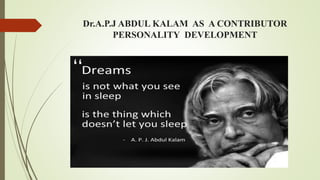
Dr.A.P.J ABDUL KALAM AS A CONTRIBUTOR 
PERSONALITY DEVELOPMENT
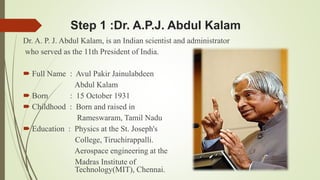
Step 1 :Dr. A.P.J. Abdul Kalam 
Dr. A. P. J. Abdul Kalam, is an Indian scientist and administrator 
who served as the 11th President of India. 
 Full Name : Avul Pakir Jainulabdeen 
Abdul Kalam 
 Born : 15 October 1931 
 Childhood : Born and raised in 
Rameswaram, Tamil Nadu 
 Education : Physics at the St. Joseph's 
College, Tiruchirappalli. 
Aerospace engineering at the 
Madras Institute of 
Technology(MIT), Chennai.
Step 2 : Career 
 Before his term as President, he worked as an aerospace 
engineer with Defense Research and Development 
Organization (DRDO) and Indian Space Research 
Organization (ISRO). 
 Kalam is popularly known as the Missile Man of India for his 
work on the development of ballistic missile and launch 
vehicle technology. 
 He played a pivotal organizational, technical and political role 
in India's Pokhran-II nuclear tests in 1998. 
 Some scientific experts have however called Kalam a man with 
no authority over nuclear physics but who just carried on the 
works of Homi J. Bhabha and Vikram Sarabhai.
Step 3 :Present Work 
 He is currently ….. 
A visiting professor at Indian Institute of Management 
Ahmedabad and Indian Institute of Management Indore. 
A Chancellor of the Indian Institute of Space Science and 
Technology Thiruvananthapuram. 
A professor of Aerospace Engineering at Anna University 
(Chennai), JSS University (Mysore). 
An adjunct/visiting faculty at many other academic and 
research institutions across India.
Step 4 : Awards and Honour 
 Kalam has received several prestigious awards, including the 
Bharat Ratna (1997), India's highest civilian honor. 
 Padma Bhushan, 1981 
 Padma Vibhushan, 1990 
 Indira Gandhi Award for National Integration, 1997 
Veer Savarkar Award, 1998 
 IEEE Honorary Membership, 2011
Step 5 : Books 
 Developments in Fluid Mechanics and Space Technology by A. P. J. 
Abdul Kalam and Roddam Narasimha; Indian Academy of Sciences, 
1988. 
 India 2020: A Vision for the New Millennium by A. P. J Abdul 
Kalam, Y. S. Rajan; New York, 1998. 
Wings of Fire: An Autobiography by A. P. J Abdul Kalam, Arun 
Tiwari; Universities Press, 1999. 
 Ignited Minds: Unleashing the Power Within India by A. P. J. Abdul 
Kalam; Viking, 2002. 
 The Luminous Sparks by A. P. J. Abdul Kalam; Punya Publishing 
Pvt Ltd, 2004. 
 Mission India by A. P. J. Abdul Kalam, Paintings by Manav Gupta; 
Penguin Books, 2005. 
 Inspiring Thoughts by A. P. J. Abdul Kalam; Rajpal & Sons, 2007.
Step 6 : Interesting Facts 
 Kalam advocated plans to develop India into a developed 
nation by 2020 in his book India 2020. Books authored by him 
have received considerable demands in South Korea for the 
translated versions. 
 Kalam is known for his motivational speeches and interaction 
with the student community in India. He launched his mission 
for the youth of the nation in 2011 called the What Can I Give 
Movement with a central theme to defeat corruption in India. 
 He also has interests in writing Tamil poetry and in playing 
veenai, a South Indian string instrument.
Conclusion 
 
I conclude about Dr.a.p.j Abdul kalam’s success vision. He 
always believe that for the success first show the dream & 
then take solid action for that direction. No think about the 
result, But always give your 100% effort to your dream. It 
will be always help you to achieve new heights of 
records…..
Thank you

Cpdp

  • 1.
    Government Engineering College,Bhavnagar Contributor Personality Development Program 2014 Prepared By : Sonali Kakadiya En. No. : 110210116004 Branch : Information Technology Semester : 7th
  • 2.
    Project Goal “To learn about contributor vision of his success or role model.”
  • 3.
    Dr.A.P.J ABDUL KALAMAS A CONTRIBUTOR PERSONALITY DEVELOPMENT
  • 4.
    Step 1 :Dr.A.P.J. Abdul Kalam Dr. A. P. J. Abdul Kalam, is an Indian scientist and administrator who served as the 11th President of India.  Full Name : Avul Pakir Jainulabdeen Abdul Kalam  Born : 15 October 1931  Childhood : Born and raised in Rameswaram, Tamil Nadu  Education : Physics at the St. Joseph's College, Tiruchirappalli. Aerospace engineering at the Madras Institute of Technology(MIT), Chennai.
  • 5.
    Step 2 :Career  Before his term as President, he worked as an aerospace engineer with Defense Research and Development Organization (DRDO) and Indian Space Research Organization (ISRO).  Kalam is popularly known as the Missile Man of India for his work on the development of ballistic missile and launch vehicle technology.  He played a pivotal organizational, technical and political role in India's Pokhran-II nuclear tests in 1998.  Some scientific experts have however called Kalam a man with no authority over nuclear physics but who just carried on the works of Homi J. Bhabha and Vikram Sarabhai.
  • 6.
    Step 3 :PresentWork  He is currently ….. A visiting professor at Indian Institute of Management Ahmedabad and Indian Institute of Management Indore. A Chancellor of the Indian Institute of Space Science and Technology Thiruvananthapuram. A professor of Aerospace Engineering at Anna University (Chennai), JSS University (Mysore). An adjunct/visiting faculty at many other academic and research institutions across India.
  • 7.
    Step 4 :Awards and Honour  Kalam has received several prestigious awards, including the Bharat Ratna (1997), India's highest civilian honor.  Padma Bhushan, 1981  Padma Vibhushan, 1990  Indira Gandhi Award for National Integration, 1997 Veer Savarkar Award, 1998  IEEE Honorary Membership, 2011
  • 8.
    Step 5 :Books  Developments in Fluid Mechanics and Space Technology by A. P. J. Abdul Kalam and Roddam Narasimha; Indian Academy of Sciences, 1988.  India 2020: A Vision for the New Millennium by A. P. J Abdul Kalam, Y. S. Rajan; New York, 1998. Wings of Fire: An Autobiography by A. P. J Abdul Kalam, Arun Tiwari; Universities Press, 1999.  Ignited Minds: Unleashing the Power Within India by A. P. J. Abdul Kalam; Viking, 2002.  The Luminous Sparks by A. P. J. Abdul Kalam; Punya Publishing Pvt Ltd, 2004.  Mission India by A. P. J. Abdul Kalam, Paintings by Manav Gupta; Penguin Books, 2005.  Inspiring Thoughts by A. P. J. Abdul Kalam; Rajpal & Sons, 2007.
  • 9.
    Step 6 :Interesting Facts  Kalam advocated plans to develop India into a developed nation by 2020 in his book India 2020. Books authored by him have received considerable demands in South Korea for the translated versions.  Kalam is known for his motivational speeches and interaction with the student community in India. He launched his mission for the youth of the nation in 2011 called the What Can I Give Movement with a central theme to defeat corruption in India.  He also has interests in writing Tamil poetry and in playing veenai, a South Indian string instrument.
  • 10.
    Conclusion  Iconclude about Dr.a.p.j Abdul kalam’s success vision. He always believe that for the success first show the dream & then take solid action for that direction. No think about the result, But always give your 100% effort to your dream. It will be always help you to achieve new heights of records…..
  • 12.