Journal of Machine Learning Research 1 (2000) x-xx Submitted 4/00; Published 10/00 
Lasso Screening Rules via Dual Polytope Projection 
Jie Wang jie.wang.ustc@asu.edu 
Peter Wonka Peter.Wonka@asu.edu 
Jieping Ye jieping.ye@asu.edu 
Department of Computer Science and Engineering 
Arizona State University 
Tempe, AZ 85287-8809, USA 
Editor: 
Abstract 
Lasso is a widely used regression technique to
nd sparse representations. When the di-mension 
of the feature space and the number of samples are extremely large, solving the 
Lasso problem remains challenging. To improve the eciency of solving large-scale Las-so 
problems, El Ghaoui and his colleagues have proposed the SAFE rules which are able 
to quickly identify the inactive predictors, i.e., predictors that have 0 components in the 
solution vector. Then, the inactive predictors or features can be removed from the op-timization 
problem to reduce its scale. By transforming the standard Lasso to its dual 
form, it can be shown that the inactive predictors include the set of inactive constraints 
on the optimal dual solution. In this paper, we propose an ecient and eective screening 
rule via Dual Polytope Projections (DPP), which is mainly based on the uniqueness and 
nonexpansiveness of the optimal dual solution due to the fact that the feasible set in the 
dual space is a convex and closed polytope. Moreover, we show that our screening rule 
can be extended to identify inactive groups in group Lasso. To the best of our knowledge, 
there is currently no exact screening rule for group Lasso. We have evaluated our screening 
rule using synthetic and real data sets. Results show that our rule is more eective in 
identifying inactive predictors than existing state-of-the-art screening rules for Lasso. 
Keywords: Lasso, Safe Screening, Sparse Regularization, Polytope Projection, Dual 
Formulation 
1. Introduction 
Data with various structures and scales comes from almost every aspect of daily life. To 
eectively extract patterns in the data and build interpretable models with high prediction 
accuracy is always desirable. One popular technique to identify important explanatory 
features is by sparse regularization. For instance, consider the widely used `1-regularized 
least squares regression problem known as Lasso (Tibshirani, 1996). The most appealing 
property of Lasso is the sparsity of the solutions, which is equivalent to feature selection. 
Suppose we have N observations and p features. Let y denote the N dimensional response 
vector and X = [x1; x2; : : : ; xp] be the N p feature matrix. Let   0 be the regularization 
parameter. The Lasso problem is formulated as the following optimization problem: 
inf
2Rp 
1 
2 
ky  X
k2 
2 + k
k1: (1) 

c 2000 Jie Wang, Peter Wonka and Jieping Ye.
Wang, Wonka and Ye 
Lasso has achieved great success in a wide range of applications (Chen et al., 2001; Candes, 
2006; Zhao and Yu, 2006; Bruckstein et al., 2009; Wright et al., 2010) and in recent years 
many algorithms have been developed to eciently solve the Lasso problem (Efron et al., 
2004; Kim et al., 2007; Park and Hastie, 2007; Donoho and Tsaig, 2008; Friedman et al., 
2007; Becker et al., 2010; Friedman et al., 2010). However, when the dimension of feature 
space and the number of samples are very large, solving the Lasso problem remains chal-lenging 
because we may not even be able to load the data matrix into main memory. The 
idea of screening has been shown very promising in solving Lasso for large-scale problems. 
Essentially, screening aims to quickly identify the inactive features that have 0 components 
in the solution and then remove them from the optimization. Therefore, we can work on a 
reduced feature matrix to solve the Lasso problem, which may lead to substantial savings 
in computational cost and memory usage. 
Existing screening methods for Lasso can be roughly divided into two categories: the 
Heuristic Screening Methods and the Safe Screening Methods. As the name indicated, 
the heuristic screening methods can not guarantee that the discarded features have zero 
coecients in the solution vector. In other words, they may mistakenly discard the active 
features which have nonzero coecients in the sparse representations. Well-known heuristic 
screening methods for Lasso include SIS (Fan and Lv, 2008) and strong rules (Tibshirani 
et al., 2012). SIS is based on the associations between features and the prediction task, 
but not from an optimization point of view. Strong rules rely on the assumption that the 
absolute values of the inner products between features and the residue are nonexpansive 
(Bauschke and Combettes, 2011) with respect to the parameter values. Notice that, in 
real applications, this assumption is not always true. In order to ensure the correctness of 
the solutions, strong rules check the KKT conditions for violations. In case of violations, 
they weaken the screened set and repeat this process. In contrast to the heuristic screening 
methods, the safe screening methods for Lasso can guarantee that the discarded features 
are absent from the resulting sparse models. Existing safe screening methods for Lasso 
includes SAFE (El Ghaoui et al., 2012) and DOME (Xiang et al., 2011; Xiang and Ramadge, 
2012), which are based on an estimation of the dual optimal solution. The key challenge 
of searching for eective safe screening rules is how to accurately estimate the dual optimal 
solution. The more accurate the estimation is, the more eective the resulting screening 
rule is in discarding the inactive features. Moreover, Xiang et al. (2011) have shown that 
the SAFE rule for Lasso can be read as a special case of their testing rules. 
In this paper, we develop novel ecient and eective screening rules for the Lasso prob-lem; 
our screening rules are safe in the sense that no active features will be discarded. As 
the name indicated (DPP), the proposed approaches heavily rely on the geometric proper-ties 
of the Lasso problem. Indeed, the dual problem of problem (1) can be formulated as 
a projection problem. More speci
cally, the dual optimal solution of the Lasso problem is 
the projection of the scaled response vector onto a nonempty closed and convex polytope 
(the feasible set of the dual problem). This nice property provides us many elegant ap-proaches 
to accurately estimate the dual optimal solutions, e.g., nonexpansiveness,
rmly 
nonexpansiveness (Bauschke and Combettes, 2011). In fact, the estimation of the dual 
optimal solution in DPP is a direct application of the nonexpansiveness of the projection 
operators. Moreover, by further exploiting the properties of the projection operators, we 
can signi
cantly improve the estimation of the dual optimal solution. Based on this esti- 
2
Lasso Screening Rules via Dual Polytope Projection 
mation, we develop the so called enhanced DPP (EDPP) rules which are able to detect far 
more inactive features than DPP. Therefore, the speedup gained by EDPP is much higher 
than the one by DPP. 
In real applications, the optimal parameter value of  is generally unknown and needs 
to be estimated. To determine an appropriate value of , commonly used approaches such 
as cross validation and stability selection involve solving the Lasso problems over a grid of 
tuning parameters 1  2  : : :  K. Thus, the process can be very time consuming. 
To address this challenge, we develop the sequential version of the DPP families. Brie
y 
speaking, for the Lasso problem, suppose we are given the solution
(k1) at k1. We 
then apply the screening rules to identify the inactive features of problem (1) at k by 
making use of
(k1). The idea of the sequential screening rules is proposed by El Ghaoui 
et al. (2012) and Tibshirani et al. (2012) and has been shown to be very eective for the 
aforementioned scenario. In Tibshirani et al. (2012), the authors demonstrate that the 
sequential strong rules are very eective in discarding inactive features especially for very 
small parameter values and achieve the state-of-the-art performance. However, in contrast 
to the recursive SAFE (the sequential version of SAFE rules) and the sequential version 
of DPP rules, it is worthwhile to mention that the sequential strong rules may mistakenly 
discard active features because they are heuristic methods. Moreover, it is worthwhile to 
mention that, for the existing screening rules including SAFE and strong rules, the basic 
versions are usually special cases of their sequential versions, and the same applies to our 
DPP and EDPP rules. For the DOME rule (Xiang et al., 2011; Xiang and Ramadge, 2012), 
it is unclear whether its sequential version exists. 
The rest of this paper is organized as follows. We present the family of DPP screening 
rules, i.e., DPP and EDPP, in detail for the Lasso problem in Section 2. Section 3 extends 
the idea of DPP screening rules to identify inactive groups in group Lasso (Yuan and 
Lin, 2006). We evaluate our screening rules on synthetic and real data sets from many 
dierent applications. In Section 4, the experimental results demonstrate that our rules are 
more eective in discarding inactive features than existing state-of-the-art screening rules. 
We show that the eciency of the solver can be improved by several orders of magnitude 
with the enhanced DPP rules, especially for the high-dimensional data sets (notice that, 
the screening methods can be integrated with any existing solvers for the Lasso problem). 
Some concluding remarks are given in Section 5. 
2. Screening Rules for Lasso via Dual Polytope Projections 
In this section, we present the details of the proposed DPP and EDPP screening rules for 
the Lasso problem. We
rst review some basics of the dual problem of Lasso including its 
geometric properties in Section 2.1; we also brie
y discuss some basic guidelines for devel-oping 
safe screening rules for Lasso. Based on the geometric properties discussed in Section 
2.1, we then develop the basic DPP screening rule in Section 2.2. As a straightforward ex-tension 
in dealing with the model selection problems, we also develop the sequential version 
of DPP rules. In Section 2.3, by exploiting more geometric properties of the dual problem 
of Lasso, we further improve the DPP rules by developing the so called enhanced DPP 
(EDPP) rules. The EDPP screening rules signi
cantly outperform DPP rules in identifying 
the inactive features for the Lasso problem. 
3
Wang, Wonka and Ye 
2.1 Basics 
Dierent from Xiang et al. (2011); Xiang and Ramadge (2012), we do not assume y and all 
xi have unit length.The dual problem of problem (1) takes the form of (to make the paper 
self-contained, we provide the detailed derivation of the dual form in the appendix): 
sup 
 
 
1 
2 
kyk22 
 
2 
2 


y 


2 
2 
: jxTi 
j  1; i = 1; 2; : : : ; p 
 
; (2) 
where  is the dual variable. For notational convenience, let the optimal solution of problem 
(2) be () [recall that the optimal solution of problem (1) with parameter  is denoted 
by
()]. Then, the KKT conditions are given by: 
y = X
() + (); (3) 
xTi 
() 2 
( 
sign([
()]i); if [
()]i6= 0; 
[1; 1]; if [
()]i = 0; 
i = 1; : : : ; p; (4) 
where []k denotes the kth component. In view of the KKT condition in (4), we have 
jxTi 
(())T j  1 ) [
()]i = 0 ) xi is an inactive feature. (R1) 
In other words, we can potentially make use of (R1) to identify the inactive features for the 
Lasso problem. However, since () is generally unknown, we can not directly apply (R1) 
to identify the inactive features. Inspired by the SAFE rules (El Ghaoui et al., 2012), we 
can
rst estimate a region  which contains (00). Then, (R1) can be relaxed as follows: 
sup 
2 
jxTi 
j  1 ) [
()]i = 0 ) xi is an inactive feature. (R1') 
Clearly, as long as we can
nd a region  which contains (), (R1') will lead to a screening 
rule to detect the inactive features for the Lasso problem. Moreover, in view of (R1) and 
(R1'), we can see that the smaller the region  is, the more accurate the estimation of () 
is. As a result, more inactive features can be identi
ed by the resulting screening rules. 
Geometric Interpretations of the Dual Problem By a closer look at the dual 
problem (2), we can observe that the dual optimal solution is the feasible point which is 
closest to y=. For notational convenience, let the feasible set of problem (2) be F. Clearly, 
F is the intersection of 2p closed half-spaces, and thus a closed and convex polytope. (Notice 
that, F is also nonempty since 0 2 F.) In other words, () is the projection of y= onto 
the polytope F. Mathematically, for an arbitrary vector w and a convex set C in a Hilbert 
space H, let us de
ne the projection operator as 
PC(w) = argmin 
u2C 
ku  wk2: (5) 
Then, the dual optimal solution () can be expressed by 
() = PF (y=) = argmin 
2F 


y 


2 
: (6) 
4
Lasso Screening Rules via Dual Polytope Projection 
Indeed, the nice property of problem (2) illustrated by Eq. (6) leads to many interesting 
Ti 
results. For example, it is easy to see that y= would be an interior point of F when  is 
large enough. If this is the case, we immediately have the following assertions: 1) y= is an 
interior point of F implies that none of the constraints of problem (2) would be active on 
y=, i.e., jx(y=()j)  1 for all i = 1; : : : ; p; 2) () is an interior point of F as well since 
() = PF (y=) = y= by Eq. (6) and the fact y= 2 F. Combining the results in 1) and 
2), it is easy to see that jxTi 
()j  1 for all i = 1; : : : ; p. By (R1), we can conclude that
() = 0, under the assumption that  is large enough. 
The above analysis may naturally lead to a question: does there exist a speci
c param-eter 
value max such that the optimal solution of problem (1) is 0 whenever   max? The 
answer is armative. Indeed, let us de
ne 
max = max 
i 
jxTi 
yj: (7) 
It is well known (Tibshirani et al., 2012) that max de
ned by Eq. (7) is the smallest 
parameter such that problem (1) has a trivial solution, i.e.,
() = 0; 8  2 [max;1): (8) 
Combining the results in (8) and Eq. (3), we immediately have 
() = 
y 
 
; 8  2 [max;1): (9) 
Therefore, through out the rest of this paper, we will focus on the cases with  2 (0; max). 
In the subsequent sections, we will follow (R1') to develop our screening rules. More 
speci
cally, the derivation of the proposed screening rules can be divided into the following 
three steps: 
Step 1. We
rst estimate a region  which contains the dual optimal solution (). 
Step 2. We solve the maximization problem in (R1'), i.e., sup2 jxTi 
j. 
Step 3. By plugging in the upper bound we
nd in Step 2, it is straightforward to develop 
the screening rule based on (R1'). 
The geometric property of the dual problem illustrated by Eq. (6) serves as a fundamentally 
important role in developing our DPP and EDPP screening rules. 
2.2 Fundamental Screening Rules via Dual Polytope Projections (DPP) 
In this Section, we propose the so called DPP screening rules for discarding the inactive 
features for Lasso. As the name indicates, the idea of DPP heavily relies on the properties 
of projection operators, e.g., the nonexpansiveness (Bertsekas, 2003). We will follow the 
three steps stated in Section 2.1 to develop the DPP screening rules. 
First, we need to
nd a region  which contains the dual optimal solution (). Indeed, 
the result in (9) provides us an important clue. That is, we may be able to estimate a possible 
region for () in terms of a known (0) with   0. Notice that, we can always set 
5
Wang, Wonka and Ye 
0 = max and make use of the fact that (max) = y=max implied by (9). Another 
key ingredient comes from Eq. (6), i.e., the dual optimal solution () is the projection 
of y= onto the feasible set F, which is nonempty closed and convex. A nice property of 
the projection operators de
ned in a Hilbert space with respect to a nonempty closed and 
convex set is the so called nonexpansiveness. For convenience, we restate the de
nition of 
nonexpansiveness in the following theorem. 
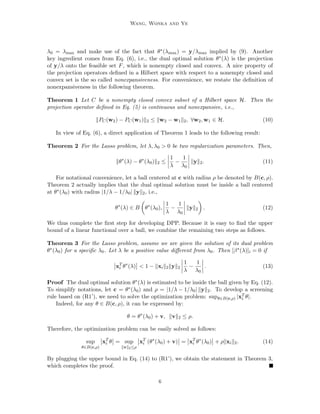
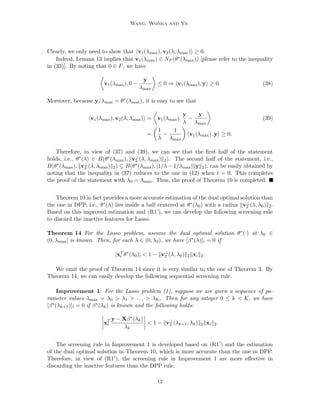
Theorem 1 Let C be a nonempty closed convex subset of a Hilbert space H. Then the 
projection operator de

Lasso Screening Rules via Dual Polytope Projection

  • 1.
    Journal of MachineLearning Research 1 (2000) x-xx Submitted 4/00; Published 10/00 Lasso Screening Rules via Dual Polytope Projection Jie Wang jie.wang.ustc@asu.edu Peter Wonka Peter.Wonka@asu.edu Jieping Ye jieping.ye@asu.edu Department of Computer Science and Engineering Arizona State University Tempe, AZ 85287-8809, USA Editor: Abstract Lasso is a widely used regression technique to
  • 2.
    nd sparse representations.When the di-mension of the feature space and the number of samples are extremely large, solving the Lasso problem remains challenging. To improve the eciency of solving large-scale Las-so problems, El Ghaoui and his colleagues have proposed the SAFE rules which are able to quickly identify the inactive predictors, i.e., predictors that have 0 components in the solution vector. Then, the inactive predictors or features can be removed from the op-timization problem to reduce its scale. By transforming the standard Lasso to its dual form, it can be shown that the inactive predictors include the set of inactive constraints on the optimal dual solution. In this paper, we propose an ecient and eective screening rule via Dual Polytope Projections (DPP), which is mainly based on the uniqueness and nonexpansiveness of the optimal dual solution due to the fact that the feasible set in the dual space is a convex and closed polytope. Moreover, we show that our screening rule can be extended to identify inactive groups in group Lasso. To the best of our knowledge, there is currently no exact screening rule for group Lasso. We have evaluated our screening rule using synthetic and real data sets. Results show that our rule is more eective in identifying inactive predictors than existing state-of-the-art screening rules for Lasso. Keywords: Lasso, Safe Screening, Sparse Regularization, Polytope Projection, Dual Formulation 1. Introduction Data with various structures and scales comes from almost every aspect of daily life. To eectively extract patterns in the data and build interpretable models with high prediction accuracy is always desirable. One popular technique to identify important explanatory features is by sparse regularization. For instance, consider the widely used `1-regularized least squares regression problem known as Lasso (Tibshirani, 1996). The most appealing property of Lasso is the sparsity of the solutions, which is equivalent to feature selection. Suppose we have N observations and p features. Let y denote the N dimensional response vector and X = [x1; x2; : : : ; xp] be the N p feature matrix. Let 0 be the regularization parameter. The Lasso problem is formulated as the following optimization problem: inf
  • 3.
    2Rp 1 2 ky X
  • 4.
  • 5.
    k1: (1) c2000 Jie Wang, Peter Wonka and Jieping Ye.
  • 6.
    Wang, Wonka andYe Lasso has achieved great success in a wide range of applications (Chen et al., 2001; Candes, 2006; Zhao and Yu, 2006; Bruckstein et al., 2009; Wright et al., 2010) and in recent years many algorithms have been developed to eciently solve the Lasso problem (Efron et al., 2004; Kim et al., 2007; Park and Hastie, 2007; Donoho and Tsaig, 2008; Friedman et al., 2007; Becker et al., 2010; Friedman et al., 2010). However, when the dimension of feature space and the number of samples are very large, solving the Lasso problem remains chal-lenging because we may not even be able to load the data matrix into main memory. The idea of screening has been shown very promising in solving Lasso for large-scale problems. Essentially, screening aims to quickly identify the inactive features that have 0 components in the solution and then remove them from the optimization. Therefore, we can work on a reduced feature matrix to solve the Lasso problem, which may lead to substantial savings in computational cost and memory usage. Existing screening methods for Lasso can be roughly divided into two categories: the Heuristic Screening Methods and the Safe Screening Methods. As the name indicated, the heuristic screening methods can not guarantee that the discarded features have zero coecients in the solution vector. In other words, they may mistakenly discard the active features which have nonzero coecients in the sparse representations. Well-known heuristic screening methods for Lasso include SIS (Fan and Lv, 2008) and strong rules (Tibshirani et al., 2012). SIS is based on the associations between features and the prediction task, but not from an optimization point of view. Strong rules rely on the assumption that the absolute values of the inner products between features and the residue are nonexpansive (Bauschke and Combettes, 2011) with respect to the parameter values. Notice that, in real applications, this assumption is not always true. In order to ensure the correctness of the solutions, strong rules check the KKT conditions for violations. In case of violations, they weaken the screened set and repeat this process. In contrast to the heuristic screening methods, the safe screening methods for Lasso can guarantee that the discarded features are absent from the resulting sparse models. Existing safe screening methods for Lasso includes SAFE (El Ghaoui et al., 2012) and DOME (Xiang et al., 2011; Xiang and Ramadge, 2012), which are based on an estimation of the dual optimal solution. The key challenge of searching for eective safe screening rules is how to accurately estimate the dual optimal solution. The more accurate the estimation is, the more eective the resulting screening rule is in discarding the inactive features. Moreover, Xiang et al. (2011) have shown that the SAFE rule for Lasso can be read as a special case of their testing rules. In this paper, we develop novel ecient and eective screening rules for the Lasso prob-lem; our screening rules are safe in the sense that no active features will be discarded. As the name indicated (DPP), the proposed approaches heavily rely on the geometric proper-ties of the Lasso problem. Indeed, the dual problem of problem (1) can be formulated as a projection problem. More speci
  • 7.
    cally, the dualoptimal solution of the Lasso problem is the projection of the scaled response vector onto a nonempty closed and convex polytope (the feasible set of the dual problem). This nice property provides us many elegant ap-proaches to accurately estimate the dual optimal solutions, e.g., nonexpansiveness,
  • 8.
    rmly nonexpansiveness (Bauschkeand Combettes, 2011). In fact, the estimation of the dual optimal solution in DPP is a direct application of the nonexpansiveness of the projection operators. Moreover, by further exploiting the properties of the projection operators, we can signi
  • 9.
    cantly improve theestimation of the dual optimal solution. Based on this esti- 2
  • 10.
    Lasso Screening Rulesvia Dual Polytope Projection mation, we develop the so called enhanced DPP (EDPP) rules which are able to detect far more inactive features than DPP. Therefore, the speedup gained by EDPP is much higher than the one by DPP. In real applications, the optimal parameter value of is generally unknown and needs to be estimated. To determine an appropriate value of , commonly used approaches such as cross validation and stability selection involve solving the Lasso problems over a grid of tuning parameters 1 2 : : : K. Thus, the process can be very time consuming. To address this challenge, we develop the sequential version of the DPP families. Brie y speaking, for the Lasso problem, suppose we are given the solution
  • 11.
    (k1) at k1.We then apply the screening rules to identify the inactive features of problem (1) at k by making use of
  • 12.
    (k1). The ideaof the sequential screening rules is proposed by El Ghaoui et al. (2012) and Tibshirani et al. (2012) and has been shown to be very eective for the aforementioned scenario. In Tibshirani et al. (2012), the authors demonstrate that the sequential strong rules are very eective in discarding inactive features especially for very small parameter values and achieve the state-of-the-art performance. However, in contrast to the recursive SAFE (the sequential version of SAFE rules) and the sequential version of DPP rules, it is worthwhile to mention that the sequential strong rules may mistakenly discard active features because they are heuristic methods. Moreover, it is worthwhile to mention that, for the existing screening rules including SAFE and strong rules, the basic versions are usually special cases of their sequential versions, and the same applies to our DPP and EDPP rules. For the DOME rule (Xiang et al., 2011; Xiang and Ramadge, 2012), it is unclear whether its sequential version exists. The rest of this paper is organized as follows. We present the family of DPP screening rules, i.e., DPP and EDPP, in detail for the Lasso problem in Section 2. Section 3 extends the idea of DPP screening rules to identify inactive groups in group Lasso (Yuan and Lin, 2006). We evaluate our screening rules on synthetic and real data sets from many dierent applications. In Section 4, the experimental results demonstrate that our rules are more eective in discarding inactive features than existing state-of-the-art screening rules. We show that the eciency of the solver can be improved by several orders of magnitude with the enhanced DPP rules, especially for the high-dimensional data sets (notice that, the screening methods can be integrated with any existing solvers for the Lasso problem). Some concluding remarks are given in Section 5. 2. Screening Rules for Lasso via Dual Polytope Projections In this section, we present the details of the proposed DPP and EDPP screening rules for the Lasso problem. We
  • 13.
    rst review somebasics of the dual problem of Lasso including its geometric properties in Section 2.1; we also brie y discuss some basic guidelines for devel-oping safe screening rules for Lasso. Based on the geometric properties discussed in Section 2.1, we then develop the basic DPP screening rule in Section 2.2. As a straightforward ex-tension in dealing with the model selection problems, we also develop the sequential version of DPP rules. In Section 2.3, by exploiting more geometric properties of the dual problem of Lasso, we further improve the DPP rules by developing the so called enhanced DPP (EDPP) rules. The EDPP screening rules signi
  • 14.
    cantly outperform DPPrules in identifying the inactive features for the Lasso problem. 3
  • 15.
    Wang, Wonka andYe 2.1 Basics Dierent from Xiang et al. (2011); Xiang and Ramadge (2012), we do not assume y and all xi have unit length.The dual problem of problem (1) takes the form of (to make the paper self-contained, we provide the detailed derivation of the dual form in the appendix): sup 1 2 kyk22 2 2 y 2 2 : jxTi j 1; i = 1; 2; : : : ; p ; (2) where is the dual variable. For notational convenience, let the optimal solution of problem (2) be () [recall that the optimal solution of problem (1) with parameter is denoted by
  • 16.
    ()]. Then, theKKT conditions are given by: y = X
  • 17.
    () + ();(3) xTi () 2 ( sign([
  • 18.
  • 19.
    ()]i6= 0; [1;1]; if [
  • 20.
    ()]i = 0; i = 1; : : : ; p; (4) where []k denotes the kth component. In view of the KKT condition in (4), we have jxTi (())T j 1 ) [
  • 21.
    ()]i = 0) xi is an inactive feature. (R1) In other words, we can potentially make use of (R1) to identify the inactive features for the Lasso problem. However, since () is generally unknown, we can not directly apply (R1) to identify the inactive features. Inspired by the SAFE rules (El Ghaoui et al., 2012), we can
  • 22.
    rst estimate aregion which contains (00). Then, (R1) can be relaxed as follows: sup 2 jxTi j 1 ) [
  • 23.
    ()]i = 0) xi is an inactive feature. (R1') Clearly, as long as we can
  • 24.
    nd a region which contains (), (R1') will lead to a screening rule to detect the inactive features for the Lasso problem. Moreover, in view of (R1) and (R1'), we can see that the smaller the region is, the more accurate the estimation of () is. As a result, more inactive features can be identi
  • 25.
    ed by theresulting screening rules. Geometric Interpretations of the Dual Problem By a closer look at the dual problem (2), we can observe that the dual optimal solution is the feasible point which is closest to y=. For notational convenience, let the feasible set of problem (2) be F. Clearly, F is the intersection of 2p closed half-spaces, and thus a closed and convex polytope. (Notice that, F is also nonempty since 0 2 F.) In other words, () is the projection of y= onto the polytope F. Mathematically, for an arbitrary vector w and a convex set C in a Hilbert space H, let us de
  • 26.
    ne the projectionoperator as PC(w) = argmin u2C ku wk2: (5) Then, the dual optimal solution () can be expressed by () = PF (y=) = argmin 2F y 2 : (6) 4
  • 27.
    Lasso Screening Rulesvia Dual Polytope Projection Indeed, the nice property of problem (2) illustrated by Eq. (6) leads to many interesting Ti results. For example, it is easy to see that y= would be an interior point of F when is large enough. If this is the case, we immediately have the following assertions: 1) y= is an interior point of F implies that none of the constraints of problem (2) would be active on y=, i.e., jx(y=()j) 1 for all i = 1; : : : ; p; 2) () is an interior point of F as well since () = PF (y=) = y= by Eq. (6) and the fact y= 2 F. Combining the results in 1) and 2), it is easy to see that jxTi ()j 1 for all i = 1; : : : ; p. By (R1), we can conclude that
  • 28.
    () = 0,under the assumption that is large enough. The above analysis may naturally lead to a question: does there exist a speci
  • 29.
    c param-eter valuemax such that the optimal solution of problem (1) is 0 whenever max? The answer is armative. Indeed, let us de
  • 30.
    ne max =max i jxTi yj: (7) It is well known (Tibshirani et al., 2012) that max de
  • 31.
    ned by Eq.(7) is the smallest parameter such that problem (1) has a trivial solution, i.e.,
  • 32.
    () = 0;8 2 [max;1): (8) Combining the results in (8) and Eq. (3), we immediately have () = y ; 8 2 [max;1): (9) Therefore, through out the rest of this paper, we will focus on the cases with 2 (0; max). In the subsequent sections, we will follow (R1') to develop our screening rules. More speci
  • 33.
    cally, the derivationof the proposed screening rules can be divided into the following three steps: Step 1. We
  • 34.
    rst estimate aregion which contains the dual optimal solution (). Step 2. We solve the maximization problem in (R1'), i.e., sup2 jxTi j. Step 3. By plugging in the upper bound we
  • 35.
    nd in Step2, it is straightforward to develop the screening rule based on (R1'). The geometric property of the dual problem illustrated by Eq. (6) serves as a fundamentally important role in developing our DPP and EDPP screening rules. 2.2 Fundamental Screening Rules via Dual Polytope Projections (DPP) In this Section, we propose the so called DPP screening rules for discarding the inactive features for Lasso. As the name indicates, the idea of DPP heavily relies on the properties of projection operators, e.g., the nonexpansiveness (Bertsekas, 2003). We will follow the three steps stated in Section 2.1 to develop the DPP screening rules. First, we need to
  • 36.
    nd a region which contains the dual optimal solution (). Indeed, the result in (9) provides us an important clue. That is, we may be able to estimate a possible region for () in terms of a known (0) with 0. Notice that, we can always set 5
  • 37.
    Wang, Wonka andYe 0 = max and make use of the fact that (max) = y=max implied by (9). Another key ingredient comes from Eq. (6), i.e., the dual optimal solution () is the projection of y= onto the feasible set F, which is nonempty closed and convex. A nice property of the projection operators de
  • 38.
    ned in aHilbert space with respect to a nonempty closed and convex set is the so called nonexpansiveness. For convenience, we restate the de
  • 39.
    nition of nonexpansivenessin the following theorem. Theorem 1 Let C be a nonempty closed convex subset of a Hilbert space H. Then the projection operator de