1
• To explain Down’s syndrome
• To explain Klinefelter’s syndrome
2
• Disorders related with human chromosomal
abnormalities.
• Structural abnormalities
• Numerical abnormalities
Euploidy
 Aneuploidy: Trisomy
Autosomal :
Down’s syndrome
Sex chromosomal:
Klinefelter’s syndrome
3
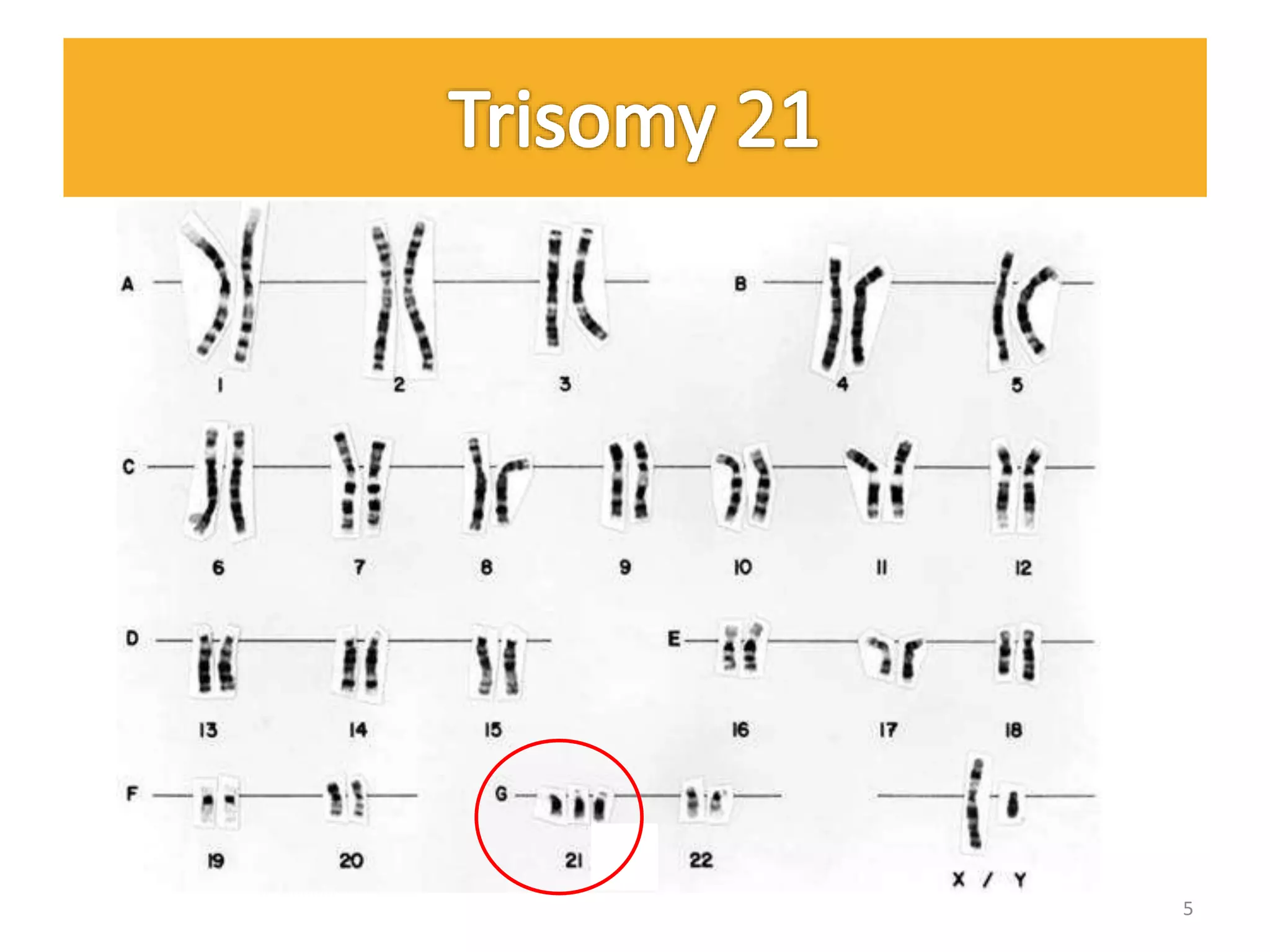
 95% -trisomy 21= 47 chromosome
Meiotic non disjunction of 21 chromosome in ovum
Frequency: is related to maternal age
• 1/1550(in <20 years female)
• 1/25(in >45 years female)
• overall 1/750 new borns
 4%-Robertsonian translocation
 1%-Mitotic non disjunction,Mosaics:46 and 47
mixture
4
5
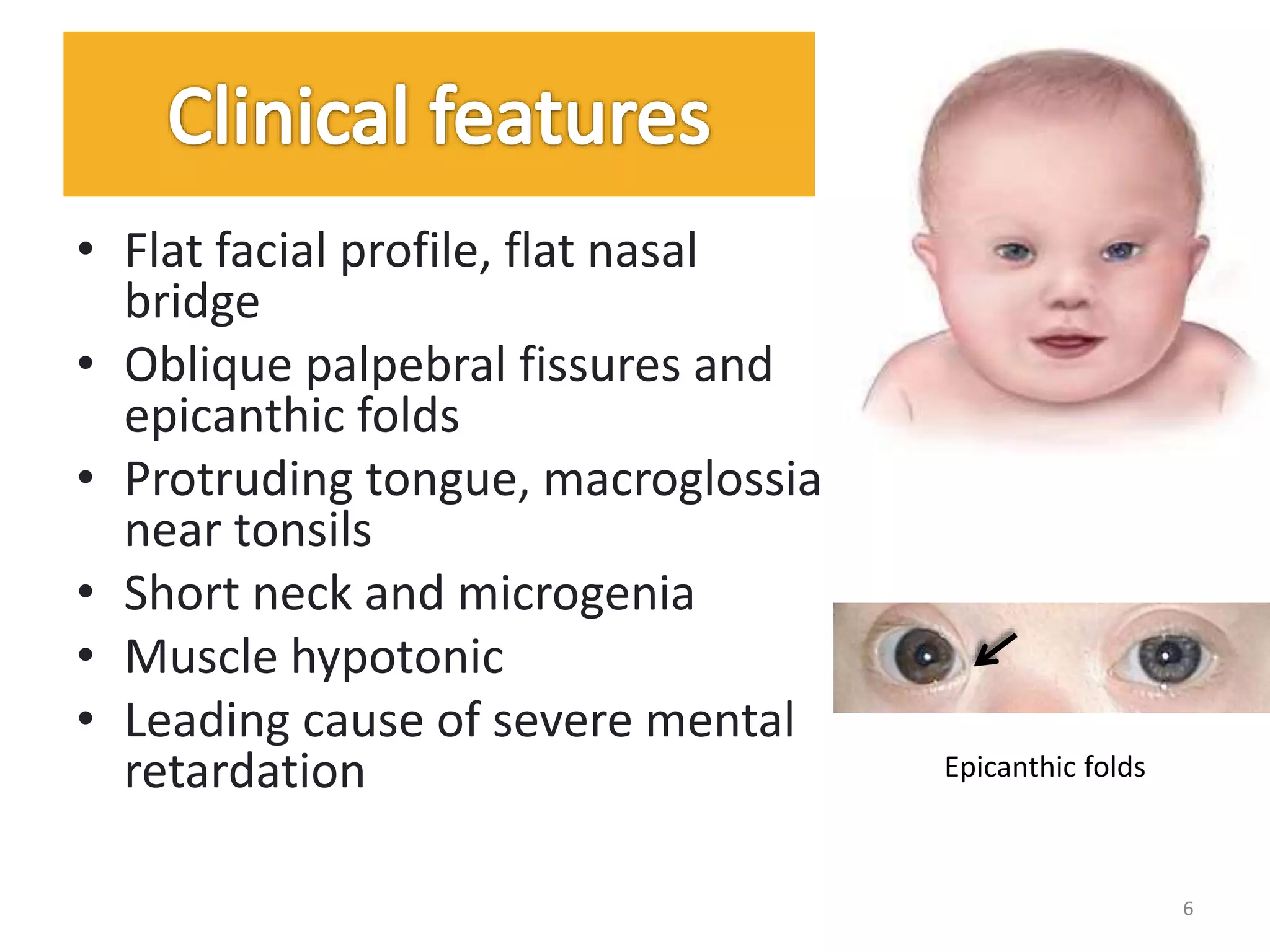
• Flat facial profile, flat nasal
bridge
• Oblique palpebral fissures and
epicanthic folds
• Protruding tongue, macroglossia
near tonsils
• Short neck and microgenia
• Muscle hypotonic
• Leading cause of severe mental
retardation Epicanthic folds
6
Epicanthic
folds
Simian
crease
Umbilical
hernia
Predisposition
to leukemia
hypotonia
Gap between first and second toe
Intestinal
stenosis
Congenital
heart disease
Abundant neck skin
Mental retardation
7
• Congenital heart diseases (40%):
– Defects of endocardial cushion
– Atrial/ventricular septal defects
– Ostium primum
– Atrio-ventricular valve malformation
• Acute leukemia(ALL/AML)
• Alzheimer’s disease (in most patient>40 yrs)
• Abnormal immune responses: lung infection and
thyroid autoimmunity
• Hyperextensibility of joint
• Sterile males
8
• Amniocentesis, Chorionic villus sampling,
Percutaneous umbilical blood sampling
• Ultrasound imaging
• With improved medical care-Median age=47
yrs
Ultrasound of fetus with Down
syndrome showing a large
bladder
Enlarged NT and absent nasal
bone in a fetus at 11 weeks
with Down syndrome
9
Male Hypogonadism that occurs when
there are 2 or more X-chromosomes
and 1 or more Y-chromosomes.
10
• Incidence: 1 in 660 male births
• 90% - 47,XXY : meiotic non-disjunction of
germ cells
• 15% mosaics, usually 46,XY/47,XXY
11
• Uneven dosage compensation during X-
inactivation
• Androgen receptor genes with inactivation of
short sensitive CAG repeats and expression of
long CAG repeats Hypogonadism
12
• Hypogonadism and long lower extremities
• Deficient male secondary sexual characters
 Small penis and testis
 Poor beard growth
• Female characters
 Gynaecomastia
 Narrow shoulder, wide hip
 Female type pubic hair pattern
 Absence of facial baldness
13
14
• Mental retardation unusual,IQ level is below
normal
• Increased incidence of type 2 diabetes
• Higher risk of breast cancer(20X)
• Higher risk of extragonadal germ cell tumor
and autoimmune diseases such as SLE
• Prone to osteoporosis and bone fractures
15
• Rarely diagnosed before puberty because
testicular abnormality does not appear before
puberty
• Presence of Barr body
• Increased lower extremities
16
• Testosterone replacement therapy
• Breast tissue removal
• Speech and physical therapy
• Fertility treatment: intra cytoplasmic sperm
injection
17
• Down Syndrome and klinefelters syndrome are
common chromosomal disorders.
• Down syndrome is due to trisomy of chromosome
21.
• Klinefelters syndrome is due to extra X chromosome
in male.
18
• Robin’s Basis of Pathology 9th edition
• Langman’s Medical Embryology 12th edition
19
20

Down’s syndrome and klinefelter's sundrome

  • 1.
  • 2.
    • To explainDown’s syndrome • To explain Klinefelter’s syndrome 2
  • 3.
    • Disorders relatedwith human chromosomal abnormalities. • Structural abnormalities • Numerical abnormalities Euploidy  Aneuploidy: Trisomy Autosomal : Down’s syndrome Sex chromosomal: Klinefelter’s syndrome 3
  • 4.
     95% -trisomy21= 47 chromosome Meiotic non disjunction of 21 chromosome in ovum Frequency: is related to maternal age • 1/1550(in <20 years female) • 1/25(in >45 years female) • overall 1/750 new borns  4%-Robertsonian translocation  1%-Mitotic non disjunction,Mosaics:46 and 47 mixture 4
  • 5.
  • 6.
    • Flat facialprofile, flat nasal bridge • Oblique palpebral fissures and epicanthic folds • Protruding tongue, macroglossia near tonsils • Short neck and microgenia • Muscle hypotonic • Leading cause of severe mental retardation Epicanthic folds 6
  • 7.
    Epicanthic folds Simian crease Umbilical hernia Predisposition to leukemia hypotonia Gap betweenfirst and second toe Intestinal stenosis Congenital heart disease Abundant neck skin Mental retardation 7
  • 8.
    • Congenital heartdiseases (40%): – Defects of endocardial cushion – Atrial/ventricular septal defects – Ostium primum – Atrio-ventricular valve malformation • Acute leukemia(ALL/AML) • Alzheimer’s disease (in most patient>40 yrs) • Abnormal immune responses: lung infection and thyroid autoimmunity • Hyperextensibility of joint • Sterile males 8
  • 9.
    • Amniocentesis, Chorionicvillus sampling, Percutaneous umbilical blood sampling • Ultrasound imaging • With improved medical care-Median age=47 yrs Ultrasound of fetus with Down syndrome showing a large bladder Enlarged NT and absent nasal bone in a fetus at 11 weeks with Down syndrome 9
  • 10.
    Male Hypogonadism thatoccurs when there are 2 or more X-chromosomes and 1 or more Y-chromosomes. 10
  • 11.
    • Incidence: 1in 660 male births • 90% - 47,XXY : meiotic non-disjunction of germ cells • 15% mosaics, usually 46,XY/47,XXY 11
  • 12.
    • Uneven dosagecompensation during X- inactivation • Androgen receptor genes with inactivation of short sensitive CAG repeats and expression of long CAG repeats Hypogonadism 12
  • 13.
    • Hypogonadism andlong lower extremities • Deficient male secondary sexual characters  Small penis and testis  Poor beard growth • Female characters  Gynaecomastia  Narrow shoulder, wide hip  Female type pubic hair pattern  Absence of facial baldness 13
  • 14.
  • 15.
    • Mental retardationunusual,IQ level is below normal • Increased incidence of type 2 diabetes • Higher risk of breast cancer(20X) • Higher risk of extragonadal germ cell tumor and autoimmune diseases such as SLE • Prone to osteoporosis and bone fractures 15
  • 16.
    • Rarely diagnosedbefore puberty because testicular abnormality does not appear before puberty • Presence of Barr body • Increased lower extremities 16
  • 17.
    • Testosterone replacementtherapy • Breast tissue removal • Speech and physical therapy • Fertility treatment: intra cytoplasmic sperm injection 17
  • 18.
    • Down Syndromeand klinefelters syndrome are common chromosomal disorders. • Down syndrome is due to trisomy of chromosome 21. • Klinefelters syndrome is due to extra X chromosome in male. 18
  • 19.
    • Robin’s Basisof Pathology 9th edition • Langman’s Medical Embryology 12th edition 19
  • 20.