AMAL ROSHAN 2 0 1 NIT 3 
CALICUT 
SUBMITTED TO- SUBMITTED BY-MMMMDDDD.... 
YYYYUUUUSSSSUUUUFFFF SSSSIIIIRRRR AAAAMMMMAAAALLLL RRRROOOOSSSSHHHHAAAANNNN 
MMMMAAAAHHHHEEEESSSSHHHH LLLLEEEEPPPPCCCCHHHHAAAA SSSSIIIIRRRR NNNNIIIITTTT CCCCAAAALLLLIIIICCCCUUUUTTTT ((((2222000011111111-11115555)))) 
SSSSEEEERRRRIIIIAAAALLLL NNNNOOOO -- 00008888
DECLARATION 
I HEREBY DECLARE THAT WORK ENTITLED “SUMMER 
TRAINING REPORT”, SUBMITTED TOWARDS COMPLETION 
OF SUMMER TRAINING AFTER 2ND YEAR OF B.TECH 
(ECE) AT NATIONAL INSTITUTE OF TECHNOLOGY (NIT) 
CALICUT , COMPRISES OF MY ORIGINAL WORK PURSUED 
UNDER THE GUIDANCE OF MR. MAHESH LEPCHA. THE 
RESULTS EMBODIED IN THIS REPORT HAVE NOT BEEN 
SUBMITTED TO ANY OTHER INSTITUTE OR UNIVERSITY 
FOR ANY AWARD. 
AMAL ROSHAN NIT CALICUT 
AMAL ROSHAN 
B.TECH(2ND YEAR)
CERTIFICATE 
AMAL ROSHAN NIT CALICUT 
THIS IS TO CERTIFY THAT MR. AMAL ROSHAN, A 
STUDENT OF B.TECH, FROM NATIONAL INSTITUTE OF 
TECHNOLOGY, CALICUT COMPLETED A 4 WEEK 
VOCATIONAL SUMMER TRAINING PROGRAM AT 
DOORDARSHAN PATNA, UNDER MY GUIDANCE AND 
DIRECTION. 
SIGNATURE OF THE GUIDE
ACKNOWLEDGEMENT 
ON THE VERY OUTSET OF THIS REPORT, I WOULD LIKE TO EXTEND MY 
SINCERE & HEARTFELT OBLIGATION TOWARDS ALL THE PERSONAGES 
WHO HAVE HELPED ME IN THIS ENDEAVOR. WITHOUT THEIR ACTIVE 
GUIDANCE, HELP, COOPERATION & ENCOURAGEMENT, I WOULD NOT 
HAVE MADE HEADWAY IN THE PROJECT. 
AMAL ROSHAN NIT CALICUT 
FIRST AND FOREMOST, I WOULD LIKE TO EXPRESS MY SINCERE 
GRATITUDE TO MY PROJECT GUIDE, MR. MAHESH LEPCHA. I WAS 
PRIVILEGED TO EXPERIENCE A SUSTAINED ENTHUSIASTIC AND 
INVOLVED INTEREST FROM HIS SIDE. THIS FUELLED MY ENTHUSIASM. 
I WOULD ALSO LIKE TO THANK MD. YUSUF SIR WHO ALWAYS GUIDED ME 
IN RIGHT DIRECTION. 
THIS WAS A TRULY AMAZING EXPERIENCE WHICH PROVIDED ME LIVE 
EXPERIENCE OF AND WORKING METHODOLOGY OF VARIOUS EQUIPMENTS. 
THANKING YOU. 
AMAL ROSHAN
AMAL ROSHAN NIT CALICUT
CONTENTS 
• DOORDARSHAN HISTORY 
• DOORDARSHAN PATNA 
AMAL ROSHAN NIT CALICUT 
• FUNDAMENTALS OF MONOCHROME AND COLOUR TV 
• COLOUR COMPOSITE VIDEO SIGNAL 
• TV STUDIO 
• TV CAMERA 
• STUDIO LIGHTING 
• MICROPHONE 
• CABLES AND CONNECTORS 
• PRINCIPLES OF VTR 
• VISION MIXING 
• TV TRANSMITTER 
• EARTH STATION 
• SATELLITE COMMUNICATION 
• DTH
DOORDARSHAN HISTORY 
Prasar Bharati is a statutory autonomous body established under the Prasar Bharati Act and 
came into existence on 23.11.1997. It is the Public Service Broadcaster of the country. The 
objectives of public service broadcasting are achieved in terms of Prasar Bharati Act through All 
India Radio and Doordarshan, which earlier were working as media units under the Ministry 
of I&B and since the above said date became constituents of Prasar Bharati 
AMAL ROSHAN NIT CALICUT 
15 September, 1959 was the first day when the transmission of television 
programme begin in India at a make shift studio in the All India Radio building. Pramita 
Puri was the first announcer who started the programme with “shehnai recital' of Ustaad 
Bismillah Khan. The programme was transmitted in a radius of 25 kilometers with a 
small transmitter. From Black & White to becoming color in 1982 to digital telecast in 
2004, the public broadcaster has grown with tune of time. 
National telecasts were introduced in 1982. In the same year, color TV was introduced in the Indi 
an market with the live telecast of the Independence Day speech by then prime minister Indira 
Gandhi on 15 August 1982, followed by the 1982 Asian Games being held in Delhi. Now 
more than 96 percent of the Indian population can receive Doordarshan (DD National) 
programmes through a network of nearly 1400 
terrestrial transmitters and about 46 Doordarshan studios produce TV 
programs today. 
SIGNIFICANT MILESTONES ACHIEVED WERE 
• Launch of international channel -D India (14 March 1995) 
• Formation of Prasar Bharti (Broadcasting Corporation of India) (23 November 1997) 
• Launch of sports channels DD sports (18 March 1999) 
• Launch of enrichment/ culture channel - DD Bharti (26 January 2002) 
• Launch of 24 hours news channel - DD News (3 November 2002) 
• Launch of free to air Direct – To – Home Service DD Direct+ (16 December 2004) 
DTH – 
DTH i.e. the direct to home telecast. This Service has been launched by DELHI 
DOORDARSHAN from earth station KU Band Todapur, Delhi. It works on KU Band 
width (11.7-13 GHz) This 
service transponds perfectly up to 200 channels. Doordarshan’s DTH service is available 
at National satellite, INSAT 4B.
DOORDARSHAN KENDRA:: PATNA AT A GLANCE 
AMAL oordarshan Kendra, Patna was 
inaugurated on the 13th October 
1990 with an interim set up 
converting a Government 
ROSHAN NIT CALICUT 
Quarter located at Chhajubagh, Patna. 
Adjacent area was demarcated for the 
construction of a full-fledged studio. 
The new studio building with all the 
modern equipments and accessories 
was finally inaugurated on the 15th 
March 1996. 
nitially, Doordarshan Kendra, Patna 
started its programme having one 
hour duration with the news 
bulletin in Hindi for a duration of 15 
minutes. A five-minute Urdu News 
Bulletin was subsequently started in 
May 1992 which was further increased 
to 10 minutes in the year 1993. A 
Satellite Link with all the Transmitters 
of Bihar was established in 1994. The 
commercial service at this Kendra was 
introduced in the year 1995. The new 
Studio Complex at Chhajubagh, Patna 
started working in March 1999. The 
Main Studio is having approximately 
400 sq. meter areas. At present, this 
Studio is being utilized for one shift 
recording and one shift transmission. 
ith the passage of time, the 
Kendra has been provided 
with the entire latest 
technical infrastructure. At present, 
the infrastructure consists of full-fledged 
studio with state of art CCD 
Cameras and Digital Production 
Switcher. For ENG recording/ 
coverage, the Kendra is having 
Betacam and Digital DVCPRO 
Cameras. Two new 10 KW High 
Power Transmitter for DD-I and DD-II 
give primary service to an area 
around 75 kilometers radius. The 
Kendra has an uplink system, which 
caters to 3 HPT, 34 LPTs and 2 
VLPTs (after bifurcation of the 
erstwhile State of Bihar) for relaying 
the regional service. One BEL Ob 
Van is available for OB Live telecast 
and recording. High Power TV 
Transmitter Complex is located at 
Bahadurpur, Patna. 
D 
I 
W
STUDIO SET UP & COVERAGE DETAILS 
 Studio - A (Main) 
AMAL ROSHAN NIT CALICUT 
9 | P a g e 
• Four Camera Digital set up 
• For recording of programmes and other major activities. 
 Studio - B (News) 
• Two Camera digital set up 
• For News  Regional transmissions 
OB VAN 
• Six Camera digital set up 
• For outdoor major coverage such as Sports, Major functions etc. 
including live coverages. 
 EFP VAN 
• For outdoor coverage such as Crop seminar, Kalyani at village 
with 3 ENG (DVC) camera set up 
 Earth Station 
• Having two uplinking channels in digital mode. 
 ENG (Electronic News Gathering) 
• With 12 portable ENG units for the purpose of day to day News and 
outdoor programmes coverage. 
 Post production facilities 
• Three nos. of Linear Edit Suits equipped with latest edit controllers. 
• Two nos. of Non-Linear computer based edit suits. 
• Computer based 3D Graphics facility. 
• Separate studio for audio dubbing. 
 Total coverage of Doordarshan in Bihar 
• Doordarshan is covering both area  population wise 93.4% of 
the total population of 82.9 millions as per 2001 census.
AMAL ROSHAN NIT CALICUT 
10 | P a g e 
• TV coverage to uncovered areas is being provided through KU 
Band Free to AIR DTH Service of Doordarshan. 
Doordarshan Network in Bihar 
 Doordarshan Studio 
• Patna (Major) 
• Muzaffarpur (PGF) 
 Doordarshan Transmitters (For Terrestrial Transmissions) 
1. High Power Transmitters (HPTs) : 
• Patna (10 KW) 
• Muzaffarpur (1 KW) 
• Katihar (10 KW) 
 Low Power Transmitters (LPTs) 
Name of LPTs/ VLPTs/DD News Under Doordarshan 
Maintenance Centre 
LOW POWER TRANSMITTERS 
Gaya, Sasaram, Buxar, Jamui, Nawadah, Sheikhpura, 
Aurangabad, Daudnagar and Bhabhua 
Gaya 
Bhagalpur, Munger, Begusarai, Khagaria, Lakhisarai, 
Sikandara and Banka 
Bhagalpur 
Motihari, Siwan, Sitamarhi, Madhubani, Bettiah, 
Gopalganj, Raxaul, Phulparas and Ramnagar 
Motihari
Darbhanga, Saharsa, Forbesganj, Madhepura, 
Simaribakhtiarpur, Kishanganj, Rosra and Supaul 
AMAL ROSHAN NIT CALICUT 
11 | P a g e 
Purnia 
VERY LOW POWER TRANSMITTERS 
Masrakh and Marhaura 
Motihari 
DD News 
High Power Transmitters at Patna (10 KW) and Muzaffarpur (1 KW) 
LPT, Darbhanga – 500 watt, LPT, Gaya – 500 watt
AMAL ROSHAN NIT CALICUT 
12 | P a g e 
FUNDAMENTALS OF MONOCHROME AND 
COLOUR TV SYSTEM 
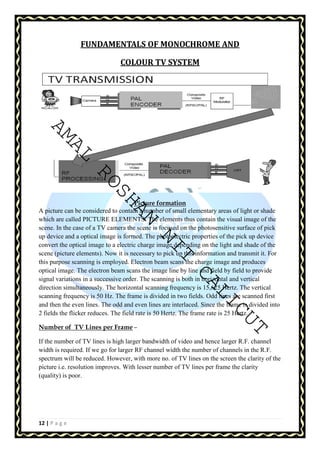
Picture formation 
A picture can be considered to contain a number of small elementary areas of light or shade 
which are called PICTURE ELEMENTS. The elements thus contain the visual image of the 
scene. In the case of a TV camera the scene is focused on the photosensitive surface of pick 
up device and a optical image is formed. The photoelectric properties of the pick up device 
convert the optical image to a electric charge image depending on the light and shade of the 
scene (picture elements). Now it is necessary to pick up this information and transmit it. For 
this purpose scanning is employed. Electron beam scans the charge image and produces 
optical image. The electron beam scans the image line by line and field by field to provide 
signal variations in a successive order. The scanning is both in horizontal and vertical 
direction simultaneously. The horizontal scanning frequency is 15,625 Hertz. The vertical 
scanning frequency is 50 Hz. The frame is divided in two fields. Odd lines are scanned first 
and then the even lines. The odd and even lines are interlaced. Since the frame is divided into 
2 fields the flicker reduces. The field rate is 50 Hertz. The frame rate is 25 Hertz. 
Number of TV Lines per Frame – 
If the number of TV lines is high larger bandwidth of video and hence larger R.F. channel 
width is required. If we go for larger RF channel width the number of channels in the R.F. 
spectrum will be reduced. However, with more no. of TV lines on the screen the clarity of the 
picture i.e. resolution improves. With lesser number of TV lines per frame the clarity 
(quality) is poor.
AMAL ROSHAN NIT CALICUT 
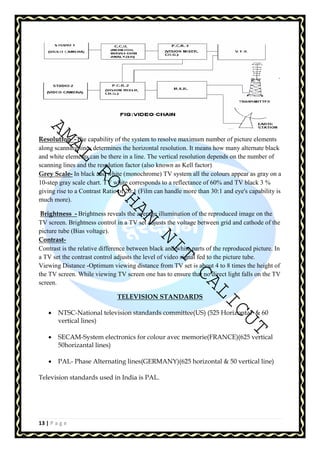
Resolution -The capability of the system to resolve maximum number of picture elements 
along scanning lines determines the horizontal resolution. It means how many alternate black 
and white elements can be there in a line. The vertical resolution depends on the number of 
scanning lines and the resolution factor (also known as Kell factor) 
Grey Scale- In black and white (monochrome) TV system all the colours appear as gray on a 
10-step gray scale chart. TV white corresponds to a reflectance of 60% and TV black 3 % 
giving rise to a Contrast Ratio of 20:1 (Film can handle more than 30:1 and eye's capability is 
much more). 
Brightness - Brightness reveals the average illumination of the reproduced image on the 
TV screen. Brightness control in a TV set adjusts the voltage between grid and cathode of the 
picture tube (Bias voltage). 
Contrast- 
Contrast is the relative difference between black and white parts of the reproduced picture. In 
a TV set the contrast control adjusts the level of video signal fed to the picture tube. 
Viewing Distance -Optimum viewing distance from TV set is about 4 to 8 times the height of 
the TV screen. While viewing TV screen one has to ensure that no direct light falls on the TV 
screen. 
13 | P a g e 
TELEVISION STANDARDS 
• NTSC-National television standards committee(US) (525 Horizontal  60 
vertical lines) 
• SECAM-System electronics for colour avec memorie(FRANCE)(625 vertical 
50horizantal lines) 
• PAL- Phase Alternating lines(GERMANY)(625 horizontal  50 vertical line) 
Television standards used in India is PAL.
AMAL ROSHAN NIT CALICUT 
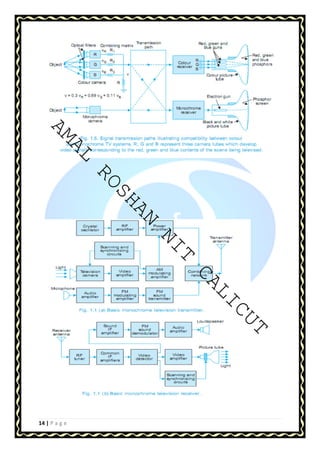
14 | P a g e
AMAL ROSHAN NIT CALICUT 
15 | P a g e 
Colour composite Video Signal(CCVS) 
• What is video signal? 
Video is nothing but a sequence of picture. The image we see is maintained in our 
eye for a 1/16 sec so if we see image at the rate more than 16 pictures per sec our 
eye cannot recognize the difference and we see the continuous motion. 
In TV cameras image is converted in electrical signal using photo sensitive material. 
Whole image is divided into many micro particle known as Pixels. 
These pixels are small enough so that our eyes cannot recognize pixel and we see 
continuous image , thus at any instant there are almost an infinite no. of pixel that 
needs to be converted in electrical signals simultaneously for transmitting picture 
details. However this is not practicable because it is no feasible to provide a separate 
path for each pixel in practice this problem is solved by scanning method in which 
information is converted in one by one pixel line by line and frame by 
frame. 
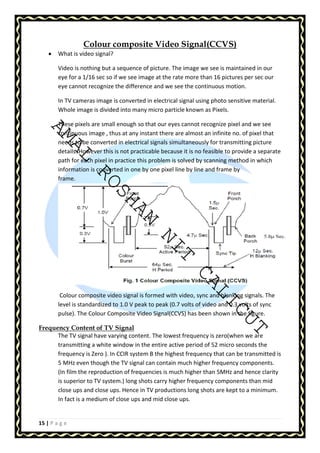
Colour composite video signal is formed with video, sync and blanking signals. The 
level is standardized to 1.0 V peak to peak (0.7 volts of video and 0.3 volts of sync 
pulse). The Colour Composite Video Signal(CCVS) has been shown in the figure. 
Frequency Content of TV Signal 
The TV signal have varying content. The lowest frequency is zero(when we are 
transmitting a white window in the entire active period of 52 micro seconds the 
frequency is Zero ). In CCIR system B the highest frequency that can be transmitted is 
5 MHz even though the TV signal can contain much higher frequency components. 
(In film the reproduction of frequencies is much higher than 5MHz and hence clarity 
is superior to TV system.) long shots carry higher frequency components than mid 
close ups and close ups. Hence in TV productions long shots are kept to a minimum. 
In fact is a medium of close ups and mid close ups.
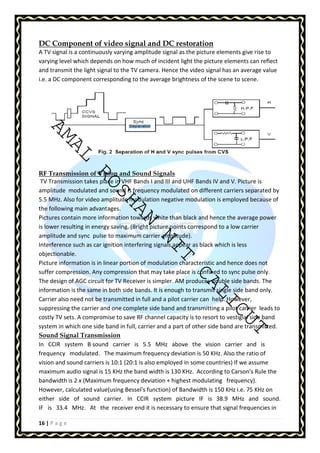
DC Component of video signal and DC restoration 
A TV signal is a continuously varying amplitude signal as the picture elements give rise to 
varying level which depends on how much of incident light the picture elements can reflect 
and transmit the light signal to the TV camera. Hence the video signal has an average value 
i.e. a DC component corresponding to the average brightness of the scene to scene. 
AMAL ROSHAN NIT CALICUT 
RF Transmission of Vision and Sound Signals 
TV Transmission takes place in VHF Bands I and III and UHF Bands IV and V. Picture is 
amplitude modulated and sound is frequency modulated on different carriers separated by 
5.5 MHz. Also for video amplitude modulation negative modulation is employed because of 
the following main advantages. 
Pictures contain more information towards white than black and hence the average power 
is lower resulting in energy saving. (Bright picture points correspond to a low carrier 
amplitude and sync pulse to maximum carrier amplitude). 
Interference such as car ignition interfering signals appear as black which is less 
objectionable. 
Picture information is in linear portion of modulation characteristic and hence does not 
suffer compression. Any compression that may take place is confined to sync pulse only. 
The design of AGC circuit for TV Receiver is simpler. AM produces double side bands. The 
information is the same in both side bands. It is enough to transmit single side band only. 
Carrier also need not be transmitted in full and a pilot carrier can help. However, 
suppressing the carrier and one complete side band and transmitting a pilot carrier leads to 
costly TV sets. A compromise to save RF channel capacity is to resort to vestigial side band 
system in which one side band in full, carrier and a part of other side band are transmitted. 
Sound Signal Transmission 
In CCIR system B sound carrier is 5.5 MHz above the vision carrier and is 
frequency modulated. The maximum frequency deviation is 50 KHz. Also the ratio of 
vision and sound carriers is 10:1 (20:1 is also employed in some countries) If we assume 
maximum audio signal is 15 KHz the band width is 130 KHz. According to Carson's Rule the 
bandwidth is 2 x (Maximum frequency deviation + highest modulating frequency). 
However, calculated value(using Bessel's function) of Bandwidth is 150 KHz i.e. 75 KHz on 
either side of sound carrier. In CCIR system picture IF is 38.9 MHz and sound. 
IF is 33.4 MHz. At the receiver end it is necessary to ensure that signal frequencies in 
16 | P a g e
the region of the vestigial side band do not appear with double amplitude after 
detection. For this purpose the IF curve employs NYQUIIST slope. 
AMAL ROSHAN NIT CALICUT 
The Colour Television 
It is possible to obtain any desired colour by mixing three primary colours i.e. Red, Blue and 
green in a suitable proportion. The retina of human eye consists of very large number of 
light- sensitive cells. These are of two types, rods and cones. Rods are sensitive only to the 
intensity of the incident light and cones are responsible for normal colour vision. The small 
range of frequencies to which the human eye is responsive is known as visible spectrum. 
This visible spectrum is from 780 mm (Red) to 380 mm(Violet). 
Additive Colour Mixing 
The figure shows the effect of projecting red, green, blue beams of light so that they overlap 
on screen. Y= 0.3 Red + 0.59 Green + 0.11 Blue 
17 | P a g e 
Additive colour mixing
AMAL ROSHAN NIT CALICUT 
18 | P a g e 
TV STUDIO 
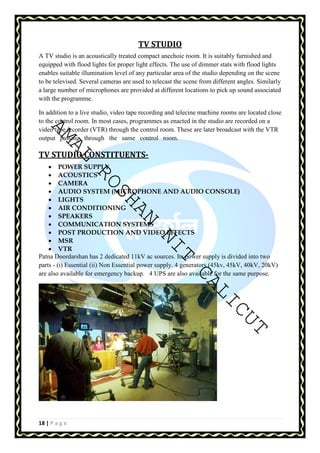
A TV studio is an acoustically treated compact anechoic room. It is suitably furnished and 
equipped with flood lights for proper light effects. The use of dimmer stats with flood lights 
enables suitable illumination level of any particular area of the studio depending on the scene 
to be televised. Several cameras are used to telecast the scene from different angles. Similarly 
a large number of microphones are provided at different locations to pick up sound associated 
with the programme. 
In addition to a live studio, video tape recording and telecine machine rooms are located close 
to the control room. In most cases, programmes as enacted in the studio are recorded on a 
video tape recorder (VTR) through the control room. These are later broadcast with the VTR 
output passing through the same control room. 
TV STUDIO CONSTITUENTS- 
• POWER SUPPLY 
• ACOUSTICS 
• CAMERA 
• AUDIO SYSTEM (MICROPHONE AND AUDIO CONSOLE) 
• LIGHTS 
• AIR CONDITIONING 
• SPEAKERS 
• COMMUNICATION SYSTEMS 
• POST PRODUCTION AND VIDEO EFFECTS 
• MSR 
• VTR 
Patna Doordarshan has 2 dedicated 11kV ac sources. Its power supply is divided into two 
parts - (i) Essential (ii) Non Essential power supply. 4 generators (45kv, 45kV, 40kV, 20kV) 
are also available for emergency backup. 4 UPS are also available for the same purpose.
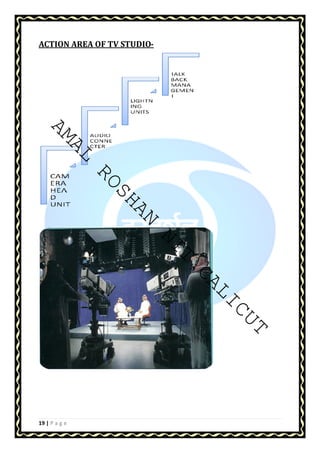
ACTION AREA OF TV STUDIO- 
AMAL ROSHAN NIT CALICUT 
19 | P a g e
AMAL ROSHAN NIT CALICUT 
20 | P a g e 
TV CAMERA 
KEY TERMS 
The camera utilizes two devices that control the amount of light that will reach the sensor. 
• One of these devices is the shutter that can be likened to a normally closed opaque 
window shade. When activated the window shade will be opened for a predetermined period 
of time to admit light to the sensor. 
• The other device is the aperture control that is an iris diaphragm located inside the lens 
and the diaphragm functions much like the iris in the human eye. This diaphragm is made 
either larger or smaller in size to control the amount of light passing through the lens to the 
sensor. 
• Shutter Speed 
• The shutter speed of the camera specifies how fast the shutter will operate that is for how 
long a period of time the shutter will be open to admit light through the lens. A faster shutter 
speed will be better to stop motion. A slower shutter speed can permit use of a smaller 
aperture that will result in a greater depth of field (to be explained in a few minutes). Shutter 
speeds are expressed in numbers such as 60, 125, 250 etc. The number 60 means 1/60 of a 
second and 125 means 1/125 of a second and so on. A special setting is sometimes included 
and labeled B. When B is used the shutter will remain open as long as the shutter release 
remains pressed. The B stands for Bulb an expression that goes back to operation of old 
cameras. Each time you increase the speed you reduce the light striking the film. As the 
shutter speed goes from 60 to 125 you cut the light in half. You do exactly the same if you go 
from 250 to 500. Full stop shutter speeds are; 1, ½ , ¼, 1/8, 1/15, 1/30, 1/60, 1/125, 1/250, 
1/500, 1/1000, 1/2000, 1/4000, 1/8000.
Aperture 
• The aperture controls the amount of light that passes through the lens to the sensor. On a 
cloudy day you need to make the diaphragm opening larger to allow more light to reach the 
film and conversely on a bright day at the beach you need to close down the diaphragm to let 
less light in. The numbers used to identify the discrete steps are 1.4, 2, 2.8, 4, 5.6 8, 11, 16, 
22, etc. and are known as f-stops. I know the numbers are strange looking but they have a 
basis in mathematics and as the number increases by one stop the light getting through the 
lens is cut in half. Thus if you go from f2 to f2.8 you cut the light in half. You also cut it in 
half if you go from f11 to f16. Just to reinforce the idea if you go from f16 to f11 you double 
the light reaching the lens. The term “stopping down” refers to closing down the diaphragm 
such as going from f11 to f16. Notice as the f-stop numbers get larger the diaphragm gets 
smaller. 
AMAL ROSHAN NIT CALICUT 
Lens Selection 
• Lens selection has a great affect on your images. Lenses are measured in terms of focal length. 
Telephoto lenses have a long focal length and wide- angle lenses have a short focal length. For 
35mm a 50mm lens is called a “normal” lens since that lens sees approximately the same field of 
view that the human eye and brain see when they look at a scene. Let us look at lenses from the 
following perspective. Say that you are standing at one point and attempting to photograph a 
subject of a given size with a 50mm lens. If the object that you want to photograph appears too 
small in the viewfinder a longer telephoto lens will allow you to fill more of the frame with that 
subject without moving closer. 
Zoom Lens 
A zoom lens has a variable focal length with a range of 10 : 1 or more. In this lens the viewing angle 
and field view can be varied without loss of focus. This enables dramatic close-up control. The 
smooth and gradual change of focal length by the cameraman while televising a scene appears to 
the viewer as it he is approaching or receding from the scene. 
The variable focal length is obtained by moving individual lens elements of a compound lens 
assembly. A zoom lens can in principle simulate any fixed lens which has a focal length within the 
zoom range. It may, however, be noted that the zoom lens is not a fast lens. The speed of a lens is 
determined by the amount of light it allows to pass through it. Thus under poor lighting conditions, 
faster fixed focal length lenses mounted on the turret are preferred. 
21 | P a g e
AMAL ROSHAN NIT CALICUT 
22 | P a g e 
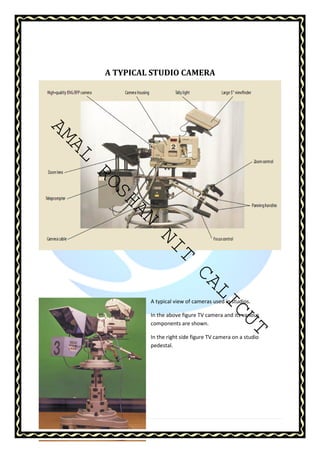
A TYPICAL STUDIO CAMERA 
A typical view of cameras used in studios. 
In the above figure TV camera and its various 
components are shown. 
In the right side figure TV camera on a studio 
pedestal.
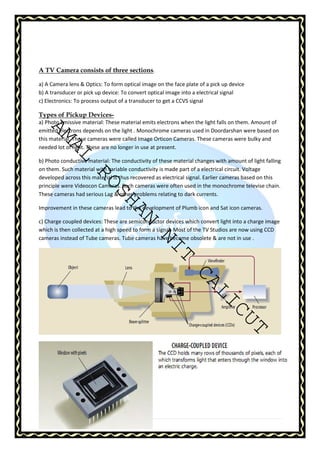
A TV Camera consists of three sections. 
a) A Camera lens  Optics: To form optical image on the face plate of a pick up device 
b) A transducer or pick up device: To convert optical image into a electrical signal 
c) Electronics: To process output of a transducer to get a CCVS signal 
Types of Pickup Devices-a) 
AMAL ROSHAN NIT CALICUT 
Photo emissive material: These material emits electrons when the light falls on them. Amount of 
emitted electrons depends on the light . Monochrome cameras used in Doordarshan were based on 
this material. These cameras were called Image Orticon Cameras. These cameras were bulky and 
needed lot of light. These are no longer in use at present. 
b) Photo conductive material: The conductivity of these material changes with amount of light falling 
on them. Such material with variable conductivity is made part of a electrical circuit. Voltage 
developed across this material is thus recovered as electrical signal. Earlier cameras based on this 
principle were Videocon Cameras. Such cameras were often used in the monochrome televise chain. 
These cameras had serious Lag  other problems relating to dark currents. 
Improvement in these cameras lead to the development of Plumb icon and Sat icon cameras. 
c) Charge coupled devices: These are semiconductor devices which convert light into a charge image 
which is then collected at a high speed to form a signal. Most of the TV Studios are now using CCD 
cameras instead of Tube cameras. Tube cameras have become obsolete  are not in use . 
23 | P a g e
Camera sensors – CCD basics 
The CCD is a solid-state device using special integrated circuitry technology, hence it is often referred 
to as a chip camera. The complete CCD sensor or chip has at least 450 000 picture elements or 
pixels, each pixel being basically an isolated (insulated) photodiode. The action of the light on each 
pixel is to cause electrons to be released which are held by the action of a positive voltage. 
AMAL ROSHAN NIT CALICUT 
The Charge held under electrode can be moved to electrode by changing the potential on the second 
electrodes. The electrons (negative charges) follow the most positive attraction. A repeat of this 
process would move the charges to next electrode, hence charge-coupled device. A system of 
transfer clock pulses is used to move the charges in CCDs to achieve scanning. 
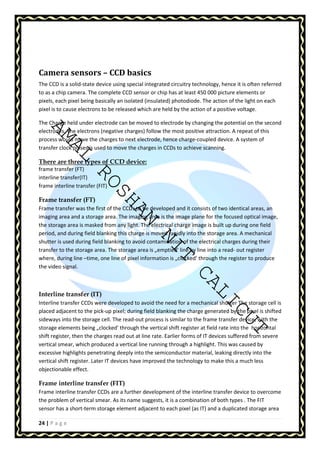
There are three types of CCD device: 
frame transfer (FT) 
interline transfer(IT) 
frame interline transfer (FIT) 
Frame transfer (FT) 
Frame transfer was the first of the CCDs to be developed and it consists of two identical areas, an 
imaging area and a storage area. The imaging area is the image plane for the focused optical image, 
the storage area is masked from any light. The electrical charge image is built up during one field 
period, and during field blanking this charge is moved rapidly into the storage area. A mechanical 
shutter is used during field blanking to avoid contamination of the electrical charges during their 
transfer to the storage area. The storage area is „emptied' line by line into a read- out register 
where, during line –time, one line of pixel information is „clocked' through the register to produce 
the video signal. 
Interline transfer (IT) 
Interline transfer CCDs were developed to avoid the need for a mechanical shutter The storage cell is 
placed adjacent to the pick-up pixel; during field blanking the charge generated by the pixel is shifted 
sideways into the storage cell. The read-out process is similar to the frame transfer device, with the 
storage elements being „clocked' through the vertical shift register at field rate into the horizontal 
shift register, then the charges read out at line rate. Earlier forms of IT devices suffered from severe 
vertical smear, which produced a vertical line running through a highlight. This was caused by 
excessive highlights penetrating deeply into the semiconductor material, leaking directly into the 
vertical shift register. Later IT devices have improved the technology to make this a much less 
objectionable effect. 
Frame interline transfer (FIT) 
Frame interline transfer CCDs are a further development of the interline transfer device to overcome 
the problem of vertical smear. As its name suggests, it is a combination of both types . The FIT 
sensor has a short-term storage element adjacent to each pixel (as IT) and a duplicated storage area 
24 | P a g e
(as FT). During field blanking the charges are moved from the pixels into the adjacent short-term 
storage element and then moved at 60 times field frequency into the storage area. This rapid 
moving of the charge away from the vulnerable imaging area overcomes the vertical smear problem. 
Development in CCD technology has seen the introduction of: 
• The hole accumulated Diode (HAD) sensor which enabled up to 750 pixels/line, with 
increased sensitivity and a reduction in vertical smear; 
• The hyper HAD sensor, which included a microlens on each pixel to collect the light more 
efficiently (this gave a one stop increase in sensitivity over the HAD sensor); 
AMAL ROSHAN NIT CALICUT 
• The power HAD sensor with improved signal-to- noise ratio which has resulted in at least 
half an ƒ-stop gain in sensitivity; in some cases a full ƒ-stop of extra sensitivity has been 
realized. 
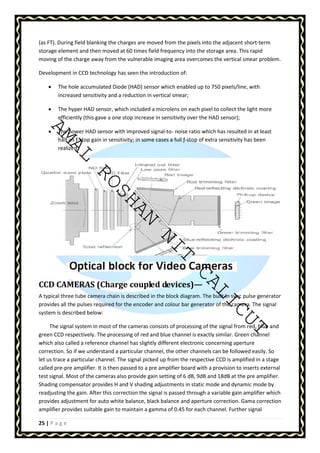
CCD CAMERAS (Charge coupled devices)— 
A typical three tube camera chain is described in the block diagram. The built in sync pulse generator 
provides all the pulses required for the encoder and colour bar generator of the camera. The signal 
system is described below: 
The signal system in most of the cameras consists of processing of the signal from red, blue and 
green CCD respectively. The processing of red and blue channel is exactly similar. Green channel 
which also called a reference channel has slightly different electronic concerning aperture 
correction. So if we understand a particular channel, the other channels can be followed easily. So 
let us trace a particular channel. The signal picked up from the respective CCD is amplified in a stage 
called pre-pre amplifier. It is then passed to a pre amplifier board with a provision to inserts external 
test signal. Most of the cameras also provide gain setting of 6 dB, 9dB and 18dB at the pre amplifier. 
Shading compensator provides H and V shading adjustments in static mode and dynamic mode by 
readjusting the gain. After this correction the signal is passed through a variable gain amplifier which 
provides adjustment for auto white balance, black balance and aperture correction. Gama correction 
amplifier provides suitable gain to maintain a gamma of 0.45 for each channel. Further signal 
25 | P a g e
processing includes mixing of blanking level, black clip, white clip and adjustment for flare 
correction. The same processing take place for blue and red channels. Green channel as an 
additional electronic which provides aperture correction to red and blue channels. Aperture 
correction provide corrections to improve the resolution or high frequency lost because of the finite 
size of the electron beam . Green channel has fixed gain amplifier instead of variable gain amplifier 
in the red and blue channels. 
All the three signals namely R, G and B are then fed to the encoder section of the camera via a 
colour bar/camera switch. This switch can select R, G and B from the camera or from the R, G, B 
Signal from colour bar generator. In the encoder section these R, G, B signals are modulated with SC 
to get V and U signals. These signals are then mixed with luminance, sync, burst,  blanking etc. to 
provide colour composite video signal (CCVS Signal). Power supply board provides regulated voltages 
to various sections. 
AMAL ROSHAN NIT CALICUT 
Other Types Of Cameras- 
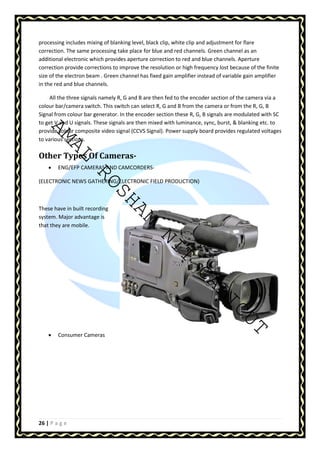
• ENG/EFP CAMERAS AND CAMCORDERS- 
(ELECTRONIC NEWS GATHERING/ELECTRONIC FIELD PRODUCTION) 
These have in built recording 
system. Major advantage is 
that they are mobile. 
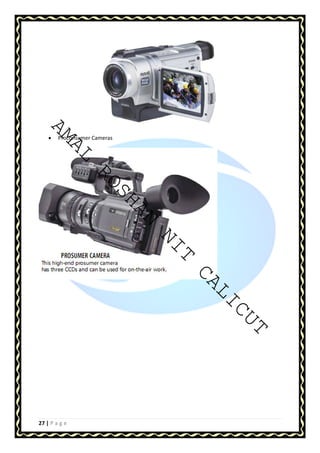
• Consumer Cameras 
26 | P a g e
AMAL ROSHAN NIT CALICUT 
• Proconsumer Cameras 
27 | P a g e
AMAL ROSHAN NIT CALICUT 
28 | P a g e 
SSSSTTTTUUUUDDDDIIIIOOOO LLLLIIIIGGGGHHHHTTTTIIIINNNNGGGG 
GENERAL PRINCIPLES: 
Lighting for television is very exciting and needs creative talent. There is always a 
tremendous scope for doing experiments to achieve the required effect. Light is a kind of 
electromagnetic radiation with a visible spectrum from red to violet i.e., wavelength from 
700 nm to 380 nm respectively. However to effectively use the hardware and software 
connected with lighting it is important to know more about this energy. 
The lighting control system is the most important tool that the lighting man has to work 
with. The lighting control system, commonly called the Dimming System, is the nerve centre 
of any lighting package. The Control System allows the studio production lights to be varied 
in intensity for the various special effects that are required. It’s dimming system that allows 
color blending of the cyclorama curtain background. It is the dimming system that allows 
complex light changes to be easily accomplished. 
Lighting in studio is of three types- 
• Key Light- 
It is used to illuminate the main object. It has most intensity. 
• Fill Light- 
It is used to remove blank shadows and the shadows created by key light. 
• Back Light- 
It is used to give the object a 3D look. It helps to give a depth in the video. 
Other lightings are background lights and lights synchronized with audio. 
Light Source: Any light source has a Luminance intensity (I) which is measured in 
Candelas. One Candela is equivalent to an intensity released by standard one candle source 
of light. 
Luminance flux (F): It is a radiant energy weighted by the photonic curve and is 
measured in Lumens. One Lumen is the luminous flux emitted by a point source of 1 
Candela. 
Illumination (E): It is a Luminous Flux incident onto a surface. It is measured in 
LUMENS/m2, which is also called as LUX. A point source of 1 candela at a uniform 
distance of 1 meter from a surface of 1 square meter gives illumination of 1 LUX. 
Luminance (L): It is a measure of the reflected light from a surface. Measured in 
Apostilbs . A surface which reflects a total flux of 1 lumen/m2 has a luminance of 1
Aposilbs . 
Elementary theory of light also says that: 
Colour temperature: 
One may wonder, how the light is associated with color . Consider a black body being 
heated; you may observe the change in colour radiated by this body as the temperature 
is increased. The colour radiated by this body changes from reddish to blue and then to 
white as the temperature is further increased. This is how the concept of relating colour 
with temperature became popular. Colour temperature is measured in degree Kelvin 
i.e., 0C +273) . The table below gives idea about the kind of radiation from different 
kinds of lamps in terms of colour temperature. 
AMAL ROSHAN NIT CALICUT 
a) Standard candle 19300K 
b) Fluorescent Lamps range 3000-6500oK 
c) HMI lamp 5600+- 400oK 
(H=Hg, M=Medium arc, I=Metal Iodide} 
d) CSI (Compact Source Iodide) 4000+- 400oK 
e) CID (Compact Iodide Daylight) 5500+- 400o 
Colour TV Display,white 6500oK 
f) Monochrome TV 9300oK 
g) Blue sky 12000 – 18000oK 
h) Tungsten Halogen 3200oK 
i) Average summer sunlight (10am –3pm) 5500oK 
It can be noted that as the temperature is increased, the following things 
happen: 
1) Increase in maximum energy released 
2) Shift in peak radiation to shorter wavelengths (Blue) 
3) Colour of radiation is a function of temperature 
Hence by measuring the energy content of the source over narrow bands at the red and 
blue ends of the spectrum ,the approximate colour temperature can be determined. All the 
color temperature meter are based on this principle. 
29 | P a g e
COLOUR FILTERS AND THEIR USE: 
Colour filters are used to modify the colour temperature of lights and to match colour 
temperature for cameras while shooting with different colour temperature. These filters 
change the colour temperature at the cost of reduction in light transmission. Colour 
temperature filters are also introduced in the optical path of cameras to facilitate camera 
electronics to do the white balance without loading the amplifier chain. Cameras electronics 
is generally optimized for a colour temperature of 3200K, hence it uses reddish filter while 
shooting at higher colour temperatures. 
Generally it is normal to correct daylight to produce tungsten quality light, because it is 
usually easier to do and saves lot of power, otherwise blue filters are going to reduce lot of 
light thus requiring the use of higher wattage lamps.. However, when the amount of 
tungsten to be corrected is small it may be more practical to convert it to daylight, but with 
a considerably reduced light output form the luminaries. There are two basic types of filter:- 
AMAL ROSHAN NIT CALICUT 
i) One which is orange in colour and converts Daylight to Tungsten Light. 
ii) One which is blue in colour and converts Tungsten to Daylight. 
Day Light: - 
The sun does not changes its colour temperature during the day it is only its appearance 
from a fixed point on earth. It is because the sunlight gets scattered because of the medium, 
shorter wavelengths like blue gets more effected. Certain situations like, sunrise and sunset 
causes the light to be more yellow than midday, because the light has to travel the long 
distance so a careful note should be made of the Transmission factor of each of the filters. 
Often a compromise has to be reached in terms of correction and light loss. 
NEUTRAL DENSITY FILTERS :- 
In addition to colour temperature correction sometimes it may be necessary to reduce the 
intensity of daylight at an interior location. Neutral density filters available to attenuate the 
light are of: 
0.3 Density which has a transmission of 50%= 6dB=1 f stop 
0.6 Density which has a transmission of 25%= 9dB=2 f stop 
0.9 Density which has a transmission of 13%= 12dB=3f stop 
COMBINATION OF CTC FILTERS AND NEUTRAL DENSITY 
FILTERS: 
Single filters exist which are a combination of full colour temperature orange and neutral 
density as follows:- 
Full Orange + 0.3 N.D. with a transmission of 50% 
Full Orange + 0.6 N.D. with a transmission of 38% 
The HMI light source has a colour temperature of about 60000K and can be used with 
exterior daylight without the need for a colour temperature correction filter. 
30 | P a g e
DIFFERENT LIGHTING TECHNIQUES: 
- Eye light, Low intensity light on camera itself to get extra sparkle to an actor's eye 
-Rim light, to highlight actor's outline, it is an extra back on entire body at camera level 
- Kickkar light, Extra light on shadow side of the face at an angle behind and to the side of 
the actor 
- Limbo Lighting, Only subject is visible, no back ground light 
- Sillhoutt lighting, No light on subject, BG is highly lit 
LIGHTING CONSOLE 
In a television production, each scene will require its own lighting plan to give the desired 
effect. In order to assist in setting up a particular lighting plon, a console should provide :- 
a) One man operation and a centralised control desk with ability to switch any circuit. 
b) Facilities to obtain good balance with flexibility to have dimming on any circuit. 
c) With all controls for power at low voltage and current. 
Modern lighting consoles also provide file  memory to enable the console operator to 
store and recall the appropriate luminaries used for a particular lighting plot. These console 
also provide Mimic panels to show which channels are in use and which memories or files 
have been recalled. 
DIMMERS 
Three basic methods for dimming are :- 
1. Resistance 
This is the simplest and cheapest form of dimmer. It consists of a wire wound resistor with a 
wiper .It is used in series with the load. 
2. Saturable Reactor (System SR) 
The basic principle of the saturable reactor is to connect an iron cored choke in series with 
the lamp. Dimmers are controlled with the help of main switch. A typical dimmer bank is 
AMAL ROSHAN NIT CALICUT 
31 | P a g e 
shown. 
LIGHTING THE SET FOR DRAMA:-- 
Openings such as windows within a set should be 
highlighted without overstating them. Where the 
walls having such feature should be lit to reveal 
these features but care must be taken to ensure 
that there is only one shadow. The top of the set 
should be darkened off by using the barndoors, 
this puts a ceiling on the set by giving the 
feeling of a roof. If more than the top of the set 
is darkened, that gives enclosed feeling.
Indoor day time: 
1. If there is a choice in the direction of the 'sun'(Key) take the shortest route inside the set 
to a wall, and if possible throw the shadow of window bars onto a door - it usually is in shot. 
2. A patch of light on the floor inside the set, backlight from outside using a soft source at 
steep elevation adds realism. 
3. When a set does not have a window, a window pattern can be projected onto a wall to 
produce a suitable window effect. 
4. Roof and Ceiling Pieces - if they make lighting impossible, check if they can be removed at 
the planning state. Light any ceiling pieces from outside, use a soft source at ground level. If 
the ceiling has plaster moulding or ornamentation, a hard source may be used. 
Indoor night time: 
- The outside of the window should be dark, except for a possible dim skyline if the room is 
well above adjacent streets, or lit by an outside practical lamp i.e. street lighting. 
- The wall with the window in it should be lit at night to be brighter than for the day 
condition. Subjectively the walls appear brighter at night than at daytime. 
- Often a completely different 'feel' to the set can be obtained by reversing he direction of 
lighting in the set compared to that used for day. 
AMAL ROSHAN NIT CALICUT 
- General for night effects it is not a good plan to just simply dim the set lighting when 
changing from day to night. This is because the excessive change in colour temperature of 
the light source and the apparent increase in saturation of surfaces at low luminance. 
Outdoor daylight and Moonlight: 
The direction of the light is dictated by the position of the 'sun' or 'moon'. As a general 
principle one should remember that sunlight (hard source) is accompanied by the reflected 
skylight (soft source) whereas moonlight is a single hard source. One of the biggest 
problems when lighting exteriors is the maintenance of “single shadow philosophy - double 
shadows on a long shot will quickly destroy the apparent realism created in the set. Very 
large area filler light is ideal for exterior daylight scenes. 
This can be achieved by using a suspended white screen 12' x 8' where the filler would be 
positioned then lighting it with hard light. 
The exact lighting treatment will depend on the situation but as a general rule, moonlight 
effects are normally achieved by back lighting to give a more softer, romantic mood than 
would be achieved than a frontal key. 
In colour, to obtain a night effect, blue cinemoid is used over the luminaries. This gives a 
stylised effect. An alternative is to use much more localised lighting than for daylight and 
light only the artists and odd parts of the set. 
32 | P a g e
AMAL ROSHAN NIT CALICUT 
33 | P a g e 
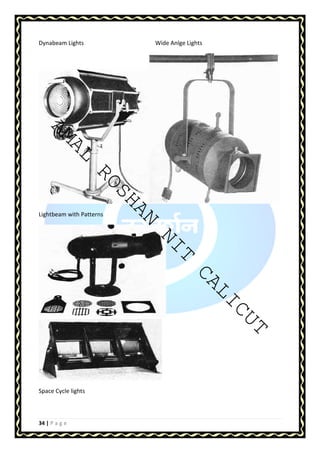
Various other lighting equipments- 
Frensel Spotlight Cylorama Lights 
Scoop Lights Pantograph
Dynabeam Lights Wide Anlge Lights 
AMAL ROSHAN NIT CALICUT 
Lightbeam with Patterns 
Space Cycle lights 
34 | P a g e
AMAL ROSHAN NIT CALICUT 
35 | P a g e 
MICROPHONES 
Introduction 
Pressure variations, whether in air, water or other mediums, which the human ear can detect, 
are considered sounds. Acoustics is the science or the study of sound. Sound can be generally 
pleasing to the ear, as in music, or undesirable, referred to as noise. The typical audible range 
of a healthy human ear is 20 to 20,000 Hz. A Sound Pressure Level 
(SPL) beyond the detectable frequencies of the human ear can also be very important to 
design engineers. Noise, Vibration and Harshness (NVH) is concerned with the study of 
vibration and audible sounds. Vibrations represent a rapid linear motion of a particle or of an 
elastic solid about an equilibrium position, or fluctuation of pressure level. 
Harshness refers to the treatments of transient frequencies or shock. Usually 
treatments are employed to eliminate noise, but in some cases products are designed to 
magnify the sound and vibration at particular frequencies. The sound 
produced or received by a typical object, which may be above and below the frequencies that 
are detectable by the human ear, or amplitudes concerning its resonant 
frequencies, are important to designers, in order to characterize the items performance and 
longevity. 
Technology Fundamentals and Microphone Types 
When an object vibrates in the presence of air, the air molecules at the surface will begin to 
vibrate, which in turn vibrates the adjacent molecules next to them. This 
vibration will travel through the air as oscillating pressure at frequencies and amplitudes 
determined by the original sound source. The human eardrum transfers these 
pressure oscillations, or sound, into electrical signals that are interpreted by our brains 
as music, speech, noise, etc. Microphones are designed, like the human ear, to transform 
pressure oscillations into electrical signals, which can be recorded and analyzed to tell us 
information about the original source of vibration or the nature of the path the sound took 
from the source to the microphone. This is exhibited in testing of noise reducing materials. 
Pressure from sound must be analyzed in the design stages to not only protect the
materials around it, but also to protect the most precious and delicate 
mechanism designed to perceive it, the human ear. Like the human ear, 
microphones are designed to measure a very large range of amplitudes, typically measured 
in decibels (dB) and frequencies in hertz (Hz.) 
In order to convert acoustical energy into electrical energy, microphones are used. There are a 
few different designs for microphones. The more common designs are Carbon 
Microphones, Externally Polarized Condenser Microphones, Prepolarized Electret 
Condenser Microphones, Magnetic Microphones, and Piezoelectric Microphones. 
Types of microphone Connectors- 
AMAL ROSHAN NIT CALICUT 
• BALANCED 
In general, microphones provide an analogue au- dio 
signal. Professional microphones feature an 
XLR-output with three pins that transfer a balanced 
signal. One pin is ground, and the other two carry the audio 
signal. Pin 2 is the so called hot signal and pin 3 the 
cold. This method reduces the susceptibility of external 
noise while allowing the usage of longer cables. 
• UNBALANCED 
Entry level microphones often feature an attached cable with 
an unbalanced 6.3 mm or 3.5 mm con- nector. An unbalanced 
output carries the signal on a single conductor and is more 
susceptible to external noise. For that reason only balanced 
connections are used in professional miking applications. 
• USB 
More and more professional USB microphones are available. A 
USB microphone is essentially a mic with a built-in USB audio 
interface that converts the analogue signal into a digital signal. It 
can be directly plugged into a computer without requiring an exter-nal 
audio interface. 
USB microphones, such as the Shure PG27USB and the 
PG42USB with plug and play functionality are an easy start into 
home recording and podcasting. 
36 | P a g e
Types of Microphones 
• Dynamic 
Dynamic microphones employ a diaphragm, a voice coil and a magnet. The voice 
coil is sur-rounded by a magnetic field and is attached to the rear of the diaphragm. The 
motion of the voice coil in this magnetic field field generates the electrical signals corresponding to 
the picked up sound. Dynamic microphones have a relatively simple construction and are 
therefore economical and rugged. They can handle extremely high sound pressure levels 
and are largely unaffected by extreme temperatures or humidity. 
AMAL ROSHAN NIT CALICUT 
• Condenser 
37 | P a g e 
Condenser microphones are based on an electrically-charged 
diaphragm/ backplate assembly which forms a 
soundsensitive capacitor. When the diaphragm is set in motion 
through sound, the space between the diaphragm and the 
backplate is changing, and therefore the capacity of the 
capacitor. This variation in spacing produces the electrical signal. 
Condensers are more sensitive and can provide a smoother, more 
natural sound, particularly at higher frequencies. All condenser microphones need to be powered: 
either by batteries in the microphone,by phantom power provided by a mixer, a sound card or an 
external analogue to digital converter 
There are two main types of condenser microphones: 
Small diaphragm – generally used for live performance and recording. They are called 
small diaphragm because the transducer’s diaphragm is less than one inch in diameter. 
Small diaphragm microphones provide a more natural sound reproduction and are 
preferably used for miking instruments. 
Large diaphragm – traditionally favored by recording studio engineers and broadcast 
announcers, condenser microphones with a large diaphragm (one inch in diameter or 
larger) usually have higher output, less self-noise (the “hiss“ the microphone might 
make), and better low-frequency response, which can result in a “higher fidelity“ 
sound for both vocals and instruments.
AMAL ROSHAN NIT CALICUT 
38 | P a g e 
BASED ON PICKUP PATTERN(POLAR DIAGRAM) 
• OMNIDIRECTIONAL 
An omnidirectional microphone picks up 
sounds equally from all directions and 
reproduces the sound source more natural 
than a unidirectional microphone. It is 
good for natural room sound and group 
vocals. Also good for when the singer or 
talker may move around different sides of 
the microphone (but their distance to the 
mic stays the same). 
As an omnidirectional microphone picks up all 
the ambient sound in a room, e.g. the 
computer fan, it is not the recommended choice for home recording. However, if the 
goal is to enable listeners to hear what is occurring in the background, you should 
consider an omnidirectional pick-up pattern. 
• CARDIOID 
This is the most common type of microphone. 
It is called “cardioid“ due to its 
heart-shaped pick up pattern and has the 
most sensitivity at the front and is least sensitive 
at the back. This microphone helps 
reduce pickup of background noise or 
bleed from nearby sound sources. 
• SUPERCARDIOID 
A supercardioid microphone is even more directional 
than the cardioid. Supercardioids 
have the tightest pickup pattern, further isolating 
the sound source. But they also have some 
pickup at the rear. Good for noisy, crowded spaces 
and when multiple microphones arebeing used, such 
as for round-table discussions where you want to 
keep the voices distinct
ON THE BASIS OF FREQUENCY RESPONSE- 
• FLAT FREQUENCY RESPONSE 
AMAL ROSHAN NIT CALICUT 
39 | P a g e 
All audible frequencies (20 Hz – 20 kHz) have 
the same output level. This is most 
suitable for applications where the sound 
source has to be reproduced without 
changing or “coloring” the original sound. 
• TAILORED FREQUENCY RESPONSE 
A tailored response has varying output levels 
across the frequency range and is usually 
designed to enhance a sound source in a 
particular application. For instance, a bass 
drum microphone does not need to reproduce 
high frequencies above 6 kHz or a vocal 
microphone may have a peak in the 2 – 4 kHz 
range to increase intelligibility 
MIicrophone in a recording 
studio
AMAL ROSHAN NIT CALICUT 
40 | P a g e 
CABLES AND CONNECTORS 
• The earliest use of cables was in Telegraphy lines. The cables were termed as SWER (Single 
Wire Earth Return) circuits. These are single phase lines (un-insulated), that were used in 
Single Wire Transmission. The use of this form of communication soon started having 
interference (noise) from the Trams (Electric Trains) and other electricity-using devices. 
• After this, companies converted to Balanced circuits lines. These are implemented using two 
wires which have circuits installed at every distance, or at the receiving or transmitting end, 
that cancel out the interference. 
– Secondly, since the they are two wires, on transmitting and the other receiving, the 
interference in the two lines is canceled out automatically. 
– Balanced lines increase length by decreasing the signal attenuation. 
• Since most of the telephone lines were installed next to power lines, this caused the 
interference that is induced from the power lines, and with the advancement of power, the 
interference kept on increasing. 
• This brought in a new era of the wire transposition, Figure 4 in a bid to reduce on the 
interference induced into the cables. In wire transposition, the transmit and receive cables 
change position every 6 to 7 poles (around 4 twists every Kilometer). The change in position 
helps to increase interference cancelation. 
The wire transposition was not enough in the reduction of noise in the communication lines. This led 
to the introduction of twisted pair cables. 
Types of Cables- 
1. E1 
2. Ethernet 
3. Coaxial 
4. Fiber 
5. Waveguide 
6. Wireless Medium 
E1/T1- 
Depending on the Size of the Cable, it can carry from 8 to 32 E1s/T1s, each E1 being made up of 
4 twisted cables. Each pair of cables is twisted onto each other to achieve noise cancellation. 
Please note that E1s can also be achieved using the an RJ 45 Connector. 
Coaxial-Coaxial cables provide the simplest and most versatile method for transmission of RF 
and microwave energy. The common types consist of a cylindrical metallic inner conductor 
surrounded by a dielectric material and then enclosed by a cylindrical metallic outer conductor.
The dielectric material is used to maintain the inner conductor concentrically within the outer 
conductor. The dielectric material is typically polyethylene (PE), Polyproplene (PP) or 
tetraflouroethylene (TFE). Most coaxial cables are then coated with a protective jacket made of 
polyethylene or poly-vinyl chloride (PVC). 
AMAL ROSHAN NIT CALICUT 
Fiber- 
An optical fiber or optical fiber is a thin, flexible, transparent fiber that acts as a waveguide, or 
light pipe, to transmit light between the two ends of the fiber. Optical fibers are widely used in 
fiber-optic communications, which permits transmission over longer distances and at higher 
bandwidths (data rates) than other forms of communication. Fibers are used instead of metal 
wires because signals travel along them with less loss and are also immune to electromagnetic 
interference. Fibers are also used for illumination, and are wrapped in bundles so they can be 
used to carry images, thus allowing viewing in tight spaces. Specially designed fibers are used for 
a variety of other applications, including sensors and fiber lasers. 
Optical fiber typically consists of a transparent core surrounded by a transparent cladding 
material with a lower index of refraction. Light is kept in the core by total internal reflection. This 
causes the fiber to act as a waveguide. 
Two types of Fiber media : 
41 | P a g e 
Multimode 
Singlemode 
Single-mode fiber 
Carries light pulses along single path 
Uses Laser Light Source 
Has a very small core and carry only one beam of light. It can support Gbps data 
rates over  100 Km without using repeaters. 
Multimode fiber 
Many pulses of light generated by LED travel at different angles 
Can support less bandwidth than Single mode Fiber
Waveguides- 
In electromagnetics and communications engineering, the term waveguide may refer to any 
linear structure that conveys electromagnetic waves between its endpoints. However, the 
original and most common meaning is a hollow metal pipe used to carry radio waves. This type 
of waveguide is used as a transmission line mostly at microwave frequencies, for such purposes 
as connecting microwave transmitters and receivers to their antennas, in equipment such as 
microwave ovens, radar sets, satellite communications, and microwave radio links. 
A dielectric waveguide employs a solid dielectric rod rather than a hollow pipe. An optical fiber is 
a dielectric guide designed to work at optical frequencies. Transmission lines such as microstrip, 
coplanar waveguide, stripline or coaxial may also be considered to be waveguides. 
AMAL ROSHAN NIT CALICUT 
The electromagnetic waves in (metal-pipe) waveguide may be imagined as travelling down the 
guide in a zig-zag path, being repeatedly reflected between opposite walls of the guide. For the 
particular case of rectangular waveguide, it is possible to base an exact analysis on this view. 
Propagation in dielectric waveguide may be viewed in the same way, with the waves confined to 
the dielectric by total internal reflection at its surface. Some structures, such as Non-radiative 
dielectric waveguide and the Goubau line, use both metal walls and dielectric surfaces to confine 
the wave. 
Types of waveguides: 
- Rectangular waveguide: This is the most commonly used form of waveguide and has a 
rectangular cross section. 
- Circular waveguide: Circular waveguide is less common than rectangular waveguide. They have 
many similarities in their basic approach, although signals often use a different mode of 
propagation. 
- Circuit board stripline: This form of waveguide is used on printed circuit boards as a 
transmission line for microwave signals. It typically consists of a line of a given thickness above 
an earth plane. Its thickness defines the impedance. 
Uses: 
- Optical fibers applications 
- In microwave, a waveguide guides microwaves from a magnetron were waves are formed. 
- In radar applications 
Stripline – Waveguides for printed circuit boards 
42 | P a g e 
Waveguides
Important parameters of cables- 
1. Characteristic Impedance 
2. VSWR (Voltage Standing Wave Ratio) 
3. Capacitance 
4. Power Rating 
5. Maximum Operating Voltage 
AMAL 6. Attenuation 
7. Electrical length stability 
8. Pulse Response 
9. Shielding 
10. Cut Off frequency 
11. Flexibility 
ROSHAN 12. Cable design and Construction 
13. Operating temperature range 
14. Cable noise 
NIT CALICUT 
Various Types of Connectors Used Are- 
 BNC connectors (Bayanet Neill Concelnam/ Bayanet Navy Connector) 
 SMA connectors (Subminiature A) 
 SMC connectors (Subminiature C) 
 TNC connectors (Threshold Navy Connectors) 
 RCA connector (Radio Connector of America) 
 Elbow connectors 
43 | P a g e
AMAL ROSHAN NIT CALICUT 
44 | P a g e 
PRINCIPLES OF VIDEO TAPE 
RECORDING 
Introduction 
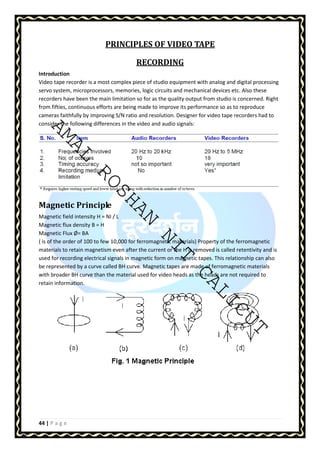
Video tape recorder is a most complex piece of studio equipment with analog and digital processing 
servo system, microprocessors, memories, logic circuits and mechanical devices etc. Also these 
recorders have been the main limitation so for as the quality output from studio is concerned. Right 
from fifties, continuous efforts are being made to improve its performance so as to reproduce 
cameras faithfully by improving S/N ratio and resolution. Designer for video tape recorders had to 
consider the following differences in the video and audio signals: 
Magnetic Principle 
Magnetic field intensity H = NI / L 
Magnetic flux density B = H 
Magnetic Flux Ø= BA 
( is of the order of 100 to few 10,000 for ferromagnetic materials) Property of the ferromagnetic 
materials to retain magnetism even after the current or the H is removed is called retentivity and is 
used for recording electrical signals in magnetic form on magnetic tapes. This relationship can also 
be represented by a curve called BH curve. Magnetic tapes are made of ferromagnetic materials 
with broader BH curve than the material used for video heads as the heads are not required to 
retain information.
WRITING SPEED AND FREQUENCY RESPONSE 
Recording Process 
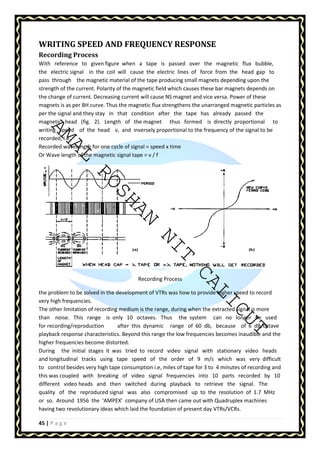
With reference to given figure when a tape is passed over the magnetic flux bubble, 
the electric signal in the coil will cause the electric lines of force from the head gap to 
pass through the magnetic material of the tape producing small magnets depending upon the 
strength of the current. Polarity of the magnetic field which causes these bar magnets depends on 
the change of current. Decreasing current will cause NS magnet and vice versa. Power of these 
magnets is as per BH curve. Thus the magnetic flux strengthens the unarranged magnetic particles as 
per the signal and they stay in that condition after the tape has already passed the 
magnetic head (fig. 2). Length of the magnet thus formed is directly proportional to 
writing speed of the head v, and inversely proportional to the frequency of the signal to be 
recorded, i.e. 
Recorded wavelength for one cycle of signal = speed x time 
Or Wave length of the magnetic signal tape = v / f 
AMAL ROSHAN NIT CALICUT 
45 | P a g e 
Recording Process 
the problem to be solved in the development of VTRs was how to provide higher speed to record 
very high frequencies. 
The other limitation of recording medium is the range, during when the extracted signal is more 
than noise. This range is only 10 octaves. Thus the system can no longer be used 
for recording/reproduction after this dynamic range of 60 db, because of 6 dB/octave 
playback response characteristics. Beyond this range the low frequencies becomes inaudible and the 
higher frequencies become distorted. 
During the initial stages it was tried to record video signal with stationary video heads 
and longitudinal tracks using tape speed of the order of 9 m/s which was very difficult 
to control besides very high tape consumption i.e, miles of tape for 3 to 4 minutes of recording and 
this was coupled with breaking of video signal frequencies into 10 parts recorded by 10 
different video heads and then switched during playback to retrieve the signal. The 
quality of the reproduced signal was also compromised up to the resolution of 1.7 MHz 
or so. Around 1956 the ‘AMPEX' company of USA then came out with Quadruplex machines 
having two revolutionary ideas which laid the foundation of present day VTRs/VCRs.
These ideas were: 
1. Rotating Video Heads and 
2. Frequency Modulation before recording 
Increase in writing speed by rotating head 
When a video head mounted on a rotating head wheel writes on a tape moving across it, will lay a 
track of length which will depend not only on the speed of the tape but also on the rotating speed of 
the head. Single head with diameter d number of rotation per sec as r and full omega wrap or two 
heads in ½ omega wrap i.e. little over 180 degree, which most of the present day VCR are using, will 
have a writing speed of dr minus or plus the linear tape speed (which is negligible as compared to 
the rotating stationary Monitoring AMAL speed). This avoids the requirements of miles of tape for few minutes of recording in a 
head type of recorders tried earlier. 
During Recording 
Most of the video tape recorders provide Electronics to Electronics monitoring (EE Mode) at the time 
of recording. The video signal is monitored after routing it through all the signal system electronics 
of the recorders excluding the video heads and preamplifiers etc. Some of the recorders also provide 
simultaneous playback for confidence heads. 
Thus the VTRs could achieve a) Faster writing speed 
ROSHAN the off tape monitoring by using additional heads during recording called 
wider frequency range with: 
b) Smaller gap, and 
c) Octave band compression with frequency modulation. 
Also achieving accurate speed for motors with servo system reduces the timing errors. 
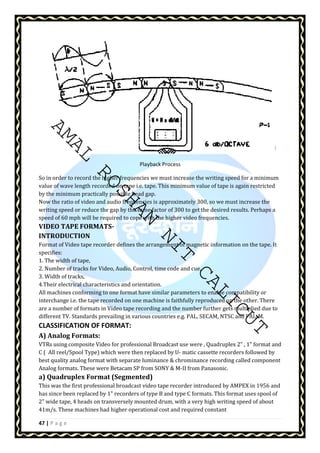
Playback process 
During play back when the recorded tape is passed was recorded, flux lines emerging from the tape on NIT over the head gap at the same speed at which it 
crossing the head gap induce voltage in the coil 
proportional to the rate of change of flux, i.e. d /dt and this in turn depends on the frequency of the 
recorded signal. Doubling of frequency causes voltage to increase by 6 dB. This 
accounts for the well known 6 dB/octave playback characteristics holds good only up to a certain limit thereafter at very high frequencies, during playback and recording process causing noise to be more than noted that when the gap becomes equal to the wavelength of the CALICUT 
of the recording medium. This 
lot of losses take place 
the signal itself. It may be 
recorded signal, two adjoining bar 
magnets may produce opposite current during playback and the output becomes zero. 
Similar thing happens when the gap equals 2, 3 …n. times the wavelength. First extinction 
frequency occurs when gap becomes equal to wavelength. For getting maximum output, 
head gap has to be one half of wavelength. 
Frequency at which zero output occurs is called extinction frequency . Thus the maximum 
usable frequency becomes half of the extinction frequency. These parameters are related by: 
46 | P a g e
AMAL ROSHAN NIT CALICUT 
47 | P a g e 
Playback Process 
So in order to record the higher frequencies we must increase the writing speed for a minimum 
value of wave length recorded on tape i.e. tape. This minimum value of tape is again restricted 
by the minimum practically possible head gap. 
Now the ratio of video and audio frequencies is approximately 300, so we must increase the 
writing speed or reduce the gap by the same factor of 300 to get the desired results. Perhaps a 
speed of 60 mph will be required to cope with the higher video frequencies. 
VIDEO TAPE FORMATS-INTRODUCTION 
Format of Video tape recorder defines the arrangement of magnetic information on the tape. It 
specifies: 
1. The width of tape, 
2. Number of tracks for Video, Audio, Control, time code and cue, 
3. Width of tracks, 
4.Their electrical characteristics and orientation. 
All machines conforming to one format have similar parameters to enable compatibility or 
interchange i.e. the tape recorded on one machine is faithfully reproduced on the other. There 
are a number of formats in Video tape recording and the number further gets multiplied due to 
different TV. Standards prevailing in various countries e.g. PAL, SECAM, NTSC and PAL-M. 
CLASSIFICATION OF FORMAT: 
A) Analog Formats: 
VTRs using composite Video for professional Broadcast use were , Quadruplex 2” , 1 format and 
C ( All reel/Spool Type) which were then replaced by U- matic cassette recorders followed by 
best quality analog format with separate luminance  chrominance recording called component 
Analog formats. These were Betacam SP from SONY  M-II from Panasonic. 
a) Quadruplex Format (Segmented) 
This was the first professional broadcast video tape recorder introduced by AMPEX in 1956 and 
has since been replaced by 1 recorders of type B and type C formats. This format uses spool of 
2 wide tape, 4 heads on transversely mounted drum, with a very high writing speed of about 
41m/s. These machines had higher operational cost and required constant
engineering efforts to keep them running. These machines have since been phased out except 
for transfer/archival purpose. 
b) Type B Format (Segmented helical) 
This format was developed by BOSCH/BTS using helical scan with 1 tape as BCN series of Video 
Tape recorders. It uses a scanner with head wheel carrying two video heads around which tape 
is wrapped in about 190o. Each television field is recorded on six tracks with each head 
scanning a 52 line segment. The scanner diameter is 50mm and rotates at 150 
rev/sec. The tape moves at 24cms/sec. The 80 mm long tracks are recorded at an angle of 
14.3o. There are four longitudinal tracks out of which two are full quality audio tracks, third for 
the time code and the fourth for the control track. Video writing speed is 24m/s. The 
flying erase head mounted on the same head- wheel and the associated electronics 
allows for roll free electronic editing. The addition of digital frame store unit provides freeze 
frame and slow motion. The portable version in the same format has also been marketed by the 
manufacturers for studio use. 
c) Type C Format (field per scan helical) 
This is the combined format of AMPEX and SONY using 1 tape with a full omega wrap around a 
helical scanner running at 50 rps. Main head mounted on a 135 mm dia drum records one field 
i.e. 
B). DIGITAL FORMATS 
Modern television post production demands multi-layer special effects with several 
manipulations having first generation quality. This requires multi-generation playback  a 
transparent recordings from Video cassette players./recorders. which can be met only by the 
digital formats without loss in picture quality. 
Digital Composite/Component Formats 
A) D1 format was the first DVTR not to compromise on the technical quality in 
any way. It is based on 4:2:2 sampling structure of CCIR-601, completely 
transparent in quality but very expensive and bulky. Still it is considered as reference 
machine for digital formats and known as father of all digital formats. 
It uses 3/4 tape  has a writing speed of about 30m/s.Its drum is running at 150 
rps with segmented tracks. Digital coding is in 8-bit words with a raw picture data rate of 216 
Mbps. 
b) D2 format was the first economical DVTR based on CCIR - 601, 4 fsc sampling on composite 
video. It offered easy interface to a composite world at a reasonable cost. It was soon 
overshadowed by the then forthcoming D 3 format. 
c) D3: D3 was developed by NHK and Panasonic using composite system, 1/2 metal particle 
VHS sized cassette thus saving cost. It records 8 bit digital video at a sampling rate of 4 fsc 
(17.73MHz) in 8 tracks per field. Data rate is similar to D2. 
AMAL ROSHAN NIT CALICUT 
d) D4: 4 is perhaps an unlucky number in Japan as there is no D4. 
e) D5: Panasonic's new component system D5 is a successor to D3. It is digital component 
using same cassettes as D3 but running at double speed. In addition to all the 
usual facilities, D5 can playback existing D3 tapes. It gives just 2 hours from a 
long size cassette. Coding is 10-bit with luminance sampling at 13.5 MHz. D5 can handle 
4:3 or 16:9 aspect ratio with full restoration. For 16:9, sampling rate is 18 MHz with 8-bit coding 
Based on CCIR 601. It is without any data compression. 
48 | P a g e
Digital Betacam: 
It is based on CCIR 601, and allows 16:9 upgrades. To reduce data rate it uses Bit Rate reduction 
(BRR).Bit rate reduction is in the ratio of 2:1. This has been made possible because of the 
conversion of data from time domain to frequency domain and removing the redundancy from 
the digital video data. Equivalent system without BRR would have required more tape speed, 
extra thin tape, and extra narrow tracks and would have also needed double the number of 
heads on drum or double the drum speed. It is compatible with Betacam SP and is having 4 PCM 
Digital Audio Track. Scanner for this machine is larger then that of Betacam SP but the helix is 
such that when rotated at frame rate ,track angle of analog Betacam is traced .This gives a time 
compressed replay is which is then expanded in TBC. For digital Betacam, to handle large data 
the scanner speed is increased to 3 times. One field is recorded in one and half revolution in 6 
tracks of 26 Micrometers each. 
BETACAM VIDEO CASSETTE RECORDERS-INTRODUCTION: 
AMAL ROSHAN NIT CALICUT 
Betacam series of VCRs are based on analog component system. These VCRs had become 
popular because of their low initial and running costs in comparison to B and C Format 
machines. The quality of reproduction of Betacam SP was near to these analog formats. Betacam 
format was introduced in 1982 followed by Betacam SP in 1987. Popular Betacam SP VCRs 
which are being replaced with digital VCRs in doordarshan are:- BVW 75P - SP Recorder cum 
player, with DT head (Slow motion heads for dynamic tracking)  PVW 2800P PRO SERIES 
besides camcorder and portable version of this format . 
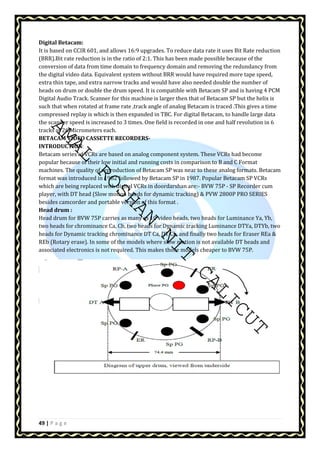
Head drum : 
Head drum for BVW 75P carries as many as 10 video heads, two heads for Luminance Ya, Yb, 
two heads for chrominance Ca, Cb, two heads for Dynamic tracking Luminance DTYa, DTYb, two 
heads for Dynamic tracking chrominance DT Ca, DT Cb, and finally two heads for Eraser REa  
REb (Rotary erase). In some of the models where slow motion is not available DT heads and 
associated electronics is not required. This makes those models cheaper to BVW 75P. 
49 | P a g e
VIDEO SYSTEM 
Video system is based on component analog system. Composite video is decoded into its 
component, Luminance Y and colours as R-Y  B-Y. You may note that these colour signal are 
base band signal and have nothing to do with 4.43MHz subcarrier frequency. Y is recorded 
directly after FM on one of the video tracks by Ya  Yb head. Chrominance signals are first 
compressed as CTDM signal (Compressed time division multiplexing) and then frequency 
modulated. This FM chroma is then mixed with AFM audio channel 3  4 before it is recorded 
along with chrominance information. 
AMAL ROSHAN NIT CALICUT 
50 | P a g e 
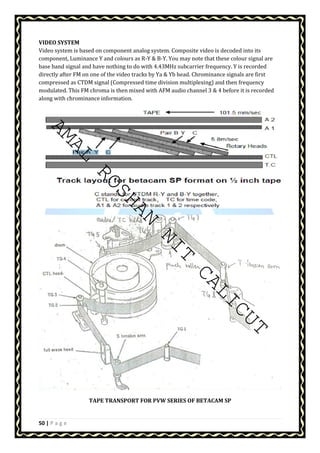
TAPE TRANSPORT FOR PVW SERIES OF BETACAM SP
AMAL ROSHAN NIT CALICUT 
DIGITAL VIDEO CASSETTE RECORDER PROFESSIONAL (DVCPRO)- 
INTRODUCTION 
With the advent of digital signals, breakthrough came in the field of recording from 
analog recording to digital recording around the year 1990. In the series of 
development of digital tape recording systems, it is felt to have a system which 
should be handy for the purpose of field recording along with capability of long 
duration recording. A recording format is developed by a consortium of ten companies 
as a consumer digital video recording format called “DV”. DV (also called ”mini DV” in its 
smallest tape form) is known as DVC (Digital Video cassette). DVCAM is a professional variant of 
the DV, developed by Sony and DVCPRO on the other hand is a professional variant of the 
DV, developed by Panasonic. These two formats differ from the DV format in terms of 
track width, tape speed and tape type. Before the digitized video signal hits the tape, it is the 
same in all three formats. 
What is DV? DV is a consumer video recording format, developed by a consortium of 10 
companies and later on by 60 companies including Sony, Panasonic, JVC, Phillips etc., was 
launched in 1996. in this format, video is encoded into tape in digital format with intra frame 
51 | P a g e
DCT compression using 4:1:1 chroma subsampling for NTSC (or 4:2:0 for PAL). This makes it 
straightforward to transfer the video onto computer for editing due to its intra frame 
compression technique. DV tapes come in two formats: MiniDV size (66mm x 48mm x 12.2mm) 
and DV, the standard full size (125mm x 78mm x 14.6mm). They record digital compressed 
video by a DCT method at 25 Megabit per second. In terms of video quality, it is a 
step up from consumer analog formats, such as 8mm, VHS-C and Hi-8. 
What is DVCPRO? 
DVCPRO is a professional variant of the DV, developed by Panasonic. In DVCPRO, 
the baseband video signal is converted to 4:1:1 sampled data sequence from the originally 
sampled 4:2:2 signal by the method of subsampling and the resulted data are converted into 
blocks which are shuffled before passing through compression circuitry and again reshuffled 
back to their original position after compression. It is to mention here that still 
pictures containing little or no movement are compressed using intra frame compression 
whereas the pictures with large amounts of movements are coded and compressed in intra field 
form. Error correction code is added to the compressed and reshuffled data sequence by 
using Reed Solomon product code before it is sent to recording modulation method. 
The modulated data sequence generated by 24-25 coding method using scrambled 
NRZI is recorded onto the tape via video head. 
AMAL ROSHAN NIT CALICUT 
Within the DV(Digital Video) format, audio can be recorded in either 2 channel (1 left and 1 
right) or 4 channel mode (2 stereo pairs). In the DVCPRO format the audio is 2 
channel record mode only, though provision is made to replay 4 channel type DV 
tapes. It is to mention here that audio data is recorded un-compressed. 
2 Channel Audio Record Mode 
The audio signal is digitized by sampling the analog audio signal with 48 kHz 
sampling frequency and quantized the samples by 16-bit linear quantizer. In PAL 
(625/50 Hz) DVCPRO system, one frame of video occupies 12 tracks on the tape. One frame 
corresponds to 40 milliseconds(25 frames/sec implies 1 frame/40 msec). So 40 
milliseconds of audio data (per channel) is recorded into 12 track frame period. At 48kHz 
sampling frequency, 1920 samples are generated in 40 msec(40 x 48 = 1920) which 
have to be accommodated in 6 tracks. DVCPRO format fix the first six tracks for data belonging 
to the channel 1 input and the second six tracks for data belonging to channel 2. Each track 
contains 1920/6 = 320 samples(320 x 16 bits = 640 bytes) which can be 
memorized in 9 x 72 matrix in processing module. 
52 | P a g e
AMAL ROSHAN NIT CALICUT 
53 | P a g e 
VISION MIXING 
Introduction 
Vision mixing is a process of creating composite pictures from various sources. 
Vision mixing involves basically three types of switching or transitions between various sources. 
These are mixing, wiping and keying. These transitions can also be accompanied by special 
effects in some of the vision mixers. 
Mixing 
Two input sources are mixed in proportion in a summing amplifier as decided by 
the position of control fader. Two extreme position of the fader gives either of the sources at the 
output. Middle of the fader gives mixed output of the two sources; control to the 
summing amplifier is derived from the fader. 
Wipe 
In this case the control for the two input sources is generated by the wipe pattern 
generator (WPG), which can either be saw tooth or parabola at H, V or both H  
V rate. Unlike in MIX, during WIPE, one source is present in one side of the wipe and the 
second source on other side of the wipe. A very simple to very complex wipe 
patterns can be generated from the WPG. 
Key 
In the Key position between two sources i.e. foreground (FG) and background (BG) 
the control derived from one of the source itself (overlay), or by the third source 
(external key). This keying signal can be generated either by the luminance, Hue or 
chrominance of the source input. The keyed portion can be filled with the same or with matte or 
external source. Matte means internally generated BG with choice of colors from the vision 
mixer.
AMAL ROSHAN NIT CALICUT 
54 | P a g e 
NON LINEAR EDITING  3-D GRAPHICS-INTRODUCTION 
Fundamentally editing is a process where one places Audio video clips in an appropriate 
sequence and mainly used in video post production. Linear editing is tape based and is 
sequential in nature. It has various problems like long hours spent on rewinding of tapes in 
search of material, potential risk of damage to original footage, difficult to insert a new shot in 
an edit, difficult to experiment with variations, quality loss is more, limited composting effects 
and color correction capability. Non-linear editing (NLE) is a video editing in digital 
format with standard computer based technology. NLE can also be extended to film editing. 
Computer technology is harnessed in Random access, computational and manipulation 
capability, multiple copies, multiple versions intelligent search, sophisticated project 
and media management tools, standard interfaces and powerful display. 
ADVANTAGES OF NLE 
NLE has various advantages over tape based (linear) editing. 
Flexibility in all editing functions. 
Easy to do changes, undo, copy, duplicate and multiple version. 
Easy operation for cut, dissolve, wipes and other transition effects. 
Multi-layering of video is easy. 
Powerful integration of video and graphics, tools for filtering, color correction, key 
framing and special 2D/3D effects. 
Equally powerful audio effects and mixing. 
Possible to trim ; compress or expand the length of the clip. 
Intelligent and powerful 3D video effect can be created and customized. 
Efficient and intelligent storage.
BREAKOUT BOX-Various 
video sources like VTR, CD player, camera and other playback/recording devices are 
connected to NLE machine through breakout box. The NLE machine takes input from various 
video sources for editing and gives output for monitoring and recording through break out box. 
AMAL ROSHAN NIT CALICUT 
INPUTS 
Video Inputs 
There are three analog inputs (1) Component Video (2) S-Video (3) Composite video 
Audio Inputs 
To capture synchronized audio with your video, you must connect audio out from the VTR or 
other play back device to the audio inputs. You can also connect audio only devices for sound 
track production etc. the dps reality board (NLE hardware) has three analog audio options ; 
balanced, unbalanced and Aux. 
55 | P a g e
AMAL ROSHAN NIT CALICUT 
Time Code 
Time code is simply a series of labels attached to a recording at timed intervals, generally 
fractions of sounds. Each label contains a time of recording. Time code is used for editing; in 
order to be able to return repeatedly to a selected time, and for synchronization among audio 
and video recorders and players. The two versions of time code that are available with dps 
OUTPUTS 
Video Output 
Component (CAV) Video has three connectors, labeled Y, B-Y, R-Y. A cable connects each of these 
three outputs to your video monitor or VTR. 
Audio Output 
Choose what type of video to output based on whether your VTR and other video and audio 
equipment can receive balance or unbalance audio. Audio out is connected to speakers for 
playback or to a VTR or other audio recording device during recording. 
56 | P a g e
AMAL ROSHAN NIT CALICUT 
3 –D GRAPHICS 
THE FIVE MODULES OF SOFTIMAGE 
Softimage 3 D Extreme has given different modules that correspond to different 
phases of the workflow process you use to create animation. Each of the modules replaces 
some of the menu cells on the left and right menu columns, while leaving other menu 
cells that are applicable in all modules. The modules are listed along the top right 
corner of the screen: Model, Motion, Actor, Matter, and Tools. You can enter these 
modules either by clicking the text labels in the top right corner, or by pressing the 
supra keys that represent them: F1 for Model, F2 for Motion, F3 for Actor, F4 for Matter, and F5 
for Tools. 
MODEL 
You start your workflow in the Model module, where you construct all your scene 
elements. Model's tools enable you to create objects from primitive shapes, draw 
curves, and develop surfaces from those curves. 
MOTION 
You then move to animate some parts of your scene, using the animation tools found in the 
Motion module. The Motion module allows you to set animation keyframes for 
objects, assign objects to paths, and to see and edit the resulting animation on screen. After 
you have refined your animation using the F Curve tools, you move to the next module, Actor. 
ACTOR 
The Actor module contains the special Softimage tools for setting up virtual actors, 
assigning inverse kinematic skeletons, assigning skin, adjusting skeletons deformations, and 
weighting the skin to the IK skeletons. Actor also contains the controls for physical-based 
animation–Dynamics,Collisions and Qstretch–which is an automatic squash-and-stretch 
features. 
MATTER 
When your modeling, animation, and acting are complete, you move to the fourth module: 
Matter. In the Matter module, you assign color and material values to the objects in your scene, 
determining how they will look in the final render. 
57 | P a g e
At any time in the first four modules, you can create lights and adjust their effect on the scene. 
The Matter module is also where you perform the last step in the workflow process, rendering. 
TOOLS 
Tools contains a variety of utility programs for viewing, editing and exporting your work. You 
may view individual images, sequences of images, and line tests. You may bring in images 
created in other programmes as image maps or import objects created in other programs as 
geometry. You can composite sequences of images together, reduce colours in sequences of 
images for reduced colour games systems, and move your finished work to video disk recorders 
and film recorders. 
AMAL ROSHAN NIT CALICUT 
58 | P a g e 
The Four View Windows
TELEVISION TRANSMISSION 
VESTIGIAL SIDE BAND TRANSMISSION - If normal amplitude modulation technique is used 
for picture transmission, the minimum transmission channel bandwidth should be 
around 11 MHz taking into account the space for sound carrier and a small guard band of 
around 0.25 MHz. Using such large transmission BW will limit the number of channels 
in the spectrum allotted for TV transmission. To accommodate large number of 
channels in the allotted spectrum, reduction in transmission BW was considered 
necessary. The transmission BW could be reduced to around 5.75 MHz by using single side band 
(SSB) AM technique, because in principle one side band of the double side band (DSB) AM could 
be suppressed, since the two side bands have the same signal content. 
AMAL ROSHAN NIT CALICUT 
Design 
All the TV transmitters have the same basic design. They consist of an exciter followed by power 
amplifiers which boost the exciter power to the required level. 
Exciter 
The exciter stage determines the quality of a transmitter. It contains pre-corrector 
units both at base band as well as at IF stage, so that after passing through all subsequent 
transmitter stages, an acceptable signal is available. Since the number and type of amplifier 
stages, may differ according to the required output power, the characteristics of the pre-correction 
circuits can be varied over a wide range. 
Block Diagram of TV Exciter (Mark-II) 
Vision and Sound Signal Amplification 
In HPTs the vision and sound carriers can be generated, modulated and amplified separately 
and then combined in the diplexer at the transmitter output. In LPTs, on the other hand, sound 
and vision are modulated separately but amplified jointly. This is common vision and aural 
amplification. A special group delay equalization circuit is needed in the first case because of 
errors caused by TV diplexer. In the second case the intermodulation products are more 
prominent and special filters for suppressing them is required.As it is difficult to meet the 
intermodulation requirements particularly at higher power ratings, separate 
59 | P a g e
amplification is used in HPTs though combined amplification requires fewer amplifier 
stages. 
IF Modulation 
It has following advantages 
1. Ease of correcting distortions 
2. Ease in Vestigial side band shaping 
3. IF modulation is available easily and economically 
Power Amplifier Stages 
In BEL mark I  II transmitters three valve stages (BEL 450 CX, BEL 4500 CX and BEL 15000 
CX) are used in vision transmitter chain and two valves (BEL 450 CX and BEL 4500 CX) in aural 
transmitter chain. In BEL mark III transmitter only two valve stages (BEL 4500 CX and BEL 
15000 CX) are used in vision transmitter chain. Aural transmitter chain is fully solid state in 
Mark III transmitter. 
Constant Impedance Notch Diplexer (CIND) 
Vision and Aural transmitters outputs are combined in CIN diplexer. Combined power is fed to 
main feeder lines through a T-transformer. 
BEL 10 kW TV TRANSMITTER (MARK-II) 
AMAL ROSHAN NIT CALICUT 
60 | P a g e 
Block Diagram of BEL 10kW TV Transmitter (Mark-II) 
TRANSMITTER CONTROL SYSTEM 
The transmitter control unit performs the task of transmitter interlocking and control. Also it 
supports operation from control console. The XTR control unit (TCU) has two independent 
system viz. 
1. Main control system. (MCS) 
2. Back-up Control System (BCS)
Functions performed by MCS (Main Control System) 
- XTR control 
- Interlocking 
- RF monitoring 
- Supporting operation from control console 
- Three second logic for protection against sudden fluctuation. 
- Thermal protection for 1 kW and 10 kW vision PAs 
- Thermal protection for 130 Watt vision PA and Aural XTRa 
- Mimic diagram 
Functions performed by BCS (Backup control system) 
AMAL ROSHAN NIT CALICUT 
- Transmitting control 
- Interlocking 
The block diagram of the TCU (Transmitter control unit) indicates the connectivity 
of TCU with control console and the control elements of the transmitter. Commands are 
inputs through the key board. The control elements are controlled in accordance with 
the programme fused in the EPROMS. 
Only while operating from the MCS (Main Control System), the interaction with TCU is 
supported through a LCD display unit. The LED bar display board showing the status 
information, is used by both the MCS and BCS (Back up Control Unit). 
Main Control System (MCS) 
The MCS consists of the following : 
1. Mother Board with the following PCBs. 
CPU 
BIT I/O 
Interlock Interface Board (IIB). 
Analog I/O Board (AIO) 
Control Interface Board (CIB) 
Analog Receiver Board (An Rx) 
Rectifier and Regulator Board (RRB mcs) 
2. Key Board 
3. LED Bar Display Board 
4. Relay Board 
5. LCD Display Unit 
6. Transformers T1 and T2 . 
7. + 5V/3A. Power Supply Unit. 
61 | P a g e
AMAL ROSHAN NIT CALICUT 
62 | P a g e 
TV TRANSMITTER 
Antenna System is that part of the Broadcasting Network which accepts RF Energy 
from transmitter and launches electromagnetic waves in space. The polarization of the 
radiation as adopted by Doordarshan is linear horizontal. The system is installed on a 
supporting tower and consists of antenna panels, power dividers, baluns, branch feeder cable, 
junction boxes and main feeder cables. Dipole antenna elements, in one or the other form are 
common at VHF frequencies where as slot antennae are mostly used at UHF frequencies. Omni 
directional radiation pattern is obtained by arranging the dipoles in the form of turnstile 
and exciting the same in quadrature phase. Desired gain is obtained by stacking the 
dipoles in vertical plane. As a result of stacking, most of the RF energy is directed in the 
horizontal plane. Radiation in vertical plane is minimized. 
The installed antenna system should fulfil the following requirements : 
a) It should have required gain and provide desired field strength at the point of reception. 
b) It should have desired horizontal radiation pattern and directivity for serving the planned area of 
interest. The radiation pattern should be omni directional if the location of the transmitting station is 
at the center of the service area and directional one, if the location is otherwise. 
c) It should offer proper impedance to the main feeder cable and thereby to the transmitter so that 
optimum RF energy is transferred into space. Impedance mismatch results into reflection of power 
and formation of standing waves. The standard RF impedance at VHF/UHF is 50 ohms.
AMAL ROSHAN NIT CALICUT 
63 | P a g e 
Outdoor Broadcasting Van (OB Van) 
O B Van (Outdoor Broadcasting van )- OB van is used for live broadcasting like any match or any 
event. It consist all the equipments that is present in the studio for telecasting. It also referring as 
mini studio . It has mainly 3 parts : 
1)Power supply unit 
2)Production control unit 
3)Audio console and VTR 
Inner View of OB van 
Inner View of OB van
AMAL ROSHAN NIT CALICUT 
64 | P a g e 
EARTH STATION 
SATELLITE COMMUNICATION 
Satellite Communication is the outcome of the desire of man to achieve the concept of global village. 
Penetration of frequencies beyond 30 Mega Hertz through ionosphere force people to think that if 
an object (Reflector) could be placed in the space above ionosphere then it could be possible to use 
complete spectrum for communication purpose. 
Intelsat-I (nick named as Early Bird) was launched on 2 April 1965. This was parked 
in geosynchronous orbit in Atlantic ocean and provided telecommunication or 
television service between USA and Europe. It had capacity for 240 one way telephone 
channels or one television channel. Subsequently Intelsat-II generation satellites were launched 
and parked in Atlantic ocean and Pacific Ocean. During Intelsat III generation, not only Atlantic and 
Pacific ocean got satellites but also Indian Ocean got satellite for the first time. Now Arthur 
C.Clarke's vision of providing global communication using three Satellites with about 120 degrees 
apart became a reality. So far Intelsat has launched 7 generations of geosynchronous 
satellites in all the three regions namely Atlantic Ocean, Pacific Ocean and Indian Ocean. 
For national as well as neighbouring countries coverage, some of the following satellites are used: 
ANIK : Canadian satellite system I 
NSAT : Indian Satellites 
AUSSAT : Australian Satellites 
BRAZILSAT : Brazilian Satellites 
FRENCH TELECOM : French Satellites 
ITALSAT : Italian Satellites 
CHINASAT : Chinese Satellites 
STATSIONAR, GORIZONT, Russian Satellites 
Architecture of a Satellite Communication System 
The Space Segment 
The space segment contains the Satellite and all terrestrial facilities for the control and monitoring of 
the Satellite. This includes the tracking, telemetry and command stations (TTC) together with the 
Satellite control centre where all the operations associated with station-keeping and checking the 
vital functions of the satellite are performed. In our case it is Master Control Facility (MCF) at 
Hassan. 
The radio waves transmitted by the earth stations are received by the satellite ; this is called the up 
link. The satellite in turn transmits to the receiving earth stations ; this is the down link. The quality 
of a radio link is specified by its carrier-to-noise ratio. The important factor is the quality of the total 
link, from station to station, and this is determined by the quality of the up link and that of the down 
link. The quality of the total link determines the quality of the signals delivered to the end user in 
accordance with the type of modulation and coding used.
AMAL ROSHAN NIT CALICUT 
The Ground Segment 
The ground segment consists of all the earth stations ; these are most often connected to the 
end- user's equipment by a terrestrial network or, in the case of small stations (Very 
Small Aperture Terminal, VSAT), directly connected to the end-user's equipment. 
Stations are distinguished by their size which varies according to the volume of traffic to be 
carried on the space link and the type of traffic (telephone, television or data). The largest are 
equipped with antenna of 30 m diameter (Standard A of the INTELSAT network). The 
smallest have 0.6 m antenna (direct television receiving stations). Fixed, 
transportable and mobile stations can also be distinguished. Some stations are both 
transmitters and receivers. 
Space Geometry 
Types of Orbit 
The orbit is the trajectory followed by the satellite in equilibrium between two 
opposing forces. These are the force of attraction, due to the earth's gravitation, directed 
towards the centre of the earth and the centrifugal force associated with the curvature 
of the satellite's trajectory. The trajectory is within a plane and shaped as an ellipse with a 
maximum extension at the apogee and a minimum at the perigee. The satellite moves more 
slowly in its trajectory as the distance from the earth increases. 
Most favourable Orbits 
Elliptical orbits inclined at an angle of 64o with respect to the equatorial plane. This orbit 
enables the satellite to cover regions of high latitude for a large fraction of the orbital period as 
it passes to the apogee. This type of orbit has been adopted by the USSR for the 
satellites of the MOLNYA system with a period of 12 hours. Please note that the satellite 
remains above the regions located under the apogee for a period of the order of 8 hours. 
Continuous coverage can be ensured with three phased satellites on different orbits. 
65 | P a g e
Circular inclined orbits : 
The altitude of the satellite is constant and equal to several hundreds of kilometers. The period 
is of the order of one and a half hours. With near 90% inclination this type of orbit guarantees 
that the satellite will pass over every region of the earth. Several systems with world wide 
coverage using constellations of satellite carries in low altitude circular orbits are for e.g. 
IRIDIUM, GLOBAL STAR, ODYSSEY, ARIES, LEOSAT, STARNET, etc. 
Circular orbits 
with zero inclination (Equatorial orbits). The most popular is the geo stationary satellite orbits ; 
the satellite orbits around the earth at an altitude of 35786 km, and in the same direction as the 
earth. The period is equal to that of the rotation of the earth and in the same direction. The 
satellite thus appears as a point fixed in the sky and ensures continuous operation as a radio 
relay in real time for the area of visibility of the satellite (43% of the earth's surface). 
Factors deciding the selection of Orbit 
The choice of orbit depends on the nature of the mission, the acceptable 
interference and the performance of the launchers : 
The extent and latitude of the area to be covered. 
The elevation angle of earth stations. 
Transmission duration and delay. 
Interference 
The performance of launchers 
AMAL ROSHAN NIT CALICUT 
66 | P a g e 
TVRO System 
Presently Doordarshan is up linking its national, metro and regional services to INSAT-2A (74oC) and 
INSAT-2B (93.5oE) and INSAT 2E (83o C). Down link frequency bands being used are C-Band (3.7-4.2 
GHz) and Ex-C Band (4.5-4.8 GHz). 
Transmission of base band to Satellite 
The base band signal consists of video (5 MHz), two audio subcarriers (5.5 MHz  5.75 MHz) and 
energy dispersal signal (25 Hz). After modulation (70 MHz) and upconversion (6 GHz) the carrier is 
amplified and uplinked through Solid Parabolic Dish Antenna (PDA). Down link signal can be received 
through same PDA using Trans-Receive Filter (TRF) and Low Noise Amplifier (LNA). After down 
conversion to 70 MHz, it is demodulated to get audio and video.
Satellite Transponder 
As shown in fig, the uplinked signal (6 GHz) at satellite is received, amplified and down converted to 
4 GHz band and sent back through filter and power amplifier (TWT). The local oscillator frequency of 
down converter is 2225 MHz for C band and Ex-C band transponders. 
AMAL ROSHAN NIT CALICUT 
67 | P a g e 
Block Diagram of Satellite Transponder 
Receiving Satellite Signal 
For receiving a satellite signal we need following equipment : 
1. Satellite receiving antenna (PDA). 
2. Feed with low noise block converter (LNBC). 
3. Indoor unit consisting of satellite system unit and a Synthesised satellite receiver. 
Parallels of Latitudes Latitude as Angular Distance
AMAL ROSHAN NIT CALICUT 
68 | P a g e 
Direct-to-Home Satellite Broadcasting (DTH) 
INTRODUCTION 
There was always a persistent quest to increase the coverage area of broadcasting. 
Before the advent of the satellite broadcasting, the terrestrial broadcasting, which is 
basically localized, was mainly providing audio and video services. The terrestrial broadcasting has 
a major disadvantage of being localized and requires a large number of transmitters to cover a big 
country like India. It is a gigantic task and expensive affair to run and maintain the large number of 
transmitters. Satellite broadcasting, came into existence in mid sixties, was thought to 
provide the one-third global coverage simply by up-link and down-link set-ups. In the 
beginning of the satellite broadcasting, up-linking stations (or Earth Stations) and satellite 
receiving centers could had only been afforded by the Governments organizations. The main 
physical constraint was the enormous size of the transmitting and receiving parabolic 
dish antennas (PDA). In the late eighties the satellite broadcasting technology had 
undergone a fair improvements resulting in the birth of cable TV. Cable TV operators set 
up their cable networks to provide the services to individual homes in local areas. It rapidly grew 
in an unregulated manner and posed a threat to terrestrial broadcasting. People are now 
mainly depending on cable TV operators. Since cable TV services are unregulated and unreliable in 
countries like India now, the satellite broadcasting technology has ripened to a level where 
an individual can think of having direct access to the satellite services, giving the 
opportunity to viewers to get rid of cable TV. Direct-to-Home satellite broadcasting (DTH) or Direct 
Satellite Broadcasting (DBS) is the distribution of television signals from high powered 
geo- stationary satellites to a small dish antenna and satellite receivers in homes across the country. 
The cost of DTH receiving equipments is now gradually declining and can be afforded by common 
man. Since DTH services are fully digital, it can offer value added services, video-on-demand, 
Internet, e- mail and lot more in addition to entertainment. DTH reception requires a small dish 
antenna (Dia 60 cm), easily be mounted on the roof top, feed along with Low Noise Block Converter 
(LNBC), Set- up Box (Integrated Receiver Decoder, IRD) with CAS (Conditional Access System). A 
bouquet of 40 to 50 video programs can simultaneously be received in DTH mode. 
UPLINK CHAIN 
DTH broadcasting is basically satellite broadcasting in Ku-Band (14/12 GHz). The main advantage of 
Ku-Band satellite broadcasting is that it requires physically manageable smaller size of 
dish antenna compared to that of C-Band satellite broadcasting. C-Band broadcasting requires about 
3.6 m dia PDA (41dB gain at 4 GHz) while Ku-Band requires 0.6 m dia PDA (35dB gain at 12 GHz). The 
shortfall of this 6 dB is compensated using Forward Error Correction (FEC), which can offer 8 to 9 dB 
coding gain in the digital broadcasting. Requirement of transmitter power (about 25 to 
50 Watts) is less than that of analog C-band broadcasting. The major drawback of 
Ku-Band transmission is that the RF signals typically suffer 8 to 9dB rain attenuation under heavy 
rainfall while rain attenuation is very low at C-Band. Fading due to rain can hamper 
the connectivity of satellite and therefore rain margin has to be kept for reliable connectivity. Rain 
margin is provided by operating transmitter at higher powers and by using larger size of the dish 
antenna (7.2m PDA). Fig.1 shows schematic of uplink chain proposed to broadcast 
bouquet of 30 video programs in Doordarshan, Prasar Bharati, India. 30 video programs may
either be down-linked from satellites or taken from other sources like video tape recorders, video 
cameras etc. in digital format. These sources are fed to Router whose outputs are divided in three 
groups A, B and C. Each group contains 10 video sources multiplexed in a Multiplexer. These three 
multiplexed streams are digitally (QPSK modulation) modulated individually at 70 MHz Intermediate 
Frequency (IF). Each group is further doubly up-converted, first conversion at L-Band (950-1450 
MHz) and second conversion at Ku-Band (12-14 GHz). 
AMAL ROSHAN NIT CALICUT 
DOWN-LINK CHAIN 
Down-Link or receiving chain of DTH signal is depicted in Fig.2. There are mainly three 
sizes of receiving antenna, 0.6m, 0.9m, and 1.2m. Any of the sizes can easily be 
mounted on rooftop of a building or house. RF waves (12.534GHz, 12.647GHz, 12.729 GHz) from 
satellite are picked up by a feed converting it into electrical signal. The electrical signal is 
amplified and further down converted to L-Band (950-1450) signal. Feed and LNBC are 
now combined in single unit called LNBF. The L-Band signal goes to indoor unit, consisting a 
set-top box and television through coaxial cable. The set-top box or Integrated Receiver 
Decoder (IRD) down converts the L-Band first IF signal to 70 MHz second IF signal, 
perform digital demodulation, de-multiplexing, decoding and finally gives audio/video output 
to TV for viewing. 
69 | P a g e
AMAL ROSHAN NIT CALICUT 
70 | P a g e
AMAL ROSHAN NIT CALICUT

Doordarshan patna summer training

  • 1.
    AMAL ROSHAN 20 1 NIT 3 CALICUT SUBMITTED TO- SUBMITTED BY-MMMMDDDD.... YYYYUUUUSSSSUUUUFFFF SSSSIIIIRRRR AAAAMMMMAAAALLLL RRRROOOOSSSSHHHHAAAANNNN MMMMAAAAHHHHEEEESSSSHHHH LLLLEEEEPPPPCCCCHHHHAAAA SSSSIIIIRRRR NNNNIIIITTTT CCCCAAAALLLLIIIICCCCUUUUTTTT ((((2222000011111111-11115555)))) SSSSEEEERRRRIIIIAAAALLLL NNNNOOOO -- 00008888
  • 2.
    DECLARATION I HEREBYDECLARE THAT WORK ENTITLED “SUMMER TRAINING REPORT”, SUBMITTED TOWARDS COMPLETION OF SUMMER TRAINING AFTER 2ND YEAR OF B.TECH (ECE) AT NATIONAL INSTITUTE OF TECHNOLOGY (NIT) CALICUT , COMPRISES OF MY ORIGINAL WORK PURSUED UNDER THE GUIDANCE OF MR. MAHESH LEPCHA. THE RESULTS EMBODIED IN THIS REPORT HAVE NOT BEEN SUBMITTED TO ANY OTHER INSTITUTE OR UNIVERSITY FOR ANY AWARD. AMAL ROSHAN NIT CALICUT AMAL ROSHAN B.TECH(2ND YEAR)
  • 3.
    CERTIFICATE AMAL ROSHANNIT CALICUT THIS IS TO CERTIFY THAT MR. AMAL ROSHAN, A STUDENT OF B.TECH, FROM NATIONAL INSTITUTE OF TECHNOLOGY, CALICUT COMPLETED A 4 WEEK VOCATIONAL SUMMER TRAINING PROGRAM AT DOORDARSHAN PATNA, UNDER MY GUIDANCE AND DIRECTION. SIGNATURE OF THE GUIDE
  • 4.
    ACKNOWLEDGEMENT ON THEVERY OUTSET OF THIS REPORT, I WOULD LIKE TO EXTEND MY SINCERE & HEARTFELT OBLIGATION TOWARDS ALL THE PERSONAGES WHO HAVE HELPED ME IN THIS ENDEAVOR. WITHOUT THEIR ACTIVE GUIDANCE, HELP, COOPERATION & ENCOURAGEMENT, I WOULD NOT HAVE MADE HEADWAY IN THE PROJECT. AMAL ROSHAN NIT CALICUT FIRST AND FOREMOST, I WOULD LIKE TO EXPRESS MY SINCERE GRATITUDE TO MY PROJECT GUIDE, MR. MAHESH LEPCHA. I WAS PRIVILEGED TO EXPERIENCE A SUSTAINED ENTHUSIASTIC AND INVOLVED INTEREST FROM HIS SIDE. THIS FUELLED MY ENTHUSIASM. I WOULD ALSO LIKE TO THANK MD. YUSUF SIR WHO ALWAYS GUIDED ME IN RIGHT DIRECTION. THIS WAS A TRULY AMAZING EXPERIENCE WHICH PROVIDED ME LIVE EXPERIENCE OF AND WORKING METHODOLOGY OF VARIOUS EQUIPMENTS. THANKING YOU. AMAL ROSHAN
  • 5.
  • 6.
    CONTENTS • DOORDARSHANHISTORY • DOORDARSHAN PATNA AMAL ROSHAN NIT CALICUT • FUNDAMENTALS OF MONOCHROME AND COLOUR TV • COLOUR COMPOSITE VIDEO SIGNAL • TV STUDIO • TV CAMERA • STUDIO LIGHTING • MICROPHONE • CABLES AND CONNECTORS • PRINCIPLES OF VTR • VISION MIXING • TV TRANSMITTER • EARTH STATION • SATELLITE COMMUNICATION • DTH
  • 7.
    DOORDARSHAN HISTORY PrasarBharati is a statutory autonomous body established under the Prasar Bharati Act and came into existence on 23.11.1997. It is the Public Service Broadcaster of the country. The objectives of public service broadcasting are achieved in terms of Prasar Bharati Act through All India Radio and Doordarshan, which earlier were working as media units under the Ministry of I&B and since the above said date became constituents of Prasar Bharati AMAL ROSHAN NIT CALICUT 15 September, 1959 was the first day when the transmission of television programme begin in India at a make shift studio in the All India Radio building. Pramita Puri was the first announcer who started the programme with “shehnai recital' of Ustaad Bismillah Khan. The programme was transmitted in a radius of 25 kilometers with a small transmitter. From Black & White to becoming color in 1982 to digital telecast in 2004, the public broadcaster has grown with tune of time. National telecasts were introduced in 1982. In the same year, color TV was introduced in the Indi an market with the live telecast of the Independence Day speech by then prime minister Indira Gandhi on 15 August 1982, followed by the 1982 Asian Games being held in Delhi. Now more than 96 percent of the Indian population can receive Doordarshan (DD National) programmes through a network of nearly 1400 terrestrial transmitters and about 46 Doordarshan studios produce TV programs today. SIGNIFICANT MILESTONES ACHIEVED WERE • Launch of international channel -D India (14 March 1995) • Formation of Prasar Bharti (Broadcasting Corporation of India) (23 November 1997) • Launch of sports channels DD sports (18 March 1999) • Launch of enrichment/ culture channel - DD Bharti (26 January 2002) • Launch of 24 hours news channel - DD News (3 November 2002) • Launch of free to air Direct – To – Home Service DD Direct+ (16 December 2004) DTH – DTH i.e. the direct to home telecast. This Service has been launched by DELHI DOORDARSHAN from earth station KU Band Todapur, Delhi. It works on KU Band width (11.7-13 GHz) This service transponds perfectly up to 200 channels. Doordarshan’s DTH service is available at National satellite, INSAT 4B.
  • 8.
    DOORDARSHAN KENDRA:: PATNAAT A GLANCE AMAL oordarshan Kendra, Patna was inaugurated on the 13th October 1990 with an interim set up converting a Government ROSHAN NIT CALICUT Quarter located at Chhajubagh, Patna. Adjacent area was demarcated for the construction of a full-fledged studio. The new studio building with all the modern equipments and accessories was finally inaugurated on the 15th March 1996. nitially, Doordarshan Kendra, Patna started its programme having one hour duration with the news bulletin in Hindi for a duration of 15 minutes. A five-minute Urdu News Bulletin was subsequently started in May 1992 which was further increased to 10 minutes in the year 1993. A Satellite Link with all the Transmitters of Bihar was established in 1994. The commercial service at this Kendra was introduced in the year 1995. The new Studio Complex at Chhajubagh, Patna started working in March 1999. The Main Studio is having approximately 400 sq. meter areas. At present, this Studio is being utilized for one shift recording and one shift transmission. ith the passage of time, the Kendra has been provided with the entire latest technical infrastructure. At present, the infrastructure consists of full-fledged studio with state of art CCD Cameras and Digital Production Switcher. For ENG recording/ coverage, the Kendra is having Betacam and Digital DVCPRO Cameras. Two new 10 KW High Power Transmitter for DD-I and DD-II give primary service to an area around 75 kilometers radius. The Kendra has an uplink system, which caters to 3 HPT, 34 LPTs and 2 VLPTs (after bifurcation of the erstwhile State of Bihar) for relaying the regional service. One BEL Ob Van is available for OB Live telecast and recording. High Power TV Transmitter Complex is located at Bahadurpur, Patna. D I W
  • 9.
    STUDIO SET UP& COVERAGE DETAILS Studio - A (Main) AMAL ROSHAN NIT CALICUT 9 | P a g e • Four Camera Digital set up • For recording of programmes and other major activities. Studio - B (News) • Two Camera digital set up • For News Regional transmissions OB VAN • Six Camera digital set up • For outdoor major coverage such as Sports, Major functions etc. including live coverages. EFP VAN • For outdoor coverage such as Crop seminar, Kalyani at village with 3 ENG (DVC) camera set up Earth Station • Having two uplinking channels in digital mode. ENG (Electronic News Gathering) • With 12 portable ENG units for the purpose of day to day News and outdoor programmes coverage. Post production facilities • Three nos. of Linear Edit Suits equipped with latest edit controllers. • Two nos. of Non-Linear computer based edit suits. • Computer based 3D Graphics facility. • Separate studio for audio dubbing. Total coverage of Doordarshan in Bihar • Doordarshan is covering both area population wise 93.4% of the total population of 82.9 millions as per 2001 census.

  • 10.
    AMAL ROSHAN NITCALICUT 10 | P a g e • TV coverage to uncovered areas is being provided through KU Band Free to AIR DTH Service of Doordarshan. Doordarshan Network in Bihar Doordarshan Studio • Patna (Major) • Muzaffarpur (PGF) Doordarshan Transmitters (For Terrestrial Transmissions) 1. High Power Transmitters (HPTs) : • Patna (10 KW) • Muzaffarpur (1 KW) • Katihar (10 KW) Low Power Transmitters (LPTs) Name of LPTs/ VLPTs/DD News Under Doordarshan Maintenance Centre LOW POWER TRANSMITTERS Gaya, Sasaram, Buxar, Jamui, Nawadah, Sheikhpura, Aurangabad, Daudnagar and Bhabhua Gaya Bhagalpur, Munger, Begusarai, Khagaria, Lakhisarai, Sikandara and Banka Bhagalpur Motihari, Siwan, Sitamarhi, Madhubani, Bettiah, Gopalganj, Raxaul, Phulparas and Ramnagar Motihari
  • 11.
    Darbhanga, Saharsa, Forbesganj,Madhepura, Simaribakhtiarpur, Kishanganj, Rosra and Supaul AMAL ROSHAN NIT CALICUT 11 | P a g e Purnia VERY LOW POWER TRANSMITTERS Masrakh and Marhaura Motihari DD News High Power Transmitters at Patna (10 KW) and Muzaffarpur (1 KW) LPT, Darbhanga – 500 watt, LPT, Gaya – 500 watt
  • 12.
    AMAL ROSHAN NITCALICUT 12 | P a g e FUNDAMENTALS OF MONOCHROME AND COLOUR TV SYSTEM Picture formation A picture can be considered to contain a number of small elementary areas of light or shade which are called PICTURE ELEMENTS. The elements thus contain the visual image of the scene. In the case of a TV camera the scene is focused on the photosensitive surface of pick up device and a optical image is formed. The photoelectric properties of the pick up device convert the optical image to a electric charge image depending on the light and shade of the scene (picture elements). Now it is necessary to pick up this information and transmit it. For this purpose scanning is employed. Electron beam scans the charge image and produces optical image. The electron beam scans the image line by line and field by field to provide signal variations in a successive order. The scanning is both in horizontal and vertical direction simultaneously. The horizontal scanning frequency is 15,625 Hertz. The vertical scanning frequency is 50 Hz. The frame is divided in two fields. Odd lines are scanned first and then the even lines. The odd and even lines are interlaced. Since the frame is divided into 2 fields the flicker reduces. The field rate is 50 Hertz. The frame rate is 25 Hertz. Number of TV Lines per Frame – If the number of TV lines is high larger bandwidth of video and hence larger R.F. channel width is required. If we go for larger RF channel width the number of channels in the R.F. spectrum will be reduced. However, with more no. of TV lines on the screen the clarity of the picture i.e. resolution improves. With lesser number of TV lines per frame the clarity (quality) is poor.
  • 13.
    AMAL ROSHAN NITCALICUT Resolution -The capability of the system to resolve maximum number of picture elements along scanning lines determines the horizontal resolution. It means how many alternate black and white elements can be there in a line. The vertical resolution depends on the number of scanning lines and the resolution factor (also known as Kell factor) Grey Scale- In black and white (monochrome) TV system all the colours appear as gray on a 10-step gray scale chart. TV white corresponds to a reflectance of 60% and TV black 3 % giving rise to a Contrast Ratio of 20:1 (Film can handle more than 30:1 and eye's capability is much more). Brightness - Brightness reveals the average illumination of the reproduced image on the TV screen. Brightness control in a TV set adjusts the voltage between grid and cathode of the picture tube (Bias voltage). Contrast- Contrast is the relative difference between black and white parts of the reproduced picture. In a TV set the contrast control adjusts the level of video signal fed to the picture tube. Viewing Distance -Optimum viewing distance from TV set is about 4 to 8 times the height of the TV screen. While viewing TV screen one has to ensure that no direct light falls on the TV screen. 13 | P a g e TELEVISION STANDARDS • NTSC-National television standards committee(US) (525 Horizontal 60 vertical lines) • SECAM-System electronics for colour avec memorie(FRANCE)(625 vertical 50horizantal lines) • PAL- Phase Alternating lines(GERMANY)(625 horizontal 50 vertical line) Television standards used in India is PAL.
  • 14.
    AMAL ROSHAN NITCALICUT 14 | P a g e
  • 15.
    AMAL ROSHAN NITCALICUT 15 | P a g e Colour composite Video Signal(CCVS) • What is video signal? Video is nothing but a sequence of picture. The image we see is maintained in our eye for a 1/16 sec so if we see image at the rate more than 16 pictures per sec our eye cannot recognize the difference and we see the continuous motion. In TV cameras image is converted in electrical signal using photo sensitive material. Whole image is divided into many micro particle known as Pixels. These pixels are small enough so that our eyes cannot recognize pixel and we see continuous image , thus at any instant there are almost an infinite no. of pixel that needs to be converted in electrical signals simultaneously for transmitting picture details. However this is not practicable because it is no feasible to provide a separate path for each pixel in practice this problem is solved by scanning method in which information is converted in one by one pixel line by line and frame by frame. Colour composite video signal is formed with video, sync and blanking signals. The level is standardized to 1.0 V peak to peak (0.7 volts of video and 0.3 volts of sync pulse). The Colour Composite Video Signal(CCVS) has been shown in the figure. Frequency Content of TV Signal The TV signal have varying content. The lowest frequency is zero(when we are transmitting a white window in the entire active period of 52 micro seconds the frequency is Zero ). In CCIR system B the highest frequency that can be transmitted is 5 MHz even though the TV signal can contain much higher frequency components. (In film the reproduction of frequencies is much higher than 5MHz and hence clarity is superior to TV system.) long shots carry higher frequency components than mid close ups and close ups. Hence in TV productions long shots are kept to a minimum. In fact is a medium of close ups and mid close ups.
  • 16.
    DC Component ofvideo signal and DC restoration A TV signal is a continuously varying amplitude signal as the picture elements give rise to varying level which depends on how much of incident light the picture elements can reflect and transmit the light signal to the TV camera. Hence the video signal has an average value i.e. a DC component corresponding to the average brightness of the scene to scene. AMAL ROSHAN NIT CALICUT RF Transmission of Vision and Sound Signals TV Transmission takes place in VHF Bands I and III and UHF Bands IV and V. Picture is amplitude modulated and sound is frequency modulated on different carriers separated by 5.5 MHz. Also for video amplitude modulation negative modulation is employed because of the following main advantages. Pictures contain more information towards white than black and hence the average power is lower resulting in energy saving. (Bright picture points correspond to a low carrier amplitude and sync pulse to maximum carrier amplitude). Interference such as car ignition interfering signals appear as black which is less objectionable. Picture information is in linear portion of modulation characteristic and hence does not suffer compression. Any compression that may take place is confined to sync pulse only. The design of AGC circuit for TV Receiver is simpler. AM produces double side bands. The information is the same in both side bands. It is enough to transmit single side band only. Carrier also need not be transmitted in full and a pilot carrier can help. However, suppressing the carrier and one complete side band and transmitting a pilot carrier leads to costly TV sets. A compromise to save RF channel capacity is to resort to vestigial side band system in which one side band in full, carrier and a part of other side band are transmitted. Sound Signal Transmission In CCIR system B sound carrier is 5.5 MHz above the vision carrier and is frequency modulated. The maximum frequency deviation is 50 KHz. Also the ratio of vision and sound carriers is 10:1 (20:1 is also employed in some countries) If we assume maximum audio signal is 15 KHz the band width is 130 KHz. According to Carson's Rule the bandwidth is 2 x (Maximum frequency deviation + highest modulating frequency). However, calculated value(using Bessel's function) of Bandwidth is 150 KHz i.e. 75 KHz on either side of sound carrier. In CCIR system picture IF is 38.9 MHz and sound. IF is 33.4 MHz. At the receiver end it is necessary to ensure that signal frequencies in 16 | P a g e
  • 17.
    the region ofthe vestigial side band do not appear with double amplitude after detection. For this purpose the IF curve employs NYQUIIST slope. AMAL ROSHAN NIT CALICUT The Colour Television It is possible to obtain any desired colour by mixing three primary colours i.e. Red, Blue and green in a suitable proportion. The retina of human eye consists of very large number of light- sensitive cells. These are of two types, rods and cones. Rods are sensitive only to the intensity of the incident light and cones are responsible for normal colour vision. The small range of frequencies to which the human eye is responsive is known as visible spectrum. This visible spectrum is from 780 mm (Red) to 380 mm(Violet). Additive Colour Mixing The figure shows the effect of projecting red, green, blue beams of light so that they overlap on screen. Y= 0.3 Red + 0.59 Green + 0.11 Blue 17 | P a g e Additive colour mixing
  • 18.
    AMAL ROSHAN NITCALICUT 18 | P a g e TV STUDIO A TV studio is an acoustically treated compact anechoic room. It is suitably furnished and equipped with flood lights for proper light effects. The use of dimmer stats with flood lights enables suitable illumination level of any particular area of the studio depending on the scene to be televised. Several cameras are used to telecast the scene from different angles. Similarly a large number of microphones are provided at different locations to pick up sound associated with the programme. In addition to a live studio, video tape recording and telecine machine rooms are located close to the control room. In most cases, programmes as enacted in the studio are recorded on a video tape recorder (VTR) through the control room. These are later broadcast with the VTR output passing through the same control room. TV STUDIO CONSTITUENTS- • POWER SUPPLY • ACOUSTICS • CAMERA • AUDIO SYSTEM (MICROPHONE AND AUDIO CONSOLE) • LIGHTS • AIR CONDITIONING • SPEAKERS • COMMUNICATION SYSTEMS • POST PRODUCTION AND VIDEO EFFECTS • MSR • VTR Patna Doordarshan has 2 dedicated 11kV ac sources. Its power supply is divided into two parts - (i) Essential (ii) Non Essential power supply. 4 generators (45kv, 45kV, 40kV, 20kV) are also available for emergency backup. 4 UPS are also available for the same purpose.
  • 19.
    ACTION AREA OFTV STUDIO- AMAL ROSHAN NIT CALICUT 19 | P a g e
  • 20.
    AMAL ROSHAN NITCALICUT 20 | P a g e TV CAMERA KEY TERMS The camera utilizes two devices that control the amount of light that will reach the sensor. • One of these devices is the shutter that can be likened to a normally closed opaque window shade. When activated the window shade will be opened for a predetermined period of time to admit light to the sensor. • The other device is the aperture control that is an iris diaphragm located inside the lens and the diaphragm functions much like the iris in the human eye. This diaphragm is made either larger or smaller in size to control the amount of light passing through the lens to the sensor. • Shutter Speed • The shutter speed of the camera specifies how fast the shutter will operate that is for how long a period of time the shutter will be open to admit light through the lens. A faster shutter speed will be better to stop motion. A slower shutter speed can permit use of a smaller aperture that will result in a greater depth of field (to be explained in a few minutes). Shutter speeds are expressed in numbers such as 60, 125, 250 etc. The number 60 means 1/60 of a second and 125 means 1/125 of a second and so on. A special setting is sometimes included and labeled B. When B is used the shutter will remain open as long as the shutter release remains pressed. The B stands for Bulb an expression that goes back to operation of old cameras. Each time you increase the speed you reduce the light striking the film. As the shutter speed goes from 60 to 125 you cut the light in half. You do exactly the same if you go from 250 to 500. Full stop shutter speeds are; 1, ½ , ¼, 1/8, 1/15, 1/30, 1/60, 1/125, 1/250, 1/500, 1/1000, 1/2000, 1/4000, 1/8000.
  • 21.
    Aperture • Theaperture controls the amount of light that passes through the lens to the sensor. On a cloudy day you need to make the diaphragm opening larger to allow more light to reach the film and conversely on a bright day at the beach you need to close down the diaphragm to let less light in. The numbers used to identify the discrete steps are 1.4, 2, 2.8, 4, 5.6 8, 11, 16, 22, etc. and are known as f-stops. I know the numbers are strange looking but they have a basis in mathematics and as the number increases by one stop the light getting through the lens is cut in half. Thus if you go from f2 to f2.8 you cut the light in half. You also cut it in half if you go from f11 to f16. Just to reinforce the idea if you go from f16 to f11 you double the light reaching the lens. The term “stopping down” refers to closing down the diaphragm such as going from f11 to f16. Notice as the f-stop numbers get larger the diaphragm gets smaller. AMAL ROSHAN NIT CALICUT Lens Selection • Lens selection has a great affect on your images. Lenses are measured in terms of focal length. Telephoto lenses have a long focal length and wide- angle lenses have a short focal length. For 35mm a 50mm lens is called a “normal” lens since that lens sees approximately the same field of view that the human eye and brain see when they look at a scene. Let us look at lenses from the following perspective. Say that you are standing at one point and attempting to photograph a subject of a given size with a 50mm lens. If the object that you want to photograph appears too small in the viewfinder a longer telephoto lens will allow you to fill more of the frame with that subject without moving closer. Zoom Lens A zoom lens has a variable focal length with a range of 10 : 1 or more. In this lens the viewing angle and field view can be varied without loss of focus. This enables dramatic close-up control. The smooth and gradual change of focal length by the cameraman while televising a scene appears to the viewer as it he is approaching or receding from the scene. The variable focal length is obtained by moving individual lens elements of a compound lens assembly. A zoom lens can in principle simulate any fixed lens which has a focal length within the zoom range. It may, however, be noted that the zoom lens is not a fast lens. The speed of a lens is determined by the amount of light it allows to pass through it. Thus under poor lighting conditions, faster fixed focal length lenses mounted on the turret are preferred. 21 | P a g e
  • 22.
    AMAL ROSHAN NITCALICUT 22 | P a g e A TYPICAL STUDIO CAMERA A typical view of cameras used in studios. In the above figure TV camera and its various components are shown. In the right side figure TV camera on a studio pedestal.
  • 23.
    A TV Cameraconsists of three sections. a) A Camera lens Optics: To form optical image on the face plate of a pick up device b) A transducer or pick up device: To convert optical image into a electrical signal c) Electronics: To process output of a transducer to get a CCVS signal Types of Pickup Devices-a) AMAL ROSHAN NIT CALICUT Photo emissive material: These material emits electrons when the light falls on them. Amount of emitted electrons depends on the light . Monochrome cameras used in Doordarshan were based on this material. These cameras were called Image Orticon Cameras. These cameras were bulky and needed lot of light. These are no longer in use at present. b) Photo conductive material: The conductivity of these material changes with amount of light falling on them. Such material with variable conductivity is made part of a electrical circuit. Voltage developed across this material is thus recovered as electrical signal. Earlier cameras based on this principle were Videocon Cameras. Such cameras were often used in the monochrome televise chain. These cameras had serious Lag other problems relating to dark currents. Improvement in these cameras lead to the development of Plumb icon and Sat icon cameras. c) Charge coupled devices: These are semiconductor devices which convert light into a charge image which is then collected at a high speed to form a signal. Most of the TV Studios are now using CCD cameras instead of Tube cameras. Tube cameras have become obsolete are not in use . 23 | P a g e
  • 24.
    Camera sensors –CCD basics The CCD is a solid-state device using special integrated circuitry technology, hence it is often referred to as a chip camera. The complete CCD sensor or chip has at least 450 000 picture elements or pixels, each pixel being basically an isolated (insulated) photodiode. The action of the light on each pixel is to cause electrons to be released which are held by the action of a positive voltage. AMAL ROSHAN NIT CALICUT The Charge held under electrode can be moved to electrode by changing the potential on the second electrodes. The electrons (negative charges) follow the most positive attraction. A repeat of this process would move the charges to next electrode, hence charge-coupled device. A system of transfer clock pulses is used to move the charges in CCDs to achieve scanning. There are three types of CCD device: frame transfer (FT) interline transfer(IT) frame interline transfer (FIT) Frame transfer (FT) Frame transfer was the first of the CCDs to be developed and it consists of two identical areas, an imaging area and a storage area. The imaging area is the image plane for the focused optical image, the storage area is masked from any light. The electrical charge image is built up during one field period, and during field blanking this charge is moved rapidly into the storage area. A mechanical shutter is used during field blanking to avoid contamination of the electrical charges during their transfer to the storage area. The storage area is „emptied' line by line into a read- out register where, during line –time, one line of pixel information is „clocked' through the register to produce the video signal. Interline transfer (IT) Interline transfer CCDs were developed to avoid the need for a mechanical shutter The storage cell is placed adjacent to the pick-up pixel; during field blanking the charge generated by the pixel is shifted sideways into the storage cell. The read-out process is similar to the frame transfer device, with the storage elements being „clocked' through the vertical shift register at field rate into the horizontal shift register, then the charges read out at line rate. Earlier forms of IT devices suffered from severe vertical smear, which produced a vertical line running through a highlight. This was caused by excessive highlights penetrating deeply into the semiconductor material, leaking directly into the vertical shift register. Later IT devices have improved the technology to make this a much less objectionable effect. Frame interline transfer (FIT) Frame interline transfer CCDs are a further development of the interline transfer device to overcome the problem of vertical smear. As its name suggests, it is a combination of both types . The FIT sensor has a short-term storage element adjacent to each pixel (as IT) and a duplicated storage area 24 | P a g e
  • 25.
    (as FT). Duringfield blanking the charges are moved from the pixels into the adjacent short-term storage element and then moved at 60 times field frequency into the storage area. This rapid moving of the charge away from the vulnerable imaging area overcomes the vertical smear problem. Development in CCD technology has seen the introduction of: • The hole accumulated Diode (HAD) sensor which enabled up to 750 pixels/line, with increased sensitivity and a reduction in vertical smear; • The hyper HAD sensor, which included a microlens on each pixel to collect the light more efficiently (this gave a one stop increase in sensitivity over the HAD sensor); AMAL ROSHAN NIT CALICUT • The power HAD sensor with improved signal-to- noise ratio which has resulted in at least half an ƒ-stop gain in sensitivity; in some cases a full ƒ-stop of extra sensitivity has been realized. CCD CAMERAS (Charge coupled devices)— A typical three tube camera chain is described in the block diagram. The built in sync pulse generator provides all the pulses required for the encoder and colour bar generator of the camera. The signal system is described below: The signal system in most of the cameras consists of processing of the signal from red, blue and green CCD respectively. The processing of red and blue channel is exactly similar. Green channel which also called a reference channel has slightly different electronic concerning aperture correction. So if we understand a particular channel, the other channels can be followed easily. So let us trace a particular channel. The signal picked up from the respective CCD is amplified in a stage called pre-pre amplifier. It is then passed to a pre amplifier board with a provision to inserts external test signal. Most of the cameras also provide gain setting of 6 dB, 9dB and 18dB at the pre amplifier. Shading compensator provides H and V shading adjustments in static mode and dynamic mode by readjusting the gain. After this correction the signal is passed through a variable gain amplifier which provides adjustment for auto white balance, black balance and aperture correction. Gama correction amplifier provides suitable gain to maintain a gamma of 0.45 for each channel. Further signal 25 | P a g e
  • 26.
    processing includes mixingof blanking level, black clip, white clip and adjustment for flare correction. The same processing take place for blue and red channels. Green channel as an additional electronic which provides aperture correction to red and blue channels. Aperture correction provide corrections to improve the resolution or high frequency lost because of the finite size of the electron beam . Green channel has fixed gain amplifier instead of variable gain amplifier in the red and blue channels. All the three signals namely R, G and B are then fed to the encoder section of the camera via a colour bar/camera switch. This switch can select R, G and B from the camera or from the R, G, B Signal from colour bar generator. In the encoder section these R, G, B signals are modulated with SC to get V and U signals. These signals are then mixed with luminance, sync, burst, blanking etc. to provide colour composite video signal (CCVS Signal). Power supply board provides regulated voltages to various sections. AMAL ROSHAN NIT CALICUT Other Types Of Cameras- • ENG/EFP CAMERAS AND CAMCORDERS- (ELECTRONIC NEWS GATHERING/ELECTRONIC FIELD PRODUCTION) These have in built recording system. Major advantage is that they are mobile. • Consumer Cameras 26 | P a g e
  • 27.
    AMAL ROSHAN NITCALICUT • Proconsumer Cameras 27 | P a g e
  • 28.
    AMAL ROSHAN NITCALICUT 28 | P a g e SSSSTTTTUUUUDDDDIIIIOOOO LLLLIIIIGGGGHHHHTTTTIIIINNNNGGGG GENERAL PRINCIPLES: Lighting for television is very exciting and needs creative talent. There is always a tremendous scope for doing experiments to achieve the required effect. Light is a kind of electromagnetic radiation with a visible spectrum from red to violet i.e., wavelength from 700 nm to 380 nm respectively. However to effectively use the hardware and software connected with lighting it is important to know more about this energy. The lighting control system is the most important tool that the lighting man has to work with. The lighting control system, commonly called the Dimming System, is the nerve centre of any lighting package. The Control System allows the studio production lights to be varied in intensity for the various special effects that are required. It’s dimming system that allows color blending of the cyclorama curtain background. It is the dimming system that allows complex light changes to be easily accomplished. Lighting in studio is of three types- • Key Light- It is used to illuminate the main object. It has most intensity. • Fill Light- It is used to remove blank shadows and the shadows created by key light. • Back Light- It is used to give the object a 3D look. It helps to give a depth in the video. Other lightings are background lights and lights synchronized with audio. Light Source: Any light source has a Luminance intensity (I) which is measured in Candelas. One Candela is equivalent to an intensity released by standard one candle source of light. Luminance flux (F): It is a radiant energy weighted by the photonic curve and is measured in Lumens. One Lumen is the luminous flux emitted by a point source of 1 Candela. Illumination (E): It is a Luminous Flux incident onto a surface. It is measured in LUMENS/m2, which is also called as LUX. A point source of 1 candela at a uniform distance of 1 meter from a surface of 1 square meter gives illumination of 1 LUX. Luminance (L): It is a measure of the reflected light from a surface. Measured in Apostilbs . A surface which reflects a total flux of 1 lumen/m2 has a luminance of 1
  • 29.
    Aposilbs . Elementarytheory of light also says that: Colour temperature: One may wonder, how the light is associated with color . Consider a black body being heated; you may observe the change in colour radiated by this body as the temperature is increased. The colour radiated by this body changes from reddish to blue and then to white as the temperature is further increased. This is how the concept of relating colour with temperature became popular. Colour temperature is measured in degree Kelvin i.e., 0C +273) . The table below gives idea about the kind of radiation from different kinds of lamps in terms of colour temperature. AMAL ROSHAN NIT CALICUT a) Standard candle 19300K b) Fluorescent Lamps range 3000-6500oK c) HMI lamp 5600+- 400oK (H=Hg, M=Medium arc, I=Metal Iodide} d) CSI (Compact Source Iodide) 4000+- 400oK e) CID (Compact Iodide Daylight) 5500+- 400o Colour TV Display,white 6500oK f) Monochrome TV 9300oK g) Blue sky 12000 – 18000oK h) Tungsten Halogen 3200oK i) Average summer sunlight (10am –3pm) 5500oK It can be noted that as the temperature is increased, the following things happen: 1) Increase in maximum energy released 2) Shift in peak radiation to shorter wavelengths (Blue) 3) Colour of radiation is a function of temperature Hence by measuring the energy content of the source over narrow bands at the red and blue ends of the spectrum ,the approximate colour temperature can be determined. All the color temperature meter are based on this principle. 29 | P a g e
  • 30.
    COLOUR FILTERS ANDTHEIR USE: Colour filters are used to modify the colour temperature of lights and to match colour temperature for cameras while shooting with different colour temperature. These filters change the colour temperature at the cost of reduction in light transmission. Colour temperature filters are also introduced in the optical path of cameras to facilitate camera electronics to do the white balance without loading the amplifier chain. Cameras electronics is generally optimized for a colour temperature of 3200K, hence it uses reddish filter while shooting at higher colour temperatures. Generally it is normal to correct daylight to produce tungsten quality light, because it is usually easier to do and saves lot of power, otherwise blue filters are going to reduce lot of light thus requiring the use of higher wattage lamps.. However, when the amount of tungsten to be corrected is small it may be more practical to convert it to daylight, but with a considerably reduced light output form the luminaries. There are two basic types of filter:- AMAL ROSHAN NIT CALICUT i) One which is orange in colour and converts Daylight to Tungsten Light. ii) One which is blue in colour and converts Tungsten to Daylight. Day Light: - The sun does not changes its colour temperature during the day it is only its appearance from a fixed point on earth. It is because the sunlight gets scattered because of the medium, shorter wavelengths like blue gets more effected. Certain situations like, sunrise and sunset causes the light to be more yellow than midday, because the light has to travel the long distance so a careful note should be made of the Transmission factor of each of the filters. Often a compromise has to be reached in terms of correction and light loss. NEUTRAL DENSITY FILTERS :- In addition to colour temperature correction sometimes it may be necessary to reduce the intensity of daylight at an interior location. Neutral density filters available to attenuate the light are of: 0.3 Density which has a transmission of 50%= 6dB=1 f stop 0.6 Density which has a transmission of 25%= 9dB=2 f stop 0.9 Density which has a transmission of 13%= 12dB=3f stop COMBINATION OF CTC FILTERS AND NEUTRAL DENSITY FILTERS: Single filters exist which are a combination of full colour temperature orange and neutral density as follows:- Full Orange + 0.3 N.D. with a transmission of 50% Full Orange + 0.6 N.D. with a transmission of 38% The HMI light source has a colour temperature of about 60000K and can be used with exterior daylight without the need for a colour temperature correction filter. 30 | P a g e

  • 31.
    DIFFERENT LIGHTING TECHNIQUES: - Eye light, Low intensity light on camera itself to get extra sparkle to an actor's eye -Rim light, to highlight actor's outline, it is an extra back on entire body at camera level - Kickkar light, Extra light on shadow side of the face at an angle behind and to the side of the actor - Limbo Lighting, Only subject is visible, no back ground light - Sillhoutt lighting, No light on subject, BG is highly lit LIGHTING CONSOLE In a television production, each scene will require its own lighting plan to give the desired effect. In order to assist in setting up a particular lighting plon, a console should provide :- a) One man operation and a centralised control desk with ability to switch any circuit. b) Facilities to obtain good balance with flexibility to have dimming on any circuit. c) With all controls for power at low voltage and current. Modern lighting consoles also provide file memory to enable the console operator to store and recall the appropriate luminaries used for a particular lighting plot. These console also provide Mimic panels to show which channels are in use and which memories or files have been recalled. DIMMERS Three basic methods for dimming are :- 1. Resistance This is the simplest and cheapest form of dimmer. It consists of a wire wound resistor with a wiper .It is used in series with the load. 2. Saturable Reactor (System SR) The basic principle of the saturable reactor is to connect an iron cored choke in series with the lamp. Dimmers are controlled with the help of main switch. A typical dimmer bank is AMAL ROSHAN NIT CALICUT 31 | P a g e shown. LIGHTING THE SET FOR DRAMA:-- Openings such as windows within a set should be highlighted without overstating them. Where the walls having such feature should be lit to reveal these features but care must be taken to ensure that there is only one shadow. The top of the set should be darkened off by using the barndoors, this puts a ceiling on the set by giving the feeling of a roof. If more than the top of the set is darkened, that gives enclosed feeling.
  • 32.
    Indoor day time: 1. If there is a choice in the direction of the 'sun'(Key) take the shortest route inside the set to a wall, and if possible throw the shadow of window bars onto a door - it usually is in shot. 2. A patch of light on the floor inside the set, backlight from outside using a soft source at steep elevation adds realism. 3. When a set does not have a window, a window pattern can be projected onto a wall to produce a suitable window effect. 4. Roof and Ceiling Pieces - if they make lighting impossible, check if they can be removed at the planning state. Light any ceiling pieces from outside, use a soft source at ground level. If the ceiling has plaster moulding or ornamentation, a hard source may be used. Indoor night time: - The outside of the window should be dark, except for a possible dim skyline if the room is well above adjacent streets, or lit by an outside practical lamp i.e. street lighting. - The wall with the window in it should be lit at night to be brighter than for the day condition. Subjectively the walls appear brighter at night than at daytime. - Often a completely different 'feel' to the set can be obtained by reversing he direction of lighting in the set compared to that used for day. AMAL ROSHAN NIT CALICUT - General for night effects it is not a good plan to just simply dim the set lighting when changing from day to night. This is because the excessive change in colour temperature of the light source and the apparent increase in saturation of surfaces at low luminance. Outdoor daylight and Moonlight: The direction of the light is dictated by the position of the 'sun' or 'moon'. As a general principle one should remember that sunlight (hard source) is accompanied by the reflected skylight (soft source) whereas moonlight is a single hard source. One of the biggest problems when lighting exteriors is the maintenance of “single shadow philosophy - double shadows on a long shot will quickly destroy the apparent realism created in the set. Very large area filler light is ideal for exterior daylight scenes. This can be achieved by using a suspended white screen 12' x 8' where the filler would be positioned then lighting it with hard light. The exact lighting treatment will depend on the situation but as a general rule, moonlight effects are normally achieved by back lighting to give a more softer, romantic mood than would be achieved than a frontal key. In colour, to obtain a night effect, blue cinemoid is used over the luminaries. This gives a stylised effect. An alternative is to use much more localised lighting than for daylight and light only the artists and odd parts of the set. 32 | P a g e
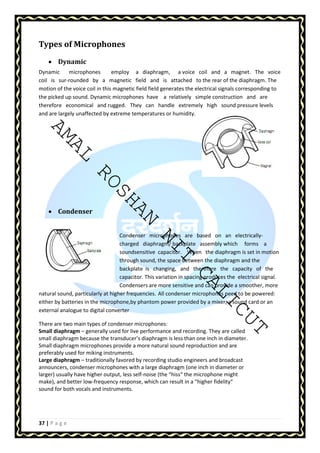

  • 33.
    AMAL ROSHAN NITCALICUT 33 | P a g e Various other lighting equipments- Frensel Spotlight Cylorama Lights Scoop Lights Pantograph
  • 34.
    Dynabeam Lights WideAnlge Lights AMAL ROSHAN NIT CALICUT Lightbeam with Patterns Space Cycle lights 34 | P a g e
  • 35.
    AMAL ROSHAN NITCALICUT 35 | P a g e MICROPHONES Introduction Pressure variations, whether in air, water or other mediums, which the human ear can detect, are considered sounds. Acoustics is the science or the study of sound. Sound can be generally pleasing to the ear, as in music, or undesirable, referred to as noise. The typical audible range of a healthy human ear is 20 to 20,000 Hz. A Sound Pressure Level (SPL) beyond the detectable frequencies of the human ear can also be very important to design engineers. Noise, Vibration and Harshness (NVH) is concerned with the study of vibration and audible sounds. Vibrations represent a rapid linear motion of a particle or of an elastic solid about an equilibrium position, or fluctuation of pressure level. Harshness refers to the treatments of transient frequencies or shock. Usually treatments are employed to eliminate noise, but in some cases products are designed to magnify the sound and vibration at particular frequencies. The sound produced or received by a typical object, which may be above and below the frequencies that are detectable by the human ear, or amplitudes concerning its resonant frequencies, are important to designers, in order to characterize the items performance and longevity. Technology Fundamentals and Microphone Types When an object vibrates in the presence of air, the air molecules at the surface will begin to vibrate, which in turn vibrates the adjacent molecules next to them. This vibration will travel through the air as oscillating pressure at frequencies and amplitudes determined by the original sound source. The human eardrum transfers these pressure oscillations, or sound, into electrical signals that are interpreted by our brains as music, speech, noise, etc. Microphones are designed, like the human ear, to transform pressure oscillations into electrical signals, which can be recorded and analyzed to tell us information about the original source of vibration or the nature of the path the sound took from the source to the microphone. This is exhibited in testing of noise reducing materials. Pressure from sound must be analyzed in the design stages to not only protect the
  • 36.
    materials around it,but also to protect the most precious and delicate mechanism designed to perceive it, the human ear. Like the human ear, microphones are designed to measure a very large range of amplitudes, typically measured in decibels (dB) and frequencies in hertz (Hz.) In order to convert acoustical energy into electrical energy, microphones are used. There are a few different designs for microphones. The more common designs are Carbon Microphones, Externally Polarized Condenser Microphones, Prepolarized Electret Condenser Microphones, Magnetic Microphones, and Piezoelectric Microphones. Types of microphone Connectors- AMAL ROSHAN NIT CALICUT • BALANCED In general, microphones provide an analogue au- dio signal. Professional microphones feature an XLR-output with three pins that transfer a balanced signal. One pin is ground, and the other two carry the audio signal. Pin 2 is the so called hot signal and pin 3 the cold. This method reduces the susceptibility of external noise while allowing the usage of longer cables. • UNBALANCED Entry level microphones often feature an attached cable with an unbalanced 6.3 mm or 3.5 mm con- nector. An unbalanced output carries the signal on a single conductor and is more susceptible to external noise. For that reason only balanced connections are used in professional miking applications. • USB More and more professional USB microphones are available. A USB microphone is essentially a mic with a built-in USB audio interface that converts the analogue signal into a digital signal. It can be directly plugged into a computer without requiring an exter-nal audio interface. USB microphones, such as the Shure PG27USB and the PG42USB with plug and play functionality are an easy start into home recording and podcasting. 36 | P a g e
  • 37.
    Types of Microphones • Dynamic Dynamic microphones employ a diaphragm, a voice coil and a magnet. The voice coil is sur-rounded by a magnetic field and is attached to the rear of the diaphragm. The motion of the voice coil in this magnetic field field generates the electrical signals corresponding to the picked up sound. Dynamic microphones have a relatively simple construction and are therefore economical and rugged. They can handle extremely high sound pressure levels and are largely unaffected by extreme temperatures or humidity. AMAL ROSHAN NIT CALICUT • Condenser 37 | P a g e Condenser microphones are based on an electrically-charged diaphragm/ backplate assembly which forms a soundsensitive capacitor. When the diaphragm is set in motion through sound, the space between the diaphragm and the backplate is changing, and therefore the capacity of the capacitor. This variation in spacing produces the electrical signal. Condensers are more sensitive and can provide a smoother, more natural sound, particularly at higher frequencies. All condenser microphones need to be powered: either by batteries in the microphone,by phantom power provided by a mixer, a sound card or an external analogue to digital converter There are two main types of condenser microphones: Small diaphragm – generally used for live performance and recording. They are called small diaphragm because the transducer’s diaphragm is less than one inch in diameter. Small diaphragm microphones provide a more natural sound reproduction and are preferably used for miking instruments. Large diaphragm – traditionally favored by recording studio engineers and broadcast announcers, condenser microphones with a large diaphragm (one inch in diameter or larger) usually have higher output, less self-noise (the “hiss“ the microphone might make), and better low-frequency response, which can result in a “higher fidelity“ sound for both vocals and instruments.
  • 38.
    AMAL ROSHAN NITCALICUT 38 | P a g e BASED ON PICKUP PATTERN(POLAR DIAGRAM) • OMNIDIRECTIONAL An omnidirectional microphone picks up sounds equally from all directions and reproduces the sound source more natural than a unidirectional microphone. It is good for natural room sound and group vocals. Also good for when the singer or talker may move around different sides of the microphone (but their distance to the mic stays the same). As an omnidirectional microphone picks up all the ambient sound in a room, e.g. the computer fan, it is not the recommended choice for home recording. However, if the goal is to enable listeners to hear what is occurring in the background, you should consider an omnidirectional pick-up pattern. • CARDIOID This is the most common type of microphone. It is called “cardioid“ due to its heart-shaped pick up pattern and has the most sensitivity at the front and is least sensitive at the back. This microphone helps reduce pickup of background noise or bleed from nearby sound sources. • SUPERCARDIOID A supercardioid microphone is even more directional than the cardioid. Supercardioids have the tightest pickup pattern, further isolating the sound source. But they also have some pickup at the rear. Good for noisy, crowded spaces and when multiple microphones arebeing used, such as for round-table discussions where you want to keep the voices distinct
  • 39.
    ON THE BASISOF FREQUENCY RESPONSE- • FLAT FREQUENCY RESPONSE AMAL ROSHAN NIT CALICUT 39 | P a g e All audible frequencies (20 Hz – 20 kHz) have the same output level. This is most suitable for applications where the sound source has to be reproduced without changing or “coloring” the original sound. • TAILORED FREQUENCY RESPONSE A tailored response has varying output levels across the frequency range and is usually designed to enhance a sound source in a particular application. For instance, a bass drum microphone does not need to reproduce high frequencies above 6 kHz or a vocal microphone may have a peak in the 2 – 4 kHz range to increase intelligibility MIicrophone in a recording studio
  • 40.
    AMAL ROSHAN NITCALICUT 40 | P a g e CABLES AND CONNECTORS • The earliest use of cables was in Telegraphy lines. The cables were termed as SWER (Single Wire Earth Return) circuits. These are single phase lines (un-insulated), that were used in Single Wire Transmission. The use of this form of communication soon started having interference (noise) from the Trams (Electric Trains) and other electricity-using devices. • After this, companies converted to Balanced circuits lines. These are implemented using two wires which have circuits installed at every distance, or at the receiving or transmitting end, that cancel out the interference. – Secondly, since the they are two wires, on transmitting and the other receiving, the interference in the two lines is canceled out automatically. – Balanced lines increase length by decreasing the signal attenuation. • Since most of the telephone lines were installed next to power lines, this caused the interference that is induced from the power lines, and with the advancement of power, the interference kept on increasing. • This brought in a new era of the wire transposition, Figure 4 in a bid to reduce on the interference induced into the cables. In wire transposition, the transmit and receive cables change position every 6 to 7 poles (around 4 twists every Kilometer). The change in position helps to increase interference cancelation. The wire transposition was not enough in the reduction of noise in the communication lines. This led to the introduction of twisted pair cables. Types of Cables- 1. E1 2. Ethernet 3. Coaxial 4. Fiber 5. Waveguide 6. Wireless Medium E1/T1- Depending on the Size of the Cable, it can carry from 8 to 32 E1s/T1s, each E1 being made up of 4 twisted cables. Each pair of cables is twisted onto each other to achieve noise cancellation. Please note that E1s can also be achieved using the an RJ 45 Connector. Coaxial-Coaxial cables provide the simplest and most versatile method for transmission of RF and microwave energy. The common types consist of a cylindrical metallic inner conductor surrounded by a dielectric material and then enclosed by a cylindrical metallic outer conductor.
  • 41.
    The dielectric materialis used to maintain the inner conductor concentrically within the outer conductor. The dielectric material is typically polyethylene (PE), Polyproplene (PP) or tetraflouroethylene (TFE). Most coaxial cables are then coated with a protective jacket made of polyethylene or poly-vinyl chloride (PVC). AMAL ROSHAN NIT CALICUT Fiber- An optical fiber or optical fiber is a thin, flexible, transparent fiber that acts as a waveguide, or light pipe, to transmit light between the two ends of the fiber. Optical fibers are widely used in fiber-optic communications, which permits transmission over longer distances and at higher bandwidths (data rates) than other forms of communication. Fibers are used instead of metal wires because signals travel along them with less loss and are also immune to electromagnetic interference. Fibers are also used for illumination, and are wrapped in bundles so they can be used to carry images, thus allowing viewing in tight spaces. Specially designed fibers are used for a variety of other applications, including sensors and fiber lasers. Optical fiber typically consists of a transparent core surrounded by a transparent cladding material with a lower index of refraction. Light is kept in the core by total internal reflection. This causes the fiber to act as a waveguide. Two types of Fiber media : 41 | P a g e Multimode Singlemode Single-mode fiber Carries light pulses along single path Uses Laser Light Source Has a very small core and carry only one beam of light. It can support Gbps data rates over 100 Km without using repeaters. Multimode fiber Many pulses of light generated by LED travel at different angles Can support less bandwidth than Single mode Fiber
  • 42.
    Waveguides- In electromagneticsand communications engineering, the term waveguide may refer to any linear structure that conveys electromagnetic waves between its endpoints. However, the original and most common meaning is a hollow metal pipe used to carry radio waves. This type of waveguide is used as a transmission line mostly at microwave frequencies, for such purposes as connecting microwave transmitters and receivers to their antennas, in equipment such as microwave ovens, radar sets, satellite communications, and microwave radio links. A dielectric waveguide employs a solid dielectric rod rather than a hollow pipe. An optical fiber is a dielectric guide designed to work at optical frequencies. Transmission lines such as microstrip, coplanar waveguide, stripline or coaxial may also be considered to be waveguides. AMAL ROSHAN NIT CALICUT The electromagnetic waves in (metal-pipe) waveguide may be imagined as travelling down the guide in a zig-zag path, being repeatedly reflected between opposite walls of the guide. For the particular case of rectangular waveguide, it is possible to base an exact analysis on this view. Propagation in dielectric waveguide may be viewed in the same way, with the waves confined to the dielectric by total internal reflection at its surface. Some structures, such as Non-radiative dielectric waveguide and the Goubau line, use both metal walls and dielectric surfaces to confine the wave. Types of waveguides: - Rectangular waveguide: This is the most commonly used form of waveguide and has a rectangular cross section. - Circular waveguide: Circular waveguide is less common than rectangular waveguide. They have many similarities in their basic approach, although signals often use a different mode of propagation. - Circuit board stripline: This form of waveguide is used on printed circuit boards as a transmission line for microwave signals. It typically consists of a line of a given thickness above an earth plane. Its thickness defines the impedance. Uses: - Optical fibers applications - In microwave, a waveguide guides microwaves from a magnetron were waves are formed. - In radar applications Stripline – Waveguides for printed circuit boards 42 | P a g e Waveguides
  • 43.
    Important parameters ofcables- 1. Characteristic Impedance 2. VSWR (Voltage Standing Wave Ratio) 3. Capacitance 4. Power Rating 5. Maximum Operating Voltage AMAL 6. Attenuation 7. Electrical length stability 8. Pulse Response 9. Shielding 10. Cut Off frequency 11. Flexibility ROSHAN 12. Cable design and Construction 13. Operating temperature range 14. Cable noise NIT CALICUT Various Types of Connectors Used Are- BNC connectors (Bayanet Neill Concelnam/ Bayanet Navy Connector) SMA connectors (Subminiature A) SMC connectors (Subminiature C) TNC connectors (Threshold Navy Connectors) RCA connector (Radio Connector of America) Elbow connectors 43 | P a g e
  • 44.
    AMAL ROSHAN NITCALICUT 44 | P a g e PRINCIPLES OF VIDEO TAPE RECORDING Introduction Video tape recorder is a most complex piece of studio equipment with analog and digital processing servo system, microprocessors, memories, logic circuits and mechanical devices etc. Also these recorders have been the main limitation so for as the quality output from studio is concerned. Right from fifties, continuous efforts are being made to improve its performance so as to reproduce cameras faithfully by improving S/N ratio and resolution. Designer for video tape recorders had to consider the following differences in the video and audio signals: Magnetic Principle Magnetic field intensity H = NI / L Magnetic flux density B = H Magnetic Flux Ø= BA ( is of the order of 100 to few 10,000 for ferromagnetic materials) Property of the ferromagnetic materials to retain magnetism even after the current or the H is removed is called retentivity and is used for recording electrical signals in magnetic form on magnetic tapes. This relationship can also be represented by a curve called BH curve. Magnetic tapes are made of ferromagnetic materials with broader BH curve than the material used for video heads as the heads are not required to retain information.
  • 45.
    WRITING SPEED ANDFREQUENCY RESPONSE Recording Process With reference to given figure when a tape is passed over the magnetic flux bubble, the electric signal in the coil will cause the electric lines of force from the head gap to pass through the magnetic material of the tape producing small magnets depending upon the strength of the current. Polarity of the magnetic field which causes these bar magnets depends on the change of current. Decreasing current will cause NS magnet and vice versa. Power of these magnets is as per BH curve. Thus the magnetic flux strengthens the unarranged magnetic particles as per the signal and they stay in that condition after the tape has already passed the magnetic head (fig. 2). Length of the magnet thus formed is directly proportional to writing speed of the head v, and inversely proportional to the frequency of the signal to be recorded, i.e. Recorded wavelength for one cycle of signal = speed x time Or Wave length of the magnetic signal tape = v / f AMAL ROSHAN NIT CALICUT 45 | P a g e Recording Process the problem to be solved in the development of VTRs was how to provide higher speed to record very high frequencies. The other limitation of recording medium is the range, during when the extracted signal is more than noise. This range is only 10 octaves. Thus the system can no longer be used for recording/reproduction after this dynamic range of 60 db, because of 6 dB/octave playback response characteristics. Beyond this range the low frequencies becomes inaudible and the higher frequencies become distorted. During the initial stages it was tried to record video signal with stationary video heads and longitudinal tracks using tape speed of the order of 9 m/s which was very difficult to control besides very high tape consumption i.e, miles of tape for 3 to 4 minutes of recording and this was coupled with breaking of video signal frequencies into 10 parts recorded by 10 different video heads and then switched during playback to retrieve the signal. The quality of the reproduced signal was also compromised up to the resolution of 1.7 MHz or so. Around 1956 the ‘AMPEX' company of USA then came out with Quadruplex machines having two revolutionary ideas which laid the foundation of present day VTRs/VCRs.
  • 46.
    These ideas were: 1. Rotating Video Heads and 2. Frequency Modulation before recording Increase in writing speed by rotating head When a video head mounted on a rotating head wheel writes on a tape moving across it, will lay a track of length which will depend not only on the speed of the tape but also on the rotating speed of the head. Single head with diameter d number of rotation per sec as r and full omega wrap or two heads in ½ omega wrap i.e. little over 180 degree, which most of the present day VCR are using, will have a writing speed of dr minus or plus the linear tape speed (which is negligible as compared to the rotating stationary Monitoring AMAL speed). This avoids the requirements of miles of tape for few minutes of recording in a head type of recorders tried earlier. During Recording Most of the video tape recorders provide Electronics to Electronics monitoring (EE Mode) at the time of recording. The video signal is monitored after routing it through all the signal system electronics of the recorders excluding the video heads and preamplifiers etc. Some of the recorders also provide simultaneous playback for confidence heads. Thus the VTRs could achieve a) Faster writing speed ROSHAN the off tape monitoring by using additional heads during recording called wider frequency range with: b) Smaller gap, and c) Octave band compression with frequency modulation. Also achieving accurate speed for motors with servo system reduces the timing errors. Playback process During play back when the recorded tape is passed was recorded, flux lines emerging from the tape on NIT over the head gap at the same speed at which it crossing the head gap induce voltage in the coil proportional to the rate of change of flux, i.e. d /dt and this in turn depends on the frequency of the recorded signal. Doubling of frequency causes voltage to increase by 6 dB. This accounts for the well known 6 dB/octave playback characteristics holds good only up to a certain limit thereafter at very high frequencies, during playback and recording process causing noise to be more than noted that when the gap becomes equal to the wavelength of the CALICUT of the recording medium. This lot of losses take place the signal itself. It may be recorded signal, two adjoining bar magnets may produce opposite current during playback and the output becomes zero. Similar thing happens when the gap equals 2, 3 …n. times the wavelength. First extinction frequency occurs when gap becomes equal to wavelength. For getting maximum output, head gap has to be one half of wavelength. Frequency at which zero output occurs is called extinction frequency . Thus the maximum usable frequency becomes half of the extinction frequency. These parameters are related by: 46 | P a g e
  • 47.
    AMAL ROSHAN NITCALICUT 47 | P a g e Playback Process So in order to record the higher frequencies we must increase the writing speed for a minimum value of wave length recorded on tape i.e. tape. This minimum value of tape is again restricted by the minimum practically possible head gap. Now the ratio of video and audio frequencies is approximately 300, so we must increase the writing speed or reduce the gap by the same factor of 300 to get the desired results. Perhaps a speed of 60 mph will be required to cope with the higher video frequencies. VIDEO TAPE FORMATS-INTRODUCTION Format of Video tape recorder defines the arrangement of magnetic information on the tape. It specifies: 1. The width of tape, 2. Number of tracks for Video, Audio, Control, time code and cue, 3. Width of tracks, 4.Their electrical characteristics and orientation. All machines conforming to one format have similar parameters to enable compatibility or interchange i.e. the tape recorded on one machine is faithfully reproduced on the other. There are a number of formats in Video tape recording and the number further gets multiplied due to different TV. Standards prevailing in various countries e.g. PAL, SECAM, NTSC and PAL-M. CLASSIFICATION OF FORMAT: A) Analog Formats: VTRs using composite Video for professional Broadcast use were , Quadruplex 2” , 1 format and C ( All reel/Spool Type) which were then replaced by U- matic cassette recorders followed by best quality analog format with separate luminance chrominance recording called component Analog formats. These were Betacam SP from SONY M-II from Panasonic. a) Quadruplex Format (Segmented) This was the first professional broadcast video tape recorder introduced by AMPEX in 1956 and has since been replaced by 1 recorders of type B and type C formats. This format uses spool of 2 wide tape, 4 heads on transversely mounted drum, with a very high writing speed of about 41m/s. These machines had higher operational cost and required constant
  • 48.
    engineering efforts tokeep them running. These machines have since been phased out except for transfer/archival purpose. b) Type B Format (Segmented helical) This format was developed by BOSCH/BTS using helical scan with 1 tape as BCN series of Video Tape recorders. It uses a scanner with head wheel carrying two video heads around which tape is wrapped in about 190o. Each television field is recorded on six tracks with each head scanning a 52 line segment. The scanner diameter is 50mm and rotates at 150 rev/sec. The tape moves at 24cms/sec. The 80 mm long tracks are recorded at an angle of 14.3o. There are four longitudinal tracks out of which two are full quality audio tracks, third for the time code and the fourth for the control track. Video writing speed is 24m/s. The flying erase head mounted on the same head- wheel and the associated electronics allows for roll free electronic editing. The addition of digital frame store unit provides freeze frame and slow motion. The portable version in the same format has also been marketed by the manufacturers for studio use. c) Type C Format (field per scan helical) This is the combined format of AMPEX and SONY using 1 tape with a full omega wrap around a helical scanner running at 50 rps. Main head mounted on a 135 mm dia drum records one field i.e. B). DIGITAL FORMATS Modern television post production demands multi-layer special effects with several manipulations having first generation quality. This requires multi-generation playback a transparent recordings from Video cassette players./recorders. which can be met only by the digital formats without loss in picture quality. Digital Composite/Component Formats A) D1 format was the first DVTR not to compromise on the technical quality in any way. It is based on 4:2:2 sampling structure of CCIR-601, completely transparent in quality but very expensive and bulky. Still it is considered as reference machine for digital formats and known as father of all digital formats. It uses 3/4 tape has a writing speed of about 30m/s.Its drum is running at 150 rps with segmented tracks. Digital coding is in 8-bit words with a raw picture data rate of 216 Mbps. b) D2 format was the first economical DVTR based on CCIR - 601, 4 fsc sampling on composite video. It offered easy interface to a composite world at a reasonable cost. It was soon overshadowed by the then forthcoming D 3 format. c) D3: D3 was developed by NHK and Panasonic using composite system, 1/2 metal particle VHS sized cassette thus saving cost. It records 8 bit digital video at a sampling rate of 4 fsc (17.73MHz) in 8 tracks per field. Data rate is similar to D2. AMAL ROSHAN NIT CALICUT d) D4: 4 is perhaps an unlucky number in Japan as there is no D4. e) D5: Panasonic's new component system D5 is a successor to D3. It is digital component using same cassettes as D3 but running at double speed. In addition to all the usual facilities, D5 can playback existing D3 tapes. It gives just 2 hours from a long size cassette. Coding is 10-bit with luminance sampling at 13.5 MHz. D5 can handle 4:3 or 16:9 aspect ratio with full restoration. For 16:9, sampling rate is 18 MHz with 8-bit coding Based on CCIR 601. It is without any data compression. 48 | P a g e
  • 49.
    Digital Betacam: Itis based on CCIR 601, and allows 16:9 upgrades. To reduce data rate it uses Bit Rate reduction (BRR).Bit rate reduction is in the ratio of 2:1. This has been made possible because of the conversion of data from time domain to frequency domain and removing the redundancy from the digital video data. Equivalent system without BRR would have required more tape speed, extra thin tape, and extra narrow tracks and would have also needed double the number of heads on drum or double the drum speed. It is compatible with Betacam SP and is having 4 PCM Digital Audio Track. Scanner for this machine is larger then that of Betacam SP but the helix is such that when rotated at frame rate ,track angle of analog Betacam is traced .This gives a time compressed replay is which is then expanded in TBC. For digital Betacam, to handle large data the scanner speed is increased to 3 times. One field is recorded in one and half revolution in 6 tracks of 26 Micrometers each. BETACAM VIDEO CASSETTE RECORDERS-INTRODUCTION: AMAL ROSHAN NIT CALICUT Betacam series of VCRs are based on analog component system. These VCRs had become popular because of their low initial and running costs in comparison to B and C Format machines. The quality of reproduction of Betacam SP was near to these analog formats. Betacam format was introduced in 1982 followed by Betacam SP in 1987. Popular Betacam SP VCRs which are being replaced with digital VCRs in doordarshan are:- BVW 75P - SP Recorder cum player, with DT head (Slow motion heads for dynamic tracking) PVW 2800P PRO SERIES besides camcorder and portable version of this format . Head drum : Head drum for BVW 75P carries as many as 10 video heads, two heads for Luminance Ya, Yb, two heads for chrominance Ca, Cb, two heads for Dynamic tracking Luminance DTYa, DTYb, two heads for Dynamic tracking chrominance DT Ca, DT Cb, and finally two heads for Eraser REa REb (Rotary erase). In some of the models where slow motion is not available DT heads and associated electronics is not required. This makes those models cheaper to BVW 75P. 49 | P a g e
  • 50.
    VIDEO SYSTEM Videosystem is based on component analog system. Composite video is decoded into its component, Luminance Y and colours as R-Y B-Y. You may note that these colour signal are base band signal and have nothing to do with 4.43MHz subcarrier frequency. Y is recorded directly after FM on one of the video tracks by Ya Yb head. Chrominance signals are first compressed as CTDM signal (Compressed time division multiplexing) and then frequency modulated. This FM chroma is then mixed with AFM audio channel 3 4 before it is recorded along with chrominance information. AMAL ROSHAN NIT CALICUT 50 | P a g e TAPE TRANSPORT FOR PVW SERIES OF BETACAM SP
  • 51.
    AMAL ROSHAN NITCALICUT DIGITAL VIDEO CASSETTE RECORDER PROFESSIONAL (DVCPRO)- INTRODUCTION With the advent of digital signals, breakthrough came in the field of recording from analog recording to digital recording around the year 1990. In the series of development of digital tape recording systems, it is felt to have a system which should be handy for the purpose of field recording along with capability of long duration recording. A recording format is developed by a consortium of ten companies as a consumer digital video recording format called “DV”. DV (also called ”mini DV” in its smallest tape form) is known as DVC (Digital Video cassette). DVCAM is a professional variant of the DV, developed by Sony and DVCPRO on the other hand is a professional variant of the DV, developed by Panasonic. These two formats differ from the DV format in terms of track width, tape speed and tape type. Before the digitized video signal hits the tape, it is the same in all three formats. What is DV? DV is a consumer video recording format, developed by a consortium of 10 companies and later on by 60 companies including Sony, Panasonic, JVC, Phillips etc., was launched in 1996. in this format, video is encoded into tape in digital format with intra frame 51 | P a g e
  • 52.
    DCT compression using4:1:1 chroma subsampling for NTSC (or 4:2:0 for PAL). This makes it straightforward to transfer the video onto computer for editing due to its intra frame compression technique. DV tapes come in two formats: MiniDV size (66mm x 48mm x 12.2mm) and DV, the standard full size (125mm x 78mm x 14.6mm). They record digital compressed video by a DCT method at 25 Megabit per second. In terms of video quality, it is a step up from consumer analog formats, such as 8mm, VHS-C and Hi-8. What is DVCPRO? DVCPRO is a professional variant of the DV, developed by Panasonic. In DVCPRO, the baseband video signal is converted to 4:1:1 sampled data sequence from the originally sampled 4:2:2 signal by the method of subsampling and the resulted data are converted into blocks which are shuffled before passing through compression circuitry and again reshuffled back to their original position after compression. It is to mention here that still pictures containing little or no movement are compressed using intra frame compression whereas the pictures with large amounts of movements are coded and compressed in intra field form. Error correction code is added to the compressed and reshuffled data sequence by using Reed Solomon product code before it is sent to recording modulation method. The modulated data sequence generated by 24-25 coding method using scrambled NRZI is recorded onto the tape via video head. AMAL ROSHAN NIT CALICUT Within the DV(Digital Video) format, audio can be recorded in either 2 channel (1 left and 1 right) or 4 channel mode (2 stereo pairs). In the DVCPRO format the audio is 2 channel record mode only, though provision is made to replay 4 channel type DV tapes. It is to mention here that audio data is recorded un-compressed. 2 Channel Audio Record Mode The audio signal is digitized by sampling the analog audio signal with 48 kHz sampling frequency and quantized the samples by 16-bit linear quantizer. In PAL (625/50 Hz) DVCPRO system, one frame of video occupies 12 tracks on the tape. One frame corresponds to 40 milliseconds(25 frames/sec implies 1 frame/40 msec). So 40 milliseconds of audio data (per channel) is recorded into 12 track frame period. At 48kHz sampling frequency, 1920 samples are generated in 40 msec(40 x 48 = 1920) which have to be accommodated in 6 tracks. DVCPRO format fix the first six tracks for data belonging to the channel 1 input and the second six tracks for data belonging to channel 2. Each track contains 1920/6 = 320 samples(320 x 16 bits = 640 bytes) which can be memorized in 9 x 72 matrix in processing module. 52 | P a g e
  • 53.
    AMAL ROSHAN NITCALICUT 53 | P a g e VISION MIXING Introduction Vision mixing is a process of creating composite pictures from various sources. Vision mixing involves basically three types of switching or transitions between various sources. These are mixing, wiping and keying. These transitions can also be accompanied by special effects in some of the vision mixers. Mixing Two input sources are mixed in proportion in a summing amplifier as decided by the position of control fader. Two extreme position of the fader gives either of the sources at the output. Middle of the fader gives mixed output of the two sources; control to the summing amplifier is derived from the fader. Wipe In this case the control for the two input sources is generated by the wipe pattern generator (WPG), which can either be saw tooth or parabola at H, V or both H V rate. Unlike in MIX, during WIPE, one source is present in one side of the wipe and the second source on other side of the wipe. A very simple to very complex wipe patterns can be generated from the WPG. Key In the Key position between two sources i.e. foreground (FG) and background (BG) the control derived from one of the source itself (overlay), or by the third source (external key). This keying signal can be generated either by the luminance, Hue or chrominance of the source input. The keyed portion can be filled with the same or with matte or external source. Matte means internally generated BG with choice of colors from the vision mixer.
  • 54.
    AMAL ROSHAN NITCALICUT 54 | P a g e NON LINEAR EDITING 3-D GRAPHICS-INTRODUCTION Fundamentally editing is a process where one places Audio video clips in an appropriate sequence and mainly used in video post production. Linear editing is tape based and is sequential in nature. It has various problems like long hours spent on rewinding of tapes in search of material, potential risk of damage to original footage, difficult to insert a new shot in an edit, difficult to experiment with variations, quality loss is more, limited composting effects and color correction capability. Non-linear editing (NLE) is a video editing in digital format with standard computer based technology. NLE can also be extended to film editing. Computer technology is harnessed in Random access, computational and manipulation capability, multiple copies, multiple versions intelligent search, sophisticated project and media management tools, standard interfaces and powerful display. ADVANTAGES OF NLE NLE has various advantages over tape based (linear) editing. Flexibility in all editing functions. Easy to do changes, undo, copy, duplicate and multiple version. Easy operation for cut, dissolve, wipes and other transition effects. Multi-layering of video is easy. Powerful integration of video and graphics, tools for filtering, color correction, key framing and special 2D/3D effects. Equally powerful audio effects and mixing. Possible to trim ; compress or expand the length of the clip. Intelligent and powerful 3D video effect can be created and customized. Efficient and intelligent storage.
  • 55.
    BREAKOUT BOX-Various videosources like VTR, CD player, camera and other playback/recording devices are connected to NLE machine through breakout box. The NLE machine takes input from various video sources for editing and gives output for monitoring and recording through break out box. AMAL ROSHAN NIT CALICUT INPUTS Video Inputs There are three analog inputs (1) Component Video (2) S-Video (3) Composite video Audio Inputs To capture synchronized audio with your video, you must connect audio out from the VTR or other play back device to the audio inputs. You can also connect audio only devices for sound track production etc. the dps reality board (NLE hardware) has three analog audio options ; balanced, unbalanced and Aux. 55 | P a g e
  • 56.
    AMAL ROSHAN NITCALICUT Time Code Time code is simply a series of labels attached to a recording at timed intervals, generally fractions of sounds. Each label contains a time of recording. Time code is used for editing; in order to be able to return repeatedly to a selected time, and for synchronization among audio and video recorders and players. The two versions of time code that are available with dps OUTPUTS Video Output Component (CAV) Video has three connectors, labeled Y, B-Y, R-Y. A cable connects each of these three outputs to your video monitor or VTR. Audio Output Choose what type of video to output based on whether your VTR and other video and audio equipment can receive balance or unbalance audio. Audio out is connected to speakers for playback or to a VTR or other audio recording device during recording. 56 | P a g e
  • 57.
    AMAL ROSHAN NITCALICUT 3 –D GRAPHICS THE FIVE MODULES OF SOFTIMAGE Softimage 3 D Extreme has given different modules that correspond to different phases of the workflow process you use to create animation. Each of the modules replaces some of the menu cells on the left and right menu columns, while leaving other menu cells that are applicable in all modules. The modules are listed along the top right corner of the screen: Model, Motion, Actor, Matter, and Tools. You can enter these modules either by clicking the text labels in the top right corner, or by pressing the supra keys that represent them: F1 for Model, F2 for Motion, F3 for Actor, F4 for Matter, and F5 for Tools. MODEL You start your workflow in the Model module, where you construct all your scene elements. Model's tools enable you to create objects from primitive shapes, draw curves, and develop surfaces from those curves. MOTION You then move to animate some parts of your scene, using the animation tools found in the Motion module. The Motion module allows you to set animation keyframes for objects, assign objects to paths, and to see and edit the resulting animation on screen. After you have refined your animation using the F Curve tools, you move to the next module, Actor. ACTOR The Actor module contains the special Softimage tools for setting up virtual actors, assigning inverse kinematic skeletons, assigning skin, adjusting skeletons deformations, and weighting the skin to the IK skeletons. Actor also contains the controls for physical-based animation–Dynamics,Collisions and Qstretch–which is an automatic squash-and-stretch features. MATTER When your modeling, animation, and acting are complete, you move to the fourth module: Matter. In the Matter module, you assign color and material values to the objects in your scene, determining how they will look in the final render. 57 | P a g e
  • 58.
    At any timein the first four modules, you can create lights and adjust their effect on the scene. The Matter module is also where you perform the last step in the workflow process, rendering. TOOLS Tools contains a variety of utility programs for viewing, editing and exporting your work. You may view individual images, sequences of images, and line tests. You may bring in images created in other programmes as image maps or import objects created in other programs as geometry. You can composite sequences of images together, reduce colours in sequences of images for reduced colour games systems, and move your finished work to video disk recorders and film recorders. AMAL ROSHAN NIT CALICUT 58 | P a g e The Four View Windows
  • 59.
    TELEVISION TRANSMISSION VESTIGIALSIDE BAND TRANSMISSION - If normal amplitude modulation technique is used for picture transmission, the minimum transmission channel bandwidth should be around 11 MHz taking into account the space for sound carrier and a small guard band of around 0.25 MHz. Using such large transmission BW will limit the number of channels in the spectrum allotted for TV transmission. To accommodate large number of channels in the allotted spectrum, reduction in transmission BW was considered necessary. The transmission BW could be reduced to around 5.75 MHz by using single side band (SSB) AM technique, because in principle one side band of the double side band (DSB) AM could be suppressed, since the two side bands have the same signal content. AMAL ROSHAN NIT CALICUT Design All the TV transmitters have the same basic design. They consist of an exciter followed by power amplifiers which boost the exciter power to the required level. Exciter The exciter stage determines the quality of a transmitter. It contains pre-corrector units both at base band as well as at IF stage, so that after passing through all subsequent transmitter stages, an acceptable signal is available. Since the number and type of amplifier stages, may differ according to the required output power, the characteristics of the pre-correction circuits can be varied over a wide range. Block Diagram of TV Exciter (Mark-II) Vision and Sound Signal Amplification In HPTs the vision and sound carriers can be generated, modulated and amplified separately and then combined in the diplexer at the transmitter output. In LPTs, on the other hand, sound and vision are modulated separately but amplified jointly. This is common vision and aural amplification. A special group delay equalization circuit is needed in the first case because of errors caused by TV diplexer. In the second case the intermodulation products are more prominent and special filters for suppressing them is required.As it is difficult to meet the intermodulation requirements particularly at higher power ratings, separate 59 | P a g e
  • 60.
    amplification is usedin HPTs though combined amplification requires fewer amplifier stages. IF Modulation It has following advantages 1. Ease of correcting distortions 2. Ease in Vestigial side band shaping 3. IF modulation is available easily and economically Power Amplifier Stages In BEL mark I II transmitters three valve stages (BEL 450 CX, BEL 4500 CX and BEL 15000 CX) are used in vision transmitter chain and two valves (BEL 450 CX and BEL 4500 CX) in aural transmitter chain. In BEL mark III transmitter only two valve stages (BEL 4500 CX and BEL 15000 CX) are used in vision transmitter chain. Aural transmitter chain is fully solid state in Mark III transmitter. Constant Impedance Notch Diplexer (CIND) Vision and Aural transmitters outputs are combined in CIN diplexer. Combined power is fed to main feeder lines through a T-transformer. BEL 10 kW TV TRANSMITTER (MARK-II) AMAL ROSHAN NIT CALICUT 60 | P a g e Block Diagram of BEL 10kW TV Transmitter (Mark-II) TRANSMITTER CONTROL SYSTEM The transmitter control unit performs the task of transmitter interlocking and control. Also it supports operation from control console. The XTR control unit (TCU) has two independent system viz. 1. Main control system. (MCS) 2. Back-up Control System (BCS)
  • 61.
    Functions performed byMCS (Main Control System) - XTR control - Interlocking - RF monitoring - Supporting operation from control console - Three second logic for protection against sudden fluctuation. - Thermal protection for 1 kW and 10 kW vision PAs - Thermal protection for 130 Watt vision PA and Aural XTRa - Mimic diagram Functions performed by BCS (Backup control system) AMAL ROSHAN NIT CALICUT - Transmitting control - Interlocking The block diagram of the TCU (Transmitter control unit) indicates the connectivity of TCU with control console and the control elements of the transmitter. Commands are inputs through the key board. The control elements are controlled in accordance with the programme fused in the EPROMS. Only while operating from the MCS (Main Control System), the interaction with TCU is supported through a LCD display unit. The LED bar display board showing the status information, is used by both the MCS and BCS (Back up Control Unit). Main Control System (MCS) The MCS consists of the following : 1. Mother Board with the following PCBs. CPU BIT I/O Interlock Interface Board (IIB). Analog I/O Board (AIO) Control Interface Board (CIB) Analog Receiver Board (An Rx) Rectifier and Regulator Board (RRB mcs) 2. Key Board 3. LED Bar Display Board 4. Relay Board 5. LCD Display Unit 6. Transformers T1 and T2 . 7. + 5V/3A. Power Supply Unit. 61 | P a g e
  • 62.
    AMAL ROSHAN NITCALICUT 62 | P a g e TV TRANSMITTER Antenna System is that part of the Broadcasting Network which accepts RF Energy from transmitter and launches electromagnetic waves in space. The polarization of the radiation as adopted by Doordarshan is linear horizontal. The system is installed on a supporting tower and consists of antenna panels, power dividers, baluns, branch feeder cable, junction boxes and main feeder cables. Dipole antenna elements, in one or the other form are common at VHF frequencies where as slot antennae are mostly used at UHF frequencies. Omni directional radiation pattern is obtained by arranging the dipoles in the form of turnstile and exciting the same in quadrature phase. Desired gain is obtained by stacking the dipoles in vertical plane. As a result of stacking, most of the RF energy is directed in the horizontal plane. Radiation in vertical plane is minimized. The installed antenna system should fulfil the following requirements : a) It should have required gain and provide desired field strength at the point of reception. b) It should have desired horizontal radiation pattern and directivity for serving the planned area of interest. The radiation pattern should be omni directional if the location of the transmitting station is at the center of the service area and directional one, if the location is otherwise. c) It should offer proper impedance to the main feeder cable and thereby to the transmitter so that optimum RF energy is transferred into space. Impedance mismatch results into reflection of power and formation of standing waves. The standard RF impedance at VHF/UHF is 50 ohms.
  • 63.
    AMAL ROSHAN NITCALICUT 63 | P a g e Outdoor Broadcasting Van (OB Van) O B Van (Outdoor Broadcasting van )- OB van is used for live broadcasting like any match or any event. It consist all the equipments that is present in the studio for telecasting. It also referring as mini studio . It has mainly 3 parts : 1)Power supply unit 2)Production control unit 3)Audio console and VTR Inner View of OB van Inner View of OB van
  • 64.
    AMAL ROSHAN NITCALICUT 64 | P a g e EARTH STATION SATELLITE COMMUNICATION Satellite Communication is the outcome of the desire of man to achieve the concept of global village. Penetration of frequencies beyond 30 Mega Hertz through ionosphere force people to think that if an object (Reflector) could be placed in the space above ionosphere then it could be possible to use complete spectrum for communication purpose. Intelsat-I (nick named as Early Bird) was launched on 2 April 1965. This was parked in geosynchronous orbit in Atlantic ocean and provided telecommunication or television service between USA and Europe. It had capacity for 240 one way telephone channels or one television channel. Subsequently Intelsat-II generation satellites were launched and parked in Atlantic ocean and Pacific Ocean. During Intelsat III generation, not only Atlantic and Pacific ocean got satellites but also Indian Ocean got satellite for the first time. Now Arthur C.Clarke's vision of providing global communication using three Satellites with about 120 degrees apart became a reality. So far Intelsat has launched 7 generations of geosynchronous satellites in all the three regions namely Atlantic Ocean, Pacific Ocean and Indian Ocean. For national as well as neighbouring countries coverage, some of the following satellites are used: ANIK : Canadian satellite system I NSAT : Indian Satellites AUSSAT : Australian Satellites BRAZILSAT : Brazilian Satellites FRENCH TELECOM : French Satellites ITALSAT : Italian Satellites CHINASAT : Chinese Satellites STATSIONAR, GORIZONT, Russian Satellites Architecture of a Satellite Communication System The Space Segment The space segment contains the Satellite and all terrestrial facilities for the control and monitoring of the Satellite. This includes the tracking, telemetry and command stations (TTC) together with the Satellite control centre where all the operations associated with station-keeping and checking the vital functions of the satellite are performed. In our case it is Master Control Facility (MCF) at Hassan. The radio waves transmitted by the earth stations are received by the satellite ; this is called the up link. The satellite in turn transmits to the receiving earth stations ; this is the down link. The quality of a radio link is specified by its carrier-to-noise ratio. The important factor is the quality of the total link, from station to station, and this is determined by the quality of the up link and that of the down link. The quality of the total link determines the quality of the signals delivered to the end user in accordance with the type of modulation and coding used.
  • 65.
    AMAL ROSHAN NITCALICUT The Ground Segment The ground segment consists of all the earth stations ; these are most often connected to the end- user's equipment by a terrestrial network or, in the case of small stations (Very Small Aperture Terminal, VSAT), directly connected to the end-user's equipment. Stations are distinguished by their size which varies according to the volume of traffic to be carried on the space link and the type of traffic (telephone, television or data). The largest are equipped with antenna of 30 m diameter (Standard A of the INTELSAT network). The smallest have 0.6 m antenna (direct television receiving stations). Fixed, transportable and mobile stations can also be distinguished. Some stations are both transmitters and receivers. Space Geometry Types of Orbit The orbit is the trajectory followed by the satellite in equilibrium between two opposing forces. These are the force of attraction, due to the earth's gravitation, directed towards the centre of the earth and the centrifugal force associated with the curvature of the satellite's trajectory. The trajectory is within a plane and shaped as an ellipse with a maximum extension at the apogee and a minimum at the perigee. The satellite moves more slowly in its trajectory as the distance from the earth increases. Most favourable Orbits Elliptical orbits inclined at an angle of 64o with respect to the equatorial plane. This orbit enables the satellite to cover regions of high latitude for a large fraction of the orbital period as it passes to the apogee. This type of orbit has been adopted by the USSR for the satellites of the MOLNYA system with a period of 12 hours. Please note that the satellite remains above the regions located under the apogee for a period of the order of 8 hours. Continuous coverage can be ensured with three phased satellites on different orbits. 65 | P a g e
  • 66.
    Circular inclined orbits: The altitude of the satellite is constant and equal to several hundreds of kilometers. The period is of the order of one and a half hours. With near 90% inclination this type of orbit guarantees that the satellite will pass over every region of the earth. Several systems with world wide coverage using constellations of satellite carries in low altitude circular orbits are for e.g. IRIDIUM, GLOBAL STAR, ODYSSEY, ARIES, LEOSAT, STARNET, etc. Circular orbits with zero inclination (Equatorial orbits). The most popular is the geo stationary satellite orbits ; the satellite orbits around the earth at an altitude of 35786 km, and in the same direction as the earth. The period is equal to that of the rotation of the earth and in the same direction. The satellite thus appears as a point fixed in the sky and ensures continuous operation as a radio relay in real time for the area of visibility of the satellite (43% of the earth's surface). Factors deciding the selection of Orbit The choice of orbit depends on the nature of the mission, the acceptable interference and the performance of the launchers : The extent and latitude of the area to be covered. The elevation angle of earth stations. Transmission duration and delay. Interference The performance of launchers AMAL ROSHAN NIT CALICUT 66 | P a g e TVRO System Presently Doordarshan is up linking its national, metro and regional services to INSAT-2A (74oC) and INSAT-2B (93.5oE) and INSAT 2E (83o C). Down link frequency bands being used are C-Band (3.7-4.2 GHz) and Ex-C Band (4.5-4.8 GHz). Transmission of base band to Satellite The base band signal consists of video (5 MHz), two audio subcarriers (5.5 MHz 5.75 MHz) and energy dispersal signal (25 Hz). After modulation (70 MHz) and upconversion (6 GHz) the carrier is amplified and uplinked through Solid Parabolic Dish Antenna (PDA). Down link signal can be received through same PDA using Trans-Receive Filter (TRF) and Low Noise Amplifier (LNA). After down conversion to 70 MHz, it is demodulated to get audio and video.
  • 67.
    Satellite Transponder Asshown in fig, the uplinked signal (6 GHz) at satellite is received, amplified and down converted to 4 GHz band and sent back through filter and power amplifier (TWT). The local oscillator frequency of down converter is 2225 MHz for C band and Ex-C band transponders. AMAL ROSHAN NIT CALICUT 67 | P a g e Block Diagram of Satellite Transponder Receiving Satellite Signal For receiving a satellite signal we need following equipment : 1. Satellite receiving antenna (PDA). 2. Feed with low noise block converter (LNBC). 3. Indoor unit consisting of satellite system unit and a Synthesised satellite receiver. Parallels of Latitudes Latitude as Angular Distance
  • 68.
    AMAL ROSHAN NITCALICUT 68 | P a g e Direct-to-Home Satellite Broadcasting (DTH) INTRODUCTION There was always a persistent quest to increase the coverage area of broadcasting. Before the advent of the satellite broadcasting, the terrestrial broadcasting, which is basically localized, was mainly providing audio and video services. The terrestrial broadcasting has a major disadvantage of being localized and requires a large number of transmitters to cover a big country like India. It is a gigantic task and expensive affair to run and maintain the large number of transmitters. Satellite broadcasting, came into existence in mid sixties, was thought to provide the one-third global coverage simply by up-link and down-link set-ups. In the beginning of the satellite broadcasting, up-linking stations (or Earth Stations) and satellite receiving centers could had only been afforded by the Governments organizations. The main physical constraint was the enormous size of the transmitting and receiving parabolic dish antennas (PDA). In the late eighties the satellite broadcasting technology had undergone a fair improvements resulting in the birth of cable TV. Cable TV operators set up their cable networks to provide the services to individual homes in local areas. It rapidly grew in an unregulated manner and posed a threat to terrestrial broadcasting. People are now mainly depending on cable TV operators. Since cable TV services are unregulated and unreliable in countries like India now, the satellite broadcasting technology has ripened to a level where an individual can think of having direct access to the satellite services, giving the opportunity to viewers to get rid of cable TV. Direct-to-Home satellite broadcasting (DTH) or Direct Satellite Broadcasting (DBS) is the distribution of television signals from high powered geo- stationary satellites to a small dish antenna and satellite receivers in homes across the country. The cost of DTH receiving equipments is now gradually declining and can be afforded by common man. Since DTH services are fully digital, it can offer value added services, video-on-demand, Internet, e- mail and lot more in addition to entertainment. DTH reception requires a small dish antenna (Dia 60 cm), easily be mounted on the roof top, feed along with Low Noise Block Converter (LNBC), Set- up Box (Integrated Receiver Decoder, IRD) with CAS (Conditional Access System). A bouquet of 40 to 50 video programs can simultaneously be received in DTH mode. UPLINK CHAIN DTH broadcasting is basically satellite broadcasting in Ku-Band (14/12 GHz). The main advantage of Ku-Band satellite broadcasting is that it requires physically manageable smaller size of dish antenna compared to that of C-Band satellite broadcasting. C-Band broadcasting requires about 3.6 m dia PDA (41dB gain at 4 GHz) while Ku-Band requires 0.6 m dia PDA (35dB gain at 12 GHz). The shortfall of this 6 dB is compensated using Forward Error Correction (FEC), which can offer 8 to 9 dB coding gain in the digital broadcasting. Requirement of transmitter power (about 25 to 50 Watts) is less than that of analog C-band broadcasting. The major drawback of Ku-Band transmission is that the RF signals typically suffer 8 to 9dB rain attenuation under heavy rainfall while rain attenuation is very low at C-Band. Fading due to rain can hamper the connectivity of satellite and therefore rain margin has to be kept for reliable connectivity. Rain margin is provided by operating transmitter at higher powers and by using larger size of the dish antenna (7.2m PDA). Fig.1 shows schematic of uplink chain proposed to broadcast bouquet of 30 video programs in Doordarshan, Prasar Bharati, India. 30 video programs may
  • 69.
    either be down-linkedfrom satellites or taken from other sources like video tape recorders, video cameras etc. in digital format. These sources are fed to Router whose outputs are divided in three groups A, B and C. Each group contains 10 video sources multiplexed in a Multiplexer. These three multiplexed streams are digitally (QPSK modulation) modulated individually at 70 MHz Intermediate Frequency (IF). Each group is further doubly up-converted, first conversion at L-Band (950-1450 MHz) and second conversion at Ku-Band (12-14 GHz). AMAL ROSHAN NIT CALICUT DOWN-LINK CHAIN Down-Link or receiving chain of DTH signal is depicted in Fig.2. There are mainly three sizes of receiving antenna, 0.6m, 0.9m, and 1.2m. Any of the sizes can easily be mounted on rooftop of a building or house. RF waves (12.534GHz, 12.647GHz, 12.729 GHz) from satellite are picked up by a feed converting it into electrical signal. The electrical signal is amplified and further down converted to L-Band (950-1450) signal. Feed and LNBC are now combined in single unit called LNBF. The L-Band signal goes to indoor unit, consisting a set-top box and television through coaxial cable. The set-top box or Integrated Receiver Decoder (IRD) down converts the L-Band first IF signal to 70 MHz second IF signal, perform digital demodulation, de-multiplexing, decoding and finally gives audio/video output to TV for viewing. 69 | P a g e
  • 70.
    AMAL ROSHAN NITCALICUT 70 | P a g e
  • 71.