The   Olweus Bullying Prevention Program
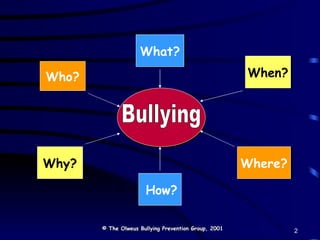
Bullying Who? What? When? Where? How? Why? © The Olweus Bullying Prevention Group, 2001 2
“ Bullying . . .” A student is being bullied when he or she is exposed,repeatedly and over time, to negative actions on the part of one or more students. © The Olweus Bullying Prevention Group, 2001
Bullying implies  an  imbalance  in  power or strength. The student who is bullied  has difficulty defending  himself/herself. © The Olweus Bullying Prevention Group, 2001 4
In Summary... Intentional harm-doing Repeated over time Occurs in a relationship in which there is an imbalance of power © The Olweus Bullying Prevention Group, 2001
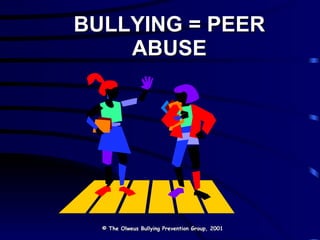
BULLYING = PEER ABUSE © The Olweus Bullying Prevention Group, 2001
Direct Bullying Physical Verbal Non-verbal Hitting, kicking, shoving, spitting… Taunting, teasing, racial slurs, verbal sexual harassment Threatening, obscene gestures © The Olweus Bullying Prevention Group, 2001
Indirect Bullying Physical Verbal Non-verbal Getting another person to assault someone Spreading rumors Deliberate exclusion from a group or activity Cyber bullying © The Olweus Bullying Prevention Group, 2001
Cyber Bullying Telephone Cell Phone Messages Emails Web Sites
Relational Bullying CCombines direct & indirect bullying strategies. TTargets relationships, and social status to cause harm to peers. BULLYING © Olweus Bullying Prevention Group, 2003
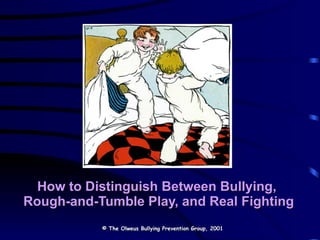
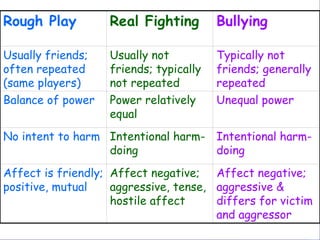
How to Distinguish Between Bullying,  Rough-and-Tumble Play, and Real Fighting © The Olweus Bullying Prevention Group, 2001
Rough Play vs. Bullying Relationship among parties Facial expressions and general atmosphere Balance of power Intention © The Olweus Bullying Prevention Group, 2001
Real Fighting... Usually not repeated Power relatively equal © The Olweus Bullying Prevention Group, 2001
 
Bullying Affects  Everyone : Those who are bullied Those who bully Bystanders © The Olweus Bullying Prevention Group, 2001
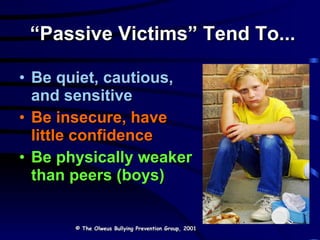
“ Passive Victims” Tend To... Be quiet, cautious, and sensitive Be insecure, have little confidence Be physically weaker than peers (boys) © The Olweus Bullying Prevention Group, 2001
“ Passive Victims” Often... Are afraid of getting hurt or hurting themselves. Find it easier to associate with adults than their peers. © The Olweus Bullying Prevention Group, 2001
The Bully/Victim or “Provocative Victim” Tends to Be... Hyperactive, restless, have difficulty concentrating Hot-tempered, attempt  to fight or answer  back when they feel attacked or insulted Clumsy and immature © The Olweus Bullying Prevention Group, 2001
The Bully/Victim or  “Provocative Victim”  Has difficulty reading social signals. Often is actively disliked by adults, including their teacher. May have reading/writing problems. May try to bully weaker students. © The Olweus Bullying Prevention Group, 2001
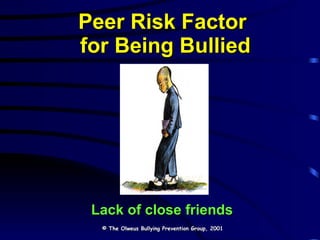
Peer Risk Factor  for Being Bullied Lack of close friends © The Olweus Bullying Prevention Group, 2001
Short-term Effects  of Being Bullied Lower self-esteem Illness Absenteeism Depression & anxiety Thoughts of suicide © The Olweus Bullying Prevention Group, 2001
...In the dark, I am free to move without their judgmental eyes on me. In the shadows, I can sleep without dreams of despair and deception. In the shadows, I am home. Brian Head “Shadows” 1994 © The Olweus Bullying Prevention Group, 2001 24
Lasting Effects Lower self-esteem Higher rates  of depression © The Olweus Bullying Prevention Group, 2001
Children Who Bully  Tend To... Have more positive attitudes toward violence than peers Have quick tempers, are easily frustrated Have difficulty conforming to rules Be stronger than peers (boys)  © The Olweus Bullying Prevention Group, 2001 NO BULLYING ALLOWED!
Children Who Bully Tend To... Appear tough, show little compassion for victims Be aggressive to adults Be good at talking themselves out of situations © The Olweus Bullying Prevention Group, 2001 NO BULLYING ALLOWED!
Children Who Bully Tend To... Have good or average self-esteem Not be anxious and uncertain Vary in popularity; popularity decreases in higher grades © The Olweus Bullying Prevention Group, 2001
What Motivates Children Who Bully? Like to dominate others in a negative way Gain satisfaction from inflicting injury and suffering Receive “rewards” by bullying others (prestige,possessions) © The Olweus Bullying Prevention Group, 2001
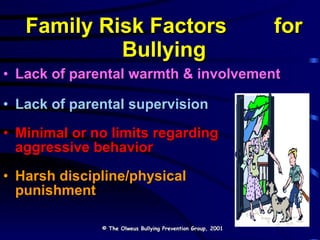
Family Risk Factors  for Bullying Lack of parental warmth & involvement Lack of parental supervision Minimal or no limits regarding aggressive behavior Harsh discipline/physical  punishment © The Olweus Bullying Prevention Group, 2001
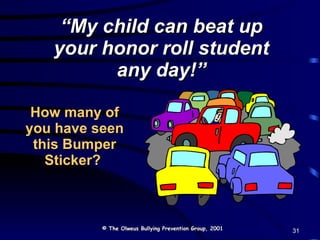
How many of you have seen this Bumper Sticker?  “ My child can beat up your honor roll student any day!” © The Olweus Bullying Prevention Group, 2001 31
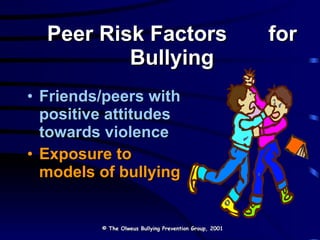
Peer Risk Factors  for Bullying Friends/peers with positive attitudes towards violence Exposure to models of bullying © The Olweus Bullying Prevention Group, 2001
Bullying Behavior Often part of a conduct- disordered behavior pattern This pattern may continue  into young adulthood Olweus study: Were 4 times as likely to have 3 or more convictions by age 24 © The Olweus Bullying Prevention Group, 2001
School Risk Factors Lack of supervision during breaks   Staff have indifferent or accepting attitudes towards bullying Students have indifferent or accepting attitudes © The Olweus Bullying Prevention Group, 2001
Effects on Bystanders Feel afraid Feel powerless to change things Feel guilty Feel diminished empathy for victims © The Olweus Bullying Prevention Group, 2001
Effects of Bullying  on School Climate Students perceive lack of control/caring Creates a climate of fear and disrespect Interferes with student learning © The Olweus Bullying Prevention Group, 2001
Let’s take a look at your  BULLYING Quiz! © The Olweus Bullying Prevention Group, 2001
1. True or False? Studies suggest that fewer than 10% of children are involved in bully/victim problems in elementary or middle school. False © The Olweus Bullying Prevention Group, 2001 B
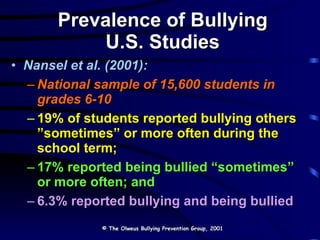
Prevalence of Bullying U.S. Studies Nansel et al. (2001): National sample of 15,600 students in grades 6-10 19% of students reported bullying others ”sometimes” or more often during the school term; 17% reported being bullied “sometimes” or more often; and 6.3% reported bullying and being bullied © The Olweus Bullying Prevention Group, 2001
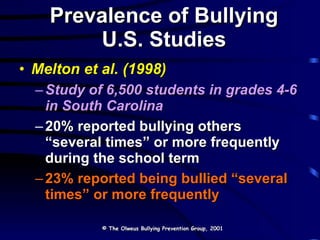
Prevalence of Bullying U.S. Studies Melton et al. (1998) Study of 6,500 students in grades 4-6 in South Carolina 20% reported bullying others “several times” or more frequently during the school term 23% reported being bullied “several times” or more frequently © The Olweus Bullying Prevention Group, 2001
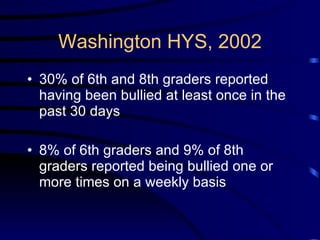
Washington HYS, 2002 30% of 6th and 8th graders reported having been bullied at least once in the past 30 days 8% of 6th graders and 9% of 8th graders reported being bullied one or more times on a weekly basis
2. True or False? Children are more likely to be bullied in middle school than in elementary school. Jury is out © The Olweus Bullying Prevention Group, 2001 B
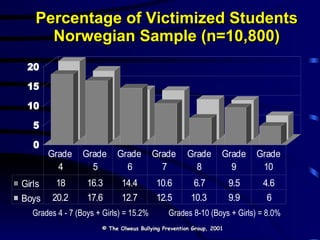
Percentage of Victimized Students Norwegian Sample (n=10,800) Grades 4 - 7 (Boys + Girls) = 15.2% Grades 8-10 (Boys + Girls) = 8.0%   © The Olweus Bullying Prevention Group, 2001
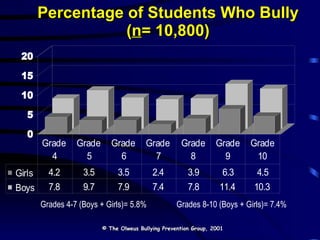
Percentage of Students Who Bully ( n = 10,800) Grades 4-7 (Boys + Girls)= 5.8% Grades 8-10 (Boys + Girls)= 7.4% © The Olweus Bullying Prevention Group, 2001
3. True or False? Most bullying is physical in nature. False © The Olweus Bullying Prevention Group, 2001 B
4. True or False? Girls bully just as much as boys; they just do it differently. False © The Olweus Bullying Prevention Group, 2001 B
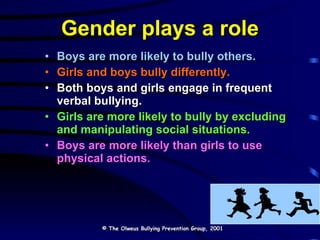
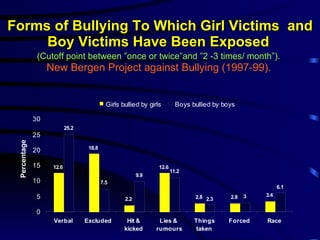
Gender plays a role Boys are more likely to bully others. Girls and boys bully differently. Both boys and girls engage in frequent verbal bullying.  Girls are more likely to bully by excluding and manipulating social situations.   Boys are more likely than girls to use physical actions. © The Olweus Bullying Prevention Group, 2001
Forms of Bullying To Which Girl Victims  and Boy Victims Have Been Exposed   (Cutoff point between ”once or twice”and ”2 -3 times/ month”).   New Bergen Project against Bullying (1997-99).   Percentage 51
5. True or False? Most victims of bullying report being bullied by large numbers of their peers. False © The Olweus Bullying Prevention Group, 2001 B
Did you know? Most children report being bullied by:   “ 2-3 others” or “ mainly one” peer © The Olweus Bullying Prevention Group, 2001
6. True or False? The vast majority of children who are bullied tell a teacher or other member of the school staff. False © The Olweus Bullying Prevention Group, 2001 B
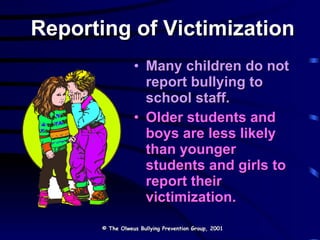
Reporting of Victimization Many children do not report bullying to school staff.  Older students and boys are less likely than younger students and girls to report their victimization. © The Olweus Bullying Prevention Group, 2001
7. True or False? Bullying is just as likely on the way to and from school as during school hours. False © The Olweus Bullying Prevention Group, 2001 B
8. True or False? Most students who observe bullying don’t think that they should get involved. False © The Olweus Bullying Prevention Group, 2001 B
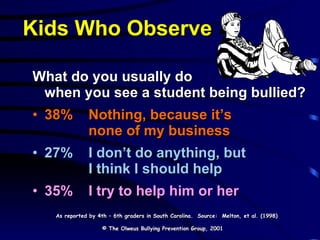
Kids Who Observe What do you usually do  when you see a student being bullied? 38% Nothing, because it’s none of my business 27% I don’t do anything, but I think I should help 35% I try to help him or her © The Olweus Bullying Prevention Group, 2001 As reported by 4th – 6th graders in South Carolina.  Source:  Melton, et al. (1998)
9. True or False? Once a bully, always a bully. False © The Olweus Bullying Prevention Group, 2001 B
Children Who Bully Can Change Bullying behaviors and victimization experiences are relatively stable over time  if  there is no intervention. BUT, appropriate intervention can change behaviors. © The Olweus Bullying Prevention Group, 2001
10. True or False? Most children who are bullied are targeted  because of  outward or physical characteristics. False © The Olweus Bullying Prevention Group, 2001 B
Did you know? Most children are not targeted specifically because of outward/physical characteristics,  although the student who bullies is likely to use a child’s appearance in order to ridicule or be negative. © The Olweus Bullying Prevention Group, 2001
11. True or False? Bullying is mostly an urban problem. False © The Olweus Bullying Prevention Group, 2001 B
Bullying Exists In: Rural and urban communities Low SES and high SES communities Different racial and ethnic communities © The Olweus Bullying Prevention Group, 2001
BULLYING PREVENTION A little history... © The Olweus Bullying Prevention Group, 2001
Origins of the Bullying  Prevention Program Strong societal interest began  in Scandinavia in the late 1960s  and early 1970s. The Bullying Prevention Program was part of a nationwide campaign against bully/victim problems in Norway in 1983. © The Olweus Bullying Prevention Group, 2001 66
Program Outcomes: Norwegian Sample (1 st  Bergen Project, 42 schools, 1983-1985) 50%-70% reductions in students’ self-reports of bullying and victimization Program effects were more marked after 20 months than 8 month evaluation © The Olweus Bullying Prevention Group, 2001 67
Program Outcomes: Norwegian Sample (1 st  Bergen Project, 42 schools, 1983-1985) Reductions in self-reports of antisocial behavior such as vandalism, fighting, theft, alcohol use, and truancy Improvements in class “social climate” Similar results have been found in two follow-up studies (1997-1998; 1999-2000). © The Olweus Bullying Prevention Group, 2001 67
Heightened attention to youth violence and school violence Recognition of the importance of early intervention Development of a research base on bullying Interest in the United States © The Olweus Bullying Prevention Group, 2001 68
Reductions in students’ self-reports of bullying after 7 months Reductions in self-reports  of other antisocial behaviors such as vandalism, school misbehavior, and punishment for school-related misbehavior Program Outcomes: South Carolina Sample, 1994 © The Olweus Bullying Prevention Group, 2001 69
Recognition of the Olweus Bullying Prevention Program One of 11 Blueprints for  Violence Prevention (Center  for the Study & Prevention of Violence) An Exemplary Program  (Center for Substance  Abuse Prevention) B © The Olweus Bullying Prevention Group, 2001
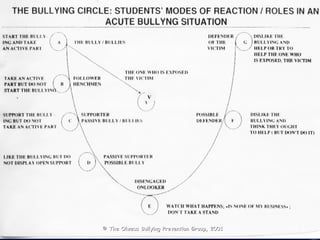
© The Olweus Bullying Prevention Group, 2001 V 73
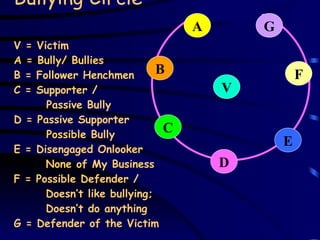
Bullying Circle V = Victim A = Bully/ Bullies B = Follower Henchmen C = Supporter /    Passive Bully D = Passive Supporter    Possible Bully E = Disengaged Onlooker  None of My Business F = Possible Defender /  Doesn’t like bullying; Doesn’t do anything  G = Defender of the Victim V C D E F B G A
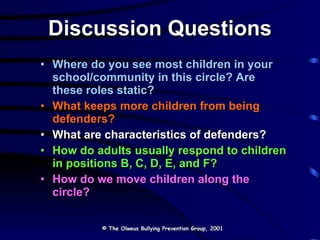
Discussion Questions Where do you see most children in your school/community in this circle? Are these roles static? What keeps more children from being defenders? What are characteristics of defenders?   How do adults usually respond to children in positions B, C, D, E, and F?  How do we move children along the circle?  © The Olweus Bullying Prevention Group, 2001
Misdirections in Bullying Prevention and Intervention Mediation/conflict resolution to resolve  bullying issues Zero tolerance policies for bullying Group treatment for children who bully Self-esteem enhancement for  children who bully Simple, short-term solutions “ Program du jour approaches” © The Olweus Bullying Prevention Group, 2001 B
Cautions Against Use of Peer Mediation in Situations of Bullying (Dan Olweus) 1. Bullying is   NOT a conflict,   but is   ABUSE. 2. There is not   “some right”   and   “some wrong”   on both sides. 3. The   “playing field,”   or balance of power, is  not level. 4. Adults need to claim   responsibility . © The Olweus Bullying Prevention Group, 2001
Implementing the  Olweus Bullying Prevention Program © The Olweus Bullying Prevention Group, 2001 79
The Bullying Prevention Program   IS NOT... a  curriculum a  conflict resolution   approach a  peer mediation   program an  anger management   program © The Olweus Bullying Prevention Group, 2001 B
The Olweus Bullying Prevention Program   IS... Universal   (a school-wide effort) Systems-oriented  AND  individual-oriented Preventive  AND  problem-solving Focused on changing norms   and   behavior Research-based NOT time-limited:  Requires systematic efforts over time © The Olweus Bullying Prevention Group, 2001
Goals of the Olweus  Bullying Prevention Program Reduce existing bully/victim problems among school children Prevent the development of new bully/victim problems Improve peer relations Improve school climate © The Olweus Bullying Prevention Group, 2001
Program Principles-- Warmth Positive Interest Involvement from adults Firm limits to unacceptable behavior It is critical to develop a school environment characterized by: © The Olweus Bullying Prevention Group, 2001
Program Principles (cont.) Non-hostile - Non-physical sanctions are consistently applied when rules are violated and/or behavior is unacceptable Adults act as authorities and positive role models © The Olweus Bullying Prevention Group, 2001
Elements of the Program School-wide interventions Classroom-level interventions Individual interventions Community interventions © The Olweus Bullying Prevention Group, 2001
School-wide Interventions © The Olweus Bullying Prevention Group, 2001
School-Wide Interventions Formation of a Bullying Prevention Coordinating Committee Training for committee and all school staff personnel Administration of bully/victim questionnaire
School-Wide Interventions Develop school rules against bullying Increase supervision in “hot spots” Use consistent positive and negative consequences Hold staff discussion groups Parent Involvement
Staff Discussion Groups Regularly scheduled meetings   Participants are 6-12 teachers and other school personnel Discussions are based on material  in  Bullying at School   and  Teacher Handbook © The Olweus Bullying Prevention Group, 2001
Goals of  Staff Discussion Groups Provide more detailed  information about program  components Stimulate rapid  implementation Discuss and learn from each other’s experiences Keep motivation and involvement high © The Olweus Bullying Prevention Group, 2001
Against   Bullying We will not bully others. We will try to help students who are bullied. We will make it a point to include students who are easily left out. When we know somebody is being bullied, we will tell an adult at school and an adult at home. © The Olweus Bullying Prevention Group, 2001
Use Appropriate Positive and Negative Consequences Identify consequences currently being used with bullying. Assess which are effective and which are not. Develop graduated sanctions and rewards that are developmentally appropriate. ©   2001 NMR:The Olweus Bullying Prevention Group
Positive Consequences May... Include verbal attention, privileges, or tangible rewards Be directed at an entire class, a smaller group, or an individual Be given out informally, or as part of a more orchestrated school-wide or grade-level effort © The Olweus Bullying Prevention Group, 2001
Positive Consequences Should be used abundantly, sincerely, and consistently Are most effective when varied strategies are used Verbal praise is more effective than reprimand in a classroom setting  © The Olweus Bullying Prevention Group, 2001
Two Types of Negative Consequences Removal of positive stimulus (e.g .,  time-out, loss of privileges at school, time away from peers) Use of a negative or unpleasant stimulus (e.g.,verbal reprimand, call to parent) © The Olweus Bullying Prevention Group, 2001
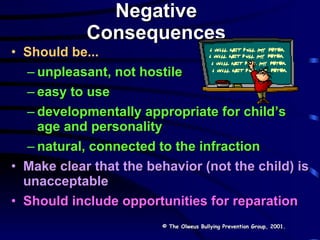
Negative Consequences Should be... unpleasant, not hostile easy to use developmentally appropriate for child’s age and personality natural, connected to the infraction Make clear that the behavior (not the child) is unacceptable   Should include opportunities for reparation © The Olweus Bullying Prevention Group, 2001.
Interventions at the  School Level  (cont.) Re-examine and fortify supervision of “hot  spots” © The Olweus Bullying Prevention Group, 2001
Common-Area Supervision How is the common-area arranged?   Are there hidden places? Is there adequate supervision? How are adults utilized? How are the premises used? Are there fun activities? Is there room for all? Is there enough equipment? © The Olweus Bullying Prevention Group, 2001
Staff Attitudes Toward Supervision Within an effective supervisory system, staff reactions to bullying should be consistent across time and across staff. © The Olweus Bullying Prevention Group, 2001
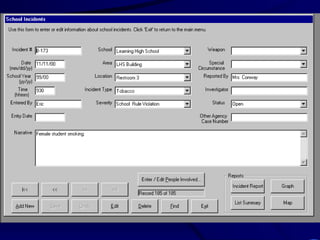
A Coordinated Supervisory System Information about known bullying & concerns about possible bullying  should be reported to teachers and/or grade-level teams may be kept in  a main log © The Olweus Bullying Prevention Group, 2001
Interventions at the  School Level  (cont.) Hold school-wide “kick-offs” Involve parents Opportunities and obstacles to implementation © The Olweus Bullying Prevention Group, 2001
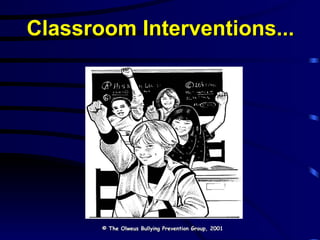
Classroom Interventions... © The Olweus Bullying Prevention Group, 2001
Interventions at  the Classroom Level School rules posted and discussed Consistent use of sanctions and  positive reinforcement Regular class meetings (weekly) Incorporation of bullying themes  across the curriculum © The Olweus Bullying Prevention Group, 2001
Classroom Meetings A regular period in which to discuss bullying and peer relations Meetings build a sense of class cohesion & community, positive peer social control Use resources as  guides . Be flexible in following students’ ideas  for discussion topics © The Olweus Bullying Prevention Group, 2001
General Strategies for Holding Classroom Meetings Hold meetings once per week, ideally at a specific time of the week Sit in a circle, if possible Utilize links to academic curricula to teach or reinforce specific skills and concepts  for greatest impact. © The Olweus Bullying Prevention Group, 2001
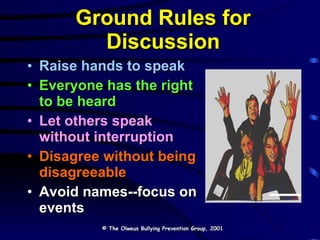
Ground Rules for Discussion Raise hands to speak Everyone has the right  to be heard Let others speak without interruption Disagree without being disagreeable Avoid names--focus on events © The Olweus Bullying Prevention Group, 2001
Teacher Strategies Be an attentive listener Avoid derogatory comments Encourage input from shy students Encourage the use of “I” statements   Encourage students to express what they think, feel, and believe Summarize viewpoints © The Olweus Bullying Prevention Group, 2001
Types of Role Playing Role playing without solutions: -  students gain an emotional understanding of bullying Role playing with solutions:   -  students arrive at, test,  practice, and assess options  © The Olweus Bullying Prevention Group, 2001
Group Work Before  the Role Play What is your character like? What is he/she thinking and feeling? Why does he/she act this way? What do the others feel about him/her? What do you think it’s like for him/her at home? © The Olweus Bullying Prevention Group, 2001
Discussion Questions  After the Role Play Is this solution safe? Did they avoid using aggression? Is it fair for the victim?  Others? Is this likely to happen? What do you think will happen the next day? © The Olweus Bullying Prevention Group, 2001
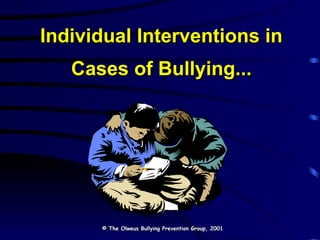
Individual Interventions in Cases of Bullying... © The Olweus Bullying Prevention Group, 2001
Where Are You Focusing Your Efforts? School-wide interventions Classroom-level interventions Individual interventions Community interventions © 2000  US Olweus Group
Interventions at the Individual Level 1.  On-the-spot interventions  & follow-up discussions with children who are bullied 2.  On-the-spot interventions & follow-up discussions with children who bully 3.  Parental involvement © The Olweus Bullying Prevention Group, 2001
Why Adults  Don’t  Always Intervene: Difficulty recognizing bullying Failure to recognize the importance of intervening Uncertainty regarding  how  best to intervene © The Olweus Bullying Prevention Group, 2001
1. On-the-Spot Interventions: The “Teachable Moment” Stop the bullying Support the victim Name the bullying behavior Refer to the school rules Impose immediate consequences  (as appropriate) as per discipline code Empower the bystander © The Olweus Bullying Prevention Group, 2001
2.  Follow-Up Interventions Report the incident, increase vigilance  and communication. Identify staff person to talk with the parties. Talk separately with the child who is bullied, and the children who bully. Begin by talking with the child who is bullied, then with the children who bully. Impose consequences for the children  who bully. Talk with the students’ parents. Follow-up with the parties later. © The Olweus Bullying Prevention Group, 2001
Meetings with  Victims of Bullying Try to put the  child at ease Collect information  about the incident Encourage the child  to express his or her emotions Provide support & encouragement © The Olweus Bullying Prevention Group, 2001
Meetings with  Victims of Bullying (cont.) Discuss a safety plan Inform the child of your intended actions with the bully/bullies Have the child agree to report future bullying Gauge the child’s distress and refer to a counselor if necessary Plan a follow-up meeting © The Olweus Bullying Prevention Group, 2001
Meetings with  Children Who Bully Ask another adult to be present, if necessary Talk with the children who bully separately, in rapid sequence Begin with the “leader” Plan a follow-up meeting © The Olweus Bullying Prevention Group, 2001
Points to Communicate  to Children Who Bully We know that you have been involved in bullying Bullying is against the school rules The bullying must  STOP  immediately As a result of your behavior,  you will be disciplined  (if necessary) You may be expected to  make “amends” to the victim(s),  if necessary and appropriate © The Olweus Bullying Prevention Group, 2001
Points to Communicate to Children Who Bully (cont.) Your future behavior will be  monitored closely There may be additional  sanctions if the bullying continues Plan ways to make reparations  (if appropriate) Your parents will be notified  (if appropriate) © The Olweus Bullying Prevention Group, 2001
Common Defenses from Children Who Bully Denial Minimizing one’s involvement Blaming the victim © The Olweus Bullying Prevention Group, 2001
When There Are Suspicions of Bullying... Intensify your observations  of the possible victim Confer with colleagues Collect information from students Contact parents © The Olweus Bullying Prevention Group, 2001
Working With Parents © The Olweus Bullying Prevention Group, 2001
How does your child like school? What kinds of things does s/he say about school? Does s/he have some good friends at school? Questions for Parents © The Olweus Bullying Prevention Group, 2001
What Can Parents Do  If Their Child Is Bullied? Help the child develop talents and positive attributes Encourage the child to make contact with friendly student(s) in their classes Encourage the child to  get to know peers in  new situations © The Olweus Bullying Prevention Group, 2001
Communicate directly to the child: We know you have been involved in bullying Bullying is a serious behavior We will not tolerate any future bullying behavior   What Can Parents Do If Their Child Bullies Others? © The Olweus Bullying Prevention Group, 2001
Enforce family rules  Reinforce positive and kind behavior Spend more time with your child Monitor the child’s activities Build upon the child’s talents Help child find more appropriate behavior patterns Seek professional assistance, if necessary  What Can Parents Do If Their Child Bullies Others? © The Olweus Bullying Prevention Group, 2001
COMMUNITY EFFORTS © The Olweus Bullying Prevention Group, 2001
Community Involvement Look for ways that community members can support the school’s efforts Examine strategies for spreading anti-bullying messages beyond the school’s doors © The Olweus Bullying Prevention Group, 2001
Interventions at the Community Level Partnerships with community organizations, businesses, houses of faith, etc. Violence prevention coalitions Formal and informal linkages to families, neighborhood associations, etc. © The Olweus Bullying Prevention Group, 2001
 
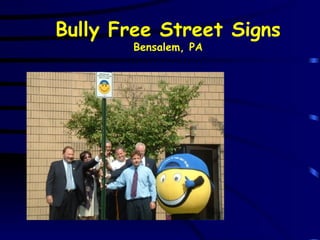
Bully Free Street Signs Bensalem, PA
Program Materials: Bullying Prevention Program Blueprint A Teacher Handbook Bullying at School: What  We Know and What We Can Do Olweus bully/victim questionnaire & statistical package Bullying  (video and accompanying teacher guide) Supplemental lesson plans Quit It!  (K-3) © The Olweus Bullying Prevention Group, 2001
The Use of Supplemental Resources Other resources should be viewed as supplemental.   They should  NOT supplant required Olweus program materials, or  be introduced until school staff are familiar with and have made use of required resources
Strategies to Encourage the Use of Required Materials Actively encourage the use of required resources such as the  Teacher Handbook  and  Bullying at School Have Staff Discussion Groups review one chapter per meeting Staff may be “assigned” to create questions for discussion
Why Specific Supplemental Materials Generally are Neither Endorsed Nor Forbidden by the Olweus Group An issue of volume Few could be endorsed unequivocally; it matters how they are  used   Good annotated compilations exist Schools benefit from reviewing materials themselves If endorsed, materials may tend to supplant required resources
Exceptions... Quit It  is a recommended resources for K-3 Use of the following are discouraged: complete curricula (e.g., Bully Proofing Your School) other comprehensive programs  (e.g., Steps to Respect)
Guidelines for Use of Supplemental Materials Consider: Does the resource bill itself as a bullying prevention  program ? Would it likely  be viewed  as a complete bullying prevention program? Is it  inconsistent  with any of the underlying principles or tenets of the Olweus model? If  “yes”  to any of the above, we recommend  not  using the materials
What Might Be Appropriate Supplemental Resources? Videos that can be used in classrooms with students and/or with adults Children’s literature that can be used in class Teacher guides/resources that provide additional information about bullying and/or strategies to address bullying in classes
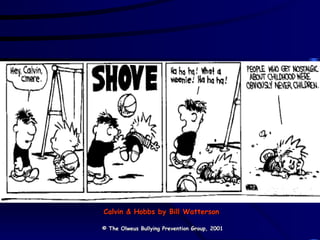
Calvin & Hobbs by Bill Watterson © The Olweus Bullying Prevention Group, 2001
Take-Home Message Stopping bullying takes a team effort. Approach the process in  steps. Change happens in  small increments .   © The Olweus Bullying Prevention Group, 2001
We   CAN   stop bullying! The reward is:  A school climate where children  are free to learn. Stopping bullying takes a team effort. Take Home Message   © The Olweus Bullying Prevention Group, 2001
The   Olweus Bullying Prevention Program
 

Olweus bully prevention master

  • 1.
    The Olweus Bullying Prevention Program
  • 2.
    Bullying Who? What?When? Where? How? Why? © The Olweus Bullying Prevention Group, 2001 2
  • 3.
    “ Bullying .. .” A student is being bullied when he or she is exposed,repeatedly and over time, to negative actions on the part of one or more students. © The Olweus Bullying Prevention Group, 2001
  • 4.
    Bullying implies an imbalance in power or strength. The student who is bullied has difficulty defending himself/herself. © The Olweus Bullying Prevention Group, 2001 4
  • 5.
    In Summary... Intentionalharm-doing Repeated over time Occurs in a relationship in which there is an imbalance of power © The Olweus Bullying Prevention Group, 2001
  • 6.
    BULLYING = PEERABUSE © The Olweus Bullying Prevention Group, 2001
  • 7.
    Direct Bullying PhysicalVerbal Non-verbal Hitting, kicking, shoving, spitting… Taunting, teasing, racial slurs, verbal sexual harassment Threatening, obscene gestures © The Olweus Bullying Prevention Group, 2001
  • 8.
    Indirect Bullying PhysicalVerbal Non-verbal Getting another person to assault someone Spreading rumors Deliberate exclusion from a group or activity Cyber bullying © The Olweus Bullying Prevention Group, 2001
  • 9.
    Cyber Bullying TelephoneCell Phone Messages Emails Web Sites
  • 10.
    Relational Bullying CCombinesdirect & indirect bullying strategies. TTargets relationships, and social status to cause harm to peers. BULLYING © Olweus Bullying Prevention Group, 2003
  • 11.
    How to DistinguishBetween Bullying, Rough-and-Tumble Play, and Real Fighting © The Olweus Bullying Prevention Group, 2001
  • 12.
    Rough Play vs.Bullying Relationship among parties Facial expressions and general atmosphere Balance of power Intention © The Olweus Bullying Prevention Group, 2001
  • 13.
    Real Fighting... Usuallynot repeated Power relatively equal © The Olweus Bullying Prevention Group, 2001
  • 14.
  • 15.
    Bullying Affects Everyone : Those who are bullied Those who bully Bystanders © The Olweus Bullying Prevention Group, 2001
  • 16.
    “ Passive Victims”Tend To... Be quiet, cautious, and sensitive Be insecure, have little confidence Be physically weaker than peers (boys) © The Olweus Bullying Prevention Group, 2001
  • 17.
    “ Passive Victims”Often... Are afraid of getting hurt or hurting themselves. Find it easier to associate with adults than their peers. © The Olweus Bullying Prevention Group, 2001
  • 18.
    The Bully/Victim or“Provocative Victim” Tends to Be... Hyperactive, restless, have difficulty concentrating Hot-tempered, attempt to fight or answer back when they feel attacked or insulted Clumsy and immature © The Olweus Bullying Prevention Group, 2001
  • 19.
    The Bully/Victim or “Provocative Victim” Has difficulty reading social signals. Often is actively disliked by adults, including their teacher. May have reading/writing problems. May try to bully weaker students. © The Olweus Bullying Prevention Group, 2001
  • 20.
    Peer Risk Factor for Being Bullied Lack of close friends © The Olweus Bullying Prevention Group, 2001
  • 21.
    Short-term Effects of Being Bullied Lower self-esteem Illness Absenteeism Depression & anxiety Thoughts of suicide © The Olweus Bullying Prevention Group, 2001
  • 22.
    ...In the dark,I am free to move without their judgmental eyes on me. In the shadows, I can sleep without dreams of despair and deception. In the shadows, I am home. Brian Head “Shadows” 1994 © The Olweus Bullying Prevention Group, 2001 24
  • 23.
    Lasting Effects Lowerself-esteem Higher rates of depression © The Olweus Bullying Prevention Group, 2001
  • 24.
    Children Who Bully Tend To... Have more positive attitudes toward violence than peers Have quick tempers, are easily frustrated Have difficulty conforming to rules Be stronger than peers (boys) © The Olweus Bullying Prevention Group, 2001 NO BULLYING ALLOWED!
  • 25.
    Children Who BullyTend To... Appear tough, show little compassion for victims Be aggressive to adults Be good at talking themselves out of situations © The Olweus Bullying Prevention Group, 2001 NO BULLYING ALLOWED!
  • 26.
    Children Who BullyTend To... Have good or average self-esteem Not be anxious and uncertain Vary in popularity; popularity decreases in higher grades © The Olweus Bullying Prevention Group, 2001
  • 27.
    What Motivates ChildrenWho Bully? Like to dominate others in a negative way Gain satisfaction from inflicting injury and suffering Receive “rewards” by bullying others (prestige,possessions) © The Olweus Bullying Prevention Group, 2001
  • 28.
    Family Risk Factors for Bullying Lack of parental warmth & involvement Lack of parental supervision Minimal or no limits regarding aggressive behavior Harsh discipline/physical punishment © The Olweus Bullying Prevention Group, 2001
  • 29.
    How many ofyou have seen this Bumper Sticker? “ My child can beat up your honor roll student any day!” © The Olweus Bullying Prevention Group, 2001 31
  • 30.
    Peer Risk Factors for Bullying Friends/peers with positive attitudes towards violence Exposure to models of bullying © The Olweus Bullying Prevention Group, 2001
  • 31.
    Bullying Behavior Oftenpart of a conduct- disordered behavior pattern This pattern may continue into young adulthood Olweus study: Were 4 times as likely to have 3 or more convictions by age 24 © The Olweus Bullying Prevention Group, 2001
  • 32.
    School Risk FactorsLack of supervision during breaks Staff have indifferent or accepting attitudes towards bullying Students have indifferent or accepting attitudes © The Olweus Bullying Prevention Group, 2001
  • 33.
    Effects on BystandersFeel afraid Feel powerless to change things Feel guilty Feel diminished empathy for victims © The Olweus Bullying Prevention Group, 2001
  • 34.
    Effects of Bullying on School Climate Students perceive lack of control/caring Creates a climate of fear and disrespect Interferes with student learning © The Olweus Bullying Prevention Group, 2001
  • 35.
    Let’s take alook at your BULLYING Quiz! © The Olweus Bullying Prevention Group, 2001
  • 36.
    1. True orFalse? Studies suggest that fewer than 10% of children are involved in bully/victim problems in elementary or middle school. False © The Olweus Bullying Prevention Group, 2001 B
  • 37.
    Prevalence of BullyingU.S. Studies Nansel et al. (2001): National sample of 15,600 students in grades 6-10 19% of students reported bullying others ”sometimes” or more often during the school term; 17% reported being bullied “sometimes” or more often; and 6.3% reported bullying and being bullied © The Olweus Bullying Prevention Group, 2001
  • 38.
    Prevalence of BullyingU.S. Studies Melton et al. (1998) Study of 6,500 students in grades 4-6 in South Carolina 20% reported bullying others “several times” or more frequently during the school term 23% reported being bullied “several times” or more frequently © The Olweus Bullying Prevention Group, 2001
  • 39.
    Washington HYS, 200230% of 6th and 8th graders reported having been bullied at least once in the past 30 days 8% of 6th graders and 9% of 8th graders reported being bullied one or more times on a weekly basis
  • 40.
    2. True orFalse? Children are more likely to be bullied in middle school than in elementary school. Jury is out © The Olweus Bullying Prevention Group, 2001 B
  • 41.
    Percentage of VictimizedStudents Norwegian Sample (n=10,800) Grades 4 - 7 (Boys + Girls) = 15.2% Grades 8-10 (Boys + Girls) = 8.0% © The Olweus Bullying Prevention Group, 2001
  • 42.
    Percentage of StudentsWho Bully ( n = 10,800) Grades 4-7 (Boys + Girls)= 5.8% Grades 8-10 (Boys + Girls)= 7.4% © The Olweus Bullying Prevention Group, 2001
  • 43.
    3. True orFalse? Most bullying is physical in nature. False © The Olweus Bullying Prevention Group, 2001 B
  • 44.
    4. True orFalse? Girls bully just as much as boys; they just do it differently. False © The Olweus Bullying Prevention Group, 2001 B
  • 45.
    Gender plays arole Boys are more likely to bully others. Girls and boys bully differently. Both boys and girls engage in frequent verbal bullying. Girls are more likely to bully by excluding and manipulating social situations. Boys are more likely than girls to use physical actions. © The Olweus Bullying Prevention Group, 2001
  • 46.
    Forms of BullyingTo Which Girl Victims and Boy Victims Have Been Exposed (Cutoff point between ”once or twice”and ”2 -3 times/ month”). New Bergen Project against Bullying (1997-99). Percentage 51
  • 47.
    5. True orFalse? Most victims of bullying report being bullied by large numbers of their peers. False © The Olweus Bullying Prevention Group, 2001 B
  • 48.
    Did you know?Most children report being bullied by: “ 2-3 others” or “ mainly one” peer © The Olweus Bullying Prevention Group, 2001
  • 49.
    6. True orFalse? The vast majority of children who are bullied tell a teacher or other member of the school staff. False © The Olweus Bullying Prevention Group, 2001 B
  • 50.
    Reporting of VictimizationMany children do not report bullying to school staff. Older students and boys are less likely than younger students and girls to report their victimization. © The Olweus Bullying Prevention Group, 2001
  • 51.
    7. True orFalse? Bullying is just as likely on the way to and from school as during school hours. False © The Olweus Bullying Prevention Group, 2001 B
  • 52.
    8. True orFalse? Most students who observe bullying don’t think that they should get involved. False © The Olweus Bullying Prevention Group, 2001 B
  • 53.
    Kids Who ObserveWhat do you usually do when you see a student being bullied? 38% Nothing, because it’s none of my business 27% I don’t do anything, but I think I should help 35% I try to help him or her © The Olweus Bullying Prevention Group, 2001 As reported by 4th – 6th graders in South Carolina. Source: Melton, et al. (1998)
  • 54.
    9. True orFalse? Once a bully, always a bully. False © The Olweus Bullying Prevention Group, 2001 B
  • 55.
    Children Who BullyCan Change Bullying behaviors and victimization experiences are relatively stable over time if there is no intervention. BUT, appropriate intervention can change behaviors. © The Olweus Bullying Prevention Group, 2001
  • 56.
    10. True orFalse? Most children who are bullied are targeted because of outward or physical characteristics. False © The Olweus Bullying Prevention Group, 2001 B
  • 57.
    Did you know?Most children are not targeted specifically because of outward/physical characteristics, although the student who bullies is likely to use a child’s appearance in order to ridicule or be negative. © The Olweus Bullying Prevention Group, 2001
  • 58.
    11. True orFalse? Bullying is mostly an urban problem. False © The Olweus Bullying Prevention Group, 2001 B
  • 59.
    Bullying Exists In:Rural and urban communities Low SES and high SES communities Different racial and ethnic communities © The Olweus Bullying Prevention Group, 2001
  • 60.
    BULLYING PREVENTION Alittle history... © The Olweus Bullying Prevention Group, 2001
  • 61.
    Origins of theBullying Prevention Program Strong societal interest began in Scandinavia in the late 1960s and early 1970s. The Bullying Prevention Program was part of a nationwide campaign against bully/victim problems in Norway in 1983. © The Olweus Bullying Prevention Group, 2001 66
  • 62.
    Program Outcomes: NorwegianSample (1 st Bergen Project, 42 schools, 1983-1985) 50%-70% reductions in students’ self-reports of bullying and victimization Program effects were more marked after 20 months than 8 month evaluation © The Olweus Bullying Prevention Group, 2001 67
  • 63.
    Program Outcomes: NorwegianSample (1 st Bergen Project, 42 schools, 1983-1985) Reductions in self-reports of antisocial behavior such as vandalism, fighting, theft, alcohol use, and truancy Improvements in class “social climate” Similar results have been found in two follow-up studies (1997-1998; 1999-2000). © The Olweus Bullying Prevention Group, 2001 67
  • 64.
    Heightened attention toyouth violence and school violence Recognition of the importance of early intervention Development of a research base on bullying Interest in the United States © The Olweus Bullying Prevention Group, 2001 68
  • 65.
    Reductions in students’self-reports of bullying after 7 months Reductions in self-reports of other antisocial behaviors such as vandalism, school misbehavior, and punishment for school-related misbehavior Program Outcomes: South Carolina Sample, 1994 © The Olweus Bullying Prevention Group, 2001 69
  • 66.
    Recognition of theOlweus Bullying Prevention Program One of 11 Blueprints for Violence Prevention (Center for the Study & Prevention of Violence) An Exemplary Program (Center for Substance Abuse Prevention) B © The Olweus Bullying Prevention Group, 2001
  • 67.
    © The OlweusBullying Prevention Group, 2001 V 73
  • 68.
    Bullying Circle V= Victim A = Bully/ Bullies B = Follower Henchmen C = Supporter / Passive Bully D = Passive Supporter Possible Bully E = Disengaged Onlooker None of My Business F = Possible Defender / Doesn’t like bullying; Doesn’t do anything G = Defender of the Victim V C D E F B G A
  • 69.
    Discussion Questions Wheredo you see most children in your school/community in this circle? Are these roles static? What keeps more children from being defenders? What are characteristics of defenders? How do adults usually respond to children in positions B, C, D, E, and F? How do we move children along the circle? © The Olweus Bullying Prevention Group, 2001
  • 70.
    Misdirections in BullyingPrevention and Intervention Mediation/conflict resolution to resolve bullying issues Zero tolerance policies for bullying Group treatment for children who bully Self-esteem enhancement for children who bully Simple, short-term solutions “ Program du jour approaches” © The Olweus Bullying Prevention Group, 2001 B
  • 71.
    Cautions Against Useof Peer Mediation in Situations of Bullying (Dan Olweus) 1. Bullying is NOT a conflict, but is ABUSE. 2. There is not “some right” and “some wrong” on both sides. 3. The “playing field,” or balance of power, is not level. 4. Adults need to claim responsibility . © The Olweus Bullying Prevention Group, 2001
  • 72.
    Implementing the Olweus Bullying Prevention Program © The Olweus Bullying Prevention Group, 2001 79
  • 73.
    The Bullying PreventionProgram IS NOT... a curriculum a conflict resolution approach a peer mediation program an anger management program © The Olweus Bullying Prevention Group, 2001 B
  • 74.
    The Olweus BullyingPrevention Program IS... Universal (a school-wide effort) Systems-oriented AND individual-oriented Preventive AND problem-solving Focused on changing norms and behavior Research-based NOT time-limited: Requires systematic efforts over time © The Olweus Bullying Prevention Group, 2001
  • 75.
    Goals of theOlweus Bullying Prevention Program Reduce existing bully/victim problems among school children Prevent the development of new bully/victim problems Improve peer relations Improve school climate © The Olweus Bullying Prevention Group, 2001
  • 76.
    Program Principles-- WarmthPositive Interest Involvement from adults Firm limits to unacceptable behavior It is critical to develop a school environment characterized by: © The Olweus Bullying Prevention Group, 2001
  • 77.
    Program Principles (cont.)Non-hostile - Non-physical sanctions are consistently applied when rules are violated and/or behavior is unacceptable Adults act as authorities and positive role models © The Olweus Bullying Prevention Group, 2001
  • 78.
    Elements of theProgram School-wide interventions Classroom-level interventions Individual interventions Community interventions © The Olweus Bullying Prevention Group, 2001
  • 79.
    School-wide Interventions ©The Olweus Bullying Prevention Group, 2001
  • 80.
    School-Wide Interventions Formationof a Bullying Prevention Coordinating Committee Training for committee and all school staff personnel Administration of bully/victim questionnaire
  • 81.
    School-Wide Interventions Developschool rules against bullying Increase supervision in “hot spots” Use consistent positive and negative consequences Hold staff discussion groups Parent Involvement
  • 82.
    Staff Discussion GroupsRegularly scheduled meetings Participants are 6-12 teachers and other school personnel Discussions are based on material in Bullying at School and Teacher Handbook © The Olweus Bullying Prevention Group, 2001
  • 83.
    Goals of Staff Discussion Groups Provide more detailed information about program components Stimulate rapid implementation Discuss and learn from each other’s experiences Keep motivation and involvement high © The Olweus Bullying Prevention Group, 2001
  • 84.
    Against Bullying We will not bully others. We will try to help students who are bullied. We will make it a point to include students who are easily left out. When we know somebody is being bullied, we will tell an adult at school and an adult at home. © The Olweus Bullying Prevention Group, 2001
  • 85.
    Use Appropriate Positiveand Negative Consequences Identify consequences currently being used with bullying. Assess which are effective and which are not. Develop graduated sanctions and rewards that are developmentally appropriate. © 2001 NMR:The Olweus Bullying Prevention Group
  • 86.
    Positive Consequences May...Include verbal attention, privileges, or tangible rewards Be directed at an entire class, a smaller group, or an individual Be given out informally, or as part of a more orchestrated school-wide or grade-level effort © The Olweus Bullying Prevention Group, 2001
  • 87.
    Positive Consequences Shouldbe used abundantly, sincerely, and consistently Are most effective when varied strategies are used Verbal praise is more effective than reprimand in a classroom setting © The Olweus Bullying Prevention Group, 2001
  • 88.
    Two Types ofNegative Consequences Removal of positive stimulus (e.g ., time-out, loss of privileges at school, time away from peers) Use of a negative or unpleasant stimulus (e.g.,verbal reprimand, call to parent) © The Olweus Bullying Prevention Group, 2001
  • 89.
    Negative Consequences Shouldbe... unpleasant, not hostile easy to use developmentally appropriate for child’s age and personality natural, connected to the infraction Make clear that the behavior (not the child) is unacceptable Should include opportunities for reparation © The Olweus Bullying Prevention Group, 2001.
  • 90.
    Interventions at the School Level (cont.) Re-examine and fortify supervision of “hot spots” © The Olweus Bullying Prevention Group, 2001
  • 91.
    Common-Area Supervision Howis the common-area arranged? Are there hidden places? Is there adequate supervision? How are adults utilized? How are the premises used? Are there fun activities? Is there room for all? Is there enough equipment? © The Olweus Bullying Prevention Group, 2001
  • 92.
    Staff Attitudes TowardSupervision Within an effective supervisory system, staff reactions to bullying should be consistent across time and across staff. © The Olweus Bullying Prevention Group, 2001
  • 93.
    A Coordinated SupervisorySystem Information about known bullying & concerns about possible bullying should be reported to teachers and/or grade-level teams may be kept in a main log © The Olweus Bullying Prevention Group, 2001
  • 94.
    Interventions at the School Level (cont.) Hold school-wide “kick-offs” Involve parents Opportunities and obstacles to implementation © The Olweus Bullying Prevention Group, 2001
  • 95.
    Classroom Interventions... ©The Olweus Bullying Prevention Group, 2001
  • 96.
    Interventions at the Classroom Level School rules posted and discussed Consistent use of sanctions and positive reinforcement Regular class meetings (weekly) Incorporation of bullying themes across the curriculum © The Olweus Bullying Prevention Group, 2001
  • 97.
    Classroom Meetings Aregular period in which to discuss bullying and peer relations Meetings build a sense of class cohesion & community, positive peer social control Use resources as guides . Be flexible in following students’ ideas for discussion topics © The Olweus Bullying Prevention Group, 2001
  • 98.
    General Strategies forHolding Classroom Meetings Hold meetings once per week, ideally at a specific time of the week Sit in a circle, if possible Utilize links to academic curricula to teach or reinforce specific skills and concepts for greatest impact. © The Olweus Bullying Prevention Group, 2001
  • 99.
    Ground Rules forDiscussion Raise hands to speak Everyone has the right to be heard Let others speak without interruption Disagree without being disagreeable Avoid names--focus on events © The Olweus Bullying Prevention Group, 2001
  • 100.
    Teacher Strategies Bean attentive listener Avoid derogatory comments Encourage input from shy students Encourage the use of “I” statements Encourage students to express what they think, feel, and believe Summarize viewpoints © The Olweus Bullying Prevention Group, 2001
  • 101.
    Types of RolePlaying Role playing without solutions: - students gain an emotional understanding of bullying Role playing with solutions: - students arrive at, test, practice, and assess options © The Olweus Bullying Prevention Group, 2001
  • 102.
    Group Work Before the Role Play What is your character like? What is he/she thinking and feeling? Why does he/she act this way? What do the others feel about him/her? What do you think it’s like for him/her at home? © The Olweus Bullying Prevention Group, 2001
  • 103.
    Discussion Questions After the Role Play Is this solution safe? Did they avoid using aggression? Is it fair for the victim? Others? Is this likely to happen? What do you think will happen the next day? © The Olweus Bullying Prevention Group, 2001
  • 104.
    Individual Interventions inCases of Bullying... © The Olweus Bullying Prevention Group, 2001
  • 105.
    Where Are YouFocusing Your Efforts? School-wide interventions Classroom-level interventions Individual interventions Community interventions © 2000 US Olweus Group
  • 106.
    Interventions at theIndividual Level 1. On-the-spot interventions & follow-up discussions with children who are bullied 2. On-the-spot interventions & follow-up discussions with children who bully 3. Parental involvement © The Olweus Bullying Prevention Group, 2001
  • 107.
    Why Adults Don’t Always Intervene: Difficulty recognizing bullying Failure to recognize the importance of intervening Uncertainty regarding how best to intervene © The Olweus Bullying Prevention Group, 2001
  • 108.
    1. On-the-Spot Interventions:The “Teachable Moment” Stop the bullying Support the victim Name the bullying behavior Refer to the school rules Impose immediate consequences (as appropriate) as per discipline code Empower the bystander © The Olweus Bullying Prevention Group, 2001
  • 109.
    2. Follow-UpInterventions Report the incident, increase vigilance and communication. Identify staff person to talk with the parties. Talk separately with the child who is bullied, and the children who bully. Begin by talking with the child who is bullied, then with the children who bully. Impose consequences for the children who bully. Talk with the students’ parents. Follow-up with the parties later. © The Olweus Bullying Prevention Group, 2001
  • 110.
    Meetings with Victims of Bullying Try to put the child at ease Collect information about the incident Encourage the child to express his or her emotions Provide support & encouragement © The Olweus Bullying Prevention Group, 2001
  • 111.
    Meetings with Victims of Bullying (cont.) Discuss a safety plan Inform the child of your intended actions with the bully/bullies Have the child agree to report future bullying Gauge the child’s distress and refer to a counselor if necessary Plan a follow-up meeting © The Olweus Bullying Prevention Group, 2001
  • 112.
    Meetings with Children Who Bully Ask another adult to be present, if necessary Talk with the children who bully separately, in rapid sequence Begin with the “leader” Plan a follow-up meeting © The Olweus Bullying Prevention Group, 2001
  • 113.
    Points to Communicate to Children Who Bully We know that you have been involved in bullying Bullying is against the school rules The bullying must STOP immediately As a result of your behavior, you will be disciplined (if necessary) You may be expected to make “amends” to the victim(s), if necessary and appropriate © The Olweus Bullying Prevention Group, 2001
  • 114.
    Points to Communicateto Children Who Bully (cont.) Your future behavior will be monitored closely There may be additional sanctions if the bullying continues Plan ways to make reparations (if appropriate) Your parents will be notified (if appropriate) © The Olweus Bullying Prevention Group, 2001
  • 115.
    Common Defenses fromChildren Who Bully Denial Minimizing one’s involvement Blaming the victim © The Olweus Bullying Prevention Group, 2001
  • 116.
    When There AreSuspicions of Bullying... Intensify your observations of the possible victim Confer with colleagues Collect information from students Contact parents © The Olweus Bullying Prevention Group, 2001
  • 117.
    Working With Parents© The Olweus Bullying Prevention Group, 2001
  • 118.
    How does yourchild like school? What kinds of things does s/he say about school? Does s/he have some good friends at school? Questions for Parents © The Olweus Bullying Prevention Group, 2001
  • 119.
    What Can ParentsDo If Their Child Is Bullied? Help the child develop talents and positive attributes Encourage the child to make contact with friendly student(s) in their classes Encourage the child to get to know peers in new situations © The Olweus Bullying Prevention Group, 2001
  • 120.
    Communicate directly tothe child: We know you have been involved in bullying Bullying is a serious behavior We will not tolerate any future bullying behavior What Can Parents Do If Their Child Bullies Others? © The Olweus Bullying Prevention Group, 2001
  • 121.
    Enforce family rules Reinforce positive and kind behavior Spend more time with your child Monitor the child’s activities Build upon the child’s talents Help child find more appropriate behavior patterns Seek professional assistance, if necessary What Can Parents Do If Their Child Bullies Others? © The Olweus Bullying Prevention Group, 2001
  • 122.
    COMMUNITY EFFORTS ©The Olweus Bullying Prevention Group, 2001
  • 123.
    Community Involvement Lookfor ways that community members can support the school’s efforts Examine strategies for spreading anti-bullying messages beyond the school’s doors © The Olweus Bullying Prevention Group, 2001
  • 124.
    Interventions at theCommunity Level Partnerships with community organizations, businesses, houses of faith, etc. Violence prevention coalitions Formal and informal linkages to families, neighborhood associations, etc. © The Olweus Bullying Prevention Group, 2001
  • 125.
  • 126.
    Bully Free StreetSigns Bensalem, PA
  • 127.
    Program Materials: BullyingPrevention Program Blueprint A Teacher Handbook Bullying at School: What We Know and What We Can Do Olweus bully/victim questionnaire & statistical package Bullying (video and accompanying teacher guide) Supplemental lesson plans Quit It! (K-3) © The Olweus Bullying Prevention Group, 2001
  • 128.
    The Use ofSupplemental Resources Other resources should be viewed as supplemental. They should NOT supplant required Olweus program materials, or be introduced until school staff are familiar with and have made use of required resources
  • 129.
    Strategies to Encouragethe Use of Required Materials Actively encourage the use of required resources such as the Teacher Handbook and Bullying at School Have Staff Discussion Groups review one chapter per meeting Staff may be “assigned” to create questions for discussion
  • 130.
    Why Specific SupplementalMaterials Generally are Neither Endorsed Nor Forbidden by the Olweus Group An issue of volume Few could be endorsed unequivocally; it matters how they are used Good annotated compilations exist Schools benefit from reviewing materials themselves If endorsed, materials may tend to supplant required resources
  • 131.
    Exceptions... Quit It is a recommended resources for K-3 Use of the following are discouraged: complete curricula (e.g., Bully Proofing Your School) other comprehensive programs (e.g., Steps to Respect)
  • 132.
    Guidelines for Useof Supplemental Materials Consider: Does the resource bill itself as a bullying prevention program ? Would it likely be viewed as a complete bullying prevention program? Is it inconsistent with any of the underlying principles or tenets of the Olweus model? If “yes” to any of the above, we recommend not using the materials
  • 133.
    What Might BeAppropriate Supplemental Resources? Videos that can be used in classrooms with students and/or with adults Children’s literature that can be used in class Teacher guides/resources that provide additional information about bullying and/or strategies to address bullying in classes
  • 134.
    Calvin & Hobbsby Bill Watterson © The Olweus Bullying Prevention Group, 2001
  • 135.
    Take-Home Message Stoppingbullying takes a team effort. Approach the process in steps. Change happens in small increments . © The Olweus Bullying Prevention Group, 2001
  • 136.
    We CAN stop bullying! The reward is: A school climate where children are free to learn. Stopping bullying takes a team effort. Take Home Message © The Olweus Bullying Prevention Group, 2001
  • 137.
    The Olweus Bullying Prevention Program
  • 138.