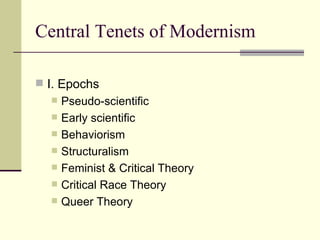
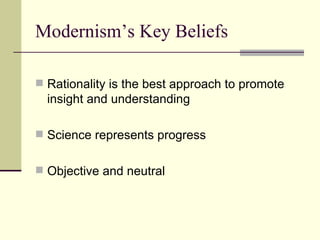
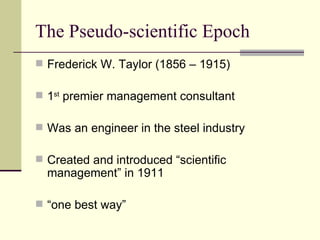
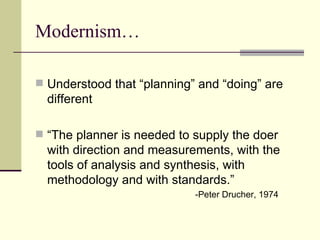
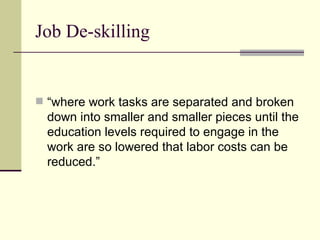
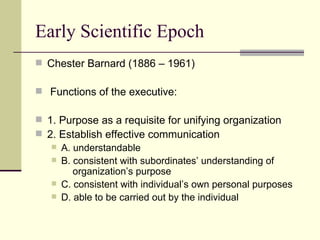
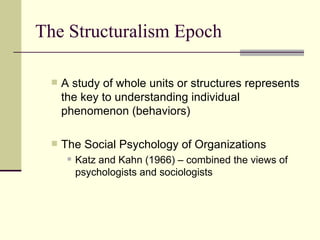
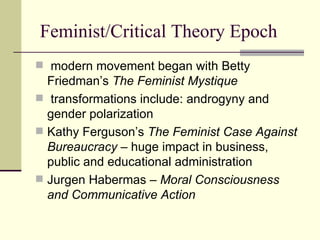
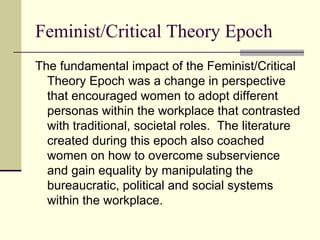
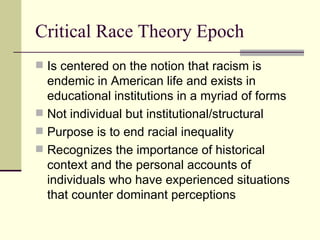
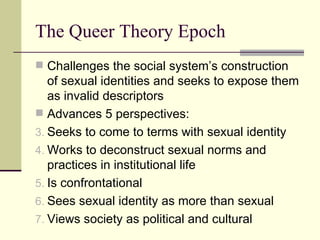
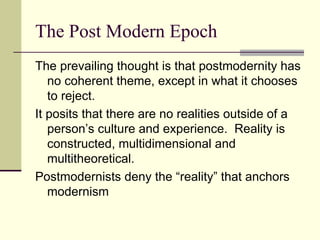
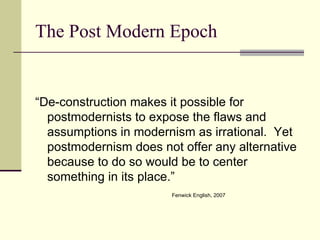
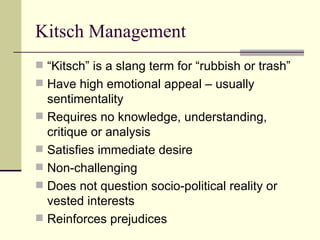
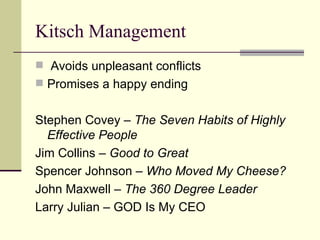
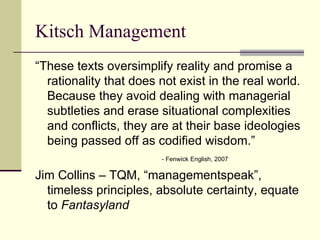
The document discusses the evolving landscape of educational leadership, outlining significant historical epochs and their influence, including modernism, pseudo-scientific management, behaviorism, feminist and critical theories, critical race theory, queer theory, and postmodernism. Each epoch presents distinct principles and impacts on organizational dynamics and leadership practices, emphasizing the shift from objective science to recognition of social constructs and individual experiences in understanding leadership. The author critiques 'kitsch management' texts for oversimplifying complex realities and promoting idealistic views that ignore deeper socio-political contexts.










![Lunenburg, fred c[1]. state mandated performance testing schooling v1 n1 2010](https://cdn.slidesharecdn.com/ss_thumbnails/lunenburgfredc1-state-mandatedperformancetestingschoolingv1n12010-101217222409-phpapp01-thumbnail.jpg?width=640&height=640&fit=bounds)


![Blackbourn, j[1]. m. postmodern eye for the education guy focus v4 n1, 2010 ...](https://cdn.slidesharecdn.com/ss_thumbnails/blackbournj1-170702202001-thumbnail.jpg?width=640&height=640&fit=bounds)
![Blackbourn, j[1]. m. postmodern eye for the education guy focus v4 n1, 2010](https://cdn.slidesharecdn.com/ss_thumbnails/blackbournj1-170702202521-thumbnail.jpg?width=640&height=640&fit=bounds)


