A Presentation by Rasheeda Lehri And
Tejaswini Bagul
Guided by: Mrs. Bhavna Jawale
1
2
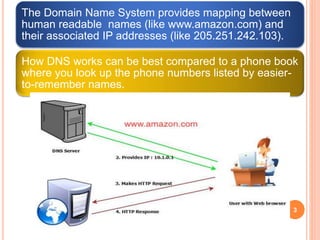
The Domain Name System provides mapping between
human readable names (like www.amazon.com) and
their associated IP addresses (like 205.251.242.103).
How DNS works can be best compared to a phone book
where you look up the phone numbers listed by easier-
to-remember names.
3
HISTORY OF DNS
Paul Mockapetris designed the Domain Name
System at the University of California, Irvine in
1983.
The Internet Engineering Task Force published
the original specifications in RFC 882 and RFC
883 in November 1983.
In 1984, four UC Berkeley wrote the
first Unix name server implementation, called
the Berkeley Internet Name Domain (BIND)
Server.
In the early 1990s BIND was ported to
the Windows NT platform in the early 1990s.
BIND was widely distributed, especially on Unix
systems, and is still the most widely used DNS
software on the Internet.
4
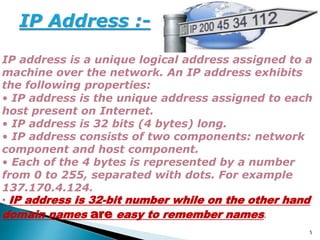
IP address is a unique logical address assigned to a
machine over the network. An IP address exhibits
the following properties:
• IP address is the unique address assigned to each
host present on Internet.
• IP address is 32 bits (4 bytes) long.
• IP address consists of two components: network
component and host component.
• Each of the 4 bytes is represented by a number
from 0 to 255, separated with dots. For example
137.170.4.124.
• IP address is 32-bit number while on the other hand
domain names are easy to remember names.
5
6
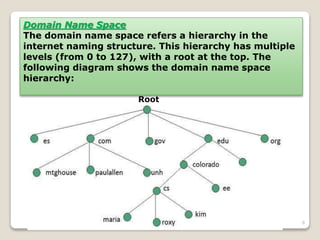
Domain Name Space
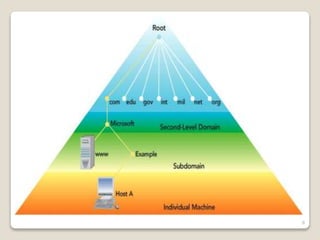
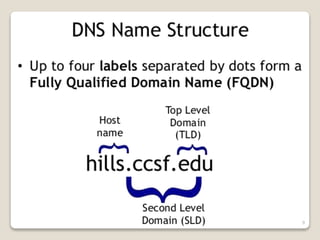
The domain name space refers a hierarchy in the
internet naming structure. This hierarchy has multiple
levels (from 0 to 127), with a root at the top. The
following diagram shows the domain name space
hierarchy:
Root
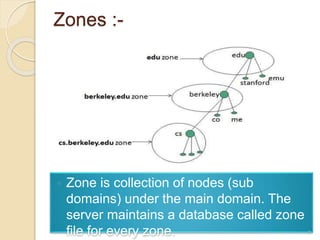
Zones :-
 Zone is collection of nodes (sub
domains) under the main domain. The
server maintains a database called zone
file for every zone. 7
8
9
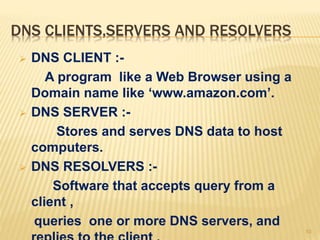
DNS CLIENTS,SERVERS AND RESOLVERS
 DNS CLIENT :-
A program like a Web Browser using a
Domain name like ‘www.amazon.com’.
 DNS SERVER :-
Stores and serves DNS data to host
computers.
 DNS RESOLVERS :-
Software that accepts query from a
client ,
queries one or more DNS servers, and
10
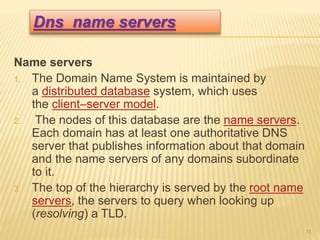
Name servers
1. The Domain Name System is maintained by
a distributed database system, which uses
the client–server model.
2. The nodes of this database are the name servers.
Each domain has at least one authoritative DNS
server that publishes information about that domain
and the name servers of any domains subordinate
to it.
3. The top of the hierarchy is served by the root name
servers, the servers to query when looking up
(resolving) a TLD.
11
Dns name servers
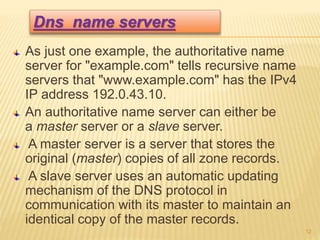
As just one example, the authoritative name
server for "example.com" tells recursive name
servers that "www.example.com" has the IPv4
IP address 192.0.43.10.
An authoritative name server can either be
a master server or a slave server.
A master server is a server that stores the
original (master) copies of all zone records.
A slave server uses an automatic updating
mechanism of the DNS protocol in
communication with its master to maintain an
identical copy of the master records.
12
Dns name servers
13
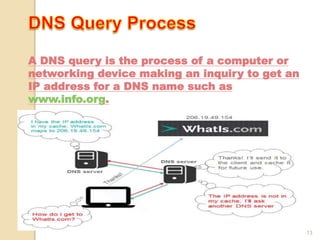
A DNS query is the process of a computer or
networking device making an inquiry to get an
IP address for a DNS name such as
www.info.org.
14
15
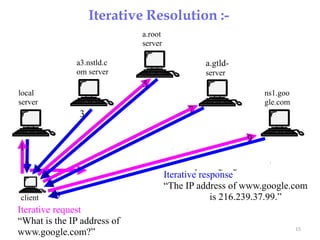
iterative response (referral)
“I don't know. Try a3.nstld.com.”
2
a3.nstld.c
om server
3
Iterative Resolution :-
client
Iterative request
“What is the IP address of
www.google.com?”
local
server
1
iterative response (referral)
“I don't know. Try a.root-servers.net.”
4
a.root
server
5
iterative response (referral)
“I don't know. Try a.gtld-servers.net.”
6
a.gtld-
server
7
iterative response (referral)
“I don't know. Try ns1.google.com.”
8
ns1.goo
gle.com
9
Iterative response
“The IP address of www.google.com
is 216.239.37.99.”10
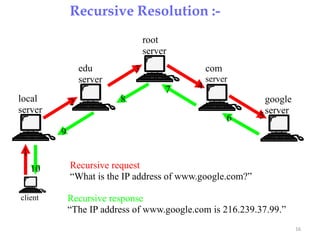
Recursive Resolution :-
16
client
Recursive request
“What is the IP address of www.google.com?”
local
server
1
edu
server
2
root
server
3 com
server
4
google
server
5
Recursive response
“The IP address of www.google.com is 216.239.37.99.”
6
10
7
8
9
17
18
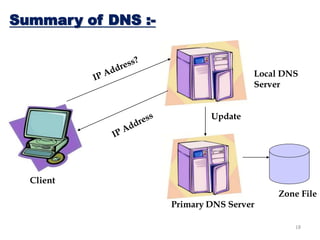
Summary of DNS :-
Client
Local DNS
Server
Primary DNS Server
Zone File
Update
REFERENCES
1.http://www.comptechdoc.org/independent/networking/ter
ms/dns-query.html
2.http://www.slideshare.net
3.https://en.wikipedia.org/wiki/Domain_Name _System
4.http://www.tutorialspoint.com/internet_technologies/inter
net_domain_name_system.html
5. www.thegeekstuff.com/2013/12/dns-basics/
6. www.google.com
19
Thank you for Viewing.
You can email us your queries at
rasheedalehri27gmail.com
Or
Contact us on
20

Domain name system

  • 1.
    A Presentation byRasheeda Lehri And Tejaswini Bagul Guided by: Mrs. Bhavna Jawale 1
  • 2.
  • 3.
    The Domain NameSystem provides mapping between human readable names (like www.amazon.com) and their associated IP addresses (like 205.251.242.103). How DNS works can be best compared to a phone book where you look up the phone numbers listed by easier- to-remember names. 3
  • 4.
    HISTORY OF DNS PaulMockapetris designed the Domain Name System at the University of California, Irvine in 1983. The Internet Engineering Task Force published the original specifications in RFC 882 and RFC 883 in November 1983. In 1984, four UC Berkeley wrote the first Unix name server implementation, called the Berkeley Internet Name Domain (BIND) Server. In the early 1990s BIND was ported to the Windows NT platform in the early 1990s. BIND was widely distributed, especially on Unix systems, and is still the most widely used DNS software on the Internet. 4
  • 5.
    IP address isa unique logical address assigned to a machine over the network. An IP address exhibits the following properties: • IP address is the unique address assigned to each host present on Internet. • IP address is 32 bits (4 bytes) long. • IP address consists of two components: network component and host component. • Each of the 4 bytes is represented by a number from 0 to 255, separated with dots. For example 137.170.4.124. • IP address is 32-bit number while on the other hand domain names are easy to remember names. 5
  • 6.
    6 Domain Name Space Thedomain name space refers a hierarchy in the internet naming structure. This hierarchy has multiple levels (from 0 to 127), with a root at the top. The following diagram shows the domain name space hierarchy: Root
  • 7.
    Zones :-  Zoneis collection of nodes (sub domains) under the main domain. The server maintains a database called zone file for every zone. 7
  • 8.
  • 9.
  • 10.
    DNS CLIENTS,SERVERS ANDRESOLVERS  DNS CLIENT :- A program like a Web Browser using a Domain name like ‘www.amazon.com’.  DNS SERVER :- Stores and serves DNS data to host computers.  DNS RESOLVERS :- Software that accepts query from a client , queries one or more DNS servers, and 10
  • 11.
    Name servers 1. TheDomain Name System is maintained by a distributed database system, which uses the client–server model. 2. The nodes of this database are the name servers. Each domain has at least one authoritative DNS server that publishes information about that domain and the name servers of any domains subordinate to it. 3. The top of the hierarchy is served by the root name servers, the servers to query when looking up (resolving) a TLD. 11 Dns name servers
  • 12.
    As just oneexample, the authoritative name server for "example.com" tells recursive name servers that "www.example.com" has the IPv4 IP address 192.0.43.10. An authoritative name server can either be a master server or a slave server. A master server is a server that stores the original (master) copies of all zone records. A slave server uses an automatic updating mechanism of the DNS protocol in communication with its master to maintain an identical copy of the master records. 12 Dns name servers
  • 13.
    13 A DNS queryis the process of a computer or networking device making an inquiry to get an IP address for a DNS name such as www.info.org.
  • 14.
  • 15.
    15 iterative response (referral) “Idon't know. Try a3.nstld.com.” 2 a3.nstld.c om server 3 Iterative Resolution :- client Iterative request “What is the IP address of www.google.com?” local server 1 iterative response (referral) “I don't know. Try a.root-servers.net.” 4 a.root server 5 iterative response (referral) “I don't know. Try a.gtld-servers.net.” 6 a.gtld- server 7 iterative response (referral) “I don't know. Try ns1.google.com.” 8 ns1.goo gle.com 9 Iterative response “The IP address of www.google.com is 216.239.37.99.”10
  • 16.
    Recursive Resolution :- 16 client Recursiverequest “What is the IP address of www.google.com?” local server 1 edu server 2 root server 3 com server 4 google server 5 Recursive response “The IP address of www.google.com is 216.239.37.99.” 6 10 7 8 9
  • 17.
  • 18.
    18 Summary of DNS:- Client Local DNS Server Primary DNS Server Zone File Update
  • 19.
  • 20.
    Thank you forViewing. You can email us your queries at rasheedalehri27gmail.com Or Contact us on 20