
Domain Name System
(DNS)
Created By:
Kheradiya Bhavik A.
Dhingani Harshil P.
Contents
 Introduction
 Example Of Domain Name
 Name Server
 DNS in Internet
 Generic Domain
 Country Domain
 Inverse Domain
Introduction
 Domain name system is a client server application that identifies each host on
the internet, with a unique user friendly name.
 Domain name system is a method to identifying hosts with user friendly names
instead of ip addresses. Because to remember numeric addresses are difficult
compare to names.
 In Domain Name System names must be unique because the addresses are
unique.
 Each Domain is partitioned into sub domains.
 Once an Organization assigned domain name, the name is reserved for the
Organization, means no other Organization will be assigned the same name.
 To map a name into IP address, an application program calls a library
procedure called the Resolver, passing it the name as a Parameter. The
Resolver sends a UDP packet to local DNS server, which then looks up the
name and returns the IP address to the resolver, which then returns it to the
caller process.
 Domain names are always read from the bottom to top.
Example Of Domain Name
Lable
Edu
Fhda
Atc
Chalanger
Edu.
Fhda.edu
Atc.Fhda.edu
Challenger.Atc.Fhda.edu
Name Server
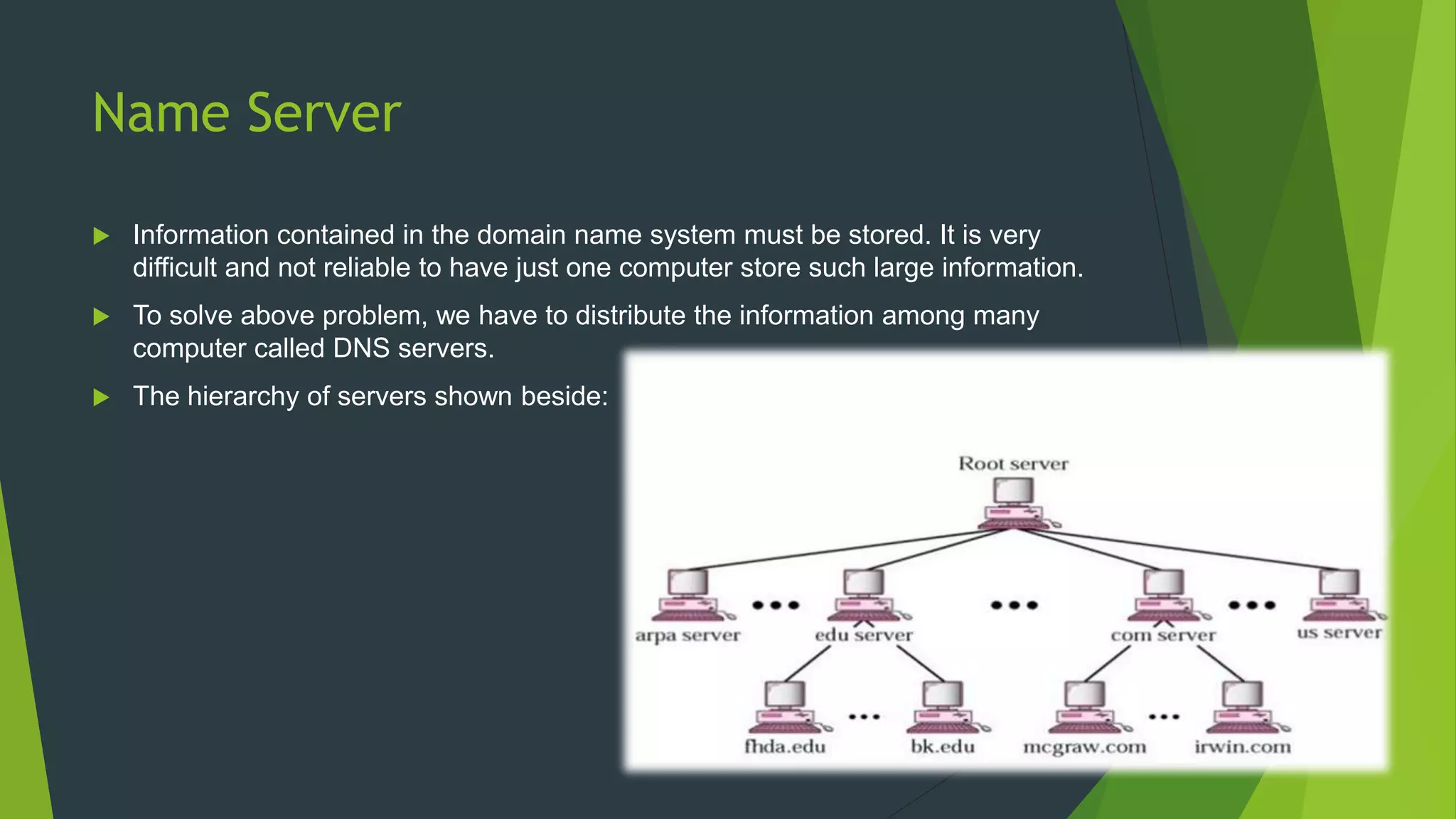
 Information contained in the domain name system must be stored. It is very
difficult and not reliable to have just one computer store such large information.
 To solve above problem, we have to distribute the information among many
computer called DNS servers.
 The hierarchy of servers shown beside:
DNS in Internet
 In the internet, domain name space is divided into 3 different section.
1. Generic domain
2. Country domain
3. Inverse domain
1. Generic Domain
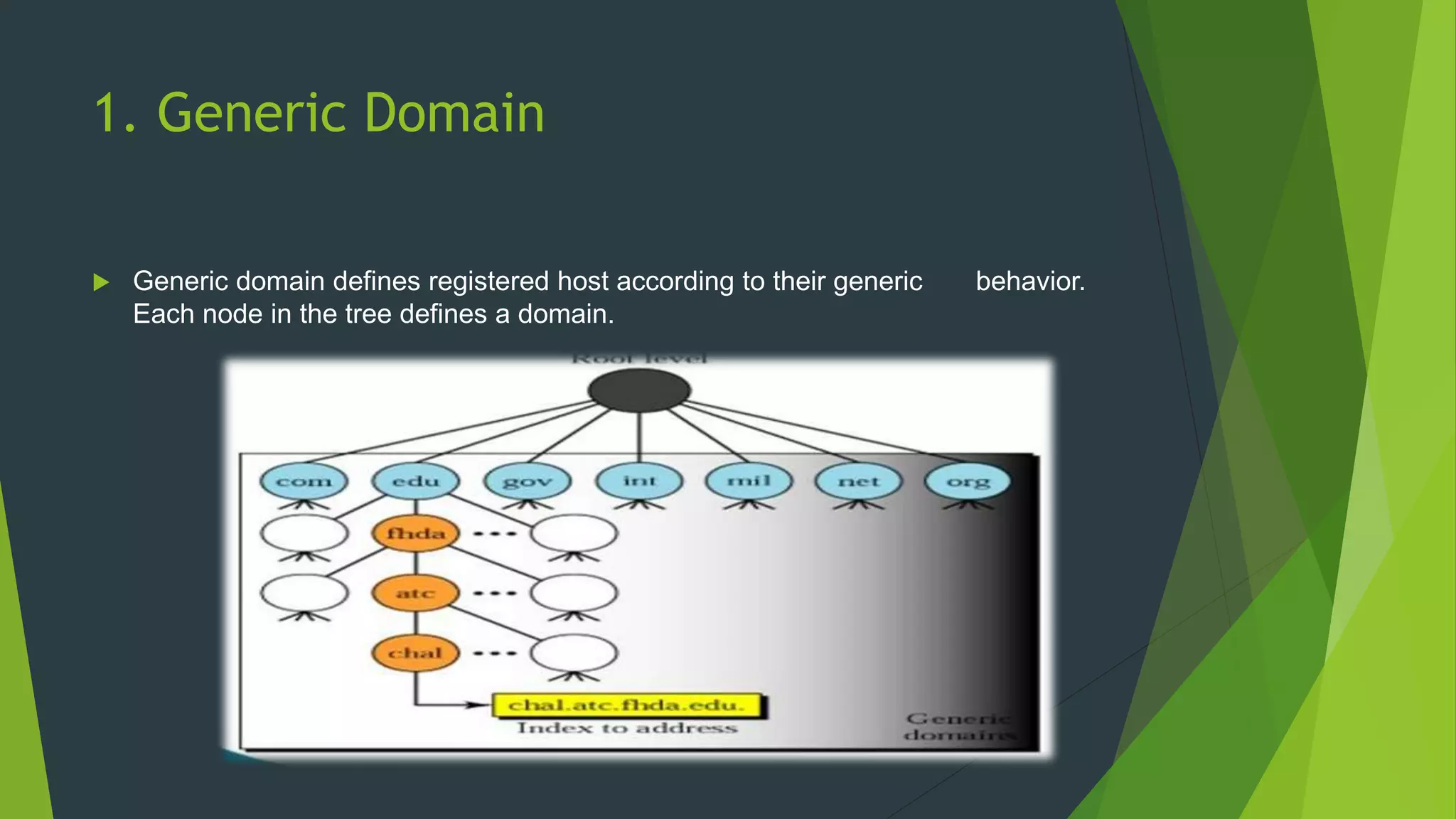
 Generic domain defines registered host according to their generic behavior.
Each node in the tree defines a domain.
Com Commercial Organization
Edu Educational Institutions
Gov Government Institutions
Int International Organization
Mil Military Groups
Net Network Organization
Org Non profit Organization
2. Country Domain
 The Country domain uses a two-character abbreviation in place of three
character abbreviation at first level.
3. Inverse Domain
 The inverse domain is used to map address to a name.
 When a server has received a request from a client to do a task,
server lists only the IP address of the client. To determine if the
client is on the authorized list, the server can send a query to the
inverse DNS server and ask for a mapping of address to name.
 The inverse domain is added to the domain name space with the
first-level node called arpa. (Advanced Research Projects Agency)
The second level is also one single node named in-addr.
(for inverse address) The rest of the domain defines IP address.
 An ip address such as 132.34.45.121(class B address) this
is read as 121.45.34.132 in-addr arpa.
 132.34 45 . 12 = ip address of class B
net id subnet id host id
Thank You

Domain Name System (DNS)

  • 1.
    Domain Name System (DNS) CreatedBy: Kheradiya Bhavik A. Dhingani Harshil P.
  • 2.
    Contents  Introduction  ExampleOf Domain Name  Name Server  DNS in Internet  Generic Domain  Country Domain  Inverse Domain
  • 3.
    Introduction  Domain namesystem is a client server application that identifies each host on the internet, with a unique user friendly name.  Domain name system is a method to identifying hosts with user friendly names instead of ip addresses. Because to remember numeric addresses are difficult compare to names.  In Domain Name System names must be unique because the addresses are unique.  Each Domain is partitioned into sub domains.  Once an Organization assigned domain name, the name is reserved for the Organization, means no other Organization will be assigned the same name.
  • 4.
     To mapa name into IP address, an application program calls a library procedure called the Resolver, passing it the name as a Parameter. The Resolver sends a UDP packet to local DNS server, which then looks up the name and returns the IP address to the resolver, which then returns it to the caller process.  Domain names are always read from the bottom to top.
  • 5.
    Example Of DomainName Lable Edu Fhda Atc Chalanger Edu. Fhda.edu Atc.Fhda.edu Challenger.Atc.Fhda.edu
  • 6.
    Name Server  Informationcontained in the domain name system must be stored. It is very difficult and not reliable to have just one computer store such large information.  To solve above problem, we have to distribute the information among many computer called DNS servers.  The hierarchy of servers shown beside:
  • 7.
    DNS in Internet In the internet, domain name space is divided into 3 different section. 1. Generic domain 2. Country domain 3. Inverse domain
  • 8.
    1. Generic Domain Generic domain defines registered host according to their generic behavior. Each node in the tree defines a domain.
  • 9.
    Com Commercial Organization EduEducational Institutions Gov Government Institutions Int International Organization Mil Military Groups Net Network Organization Org Non profit Organization
  • 10.
    2. Country Domain The Country domain uses a two-character abbreviation in place of three character abbreviation at first level.
  • 11.
    3. Inverse Domain The inverse domain is used to map address to a name.  When a server has received a request from a client to do a task, server lists only the IP address of the client. To determine if the client is on the authorized list, the server can send a query to the inverse DNS server and ask for a mapping of address to name.  The inverse domain is added to the domain name space with the first-level node called arpa. (Advanced Research Projects Agency) The second level is also one single node named in-addr. (for inverse address) The rest of the domain defines IP address.  An ip address such as 132.34.45.121(class B address) this is read as 121.45.34.132 in-addr arpa.  132.34 45 . 12 = ip address of class B net id subnet id host id
  • 12.