WELCOM
E
Standoff
Doklam
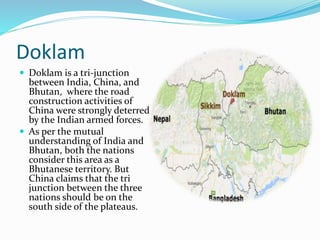
 Doklam is a tri-junction
between India, China, and
Bhutan, where the road
construction activities of
China were strongly deterred
by the Indian armed forces.
 As per the mutual
understanding of India and
Bhutan, both the nations
consider this area as a
Bhutanese territory. But
China claims that the tri
junction between the three
nations should be on the
south side of the plateaus.
What is the source of the conflict?
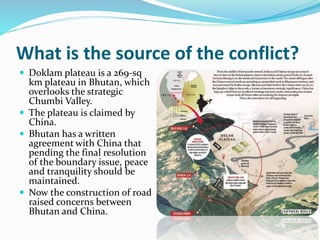
 Doklam plateau is a 269-sq
km plateau in Bhutan, which
overlooks the strategic
Chumbi Valley.
 The plateau is claimed by
China.
 Bhutan has a written
agreement with China that
pending the final resolution
of the boundary issue, peace
and tranquility should be
maintained.
 Now the construction of road
raised concerns between
Bhutan and China.
Why China is interested in the
region?
 The road, which passes through Bhutan’s territory, has
significantly
enhanced China’s military logistics in the region.
 China aims to promote the development of the Yadong region,
which is
connected to Lhasa with a highway.
 China is also aiming to establish formal ties with Bhutan..
 It was reported to have Pressured Bhutan by saying it would not
agree to a border deal until Bhutan allowed it to open a
diplomatic mission in that country.
 It would also like to adopt a military posture in the area to ensure
that it can defeat India in any military contest.
 At the same time it is seeking to check India’s efforts to help
Bhutan.
China view
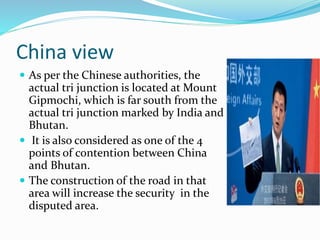
 As per the Chinese authorities, the
actual tri junction is located at Mount
Gipmochi, which is far south from the
actual tri junction marked by India and
Bhutan.
 It is also considered as one of the 4
points of contention between China
and Bhutan.
 The construction of the road in that
area will increase the security in the
disputed area.
Why Bhutan want India to
interfere?
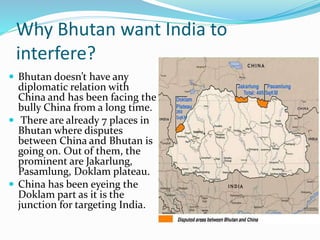
 Bhutan doesn’t have any
diplomatic relation with
China and has been facing the
bully China from a long time.
 There are already 7 places in
Bhutan where disputes
between China and Bhutan is
going on. Out of them, the
prominent are Jakarlung,
Pasamlung, Doklam plateau.
 China has been eyeing the
Doklam part as it is the
junction for targeting India.
2007 India-Bhutan Friendship Treaty
 Under the 2007 India-Bhutan Friendship Treaty, both countries cooperate
closely on national interests. Neither Government allows use of its territory
for activities harmful to the national security and interest of the other.
 Previously India guided Bhutan on foreign and defense policies. 2007 treaty
respects sovereignty of Bhutan.
 The new treaty does not require Bhutan to obtain India’s permission over
arms imports.
 India allows 16 entry and exit points for Bhutanese trade with other
countries (the only exception being the PRC) and has agreed to develop and
import a minimum of 10, 000 megawatts of electricity from Bhutan by 2021
 Gives India responsibility to protect Bhutan- Eastern Army Command and
the Eastern Air Command now integrate protection of Bhutan.
 The Indian Military Training Team (IMTRAT) trains Bhutanese security
personnel.
Why is Doklam so critical?
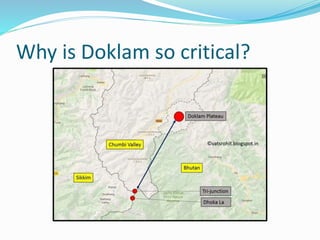
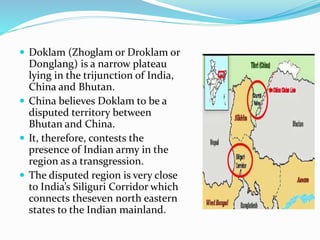
 Doklam (Zhoglam or Droklam or
Donglang) is a narrow plateau
lying in the trijunction of India,
China and Bhutan.
 China believes Doklam to be a
disputed territory between
Bhutan and China.
 It, therefore, contests the
presence of Indian army in the
region as a transgression.
 The disputed region is very close
to India’s Siliguri Corridor which
connects theseven north eastern
states to the Indian mainland.
Why is India supporting Bhutan in
the Doklam issue?
 Bhutan and India have a very cordial relationship were as
Bhutan and China do not have formal relations.
 Bhutan has a very strategic position considering India’s
geography.
 To foster the relationship, India and Bhutan signed a
‘Friendship Treaty’ in 2007 that commits India to protect
Bhutan’s interests and the close coordination between the
two militaries.
 Also, India is worried that if the road is completed, it will
give China greater access to India’s strategically vulnerable
“chicken’s neck” (Siliguri Corridor) that links the seven
north eastern states to the Indian mainland.
Strategic significance to India
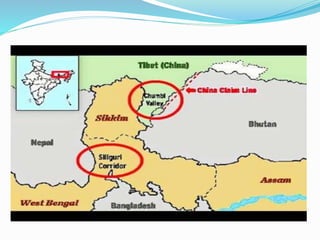
 Scholar Susan Walcott counts China's Chumbi Valley, to
the north of Doklam, and India's Siliguri Corridor, to the
south of Doklam, among "strategic mountain chokepoints
critical in global power Competition".
 The Chumbi Valley intervenes between Sikkim and Bhutan
south of the high Himalayas, pointing towards India's
Siliguri Corridor like a "dagger".
 The latter is a narrow 24 kilometer-wide corridor between
Nepal and Bangladesh in India's West Bengal state, which
connects the central parts of India with the northeastern
states including the contested state of Arunachal Pradesh.
Often referred to as the "chicken's neck", the Siliguri
Corridor represents a strategic vulnerability for India.
 It is also of key strategicsignificance to Bhutan, containing
the main supply routes into the country.
Border disputes between India and
China
 The India-China borders can be
broken down into three sectors
 1. Western Sector – DISPUTED –
This comprises the Aksai Chin
sector. This region which originally
was a part of the state of Jammu and
Kashmir is claimed by China as part
of its autonomous Xinjiang region
 2. Central Sector – UNDISPUTED –
Although China has recognised
India’s sovereignty over Sikkim and
had initiated the trade at Nathu La
pass, the Doklam fiasco could mean
trouble at all ends.
 3. Eastern Sector – DISPUTED – The
Arunachal Pradesh border that
China still claims to be its own
territory is the largest disputed area,
covering around 90000 sq. km.
Agreements and initiatives to
resolve the border disputes
1. Shimla agreement of 1914:
To demarcate the boundary between Tibet and North East
India, a convention was held at Shimla in 1914, representatives of
all three i.e. Tibet, China and British India. After the discussion,
the agreement was signed by British India and Tibet but not by
the Chinese officials. Presently India recognises the Mcmahon
line, as agreed by the Shimla convention, as the legal boundary
between India and China. However, China rejects the Shimla
agreement and the Mcmahon line, contending that Tibet was
not a sovereign state and therefore did not have the power to
conclude treaties.

2. Panchsheel Agreement of 1954:
The Panchsheel doctrine clearly indicated the
willingness to ‘Respect each other’s sovereignty and
territorial integrity’. Although we have come a long way
since, from 1962 war to the cold peace era of 1962-1989,
to the revived tensions of the present, the intent of the
doctrine was well directed
3. In 1989, India-China formed a Joint Working Group
for Confidence building measures (CBMs) and agreed to
mutually settle all border disputes.
4. India-China Agreements regarding the Line of Actual Control (LAC):
The LAC is the effective military border which separates Indian controlled
areas of Jammu and Kashmir from Aksai Chin.
It is to be noted that this border is not a legally recognised international
boundary, but rather it is the practical boundary.
Conventionally, India considers the Johnson line of 1865, marked by a civil
servant W.H. Johnson, which put Aksai Chin in Jammu and Kashmir.
On the other hand, China recognises the Macartney-Macdonald Line as
the actual boundary which puts Aksai Chin in Xinjiang region of China.
In 1993, when the then Prime Minister Narasimha Rao visited China, ‘The
Agreement for Maintenance of Peace and Tranquillity along the LAC‘ has
been signed between India and China.
In 1996 an agreement took place on Confidence Building Measures in the
military field along the LAC.
5. In 2003 India and China signed a Declaration on Principles for
Relations and Comprehensive Cooperation and also mutually
decided to appoint Special Representatives to explore the
framework of a boundary settlement from the political perspective.
The India-China relations received a major boost in 2003.
China recognised India’s sovereignty over Sikkim.
This was also followed by a framework of Guiding principles and
political parameters to improve bilateral ties.
It proposed a three-step resolution to the border disputes:
a. A bilateral agreement on the laid down principles.
b. This was to be followed by an exchange of maps between
he two countries.
c. Once satisfied with the markings, the final demarcation of
borders was to take place.
 6. In 2005 a protocol was agreed on Modalities for the
implementation of Confidence Building Measures in
the Military field along the LAC.
7. In 2012 India and China agreed on the establishment
of a working mechanism for Consultation and
Coordination on India China borders.
Step to resolve recent Doklam Issue
Diplomatically convey message to china
 India has also cited the Bhutanese foreign ministry as
emphasizing to China that "the construction of the road
inside Bhutanese territory is a direct violation of the 1988
and 1998 agreements between Bhutan and China
 India has conveyed to China that the road construction
would represent a significant change of status quo with
serious security implications for New Delhi.
 India has maintained both sides should first pull back
their troops for any talks to take place.
 Bhutan has no direct diplomatic relations with China and
maintains contacts with Beijing through its diplomatic
mission in New Delhi.
China respone
 China has insisted that India unilaterally withdraw its
troops from the remote Doklam plateau claimed by
both Beijing and Indian ally Bhutan.
 China did not respond to India’s suggestion in the
talks that it move its troops back 250 meters (820 ft) in
return
 the Chinese countered with an offer to move back 100
meters (328 ft)
Doklam issue resolve
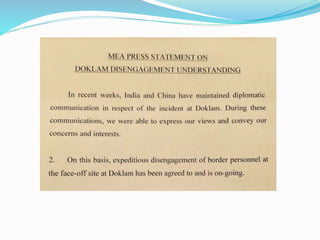
 In a diplomatic victory , India and China have agreed to
“expeditiously disengage“ from the stand-off in Doklam on
Bhutanese territory after 72 days, with China agreeing to New
Delhi's insistence on simultaneous withdrawal for a resolution.
 After almost 10 weeks of negotiations between top-level Indian
and Chinese officials, the foreign ministry announced on
Monday that “expeditious disengagement of border personnel at
the face-off site in Doklam has been agreed to and is ongoing”.
 By the end of the day , as Indian troops withdrew to their post at
Doka La, Chinese troops and their road-building equipment,
too, were removed from the faceoff site. In a second statement at
the end of the day , the MEA confirmed that “this process has
almost been completed under verification“.
Biblography
Thank You
Query

Doklam stand off

  • 1.
  • 3.
  • 5.
    Doklam  Doklam isa tri-junction between India, China, and Bhutan, where the road construction activities of China were strongly deterred by the Indian armed forces.  As per the mutual understanding of India and Bhutan, both the nations consider this area as a Bhutanese territory. But China claims that the tri junction between the three nations should be on the south side of the plateaus.
  • 6.
    What is thesource of the conflict?  Doklam plateau is a 269-sq km plateau in Bhutan, which overlooks the strategic Chumbi Valley.  The plateau is claimed by China.  Bhutan has a written agreement with China that pending the final resolution of the boundary issue, peace and tranquility should be maintained.  Now the construction of road raised concerns between Bhutan and China.
  • 7.
    Why China isinterested in the region?  The road, which passes through Bhutan’s territory, has significantly enhanced China’s military logistics in the region.  China aims to promote the development of the Yadong region, which is connected to Lhasa with a highway.  China is also aiming to establish formal ties with Bhutan..  It was reported to have Pressured Bhutan by saying it would not agree to a border deal until Bhutan allowed it to open a diplomatic mission in that country.  It would also like to adopt a military posture in the area to ensure that it can defeat India in any military contest.  At the same time it is seeking to check India’s efforts to help Bhutan.
  • 8.
    China view  Asper the Chinese authorities, the actual tri junction is located at Mount Gipmochi, which is far south from the actual tri junction marked by India and Bhutan.  It is also considered as one of the 4 points of contention between China and Bhutan.  The construction of the road in that area will increase the security in the disputed area.
  • 9.
    Why Bhutan wantIndia to interfere?  Bhutan doesn’t have any diplomatic relation with China and has been facing the bully China from a long time.  There are already 7 places in Bhutan where disputes between China and Bhutan is going on. Out of them, the prominent are Jakarlung, Pasamlung, Doklam plateau.  China has been eyeing the Doklam part as it is the junction for targeting India.
  • 10.
  • 11.
     Under the2007 India-Bhutan Friendship Treaty, both countries cooperate closely on national interests. Neither Government allows use of its territory for activities harmful to the national security and interest of the other.  Previously India guided Bhutan on foreign and defense policies. 2007 treaty respects sovereignty of Bhutan.  The new treaty does not require Bhutan to obtain India’s permission over arms imports.  India allows 16 entry and exit points for Bhutanese trade with other countries (the only exception being the PRC) and has agreed to develop and import a minimum of 10, 000 megawatts of electricity from Bhutan by 2021  Gives India responsibility to protect Bhutan- Eastern Army Command and the Eastern Air Command now integrate protection of Bhutan.  The Indian Military Training Team (IMTRAT) trains Bhutanese security personnel.
  • 12.
    Why is Doklamso critical?
  • 14.
     Doklam (Zhoglamor Droklam or Donglang) is a narrow plateau lying in the trijunction of India, China and Bhutan.  China believes Doklam to be a disputed territory between Bhutan and China.  It, therefore, contests the presence of Indian army in the region as a transgression.  The disputed region is very close to India’s Siliguri Corridor which connects theseven north eastern states to the Indian mainland.
  • 15.
    Why is Indiasupporting Bhutan in the Doklam issue?  Bhutan and India have a very cordial relationship were as Bhutan and China do not have formal relations.  Bhutan has a very strategic position considering India’s geography.  To foster the relationship, India and Bhutan signed a ‘Friendship Treaty’ in 2007 that commits India to protect Bhutan’s interests and the close coordination between the two militaries.  Also, India is worried that if the road is completed, it will give China greater access to India’s strategically vulnerable “chicken’s neck” (Siliguri Corridor) that links the seven north eastern states to the Indian mainland.
  • 16.
    Strategic significance toIndia  Scholar Susan Walcott counts China's Chumbi Valley, to the north of Doklam, and India's Siliguri Corridor, to the south of Doklam, among "strategic mountain chokepoints critical in global power Competition".  The Chumbi Valley intervenes between Sikkim and Bhutan south of the high Himalayas, pointing towards India's Siliguri Corridor like a "dagger".  The latter is a narrow 24 kilometer-wide corridor between Nepal and Bangladesh in India's West Bengal state, which connects the central parts of India with the northeastern states including the contested state of Arunachal Pradesh. Often referred to as the "chicken's neck", the Siliguri Corridor represents a strategic vulnerability for India.  It is also of key strategicsignificance to Bhutan, containing the main supply routes into the country.
  • 17.
    Border disputes betweenIndia and China  The India-China borders can be broken down into three sectors  1. Western Sector – DISPUTED – This comprises the Aksai Chin sector. This region which originally was a part of the state of Jammu and Kashmir is claimed by China as part of its autonomous Xinjiang region  2. Central Sector – UNDISPUTED – Although China has recognised India’s sovereignty over Sikkim and had initiated the trade at Nathu La pass, the Doklam fiasco could mean trouble at all ends.  3. Eastern Sector – DISPUTED – The Arunachal Pradesh border that China still claims to be its own territory is the largest disputed area, covering around 90000 sq. km.
  • 18.
    Agreements and initiativesto resolve the border disputes 1. Shimla agreement of 1914: To demarcate the boundary between Tibet and North East India, a convention was held at Shimla in 1914, representatives of all three i.e. Tibet, China and British India. After the discussion, the agreement was signed by British India and Tibet but not by the Chinese officials. Presently India recognises the Mcmahon line, as agreed by the Shimla convention, as the legal boundary between India and China. However, China rejects the Shimla agreement and the Mcmahon line, contending that Tibet was not a sovereign state and therefore did not have the power to conclude treaties. 
  • 19.
    2. Panchsheel Agreementof 1954: The Panchsheel doctrine clearly indicated the willingness to ‘Respect each other’s sovereignty and territorial integrity’. Although we have come a long way since, from 1962 war to the cold peace era of 1962-1989, to the revived tensions of the present, the intent of the doctrine was well directed
  • 20.
    3. In 1989,India-China formed a Joint Working Group for Confidence building measures (CBMs) and agreed to mutually settle all border disputes.
  • 21.
    4. India-China Agreementsregarding the Line of Actual Control (LAC): The LAC is the effective military border which separates Indian controlled areas of Jammu and Kashmir from Aksai Chin. It is to be noted that this border is not a legally recognised international boundary, but rather it is the practical boundary. Conventionally, India considers the Johnson line of 1865, marked by a civil servant W.H. Johnson, which put Aksai Chin in Jammu and Kashmir. On the other hand, China recognises the Macartney-Macdonald Line as the actual boundary which puts Aksai Chin in Xinjiang region of China. In 1993, when the then Prime Minister Narasimha Rao visited China, ‘The Agreement for Maintenance of Peace and Tranquillity along the LAC‘ has been signed between India and China. In 1996 an agreement took place on Confidence Building Measures in the military field along the LAC.
  • 22.
    5. In 2003India and China signed a Declaration on Principles for Relations and Comprehensive Cooperation and also mutually decided to appoint Special Representatives to explore the framework of a boundary settlement from the political perspective. The India-China relations received a major boost in 2003. China recognised India’s sovereignty over Sikkim. This was also followed by a framework of Guiding principles and political parameters to improve bilateral ties. It proposed a three-step resolution to the border disputes: a. A bilateral agreement on the laid down principles. b. This was to be followed by an exchange of maps between he two countries. c. Once satisfied with the markings, the final demarcation of borders was to take place.
  • 23.
     6. In2005 a protocol was agreed on Modalities for the implementation of Confidence Building Measures in the Military field along the LAC.
  • 24.
    7. In 2012India and China agreed on the establishment of a working mechanism for Consultation and Coordination on India China borders.
  • 25.
    Step to resolverecent Doklam Issue
  • 26.
    Diplomatically convey messageto china  India has also cited the Bhutanese foreign ministry as emphasizing to China that "the construction of the road inside Bhutanese territory is a direct violation of the 1988 and 1998 agreements between Bhutan and China  India has conveyed to China that the road construction would represent a significant change of status quo with serious security implications for New Delhi.  India has maintained both sides should first pull back their troops for any talks to take place.  Bhutan has no direct diplomatic relations with China and maintains contacts with Beijing through its diplomatic mission in New Delhi.
  • 27.
    China respone  Chinahas insisted that India unilaterally withdraw its troops from the remote Doklam plateau claimed by both Beijing and Indian ally Bhutan.  China did not respond to India’s suggestion in the talks that it move its troops back 250 meters (820 ft) in return  the Chinese countered with an offer to move back 100 meters (328 ft)
  • 28.
    Doklam issue resolve In a diplomatic victory , India and China have agreed to “expeditiously disengage“ from the stand-off in Doklam on Bhutanese territory after 72 days, with China agreeing to New Delhi's insistence on simultaneous withdrawal for a resolution.  After almost 10 weeks of negotiations between top-level Indian and Chinese officials, the foreign ministry announced on Monday that “expeditious disengagement of border personnel at the face-off site in Doklam has been agreed to and is ongoing”.  By the end of the day , as Indian troops withdrew to their post at Doka La, Chinese troops and their road-building equipment, too, were removed from the faceoff site. In a second statement at the end of the day , the MEA confirmed that “this process has almost been completed under verification“.
  • 30.
  • 31.
  • 32.