DevOps Transformations
at National Instruments
and Bazaarvoice
ERNEST MUELLER @ERNESTMUELLER
THEAGILEADMIN.COM ERNEST.MUELLER@GMAIL.COM
Who Am I?
YES
 B.S. Electrical Engineering, Rice
University
 Programmer, Webmaster at FedEx
 VP of IT at Towery Publishing
 Web Systems Manager, SaaS
Systems Architect at National
Instruments
 Release Manager, Engineering
Manager at Bazaarvoice
NO
National Instruments
 NATI – founded in 1976, $1.24bn
revenue, 7249 employees, 10
sites worldwide (HQ: Austin)
 Makes hardware and software for
data acquisition, virtual
instrumentation, automated test,
instrument control
 Frequently on Fortune’s 100 Best
Companies to Work For list
#1: NI Web Systems (2002-2008)
 Managed Web Systems team supporting NI’s Web presence (ni.com)
 Primary source of product information (site visits were a key KPI on
the overall lead to sales conversion pipeline), half of all lead
generation, and about 12% of corp revenue was direct e-commerce.
 Key goals were all about aggressive growth - globalization, driving
traffic, increasing conversion, and e-commerce sales.
 Team was 4 sysadmins supporting 80 developers and coordinating
with the other IT Infrastructure teams.
 Large and diverse tech stack –hundreds of applications comprised of
Java, Oracle PL/SQL, Lotus Notes Domino, and more.
The Problems
 Previous team philosophy had been actively anti-automation.
 Stability was low; site uptime hovered around 97% with constant work.
 Web Admin quality of life was poor and turnover was high. Some weeks
we had more than 200 oncall pages (resulting in two destroyed oncall
pagers).
 Application teams were siloed by business initiative, infrastructure teams
siloed by technology. Our team sat “between” them, and they didn’t play
well together (especially the infrastructure teams).
 Monthly code releases were “all hands on deck,” beginning late Friday
evening and going well into Saturday.
What We Did
 Stop the bleeding – triage issues, get metrics, do RCAs, operations
shield, staff up (eventually doubling our size)
 Automate – service restarts, app deployment, self serve tools
 Process – “Systems Development Framework”, operational rotation
 Partner with Apps and Business
 Drove creation of “all stakeholders” overall Web team goal roadmap
(performance, availability, budget, maintenance%, agility)
 Security Practice
 Application Performance Management practice
Results
“The value of the Web Systems group to the Web
Team is that it understands what we’re trying to
achieve, not just what tasks need completing.”
-Christer Ljungdahl, Director, Web Marketing
But…
We were still “the bottleneck.”
#2: NI R&D Cloud Architect (2009-2011)
 NI R&D decided to branch out into SaaS products.
 Formed a greenfield team with myself as systems architect
and 5 other key devs and ops from IT
 Experimental, had some initial product ideas but also
wanted to see what we could develop
 LabVIEW Cloud UI Builder (Silverlight app, save/compile/share in
cloud)
 LabVIEW FPGA Compile Cloud (FPGA compiles in cloud from LV
product)
 Technical Data Cloud (IoT data upload)
What We Did - Initial Decisions
Cloud First
 Do not use existing IT systems or processes, go integrated self-contained team
 Adapt R&D NPI and design review processes to agile
 All cloud hosted and RESTful apps - all our old tools wouldn’t work
Security First
 We knew security would be one of the key barriers to adoption
 Doubled down on threat modeling, scanning, documentation
Automation First
 PIE, the Programmable Infrastructure Environment
What We Did, Part 2
 Close dev/ops collaboration initially rocky, powered through it
 REST not-quite-microservices approach
 Educated desktop software devs on Web-scale operational
needs
 Used “Operations: The New Secret Sauce” mentality to add
value:
 Transparent uptime/status page
 Rapid deployment anytime
 Incident handling, follow-the-sun ops
 Monitoring/logging metrics feedback to developers and business
Results
 Average NI new software product time to market –
3 years
 Average NI Cloud new product time to market –
1 year
Meanwhile… DevOps!
 Velocity 2009, June 2009
 DevOpsDays Ghent, Nov 2009
 OpsCamp Austin, Feb 2010
 Velocity 2010/DevOpsDays Mountain View, June
2010
 Helped launch CloudAustin July 2010
 We hosted DevOpsDays Austin 2012 at NI!
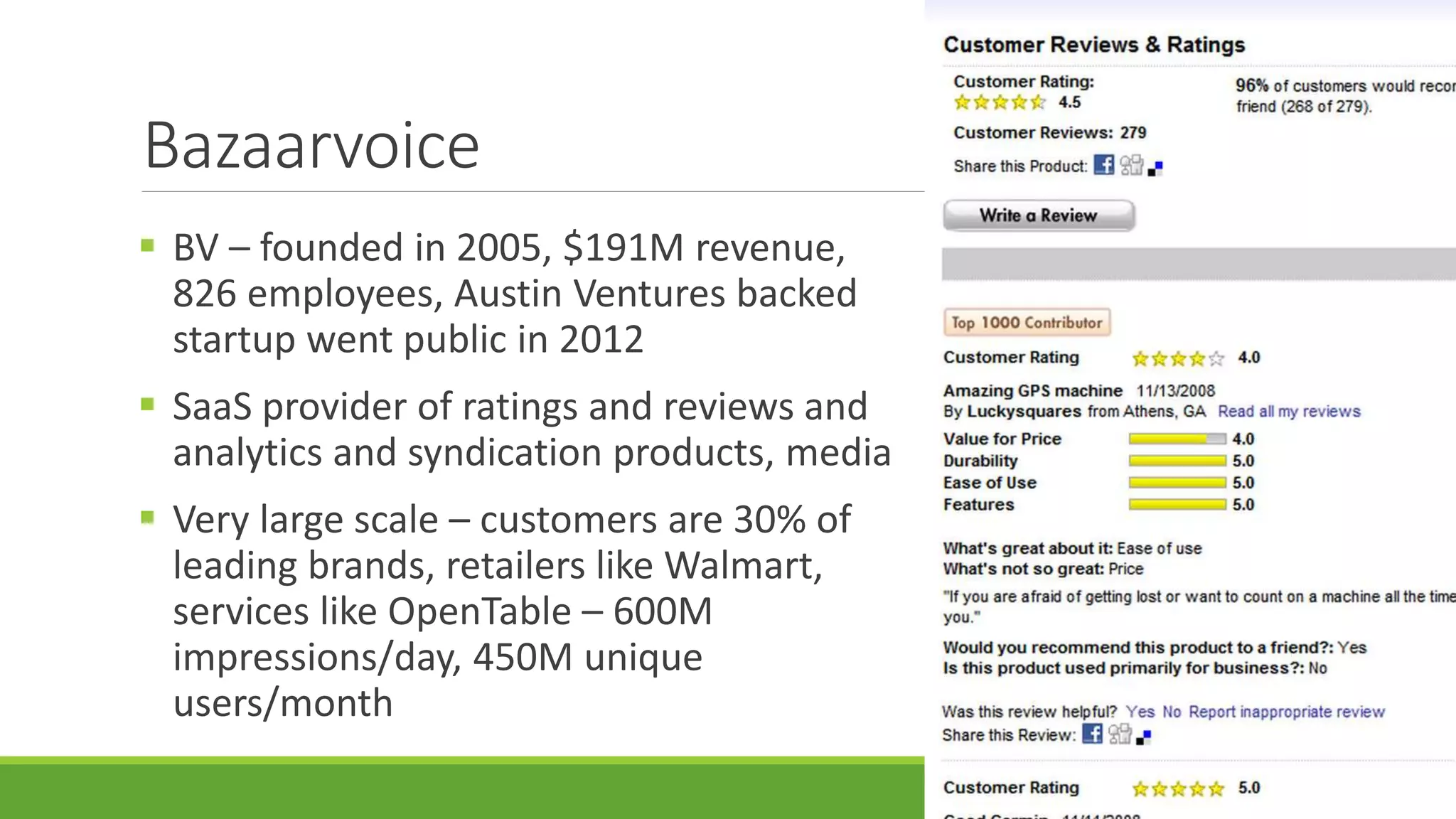
Bazaarvoice
 BV – founded in 2005, $191M revenue,
826 employees, Austin Ventures backed
startup went public in 2012
 SaaS provider of ratings and reviews and
analytics and syndication products, media
 Very large scale – customers are 30% of
leading brands, retailers like Walmart,
services like OpenTable – 600M
impressions/day, 450M unique
users/month
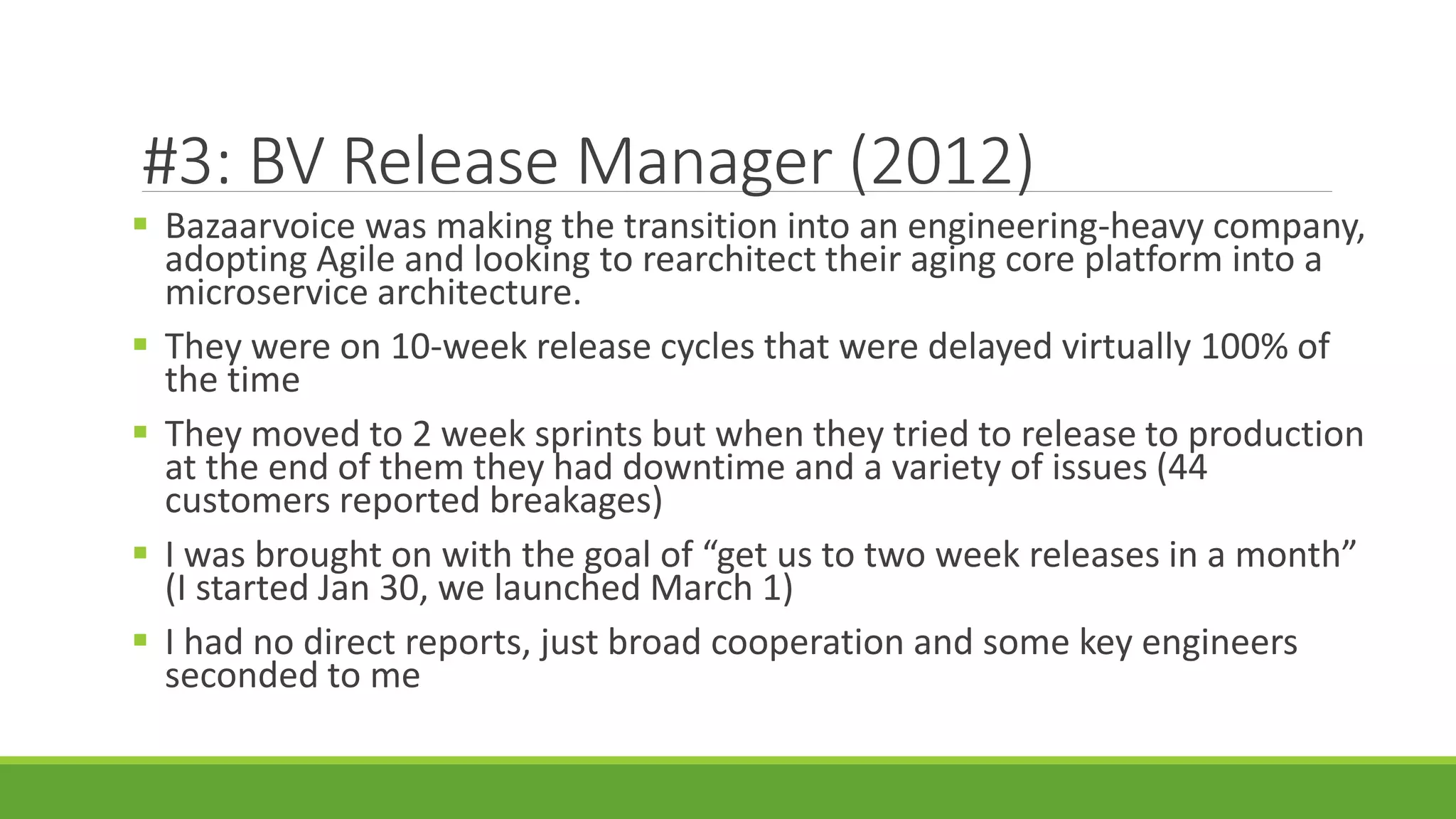
#3: BV Release Manager (2012)
 Bazaarvoice was making the transition into an engineering-heavy company,
adopting Agile and looking to rearchitect their aging core platform into a
microservice architecture.
 They were on 10-week release cycles that were delayed virtually 100% of
the time
 They moved to 2 week sprints but when they tried to release to production
at the end of them they had downtime and a variety of issues (44
customers reported breakages)
 I was brought on with the goal of “get us to two week releases in a month”
(I started Jan 30, we launched March 1)
 I had no direct reports, just broad cooperation and some key engineers
seconded to me
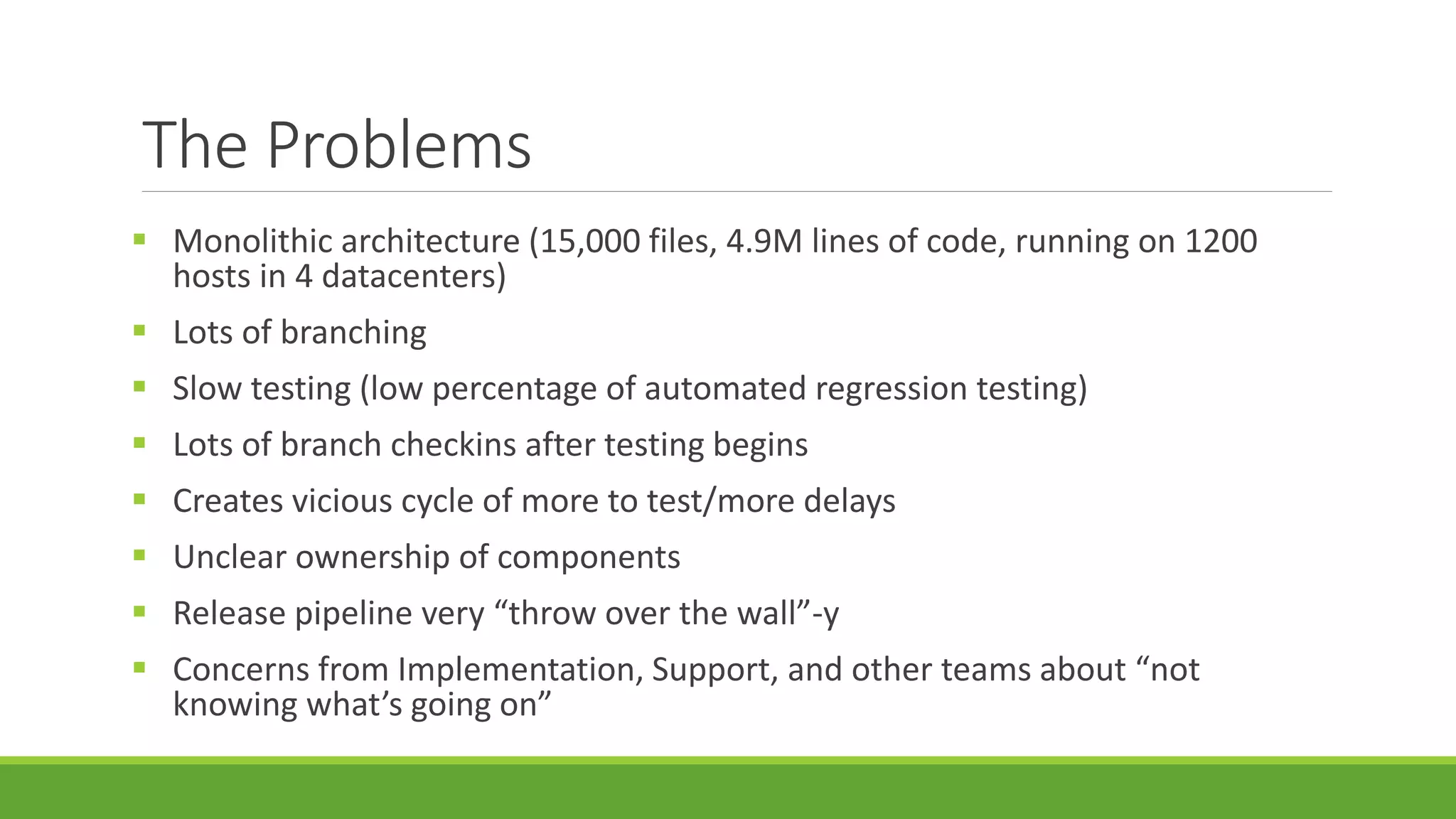
The Problems
 Monolithic architecture (15,000 files, 4.9M lines of code, running on 1200
hosts in 4 datacenters)
 Lots of branching
 Slow testing (low percentage of automated regression testing)
 Lots of branch checkins after testing begins
 Creates vicious cycle of more to test/more delays
 Unclear ownership of components
 Release pipeline very “throw over the wall”-y
 Concerns from Implementation, Support, and other teams about “not
knowing what’s going on”
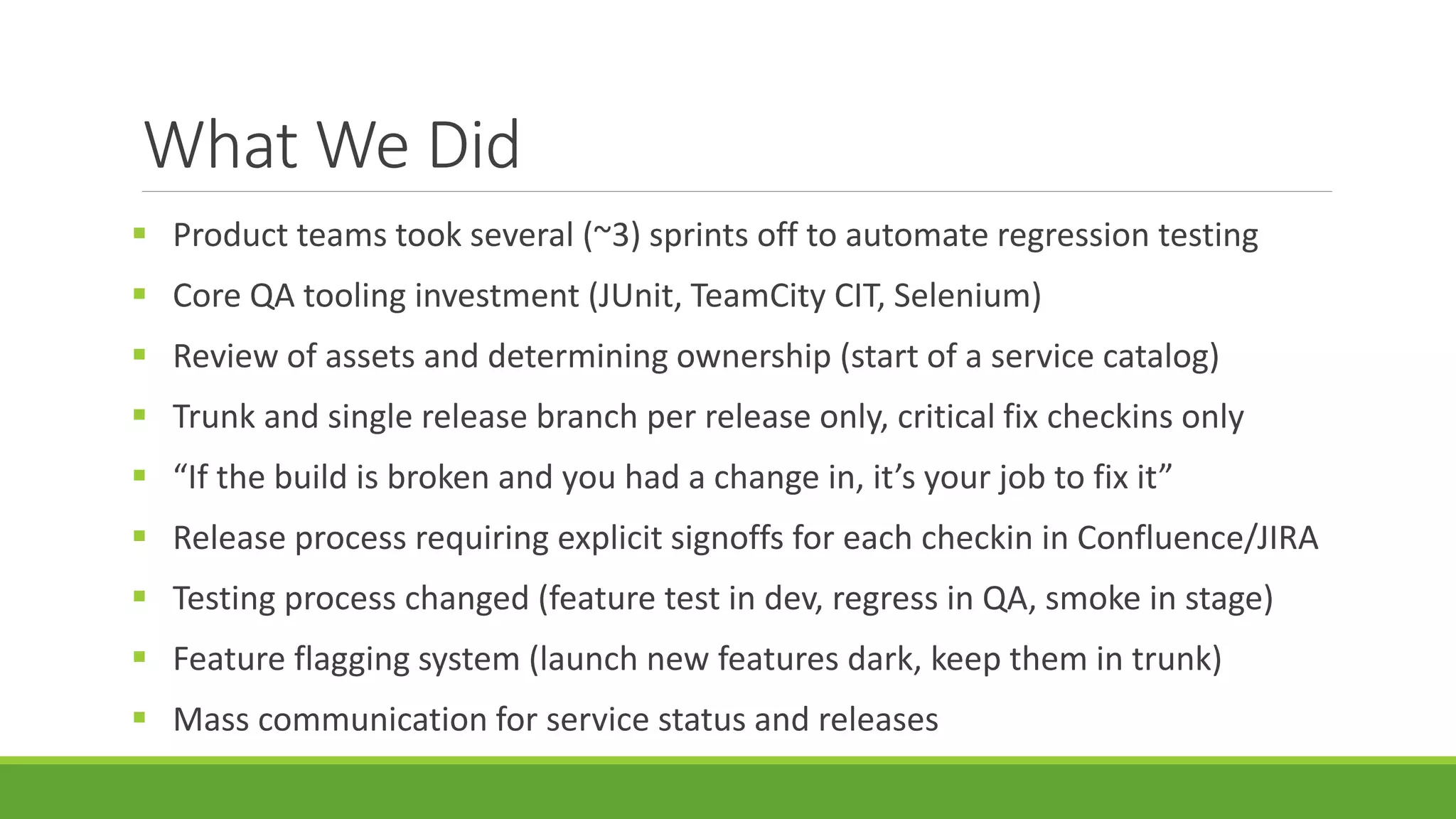
What We Did
 Product teams took several (~3) sprints off to automate regression testing
 Core QA tooling investment (JUnit, TeamCity CIT, Selenium)
 Review of assets and determining ownership (start of a service catalog)
 Trunk and single release branch per release only, critical fix checkins only
 “If the build is broken and you had a change in, it’s your job to fix it”
 Release process requiring explicit signoffs for each checkin in Confluence/JIRA
 Testing process changed (feature test in dev, regress in QA, smoke in stage)
 Feature flagging system (launch new features dark, keep them in trunk)
 Mass communication for service status and releases
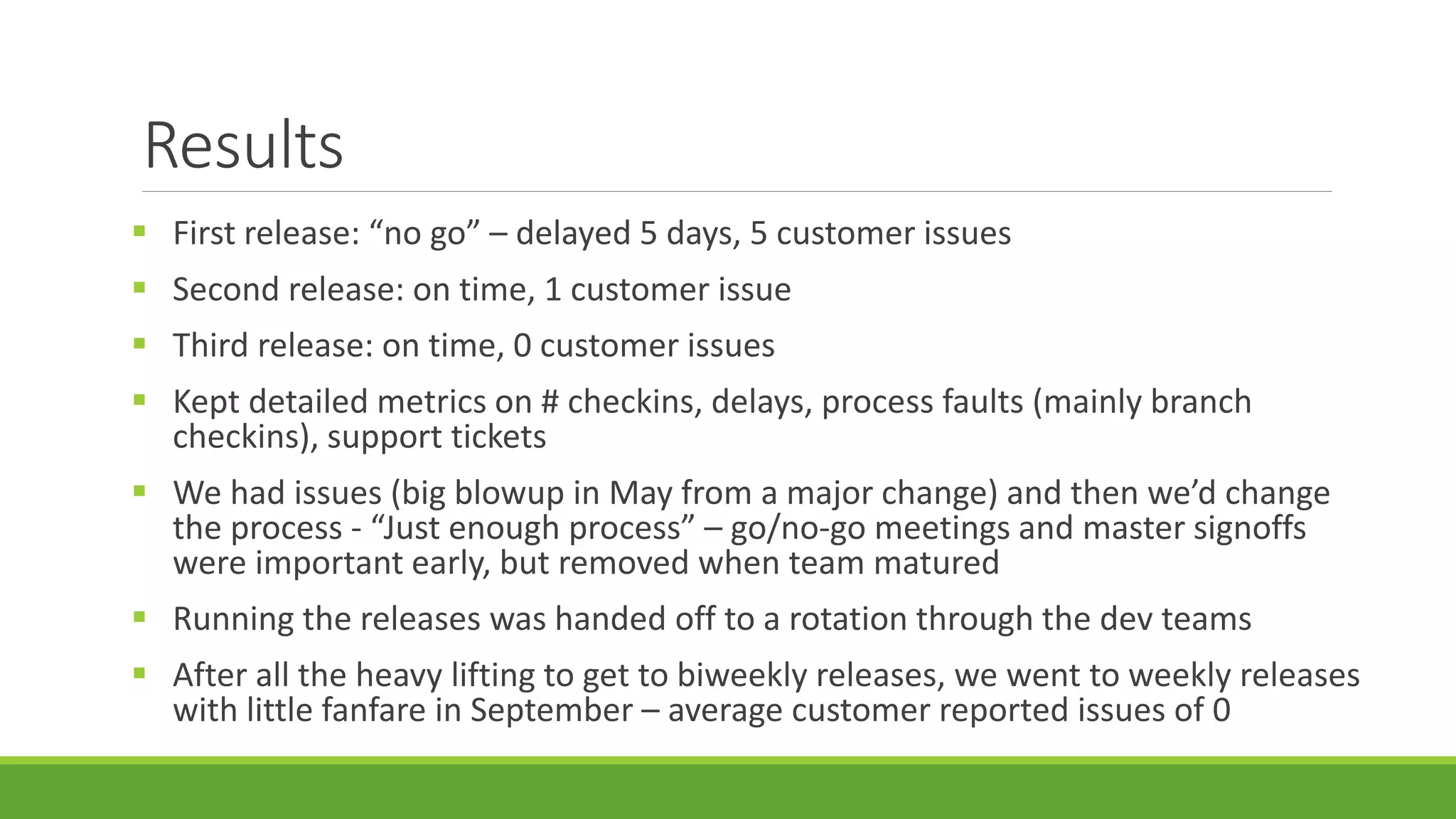
Results
 First release: “no go” – delayed 5 days, 5 customer issues
 Second release: on time, 1 customer issue
 Third release: on time, 0 customer issues
 Kept detailed metrics on # checkins, delays, process faults (mainly branch
checkins), support tickets
 We had issues (big blowup in May from a major change) and then we’d change
the process - “Just enough process” – go/no-go meetings and master signoffs
were important early, but removed when team matured
 Running the releases was handed off to a rotation through the dev teams
 After all the heavy lifting to get to biweekly releases, we went to weekly releases
with little fanfare in September – average customer reported issues of 0
#4:BV Engineering Manager (2012-2014)
 We had a core team working on the legacy ratings & reviews system
while new microservice teams embarked on a rewrite “to the side”
 We declared “the death of the centralized ops team” mid-2012 and
disseminated them into the dev teams, initially reporting to a DevOps
manager
 I took over the various engineers working on the existing product –
about 40 engineers, 2/3 of which were offshore outsourcers from
Softserve
The Problems
 With the assumption that “the legacy stack” would only be around a short
time, they had not been moved to agile and were very understaffed.
 Volume (hits and data volume) continued to grow at a blistering pace
necessitating continuous expansion and rearchitecture
 Black Friday peaks stressed our architecture, with us serving 2.6 billion review
impressions on Black Friday and Cyber Monday 2013.
 Relationships with our outsourcer partner was strained
 Escalated support tickets were only hitting SLA 72% of the time
 Hundreds to thousands of alerts a day, 750-item product backlog
 Growing security and privacy compliance needs – SOX, ISO, TÜV, AFNOR
What We Did
 Moved the teams to agile, embedded DevOps and PM
(took a couple tries)
 Started onshore rotations and better communication with
outsourcers, empowered their engineers
 Balanced Scrum product backlogs with a Kanban-style
“triage process” to handle large load of incidents and
support tickets
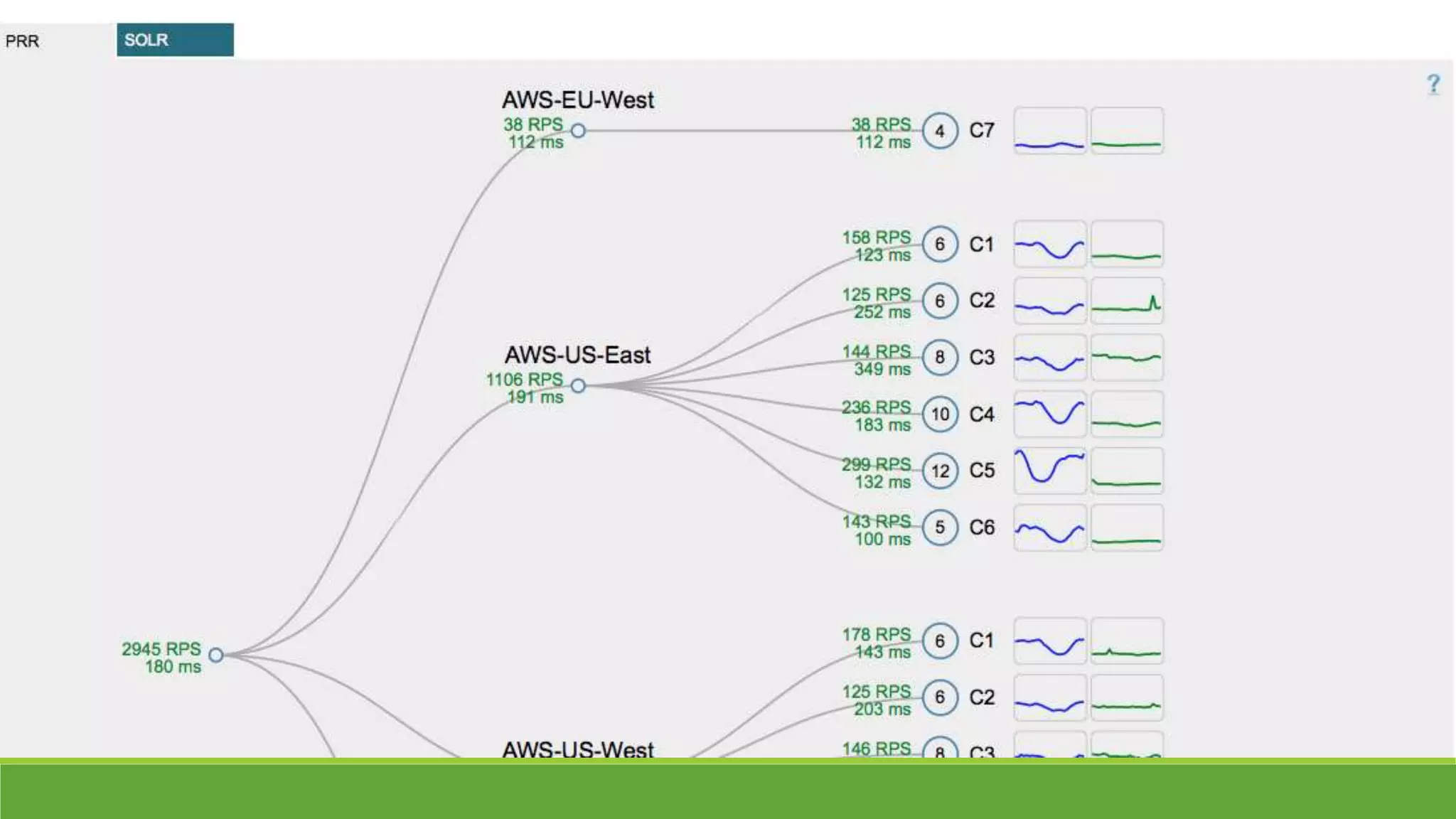
 Focused on metrics and custom visualizations and
transparent communication to align staff across teams
What We Did, Part 2
 “Merit Badge” style crosstraining program to bring up new
SMEs to reduce load on “the one person that knows how to
do that”
 “Dynamic Duo” day/night dev/ops operational rotation
 Joint old team/new team Black Friday planning, game days
 Worked with auditors and InfoSec team – everything
automated and auditable in source control, documentation
in wiki. Integrated security team findings into product
backlog for PM stack ranking.
Results
 Customer support SLA went up quarter by quarter to 100%
 Steadily increasing velocity across all 4 sprint teams
 Great value from outsourcer partner
 Successfully weathered Black Friday spikes year after year
 Incorporation of “new stack” services, while slower than
initially desired, happened in a more measured manner
(pivot to strangler pattern)
 Automation made compliance easy
Top Five Takeaways
Help Your People - Culture and Quality of Life
Improve Latency *and* Bandwidth
◦(Custom) Automation
◦Lean, Agile Process
Don't Be Penny Wise, Pound Foolish
◦Play Man Not Zone
Balancing Planned And Unplanned Work Is Key
Communication Sows Collaboration
Questions?
ERNEST MUELLER @ERNESTMUELLER
THEAGILEADMIN.COM ERNEST.MUELLER@GMAIL.COM

DOES15 - Ernest Mueller - DevOps Transformations At National Instruments and...

  • 1.
    DevOps Transformations at NationalInstruments and Bazaarvoice ERNEST MUELLER @ERNESTMUELLER THEAGILEADMIN.COM ERNEST.MUELLER@GMAIL.COM
  • 2.
    Who Am I? YES B.S. Electrical Engineering, Rice University  Programmer, Webmaster at FedEx  VP of IT at Towery Publishing  Web Systems Manager, SaaS Systems Architect at National Instruments  Release Manager, Engineering Manager at Bazaarvoice NO
  • 3.
    National Instruments  NATI– founded in 1976, $1.24bn revenue, 7249 employees, 10 sites worldwide (HQ: Austin)  Makes hardware and software for data acquisition, virtual instrumentation, automated test, instrument control  Frequently on Fortune’s 100 Best Companies to Work For list
  • 4.
    #1: NI WebSystems (2002-2008)  Managed Web Systems team supporting NI’s Web presence (ni.com)  Primary source of product information (site visits were a key KPI on the overall lead to sales conversion pipeline), half of all lead generation, and about 12% of corp revenue was direct e-commerce.  Key goals were all about aggressive growth - globalization, driving traffic, increasing conversion, and e-commerce sales.  Team was 4 sysadmins supporting 80 developers and coordinating with the other IT Infrastructure teams.  Large and diverse tech stack –hundreds of applications comprised of Java, Oracle PL/SQL, Lotus Notes Domino, and more.
  • 5.
    The Problems  Previousteam philosophy had been actively anti-automation.  Stability was low; site uptime hovered around 97% with constant work.  Web Admin quality of life was poor and turnover was high. Some weeks we had more than 200 oncall pages (resulting in two destroyed oncall pagers).  Application teams were siloed by business initiative, infrastructure teams siloed by technology. Our team sat “between” them, and they didn’t play well together (especially the infrastructure teams).  Monthly code releases were “all hands on deck,” beginning late Friday evening and going well into Saturday.
  • 6.
    What We Did Stop the bleeding – triage issues, get metrics, do RCAs, operations shield, staff up (eventually doubling our size)  Automate – service restarts, app deployment, self serve tools  Process – “Systems Development Framework”, operational rotation  Partner with Apps and Business  Drove creation of “all stakeholders” overall Web team goal roadmap (performance, availability, budget, maintenance%, agility)  Security Practice  Application Performance Management practice
  • 7.
    Results “The value ofthe Web Systems group to the Web Team is that it understands what we’re trying to achieve, not just what tasks need completing.” -Christer Ljungdahl, Director, Web Marketing
  • 8.
    But… We were still“the bottleneck.”
  • 9.
    #2: NI R&DCloud Architect (2009-2011)  NI R&D decided to branch out into SaaS products.  Formed a greenfield team with myself as systems architect and 5 other key devs and ops from IT  Experimental, had some initial product ideas but also wanted to see what we could develop  LabVIEW Cloud UI Builder (Silverlight app, save/compile/share in cloud)  LabVIEW FPGA Compile Cloud (FPGA compiles in cloud from LV product)  Technical Data Cloud (IoT data upload)
  • 10.
    What We Did- Initial Decisions Cloud First  Do not use existing IT systems or processes, go integrated self-contained team  Adapt R&D NPI and design review processes to agile  All cloud hosted and RESTful apps - all our old tools wouldn’t work Security First  We knew security would be one of the key barriers to adoption  Doubled down on threat modeling, scanning, documentation Automation First  PIE, the Programmable Infrastructure Environment
  • 13.
    What We Did,Part 2  Close dev/ops collaboration initially rocky, powered through it  REST not-quite-microservices approach  Educated desktop software devs on Web-scale operational needs  Used “Operations: The New Secret Sauce” mentality to add value:  Transparent uptime/status page  Rapid deployment anytime  Incident handling, follow-the-sun ops  Monitoring/logging metrics feedback to developers and business
  • 14.
    Results  Average NInew software product time to market – 3 years  Average NI Cloud new product time to market – 1 year
  • 15.
    Meanwhile… DevOps!  Velocity2009, June 2009  DevOpsDays Ghent, Nov 2009  OpsCamp Austin, Feb 2010  Velocity 2010/DevOpsDays Mountain View, June 2010  Helped launch CloudAustin July 2010  We hosted DevOpsDays Austin 2012 at NI!
  • 16.
    Bazaarvoice  BV –founded in 2005, $191M revenue, 826 employees, Austin Ventures backed startup went public in 2012  SaaS provider of ratings and reviews and analytics and syndication products, media  Very large scale – customers are 30% of leading brands, retailers like Walmart, services like OpenTable – 600M impressions/day, 450M unique users/month
  • 17.
    #3: BV ReleaseManager (2012)  Bazaarvoice was making the transition into an engineering-heavy company, adopting Agile and looking to rearchitect their aging core platform into a microservice architecture.  They were on 10-week release cycles that were delayed virtually 100% of the time  They moved to 2 week sprints but when they tried to release to production at the end of them they had downtime and a variety of issues (44 customers reported breakages)  I was brought on with the goal of “get us to two week releases in a month” (I started Jan 30, we launched March 1)  I had no direct reports, just broad cooperation and some key engineers seconded to me
  • 18.
    The Problems  Monolithicarchitecture (15,000 files, 4.9M lines of code, running on 1200 hosts in 4 datacenters)  Lots of branching  Slow testing (low percentage of automated regression testing)  Lots of branch checkins after testing begins  Creates vicious cycle of more to test/more delays  Unclear ownership of components  Release pipeline very “throw over the wall”-y  Concerns from Implementation, Support, and other teams about “not knowing what’s going on”
  • 19.
    What We Did Product teams took several (~3) sprints off to automate regression testing  Core QA tooling investment (JUnit, TeamCity CIT, Selenium)  Review of assets and determining ownership (start of a service catalog)  Trunk and single release branch per release only, critical fix checkins only  “If the build is broken and you had a change in, it’s your job to fix it”  Release process requiring explicit signoffs for each checkin in Confluence/JIRA  Testing process changed (feature test in dev, regress in QA, smoke in stage)  Feature flagging system (launch new features dark, keep them in trunk)  Mass communication for service status and releases
  • 20.
    Results  First release:“no go” – delayed 5 days, 5 customer issues  Second release: on time, 1 customer issue  Third release: on time, 0 customer issues  Kept detailed metrics on # checkins, delays, process faults (mainly branch checkins), support tickets  We had issues (big blowup in May from a major change) and then we’d change the process - “Just enough process” – go/no-go meetings and master signoffs were important early, but removed when team matured  Running the releases was handed off to a rotation through the dev teams  After all the heavy lifting to get to biweekly releases, we went to weekly releases with little fanfare in September – average customer reported issues of 0
  • 21.
    #4:BV Engineering Manager(2012-2014)  We had a core team working on the legacy ratings & reviews system while new microservice teams embarked on a rewrite “to the side”  We declared “the death of the centralized ops team” mid-2012 and disseminated them into the dev teams, initially reporting to a DevOps manager  I took over the various engineers working on the existing product – about 40 engineers, 2/3 of which were offshore outsourcers from Softserve
  • 22.
    The Problems  Withthe assumption that “the legacy stack” would only be around a short time, they had not been moved to agile and were very understaffed.  Volume (hits and data volume) continued to grow at a blistering pace necessitating continuous expansion and rearchitecture  Black Friday peaks stressed our architecture, with us serving 2.6 billion review impressions on Black Friday and Cyber Monday 2013.  Relationships with our outsourcer partner was strained  Escalated support tickets were only hitting SLA 72% of the time  Hundreds to thousands of alerts a day, 750-item product backlog  Growing security and privacy compliance needs – SOX, ISO, TÜV, AFNOR
  • 23.
    What We Did Moved the teams to agile, embedded DevOps and PM (took a couple tries)  Started onshore rotations and better communication with outsourcers, empowered their engineers  Balanced Scrum product backlogs with a Kanban-style “triage process” to handle large load of incidents and support tickets  Focused on metrics and custom visualizations and transparent communication to align staff across teams
  • 25.
    What We Did,Part 2  “Merit Badge” style crosstraining program to bring up new SMEs to reduce load on “the one person that knows how to do that”  “Dynamic Duo” day/night dev/ops operational rotation  Joint old team/new team Black Friday planning, game days  Worked with auditors and InfoSec team – everything automated and auditable in source control, documentation in wiki. Integrated security team findings into product backlog for PM stack ranking.
  • 26.
    Results  Customer supportSLA went up quarter by quarter to 100%  Steadily increasing velocity across all 4 sprint teams  Great value from outsourcer partner  Successfully weathered Black Friday spikes year after year  Incorporation of “new stack” services, while slower than initially desired, happened in a more measured manner (pivot to strangler pattern)  Automation made compliance easy
  • 28.
    Top Five Takeaways HelpYour People - Culture and Quality of Life Improve Latency *and* Bandwidth ◦(Custom) Automation ◦Lean, Agile Process Don't Be Penny Wise, Pound Foolish ◦Play Man Not Zone Balancing Planned And Unplanned Work Is Key Communication Sows Collaboration
  • 29.

Editor's Notes

  • #2 Hello from Austin, TX! I’m Ernest Mueller and I’m here to talk to you about a series of four DevOps transformations I’ve led.
  • #3 Before you ask, no, I am not Paul Blart, Mall Cop. I spent the 1990s in Memphis, TN, at both the giant IT shop at FedEx and a print and Internet publishing startup. In 2001 I came to Austin and started in on a series of DevOps transformations at two companies. I want to share with you what we did and how it went – you’ll hear a lot of great theory talks here, but this talk is a strictly experiential format - what we did/how it turned out, including the mistakes I made and how my teams learned over time.
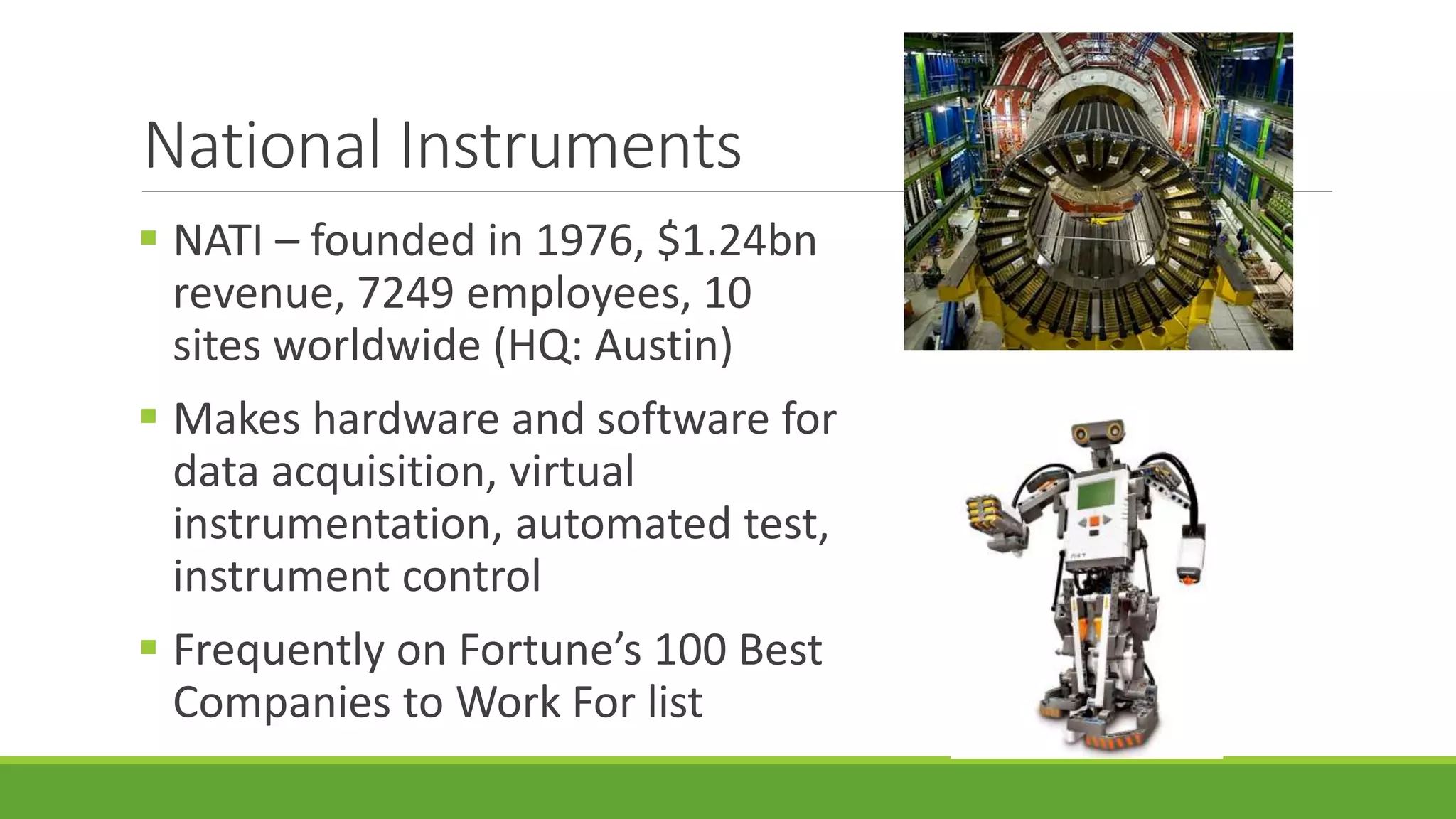
  • #4 First, National Instruments, an Austin-based enterprise producing hardware and software for engineers and scientists in design, test, and measurement. NI products help scientists and engineers power everything from the CERN supercollider to LEGO robots. Has anyone here used LabVIEW?
  • #5 My previous company had gone under in the post-9/11 bust. My passion for Web technology and technical management led to a role back home in Texas at National Instruments. IT at NI was organized around standard enterprise lines, with separate dev and infrastructure organizations supporting both internal systems and customer-facing Web systems.
  • #7 So keep in mind this was “pre-DevOps” (and even pre-Agile, mostly).  We had to initially prioritize things that would most reduce the load on us. Only then could we pivot to considering what would most benefit the developers, and then, the business. The APM practice reduced our production issues by 30% and reduced troubleshooting time by 90%. (see http://www.riverbed.com/customer-stories/National-Instruments.html for the source on the APM benefit stats.)
  • #8 We got to where we had measurable availability and performance goals that we were hitting along with hitting the yearly site growth and sales goals, and made the team’s work sustainable.  At the end of six years we had a good sized, highly skilled team with great tools and process. Quality of life for the engineers was a lot better.
  • #9 I knew in my heart something was wrong. We were throwing a lot of smart people at the work we had and had good process, good automation, good collaboration – but we were still the blocker for overall organizational velocity.  The dev teams were just starting to use Agile and it was giving us heartache. Also, interaction within other Infrastructure teams was a problem. As our approach and goals began to differ from those of the other teams we experienced conflict – we needed OpsOps, you might say. Keep in mind, there hadn’t been the first DevOpsDays yet.  But we had gone to the first Velocity conference in 2008 and had been filled with all kinds of new ideas…
  • #11 We didn’t know exactly what to do, but we knew that the existing way we worked IT systems would never be fast or agile enough for product purposes. When we got VMWare in IT, it turned a 6 week server procurement process into 4 weeks, only removing the Dell fulfillment time. So we went all in on cloud up front as a single integrated agile team, even though it meant displacing every single tool we were familiar with (none were cloud friendly at the time).  Security wise, we got ahead of that by doing security work proactively and being transparent about doing so. The first question every LabVIEW FPGA customer asked was “wait but what about the security of my IP?” And we had a prepared response assuring them “your data is yours” with our CISSP talking about how we do threat modeling and regular security testing and have an incident reporting. And that satisfied every asker!
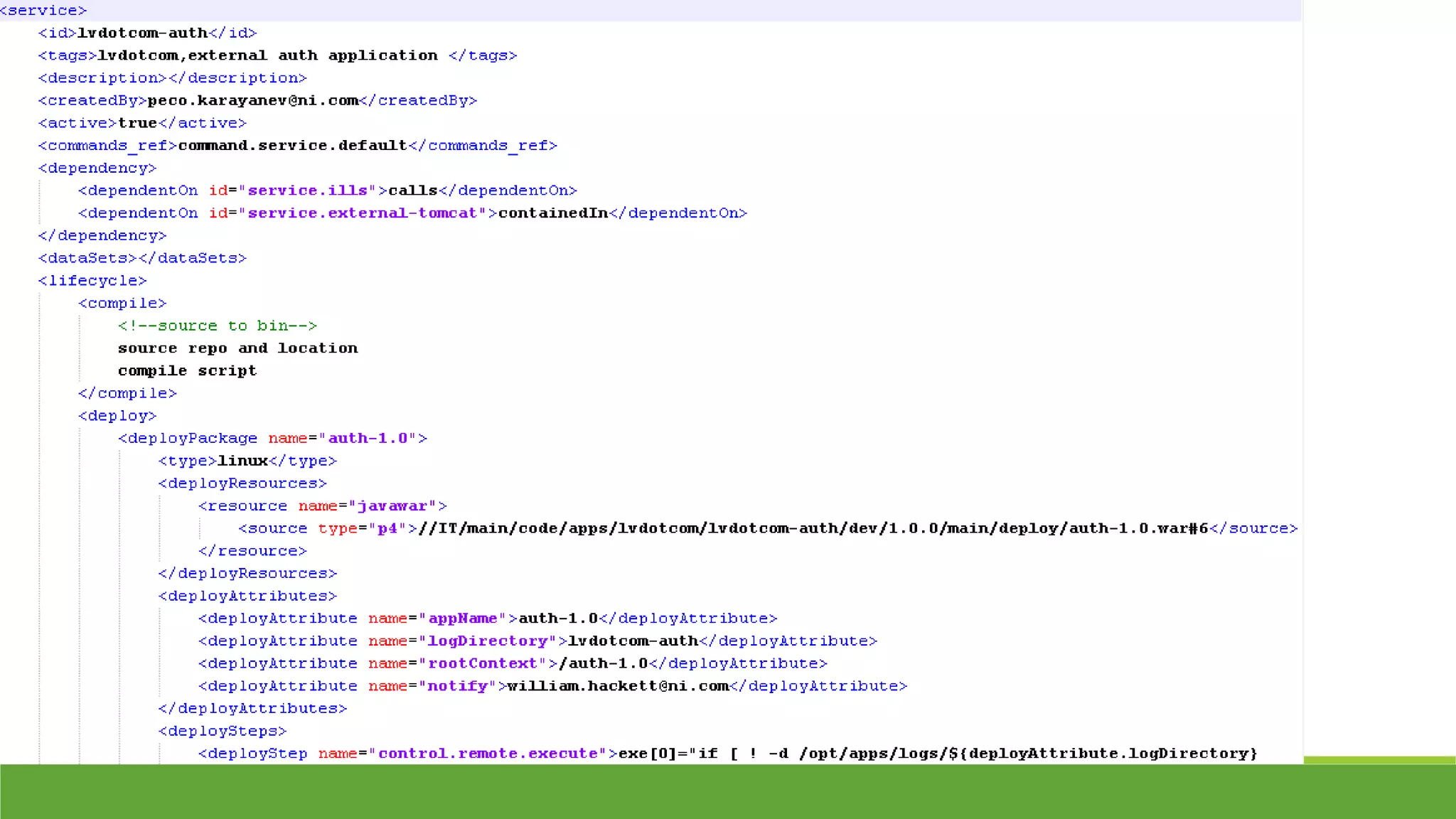
  • #12 We also embarked on writing our own configuration management system, PIE. Why? Simply, chef and puppet existed at the time but didn’t do what we need – Windows support in particular, but also we knew we wanted something that could instantiate and manage an entire system at runtime and understand service dependencies. We figured we’d need to mix Amazon cloud, Azure cloud, NI on premise services, and other SaaS services and a CM system that “puts bits on machines” doesn’t do that. We knew this would be a lot of work that a small team would not be putting towards direct product development and we had to really all look at each other and decide that yes, this was a necessary part of achieving our goal.
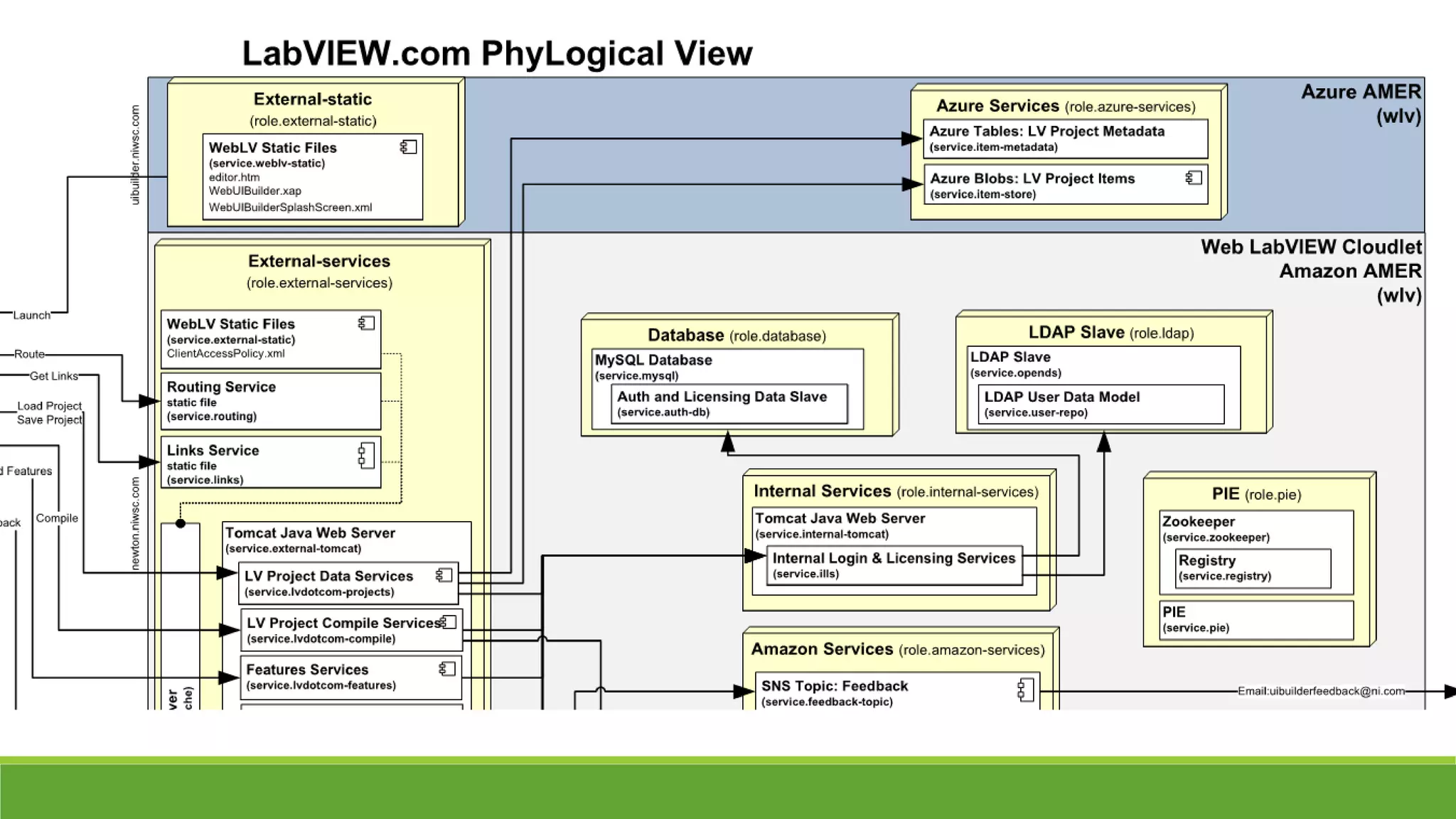
  • #13 So we went in with a very simple but strict goal of “have that entire phylogical diagram be code, and have it be dynamic as systems change, code is deployed, etc.” PIE had an XML model detailing the systems, the services running on those systems, and their interconnections. It used zookeeper as a runtime registry. Dev, test, and production systems were always identical. Changes were made exclusively through version control. We even used PIE for ad hoc command dispatch so that could be logged. This approach is finally gaining currency especially with docker’s more explicit support for service dependencies, but nothing else did this well for a long time.
  • #14 We had some design reviews where the app architect came to me and said “these ops guys are asking questions we just don’t understand… Maybe we should have separate reviews.” I explained that we could learn each other’s language and set up a virtuous cycle of collaboration or continue to split everything and go down the vicious cycle of tickets and process and bottlenecks. So we kept at it.
  • #15 Even with building our own automation platform (and other plumbing like login and licensing services), we delivered a product to market each year (plus some other prototypes and internal services), both directly web-facing and integrated with NI’s desktop products. Besides this, our uptime was 100% (vs 98.59% for our online catalog during the same period), we had security we’d never been able to get done (DMZs for example)… It may not be “fair” to compare a greenfield app with our legacy site, but we’d been working on that site for 6 years, and in the end it’s the results that matter. We didn’t have to balance resiliency and innovation, we were getting both with our approach. And quality of life was great, night and day from the previous setup. The primary hurdle was more in the sales and marketing of these new solutions – they were coming faster than they were prepared for!
  • #16 I think it’s important to note that during this period is when DevOps was coined as a term and took off. I was very, very lucky in that many of the principals happened to come to OpsCamp Austin right after the first DevOpsDays happened and were all abuzz about it. Getting plugged into this wave of sharing was extremely energizing – we kept wondering if we were completely crazy and off track until we found out that so many people were finding the same issues and headed in the same direction.
  • #17 Bazaarvoice provides hosted ratings and reviews, along with related services like authenticity, analytics, content syndication between retailers and brands, etc. They’re one of the big Austin tech startup success stories.
  • #18 Agile without DevOps was causing problems, in other words.
  • #20 We took a strong stance on dev empowerment and responsibility, and also each team setting their own specific metrics. So teams took off as many sprints as they needed to hit their own automated regression testing metric, with the rubric “you better not mess this up for everyone else.”
  • #21 Lean process, You should be looking to remove – process steps, old code, unused features – not just add, as you go.
  • #22 A lot of the existing ops team went to the PRR team. I started with them, got them running on Scrum, worked on oncall, incident command, etc. processes and then incorporated the devs.
  • #23 This “legacy stack” is still around now, of course.
  • #24 With what I had learned, we started more with culture and process than with tools and technology. Pretty much it’s all about collaboration, and putting just enough process in place to aid collaboration.
  • #25 For example, this is a custom system metric visualization I had our devs write that replaced ~20 linear feet of Zabbix graphs in a way that ops, devs, level 1 support, and even business folk could understand.
  • #27 In the end we had large scale integrated DevOps doing a lot of sustaining work as well as continuing heavy infrastructure development successfully. I met with some ISO auditors asking about hackups, and I showed them our wiki pages and where the automation code was in github that did all of it automated, with clear retention times etc., and I thought they were going to cry for a minute.
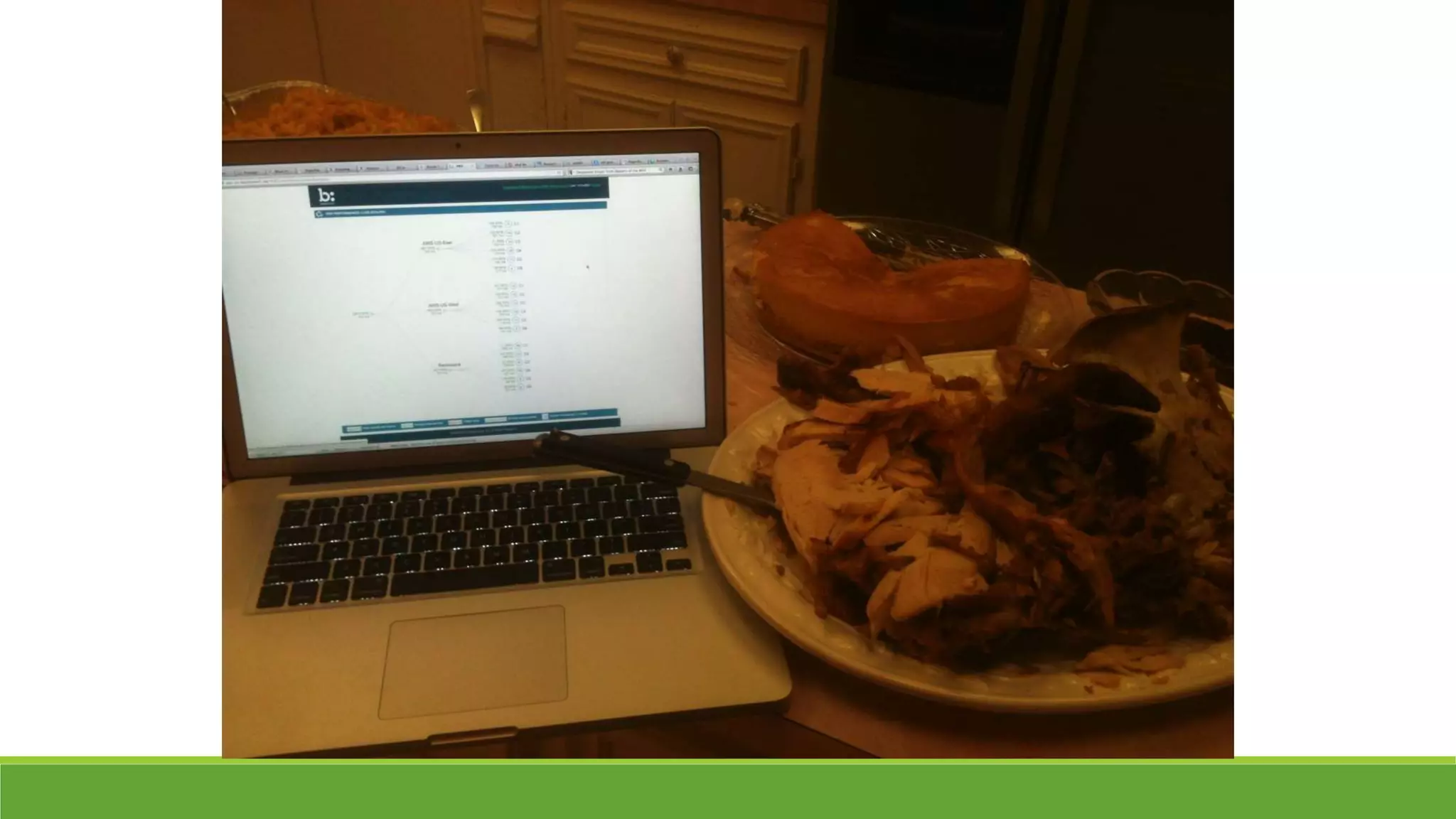
  • #28 And perhaps most importantly, engineer quality of life improved! So that critical Black Friday? Did we do an all-hands crisis center over the holiday weekend? Nope, people went home and had Thanksgiving dinner, relying on our tooling, training and process to bring us through a critical crunch time – and it did, year after year.
  • #29 Common threads across all of these? Look at it all holistically. Your value chain is your latency, but how much work you're putting in is your bandwidth; you should work on both (self serve reduces what all's coming into the pipeline). Have staff dedicated to products.  Automate for maximum speed and efficiency, and don’t be afraid to write your own. Communicate as much as you can to anyone who’ll listen. Carefully work on ways to balance planned and unplanned work. And have just enough process, base it on metrics, and don’t be afraid to prune it back.