CSG International Confidential and Proprietary Information Copyright © 2016 CSG Systems International, Inc. and/or its affiliates (“CSG International”). All rights reserved.
When Ops Swallows Dev
Our Cultural and Technical Journey to Realize DevOps at CSG
Scott Prugh, Chief Architect & VP Software Development & Operations, scott.prugh@csgi.com, @ScottPrugh
Erica Morrison, Director Software Development, erica.morrison@csgi.com, @ericarmorrison
CSG International Confidential and Proprietary Information Copyright © 2016 CSG Systems International, Inc. and/or its affiliates (“CSG International”). All rights reserved.
When Ops Swallows Dev
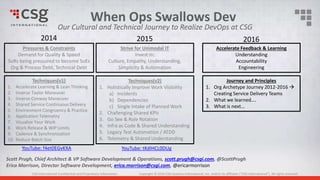
Techniques(v2)
1. Holistically Improve Work Visibility
a) Incidents
b) Dependencies
c) Single Intake of Planned Work
2. Challenging Shared KPIs
3. Go See & Role Rotation
4. Infra as Code & Shared Understanding
5. Legacy Test Automation / ATDD
6. Telemetry & Shared Understanding
Pressures & Constraints
Demand for Quality & Speed
SoRs being pressured to become SoEs
Org & Process Debt, Technical Debt
Strive for Unimodal IT
Invest in:
Culture, Empathy, Understanding,
Simplicity & Automation
Techniques(v1)
1. Accelerate Learning & Lean Thinking
2. Inverse Taylor Maneuver
3. Inverse Conway Maneuver
4. Shared Service Continuous Delivery
5. Environment Congruency & Practice
6. Application Telemetry
7. Visualize Your Work
8. Work Release & WIP Limits
9. Cadence & Synchronization
10. Reduce Batch Size
Accelerate Feedback & Learning
Understanding
Accountability
Engineering
2014 2015 2016
Journey and Principles
1. Org Archetype Journey 2012-2016 
Creating Service Delivery Teams
2. What we learned….
3. What is next…
Scott Prugh, Chief Architect & VP Software Development & Operations, scott.prugh@csgi.com, @ScottPrugh
Erica Morrison, Director Software Development, erica.morrison@csgi.com, @ericarmorrison
Our Cultural and Technical Journey to Realize DevOps at CSG
YouTube: f4et0EGvKXA YouTube: tKdIHCL0DUg
CSG International Confidential and Proprietary Information Copyright © 2015 CSG Systems International, Inc. and/or its affiliates (“CSG International”). All rights reserved.CSG International Confidential and Proprietary Information Copyright © 2016 CSG Systems International, Inc. and/or its affiliates (“CSG International”). All rights reserved.
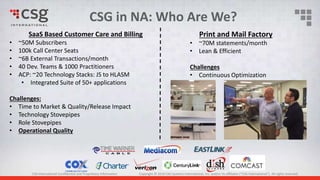
CSG in NA: Who Are We?
SaaS Based Customer Care and Billing
• ~50M Subscribers
• 100k Call Center Seats
• ~6B External Transactions/month
• 40 Dev. Teams & 1000 Practitioners
• ACP: ~20 Technology Stacks: JS to HLASM
• Integrated Suite of 50+ applications
Challenges:
• Time to Market & Quality/Release Impact
• Technology Stovepipes
• Role Stovepipes
• Operational Quality
Print and Mail Factory
• ~70M statements/month
• Lean & Efficient
Challenges
• Continuous Optimization
CSG International Confidential and Proprietary Information Copyright © 2015 CSG Systems International, Inc. and/or its affiliates (“CSG International”). All rights reserved.CSG International Confidential and Proprietary Information Copyright © 2016 CSG Systems International, Inc. and/or its affiliates (“CSG International”). All rights reserved.
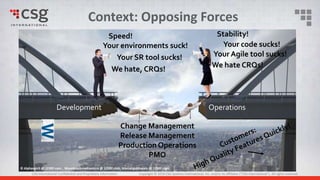
Context: Opposing Forces
Development Operations
Change Management
Release Management
Production Operations
PMO
Speed! Stability!
Your code sucks!Your environments suck!
Your SR tool sucks! Your Agile tool sucks!
We hate CRQs!
We hate, CRQs!
© Alphaspirit @ 123RF.com , Wavebreakmediamicro @ 123RF.com, Warrengoldswain @ 123RF.com
CSG International Confidential and Proprietary Information Copyright © 2016 CSG Systems International, Inc. and/or its affiliates (“CSG International”). All rights reserved.
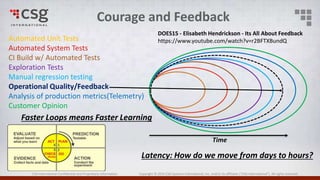
Courage and Feedback
Automated Unit Tests
Automated System Tests
CI Build w/ Automated Tests
Exploration Tests
Manual regression testing
Operational Quality/Feedback
Analysis of production metrics(Telemetry)
Customer Opinion
Time
DOES15 - Elisabeth Hendrickson - Its All About Feedback
https://www.youtube.com/watch?v=r2BFTXBundQ
Latency: How do we move from days to hours?
Faster Loops means Faster Learning
CSG International Confidential and Proprietary Information Copyright © 2016 CSG Systems International, Inc. and/or its affiliates (“CSG International”). All rights reserved.
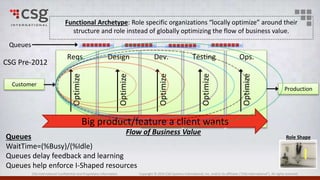
Functional Archetype: Role specific organizations “locally optimize” around their
structure and role instead of globally optimizing the flow of business value.
Customer
Reqs. Design Dev. Testing Ops.
Production
Optimize
Optimize
Optimize
Optimize
Optimize
Flow of Business Value
Big product/feature a client wants
Queues
CSG Pre-2012
Role ShapeQueues
WaitTime=(%Busy)/(%Idle)
Queues delay feedback and learning
Queues help enforce I-Shaped resources
CSG International Confidential and Proprietary Information Copyright © 2016 CSG Systems International, Inc. and/or its affiliates (“CSG International”). All rights reserved.
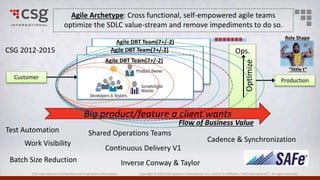
Agile Archetype: Cross functional, self-empowered agile teams
optimize the SDLC value-stream and remove impediments to do so.
Customer
Ops.
Production
Optimize
Flow of Business Value
Big product/feature a client wants
Agile DBT Team(7+/-2)
CSG 2012-2015
Role Shape
Batch Size Reduction
Test Automation
Cadence & Synchronization
Shared Operations Teams
Inverse Conway & Taylor
Work Visibility
Continuous Delivery V1
“little t”
CSG International Confidential and Proprietary Information Copyright © 2015 CSG Systems International, Inc. and/or its affiliates (“CSG International”). All rights reserved.CSG International Confidential and Proprietary Information Copyright © 2016 CSG Systems International, Inc. and/or its affiliates (“CSG International”). All rights reserved.
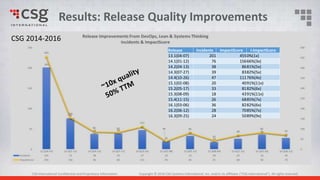
Release Incidents ImpactScore I-ImpactScore
13.1(04-07) 201 4550%(1x)
14.1(01-12) 76 15666%(3x)
14.2(04-13) 38 8681%(5x)
14.3(07-27) 39 8382%(5x)
14.4(10-26) 47 11176%(4x)
15.1(02-08) 20 4091%(11x)
15.2(05-17) 33 8182%(6x)
15.3(08-09) 18 4391%(11x)
15.4(11-15) 26 6885%(7x)
16.1(03-06) 36 8282%(6x)
16.2(06-12) 28 7085%(7x)
16.3(09-25) 24 5089%(9x)
Results: Release Quality Improvements
CSG 2014-2016
CSG International Confidential and Proprietary Information Copyright © 2015 CSG Systems International, Inc. and/or its affiliates (“CSG International”). All rights reserved.CSG International Confidential and Proprietary Information Copyright © 2016 CSG Systems International, Inc. and/or its affiliates (“CSG International”). All rights reserved.
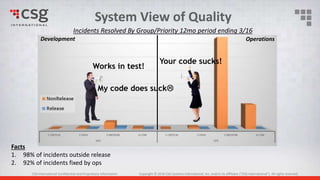
System View of Quality
Facts
1. 98% of incidents outside release
2. 92% of incidents fixed by ops
OperationsDevelopment
Your code sucks!
Works in test!
Incidents Resolved By Group/Priority 12mo period ending 3/16
My code does suck
CSG International Confidential and Proprietary Information Copyright © 2015 CSG Systems International, Inc. and/or its affiliates (“CSG International”). All rights reserved.CSG International Confidential and Proprietary Information Copyright © 2016 CSG Systems International, Inc. and/or its affiliates (“CSG International”). All rights reserved.
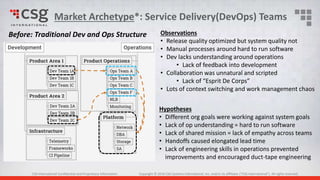
Before: Traditional Dev and Ops Structure
Hypotheses
• Different org goals were working against system goals
• Lack of op understanding = hard to run software
• Lack of shared mission = lack of empathy across teams
• Handoffs caused elongated lead time
• Lack of engineering skills in operations prevented
improvements and encouraged duct-tape engineering
Observations
• Release quality optimized but system quality not
• Manual processes around hard to run software
• Dev lacks understanding around operations
• Lack of feedback into development
• Collaboration was unnatural and scripted
• Lack of “Esprit De Corps”
• Lots of context switching and work management chaos
Market Archetype*: Service Delivery(DevOps) Teams
CSG International Confidential and Proprietary Information Copyright © 2015 CSG Systems International, Inc. and/or its affiliates (“CSG International”). All rights reserved.CSG International Confidential and Proprietary Information Copyright © 2016 CSG Systems International, Inc. and/or its affiliates (“CSG International”). All rights reserved.
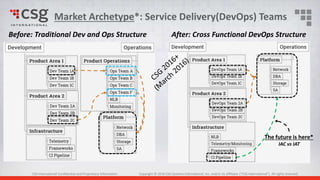
Before: Traditional Dev and Ops Structure After: Cross Functional DevOps Structure
The future is here*
IAC vs IAT
Market Archetype*: Service Delivery(DevOps) Teams
CSG International Confidential and Proprietary Information Copyright © 2016 CSG Systems International, Inc. and/or its affiliates (“CSG International”). All rights reserved.
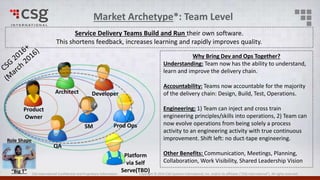
Market Archetype*: Team Level
Architect
Product
Owner
Prod Ops
Developer
QA
SM
Platform
via Self
Serve(TBD)
Service Delivery Teams Build and Run their own software.
This shortens feedback, increases learning and rapidly improves quality.
Why Bring Dev and Ops Together?
Understanding: Team now has the ability to understand,
learn and improve the delivery chain.
Accountability: Teams now accountable for the majority
of the delivery chain: Design, Build, Test, Operations.
Engineering: 1) Team can inject and cross train
engineering principles/skills into operations, 2) Team can
now evolve operations from being solely a process
activity to an engineering activity with true continuous
improvement. Shift left: no duct-tape engineering.
Other Benefits: Communication, Meetings, Planning,
Collaboration, Work Visibility, Shared Leadership Vision
Role Shape
“Big T”
CSG International Confidential and Proprietary Information Copyright © 2016 CSG Systems International, Inc. and/or its affiliates (“CSG International”). All rights reserved.
What We Learned
CSG International Confidential and Proprietary Information Copyright © 2016 CSG Systems International, Inc. and/or its affiliates (“CSG International”). All rights reserved.
Going All In
CSG International Confidential and Proprietary Information Copyright © 2016 CSG Systems International, Inc. and/or its affiliates (“CSG International”). All rights reserved.
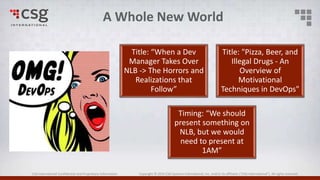
Title: “When a Dev
Manager Takes Over
NLB -> The Horrors and
Realizations that
Follow”
Title: "Pizza, Beer, and
Illegal Drugs - An
Overview of
Motivational
Techniques in DevOps"
Timing: “We should
present something on
NLB, but we would
need to present at
1AM”
A Whole New World
CSG International Confidential and Proprietary Information Copyright © 2016 CSG Systems International, Inc. and/or its affiliates (“CSG International”). All rights reserved.
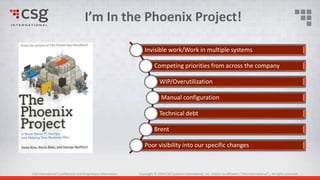
I’m In the Phoenix Project!
Invisible work/Work in multiple systems
Competing priorities from across the company
WIP/Overutilization
Manual configuration
Technical debt
Brent
Poor visibility into our specific changes
CSG International Confidential and Proprietary Information Copyright © 2016 CSG Systems International, Inc. and/or its affiliates (“CSG International”). All rights reserved.
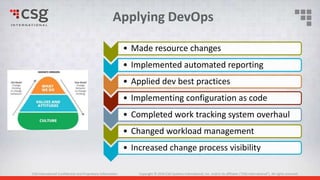
Applying DevOps
• Made resource changes
• Implemented automated reporting
• Applied dev best practices
• Implementing configuration as code
• Completed work tracking system overhaul
• Changed workload management
• Increased change process visibility
CSG International Confidential and Proprietary Information Copyright © 2016 CSG Systems International, Inc. and/or its affiliates (“CSG International”). All rights reserved.
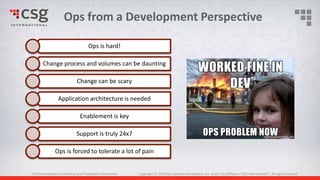
Ops is hard!
Change process and volumes can be daunting
Change can be scary
Application architecture is needed
Enablement is key
Support is truly 24x7
Ops is forced to tolerate a lot of pain
Ops from a Development Perspective
CSG International Confidential and Proprietary Information Copyright © 2016 CSG Systems International, Inc. and/or its affiliates (“CSG International”). All rights reserved.
Summary / What’s Next
Accelerate Feedback & Learning:
Understanding, Accountability, Engineering
Challenge Org Norms(Courage)
Structure for Feedback/Outcome  Speed, Quality
Things Learned
Work Chaos: Change and BAU
Manual Processes
Resource Bottlenecks
Tech Debt
Testing(lack of)
Process
Change: Lead Time, SDLC Rigor, Ownership
Bridge ITIL/SDLC(Process & Tools)
Impact Reduction
Centers of Enablement(vs Excellence)
Technology
More engineering less duct-tape
Mainframe ASM  Java: 30-1 reduction
CD v2.0: From IAT to IAC/Cloud Pipeline
People
Engineering Culture
Cross Skilling / Upskilling
What’s Next….
CSG International Confidential and Proprietary Information Copyright © 2016 CSG Systems International, Inc. and/or its affiliates (“CSG International”). All rights reserved.
Change Lead Time & Schedule Buffers

DOES16 San Francisco - Scott Prugh & Erica Morrison - When Ops Swallows Dev

  • 1.
    CSG International Confidentialand Proprietary Information Copyright © 2016 CSG Systems International, Inc. and/or its affiliates (“CSG International”). All rights reserved. When Ops Swallows Dev Our Cultural and Technical Journey to Realize DevOps at CSG Scott Prugh, Chief Architect & VP Software Development & Operations, scott.prugh@csgi.com, @ScottPrugh Erica Morrison, Director Software Development, erica.morrison@csgi.com, @ericarmorrison
  • 2.
    CSG International Confidentialand Proprietary Information Copyright © 2016 CSG Systems International, Inc. and/or its affiliates (“CSG International”). All rights reserved. When Ops Swallows Dev Techniques(v2) 1. Holistically Improve Work Visibility a) Incidents b) Dependencies c) Single Intake of Planned Work 2. Challenging Shared KPIs 3. Go See & Role Rotation 4. Infra as Code & Shared Understanding 5. Legacy Test Automation / ATDD 6. Telemetry & Shared Understanding Pressures & Constraints Demand for Quality & Speed SoRs being pressured to become SoEs Org & Process Debt, Technical Debt Strive for Unimodal IT Invest in: Culture, Empathy, Understanding, Simplicity & Automation Techniques(v1) 1. Accelerate Learning & Lean Thinking 2. Inverse Taylor Maneuver 3. Inverse Conway Maneuver 4. Shared Service Continuous Delivery 5. Environment Congruency & Practice 6. Application Telemetry 7. Visualize Your Work 8. Work Release & WIP Limits 9. Cadence & Synchronization 10. Reduce Batch Size Accelerate Feedback & Learning Understanding Accountability Engineering 2014 2015 2016 Journey and Principles 1. Org Archetype Journey 2012-2016  Creating Service Delivery Teams 2. What we learned…. 3. What is next… Scott Prugh, Chief Architect & VP Software Development & Operations, scott.prugh@csgi.com, @ScottPrugh Erica Morrison, Director Software Development, erica.morrison@csgi.com, @ericarmorrison Our Cultural and Technical Journey to Realize DevOps at CSG YouTube: f4et0EGvKXA YouTube: tKdIHCL0DUg
  • 3.
    CSG International Confidentialand Proprietary Information Copyright © 2015 CSG Systems International, Inc. and/or its affiliates (“CSG International”). All rights reserved.CSG International Confidential and Proprietary Information Copyright © 2016 CSG Systems International, Inc. and/or its affiliates (“CSG International”). All rights reserved. CSG in NA: Who Are We? SaaS Based Customer Care and Billing • ~50M Subscribers • 100k Call Center Seats • ~6B External Transactions/month • 40 Dev. Teams & 1000 Practitioners • ACP: ~20 Technology Stacks: JS to HLASM • Integrated Suite of 50+ applications Challenges: • Time to Market & Quality/Release Impact • Technology Stovepipes • Role Stovepipes • Operational Quality Print and Mail Factory • ~70M statements/month • Lean & Efficient Challenges • Continuous Optimization
  • 4.
    CSG International Confidentialand Proprietary Information Copyright © 2015 CSG Systems International, Inc. and/or its affiliates (“CSG International”). All rights reserved.CSG International Confidential and Proprietary Information Copyright © 2016 CSG Systems International, Inc. and/or its affiliates (“CSG International”). All rights reserved. Context: Opposing Forces Development Operations Change Management Release Management Production Operations PMO Speed! Stability! Your code sucks!Your environments suck! Your SR tool sucks! Your Agile tool sucks! We hate CRQs! We hate, CRQs! © Alphaspirit @ 123RF.com , Wavebreakmediamicro @ 123RF.com, Warrengoldswain @ 123RF.com
  • 5.
    CSG International Confidentialand Proprietary Information Copyright © 2016 CSG Systems International, Inc. and/or its affiliates (“CSG International”). All rights reserved. Courage and Feedback Automated Unit Tests Automated System Tests CI Build w/ Automated Tests Exploration Tests Manual regression testing Operational Quality/Feedback Analysis of production metrics(Telemetry) Customer Opinion Time DOES15 - Elisabeth Hendrickson - Its All About Feedback https://www.youtube.com/watch?v=r2BFTXBundQ Latency: How do we move from days to hours? Faster Loops means Faster Learning
  • 6.
    CSG International Confidentialand Proprietary Information Copyright © 2016 CSG Systems International, Inc. and/or its affiliates (“CSG International”). All rights reserved. Functional Archetype: Role specific organizations “locally optimize” around their structure and role instead of globally optimizing the flow of business value. Customer Reqs. Design Dev. Testing Ops. Production Optimize Optimize Optimize Optimize Optimize Flow of Business Value Big product/feature a client wants Queues CSG Pre-2012 Role ShapeQueues WaitTime=(%Busy)/(%Idle) Queues delay feedback and learning Queues help enforce I-Shaped resources
  • 7.
    CSG International Confidentialand Proprietary Information Copyright © 2016 CSG Systems International, Inc. and/or its affiliates (“CSG International”). All rights reserved. Agile Archetype: Cross functional, self-empowered agile teams optimize the SDLC value-stream and remove impediments to do so. Customer Ops. Production Optimize Flow of Business Value Big product/feature a client wants Agile DBT Team(7+/-2) Agile DBT Team(7+/-2) Agile DBT Team(7+/-2) CSG 2012-2015 Role Shape Batch Size Reduction Test Automation Cadence & Synchronization Shared Operations Teams Inverse Conway & Taylor Work Visibility Continuous Delivery V1 “little t”
  • 8.
    CSG International Confidentialand Proprietary Information Copyright © 2015 CSG Systems International, Inc. and/or its affiliates (“CSG International”). All rights reserved.CSG International Confidential and Proprietary Information Copyright © 2016 CSG Systems International, Inc. and/or its affiliates (“CSG International”). All rights reserved. Release Incidents ImpactScore I-ImpactScore 13.1(04-07) 201 4550%(1x) 14.1(01-12) 76 15666%(3x) 14.2(04-13) 38 8681%(5x) 14.3(07-27) 39 8382%(5x) 14.4(10-26) 47 11176%(4x) 15.1(02-08) 20 4091%(11x) 15.2(05-17) 33 8182%(6x) 15.3(08-09) 18 4391%(11x) 15.4(11-15) 26 6885%(7x) 16.1(03-06) 36 8282%(6x) 16.2(06-12) 28 7085%(7x) 16.3(09-25) 24 5089%(9x) Results: Release Quality Improvements CSG 2014-2016
  • 9.
    CSG International Confidentialand Proprietary Information Copyright © 2015 CSG Systems International, Inc. and/or its affiliates (“CSG International”). All rights reserved.CSG International Confidential and Proprietary Information Copyright © 2016 CSG Systems International, Inc. and/or its affiliates (“CSG International”). All rights reserved. System View of Quality Facts 1. 98% of incidents outside release 2. 92% of incidents fixed by ops OperationsDevelopment Your code sucks! Works in test! Incidents Resolved By Group/Priority 12mo period ending 3/16 My code does suck
  • 10.
    CSG International Confidentialand Proprietary Information Copyright © 2015 CSG Systems International, Inc. and/or its affiliates (“CSG International”). All rights reserved.CSG International Confidential and Proprietary Information Copyright © 2016 CSG Systems International, Inc. and/or its affiliates (“CSG International”). All rights reserved. Before: Traditional Dev and Ops Structure Hypotheses • Different org goals were working against system goals • Lack of op understanding = hard to run software • Lack of shared mission = lack of empathy across teams • Handoffs caused elongated lead time • Lack of engineering skills in operations prevented improvements and encouraged duct-tape engineering Observations • Release quality optimized but system quality not • Manual processes around hard to run software • Dev lacks understanding around operations • Lack of feedback into development • Collaboration was unnatural and scripted • Lack of “Esprit De Corps” • Lots of context switching and work management chaos Market Archetype*: Service Delivery(DevOps) Teams
  • 11.
    CSG International Confidentialand Proprietary Information Copyright © 2015 CSG Systems International, Inc. and/or its affiliates (“CSG International”). All rights reserved.CSG International Confidential and Proprietary Information Copyright © 2016 CSG Systems International, Inc. and/or its affiliates (“CSG International”). All rights reserved. Before: Traditional Dev and Ops Structure After: Cross Functional DevOps Structure The future is here* IAC vs IAT Market Archetype*: Service Delivery(DevOps) Teams
  • 12.
    CSG International Confidentialand Proprietary Information Copyright © 2016 CSG Systems International, Inc. and/or its affiliates (“CSG International”). All rights reserved. Market Archetype*: Team Level Architect Product Owner Prod Ops Developer QA SM Platform via Self Serve(TBD) Service Delivery Teams Build and Run their own software. This shortens feedback, increases learning and rapidly improves quality. Why Bring Dev and Ops Together? Understanding: Team now has the ability to understand, learn and improve the delivery chain. Accountability: Teams now accountable for the majority of the delivery chain: Design, Build, Test, Operations. Engineering: 1) Team can inject and cross train engineering principles/skills into operations, 2) Team can now evolve operations from being solely a process activity to an engineering activity with true continuous improvement. Shift left: no duct-tape engineering. Other Benefits: Communication, Meetings, Planning, Collaboration, Work Visibility, Shared Leadership Vision Role Shape “Big T”
  • 13.
    CSG International Confidentialand Proprietary Information Copyright © 2016 CSG Systems International, Inc. and/or its affiliates (“CSG International”). All rights reserved. What We Learned
  • 14.
    CSG International Confidentialand Proprietary Information Copyright © 2016 CSG Systems International, Inc. and/or its affiliates (“CSG International”). All rights reserved. Going All In
  • 15.
    CSG International Confidentialand Proprietary Information Copyright © 2016 CSG Systems International, Inc. and/or its affiliates (“CSG International”). All rights reserved. Title: “When a Dev Manager Takes Over NLB -> The Horrors and Realizations that Follow” Title: "Pizza, Beer, and Illegal Drugs - An Overview of Motivational Techniques in DevOps" Timing: “We should present something on NLB, but we would need to present at 1AM” A Whole New World
  • 16.
    CSG International Confidentialand Proprietary Information Copyright © 2016 CSG Systems International, Inc. and/or its affiliates (“CSG International”). All rights reserved. I’m In the Phoenix Project! Invisible work/Work in multiple systems Competing priorities from across the company WIP/Overutilization Manual configuration Technical debt Brent Poor visibility into our specific changes
  • 17.
    CSG International Confidentialand Proprietary Information Copyright © 2016 CSG Systems International, Inc. and/or its affiliates (“CSG International”). All rights reserved. Applying DevOps • Made resource changes • Implemented automated reporting • Applied dev best practices • Implementing configuration as code • Completed work tracking system overhaul • Changed workload management • Increased change process visibility
  • 18.
    CSG International Confidentialand Proprietary Information Copyright © 2016 CSG Systems International, Inc. and/or its affiliates (“CSG International”). All rights reserved. Ops is hard! Change process and volumes can be daunting Change can be scary Application architecture is needed Enablement is key Support is truly 24x7 Ops is forced to tolerate a lot of pain Ops from a Development Perspective
  • 19.
    CSG International Confidentialand Proprietary Information Copyright © 2016 CSG Systems International, Inc. and/or its affiliates (“CSG International”). All rights reserved. Summary / What’s Next Accelerate Feedback & Learning: Understanding, Accountability, Engineering Challenge Org Norms(Courage) Structure for Feedback/Outcome  Speed, Quality Things Learned Work Chaos: Change and BAU Manual Processes Resource Bottlenecks Tech Debt Testing(lack of) Process Change: Lead Time, SDLC Rigor, Ownership Bridge ITIL/SDLC(Process & Tools) Impact Reduction Centers of Enablement(vs Excellence) Technology More engineering less duct-tape Mainframe ASM  Java: 30-1 reduction CD v2.0: From IAT to IAC/Cloud Pipeline People Engineering Culture Cross Skilling / Upskilling What’s Next….
  • 20.
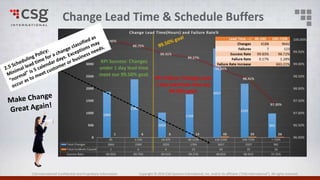
    CSG International Confidentialand Proprietary Information Copyright © 2016 CSG Systems International, Inc. and/or its affiliates (“CSG International”). All rights reserved. Change Lead Time & Schedule Buffers

Editor's Notes

  • #3 01:20 -Thanks. -3rd time at DOES; first with op duties -Current chapter: “When Ops Swallows Dev”. Past 7 months brought together dev and ops; felt like doing more ops than dev as we work through challenges -Overall theme: Accelerate Feedback & Learning to enable Understanding, Accountability and engineering -First: Org Archetype walkthrough ending in Creation of Service Delivery Teams; Erica: What we learned; Scott: What is next -Panel: How to do DevOps with traditional IT Orgs. I’ll cover that today. You will either be excited or scared. Hope it’s the former and have the courage to work through the later.
  • #4 00:30 -Superquick: CSG is the largest Saas Provider of CC & Billing for the Cable industry -40 dev teams & 1000 practioners -Our platform(ACP) crosses 20 technologies: JS to mainframe assembly and is delivered as an integrated suite -Same challenges as everyone else. Current challenge: Operational Quality -We also run the largest print operation in the US and product 70M statements/month
  • #5 01:00 -Set context fist about the problem large enterprises have been battling. -Picture in my head. Needed to get it out. -Dev on left; ops on right connected by a precarious path to production. Leaders yelling at each other. -Agree on 3 things: 1) CRQs/Change sucks. Environment blows up; 2) Path to production is paved on the herculean efforts of others(CM, RM, Prod Ops, PMO); 3) Customers want quality and speed -The good thing: It doesn’t have to be this way. With DevOps we can make the path to production smooth and deliver much higher quality at speed.
  • #6 01:20 -EH had a great presentation last year. Highly recommend it. So many great points but two I pulled out here -1st: Courage and how you need to experiment with re-drawing team lines/boundaries(reform teams). Story: Head of QA’s first act was to get rid of the QA org. Realized it was de-optimizing the system. -2nd the concept of feedback and how important it is to enable learning -Lower left: standard PDCA loop. Faster loops mean faster learning -Above in colored text. Different types of testing practices that help enable quality. -To the right; colored loops represent feedback from these tests stretched out over time. -The lower the latency; the faster we learn and the faster we can deliver quality software -One loop missed. I’ll add it now. Operational quality -We will use these loops to look at the different org archetypes and how we have optimized our org structures to reduce the latency in our feedback
  • #7 01:40 -First org archetype: Functional. Recognize this as waterfall. This was CSG pre-2012. My hope is that no one is doing this now… -You will the concept of queues in this picture. Each org processes its work and passes it downstream via a queue. -We know from two popular works how queues scale. Larman’s Scaling Lean and Agile Dev. Phoenix Project formula. -Queues degrade exponentially and latency for feedback increases exponentially as this type of org gets busy -Even more evil than the queues themselves is what this does to your people shape. Creates I-Shaped resources. Good at one thing only. -Look at our feedback loops. Note how far out a loop like operational quality is. Across 5 orgs to get that feedback. Not that some of these orgs will even have queues inside them.
  • #8 01:15 -Next: Agile Archetype -In 2012 we led a re-org to get rid of role specific orgs in development. Realized that these orgs were de-optimizing the flow of value and quality. -Rolled out SAFe and also implemented many other techniques… -This type of structure has a lot fewer queues and encourages little t resources. People who understand the entire SDLC value chain and interface more directly with ops -Now look at our feedback loops. Lower latency because many more are within the context of a team that is executing in a two week cadence. They learn faster.
  • #9 01:00 -Results of this are well know. Previously presented and also in DevOps handbook. -From 2014 to current these changes improved quality almost 10x and reduced TTM by 50%
  • #10 00:40 -Now lets take a current look at overall quality end to end -Blue is release quality that we optimized away. Orange is NonRelease -Left is dev; right is ops. -Simple facts are: 98%; 92% -These leaders are still yelling at each other. They are probably saying something like… -Dev guy hangs his head… -So. Lets look at what we needed to do next.
  • #11 01:10 -Next Archetype is the Market or Service -On the left you see a rep of our org structure prior to march 2016. This is a traditional Dev & IT ops model. Dev builds. Ops runs. Platform provides infra. -Orange lines represent the flow of handoffs -Observations we had -From this we had a few hypotheses as to what was happeneing
  • #12 01:00 -March 2016 I was asked to take over prod operations at CSG -My first act was to sit down for a few days with my leaders. -Gave them a challenge. How do we bring these teams together to create teams that build and run their software. -On the right you can see how we collapsed down several orgs into combined SD or DevOps teams. We still interface in the traditional way with platform -Note green line. The future is that our platform will connect via our CI system to auto-provvision infrastructure
  • #13 01:30 -Now the team level view. -See how the feedback loops are now contained within one team. Learning is accelerated as feedback is gained on all concerns withing a sprint -This encourages Big T resource shapes that understand the majority of the value chain -So why bring Dev and Ops together: Understanding; Accountability; Engineering; Other -Now I will turn it over to Erica to go through what we have learned in the past 7 months going through this transtion
  • #14 Need to get here in 13min(13:00 now) 11:00 for Erica. Puts us at 24:00
  • #15 Reorg Understood ops This View When we started this reorganization journey, I thought I knew all about DevOps and what it was like to do operations. I had several teams already doing “you build it, you run it.” This is what my view of DevOps was – a tranquil best-practice of how we want to develop software. http://www.forbes.com/sites/benkerschberg/2015/02/04/why-devops-integration-and-continuous-delivery-hold-the-key-to-enterprise-mobile-app-dev/#26390d3279bf
  • #16 Previous DevOps Teams Gained pure Ops Extremely education Extremely challenging Solidified DevOps Framework and methodologies Not overnight thing However, when we got going…..it felt a lot more like this. My previous DevOps teams were internal teams support internal products (build system, telemetry). BigIP introduced me a lot more to the pure operations world and the operational teams for all of our different products and all the things they put up with. It has been an amazing educational experience and given me a whole new perspective on the Ops world. While I’m much better for this journey, it’s been a tough one that has had many bumps along the way. A lot of outages right out of the gate Thrown into a world of chaos – very disruptive It’s solidified the value of many DevOps principles as I’ve seen what it’s like to be in the Ops world without many of these concepts in place. Fixing these issues requires you to roll up your sleeves and put in a ton of hard work to change culture and implement best practices. I’d like to talk about my specific experiences with one team I’ve been deeply involved with, and expand those learnings to the larger org. Our journey is by no means done, but we have made substantial progress. I thought I’d start out by sharing some thoughts coworkers shared with me regarding this presentation which give some good insight into my year https://thinkingmonster.files.wordpress.com/2015/08/devops.jpeg?w=300&h=300
  • #17 As I got more involved with the BigIP team, I quickly started to feel like I was in the Phoenix Project. While I had seen many parallels to the book in previous work experiences, it was nothing like this. Invisible work/work in multiple systems One system for stories, another for incidents, another for CRQs, another for new requests. And TONS of email. And some stuff wasn’t in any system Lack of work visibility. My brain was exploding trying to track it all No single pane of glass Impossible to follow up with teams – whoever screamed the loudest So many #1 priorities, not a good way to prioritize and work. Squeaky wheel getting the grease. Sometimes other important things dropped WIP/Overutilizarion Tech debt Vendor upgrades Standards – lack of standards. When we do have them, not universally applied and rolled out to production Taken on capabilities that probably belong within the development side that have added complexity and caused maintenance challenges, as well as prod outages. Brent to the nth degree. Pulled in to firefight every issue, no time to make things better even those he’s the visionary for the product Poor visibility into specific changes Details/impacts of changes not always understood No easy way to track what had been done Manual configuration Pretty much all changes done by hand
  • #18 We’ve taken a look at the numerous challenges facing this team and attacked them with DevOps concepts John Shook from Toyota talks about making culture changes by changing what we do in order to change the underlying belief system and culture. We’ve done that here Biggest culture change happens by seeing the changes in action. Just do it and become a believer by seeing how it pays off Resistance to change at varying degrees. Feeling of just another fad or we’ve said this before. Resource changes Brought developers and architects in to supplement the network/operational engineers and help drive culture change Automated reporting Traffic reports, device reports Jenkins jobs to orchestrate ACL changes/jobs Writing to StatHub Deployment mechanism Config as code iApp FW, auto test and deploy FW Automation of cert renewals Dev best practices Source control CI Automated testing Automation of deployments Peer reviews VE’s locally Work tracking Got everything in JIRA. Automation written to pull from several different tools Includes changes so we can easily see what went in, what’s going in Workload management Dev time vs ops time Ops rotation Implemented change review for every single change with team and DevOps partners On top of peer review Through all of this work we are Achieving culture changes Setting ourselves up for the long term vision Ability to safely make changes Reduced impact to customers Self service
  • #19 Before I turn it back over to Scott to talk about where we are going next in our DevOps journey, I’d like to share some thoughts on Ops from a Development Perspective As our Dev org has moved to a system focus, we have brought dev best practices to the Ops world. However, the bottom line is the product still needs to continue to run and be configured to meet customer needs. Outside our wheelhouse Through our DevOps journey, some things have gone as expected, but others have been surprises. Probably the biggest surprise is the extent to which Ops is hard. It’s one thing to read it in a book, but another entirely to experience it firsthand. Those from Ops world are looking at me and thinking “duh” Change process was not visible to dev world I didn’t know any of the details of our change process I now deal with it on a daily basis Process is cumbersome and time consuming Overwhelming volume of changes and how change is such a big element of what the team does Change can be scary! As a developer you want to get your changes into prod as soon as possible. But in Ops, as you are the one responsible for implementing the change and dealing with fallout, you understand each change comes with risk, especially when it’s manually and without an automated test framework. That causes a natural reaction to want to go slower. We know we can’t do that, but we now understand the perspective Need for application architecture Historically, dev developed with architecture in mind Ops developed with a tactical focus Ops world needs architecture just like dev does. It’s maybe different than traditional architecture but requires some of the same skills and rigor Tactical focus vs strategic. Driven by constant workload and culture We’ve treated Ops as a commodity. It needs to be treated as something that needs to be designed, just like anything else We haven’t always enabled Ops to be successful Examples: # of resources and training All hours support I’m not attached at the hip to my phone Sleep with it next to me with volume on Get woken up more than I would like Vaca boating example Truly a 24x7 gig where you are never off Dedicated group of people doing this We ask a lot of our Ops teams. They’ve been given crappy equipment and in some cases, not the right training https://memegenerator.net/instance/22605665
  • #20 01:30(24:00-25:30) -Next things: Process: Lead Time; Bridging ITIL/SDLC; Impact Reduction; More Centers of Enablement -Technology: More engineering; Mainframe; CD v2.0 -People: Vital to grow an engineering culture and cross skilling
  • #21 -Bonus slide. Couldn’t resist. -Very busy.. Our goal for changes is 99.5% success rate… The yellow line represents where this quality line falls.. -The buckets in the graph reprent lead time windows that changes were put in. -Very simply: changes that go in < 24h are 99.83% successful -Greater than 24h drop to 98.72%. -Reinersten: Schedule buffers transform uncertain lateness into certain lateness; Transform uncertain failure into more certain failure. At least 600% more in this case. -Policy dictates 5 day lead time in order to provide for coordination and external review. -Teams know most about the change and the state of the system is best known when the change is commissioned. The change does not get better with more review and more time. -This is something we will be working on next. -That’s it. Thanks