Building a business case for Agile and
DevOps
https://uk.linkedin.com/in/jamesroberts1
http://www.basistechnologies.com
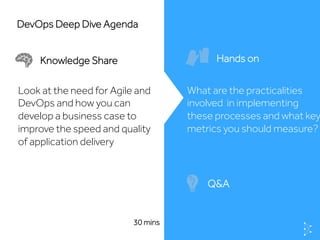
DevOps Deep Dive Agenda
What are the practicalities
involved in implementing
these processes and what key
metrics you should measure?
Hands onKnowledge Share
Q&A
30 mins
Look at the need for Agile and
DevOps and how you can
develop a business case to
improve the speed and quality
of application delivery
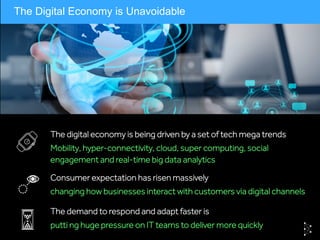
The demand to respond and adapt faster is
putti ng huge pressure on IT teams to deliver more quickly
Consumer expectation has risen massively
changing how businesses interact with customers via digital channels
The Digital Economy is Unavoidable
The digital economy is being driven by a set of tech mega trends
Mobility, hyper-connectivity, cloud, super computing, social
engagement and real-time big data analytics
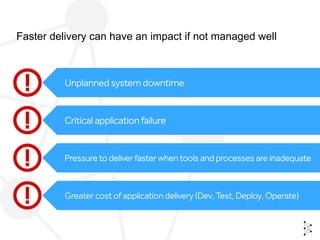
Faster delivery can have an impact if not managed well
Unplanned system downtime
Critical application failure
Pressure to deliver faster when tools and processes are inadequate
Greater cost of application delivery (Dev, Test, Deploy, Operate)
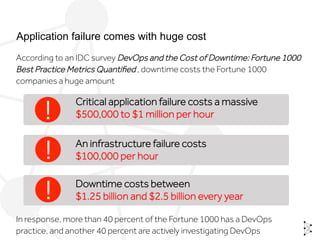
Application failure comes with huge cost
According to an IDC survey DevOps and the Cost of Downtime: Fortune 1000
Best Practice Metrics Quantified , downtime costs the Fortune 1000
companies a huge amount
Critical application failure costs a massive
$500,000 to $1 million per hour!
An infrastructure failure costs
$100,000 per hour!
Downtime costs between
$1.25 billion and $2.5 billion every year!
In response, more than 40 percent of the Fortune 1000 has a DevOps
practice, and another 40 percent are actively investigating DevOps
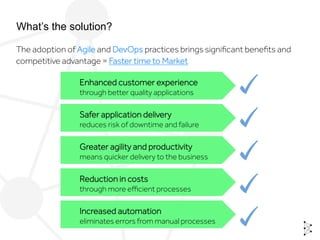
What’s the solution?
The adoption of Agile and DevOps practices brings significant benefits and
competitive advantage = Faster time to Market
Enhanced customer experience
through better quality applications
Safer application delivery
reduces risk of downtime and failure
Greater agility and productivity
means quicker delivery to the business
Reduction in costs
through more efficient processes
Increased automation
eliminates errors from manual processes
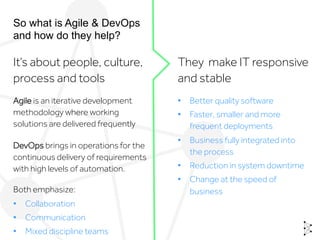
So what is Agile & DevOps
and how do they help?
It’s about people, culture,
process and tools
They make IT responsive
and stable
Agile is an iterative development
methodology where working
solutions are delivered frequently
DevOps brings in operations for the
continuous delivery of requirements
with high levels of automation.
Both emphasize:
•  Collaboration
•  Communication
•  Mixed discipline teams
•  Better quality software
•  Faster, smaller and more
frequent deployments
•  Business fully integrated into
the process
•  Reduction in system downtime
•  Change at the speed of
business
Software is changing every business
The speed at which software can change and deliver innovation is now
the speed at which the business, and your competitors, can innovate
Delivering a business case
Application delivery needs to be modernized
Lean applies to application delivery
Applying lean principles commonly seen in manufacturing can
optimize application development processes and remove waste
Agile and DevOps apply to enterprise systems as well
It’s not just customer facing “Systems of Engagement” that need to be
changed quickly. All applications need to be delivered faster - including
SAP
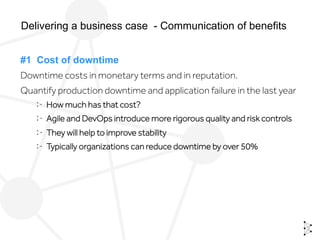
#1 Cost of downtime
Downtime costs in monetary terms and in reputation.
Quantify production downtime and application failure in the last year
  How much has that cost?
  Agile and DevOps introduce more rigorous quality and risk controls
  They will help to improve stability
  Typically organizations can reduce downtime by over 50%
Delivering a business case - Communication of benefits
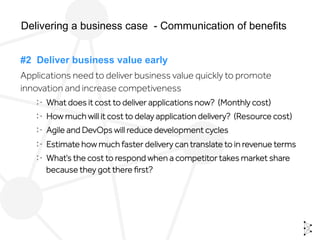
#2 Deliver business value early
Applications need to deliver business value quickly to promote
innovation and increase competiveness
  What does it cost to deliver applications now? (Monthly cost)
  How much will it cost to delay application delivery? (Resource cost)
  Agile and DevOps will reduce development cycles
  Estimate how much faster delivery can translate to in revenue terms
  What’s the cost to respond when a competitor takes market share
because they got there first?
Delivering a business case - Communication of benefits
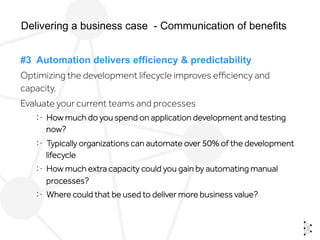
#3 Automation delivers efficiency & predictability
Optimizing the development lifecycle improves efficiency and
capacity.
Evaluate your current teams and processes
  How much do you spend on application development and testing
now?
  Typically organizations can automate over 50% of the development
lifecycle
  How much extra capacity could you gain by automating manual
processes?
  Where could that be used to deliver more business value?
Delivering a business case - Communication of benefits
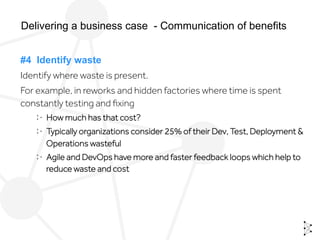
#4 Identify waste
Identify where waste is present.
For example, in reworks and hidden factories where time is spent
constantly testing and fixing
  How much has that cost?
  Typically organizations consider 25% of their Dev, Test, Deployment &
Operations wasteful
  Agile and DevOps have more and faster feedback loops which help to
reduce waste and cost
Delivering a business case - Communication of benefits
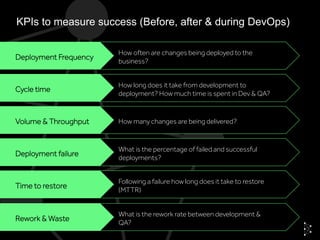
How long does it take from development to
deployment? How much time is spent in Dev & QA?
How many changes are being delivered?
What is the percentage of failed and successful
deployments?
Following a failure how long does it take to restore
(MTTR)
How often are changes being deployed to the
business?
KPIs to measure success (Before, after & during DevOps)
Deployment Frequency
Cycle time
Volume & Throughput
Deployment failure
Time to restore
What is the rework rate between development &
QA?
Rework & Waste
DevOps Organization – How to get started
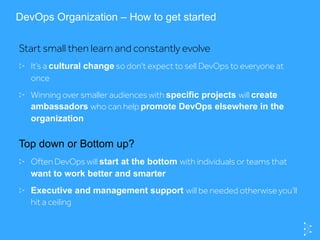
Start small then learn and constantly evolve
  It’s a cultural change so don't expect to sell DevOps to everyone at
once
  Winning over smaller audiences with specific projects will create
ambassadors who can help promote DevOps elsewhere in the
organization
Top down or Bottom up?
  Often DevOps will start at the bottom with individuals or teams that
want to work better and smarter
  Executive and management support will be needed otherwise you’ll
hit a ceiling
DevOps Organization – How to get started
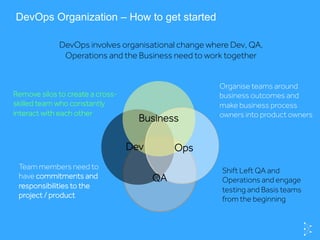
Dev
QA
Ops
Business
Organise teams around
business outcomes and
make business process
owners into product owners
Team members need to
have commitments and
responsibilities to the
project / product
Remove silos to create a cross-
skilled team who constantly
interact with each other
DevOps involves organisational change where Dev, QA,
Operations and the Business need to work together
Shift Left QA and
Operations and engage
testing and Basis teams
from the beginning
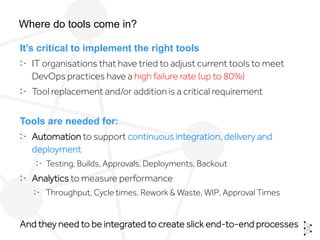
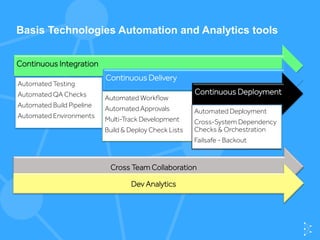
It’s critical to implement the right tools
  IT organisations that have tried to adjust current tools to meet
DevOps practices have a high failure rate (up to 80%)
  Tool replacement and/or addition is a critical requirement
Tools are needed for:
  Automation to support continuous integration, delivery and
deployment
  Testing, Builds, Approvals, Deployments, Backout
  Analytics to measure performance
  Throughput, Cycle times, Rework & Waste, WIP, Approval Times
And they need to be integrated to create slick end-to-end processes
Where do tools come in?
Continuous Integration
Automated Testing
Automated QA Checks
Automated Build Pipeline
Automated Environments
Continuous Delivery
Automated Workflow
Automated Approvals
Multi-Track Development
Build & Deploy Check Lists
Continuous Deployment
Automated Deployment
Cross-System Dependency
Checks & Orchestration
Failsafe - Backout
Basis Technologies Automation and Analytics tools
Cross Team Collaboration
Dev Analytics
Building a business case for Agile and
DevOps
Q & A
https://uk.linkedin.com/in/jamesroberts1
http://www.basistechnologies.com

DevOps Deep Dive Webinar: Building a business case for agile and devops

  • 1.
    Building a businesscase for Agile and DevOps https://uk.linkedin.com/in/jamesroberts1 http://www.basistechnologies.com
  • 2.
    DevOps Deep DiveAgenda What are the practicalities involved in implementing these processes and what key metrics you should measure? Hands onKnowledge Share Q&A 30 mins Look at the need for Agile and DevOps and how you can develop a business case to improve the speed and quality of application delivery
  • 3.
    The demand torespond and adapt faster is putti ng huge pressure on IT teams to deliver more quickly Consumer expectation has risen massively changing how businesses interact with customers via digital channels The Digital Economy is Unavoidable The digital economy is being driven by a set of tech mega trends Mobility, hyper-connectivity, cloud, super computing, social engagement and real-time big data analytics
  • 4.
    Faster delivery canhave an impact if not managed well Unplanned system downtime Critical application failure Pressure to deliver faster when tools and processes are inadequate Greater cost of application delivery (Dev, Test, Deploy, Operate)
  • 5.
    Application failure comeswith huge cost According to an IDC survey DevOps and the Cost of Downtime: Fortune 1000 Best Practice Metrics Quantified , downtime costs the Fortune 1000 companies a huge amount Critical application failure costs a massive $500,000 to $1 million per hour! An infrastructure failure costs $100,000 per hour! Downtime costs between $1.25 billion and $2.5 billion every year! In response, more than 40 percent of the Fortune 1000 has a DevOps practice, and another 40 percent are actively investigating DevOps
  • 6.
    What’s the solution? Theadoption of Agile and DevOps practices brings significant benefits and competitive advantage = Faster time to Market Enhanced customer experience through better quality applications Safer application delivery reduces risk of downtime and failure Greater agility and productivity means quicker delivery to the business Reduction in costs through more efficient processes Increased automation eliminates errors from manual processes
  • 7.
    So what isAgile & DevOps and how do they help? It’s about people, culture, process and tools They make IT responsive and stable Agile is an iterative development methodology where working solutions are delivered frequently DevOps brings in operations for the continuous delivery of requirements with high levels of automation. Both emphasize: •  Collaboration •  Communication •  Mixed discipline teams •  Better quality software •  Faster, smaller and more frequent deployments •  Business fully integrated into the process •  Reduction in system downtime •  Change at the speed of business
  • 8.
    Software is changingevery business The speed at which software can change and deliver innovation is now the speed at which the business, and your competitors, can innovate Delivering a business case Application delivery needs to be modernized Lean applies to application delivery Applying lean principles commonly seen in manufacturing can optimize application development processes and remove waste Agile and DevOps apply to enterprise systems as well It’s not just customer facing “Systems of Engagement” that need to be changed quickly. All applications need to be delivered faster - including SAP
  • 9.
    #1 Cost ofdowntime Downtime costs in monetary terms and in reputation. Quantify production downtime and application failure in the last year   How much has that cost?   Agile and DevOps introduce more rigorous quality and risk controls   They will help to improve stability   Typically organizations can reduce downtime by over 50% Delivering a business case - Communication of benefits
  • 10.
    #2 Deliver businessvalue early Applications need to deliver business value quickly to promote innovation and increase competiveness   What does it cost to deliver applications now? (Monthly cost)   How much will it cost to delay application delivery? (Resource cost)   Agile and DevOps will reduce development cycles   Estimate how much faster delivery can translate to in revenue terms   What’s the cost to respond when a competitor takes market share because they got there first? Delivering a business case - Communication of benefits
  • 11.
    #3 Automation deliversefficiency & predictability Optimizing the development lifecycle improves efficiency and capacity. Evaluate your current teams and processes   How much do you spend on application development and testing now?   Typically organizations can automate over 50% of the development lifecycle   How much extra capacity could you gain by automating manual processes?   Where could that be used to deliver more business value? Delivering a business case - Communication of benefits
  • 12.
    #4 Identify waste Identifywhere waste is present. For example, in reworks and hidden factories where time is spent constantly testing and fixing   How much has that cost?   Typically organizations consider 25% of their Dev, Test, Deployment & Operations wasteful   Agile and DevOps have more and faster feedback loops which help to reduce waste and cost Delivering a business case - Communication of benefits
  • 13.
    How long doesit take from development to deployment? How much time is spent in Dev & QA? How many changes are being delivered? What is the percentage of failed and successful deployments? Following a failure how long does it take to restore (MTTR) How often are changes being deployed to the business? KPIs to measure success (Before, after & during DevOps) Deployment Frequency Cycle time Volume & Throughput Deployment failure Time to restore What is the rework rate between development & QA? Rework & Waste
  • 14.
    DevOps Organization –How to get started Start small then learn and constantly evolve   It’s a cultural change so don't expect to sell DevOps to everyone at once   Winning over smaller audiences with specific projects will create ambassadors who can help promote DevOps elsewhere in the organization Top down or Bottom up?   Often DevOps will start at the bottom with individuals or teams that want to work better and smarter   Executive and management support will be needed otherwise you’ll hit a ceiling
  • 15.
    DevOps Organization –How to get started Dev QA Ops Business Organise teams around business outcomes and make business process owners into product owners Team members need to have commitments and responsibilities to the project / product Remove silos to create a cross- skilled team who constantly interact with each other DevOps involves organisational change where Dev, QA, Operations and the Business need to work together Shift Left QA and Operations and engage testing and Basis teams from the beginning
  • 16.
    It’s critical toimplement the right tools   IT organisations that have tried to adjust current tools to meet DevOps practices have a high failure rate (up to 80%)   Tool replacement and/or addition is a critical requirement Tools are needed for:   Automation to support continuous integration, delivery and deployment   Testing, Builds, Approvals, Deployments, Backout   Analytics to measure performance   Throughput, Cycle times, Rework & Waste, WIP, Approval Times And they need to be integrated to create slick end-to-end processes Where do tools come in?
  • 17.
    Continuous Integration Automated Testing AutomatedQA Checks Automated Build Pipeline Automated Environments Continuous Delivery Automated Workflow Automated Approvals Multi-Track Development Build & Deploy Check Lists Continuous Deployment Automated Deployment Cross-System Dependency Checks & Orchestration Failsafe - Backout Basis Technologies Automation and Analytics tools Cross Team Collaboration Dev Analytics
  • 18.
    Building a businesscase for Agile and DevOps Q & A https://uk.linkedin.com/in/jamesroberts1 http://www.basistechnologies.com