D O E S P R A I S E P R O M O T E S T U D E N T
A C H I E V E M E N T ?
B Y : G L O R I A H E R R E R A
S O E 1 1 5 P S Y C H O L O G Y O F T E A C H I N G A N D
L E A R N I N G
K E N D A L L C O L L E G E
OVERVIEW OF THE STRATEGY
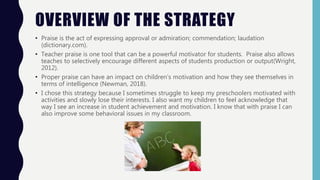
• Praise is the act of expressing approval or admiration; commendation; laudation
(dictionary.com).
• Teacher praise is one tool that can be a powerful motivator for students. Praise also allows
teaches to selectively encourage different aspects of students production or output(Wright,
2012).
• Proper praise can have an impact on children's motivation and how they see themselves in
terms of intelligence (Newman, 2018).
• I chose this strategy because I sometimes struggle to keep my preschoolers motivated with
activities and slowly lose their interests. I also want my children to feel acknowledge that
way I see an increase in student achievement and motivation. I know that with praise I can
also improve some behavioral issues in my classroom.
CREDIBLE SOURCE #1
• Praise has the ability to improve student academic or behavioral performance-but only
if the student finds it reinforcing(Wright, 2012).
• Praise effort and accomplishment, not ability. There is evidence that teachers praise
statements about general ability can actually reduce appetite for risk taking therefore,
praise should instead focus on specific examples of student effort or
accomplishment(Wright, 2012). For example, "from your final project grade, it is
obvious you worked hard on it, Keep up the great work!”. When praise singles out
exertion and work products, it can help students to see a direct link between the effort
that they invest in a task and improve academic performance.
• A teacher may use praise to boost the students performance, praising effort, accuracy,
or speed in an assignment.
• Praise is often underused because teachers find it very difficult to deliver effective
group instruction and to provide (and keep track of) praise to individual students.
CREDIBLE SOURCE #2
• Motivation in students is an important issue in students and it affects every grade level. It is
particularly important in the context of the increasing diversity of student populations. “A
social-cognitive perspective assumes motivation to be dynamic, context sensitive and
changeable, thereby rendering it to be a much more differentiated construct than
previously understood”(Maclellan, 2005. para.1). One application that is within the control
of an educator, at least to some extent, is the use of praise. In motivating students, the
educator is not well served by relying on simplistic and common sense understandings of
the construct of praise and that effective applications of praise are mediated by students’
goals orientations, which themselves may be either additive or interactive composites of
different objectives and different contexts(Maclellan, 2005).
CREDIBLE SOURCE #3
• “According to a 2013 study, published in Child Development, process praise results in a child believing that
intelligence is malleable, not fixed. Children who receive process praise from parents develop what the
researchers call “incremental motivation or the belief that intelligence can be developed.” The authors
explained it this way: “Children who hear a greater proportion of process praise for example, “you worked
hard” may come to believe that the sources of their accomplishments are effort and deliberate practice,
whereas children who hear a greater proportion of person praise, for example “you’re so smart” may come to
believe that the sources of their accomplishments are fixed traits” (Newman, 2018).
• “You’re so smart” praises the child, a form of person praise. One would think this is a perfectly fine
compliment, but person praise has been shown to undermine a child’s motivation and view of his or her
intelligence. Saying, “You got a good grade because you worked hard,” addresses a child’s diligence and
effort—the process. “Process praise” can focus on effort or the strategies a child uses” (Newman, 2018, para.
3).
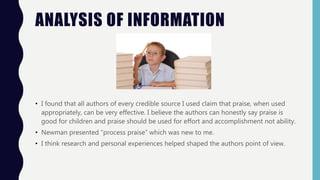
ANALYSIS OF INFORMATION
• I found that all authors of every credible source I used claim that praise, when used
appropriately, can be very effective. I believe the authors can honestly say praise is
good for children and praise should be used for effort and accomplishment not ability.
• Newman presented “process praise” which was new to me.
• I think research and personal experiences helped shaped the authors point of view.
CONNECTIONS• Some connections that I can make between the information I gathered about the praise
strategy and theories/concepts in educational psychology is that teachers can have an
effect on praise which will have children motivated and there is relationship between the
formation of incremental motivation and scholastic achievement.
• I can recall back to chapter 7 when I was reading about operant conditioning. “The positive
results found in research occur when teachers carefully and systematically praise their
students”(Woolfolk, 2016, p. 263).
• Children who received process praise “had a greater desire for a challenge” (Newman,
2018).
• Praising can not only improve student achievement but also behaviors, which I also read in
Educational Psychology, Chapter 7.
CONCLUSIONS
• “Psychologists have long been telling parents that praise is good for children. But, it
turns out praise comes in different forms—from “You’re so smart” to “You got a good
grade because you worked hard.” The distinction between these two praise statements
is critical and affects how children view themselves and tackle their schoolwork as they
get older” (Newman, 2018).
• I believe that there is enough evidence and research that proves praise and being
acknowledge for a students success and hard work can promote student achievement,
and that it needs to be done correctly in order to avoid negative outcomes.
• Teachers can even make it habit forming and tie praise to classroom routines.
COMMUNICATION WITH FAMILIES
I will encourage parents to use praise at home as well as I would at school to
promote student achievement.
There has been research that has shown that praising a student supports student
achievement and motivates them in education.
I would also tell parents: “It’s probably a good idea to heavy up the process praise.
Instead of saying, “You're great at building things,” a statement that praises the child,
try, for example, “You built that birdhouse so it’s safe for baby birds. How did you do
that?” Asking how your child made the birdhouse safe for baby birds puts the
emphasis on his skill set and praises the process they used” (Newman, 2018).
I will also provide techniques on how I use praise in a classroom and connections to
an increase in school achievement and motivation.
REFERENCES
• Praise. (n.d.). Dictionary.com Unabridged. Retrieved May 16, 2018 from
Dictionary.com website http://www.dictionary.com/browse/praise
• Woolfolk, A. (2016). Educational Psychology (13th ed.). Boston, MA: Pearson Education,
Inc.
• Wright J. (2012). Teacher Praise: An Efficient Tool to Motivate Students. Retrieved May
14, 2018, from http://www.interventioncentral.org/behavioral-
interventions/motivation/teacher-praise-efficient-tool-motivate-students
• Maclellan, E. (2005). Academic achievement: The role of praise in motivating students.
Active Learning in Higher Education, 6(3),194 – 206
• Newman, S. (2018). The Right Kind of Praise May Boost Academic Performance.
Retrieved May 14, 2018, from
https://www.psychologytoday.com/us/blog/singletons/201801/the-right-kind-praise-
may-boost-academic-performance

Does praise promote student achievement?

  • 1.
    D O ES P R A I S E P R O M O T E S T U D E N T A C H I E V E M E N T ? B Y : G L O R I A H E R R E R A S O E 1 1 5 P S Y C H O L O G Y O F T E A C H I N G A N D L E A R N I N G K E N D A L L C O L L E G E
  • 2.
    OVERVIEW OF THESTRATEGY • Praise is the act of expressing approval or admiration; commendation; laudation (dictionary.com). • Teacher praise is one tool that can be a powerful motivator for students. Praise also allows teaches to selectively encourage different aspects of students production or output(Wright, 2012). • Proper praise can have an impact on children's motivation and how they see themselves in terms of intelligence (Newman, 2018). • I chose this strategy because I sometimes struggle to keep my preschoolers motivated with activities and slowly lose their interests. I also want my children to feel acknowledge that way I see an increase in student achievement and motivation. I know that with praise I can also improve some behavioral issues in my classroom.
  • 3.
    CREDIBLE SOURCE #1 •Praise has the ability to improve student academic or behavioral performance-but only if the student finds it reinforcing(Wright, 2012). • Praise effort and accomplishment, not ability. There is evidence that teachers praise statements about general ability can actually reduce appetite for risk taking therefore, praise should instead focus on specific examples of student effort or accomplishment(Wright, 2012). For example, "from your final project grade, it is obvious you worked hard on it, Keep up the great work!”. When praise singles out exertion and work products, it can help students to see a direct link between the effort that they invest in a task and improve academic performance. • A teacher may use praise to boost the students performance, praising effort, accuracy, or speed in an assignment. • Praise is often underused because teachers find it very difficult to deliver effective group instruction and to provide (and keep track of) praise to individual students.
  • 4.
    CREDIBLE SOURCE #2 •Motivation in students is an important issue in students and it affects every grade level. It is particularly important in the context of the increasing diversity of student populations. “A social-cognitive perspective assumes motivation to be dynamic, context sensitive and changeable, thereby rendering it to be a much more differentiated construct than previously understood”(Maclellan, 2005. para.1). One application that is within the control of an educator, at least to some extent, is the use of praise. In motivating students, the educator is not well served by relying on simplistic and common sense understandings of the construct of praise and that effective applications of praise are mediated by students’ goals orientations, which themselves may be either additive or interactive composites of different objectives and different contexts(Maclellan, 2005).
  • 5.
    CREDIBLE SOURCE #3 •“According to a 2013 study, published in Child Development, process praise results in a child believing that intelligence is malleable, not fixed. Children who receive process praise from parents develop what the researchers call “incremental motivation or the belief that intelligence can be developed.” The authors explained it this way: “Children who hear a greater proportion of process praise for example, “you worked hard” may come to believe that the sources of their accomplishments are effort and deliberate practice, whereas children who hear a greater proportion of person praise, for example “you’re so smart” may come to believe that the sources of their accomplishments are fixed traits” (Newman, 2018). • “You’re so smart” praises the child, a form of person praise. One would think this is a perfectly fine compliment, but person praise has been shown to undermine a child’s motivation and view of his or her intelligence. Saying, “You got a good grade because you worked hard,” addresses a child’s diligence and effort—the process. “Process praise” can focus on effort or the strategies a child uses” (Newman, 2018, para. 3).
  • 6.
    ANALYSIS OF INFORMATION •I found that all authors of every credible source I used claim that praise, when used appropriately, can be very effective. I believe the authors can honestly say praise is good for children and praise should be used for effort and accomplishment not ability. • Newman presented “process praise” which was new to me. • I think research and personal experiences helped shaped the authors point of view.
  • 7.
    CONNECTIONS• Some connectionsthat I can make between the information I gathered about the praise strategy and theories/concepts in educational psychology is that teachers can have an effect on praise which will have children motivated and there is relationship between the formation of incremental motivation and scholastic achievement. • I can recall back to chapter 7 when I was reading about operant conditioning. “The positive results found in research occur when teachers carefully and systematically praise their students”(Woolfolk, 2016, p. 263). • Children who received process praise “had a greater desire for a challenge” (Newman, 2018). • Praising can not only improve student achievement but also behaviors, which I also read in Educational Psychology, Chapter 7.
  • 8.
    CONCLUSIONS • “Psychologists havelong been telling parents that praise is good for children. But, it turns out praise comes in different forms—from “You’re so smart” to “You got a good grade because you worked hard.” The distinction between these two praise statements is critical and affects how children view themselves and tackle their schoolwork as they get older” (Newman, 2018). • I believe that there is enough evidence and research that proves praise and being acknowledge for a students success and hard work can promote student achievement, and that it needs to be done correctly in order to avoid negative outcomes. • Teachers can even make it habit forming and tie praise to classroom routines.
  • 9.
    COMMUNICATION WITH FAMILIES Iwill encourage parents to use praise at home as well as I would at school to promote student achievement. There has been research that has shown that praising a student supports student achievement and motivates them in education. I would also tell parents: “It’s probably a good idea to heavy up the process praise. Instead of saying, “You're great at building things,” a statement that praises the child, try, for example, “You built that birdhouse so it’s safe for baby birds. How did you do that?” Asking how your child made the birdhouse safe for baby birds puts the emphasis on his skill set and praises the process they used” (Newman, 2018). I will also provide techniques on how I use praise in a classroom and connections to an increase in school achievement and motivation.
  • 10.
    REFERENCES • Praise. (n.d.).Dictionary.com Unabridged. Retrieved May 16, 2018 from Dictionary.com website http://www.dictionary.com/browse/praise • Woolfolk, A. (2016). Educational Psychology (13th ed.). Boston, MA: Pearson Education, Inc. • Wright J. (2012). Teacher Praise: An Efficient Tool to Motivate Students. Retrieved May 14, 2018, from http://www.interventioncentral.org/behavioral- interventions/motivation/teacher-praise-efficient-tool-motivate-students • Maclellan, E. (2005). Academic achievement: The role of praise in motivating students. Active Learning in Higher Education, 6(3),194 – 206 • Newman, S. (2018). The Right Kind of Praise May Boost Academic Performance. Retrieved May 14, 2018, from https://www.psychologytoday.com/us/blog/singletons/201801/the-right-kind-praise- may-boost-academic-performance