USING EFFECTIVE PRAISE AND FEEDBACK


Creating a Positive Classroom Atmosphere: Teachers' Use of Effective
Praise and Feedback
MAUREEN A. CONROY, KEVIN S. SUTHERLAND, ANGELA SNYDER, MAHA A L - H E N D A W I , AND ABIGAIL V O , VIRGINIA COMMONWEALTH UNIVERSITY


                                              praise children's appropriate                  these instructional tools in their

C
        reating a positive and
        engaging classroom                    behaviors and ignore their problem             classrooms, researchers have found
        atmosphere is one of the most         behaviors, children will learn that            that they may not always be used
powerful tools teachers can use to            these positive types of behaviors are          frequently or effectively. Iri the
encourage children's learning and             more likely to obtain teacher attention        following sections, we will discuss
prevent problem behaviors from                than problem behaviors. Creating               how teachers can use praise and
occurring. Although a number of               these positive interactions between a          feedback most effectively to affect
factors are related to a positive             teacher and child is one important             their interactions with children in
classroom atmosphere, such as                 way to help build a positive                   their classrooms and improve the
classroom management techniques               classroom environment.                         classroom atmosphere.
and instructional pacing, one                     Unfortunately, engaging in
important factor is how teachers              positive interactions with children            The Use of Effective Praise to Build
attend or respond to children's               may be easier said than done for                a Positive Classroom Atmosphere
behaviors. Teachers' responses to             teachers, especially if the children in
children's appropriate and problem            their classrooms have emotional and/           What Is Effective Praise?
behavior can help set the tone of the         or behavioral disorders (EBD).                     Teachers regularly use praise as
classroom environment. If teachers            Because one of the key defining                an instructional strategy to increase
attend to and respond in a harsh and          features of children with EBD is               the occurrence of children's positive
combative manner to children's                chronic and persistent problem                 social and academic behaviors. On
display of problem behavior, they             behavior, these behaviors are often            the surface, praise appears to be a
most likely will receive combative            well established in their behavioral           simple strategy that the teacher alone
responses from children in return and         repertories. Children often enter              can implement. However, in reality,
see an increase in their display of           classrooms with coercive and                   praise is a complex reciprocal process
problem behavior. This type of                negative interaction styles that have          that involves both the teacher who
response can lead to coercive                 been previously established and may            provides praise and the children who
interactions between teachers and             have a strong history of                       are recipients of that praise. The
children and negatively affect the            reinforcement. These negative                  effectiveness of a teacher's use of
classroom atmosphere. Similarly, if           interaction patterns can significantly         praise is influenced by the children's
teachers ignore children's                    affect the atmosphere of the                   individual and cultural differences,
appropriate behavior and more                 classroom. It is not unusual for even          different conditions under which
frequently attend to their problem            one child with severe problem                  praise has been previously provided
behaviors, children most likely will          behaviors to change the entire                 to them (Henderlong & Lepper, 2002;
learn to engage in problem behaviors          classroom climate, influencing                 Lam, Yim, & Ng, 2008), and
as a predictable way to obtain a              teacher interactions with all children.        characteristics of the praise that is
teacher's attention.                          Fortvinately, teachers can employ              given. Children from different
     On the other hand, if teachers           strategies that can change the nature          backgrounds and experiences,
provide corrective feedback to                of negative interactions. By changing          including socioeconomic classes,
children about their behavior in a            the negative interaction patterns into         ability levels, developmental levels,
positive manner and help them learn           positive interactions, the climate of          and genders, may respond differently
alternative behaviors that will gain          the classroom can dramatically                 to praise (Hitz & Driscoll, 1988). In
them positive teacher attention,              improve.                                       addition, the characteristics of the
teachers may be more likely to have                In this article, we will discuss two      praise statements may also influence
positive reactions from children. In          important forms of teacher attention           children's responsiveness to praise.
addition, children will leam new              that can be used to help promote               Characteristics of effective praise
skills and behavior, and more time            positive teacher-child interactions:           include its being contingent on
will be available for instruction.            teacher praise and feedback.                   desirable behavior (Shores, Gunter, &
Likewise, if teachers attend to and           Although most teachers already use             Jack, 1993), behavior specific (Chalk

18    BEYOND B E H A V I O R
USING EFFECTIVE PRAISE AND FEEDBACK


 & Bizo, 2004), and focused on effort             to individualize their praise             According to Brophy (1981),
 (Lam et al., 2008) and process                   statements and direct them at             praise often may not be
 (Dweck, 2000). Just as the                       individual children and groups            deliberately provided by the
 terhiinology describing praise varies,           of children. For example, if ail          teacher; rather, teachers are more
 the definitions of praise in the                 the children are working                  likely to respond to children who
literature also vary (Chalk & Bizo,               diligently on a task, the teacher         elicit praise from them. To be
2004). According to Brophy (1981),                may praise one child for sitting          effective, teachers should plan
general praise means "to commend                  quietly at his desk, praise a             and initiate unsolicited praise to
the worth of or to express approval or            second child for the amount of            children in their classroom.
admiration" (p. 5), and it is provided            work she has completed on the         5. Praise should focus on children's
when a child completes an expected                task, and a third child for his           improvement and effort (Hitz &
task appropriately (Dreikurs,                     correct responses. The teacher            Driscoll, 1988; Lam et al., 2008).
Grunwald, & Pepper, 1982).                        then concludes by praising the            That is, praise should
Examples of general praise                        group, "I see everyone working            acknowledge children's efforts
statements typically include phrases              very hard on this task."                  and accomplishments rather
such as "Great job!" or "Good." In            2. Praise should be contingent                than being an evaluation of
this article, we define effective praise as       upon a desired behavior; that             individual abilities and/or
teacher-initiated statements that                 is, it should be provided                 outcomes. For example, a
convey to children the specific                   immediately following the                 statement such as, "You are so
academic or social behaviors in which             behavior (Willingham, 2005).              smart!" is an evaluative
teachers would like to see students               Praising the children later can           statement of a child's abilities,
continue to engage. It uniquely fits              diminish the effectiveness of             rather than an effective praise
each situation and focuses on                     praise.                                   statement that focuses on effort.
children's effort, improvement, and/                                                        It labels children as "smart" or
                                              3. The instructional nature of
or quality of work, rather than                                                             "not smart" and communicates
                                                  praise is another important
focusing on outcomes or abilities.                                                          a vague message about what can
                                                  characteristic of effective praise.
Examples of effective praise                                                               be considered "smart," as well
                                                  For example, it is important to
statements might be, "Great job, you                                                        as how a child can become
                                                 provide frequent praise when
repeated the words after me" or                                                             "smart." In this situation,
                                                  children are initially acquiring a
"Wow! You sat quietly and listened                                                         children are judged on the basis
                                                  skill. However, once they have
to the entire story."                                                                      of their cognitive abilities, which
                                                 acquired the skill, the teacher
                                                 may want to decrease the use of           is hard to modify (Dweck, 2000;
How Can Teachers Use                             praise and provide it on a more           Lam et al., 2008). As a result,
Praise Effectively?                              intermittent basis. Then, the             children may become less
     Identifying the essential                   teacher might identify another            confident, afraid of making
characteristics of praise that make it           behavior that the child is                mistakes, and afraid of
most effective can help teachers to              acquiring and increase the                completing work that is not
learn how to use praise successfully             amount of praise that she or he           perfect. They may worry about
in their classrooms. Thus, for praise            provides for this behavior while          not meeting the teacher's
to be effective, it should include the           simultaneously fading the praise          expectations. This type of praise
following characteristics.                       for the behavior that the child is        may set children up for failure
  1. Praise should include specific              demonstrating with more                   and discourage them from
      statements about the                       fluency.                                  trying new tasks and taking
      appropriate behavior children           4. Praise should be teacher initiated        risks.
      displayed (Chalk & Bizo, 2004;             (Hitz & Driscoll, 1988). Effective     6. Praise should be sincere; be
      Sutherland, Wehby, &                       praise requires a teacher to              delivered with an affirmative,
      Copeland, 2000). That is,                  monitor children's behaviors and          natural voice; and be
      children need to know explicitly           initiate praise in a timely manner        appropriate for children's
      what behavior is being praised             rather than waiting for the               abilities and chronological age
      and acknowledged by the                    children to elicit praise from the        level. Children can easily
      teacher. "You did a great job              teacher. In other words, waiting          recognize false exaggeration and
      counting numbers!" is an                   for a child to say, "Look at what I       overestimation of simple effort,
      example of a behavior-specific             did!" is far less effective than the      and this type of praise may
      praise statement. In addition, to          teacher catching the child                negatively affect children's
      increase the power of praise               engaging in the desired behavior          responses. In addition, praise
      statements, teachers may want              and praising it immediately.              statements should match

                                                                                                     WINTER 2009          19
USING EFFECTIVE PRAISE AND FEEDBACK


     children's age and skill levels. A    with a particular child to help              2. Make a recording of this activity
     praise statement for a preschool-     motivate the child to increase a                  using any convenient method
     age child should be very              particular behavior. Using effective              (e.g., audiotape, videotape). This
     different from a praise statement     praise in a classroom can increase                recording will provide the data
     for a teenager. For example,          positive interactions between                     to help you change your use of
     preschool-age children may            teachers and children, which also                 praise.
     respond to teachers providing         helps build an overall positive              3. Measure and examine the c uan-
     frequent praises statements           classroom atmosphere.                             tity and quality of the praise
     aloud in front of the entire class.                                                     statements that occurred during
     Teenagers, on the other hand,         Strategies for Increasing Effective               this activity. How often do you
     may be embarrassed of being           Praise in Classroom Settings                      praise children? Do you provide
     praised in front of the entire             The benefits of using effective              general praise or specific praise?
     class and respond to brief praise     praise in classroom settings are many.            Is your praise focused on the
     statements made by the teacher        For example, research indicates that              child's effort? Does every child
     privately. One important thing        increases in teacher praise have                  receive praise, or do only a couple
     to note is that teachers should       positive effects on children's                    of children receive most of the
     provide some form of praise and       academic and social behaviors (Gable              praise statements? Are praise
     attention to all children in their    & Shores, 1980; Sutherland et al.,                statements appropriate for the
     classrooms. This will help            2000). Teacher praise is associated               children's skul levels?
     eliminate the interpretation that     with an increase in children's correct        4. Set a goal of increasing the
     some children are the "teacher's      responses, on-task behavior, and                  number and quality of praise
     pet" because they receive a high      engagement. It has been associated                statements that include the
     rate of praise statements.            with an increase in the work                      characteristics outlined above.
 7. Praise should avoid competition        completed by children across all age          5. Identify the children who have
     or comparisons across children.       levels (Kirby & Shields, 1972; Luiselli            the most social or academic
     For example, "Nico, you do a          & Downing, 1980). Unfortunately,                  problem behaviors and who
     much better job of coloring than      researchers have found that teachers               seldom receive praise.
      Aimee," or "Johnny is the best!"     do not necessarily use praise                 6. Make a list of four target
      may establish a competitive          effectively or frequently (Beaman &               behaviors that will elicit praise
      environment in the classroom         Wheldall, 2000). Alber, Heward, and                statements for these children.
      and unintentionally create           Hippler (1999) pointed out that only          7. Make a chart of the problem
      hierarchies of children based on     5% of teachers' praise statements are              behaviors that these children
      different skill levels. Instead,     behavior specific. In addition,                    display and the desired
      praise should compare                researchers have found that for                    replacement behaviors that are
      children's work with their           students with EBD, praise is provided              in the children's repertoire.
      previous work and current skill      at a rate of only 1.2 to 4.5 praise           8. Make a list of effective praise
      level. For example, letting a         statements per hour per student                   statements that can be provided
      child know that his work is           (Shores et al., 1993; Sutherland &                to the children. For example,
      better today in comparison to        Wehby, 2001; VanAcker, Grant, &                    "Your handwriting has
      last week is much more effective      Henry, 1996; Wehby, Symons, &                     improved. It is clear and neat
      than comparing him to his             Shores, 1995).                                    here." "You worked hard on
      classroom peers.
                                                 Clearly, there is a need to increase         these math problems." "You put
     When teachers provide praise
                                            both the quantity and quality of                  the toys away quietly and with
that includes these characteristics, it
                                            praise in classrooms for all children.            care, thank you." "Good job
is more likely to increase children's
                                            To help teachers improve on their use             cleaning the table." "You shared
appropriate learning and behavior.
                                            of praise, we suggest they begin by                the blocks today with Tim and
Effective praise is considered a
                                            implementing the following                         you played together." "You
generalized reinforcer that can help to
                                            strategies:                                        must have tried hard to
foster children's intrinsic motivation
                                              1. Identify a time or activity when              complete this homework."
to learn that comes from mastering
                                                  a particular child or group of          9. Implement your plan and
tasks (Brophy, 1981; Hitz & Driscoll,
                                                  children are engaging in                     evaluate changes in your praise
1988; Willingham, 2006). Although
                                                  problem behaviors that interfere             statements and the influence on
praise should be provided to groups
                                                  with classroom instruction and               children's behavior.
of children in a classroom, at times it
                                                  management. Such behaviors                 To assist in implementing your
might be more appropriate for
                                                  may include being off task,           plan, we suggest teachers use self-
teachers to deliver praise individually
                                                  noncompliant, or disruptive.          monitoring strategies. Self-

20   B EYOND B EHAVIOR
USING EFFECTIVE PRAISE AND FEEDBACK


monitoring has been supported as an         information regarding children's            Timperley, 2007; Mastropieri &
effective method to promote and             performance and understanding and           Scruggs, 1987).
change behaviors in a variety of            allow for continued learning                     Two specific types of feedback
settings with different populations,        following initial instruction (Miller,      that can be used to address correct
and thus, it has been effective in          2002). Effective feedback has the           and incorrect responses, respectively,
changing teachers' behavior with            potential to affect future student          are instructive feedback and error
respect to increasing the quantity and      performance by increasing correct           correction. Instructive feedback is a
quality of praise in the classrooms         responding and desirable behaviors          method for responding to correct
(Kalis, Vannest, & Parker, 2007). Self-     and decreasing incorrect responding         student actions or responses. The
monitoring is the process in which          and undesirable behaviors (Bangert-        purpose of instructive feedback is to
"teachers identify if the target            Drowns et al., 1991; Konoid, Miller, &     expose children to additional
behavior has occurred and record the        Konoid, 2004).                             instructional information in relatively
occurrence of the target behavior"                                                     little instructional time. This practice
                                                 In this article, we define feedback
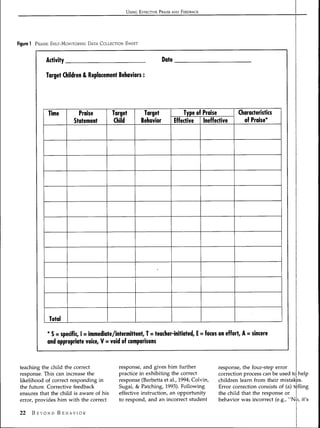
(Kalis et al., 2007, p. 21). Figure 1                                                  can enhance the efficiency of
                                            as information provided to children
provides a data collection sheet that                                                  instruction and lead to the learning of
                                            by teachers regarding their
can help a teacher to monitor the                                                      both the targeted instructional
                                            understanding or performance of
effectiveness of using praise in the                                                   material and the additional material.
classrooms.                                 academic or behavioral tasks. Teacher
                                            feedback is just one step in an            Instructive feedback follows effective
     The use of effective praise is an      instructional sequence and                 instruction on target material, an
important teaching strategy that can        necessarily follows effective              opportunity to respond, and a correct
facilitate positive interactions                                                       student response (Werts et al., 1995).
                                            instruction, opportunities to respond,
between teachers and children in            and active student responding (Hattie            Instead of simply continuing with
their classroom. Along with the use of      & Timperley, 2007). It can be used to      instruction or praising the correct
effective praise, providing feedback        address both correct and incorrect         response, teachers can foster
to children in an effective way is also     student responses and can support          additional learning using a simple
critical. In the next section, we discuss   the learning of academic information       two-step process. To use instructive
strategies to help foster the use of        as well as social or behavioral skills     feedback, a teacher will (a)
effective feedback.                         (Miller, 2002). In addition, feedback      acknowledge the correct response or
                                            can increase teaching efficiency and       behavior (e.g., "That's right, it is a
 The Use of Effective Feedback to           result in increased opportunities for      square") and (b) supply additional
        Create a Positive                   learning (Werts et al., 1995). Feedback    related or novel information. After
     Classroom Atmosphere                   can be presented in a variety of           acknowledgment of the correct
                                            instructional formats either verbally,     response, the additional instructional
What Is Effective Feedback?                                                            material can expand on the child's
                                            visually (e.g., pictures, flash cards,
     Similar to praise, effective teacher   manual signs, compu.ter-based,             response by providing related
feedback is a simple and powerful                                                      information (e.g., "It has four sides"),
                                            modeled), or using a combination of
form of teacher attention that can                                                     can draw a parallel between the
                                            the two (Werts et al., 1995; Werts,
enhance learning, increase                                                             response and another target requiring
                                            Wolery, Gast, & Holcombe, 1996).
achievement, and promote self-                                                         the same response (e.g., "That table is
regulatory competence in children                                                      a square too"), or can provide
with and without disabilities (Hattie       How Can Teachers Use                       unrelated material from a different
& Timperley, 2007; Werts, Wolery,           Feedback Effectively?                      conceptual class (e.g., "It's purple").
Holcombe, & Gast, 1995). Teacher                 There are a number of important       The additional material selected for
feedback is an essential component of       characteristics of feedback that can       use as instructive feedback may be
the learning process and can help           make it more effective. The literature     information that teachers want
create a positive classroom                 suggests that to be effective, teacher     children to learn but that is not
atmosphere in which mistakes are            feedback should be (a) intentional, (b)    specifically addressed in the
valued for their potential to enhance       overt, (c) prompt, (d) direct, (e)         curriculum, or information that is
learning and in which academic              specific, and (f) positive. It should      scheduled to be taught in the near
success and appropriate behavior are        occur frequently and consistently          future (Werts et al., 1995, 1996).
reinforced (Bangert-Drowns, Kulik,          within a supportive classroom                   Another type of feedback that can
Kulik, & Morgan, 1991; Hattie &             climate and target skills for which        be beneficial in the classroom is error
Timperley, 2007; Witt,                      children have received sufficient          correction, also called corrective
VanDerHeyden, & Gilbertson, 2004).          developmentally appropriate                feedback. Error correction is provided
The purpose of feedback is to provide       instruction (Barbetta, Heward,             to a child following an academic or
children and teachers with                  Bradley, & Miller, 1994; Hattie &          behavioral error with the purpose of

                                                                                                      WINTER     2009      21
USING EFFECTIVE PRAISE AND FEEDBACK


Figure 1 PR^MSE SELF-MONITORING DATA COLLECTION SHEET


            Activity                                                Date

            Target Children & Replacement Behaviors :


             Time         Praise          Target          Target               Type of Praise         Characteristics
                        Statement         Child          Behavior          Effective   Ineffective      of Praise*^


             Total

             * S = specific, I = immediate/intermittent, T = teacher-initiated, E = focus on effort, A = sincere
             and appropriate voice, V = void of comparisons


 teaching the child the correct             response, and gives him further                   response, the four-step error
 response. This can increase the            practice in exhibiting the correct                correction process can be used td help
 likelihood of correct responding in        response (Barbetta et al., 1994; Colvin,          children learn from their mistakes.
 the future. Corrective feedback            Sugai, & Patching, 1993). Following               Error correction consists of (a) telling
 ensures that the child is aware of his     effective instruction, an opportunity             the child that the response or
 error, provides him with the correct       to respond, and an incorrect student              behavior was incorrect (e.g., "No, it's

 22   BEYOND B E H A V I O R
USING EFFECTIVE PRAISE AND FEEDBACK


not a triangle"), (b) providing the        used following each correct or            children's performance, the purposes
correct response (e.g., "It is a           incorrect student response in a           for these different types of teacher
square"), (c) giving the student           targeted instructional session (Werts     behaviors are quite different. For
another opportunity to exhibit the         et al, 1996).                             example, the purposes of teacher
correct response (e.g., "What shape is          Teachers can measure their own       praise include acknowledging
this?"), and (d) providing specific        behavior (i.e., provision of either       children's correct academic
praise for cooperation (e.g., "That's      instructive feedback or error             performance and/or desirable social
right, you identified the square!";        correction following each student         behavior. In this manner, praise is
Colvin et al., 1993).                      response) using a data sheet on which     used as a reinforcer: The teacher is
                                           they can record the number of             attempting to increase the likelihood
Strategies for Increasing                  opportunities for providing feedback      of the desired response by the child in
Effective Feedback                         and the number of times that              the future. Alternatively, the purpose
      Similar to increasing effective      feedback was actually provided. For       of teacher feedback is not necessarily
praise, to increase the use of             monitoring children's behaviors (e.g.,    reinforcement (and may in fact not be
instructive feedback and error             learning of additional instructional      reinforcing to some children) but
correction in the classroom, teachers      material through instructive              rather to provide information to the
can                                        feedback, or learning of targeted         child that can enhance his or her
  • identify specific opportunities        skills or information during error        learning. For example, the purpose of
     and                                   correction), teachers can use a data      corrective feedback is to provide the
  • plan for the intentional use of        sheet to collect information on           child with information to increase the
     these two strategies.                 children's success on learning probes.    likelihood of correct responses to
      Initially, it may be helpful to      Learning probes are a simple way          future instructional requests, whereas
focus on increasing feedback during        teachers can keep track of children's     instructive feedback is used to help
specific activities or times of the day.   progress by providing opportunities       expand children's understanding of
For instance, a preschool teacher may      for them to engage in the correct         content. When used effectively,
initially choose to increase her use of    responses and then recording their        teacher praise and feedback have a
feedback during circle time (e.g.,         correct or incorrect responses. For       long history of contributing to
adding color words as instructive          instructive feedback, to assess           positive classroom outcomes for
feedback following students' correct       children's responses, learning probes     children with learning and behavior
identification of shapes and using         are typically conducted before            problems.
error correction following incorrect       beginning the use of instructive               In sum, it appears that the
responses). Similarly, a third-grade       feedback and after the child has          effective use of both teacher praise
teacher may decide to increase his use     reached criterion on the targeted skill   and feedback can be effective tools for
of feedback during spelling lessons        or behavior (e.g., spelling is the        teachers as they attempt to best meet
(e.g., adding the definition of the        targeted skill in the spelling lesson     the needs of the children in their
word following students' correct           example above). However, more             classrooms. It must be pointed out,
spelling responses and using error         frequent probes may be desirable.         however, that neither of these
correction following incorrect             With corrective feedback, learning        consequent events will be effective
responses; Werts et al., 1996). Once       probes occur and can be recorded          unless used within the context of a
teachers are able to consistently use      each time the child is given an           positive classroom atmosphere that is
feedback during one routine or             opportunity to respond to the target      a structured, safe learning
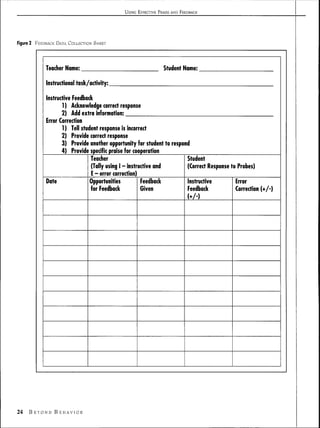
activity, it can be expanded to other      material (see Figure 2 for a sample       environment. In this positive
classroom activities. Recall that          data sheet). Consistent recording of      environment, children are
feedback can also be used to address       this information can help prompt          comfortable taking learning risks, and
social and behavioral tasks such as        teachers to provide adequate              errors, both academic and social/
student responses to behavioral            amounts of feedback and can provide       behavioral, are seen as opportunities
expectations and class rules.              information on whether feedback           for growth. Within a supportive
      As with any new instructional        strategies are assisting students in      learning context, teacher praise and
strategy, it is essential that teachers    learning new skills and information       feedback can augment each other in a
monitor their use of these feedback        (Werts et al, 1995, 1996).                powerful way. To illustrate, consider
procedures to ensure consistency and                                                 that teachers might have three
correct implementation and measure         Implications for Practice                 options for responding to a child's
children's responses to determine              Although both teacher praise and      responses. First, if a response is
whether the procedures are having          teacher feedback can be                   correct, the teacher might provide
the intended effect. These strategies      conceptualized as forms of teacher        contingent, specific praise to
are thought to be most effective when      attention as a consequence of             acknowledge the correct response

                                                                                                    WINTER 20 0 9       2 3
USING EFFECTIVE PRAISE AND FEEDBACK


Figure 2   FEEDBACK DATA COLLECTION SHEIET


               Teacher Name:                                     Student 14ame:

               Instructional task/^activity:

               Instructive Feedba ck
                      1) Acknovfledge correct response
                      2) Add ex tra information:
               Error Correction
                      1 ) Tell student response is incorrect
                      2) Provide correct response
                      3) Provide another opportunity for student to respond
                      4) Provide specific praise for cooperation
                                   Teacher                                Student
                                   (Tally using 1 - instructive and       (Correct Response to Probes)
                                   E - error correction)
               Date                Opportunities          Feedback        Instructive         Error
                                   for Feedback          Given            Feedback            Correction (+/-)
                                                                             (+/-)


24    BEYOND BEHAVIOR
USING EFFECTIVE PRAISE AND FEEDBACK


(thus increasing the likelihood of           Bangert-Drowns, R., Kulik, C. C , Kulik, J.          praise: Implication for early
future occurrences of the response).             A., & Morgan, M. T. (1991). The                  childhood teachers. Young Children,
Second, if a response is correct, the            instructional effect of feedback in              6-13.
teacher might use praise to reinforce            test-like events. Review of Educational      Kalis, T. M., Vannest, K. J., & Parker, R.
the response while also providing                Research, 61, 213-238.                            (2007). Praise counts: Using self-
instructive feedback to help expand          Barbetta, P. M., Heward, W. L., Bradley,              monitoring to increase effective
the child's understanding of the                 D. M., & Miller, A. D. (1994). Effects            teaching practices. Preventing School
concept. Third, if a response is                 of immediate and delayed error                   Failure, 51, 20-27.
incorrect, the teacher might praise the          correction on the acquisition and            Kirby, F. D., & Shields, F. (1972).
effort made, use corrective feedback             maintenance of sight words by                     Modification of arithmetic response
to provide information for the child             students with developmental                       rate and attending behavior in a
to respond correctly in the future,              disabilities. Journal of Applied Behavior         seventh-grade student. Journal of
provide another response                         Analysis, 27, 177-178.                            Applied Behavioral Analysis, 5, 79-84.
opportunity, and then praise the child       Beaman, R., & Wheldall, K. (2000).               Konoid, K. E., Miller, S. P., & Konoid, K.
for the ensuing correct response (thus           Teachers' use of approval and                     B. (2004). Using teacher feedback to
increasing the child's knowledge of              disapproval in the classroom.                     enhance student learning. Teaching
the content and the likelihood of                Educational Psychology, 20, 431-446.              Exceptional Children, 36, 64-69.
future attempts to answer even if he         Brophy, J. (1981). Teacher praise: A             Lam, S.-f., Yim, P.-s., & Ng, Y.-l. (2008). Is
is unsure about the correctness of the           functional analysis. Review of                    effort praise motivational? The role of
response). Each of these teacher                 Educational Research, 51, 5-32.                   beliefs in the effort-ability
responses would be useful and                Chalk, K., & Bizo, L. A. (2004). Specific             relationship. Contemporary
appropriate and, if used                         praise improves on-task behaviour                 Educational Psychology, 33, 694-710.
interchangeably in the classroom, can            and numeracy enjoyment: A study of           Luiselli, J. K., & Downing, J. N. (1980).
lead to increases in children's                  year four pupils engaged in the                   Improving a student's arithmetic
responding and engagement.                       numeracy hour. Educational                        performance using feedback and
     Beyond the effects on the                   Psychology in Practice, 20, 335-351.              reinforcement procedures. Education
individual child, highlighted by the         Colvin, G., Sugai, C , & Patching, B.                 and Treatment of Children, 3, 45-49.
results of research summarized                   (1993). Precorrection: An                    Mastropieri, M. A., & Scruggs, T. E.
previously, these types of                       instructional approach for managing               (1987). Effective instruction for special
instructional interactions also may              predictable problem behaviors.                    education. Boston: College-Hill Press.
have an effect on the learning of other          Intervention in School and Clinic, 28,       Miller, S. P. (2002). Using effective
children in the classroom as they are             143-150.                                         teaching behaviors. In S. P. Miller,
exposed to both their peers' correct         Dreikurs, R., Grunwald, B. B., & Pepper,               Validated practices for teaching students
responding as well as the teacher's              F. C. (1982). Maintaining sanity in the           luith diverse needs and abilities (pp. 189-
expansion of concept information.                classroom: Classroom management                   233). Boston: Allyn & Bacon.
Moreover, the use of effective praise             techniques (2nd ed.). New York:             Shores, R. E., Cunter, P. L., & Jack, S. L.
and feedback can have an overall                 Harper & Row.                                      (1993). Classroom management
impact on classroom climate,                                                                       strategies: Are they setting events for
                                             Dweck, C. S. (2000). Self-theories: Their role
manifested through increases in                                                                    coercion? Behavioral Disorders, 18,
                                                  in motivation, personality and
children's engagement and decreases                                                                92-102.
                                                 development. Hove: Psychology Press.
in their disruptions. Given the
                                             Cable, R. A., & Shores, R. E. (1980).            Sutherland, K. S., & Wehby, J. H. (2001).
complexity of learning and behavior
                                                 Comparison of procedures for                      The effects of self-evaluation on
problems of students, particularly
                                                 promoting reading proficiency of two               teaching behavior in classroom for
those with EBD, it appears that using
                                                  children with behavioral and                      students with emotional and
praise and feedback as effectively and
                                                  learning disorders. Behavioral                   behavioral disorders. Journal of Special
efficiently as possible should be goals
                                                  Disorders, 5, 102-107.                            Education, 35, 161-171.
 for all professionals interested in
                                             Hattie, ]., & Timperley, H. (2007). The          Sutherland, K. S., Wehby, J. H., &
improving outcomes for children.
                                                  power of feedback. Review of                      Copeland, S. R. (2000). Effect of
                                                  Educational Research, 77, 81-112.                 varying rates of behavior-specific
                                             Henderlong, J., & Lepper, M. R. (2002).                praise on the on-task behavior of
REFERENCES                                        The effects of praise on children's               students with emotional and
Alber, S. R., Heward, W. L., & Hippler, B.        intrinsic motivation: A review and                behavioral disorders. Journal of
    J. (1999). Teaching middle school             synthesis. Psychological Bulletin, 128,           Emotional and Behavioral Disorders, 8,
    students with learning disabilities to        774-795.                                          2-8.
    recruit positive teacher attention.      Hitz, R., & Driscoll, A. (1988, July). Praise    Van Acker, R., Crant, S. H., & Henry, D.
    Exceptional Children, 65, 253-270.            or encouragement? New insights into               (1996). Teacher and student behavior

                                                                                                               VINTKR2009             25
USING EFFECTIVE PRAISE AND FEEDBACK


     as a function of risk for aggression.        opportunities for learning through the       emotional and behavioral disorders
     Education and Treatment of Children,         addition of incidental information.          (pp. 426-Í45). New York: Guilford.
    19, 316-334.                                   Pittsburgh, PA: Allegheny-Singer
Wehby, J. H., Symons, F. ]., & Shores, R. E.       Research Institute, (ERIC Document
    (1995). A descriptive analysis of              Reproduction Service No. ED407755)            ACKNOWLEDGMENTS
    aggressive behavior in classrooms for     Willingham, D. L. (2005). Ask the
    chüdren with emotional and behavioral         cognitive scientist: How praise can         Development of this article was
    disorders. Behavioral Disorders, 20,87-105.    motivate—or stifle. American            partially supported with funding
Werts, M. G., Wolery, M., Gast, D. L., &           Educator, 29, 23-27.                    from the U.S. Department of
   Holcombe, A. (1996). Sneak in some         Witt, J. C, VanDerHeyden, A. M., &           Education, Institute for Educational
   extra learning by using instructive            Gilbertson, D. (2004). Instruction and   Sciences (No. R324A80074). The
   feedback. Teaching Exceptional                 classroom management: Prevention         opinions expressed by the authors are
    Children, 28, 70-71.                          and intervention research. In R. B.      not necessarily reflective of the
Werts, M. G., Wolery, M., & Holcombe, A.          Rutherford Jr., M. M. Quinn, & S. R.     position of or endorsed by the U S.
     (1991). Instructive feedback: Increasing     Mathur (Eds.), Handbook of research in   Department of Education.


26   B EYON'D B EHAVIOR
Conroy praise

Conroy praise

  • 1.
    USING EFFECTIVE PRAISEAND FEEDBACK Creating a Positive Classroom Atmosphere: Teachers' Use of Effective Praise and Feedback MAUREEN A. CONROY, KEVIN S. SUTHERLAND, ANGELA SNYDER, MAHA A L - H E N D A W I , AND ABIGAIL V O , VIRGINIA COMMONWEALTH UNIVERSITY praise children's appropriate these instructional tools in their C reating a positive and engaging classroom behaviors and ignore their problem classrooms, researchers have found atmosphere is one of the most behaviors, children will learn that that they may not always be used powerful tools teachers can use to these positive types of behaviors are frequently or effectively. Iri the encourage children's learning and more likely to obtain teacher attention following sections, we will discuss prevent problem behaviors from than problem behaviors. Creating how teachers can use praise and occurring. Although a number of these positive interactions between a feedback most effectively to affect factors are related to a positive teacher and child is one important their interactions with children in classroom atmosphere, such as way to help build a positive their classrooms and improve the classroom management techniques classroom environment. classroom atmosphere. and instructional pacing, one Unfortunately, engaging in important factor is how teachers positive interactions with children The Use of Effective Praise to Build attend or respond to children's may be easier said than done for a Positive Classroom Atmosphere behaviors. Teachers' responses to teachers, especially if the children in children's appropriate and problem their classrooms have emotional and/ What Is Effective Praise? behavior can help set the tone of the or behavioral disorders (EBD). Teachers regularly use praise as classroom environment. If teachers Because one of the key defining an instructional strategy to increase attend to and respond in a harsh and features of children with EBD is the occurrence of children's positive combative manner to children's chronic and persistent problem social and academic behaviors. On display of problem behavior, they behavior, these behaviors are often the surface, praise appears to be a most likely will receive combative well established in their behavioral simple strategy that the teacher alone responses from children in return and repertories. Children often enter can implement. However, in reality, see an increase in their display of classrooms with coercive and praise is a complex reciprocal process problem behavior. This type of negative interaction styles that have that involves both the teacher who response can lead to coercive been previously established and may provides praise and the children who interactions between teachers and have a strong history of are recipients of that praise. The children and negatively affect the reinforcement. These negative effectiveness of a teacher's use of classroom atmosphere. Similarly, if interaction patterns can significantly praise is influenced by the children's teachers ignore children's affect the atmosphere of the individual and cultural differences, appropriate behavior and more classroom. It is not unusual for even different conditions under which frequently attend to their problem one child with severe problem praise has been previously provided behaviors, children most likely will behaviors to change the entire to them (Henderlong & Lepper, 2002; learn to engage in problem behaviors classroom climate, influencing Lam, Yim, & Ng, 2008), and as a predictable way to obtain a teacher interactions with all children. characteristics of the praise that is teacher's attention. Fortvinately, teachers can employ given. Children from different On the other hand, if teachers strategies that can change the nature backgrounds and experiences, provide corrective feedback to of negative interactions. By changing including socioeconomic classes, children about their behavior in a the negative interaction patterns into ability levels, developmental levels, positive manner and help them learn positive interactions, the climate of and genders, may respond differently alternative behaviors that will gain the classroom can dramatically to praise (Hitz & Driscoll, 1988). In them positive teacher attention, improve. addition, the characteristics of the teachers may be more likely to have In this article, we will discuss two praise statements may also influence positive reactions from children. In important forms of teacher attention children's responsiveness to praise. addition, children will leam new that can be used to help promote Characteristics of effective praise skills and behavior, and more time positive teacher-child interactions: include its being contingent on will be available for instruction. teacher praise and feedback. desirable behavior (Shores, Gunter, & Likewise, if teachers attend to and Although most teachers already use Jack, 1993), behavior specific (Chalk 18 BEYOND B E H A V I O R
  • 2.
    USING EFFECTIVE PRAISEAND FEEDBACK & Bizo, 2004), and focused on effort to individualize their praise According to Brophy (1981), (Lam et al., 2008) and process statements and direct them at praise often may not be (Dweck, 2000). Just as the individual children and groups deliberately provided by the terhiinology describing praise varies, of children. For example, if ail teacher; rather, teachers are more the definitions of praise in the the children are working likely to respond to children who literature also vary (Chalk & Bizo, diligently on a task, the teacher elicit praise from them. To be 2004). According to Brophy (1981), may praise one child for sitting effective, teachers should plan general praise means "to commend quietly at his desk, praise a and initiate unsolicited praise to the worth of or to express approval or second child for the amount of children in their classroom. admiration" (p. 5), and it is provided work she has completed on the 5. Praise should focus on children's when a child completes an expected task, and a third child for his improvement and effort (Hitz & task appropriately (Dreikurs, correct responses. The teacher Driscoll, 1988; Lam et al., 2008). Grunwald, & Pepper, 1982). then concludes by praising the That is, praise should Examples of general praise group, "I see everyone working acknowledge children's efforts statements typically include phrases very hard on this task." and accomplishments rather such as "Great job!" or "Good." In 2. Praise should be contingent than being an evaluation of this article, we define effective praise as upon a desired behavior; that individual abilities and/or teacher-initiated statements that is, it should be provided outcomes. For example, a convey to children the specific immediately following the statement such as, "You are so academic or social behaviors in which behavior (Willingham, 2005). smart!" is an evaluative teachers would like to see students Praising the children later can statement of a child's abilities, continue to engage. It uniquely fits diminish the effectiveness of rather than an effective praise each situation and focuses on praise. statement that focuses on effort. children's effort, improvement, and/ It labels children as "smart" or 3. The instructional nature of or quality of work, rather than "not smart" and communicates praise is another important focusing on outcomes or abilities. a vague message about what can characteristic of effective praise. Examples of effective praise be considered "smart," as well For example, it is important to statements might be, "Great job, you as how a child can become provide frequent praise when repeated the words after me" or "smart." In this situation, children are initially acquiring a "Wow! You sat quietly and listened children are judged on the basis skill. However, once they have to the entire story." of their cognitive abilities, which acquired the skill, the teacher may want to decrease the use of is hard to modify (Dweck, 2000; How Can Teachers Use praise and provide it on a more Lam et al., 2008). As a result, Praise Effectively? intermittent basis. Then, the children may become less Identifying the essential teacher might identify another confident, afraid of making characteristics of praise that make it behavior that the child is mistakes, and afraid of most effective can help teachers to acquiring and increase the completing work that is not learn how to use praise successfully amount of praise that she or he perfect. They may worry about in their classrooms. Thus, for praise provides for this behavior while not meeting the teacher's to be effective, it should include the simultaneously fading the praise expectations. This type of praise following characteristics. for the behavior that the child is may set children up for failure 1. Praise should include specific demonstrating with more and discourage them from statements about the fluency. trying new tasks and taking appropriate behavior children 4. Praise should be teacher initiated risks. displayed (Chalk & Bizo, 2004; (Hitz & Driscoll, 1988). Effective 6. Praise should be sincere; be Sutherland, Wehby, & praise requires a teacher to delivered with an affirmative, Copeland, 2000). That is, monitor children's behaviors and natural voice; and be children need to know explicitly initiate praise in a timely manner appropriate for children's what behavior is being praised rather than waiting for the abilities and chronological age and acknowledged by the children to elicit praise from the level. Children can easily teacher. "You did a great job teacher. In other words, waiting recognize false exaggeration and counting numbers!" is an for a child to say, "Look at what I overestimation of simple effort, example of a behavior-specific did!" is far less effective than the and this type of praise may praise statement. In addition, to teacher catching the child negatively affect children's increase the power of praise engaging in the desired behavior responses. In addition, praise statements, teachers may want and praising it immediately. statements should match WINTER 2009 19
  • 3.
    USING EFFECTIVE PRAISEAND FEEDBACK children's age and skill levels. A with a particular child to help 2. Make a recording of this activity praise statement for a preschool- motivate the child to increase a using any convenient method age child should be very particular behavior. Using effective (e.g., audiotape, videotape). This different from a praise statement praise in a classroom can increase recording will provide the data for a teenager. For example, positive interactions between to help you change your use of preschool-age children may teachers and children, which also praise. respond to teachers providing helps build an overall positive 3. Measure and examine the c uan- frequent praises statements classroom atmosphere. tity and quality of the praise aloud in front of the entire class. statements that occurred during Teenagers, on the other hand, Strategies for Increasing Effective this activity. How often do you may be embarrassed of being Praise in Classroom Settings praise children? Do you provide praised in front of the entire The benefits of using effective general praise or specific praise? class and respond to brief praise praise in classroom settings are many. Is your praise focused on the statements made by the teacher For example, research indicates that child's effort? Does every child privately. One important thing increases in teacher praise have receive praise, or do only a couple to note is that teachers should positive effects on children's of children receive most of the provide some form of praise and academic and social behaviors (Gable praise statements? Are praise attention to all children in their & Shores, 1980; Sutherland et al., statements appropriate for the classrooms. This will help 2000). Teacher praise is associated children's skul levels? eliminate the interpretation that with an increase in children's correct 4. Set a goal of increasing the some children are the "teacher's responses, on-task behavior, and number and quality of praise pet" because they receive a high engagement. It has been associated statements that include the rate of praise statements. with an increase in the work characteristics outlined above. 7. Praise should avoid competition completed by children across all age 5. Identify the children who have or comparisons across children. levels (Kirby & Shields, 1972; Luiselli the most social or academic For example, "Nico, you do a & Downing, 1980). Unfortunately, problem behaviors and who much better job of coloring than researchers have found that teachers seldom receive praise. Aimee," or "Johnny is the best!" do not necessarily use praise 6. Make a list of four target may establish a competitive effectively or frequently (Beaman & behaviors that will elicit praise environment in the classroom Wheldall, 2000). Alber, Heward, and statements for these children. and unintentionally create Hippler (1999) pointed out that only 7. Make a chart of the problem hierarchies of children based on 5% of teachers' praise statements are behaviors that these children different skill levels. Instead, behavior specific. In addition, display and the desired praise should compare researchers have found that for replacement behaviors that are children's work with their students with EBD, praise is provided in the children's repertoire. previous work and current skill at a rate of only 1.2 to 4.5 praise 8. Make a list of effective praise level. For example, letting a statements per hour per student statements that can be provided child know that his work is (Shores et al., 1993; Sutherland & to the children. For example, better today in comparison to Wehby, 2001; VanAcker, Grant, & "Your handwriting has last week is much more effective Henry, 1996; Wehby, Symons, & improved. It is clear and neat than comparing him to his Shores, 1995). here." "You worked hard on classroom peers. Clearly, there is a need to increase these math problems." "You put When teachers provide praise both the quantity and quality of the toys away quietly and with that includes these characteristics, it praise in classrooms for all children. care, thank you." "Good job is more likely to increase children's To help teachers improve on their use cleaning the table." "You shared appropriate learning and behavior. of praise, we suggest they begin by the blocks today with Tim and Effective praise is considered a implementing the following you played together." "You generalized reinforcer that can help to strategies: must have tried hard to foster children's intrinsic motivation 1. Identify a time or activity when complete this homework." to learn that comes from mastering a particular child or group of 9. Implement your plan and tasks (Brophy, 1981; Hitz & Driscoll, children are engaging in evaluate changes in your praise 1988; Willingham, 2006). Although problem behaviors that interfere statements and the influence on praise should be provided to groups with classroom instruction and children's behavior. of children in a classroom, at times it management. Such behaviors To assist in implementing your might be more appropriate for may include being off task, plan, we suggest teachers use self- teachers to deliver praise individually noncompliant, or disruptive. monitoring strategies. Self- 20 B EYOND B EHAVIOR
  • 4.
    USING EFFECTIVE PRAISEAND FEEDBACK monitoring has been supported as an information regarding children's Timperley, 2007; Mastropieri & effective method to promote and performance and understanding and Scruggs, 1987). change behaviors in a variety of allow for continued learning Two specific types of feedback settings with different populations, following initial instruction (Miller, that can be used to address correct and thus, it has been effective in 2002). Effective feedback has the and incorrect responses, respectively, changing teachers' behavior with potential to affect future student are instructive feedback and error respect to increasing the quantity and performance by increasing correct correction. Instructive feedback is a quality of praise in the classrooms responding and desirable behaviors method for responding to correct (Kalis, Vannest, & Parker, 2007). Self- and decreasing incorrect responding student actions or responses. The monitoring is the process in which and undesirable behaviors (Bangert- purpose of instructive feedback is to "teachers identify if the target Drowns et al., 1991; Konoid, Miller, & expose children to additional behavior has occurred and record the Konoid, 2004). instructional information in relatively occurrence of the target behavior" little instructional time. This practice In this article, we define feedback (Kalis et al., 2007, p. 21). Figure 1 can enhance the efficiency of as information provided to children provides a data collection sheet that instruction and lead to the learning of by teachers regarding their can help a teacher to monitor the both the targeted instructional understanding or performance of effectiveness of using praise in the material and the additional material. classrooms. academic or behavioral tasks. Teacher feedback is just one step in an Instructive feedback follows effective The use of effective praise is an instructional sequence and instruction on target material, an important teaching strategy that can necessarily follows effective opportunity to respond, and a correct facilitate positive interactions student response (Werts et al., 1995). instruction, opportunities to respond, between teachers and children in and active student responding (Hattie Instead of simply continuing with their classroom. Along with the use of & Timperley, 2007). It can be used to instruction or praising the correct effective praise, providing feedback address both correct and incorrect response, teachers can foster to children in an effective way is also student responses and can support additional learning using a simple critical. In the next section, we discuss the learning of academic information two-step process. To use instructive strategies to help foster the use of as well as social or behavioral skills feedback, a teacher will (a) effective feedback. (Miller, 2002). In addition, feedback acknowledge the correct response or can increase teaching efficiency and behavior (e.g., "That's right, it is a The Use of Effective Feedback to result in increased opportunities for square") and (b) supply additional Create a Positive learning (Werts et al., 1995). Feedback related or novel information. After Classroom Atmosphere can be presented in a variety of acknowledgment of the correct instructional formats either verbally, response, the additional instructional What Is Effective Feedback? material can expand on the child's visually (e.g., pictures, flash cards, Similar to praise, effective teacher manual signs, compu.ter-based, response by providing related feedback is a simple and powerful information (e.g., "It has four sides"), modeled), or using a combination of form of teacher attention that can can draw a parallel between the the two (Werts et al., 1995; Werts, enhance learning, increase response and another target requiring Wolery, Gast, & Holcombe, 1996). achievement, and promote self- the same response (e.g., "That table is regulatory competence in children a square too"), or can provide with and without disabilities (Hattie How Can Teachers Use unrelated material from a different & Timperley, 2007; Werts, Wolery, Feedback Effectively? conceptual class (e.g., "It's purple"). Holcombe, & Gast, 1995). Teacher There are a number of important The additional material selected for feedback is an essential component of characteristics of feedback that can use as instructive feedback may be the learning process and can help make it more effective. The literature information that teachers want create a positive classroom suggests that to be effective, teacher children to learn but that is not atmosphere in which mistakes are feedback should be (a) intentional, (b) specifically addressed in the valued for their potential to enhance overt, (c) prompt, (d) direct, (e) curriculum, or information that is learning and in which academic specific, and (f) positive. It should scheduled to be taught in the near success and appropriate behavior are occur frequently and consistently future (Werts et al., 1995, 1996). reinforced (Bangert-Drowns, Kulik, within a supportive classroom Another type of feedback that can Kulik, & Morgan, 1991; Hattie & climate and target skills for which be beneficial in the classroom is error Timperley, 2007; Witt, children have received sufficient correction, also called corrective VanDerHeyden, & Gilbertson, 2004). developmentally appropriate feedback. Error correction is provided The purpose of feedback is to provide instruction (Barbetta, Heward, to a child following an academic or children and teachers with Bradley, & Miller, 1994; Hattie & behavioral error with the purpose of WINTER 2009 21
  • 5.
    USING EFFECTIVE PRAISEAND FEEDBACK Figure 1 PR^MSE SELF-MONITORING DATA COLLECTION SHEET Activity Date Target Children & Replacement Behaviors : Time Praise Target Target Type of Praise Characteristics Statement Child Behavior Effective Ineffective of Praise*^ Total * S = specific, I = immediate/intermittent, T = teacher-initiated, E = focus on effort, A = sincere and appropriate voice, V = void of comparisons teaching the child the correct response, and gives him further response, the four-step error response. This can increase the practice in exhibiting the correct correction process can be used td help likelihood of correct responding in response (Barbetta et al., 1994; Colvin, children learn from their mistakes. the future. Corrective feedback Sugai, & Patching, 1993). Following Error correction consists of (a) telling ensures that the child is aware of his effective instruction, an opportunity the child that the response or error, provides him with the correct to respond, and an incorrect student behavior was incorrect (e.g., "No, it's 22 BEYOND B E H A V I O R
  • 6.
    USING EFFECTIVE PRAISEAND FEEDBACK not a triangle"), (b) providing the used following each correct or children's performance, the purposes correct response (e.g., "It is a incorrect student response in a for these different types of teacher square"), (c) giving the student targeted instructional session (Werts behaviors are quite different. For another opportunity to exhibit the et al, 1996). example, the purposes of teacher correct response (e.g., "What shape is Teachers can measure their own praise include acknowledging this?"), and (d) providing specific behavior (i.e., provision of either children's correct academic praise for cooperation (e.g., "That's instructive feedback or error performance and/or desirable social right, you identified the square!"; correction following each student behavior. In this manner, praise is Colvin et al., 1993). response) using a data sheet on which used as a reinforcer: The teacher is they can record the number of attempting to increase the likelihood Strategies for Increasing opportunities for providing feedback of the desired response by the child in Effective Feedback and the number of times that the future. Alternatively, the purpose Similar to increasing effective feedback was actually provided. For of teacher feedback is not necessarily praise, to increase the use of monitoring children's behaviors (e.g., reinforcement (and may in fact not be instructive feedback and error learning of additional instructional reinforcing to some children) but correction in the classroom, teachers material through instructive rather to provide information to the can feedback, or learning of targeted child that can enhance his or her • identify specific opportunities skills or information during error learning. For example, the purpose of and correction), teachers can use a data corrective feedback is to provide the • plan for the intentional use of sheet to collect information on child with information to increase the these two strategies. children's success on learning probes. likelihood of correct responses to Initially, it may be helpful to Learning probes are a simple way future instructional requests, whereas focus on increasing feedback during teachers can keep track of children's instructive feedback is used to help specific activities or times of the day. progress by providing opportunities expand children's understanding of For instance, a preschool teacher may for them to engage in the correct content. When used effectively, initially choose to increase her use of responses and then recording their teacher praise and feedback have a feedback during circle time (e.g., correct or incorrect responses. For long history of contributing to adding color words as instructive instructive feedback, to assess positive classroom outcomes for feedback following students' correct children's responses, learning probes children with learning and behavior identification of shapes and using are typically conducted before problems. error correction following incorrect beginning the use of instructive In sum, it appears that the responses). Similarly, a third-grade feedback and after the child has effective use of both teacher praise teacher may decide to increase his use reached criterion on the targeted skill and feedback can be effective tools for of feedback during spelling lessons or behavior (e.g., spelling is the teachers as they attempt to best meet (e.g., adding the definition of the targeted skill in the spelling lesson the needs of the children in their word following students' correct example above). However, more classrooms. It must be pointed out, spelling responses and using error frequent probes may be desirable. however, that neither of these correction following incorrect With corrective feedback, learning consequent events will be effective responses; Werts et al., 1996). Once probes occur and can be recorded unless used within the context of a teachers are able to consistently use each time the child is given an positive classroom atmosphere that is feedback during one routine or opportunity to respond to the target a structured, safe learning activity, it can be expanded to other material (see Figure 2 for a sample environment. In this positive classroom activities. Recall that data sheet). Consistent recording of environment, children are feedback can also be used to address this information can help prompt comfortable taking learning risks, and social and behavioral tasks such as teachers to provide adequate errors, both academic and social/ student responses to behavioral amounts of feedback and can provide behavioral, are seen as opportunities expectations and class rules. information on whether feedback for growth. Within a supportive As with any new instructional strategies are assisting students in learning context, teacher praise and strategy, it is essential that teachers learning new skills and information feedback can augment each other in a monitor their use of these feedback (Werts et al, 1995, 1996). powerful way. To illustrate, consider procedures to ensure consistency and that teachers might have three correct implementation and measure Implications for Practice options for responding to a child's children's responses to determine Although both teacher praise and responses. First, if a response is whether the procedures are having teacher feedback can be correct, the teacher might provide the intended effect. These strategies conceptualized as forms of teacher contingent, specific praise to are thought to be most effective when attention as a consequence of acknowledge the correct response WINTER 20 0 9 2 3
  • 7.
    USING EFFECTIVE PRAISEAND FEEDBACK Figure 2 FEEDBACK DATA COLLECTION SHEIET Teacher Name: Student 14ame: Instructional task/^activity: Instructive Feedba ck 1) Acknovfledge correct response 2) Add ex tra information: Error Correction 1 ) Tell student response is incorrect 2) Provide correct response 3) Provide another opportunity for student to respond 4) Provide specific praise for cooperation Teacher Student (Tally using 1 - instructive and (Correct Response to Probes) E - error correction) Date Opportunities Feedback Instructive Error for Feedback Given Feedback Correction (+/-) (+/-) 24 BEYOND BEHAVIOR
  • 8.
    USING EFFECTIVE PRAISEAND FEEDBACK (thus increasing the likelihood of Bangert-Drowns, R., Kulik, C. C , Kulik, J. praise: Implication for early future occurrences of the response). A., & Morgan, M. T. (1991). The childhood teachers. Young Children, Second, if a response is correct, the instructional effect of feedback in 6-13. teacher might use praise to reinforce test-like events. Review of Educational Kalis, T. M., Vannest, K. J., & Parker, R. the response while also providing Research, 61, 213-238. (2007). Praise counts: Using self- instructive feedback to help expand Barbetta, P. M., Heward, W. L., Bradley, monitoring to increase effective the child's understanding of the D. M., & Miller, A. D. (1994). Effects teaching practices. Preventing School concept. Third, if a response is of immediate and delayed error Failure, 51, 20-27. incorrect, the teacher might praise the correction on the acquisition and Kirby, F. D., & Shields, F. (1972). effort made, use corrective feedback maintenance of sight words by Modification of arithmetic response to provide information for the child students with developmental rate and attending behavior in a to respond correctly in the future, disabilities. Journal of Applied Behavior seventh-grade student. Journal of provide another response Analysis, 27, 177-178. Applied Behavioral Analysis, 5, 79-84. opportunity, and then praise the child Beaman, R., & Wheldall, K. (2000). Konoid, K. E., Miller, S. P., & Konoid, K. for the ensuing correct response (thus Teachers' use of approval and B. (2004). Using teacher feedback to increasing the child's knowledge of disapproval in the classroom. enhance student learning. Teaching the content and the likelihood of Educational Psychology, 20, 431-446. Exceptional Children, 36, 64-69. future attempts to answer even if he Brophy, J. (1981). Teacher praise: A Lam, S.-f., Yim, P.-s., & Ng, Y.-l. (2008). Is is unsure about the correctness of the functional analysis. Review of effort praise motivational? The role of response). Each of these teacher Educational Research, 51, 5-32. beliefs in the effort-ability responses would be useful and Chalk, K., & Bizo, L. A. (2004). Specific relationship. Contemporary appropriate and, if used praise improves on-task behaviour Educational Psychology, 33, 694-710. interchangeably in the classroom, can and numeracy enjoyment: A study of Luiselli, J. K., & Downing, J. N. (1980). lead to increases in children's year four pupils engaged in the Improving a student's arithmetic responding and engagement. numeracy hour. Educational performance using feedback and Beyond the effects on the Psychology in Practice, 20, 335-351. reinforcement procedures. Education individual child, highlighted by the Colvin, G., Sugai, C , & Patching, B. and Treatment of Children, 3, 45-49. results of research summarized (1993). Precorrection: An Mastropieri, M. A., & Scruggs, T. E. previously, these types of instructional approach for managing (1987). Effective instruction for special instructional interactions also may predictable problem behaviors. education. Boston: College-Hill Press. have an effect on the learning of other Intervention in School and Clinic, 28, Miller, S. P. (2002). Using effective children in the classroom as they are 143-150. teaching behaviors. In S. P. Miller, exposed to both their peers' correct Dreikurs, R., Grunwald, B. B., & Pepper, Validated practices for teaching students responding as well as the teacher's F. C. (1982). Maintaining sanity in the luith diverse needs and abilities (pp. 189- expansion of concept information. classroom: Classroom management 233). Boston: Allyn & Bacon. Moreover, the use of effective praise techniques (2nd ed.). New York: Shores, R. E., Cunter, P. L., & Jack, S. L. and feedback can have an overall Harper & Row. (1993). Classroom management impact on classroom climate, strategies: Are they setting events for Dweck, C. S. (2000). Self-theories: Their role manifested through increases in coercion? Behavioral Disorders, 18, in motivation, personality and children's engagement and decreases 92-102. development. Hove: Psychology Press. in their disruptions. Given the Cable, R. A., & Shores, R. E. (1980). Sutherland, K. S., & Wehby, J. H. (2001). complexity of learning and behavior Comparison of procedures for The effects of self-evaluation on problems of students, particularly promoting reading proficiency of two teaching behavior in classroom for those with EBD, it appears that using children with behavioral and students with emotional and praise and feedback as effectively and learning disorders. Behavioral behavioral disorders. Journal of Special efficiently as possible should be goals Disorders, 5, 102-107. Education, 35, 161-171. for all professionals interested in Hattie, ]., & Timperley, H. (2007). The Sutherland, K. S., Wehby, J. H., & improving outcomes for children. power of feedback. Review of Copeland, S. R. (2000). Effect of Educational Research, 77, 81-112. varying rates of behavior-specific Henderlong, J., & Lepper, M. R. (2002). praise on the on-task behavior of REFERENCES The effects of praise on children's students with emotional and Alber, S. R., Heward, W. L., & Hippler, B. intrinsic motivation: A review and behavioral disorders. Journal of J. (1999). Teaching middle school synthesis. Psychological Bulletin, 128, Emotional and Behavioral Disorders, 8, students with learning disabilities to 774-795. 2-8. recruit positive teacher attention. Hitz, R., & Driscoll, A. (1988, July). Praise Van Acker, R., Crant, S. H., & Henry, D. Exceptional Children, 65, 253-270. or encouragement? New insights into (1996). Teacher and student behavior VINTKR2009 25
  • 9.
    USING EFFECTIVE PRAISEAND FEEDBACK as a function of risk for aggression. opportunities for learning through the emotional and behavioral disorders Education and Treatment of Children, addition of incidental information. (pp. 426-Í45). New York: Guilford. 19, 316-334. Pittsburgh, PA: Allegheny-Singer Wehby, J. H., Symons, F. ]., & Shores, R. E. Research Institute, (ERIC Document (1995). A descriptive analysis of Reproduction Service No. ED407755) ACKNOWLEDGMENTS aggressive behavior in classrooms for Willingham, D. L. (2005). Ask the chüdren with emotional and behavioral cognitive scientist: How praise can Development of this article was disorders. Behavioral Disorders, 20,87-105. motivate—or stifle. American partially supported with funding Werts, M. G., Wolery, M., Gast, D. L., & Educator, 29, 23-27. from the U.S. Department of Holcombe, A. (1996). Sneak in some Witt, J. C, VanDerHeyden, A. M., & Education, Institute for Educational extra learning by using instructive Gilbertson, D. (2004). Instruction and Sciences (No. R324A80074). The feedback. Teaching Exceptional classroom management: Prevention opinions expressed by the authors are Children, 28, 70-71. and intervention research. In R. B. not necessarily reflective of the Werts, M. G., Wolery, M., & Holcombe, A. Rutherford Jr., M. M. Quinn, & S. R. position of or endorsed by the U S. (1991). Instructive feedback: Increasing Mathur (Eds.), Handbook of research in Department of Education. 26 B EYON'D B EHAVIOR