




@nicolefv
@jezhumble
What We Learned from
Four Years of Sciencing
the Crap Out of DevOps
Nicole Forsgren, PhD
Jez Humble
@nicolefv
@jezhumble
Outline
How to make your data suck less
• Writing good survey questions
• Making sure the survey questions are good
- with SCIENCE
• (These methods apply to your system and
log data)
What we found… that we did (AND didn’t) expect
Things about Continuous Delivery
Things about Management
@nicolefv
@jezhumble
Not all data is created equal
Who here thinks surveys are sh*t?
@nicolefv
@jezhumble
Not all data is created equal
Who here thinks surveys are sh*t?
Who here LOVES the data from their log files?
@nicolefv
@jezhumble
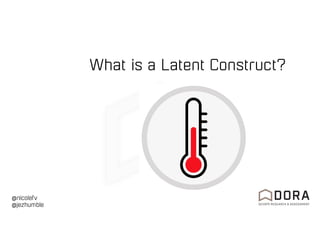
What is a Latent Construct?
@nicolefv
@jezhumble
We use
PSYCHOMETRICS
to make our survey data good*
*or give us a reasonable assurance that it’s telling us
what we think it’s telling us (& some of this can also apply
to your log data)
@nicolefv
@jezhumble
Psychometrics includes:
Construct creation (manual)
• When possible: use previously validated
constructs
• Based on definitions and theory, carefully and
precisely worded, card sorting task, pilot tested
Construct evaluation (statistics)
• Establishing Validity: discriminant and
convergent
• Establishing Reliability
@nicolefv
@jezhumble
Psychometrics Writing
Example: Culture
• Does it matter to our study?
• More than just intuition?
• What KIND of culture?
• National identity and norms
• Adaptive culture
• Value learning (2014 study)
• Value information flow and trust (2014 and 2015
studies -- Westrum culture)
@nicolefv
@jezhumble
Psychometrics Writing
Example: Culture
• Does it matter to our study?
• More than just intuition?
• What KIND of culture?
• National identity and norms
• Adaptive culture
• Value learning (2014 study)
• Value information flow and trust (2014 and 2015
studies -- Westrum culture)
@nicolefv
@jezhumble
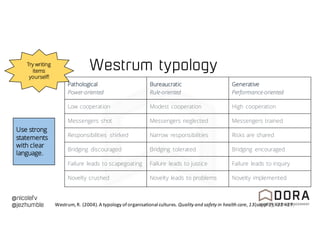
Westrum typology
Pathological
Power-oriented
Bureaucratic
Rule-oriented
Generative
Performance-oriented
Low cooperation Modest cooperation High cooperation
Messengers shot Messengers neglected Messengers trained
Responsibilities shirked Narrow responsibilities Risks are shared
Bridging discouraged Bridging tolerated Bridging encouraged
Failure leads to scapegoating Failure leads to justice Failure leads to inquiry
Novelty crushed Novelty leads to problems Novelty implemented
Try writing
items
yourself!
Use strong
statements
with clear
language.
Westrum,	R.	(2004).	A	typology	of	organisational cultures. Quality	and	safety	in	health	care, 13(suppl 2),	ii22-ii27.
@nicolefv
@jezhumble
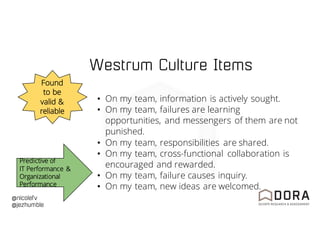
Westrum Culture Items
• On my team, information is actively sought.
• On my team, failures are learning
opportunities, and messengers of them are not
punished.
• On my team, responsibilities are shared.
• On my team, cross-functional collaboration is
encouraged and rewarded.
• On my team, failure causes inquiry.
• On my team, new ideas are welcomed.
Found
to be
valid &
reliable
Predictive of
IT Performance &
Organizational
Performance
@nicolefv
@jezhumble
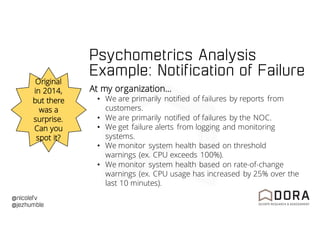
Psychometrics Analysis
Example: Notification of Failure
Original
in 2014,
but there
was a
surprise.
Can you
spot it?
At my organization…
• We are primarily notified of failures by reports from
customers.
• We are primarily notified of failures by the NOC.
• We get failure alerts from logging and monitoring
systems.
• We monitor system health based on threshold
warnings (ex. CPU exceeds 100%).
• We monitor system health based on rate-of-change
warnings (ex. CPU usage has increased by 25% over the
last 10 minutes).
@nicolefv
@jezhumble
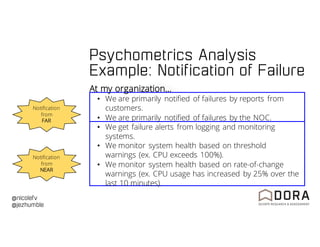
At my organization…
• We are primarily notified of failures by reports from
customers.
• We are primarily notified of failures by the NOC.
• We get failure alerts from logging and monitoring
systems.
• We monitor system health based on threshold
warnings (ex. CPU exceeds 100%).
• We monitor system health based on rate-of-change
warnings (ex. CPU usage has increased by 25% over the
last 10 minutes).
Notification
from
NEAR
Notification
from
FAR
Psychometrics Analysis
Example: Notification of Failure
@nicolefv
@jezhumble
More data tests!
Plus, we test to make sure the survey doesn’t have
other problems.
• Common method variance (CMV) (aka CMB for
Bias)
• Early vs. late responders
• Survey drop-off rates and bias
@nicolefv
@jezhumble
Okay NOW we can look at the
data and how it relates to each
other
@nicolefv
@jezhumble
A note about analysis methods
One of three conditions must be met:
1. Longitudinal (no, this is cross-sectional)
2. Randomized, experimental design (no, this
is a non-experimental)
3. Theory-based design
When this condition was not met, only
correlations were tested and reported
@nicolefv
@jezhumble
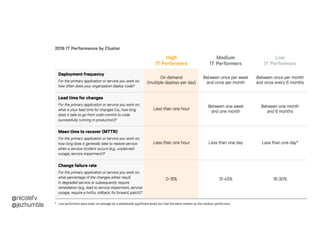
KEY FINDING:
IT Performance and its
behavior
A combination of throughput and stability
• lead time for changes
• release frequency
• time to restore service
• change fail rate
Forsgren,	N.,	J.	Humble	(2016).	"DevOps:	Profiles	in	ITSM	Performance	and	Contributing	Factors."	In	the	
Proceedings	of	the	Western	Decision	Sciences	Institute	(WDSI)	2016,	Las	Vegas,	 NV.
@nicolefv
@jezhumble
KEY FINDING:
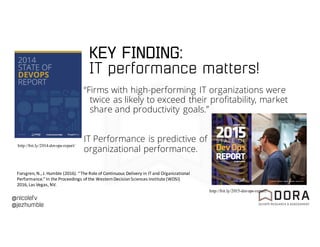
IT performance matters!
“Firms with high-performing IT organizations were
twice as likely to exceed their profitability, market
share and productivity goals.”
IT Performance is predictive of
organizational performance.
http://bit.ly/2014-devops-report/
http://bit.ly/2015-devops-report/
Forsgren,	N.,	J.	Humble	(2016).	“The	Role	of	Continuous	Delivery	in	IT	and	Organizational	
Performance.”	In	the	Proceedings	of	the	Western	Decision	Sciences	Institute	(WDSI)	
2016,	Las	Vegas,	NV.
@nicolefv
@jezhumble
@nicolefv
@jezhumble
@nicolefv
@jezhumble
some surprises
@nicolefv
@jezhumble
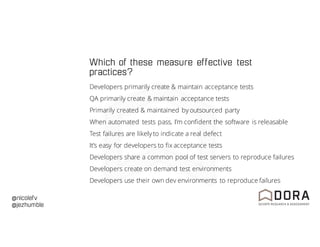
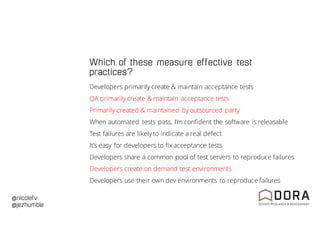
Which of these measure effective test
practices?
Developers primarily create & maintain acceptance tests
QA primarily create & maintain acceptance tests
Primarily created & maintained by outsourced party
When automated tests pass, I’m confident the software is releasable
Test failures are likely to indicate a real defect
It’s easy for developers to fix acceptance tests
Developers share a common pool of test servers to reproduce failures
Developers create on demand test environments
Developers use their own dev environments to reproduce failures
@nicolefv
@jezhumble
Which of these measure effective test
practices?
Developers primarily create & maintain acceptance tests
QA primarily create & maintain acceptance tests
Primarily created & maintained by outsourced party
When automated tests pass, I’m confident the software is releasable
Test failures are likely to indicate a real defect
It’s easy for developers to fix acceptance tests
Developers share a common pool of test servers to reproduce failures
Developers create on demand test environments
Developers use their own dev environments to reproduce failures
@nicolefv
@jezhumble
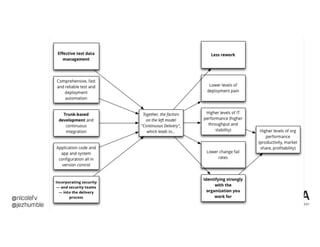
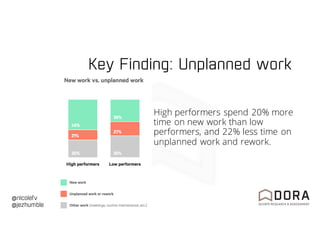
Key Finding: Unplanned work
High performers spend 20% more
time on new work than low
performers, and 22% less time on
unplanned work and rework.
@nicolefv
@jezhumble
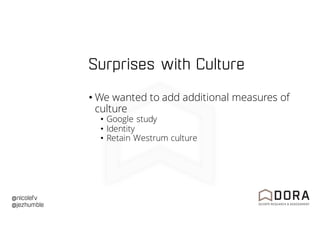
Surprises with Culture
• We wanted to add additional measures of
culture
• Google study
• Identity
• Retain Westrum culture
@nicolefv
@jezhumble
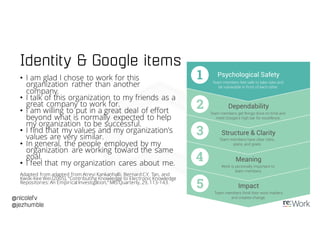
Identity & Google items
• I am glad I chose to work for this
organization rather than another
company.
• I talk of this organization to my friends as a
great company to work for.
• I am willing to put in a great deal of effort
beyond what is normally expected to help
my organization to be successful.
• I find that my values and my organization's
values are very similar.
• In general, the people employed by my
organization are working toward the same
goal.
• I feel that my organization cares about me.
Adapted from adapted from Atreyi Kankanhalli, Bernard C.Y. Tan, and
Kwok-Kee Wei (2005), “Contributing Knowledge to Electronic Knowledge
Repositories: An Empirical Investigation,“ MIS Quarterly, 29, 113-143.
@nicolefv
@jezhumble
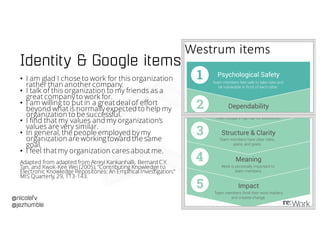
Identity & Google items
• I am glad I chose to work for this organization
rather than another company.
• I talk of this organization to my friends as a
great company to work for.
• I am willing to put in a great deal of effort
beyond what is normally expected to help my
organization to be successful.
• I find that my values and my organization's
values are very similar.
• In general, the people employed by my
organization are workingtoward the same
goal.
• I feel that my organization caresabout me.
Adapted from adapted from Atreyi Kankanhalli, Bernard C.Y.
Tan, and Kwok-Kee Wei (2005), “Contributing Knowledge to
Electronic Knowledge Repositories: An Empirical Investigation,“
MIS Quarterly, 29, 113-143.
Westrum items
@nicolefv
@jezhumble
Now for management stuff
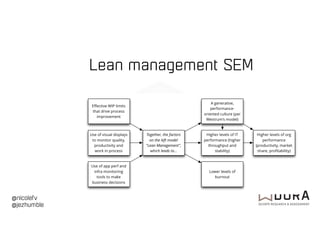
We all know managing WIP is important, right?
@nicolefv
@jezhumble
Now for management stuff
We all know managing WIP is important, right?
Correlation between WIP and ITPerf is negligible
@nicolefv
@jezhumble
Now for management stuff
We all know managing WIP is important, right?
Correlation between WIP and ITPerf is negligible
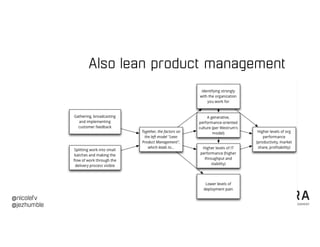
What’s going on?
@nicolefv
@jezhumble
Lean management SEM
@nicolefv
@jezhumble
Also lean product management
@nicolefv
@jezhumble
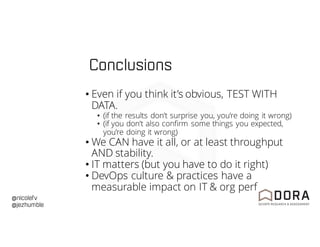
Conclusions
• Even if you think it’s obvious, TEST WITH
DATA.
• (if the results don’t surprise you, you’re doing it wrong)
• (if you don’t also confirm some things you expected,
you’re doing it wrong)
• We CAN have it all, or at least throughput
AND stability.
• IT matters (but you have to do it right)
• DevOps culture & practices have a
measurable impact on IT & org perf
@nicolefv
@jezhumble
Sign	up	for	our	ROI	whitepaper	&	
get	peer-reviewed	research
devops-research.com
For more science-ing…
@nicolefv
@jezhumble
Thank you
devops-research.com

DOES 2016 Sciencing the Crap Out of DevOps

  • 1.
    @nicolefv @jezhumble What We Learnedfrom Four Years of Sciencing the Crap Out of DevOps Nicole Forsgren, PhD Jez Humble
  • 2.
    @nicolefv @jezhumble Outline How to makeyour data suck less • Writing good survey questions • Making sure the survey questions are good - with SCIENCE • (These methods apply to your system and log data) What we found… that we did (AND didn’t) expect Things about Continuous Delivery Things about Management
  • 3.
    @nicolefv @jezhumble Not all datais created equal Who here thinks surveys are sh*t?
  • 4.
    @nicolefv @jezhumble Not all datais created equal Who here thinks surveys are sh*t? Who here LOVES the data from their log files?
  • 5.
  • 6.
    @nicolefv @jezhumble We use PSYCHOMETRICS to makeour survey data good* *or give us a reasonable assurance that it’s telling us what we think it’s telling us (& some of this can also apply to your log data)
  • 7.
    @nicolefv @jezhumble Psychometrics includes: Construct creation(manual) • When possible: use previously validated constructs • Based on definitions and theory, carefully and precisely worded, card sorting task, pilot tested Construct evaluation (statistics) • Establishing Validity: discriminant and convergent • Establishing Reliability
  • 8.
    @nicolefv @jezhumble Psychometrics Writing Example: Culture •Does it matter to our study? • More than just intuition? • What KIND of culture? • National identity and norms • Adaptive culture • Value learning (2014 study) • Value information flow and trust (2014 and 2015 studies -- Westrum culture)
  • 9.
    @nicolefv @jezhumble Psychometrics Writing Example: Culture •Does it matter to our study? • More than just intuition? • What KIND of culture? • National identity and norms • Adaptive culture • Value learning (2014 study) • Value information flow and trust (2014 and 2015 studies -- Westrum culture)
  • 10.
    @nicolefv @jezhumble Westrum typology Pathological Power-oriented Bureaucratic Rule-oriented Generative Performance-oriented Low cooperationModest cooperation High cooperation Messengers shot Messengers neglected Messengers trained Responsibilities shirked Narrow responsibilities Risks are shared Bridging discouraged Bridging tolerated Bridging encouraged Failure leads to scapegoating Failure leads to justice Failure leads to inquiry Novelty crushed Novelty leads to problems Novelty implemented Try writing items yourself! Use strong statements with clear language. Westrum, R. (2004). A typology of organisational cultures. Quality and safety in health care, 13(suppl 2), ii22-ii27.
  • 11.
    @nicolefv @jezhumble Westrum Culture Items •On my team, information is actively sought. • On my team, failures are learning opportunities, and messengers of them are not punished. • On my team, responsibilities are shared. • On my team, cross-functional collaboration is encouraged and rewarded. • On my team, failure causes inquiry. • On my team, new ideas are welcomed. Found to be valid & reliable Predictive of IT Performance & Organizational Performance
  • 12.
    @nicolefv @jezhumble Psychometrics Analysis Example: Notificationof Failure Original in 2014, but there was a surprise. Can you spot it? At my organization… • We are primarily notified of failures by reports from customers. • We are primarily notified of failures by the NOC. • We get failure alerts from logging and monitoring systems. • We monitor system health based on threshold warnings (ex. CPU exceeds 100%). • We monitor system health based on rate-of-change warnings (ex. CPU usage has increased by 25% over the last 10 minutes).
  • 13.
    @nicolefv @jezhumble At my organization… •We are primarily notified of failures by reports from customers. • We are primarily notified of failures by the NOC. • We get failure alerts from logging and monitoring systems. • We monitor system health based on threshold warnings (ex. CPU exceeds 100%). • We monitor system health based on rate-of-change warnings (ex. CPU usage has increased by 25% over the last 10 minutes). Notification from NEAR Notification from FAR Psychometrics Analysis Example: Notification of Failure
  • 14.
    @nicolefv @jezhumble More data tests! Plus,we test to make sure the survey doesn’t have other problems. • Common method variance (CMV) (aka CMB for Bias) • Early vs. late responders • Survey drop-off rates and bias
  • 15.
    @nicolefv @jezhumble Okay NOW wecan look at the data and how it relates to each other
  • 16.
    @nicolefv @jezhumble A note aboutanalysis methods One of three conditions must be met: 1. Longitudinal (no, this is cross-sectional) 2. Randomized, experimental design (no, this is a non-experimental) 3. Theory-based design When this condition was not met, only correlations were tested and reported
  • 17.
    @nicolefv @jezhumble KEY FINDING: IT Performanceand its behavior A combination of throughput and stability • lead time for changes • release frequency • time to restore service • change fail rate Forsgren, N., J. Humble (2016). "DevOps: Profiles in ITSM Performance and Contributing Factors." In the Proceedings of the Western Decision Sciences Institute (WDSI) 2016, Las Vegas, NV.
  • 18.
    @nicolefv @jezhumble KEY FINDING: IT performancematters! “Firms with high-performing IT organizations were twice as likely to exceed their profitability, market share and productivity goals.” IT Performance is predictive of organizational performance. http://bit.ly/2014-devops-report/ http://bit.ly/2015-devops-report/ Forsgren, N., J. Humble (2016). “The Role of Continuous Delivery in IT and Organizational Performance.” In the Proceedings of the Western Decision Sciences Institute (WDSI) 2016, Las Vegas, NV.
  • 19.
  • 20.
  • 21.
  • 22.
    @nicolefv @jezhumble Which of thesemeasure effective test practices? Developers primarily create & maintain acceptance tests QA primarily create & maintain acceptance tests Primarily created & maintained by outsourced party When automated tests pass, I’m confident the software is releasable Test failures are likely to indicate a real defect It’s easy for developers to fix acceptance tests Developers share a common pool of test servers to reproduce failures Developers create on demand test environments Developers use their own dev environments to reproduce failures
  • 23.
    @nicolefv @jezhumble Which of thesemeasure effective test practices? Developers primarily create & maintain acceptance tests QA primarily create & maintain acceptance tests Primarily created & maintained by outsourced party When automated tests pass, I’m confident the software is releasable Test failures are likely to indicate a real defect It’s easy for developers to fix acceptance tests Developers share a common pool of test servers to reproduce failures Developers create on demand test environments Developers use their own dev environments to reproduce failures
  • 24.
    @nicolefv @jezhumble Key Finding: Unplannedwork High performers spend 20% more time on new work than low performers, and 22% less time on unplanned work and rework.
  • 25.
    @nicolefv @jezhumble Surprises with Culture •We wanted to add additional measures of culture • Google study • Identity • Retain Westrum culture
  • 26.
    @nicolefv @jezhumble Identity & Googleitems • I am glad I chose to work for this organization rather than another company. • I talk of this organization to my friends as a great company to work for. • I am willing to put in a great deal of effort beyond what is normally expected to help my organization to be successful. • I find that my values and my organization's values are very similar. • In general, the people employed by my organization are working toward the same goal. • I feel that my organization cares about me. Adapted from adapted from Atreyi Kankanhalli, Bernard C.Y. Tan, and Kwok-Kee Wei (2005), “Contributing Knowledge to Electronic Knowledge Repositories: An Empirical Investigation,“ MIS Quarterly, 29, 113-143.
  • 27.
    @nicolefv @jezhumble Identity & Googleitems • I am glad I chose to work for this organization rather than another company. • I talk of this organization to my friends as a great company to work for. • I am willing to put in a great deal of effort beyond what is normally expected to help my organization to be successful. • I find that my values and my organization's values are very similar. • In general, the people employed by my organization are workingtoward the same goal. • I feel that my organization caresabout me. Adapted from adapted from Atreyi Kankanhalli, Bernard C.Y. Tan, and Kwok-Kee Wei (2005), “Contributing Knowledge to Electronic Knowledge Repositories: An Empirical Investigation,“ MIS Quarterly, 29, 113-143. Westrum items
  • 28.
    @nicolefv @jezhumble Now for managementstuff We all know managing WIP is important, right?
  • 29.
    @nicolefv @jezhumble Now for managementstuff We all know managing WIP is important, right? Correlation between WIP and ITPerf is negligible
  • 30.
    @nicolefv @jezhumble Now for managementstuff We all know managing WIP is important, right? Correlation between WIP and ITPerf is negligible What’s going on?
  • 31.
  • 32.
  • 33.
    @nicolefv @jezhumble Conclusions • Even ifyou think it’s obvious, TEST WITH DATA. • (if the results don’t surprise you, you’re doing it wrong) • (if you don’t also confirm some things you expected, you’re doing it wrong) • We CAN have it all, or at least throughput AND stability. • IT matters (but you have to do it right) • DevOps culture & practices have a measurable impact on IT & org perf
  • 34.
  • 35.