Testing is an Island
A Software Testing Dystopia
Rikard Edgren
TIBCO Spotfire Division
EuroSTAR 2008-11-12, Haag
My problem
• Software Testing is a lot of fun
• I see trends that make it less fun
• Don’t destroy the good things about
software testing!
Testing is an Island
• Introduction film...
Software Complexity
• Software is complex; and the usage of
software is even more complex
• There is not one solution; no silver bullets
• We need to look in many different ways
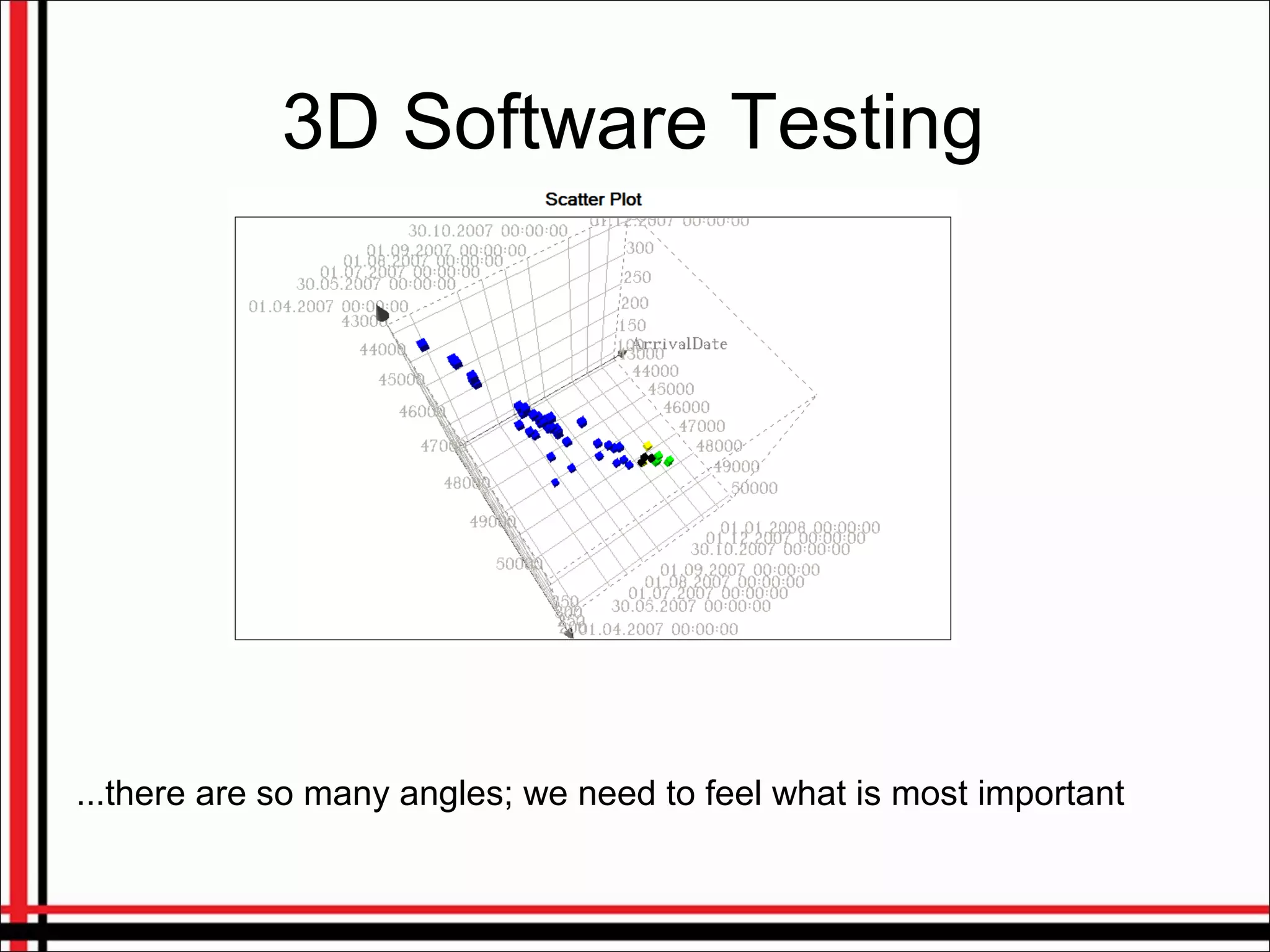
3D Software Testing
...there are so many angles; we need to feel what is most important
Trends
• “all testing is verification testing”
• Status/certification/standards/specialization
• You can’t control what you can’t measure
• We only think about results; not about people
• Management rules
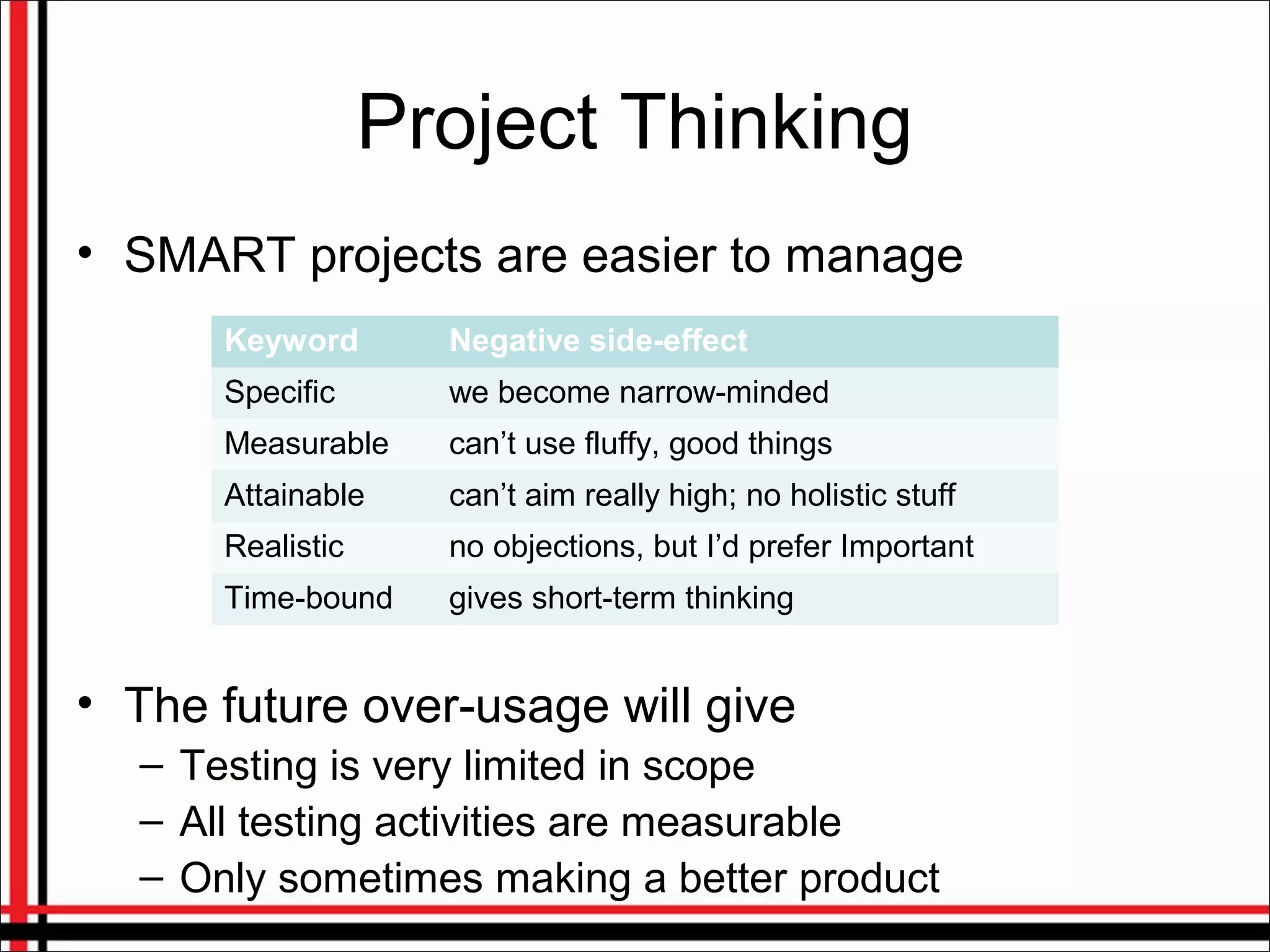
Project Thinking
• SMART projects are easier to manage
• The future over-usage will give
– Testing is very limited in scope
– All testing activities are measurable
– Only sometimes making a better product
Keyword Negative side-effect
Specific we become narrow-minded
Measurable can’t use fluffy, good things
Attainable can’t aim really high; no holistic stuff
Realistic no objections, but I’d prefer Important
Time-bound gives short-term thinking
Verification & Validation
• Validation will mean looking at high-level; and
verification at low-level
• That validation means that the product actually
does good things is forgotten
• The combinations and grey areas in between will
be ignored
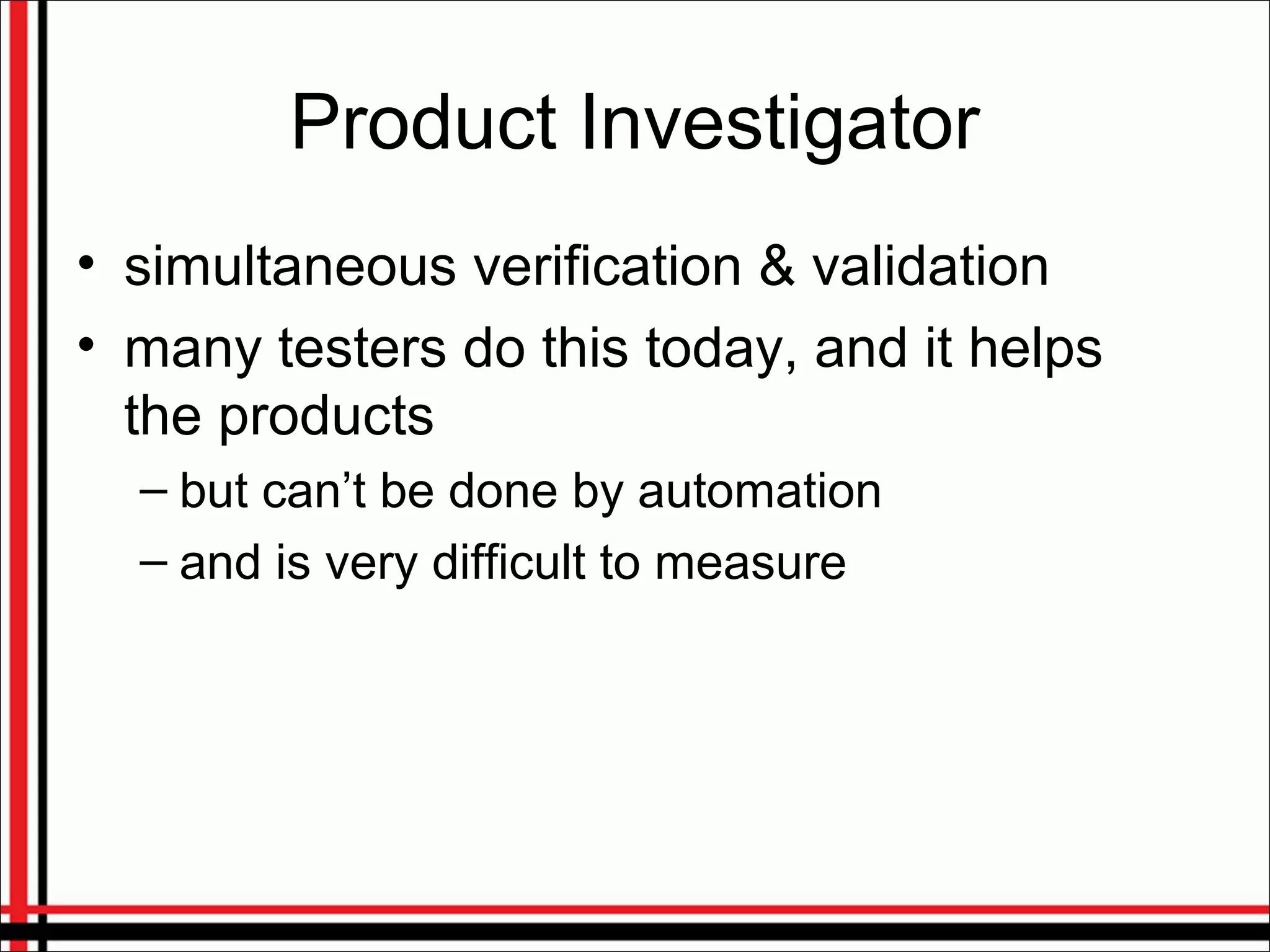
Product Investigator
• simultaneous verification & validation
• many testers do this today, and it helps
the products
– but can’t be done by automation
– and is very difficult to measure
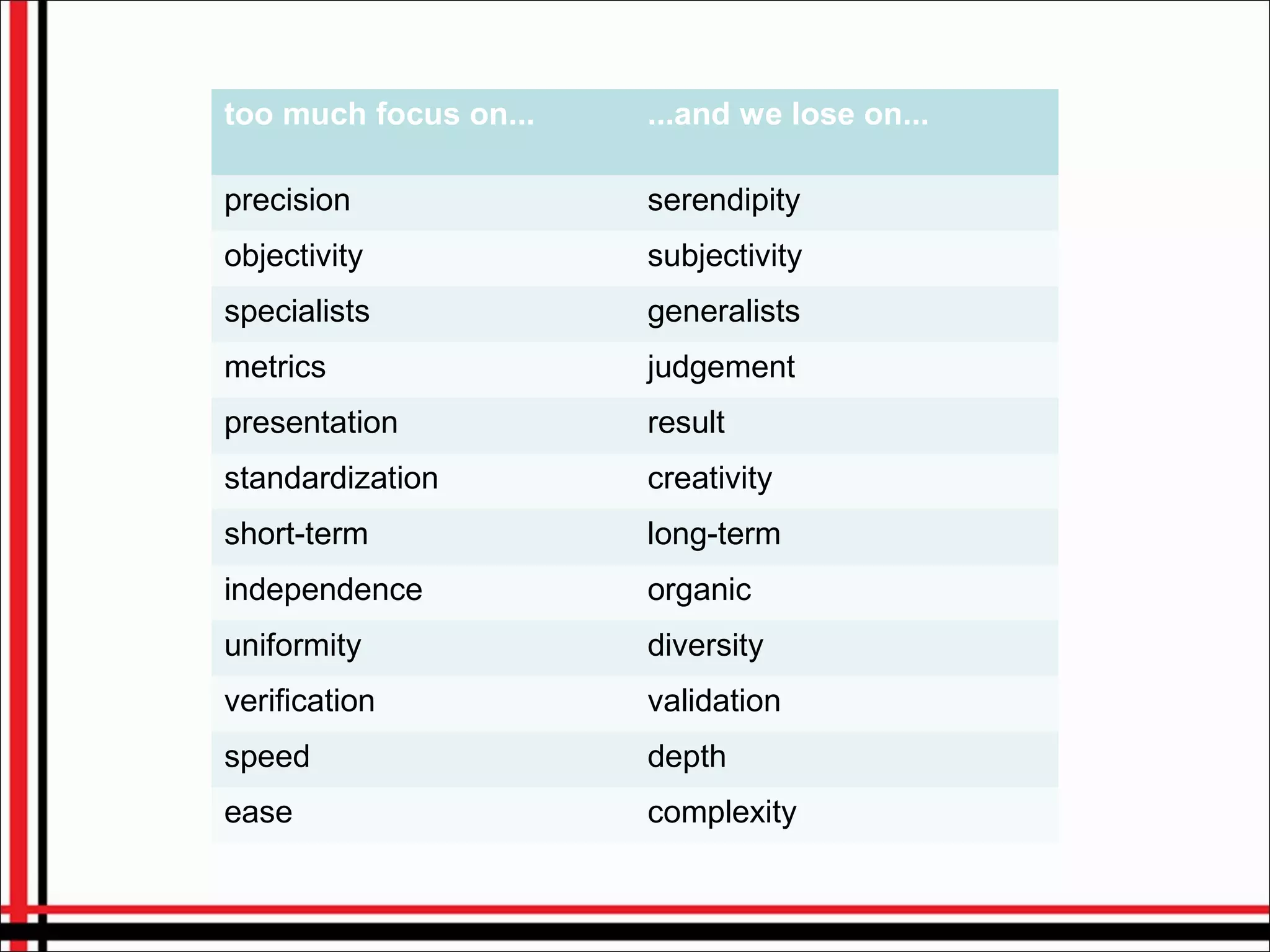
too much focus on... ...and we lose on...
precision serendipity
objectivity subjectivity
specialists generalists
metrics judgement
presentation result
standardization creativity
short-term long-term
independence organic
uniformity diversity
verification validation
speed depth
ease complexity
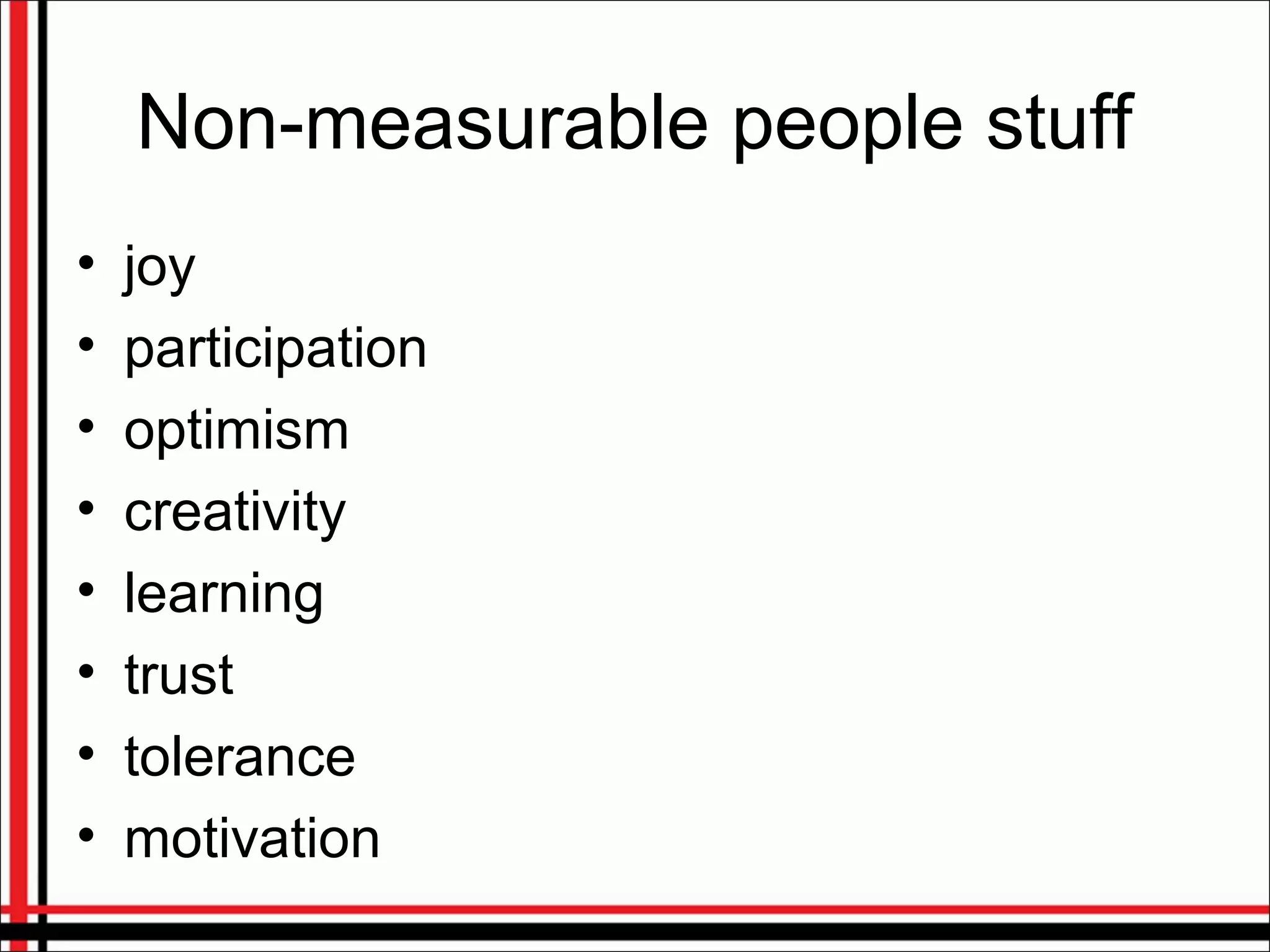
Non-measurable people stuff
• joy
• participation
• optimism
• creativity
• learning
• trust
• tolerance
• motivation
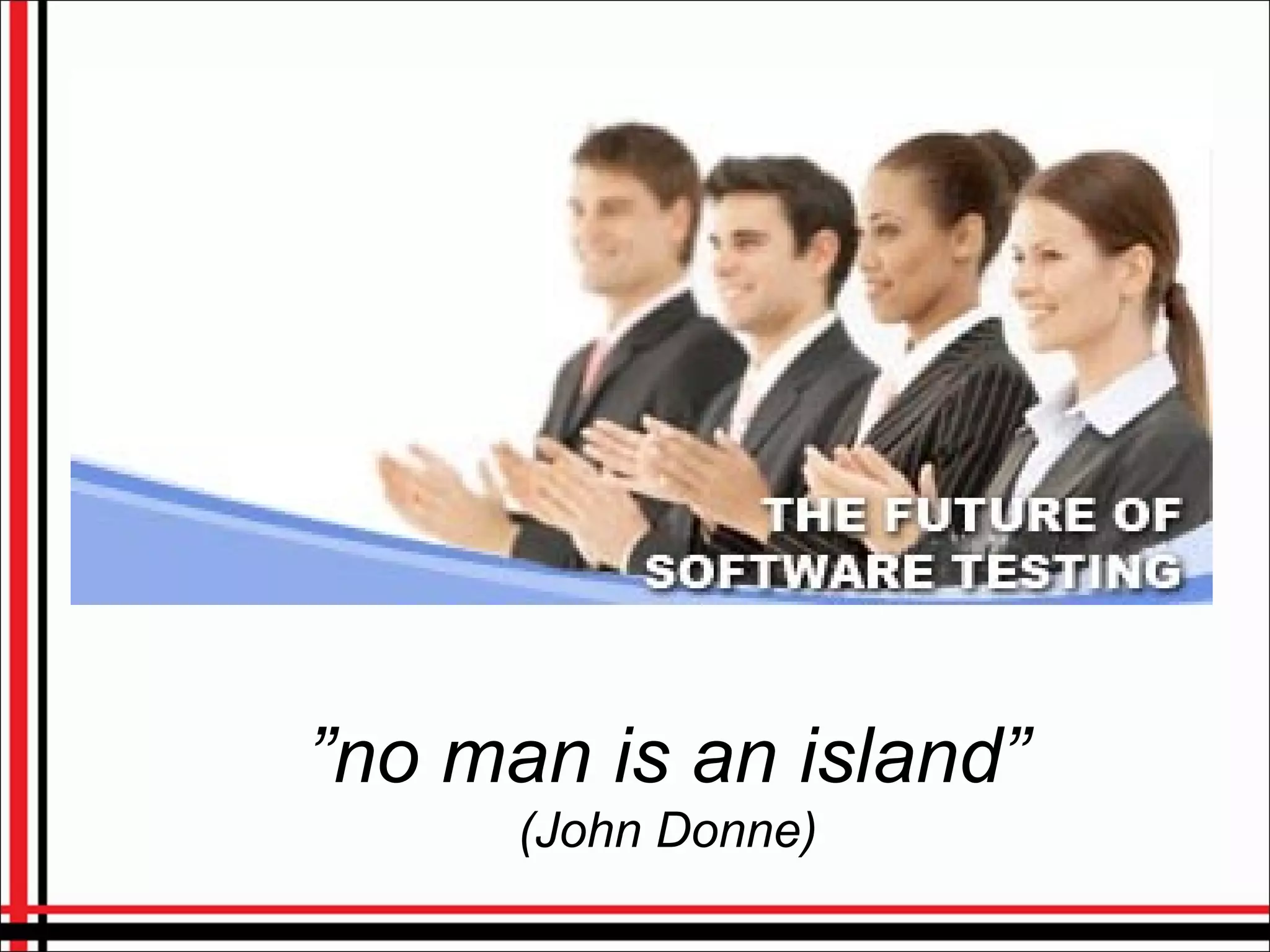
”no man is an island”
(John Donne)
The Future Tester
• Precise
• Alone
• Quiet
Holistic-Subjective Approach
• Holistic
– time
– product
– whole company
– all quality aspects
• Subjective
– people
– quality
– no metrics
Summary
• subjectivity is something useful
• the seemingly sound ideas have risks
• people and results go hand in hand
Questions
• ???
• I have a paper with details and references
redgren@tibco.com

Rikard Edgren - Testing is an Island - A Software Testing Dystopia

  • 1.
    Testing is anIsland A Software Testing Dystopia Rikard Edgren TIBCO Spotfire Division EuroSTAR 2008-11-12, Haag
  • 2.
    My problem • SoftwareTesting is a lot of fun • I see trends that make it less fun • Don’t destroy the good things about software testing!
  • 3.
    Testing is anIsland • Introduction film...
  • 4.
    Software Complexity • Softwareis complex; and the usage of software is even more complex • There is not one solution; no silver bullets • We need to look in many different ways
  • 5.
    3D Software Testing ...thereare so many angles; we need to feel what is most important
  • 6.
    Trends • “all testingis verification testing” • Status/certification/standards/specialization • You can’t control what you can’t measure • We only think about results; not about people • Management rules
  • 7.
    Project Thinking • SMARTprojects are easier to manage • The future over-usage will give – Testing is very limited in scope – All testing activities are measurable – Only sometimes making a better product Keyword Negative side-effect Specific we become narrow-minded Measurable can’t use fluffy, good things Attainable can’t aim really high; no holistic stuff Realistic no objections, but I’d prefer Important Time-bound gives short-term thinking
  • 8.
    Verification & Validation •Validation will mean looking at high-level; and verification at low-level • That validation means that the product actually does good things is forgotten • The combinations and grey areas in between will be ignored
  • 9.
    Product Investigator • simultaneousverification & validation • many testers do this today, and it helps the products – but can’t be done by automation – and is very difficult to measure
  • 10.
    too much focuson... ...and we lose on... precision serendipity objectivity subjectivity specialists generalists metrics judgement presentation result standardization creativity short-term long-term independence organic uniformity diversity verification validation speed depth ease complexity
  • 11.
    Non-measurable people stuff •joy • participation • optimism • creativity • learning • trust • tolerance • motivation
  • 12.
    ”no man isan island” (John Donne)
  • 13.
    The Future Tester •Precise • Alone • Quiet
  • 14.
    Holistic-Subjective Approach • Holistic –time – product – whole company – all quality aspects • Subjective – people – quality – no metrics
  • 15.
    Summary • subjectivity issomething useful • the seemingly sound ideas have risks • people and results go hand in hand
  • 16.
    Questions • ??? • Ihave a paper with details and references redgren@tibco.com

Editor's Notes

  • #2 This years EuroSTAR theme is ”the future of software testing”
  • #3 My main message is that we need to keep the people aspect of software engineering.
  • #5 "Ser man till forskningen om styrning av organisationer råder det stor enighet om att organisationer med komplex verksamhet inte bör styras med hjälp av kontroller och övervakning." Hans-Åke Scherp, http://www.svd.se/opinion/brannpunkt/artikel_1006953.svd
  • #6 There are a lot of defects to find and fix. There are a lot of ways to test the software; but you often test from one angle, so there are many things you miss. I want to look at many ways at the same time. The minefield problem should add a third dimension: different “quality attributes”. And the fact that when combining features, it is like you are at many places at the same time Humans can understand what is important.
  • #7 “all testing is verification testing” - Michael Bolton The root cause to most of the problems might be three-fold: Project thinking – leads to short-term results, which gives technical debt and other problems. Metrics – managers want to decide, and since they can’t know the details, they need to use numbers, that reduces the complexity, and thereby the “truth”. Specialization- Precision: Not sure where it comes from; it could be that we want to be appreciated for what we do, and it is easier to get really good at a very narrow area. I also think that for people of today, it is very important to appear as capable
  • #11 Not that Precision, Objectivity et.al. are necessarily bad; but when doing too much of them, they are really hurting our work in the sense that we don’t do what is most important
  • #13 “quality is value to some person” (Jerry Weinberg) “People are the most important asset of any company” (Tom DeMarco) “the truth is the subjectivity” (Sören Kierkegaard) The future ”by-stander” testers don’t want to get their hands dirty. But they have very nice haircuts.
  • #15 * there are many goals of software testing * testing is only a part of software development, and a part of the tester's life * subjectivity is the truth, objectivity is true, but not important * metrics and measurements are dangerous * you should choose serendipity over precision, creativity over standardization, ... A good tester should look at all quality aspects at the same time Testing is a very small, but very important part of software development, that should interact in many ways with many different persons/things Everything is connected/Things should be overlapping