Chicago, USA
August 24-28, 2009
WANTED: Seeking Single Agile
Knowledge Development Tool-set
by Brad Appleton
Chicago, USA
August 24-28, 2009
WANTED: Desperately Seeking Single Agile
Knowledge Development Tool-setBrad Appleton 2
Presenter Information
Brad Appleton
 22 years in industry – last 15 w/large Telecom.
 Leading software development, CM & ALM solution
architecture
 Leading adoption & scaling of Agile development for
large organization since 2000.
 Co-author: Software Configuration Management
Patterns (Addison-Wesley 2002), Agile CM Environments
(column in CM Journal), Reviewer for The Agile Journal
Chicago, USA
August 24-28, 2009
WANTED: Desperately Seeking Single Agile
Knowledge Development Tool-setBrad Appleton 3
What to expect in this talk?
More questions & challenges than answers
 I don’t have all the answers here!
 Just a perspective to share about “knowledge creation”
for software development and supporting tools
 Lots of “what if” and “why can’t I” questions
 Borne out of a lot of experience in software development
for projects of ALL shapes and sizes and …
 Extensive experience/practice in CM & ALM processes,
tools and their patterns of usage & design
Discussion/brainstorming of possible solutions
 Especially from tool vendors/developers
Chicago, USA
August 24-28, 2009
WANTED: Desperately Seeking Single Agile
Knowledge Development Tool-setBrad Appleton 4
Making Software == Creating Knowledge
“The hard part about creating software systems is
not creating them, it is in acquiring the knowledge
necessary to create them (correctly).
Therefore:
 Software is not a product, it is a medium for storing
executable knowledge!
 We do not ‘build systems’—we acquire knowledge.
 The systems we ship to our customers are actually the
byproducts of the real activity, which is to learn
 The real product is the knowledge that is in the systems we
ship to the customer.”
— Phil Armour, Software is NOT a Product (CACM, August 2000)
Chicago, USA
August 24-28, 2009
WANTED: Desperately Seeking Single Agile
Knowledge Development Tool-setBrad Appleton 5
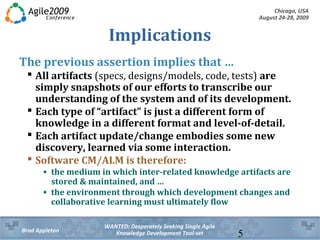
Implications
The previous assertion implies that …
 All artifacts (specs, designs/models, code, tests) are
simply snapshots of our efforts to transcribe our
understanding of the system and of its development.
 Each type of “artifact” is just a different form of
knowledge in a different format and level-of-detail.
 Each artifact update/change embodies some new
discovery, learned via some interaction.
 Software CM/ALM is therefore:
• the medium in which inter-related knowledge artifacts are
stored & maintained, and …
• the environment through which development changes and
collaborative learning must ultimately flow
Chicago, USA
August 24-28, 2009
WANTED: Desperately Seeking Single Agile
Knowledge Development Tool-setBrad Appleton 6
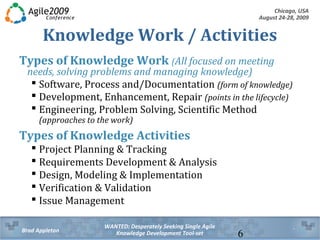
Knowledge Work / Activities
Types of Knowledge Work (All focused on meeting
needs, solving problems and managing knowledge)
 Software, Process and/Documentation (form of knowledge)
 Development, Enhancement, Repair (points in the lifecycle)
 Engineering, Problem Solving, Scientific Method
(approaches to the work)
Types of Knowledge Activities
 Project Planning & Tracking
 Requirements Development & Analysis
 Design, Modeling & Implementation
 Verification & Validation
 Issue Management
Chicago, USA
August 24-28, 2009
WANTED: Desperately Seeking Single Agile
Knowledge Development Tool-setBrad Appleton 7
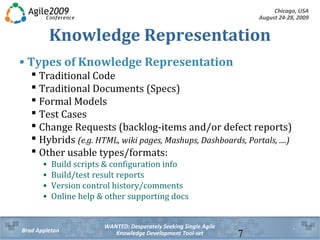
Knowledge Representation
• Types of Knowledge Representation
 Traditional Code
 Traditional Documents (Specs)
 Formal Models
 Test Cases
 Change Requests (backlog-items and/or defect reports)
 Hybrids (e.g. HTML, wiki pages, Mashups, Dashboards, Portals, ....)
 Other usable types/formats:
• Build scripts & configuration info
• Build/test result reports
• Version control history/comments
• Online help & other supporting docs
Chicago, USA
August 24-28, 2009
WANTED: Desperately Seeking Single Agile
Knowledge Development Tool-setBrad Appleton 8
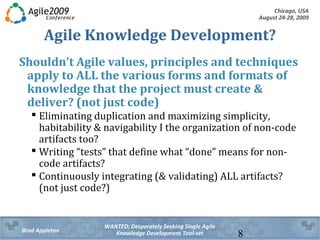
Agile Knowledge Development?
Shouldn’t Agile values, principles and techniques
apply to ALL the various forms and formats of
knowledge that the project must create &
deliver? (not just code)
 Eliminating duplication and maximizing simplicity,
habitability & navigability applies to the organization of
non-code artifacts too
 Writing “tests” that define what “done” means for non-
code artifacts
 Continuously integrating (& validating) ALL types of
knowledge artifacts (not just code)
Chicago, USA
August 24-28, 2009
WANTED: Desperately Seeking Single Agile
Knowledge Development Tool-setBrad Appleton 9
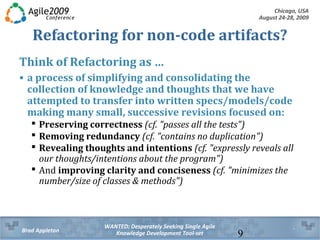
Refactoring for non-code artifacts?
Think of Refactoring as …
• a process of simplifying and consolidating the collection
of knowledge and thoughts that we have attempted to
transfer into written specs/models/code making many
small, successive revisions focused on:
 Preserving correctness (cf. "passes all the tests")
 Removing redundancy (cf. "contains no duplication")
 Revealing thoughts and intentions (cf. "expressly reveals all
our thoughts/intentions about the program")
 And improving clarity and conciseness (cf. "minimizes the
number/size of classes & methods")
Chicago, USA
August 24-28, 2009
WANTED: Desperately Seeking Single Agile
Knowledge Development Tool-setBrad Appleton 10
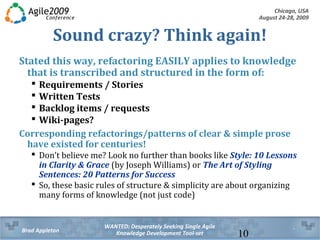
Sound crazy? Think again!
Stated this way, refactoring EASILY applies to knowledge
that is transcribed and structured in the form of:
 Requirements / Stories
 Written Tests
 Backlog items / requests
 Wiki-pages?
Corresponding refactorings/patterns of clear & simple prose
have existed for centuries!
 Don’t believe me? Look no further than books like Style: 10 Lessons
in Clarity & Grace (by Joseph Williams) or The Art of Styling
Sentences: 20 Patterns for Success
 So, these basic rules of structure & simplicity are about organizing
many forms of knowledge (not just code)
Chicago, USA
August 24-28, 2009
WANTED: Desperately Seeking Single Agile
Knowledge Development Tool-setBrad Appleton 11
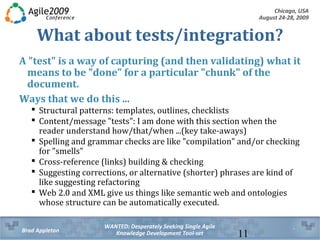
What about tests/integration?
A "test" is a way of capturing (and then validating) what it
means to be "done" for a particular "chunk" of the
document.
Ways that we do this ...
 Structural patterns: templates, outlines, checklists
 Content/message "tests": I am done with this section when the
reader understand how/that/when ...(key take-aways)
 Spelling and grammar checks are like "compilation" and/or checking
for "smells"
 Cross-reference (links) building & checking
 Suggesting corrections, or alternative (shorter) phrases are kind of
like suggesting refactoring
 Web 2.0 and XML give us things like semantic web and ontologies
whose structure can be automatically executed.
Chicago, USA
August 24-28, 2009
WANTED: Desperately Seeking Single Agile
Knowledge Development Tool-setBrad Appleton 12
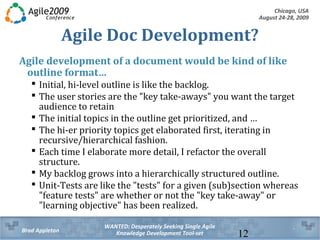
Agile Doc Development?
Agile development of a document would be kind of like
outline format…
 Initial, hi-level outline is like the backlog.
 The user stories are the "key take-aways" you want the target
audience to retain
 The initial topics in the outline get prioritized, and …
 The hi-er priority topics get elaborated first, iterating in
recursive/hierarchical fashion.
 Each time I elaborate more detail, I refactor the overall
structure.
 My backlog grows into a hierarchically structured outline.
 Unit-Tests are like the "tests" for a given (sub)section whereas
"feature tests" are whether or not the "key take-away" or
"learning objective" has been realized.
Chicago, USA
August 24-28, 2009
WANTED: Desperately Seeking Single Agile
Knowledge Development Tool-setBrad Appleton 13
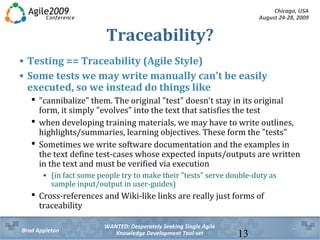
Traceability?
• Testing == Traceability (Agile Style)
• Some tests we may write manually can't be easily
executed, so we instead do things like
 "cannibalize" them. The original "test" doesn't stay in its original
form, it simply "evolves" into the text that satisfies the test
 when developing training materials, we may have to write outlines,
highlights/summaries, learning objectives. These form the "tests"
 Sometimes we write software documentation and the examples in
the text define test-cases whose expected inputs/outputs are written
in the text and must be verified via execution
• (in fact some people try to make their "tests" serve double-duty as
sample input/output in user-guides)
 Cross-references and Wiki-like links are really just forms of
traceability
Chicago, USA
August 24-28, 2009
WANTED: Desperately Seeking Single Agile
Knowledge Development Tool-setBrad Appleton 14
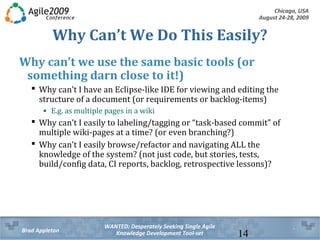
Why Can’t We Do This Easily?
Why can’t we use the same basic tools (or
something darn close to it!)
 Why can’t I have an Eclipse-like IDE for viewing and editing the
structure of a document (or requirements or backlog-items)
• E.g. as multiple pages in a wiki
 Why can’t I easily to labeling/tagging or “task-based commit” of
multiple wiki-pages at a time? (or even branching?)
 Why can’t I easily browse/refactor and navigating ALL the
knowledge of the system? (not just code, but stories, tests,
build/config data, CI reports, backlog, retrospective lessons)?
Chicago, USA
August 24-28, 2009
WANTED: Desperately Seeking Single Agile
Knowledge Development Tool-setBrad Appleton 15
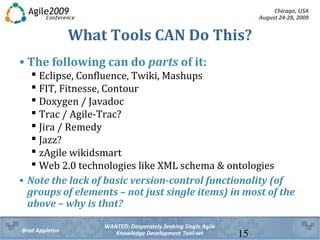
What Tools CAN Do This?
• The following can do parts of it:
 Eclipse, Confluence, Twiki, Mashups
 FIT, Fitnesse, Contour
 Doxygen / Javadoc
 Trac / Agile-Trac?
 Jira / Remedy
 Jazz?
 zAgile wikidsmart
 Web 2.0 technologies like XML schema & ontologies
• Note the lack of basic version-control functionality (of
groups of elements – not just single items) in most of the
above – why is that?
Chicago, USA
August 24-28, 2009
WANTED: Desperately Seeking Single Agile
Knowledge Development Tool-setBrad Appleton 16
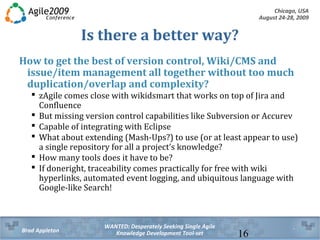
Is there a better way?
How to get the best of version control, Wiki/CMS and
issue/item management all together without too much
duplication/overlap and complexity?
 zAgile comes close with wikidsmart that works on top of Jira and
Confluence
 But missing version control capabilities like Subversion or Accurev
 Capable of integrating with Eclipse
 What about extending (Mash-Ups?) to use (or at least appear to use)
a single repository for all a project’s knowledge?
 How many tools does it have to be?
 If doneright, traceability comes practically for free with wiki
hyperlinks, automated event logging, and ubiquitous language with
Google-like Search!
Chicago, USA
August 24-28, 2009
Let’s Brainstorm & Discuss!
How would you do it?
What would you recommend?
Chicago, USA
August 24-28, 2009
WANTED: Desperately Seeking Single Agile
Knowledge Development Tool-setBrad Appleton 18
Conclusions?
• How did we do?
Chicago, USA
August 24-28, 2009
WANTED: Desperately Seeking Single Agile
Knowledge Development Tool-setBrad Appleton 19
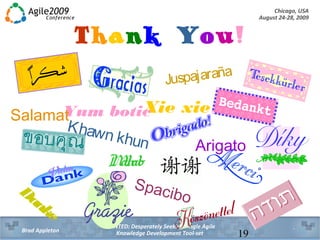
Thank You!
Mahalo
XiexieYumboticSalamat
Arigato

WANTED: Seeking Single Agile Knowledge Development Tool-set

  • 1.
    Chicago, USA August 24-28,2009 WANTED: Seeking Single Agile Knowledge Development Tool-set by Brad Appleton
  • 2.
    Chicago, USA August 24-28,2009 WANTED: Desperately Seeking Single Agile Knowledge Development Tool-setBrad Appleton 2 Presenter Information Brad Appleton  22 years in industry – last 15 w/large Telecom.  Leading software development, CM & ALM solution architecture  Leading adoption & scaling of Agile development for large organization since 2000.  Co-author: Software Configuration Management Patterns (Addison-Wesley 2002), Agile CM Environments (column in CM Journal), Reviewer for The Agile Journal
  • 3.
    Chicago, USA August 24-28,2009 WANTED: Desperately Seeking Single Agile Knowledge Development Tool-setBrad Appleton 3 What to expect in this talk? More questions & challenges than answers  I don’t have all the answers here!  Just a perspective to share about “knowledge creation” for software development and supporting tools  Lots of “what if” and “why can’t I” questions  Borne out of a lot of experience in software development for projects of ALL shapes and sizes and …  Extensive experience/practice in CM & ALM processes, tools and their patterns of usage & design Discussion/brainstorming of possible solutions  Especially from tool vendors/developers
  • 4.
    Chicago, USA August 24-28,2009 WANTED: Desperately Seeking Single Agile Knowledge Development Tool-setBrad Appleton 4 Making Software == Creating Knowledge “The hard part about creating software systems is not creating them, it is in acquiring the knowledge necessary to create them (correctly). Therefore:  Software is not a product, it is a medium for storing executable knowledge!  We do not ‘build systems’—we acquire knowledge.  The systems we ship to our customers are actually the byproducts of the real activity, which is to learn  The real product is the knowledge that is in the systems we ship to the customer.” — Phil Armour, Software is NOT a Product (CACM, August 2000)
  • 5.
    Chicago, USA August 24-28,2009 WANTED: Desperately Seeking Single Agile Knowledge Development Tool-setBrad Appleton 5 Implications The previous assertion implies that …  All artifacts (specs, designs/models, code, tests) are simply snapshots of our efforts to transcribe our understanding of the system and of its development.  Each type of “artifact” is just a different form of knowledge in a different format and level-of-detail.  Each artifact update/change embodies some new discovery, learned via some interaction.  Software CM/ALM is therefore: • the medium in which inter-related knowledge artifacts are stored & maintained, and … • the environment through which development changes and collaborative learning must ultimately flow
  • 6.
    Chicago, USA August 24-28,2009 WANTED: Desperately Seeking Single Agile Knowledge Development Tool-setBrad Appleton 6 Knowledge Work / Activities Types of Knowledge Work (All focused on meeting needs, solving problems and managing knowledge)  Software, Process and/Documentation (form of knowledge)  Development, Enhancement, Repair (points in the lifecycle)  Engineering, Problem Solving, Scientific Method (approaches to the work) Types of Knowledge Activities  Project Planning & Tracking  Requirements Development & Analysis  Design, Modeling & Implementation  Verification & Validation  Issue Management
  • 7.
    Chicago, USA August 24-28,2009 WANTED: Desperately Seeking Single Agile Knowledge Development Tool-setBrad Appleton 7 Knowledge Representation • Types of Knowledge Representation  Traditional Code  Traditional Documents (Specs)  Formal Models  Test Cases  Change Requests (backlog-items and/or defect reports)  Hybrids (e.g. HTML, wiki pages, Mashups, Dashboards, Portals, ....)  Other usable types/formats: • Build scripts & configuration info • Build/test result reports • Version control history/comments • Online help & other supporting docs
  • 8.
    Chicago, USA August 24-28,2009 WANTED: Desperately Seeking Single Agile Knowledge Development Tool-setBrad Appleton 8 Agile Knowledge Development? Shouldn’t Agile values, principles and techniques apply to ALL the various forms and formats of knowledge that the project must create & deliver? (not just code)  Eliminating duplication and maximizing simplicity, habitability & navigability applies to the organization of non-code artifacts too  Writing “tests” that define what “done” means for non- code artifacts  Continuously integrating (& validating) ALL types of knowledge artifacts (not just code)
  • 9.
    Chicago, USA August 24-28,2009 WANTED: Desperately Seeking Single Agile Knowledge Development Tool-setBrad Appleton 9 Refactoring for non-code artifacts? Think of Refactoring as … • a process of simplifying and consolidating the collection of knowledge and thoughts that we have attempted to transfer into written specs/models/code making many small, successive revisions focused on:  Preserving correctness (cf. "passes all the tests")  Removing redundancy (cf. "contains no duplication")  Revealing thoughts and intentions (cf. "expressly reveals all our thoughts/intentions about the program")  And improving clarity and conciseness (cf. "minimizes the number/size of classes & methods")
  • 10.
    Chicago, USA August 24-28,2009 WANTED: Desperately Seeking Single Agile Knowledge Development Tool-setBrad Appleton 10 Sound crazy? Think again! Stated this way, refactoring EASILY applies to knowledge that is transcribed and structured in the form of:  Requirements / Stories  Written Tests  Backlog items / requests  Wiki-pages? Corresponding refactorings/patterns of clear & simple prose have existed for centuries!  Don’t believe me? Look no further than books like Style: 10 Lessons in Clarity & Grace (by Joseph Williams) or The Art of Styling Sentences: 20 Patterns for Success  So, these basic rules of structure & simplicity are about organizing many forms of knowledge (not just code)
  • 11.
    Chicago, USA August 24-28,2009 WANTED: Desperately Seeking Single Agile Knowledge Development Tool-setBrad Appleton 11 What about tests/integration? A "test" is a way of capturing (and then validating) what it means to be "done" for a particular "chunk" of the document. Ways that we do this ...  Structural patterns: templates, outlines, checklists  Content/message "tests": I am done with this section when the reader understand how/that/when ...(key take-aways)  Spelling and grammar checks are like "compilation" and/or checking for "smells"  Cross-reference (links) building & checking  Suggesting corrections, or alternative (shorter) phrases are kind of like suggesting refactoring  Web 2.0 and XML give us things like semantic web and ontologies whose structure can be automatically executed.
  • 12.
    Chicago, USA August 24-28,2009 WANTED: Desperately Seeking Single Agile Knowledge Development Tool-setBrad Appleton 12 Agile Doc Development? Agile development of a document would be kind of like outline format…  Initial, hi-level outline is like the backlog.  The user stories are the "key take-aways" you want the target audience to retain  The initial topics in the outline get prioritized, and …  The hi-er priority topics get elaborated first, iterating in recursive/hierarchical fashion.  Each time I elaborate more detail, I refactor the overall structure.  My backlog grows into a hierarchically structured outline.  Unit-Tests are like the "tests" for a given (sub)section whereas "feature tests" are whether or not the "key take-away" or "learning objective" has been realized.
  • 13.
    Chicago, USA August 24-28,2009 WANTED: Desperately Seeking Single Agile Knowledge Development Tool-setBrad Appleton 13 Traceability? • Testing == Traceability (Agile Style) • Some tests we may write manually can't be easily executed, so we instead do things like  "cannibalize" them. The original "test" doesn't stay in its original form, it simply "evolves" into the text that satisfies the test  when developing training materials, we may have to write outlines, highlights/summaries, learning objectives. These form the "tests"  Sometimes we write software documentation and the examples in the text define test-cases whose expected inputs/outputs are written in the text and must be verified via execution • (in fact some people try to make their "tests" serve double-duty as sample input/output in user-guides)  Cross-references and Wiki-like links are really just forms of traceability
  • 14.
    Chicago, USA August 24-28,2009 WANTED: Desperately Seeking Single Agile Knowledge Development Tool-setBrad Appleton 14 Why Can’t We Do This Easily? Why can’t we use the same basic tools (or something darn close to it!)  Why can’t I have an Eclipse-like IDE for viewing and editing the structure of a document (or requirements or backlog-items) • E.g. as multiple pages in a wiki  Why can’t I easily to labeling/tagging or “task-based commit” of multiple wiki-pages at a time? (or even branching?)  Why can’t I easily browse/refactor and navigating ALL the knowledge of the system? (not just code, but stories, tests, build/config data, CI reports, backlog, retrospective lessons)?
  • 15.
    Chicago, USA August 24-28,2009 WANTED: Desperately Seeking Single Agile Knowledge Development Tool-setBrad Appleton 15 What Tools CAN Do This? • The following can do parts of it:  Eclipse, Confluence, Twiki, Mashups  FIT, Fitnesse, Contour  Doxygen / Javadoc  Trac / Agile-Trac?  Jira / Remedy  Jazz?  zAgile wikidsmart  Web 2.0 technologies like XML schema & ontologies • Note the lack of basic version-control functionality (of groups of elements – not just single items) in most of the above – why is that?
  • 16.
    Chicago, USA August 24-28,2009 WANTED: Desperately Seeking Single Agile Knowledge Development Tool-setBrad Appleton 16 Is there a better way? How to get the best of version control, Wiki/CMS and issue/item management all together without too much duplication/overlap and complexity?  zAgile comes close with wikidsmart that works on top of Jira and Confluence  But missing version control capabilities like Subversion or Accurev  Capable of integrating with Eclipse  What about extending (Mash-Ups?) to use (or at least appear to use) a single repository for all a project’s knowledge?  How many tools does it have to be?  If doneright, traceability comes practically for free with wiki hyperlinks, automated event logging, and ubiquitous language with Google-like Search!
  • 17.
    Chicago, USA August 24-28,2009 Let’s Brainstorm & Discuss! How would you do it? What would you recommend?
  • 18.
    Chicago, USA August 24-28,2009 WANTED: Desperately Seeking Single Agile Knowledge Development Tool-setBrad Appleton 18 Conclusions? • How did we do?
  • 19.
    Chicago, USA August 24-28,2009 WANTED: Desperately Seeking Single Agile Knowledge Development Tool-setBrad Appleton 19 Thank You! Mahalo XiexieYumboticSalamat Arigato