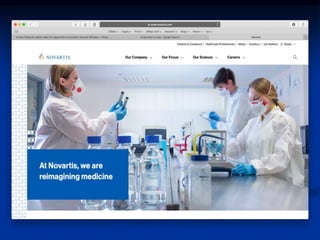
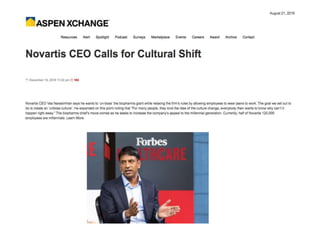
Novartis
An Evidence-Based Case Example
CEBMa EBM Practitioners Jamboree, June 11, 2021
From an EB-perspective,
what would your first step(s) be?
Four sources, six steps
problem solution
Practitioners
professional expertise
Organization
internal data
Stakeholders
values and concerns
Scientific literature
empirical studies
Ask
Acquire
Appraise
Aggregate
Apply
Assess
6 steps & skills
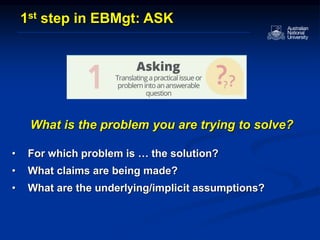
What is the problem you are trying to solve?
• For which problem is … the solution?
• What claims are being made?
• What are the underlying/implicit assumptions?
1st step in EBMgt: ASK
Our experience:
1. Messy, vague, abstract, all-encompassing
2. Looooooooooooooots of words (lectures)
3. Management jargon > construct validity?
4. The problem is often not the core-problem!
ASK > beware!
Business or Operating Unit/Franchise or Department
Our cultural aspiration comes to life
through our People Strategy and
“Moments that Matter”
My first
impression
My impact
Inspired
My growth
Curious
My ease of
doing work
My
rewards
My lasting
impression
“I’m learning to lead from role
models while preparing others to
lead today and in the future.”
My
leadership
Unbossed
1
“I am energized to work on
things that matter and connect
with others to amplify our
impact.”
“As I grow professionally, I have
the very best opportunities to
learn and develop.”
My
personal
moments
Business or Operating Unit/Franchise or Department
Culture Dashboard
Indicators to track cultural transformation
0
1
2
3
4
5
6
Category 1 Category 2 Category 3 Category 4
Curious Inspired
73
Unbossed
50%
10%
10%
10%
10%
10%
How can we see whether the culture transformation has effect?
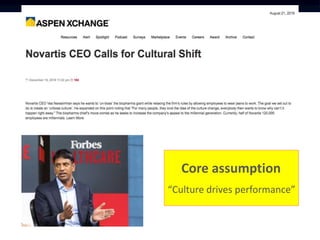
Core assumption
“Culture drives performance”
1. What is organizational culture?
2. How can you measure it in a reliable way?
3. Is there indeed a link between culture and
performance?
4. If so, are there contextual factors /
moderators that may affect the outcome?
Relevant EB-questions
Organizational culture?
Organization
internal data
Stakeholders
values and concerns
Scientific literature
empirical studies
Practitioners
professional expertise
Discuss with your table-members for 2 minutes
For you, as a manager,
1. What does ‘organizational culture’ mean?
2. How do you see, sense, or notice it?
• The term 'organizational culture’ is widely used by
managers but rarely defined. The definition has
been formulated inadequately with key aspects
remained undetermined.
Review of the business literature
Ten Have, S., ten Have, W., Huijsmans, A. B., & Otto, M. (2016). Reconsidering change management:
Applying evidence-based insights in change management practice. Routledge.
“The way we do things around here.”
“The collective behavior of people within an organization”
“The corporate values and norms that drive peoples’ behavior”
“Very hard to change, takes a lot of time & effort”
Practitioners
professional expertise
Organization
internal data
Stakeholders
values and concerns
Scientific literature
empirical studies
Scientific literature: REA
REA: Main finding nr 1
1. There is no consensus of what ‘organizational culture’ entails
Problem 1: ‘The’ organizational culture
Determined by
1. Profession
2. Social background
3. Cultural, ethnical
4. Age
5. Etc.
Problem 2: ’The’ organizational culture
Many sub-cultures
1. Division
2. Team
3. Functional group
4. Product group
5. Location
Problem 3: ’The’ organizational culture
Many topics
1. Equal payment
2. Health safety
3. Learning
4. Innovation
5. Speaking up
6. Respect
7. etc
The biggest problem = scope
A culture assessment is of little value unless it is
tied to an organizational problem or issue.
Assessing the culture for its own sake is useless!
1. What is organizational culture?
2. How can you measure it?
3. Is there a link between culture
and performance?
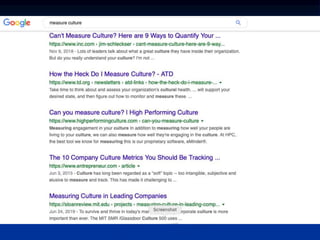
More than 100 culture assessment instruments
Many commercial instruments
Consulting firms have their own tool
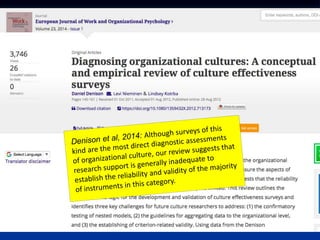
REA: Main finding nr 2
2. There is no consensus of how organizational culture can be
measured. Although many culture assessment tools are
available, most of the underlying research is inadequate to
establish their reliability and validity.
But surely there is some
relationship between an
organization’s culture and its
performance?
REA: main finding nr 3
3. The scientific evidence does not consistently show that
organizational culture is linked to performance
• The correlation between organizational culture and
performance is low (r < .2)
• Organizational culture is a weak predictor for performance
when compared to other factors
• It’s not the biggest bang for your buck
GREAT! NOW WHAT?
Evidence-based managers,
please, always …
1st step in EBMgt: ASK
What is the problem you are trying to solve?
Culture > people performance!
What are the company’s 2 or 5
core assumptions regarding peoples’
performance?
Global Talent Management
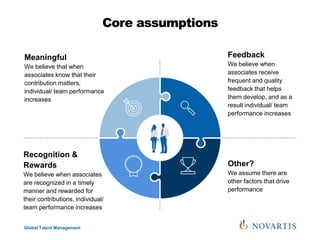
Core assumptions
Meaningful
We believe that when
associates know that their
contribution matters,
individual/ team performance
increases
Feedback
We believe when
associates receive
frequent and quality
feedback that helps
them develop, and as a
result individual/ team
performance increases
Recognition &
Rewards
We believe when associates
are recognized in a timely
manner and rewarded for
their contributions, individual/
team performance increases
Other?
We assume there are
other factors that drive
performance
ASK:
What is known in the scientific literature about the
impact of …
 feedback
 meaningful work
 recognition and rewards
 other factors - drivers of KWP
- attributes of successful teams
… on workplace performance?
REAs conducted by CEBMa
Main findings feedback
1. There is strong evidence that feedback can have a large effect
on people’s learning and performance (.4 / .7)
2. But … the effect sizes reported show considerable variability,
indicating that the effect of feedback is contingent upon
various moderating factors (level A)
Main findings feedback
1. Reactions to feedback, rather than the feedback itself,
influence performance
2. The effect of feedback is moderated by task type
3. The perceived fairness of the feedback has a medium to large
moderating effect on performance
4. Feedback which provides detailed information leads to a
higher improvement in performance
5. Feedback is less effective when it is perceived as threatening
one’s self esteem
Main findings meaningful work
1. Work meaningfulness is strongly associated with higher
performance (.7/.5)
2. Work meaningfulness is positively related to general health and
psychological well-being (.45)
3. Work meaningfulness moderates the relationship between
work demands and stress & burnout
4. There are several antecedents of meaningful work, such as
• Job characteristics (variety, autonomy, feedback)
• Corporate social responsibility
• Leadership style (empowering, ethical, responsible)
• Relationship with co-workers
Main findings recognition & rewards
1. There is strong evidence that employee recognition and non-
financial rewards have a moderate to large effect on workplace
performance
2. Recognition and rewards can have a negative impact on
performance when they are offered for simply doing a task
3. Employee recognition has a large positive impact on employee
attendance
4. Employee recognition produces strong spillover effects on
other employees
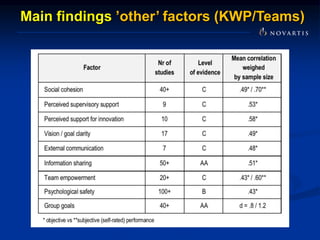
Main findings ’other’ factors (KWP/Teams)
How could you apply these
findings in practice?
Next steps (in general)
1. Establish a baseline > are there differences?
2. Educate / train managers
3. Develop tools, guidelines & provide support
4. Build a dashboard & monitor (assess) the outcomes
Next steps (Novartis)
1. Developed an internal diagnostic tool based on
validated scales identified by the REAs > pre-tested it
with 125 teams, outcome analyzed by Novartis’
People Metrics team.
Next steps (Novartis)
2. Set up a “Team Effectiveness” Community of Practice
3. Partnered with Ashridge Executive Education school
to build a ‘team effectiveness’ program as part of
Novartis’ internal HR education practice.
4. Developed an internal Team Effectiveness share point
site with a variety of on-line tools linked directly to
the diagnostic tool.
Next steps (Novartis)
5. Conducted a randomized controlled trial (n = 16.000?)
to measure the effect.
1. Always ask: what is exactly the problem that needs to be
solved? (keep asking “Why”!)
2. It’s often messy, vague, unclear, all-encompassing
3. Think twice before you take the culture approach:
improper use of culture as an excuse or metaphor
4. Caveat: language, jargon, constructs!
(does it mean what they think it means?)
5. Focus on claims, core assumptions
6. Keep it simple! Boil it down to (max 3 to 5) issues
7. Be nice!
Take always
Presentation CEBMa EBM Case example: Novartis

Presentation CEBMa EBM Case example: Novartis

  • 1.
    Novartis An Evidence-Based CaseExample CEBMa EBM Practitioners Jamboree, June 11, 2021
  • 4.
    From an EB-perspective, whatwould your first step(s) be?
  • 5.
    Four sources, sixsteps problem solution Practitioners professional expertise Organization internal data Stakeholders values and concerns Scientific literature empirical studies Ask Acquire Appraise Aggregate Apply Assess
  • 6.
    6 steps &skills
  • 7.
    What is theproblem you are trying to solve? • For which problem is … the solution? • What claims are being made? • What are the underlying/implicit assumptions? 1st step in EBMgt: ASK
  • 8.
    1st step inEBMgt: ASK Our experience: 1. Messy, vague, abstract, all-encompassing 2. Looooooooooooooots of words (lectures) 3. Management jargon > construct validity? 4. The problem is often not the core-problem!
  • 9.
  • 11.
    Business or OperatingUnit/Franchise or Department Our cultural aspiration comes to life through our People Strategy and “Moments that Matter” My first impression My impact Inspired My growth Curious My ease of doing work My rewards My lasting impression “I’m learning to lead from role models while preparing others to lead today and in the future.” My leadership Unbossed 1 “I am energized to work on things that matter and connect with others to amplify our impact.” “As I grow professionally, I have the very best opportunities to learn and develop.” My personal moments
  • 12.
    Business or OperatingUnit/Franchise or Department Culture Dashboard Indicators to track cultural transformation 0 1 2 3 4 5 6 Category 1 Category 2 Category 3 Category 4 Curious Inspired 73 Unbossed 50% 10% 10% 10% 10% 10% How can we see whether the culture transformation has effect?
  • 13.
  • 14.
    1. What isorganizational culture? 2. How can you measure it in a reliable way? 3. Is there indeed a link between culture and performance? 4. If so, are there contextual factors / moderators that may affect the outcome? Relevant EB-questions
  • 15.
  • 16.
    Organization internal data Stakeholders values andconcerns Scientific literature empirical studies Practitioners professional expertise
  • 22.
    Discuss with yourtable-members for 2 minutes For you, as a manager, 1. What does ‘organizational culture’ mean? 2. How do you see, sense, or notice it?
  • 23.
    • The term'organizational culture’ is widely used by managers but rarely defined. The definition has been formulated inadequately with key aspects remained undetermined. Review of the business literature Ten Have, S., ten Have, W., Huijsmans, A. B., & Otto, M. (2016). Reconsidering change management: Applying evidence-based insights in change management practice. Routledge. “The way we do things around here.” “The collective behavior of people within an organization” “The corporate values and norms that drive peoples’ behavior” “Very hard to change, takes a lot of time & effort”
  • 24.
    Practitioners professional expertise Organization internal data Stakeholders valuesand concerns Scientific literature empirical studies Scientific literature: REA
  • 26.
    REA: Main findingnr 1 1. There is no consensus of what ‘organizational culture’ entails
  • 27.
    Problem 1: ‘The’organizational culture Determined by 1. Profession 2. Social background 3. Cultural, ethnical 4. Age 5. Etc.
  • 28.
    Problem 2: ’The’organizational culture Many sub-cultures 1. Division 2. Team 3. Functional group 4. Product group 5. Location
  • 29.
    Problem 3: ’The’organizational culture Many topics 1. Equal payment 2. Health safety 3. Learning 4. Innovation 5. Speaking up 6. Respect 7. etc
  • 30.
    The biggest problem= scope A culture assessment is of little value unless it is tied to an organizational problem or issue. Assessing the culture for its own sake is useless!
  • 34.
    1. What isorganizational culture? 2. How can you measure it? 3. Is there a link between culture and performance?
  • 36.
    More than 100culture assessment instruments
  • 37.
  • 38.
    Consulting firms havetheir own tool
  • 39.
    REA: Main findingnr 2 2. There is no consensus of how organizational culture can be measured. Although many culture assessment tools are available, most of the underlying research is inadequate to establish their reliability and validity.
  • 42.
    But surely thereis some relationship between an organization’s culture and its performance?
  • 43.
    REA: main findingnr 3 3. The scientific evidence does not consistently show that organizational culture is linked to performance • The correlation between organizational culture and performance is low (r < .2) • Organizational culture is a weak predictor for performance when compared to other factors • It’s not the biggest bang for your buck
  • 45.
  • 46.
  • 48.
    1st step inEBMgt: ASK What is the problem you are trying to solve? Culture > people performance! What are the company’s 2 or 5 core assumptions regarding peoples’ performance?
  • 49.
    Global Talent Management Coreassumptions Meaningful We believe that when associates know that their contribution matters, individual/ team performance increases Feedback We believe when associates receive frequent and quality feedback that helps them develop, and as a result individual/ team performance increases Recognition & Rewards We believe when associates are recognized in a timely manner and rewarded for their contributions, individual/ team performance increases Other? We assume there are other factors that drive performance
  • 50.
    ASK: What is knownin the scientific literature about the impact of …  feedback  meaningful work  recognition and rewards  other factors - drivers of KWP - attributes of successful teams … on workplace performance?
  • 51.
  • 52.
    Main findings feedback 1.There is strong evidence that feedback can have a large effect on people’s learning and performance (.4 / .7) 2. But … the effect sizes reported show considerable variability, indicating that the effect of feedback is contingent upon various moderating factors (level A)
  • 53.
    Main findings feedback 1.Reactions to feedback, rather than the feedback itself, influence performance 2. The effect of feedback is moderated by task type 3. The perceived fairness of the feedback has a medium to large moderating effect on performance 4. Feedback which provides detailed information leads to a higher improvement in performance 5. Feedback is less effective when it is perceived as threatening one’s self esteem
  • 54.
    Main findings meaningfulwork 1. Work meaningfulness is strongly associated with higher performance (.7/.5) 2. Work meaningfulness is positively related to general health and psychological well-being (.45) 3. Work meaningfulness moderates the relationship between work demands and stress & burnout 4. There are several antecedents of meaningful work, such as • Job characteristics (variety, autonomy, feedback) • Corporate social responsibility • Leadership style (empowering, ethical, responsible) • Relationship with co-workers
  • 55.
    Main findings recognition& rewards 1. There is strong evidence that employee recognition and non- financial rewards have a moderate to large effect on workplace performance 2. Recognition and rewards can have a negative impact on performance when they are offered for simply doing a task 3. Employee recognition has a large positive impact on employee attendance 4. Employee recognition produces strong spillover effects on other employees
  • 56.
    Main findings ’other’factors (KWP/Teams)
  • 57.
    How could youapply these findings in practice?
  • 58.
    Next steps (ingeneral) 1. Establish a baseline > are there differences? 2. Educate / train managers 3. Develop tools, guidelines & provide support 4. Build a dashboard & monitor (assess) the outcomes
  • 59.
    Next steps (Novartis) 1.Developed an internal diagnostic tool based on validated scales identified by the REAs > pre-tested it with 125 teams, outcome analyzed by Novartis’ People Metrics team.
  • 60.
    Next steps (Novartis) 2.Set up a “Team Effectiveness” Community of Practice 3. Partnered with Ashridge Executive Education school to build a ‘team effectiveness’ program as part of Novartis’ internal HR education practice. 4. Developed an internal Team Effectiveness share point site with a variety of on-line tools linked directly to the diagnostic tool.
  • 61.
    Next steps (Novartis) 5.Conducted a randomized controlled trial (n = 16.000?) to measure the effect.
  • 62.
    1. Always ask:what is exactly the problem that needs to be solved? (keep asking “Why”!) 2. It’s often messy, vague, unclear, all-encompassing 3. Think twice before you take the culture approach: improper use of culture as an excuse or metaphor 4. Caveat: language, jargon, constructs! (does it mean what they think it means?) 5. Focus on claims, core assumptions 6. Keep it simple! Boil it down to (max 3 to 5) issues 7. Be nice! Take always