Agenda
A brief history of the State of DevOps Report
Theory, survey design, demographics and psychographics
IT and security performance findings
Continuous integration/delivery redux
About the authors
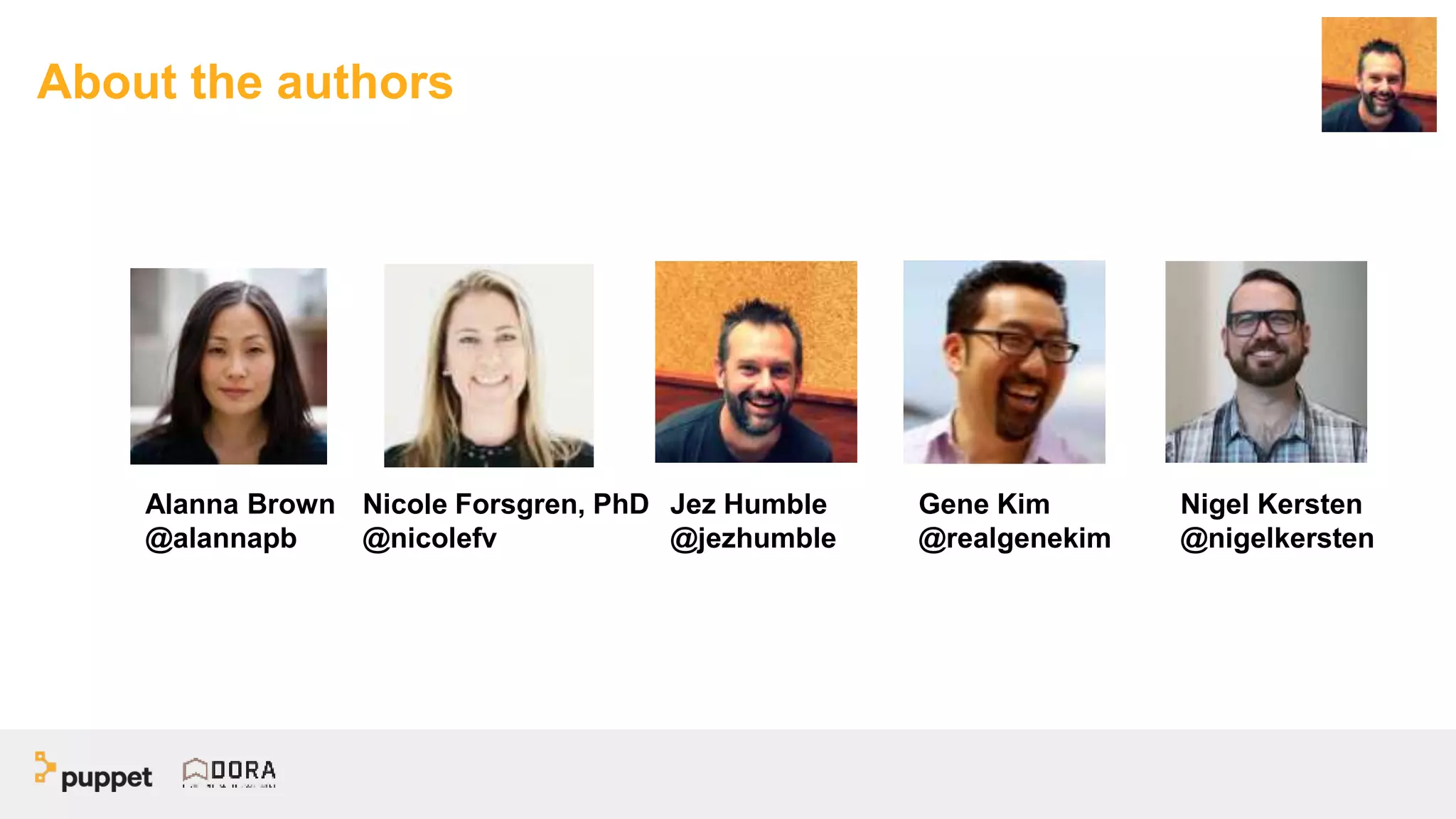
Alanna Brown
@alannapb
Nicole Forsgren, PhD
@nicolefv
Jez Humble
@jezhumble
Nigel Kersten
@nigelkersten
Gene Kim
@realgenekim
DevOps Grows Up
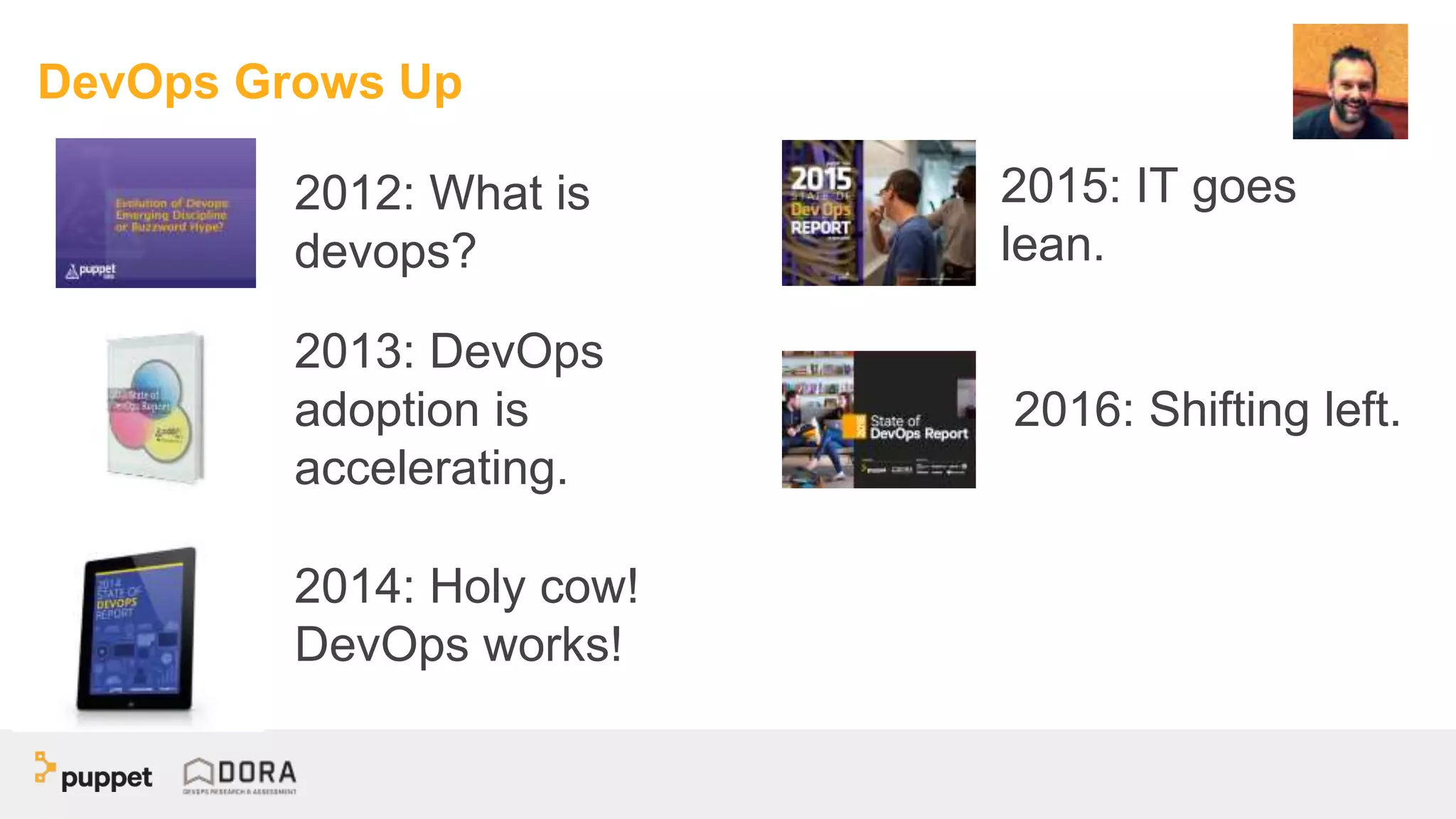
2012: What is
devops?
2013: DevOps
adoption is
accelerating.
2014: Holy cow!
DevOps works!
2015: IT goes
lean.
2016: Shifting left.
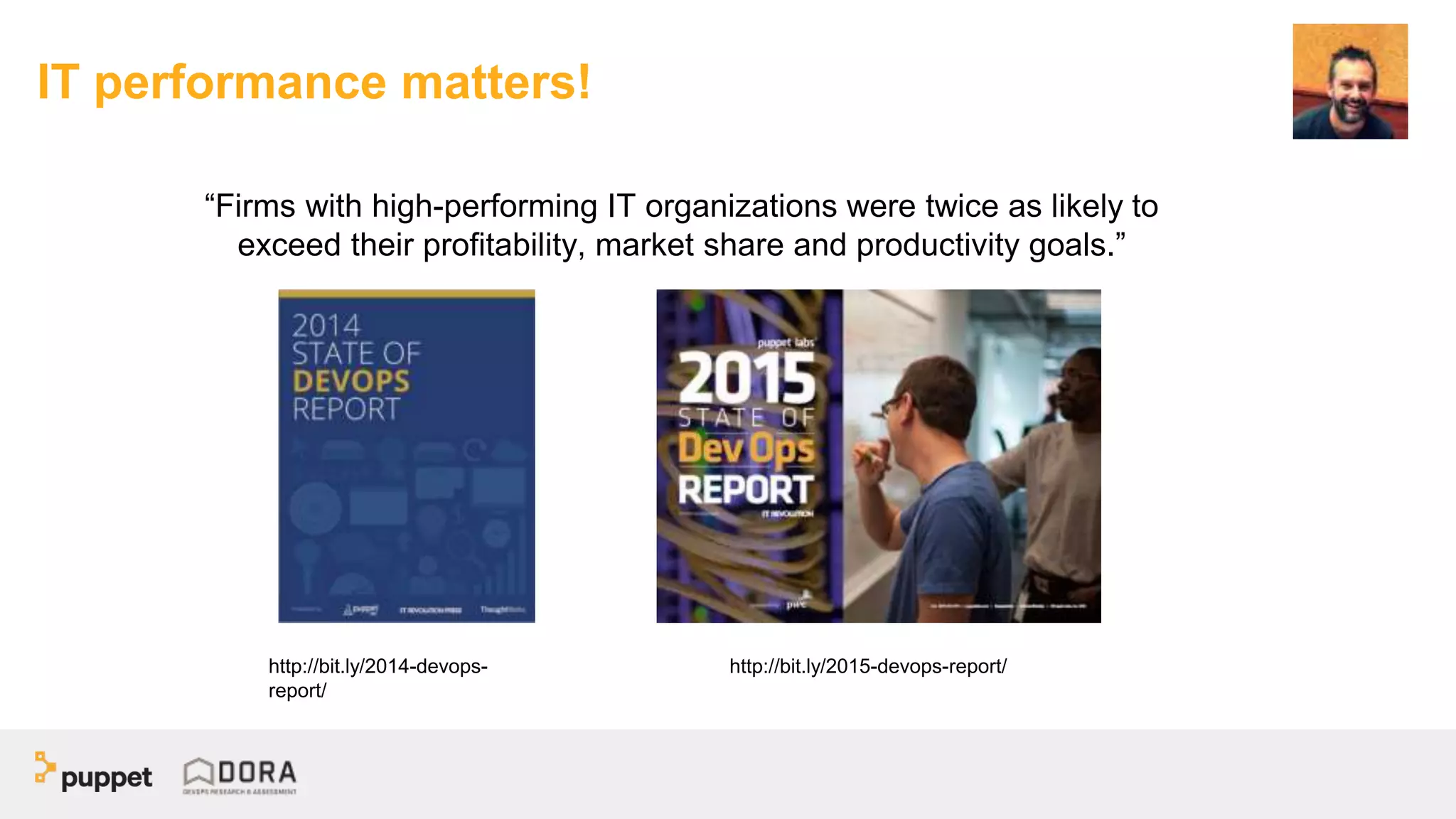
IT performance matters!
“Firms with high-performing IT organizations were twice as likely to
exceed their profitability, market share and productivity goals.”
http://bit.ly/2015-devops-report/http://bit.ly/2014-devops-
report/
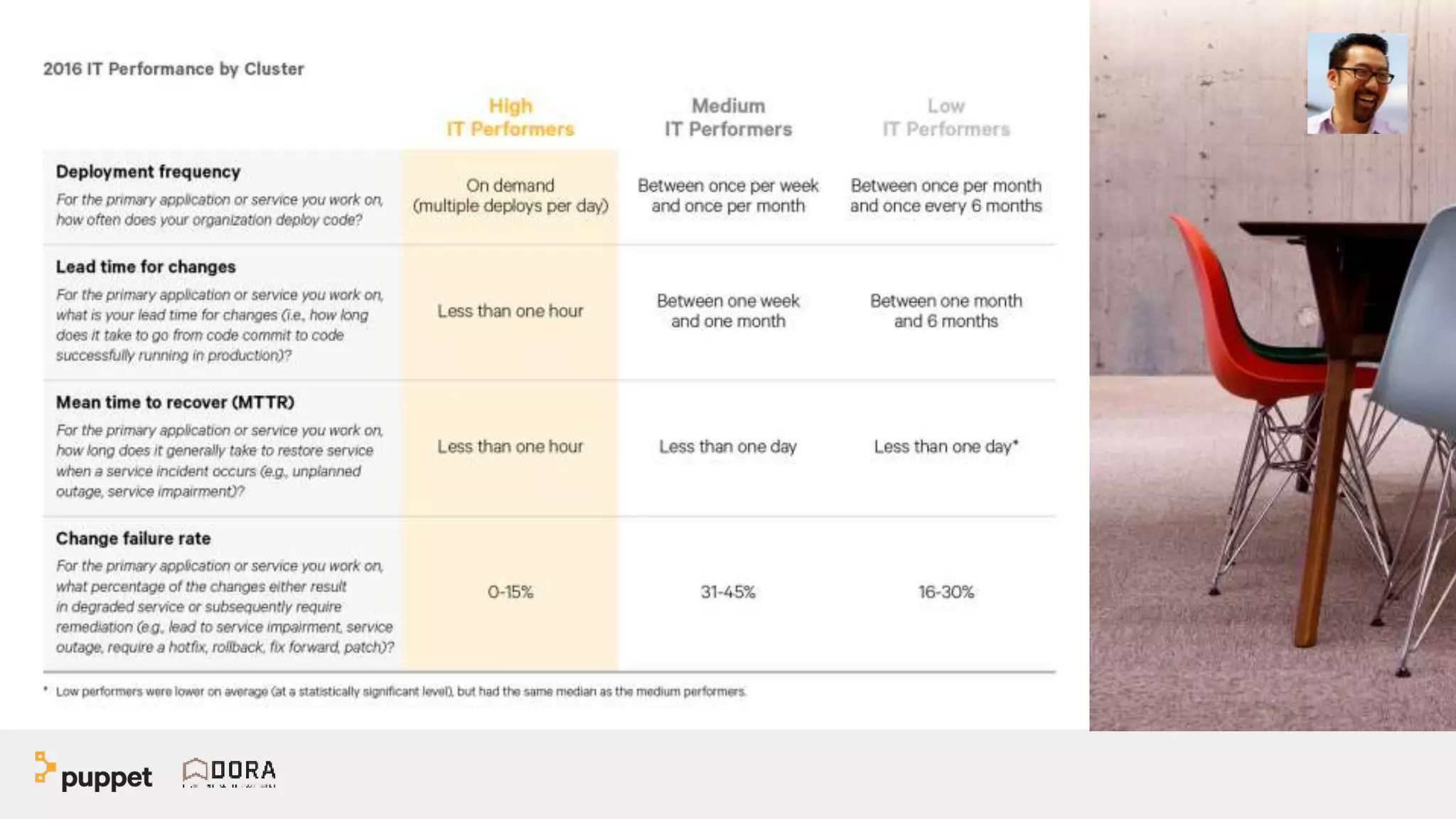
IT performance
lead time for changes
release frequency
time to restore service
change fail rate
Not all data is created equal
Who here thinks surveys are sh*t?
[Nicole should probably turn around]
Who here LOVES the data from their log files?
And who has seen sh*t data in a log file?
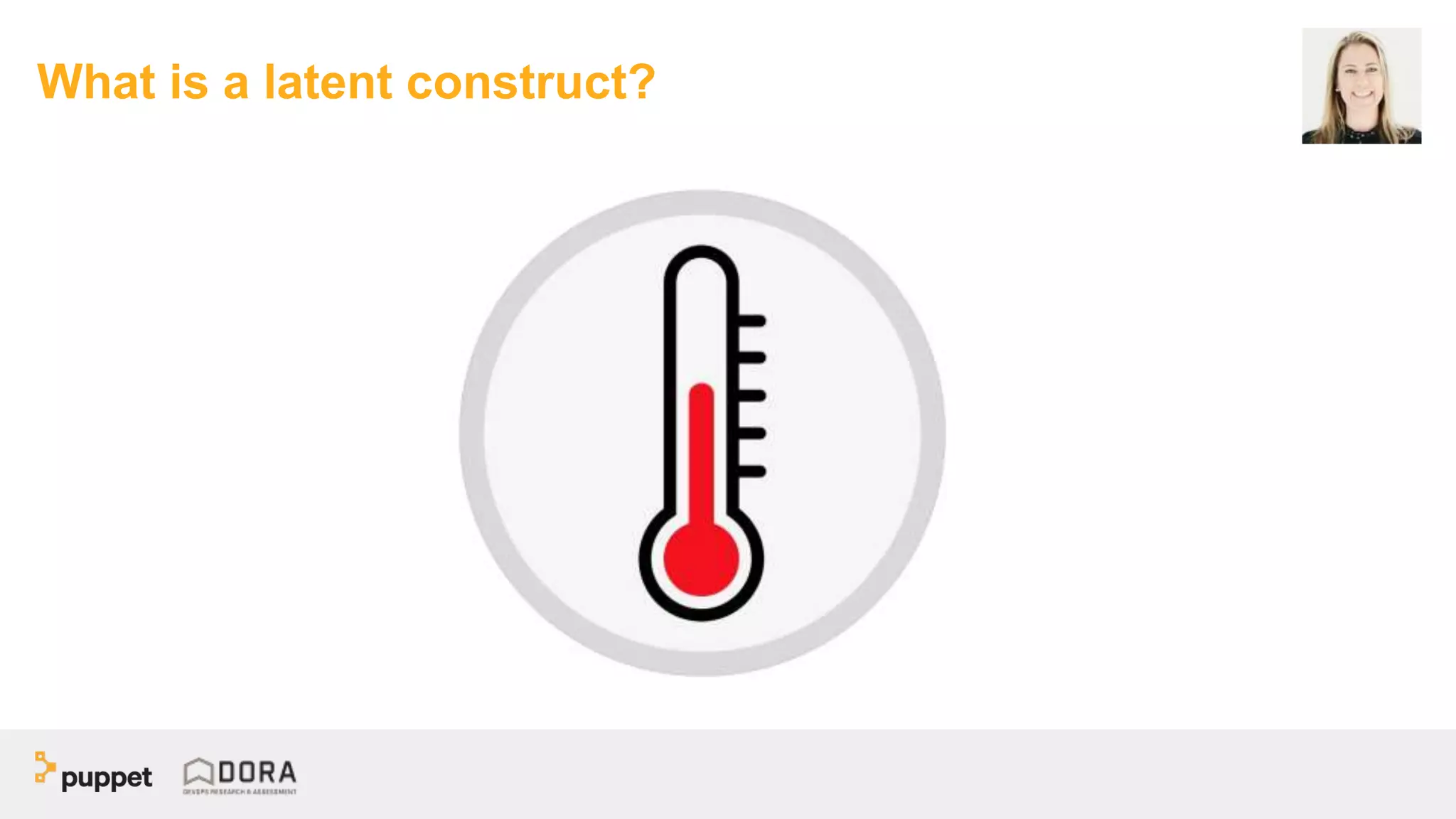
What is a latent construct?
We use
PSYCHOMETRICS
to make our survey data good*
*or give us a reasonable assurance that it’s telling us what we think it’s
telling us (& some of this can also apply to your log data)
Construct creation (manual)
When possible: use previously validated constructs
Based on definitions and theory, carefully and precisely worded, card
sorting task, pilot tested
Construct evaluation (statistics)
Establishing Validity: discriminant and convergent
Establishing Reliability
Psychometrics includes:
Statistics bingo!
Measure assessment: measures exhibit good psychometric properties
(composite reliability, AVE, EFA measures load well and do not
cross-load, etc)
Model assessment: PLS was used to assess the structured equation
models
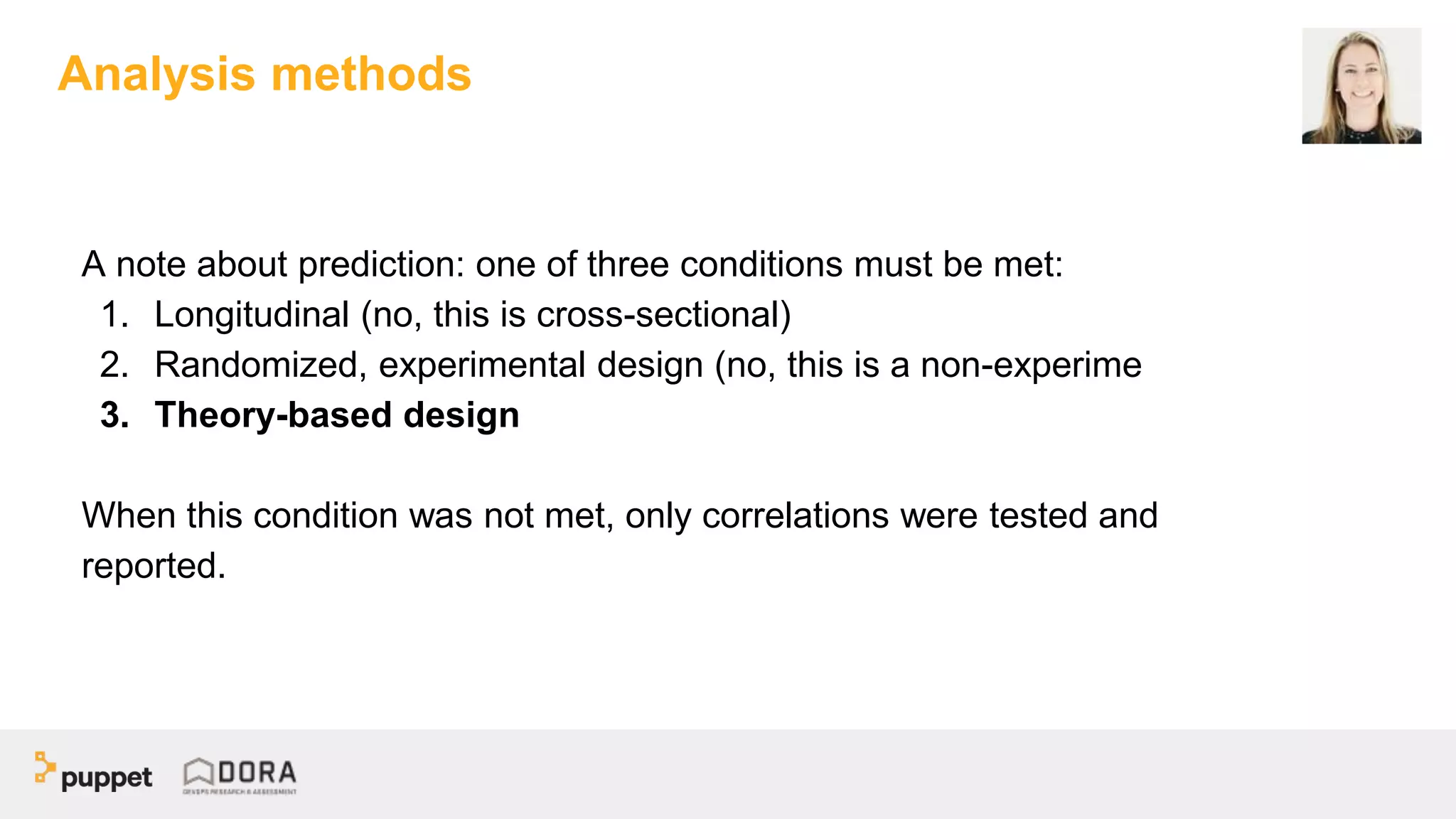
Analysis methods
A note about prediction: one of three conditions must be met:
1. Longitudinal (no, this is cross-sectional)
2. Randomized, experimental design (no, this is a non-experime
3. Theory-based design
When this condition was not met, only correlations were tested and
reported.
Analysis methods
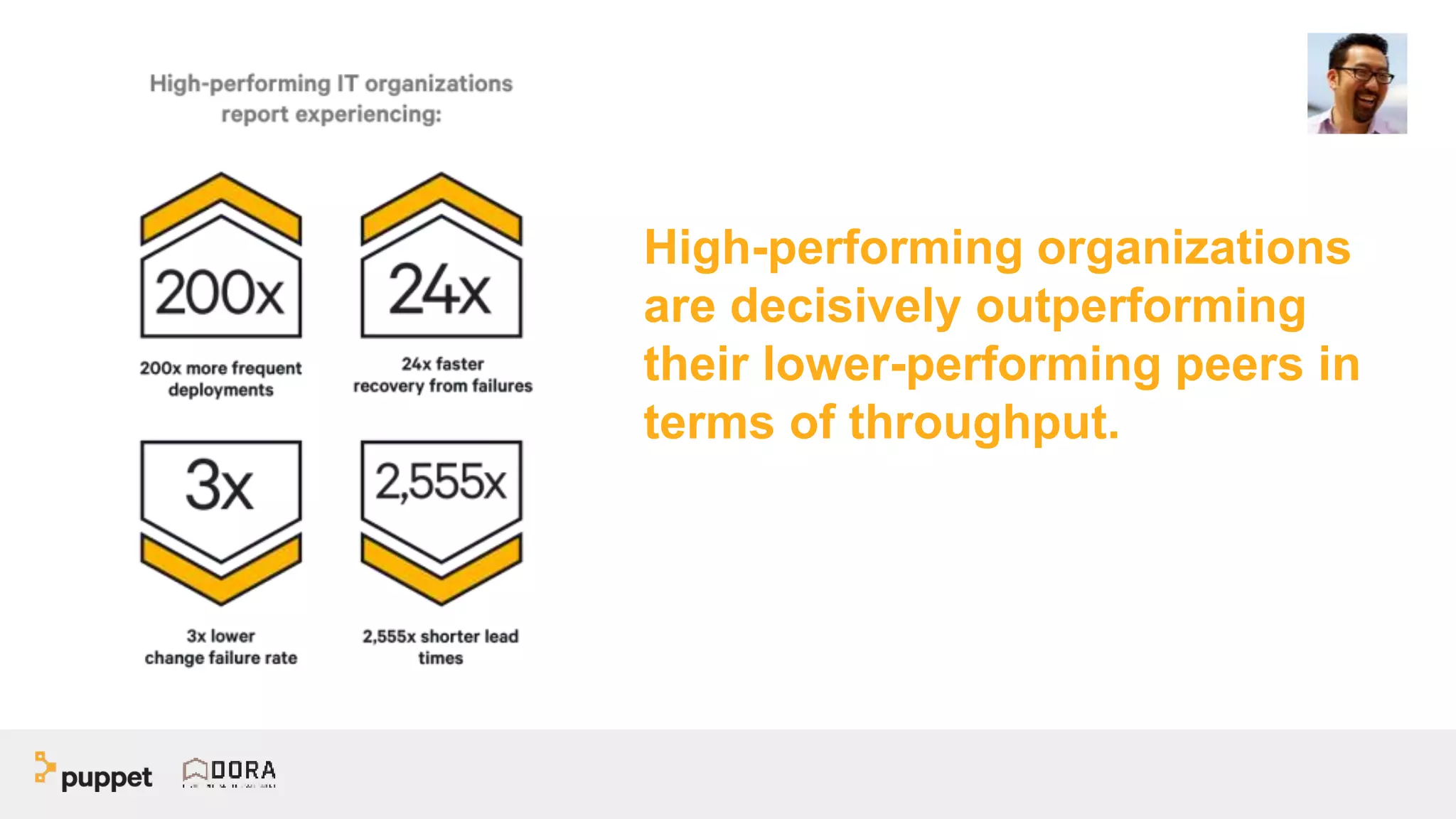
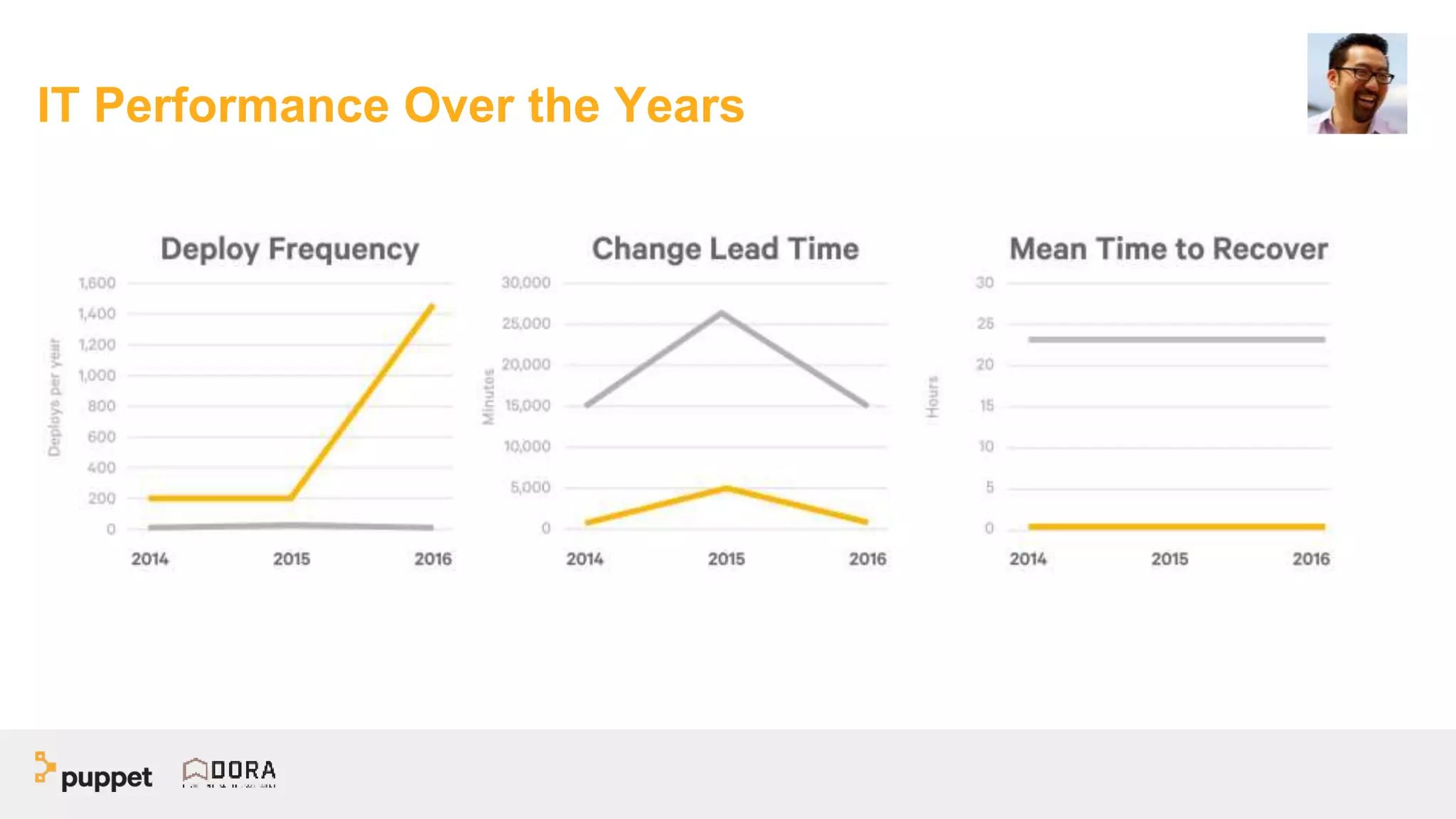
High-performing organizations
are decisively outperforming
their lower-performing peers in
terms of throughput.
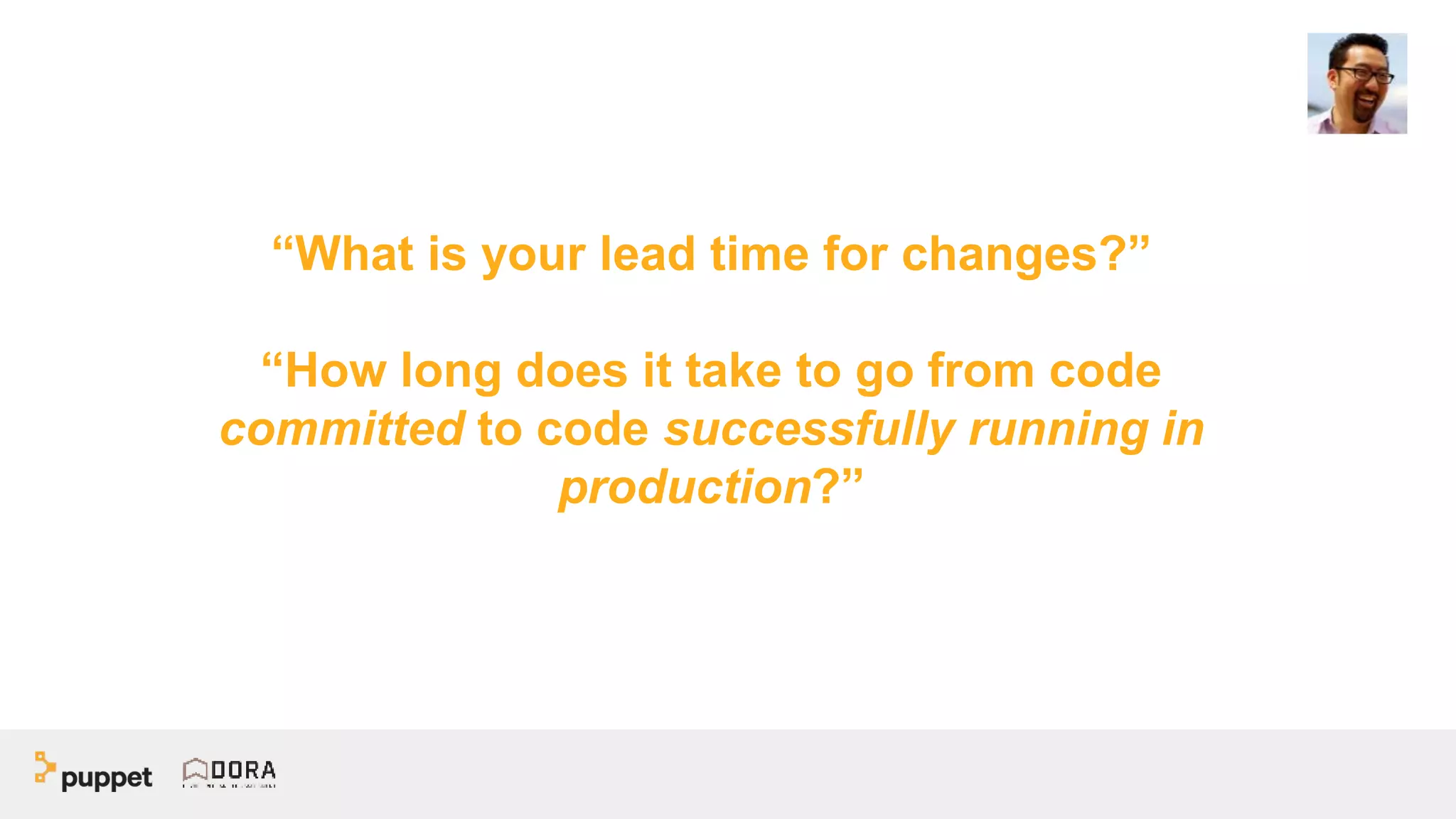
“What is your lead time for changes?”
“How long does it take to go from code
committed to code successfully running in
production?”
IT Performance Over the Years
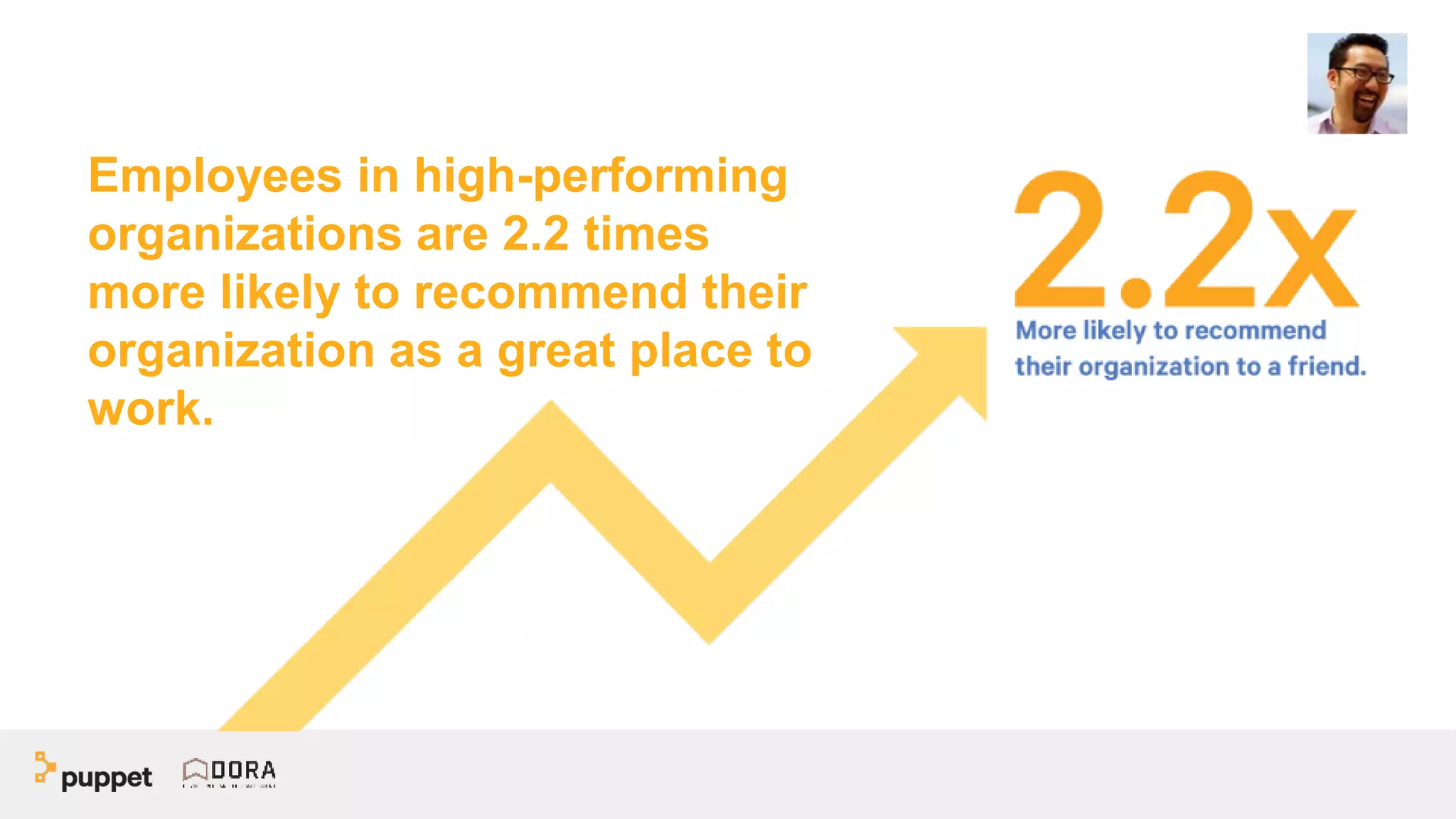
Employees in high-performing
organizations are 2.2 times
more likely to recommend their
organization as a great place to
work.
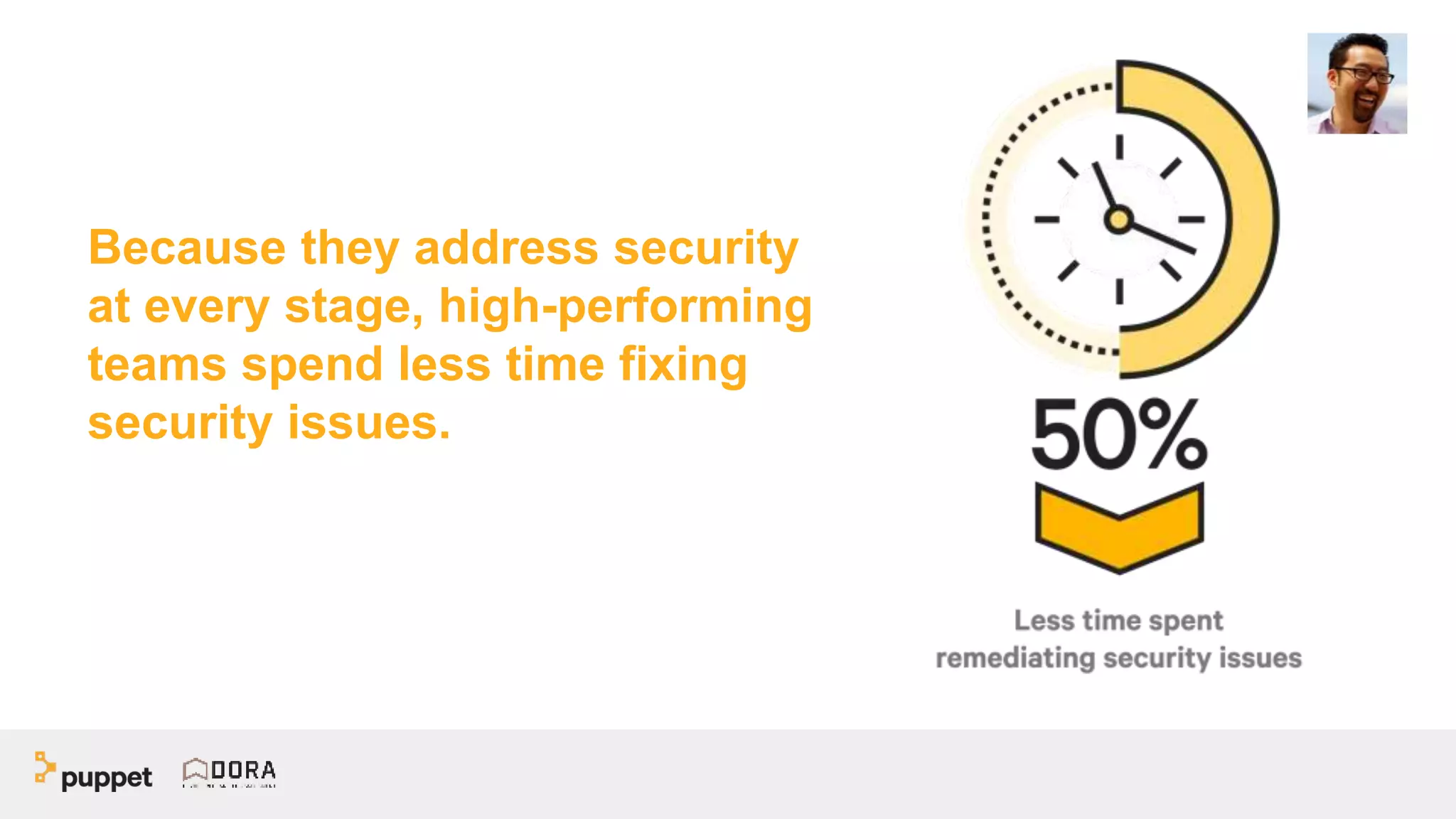
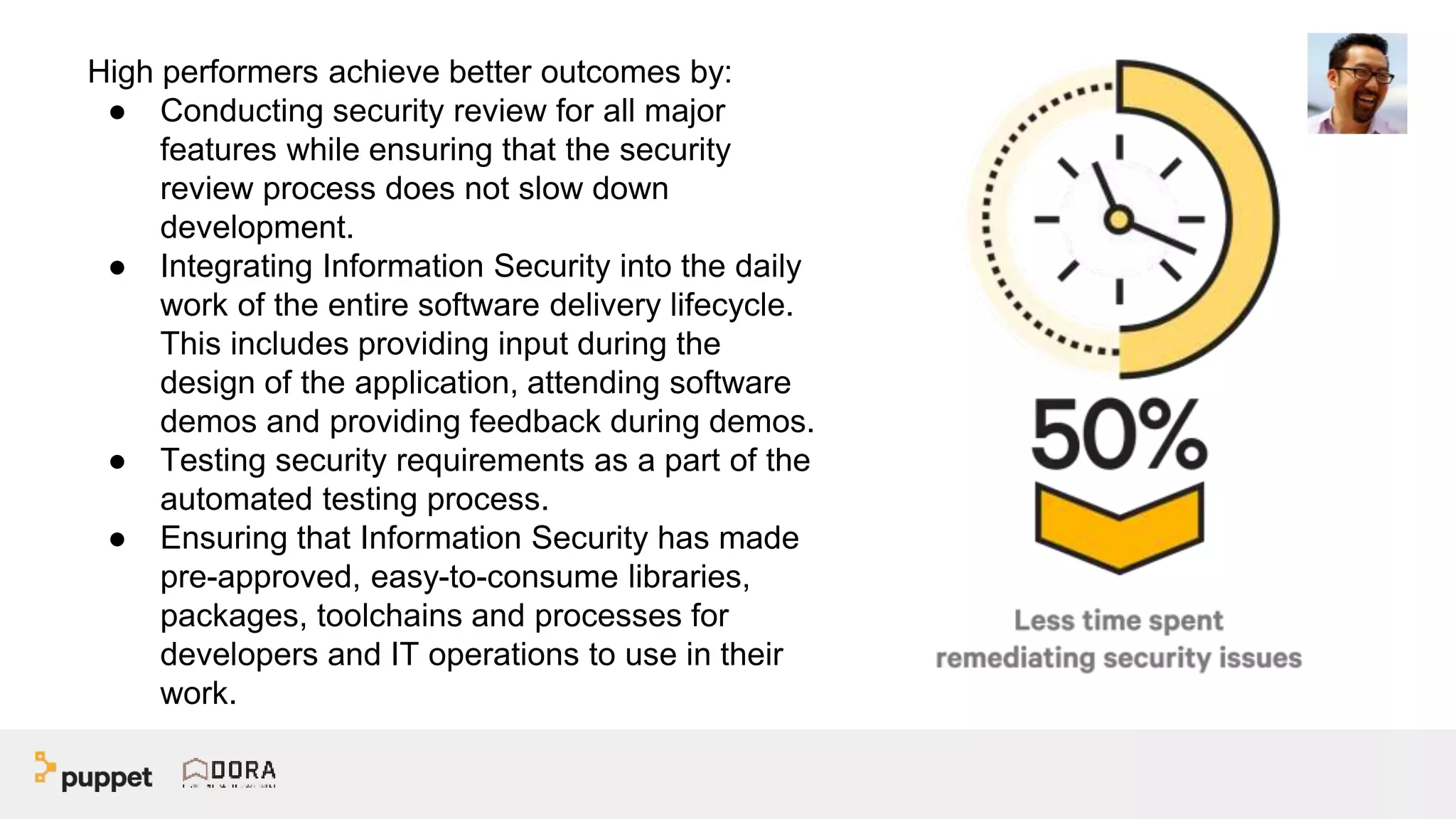
Because they address security
at every stage, high-performing
teams spend less time fixing
security issues.
23
High performers achieve better outcomes by:
● Conducting security review for all major
features while ensuring that the security
review process does not slow down
development.
● Integrating Information Security into the daily
work of the entire software delivery lifecycle.
This includes providing input during the
design of the application, attending software
demos and providing feedback during demos.
● Testing security requirements as a part of the
automated testing process.
● Ensuring that Information Security has made
pre-approved, easy-to-consume libraries,
packages, toolchains and processes for
developers and IT operations to use in their
work.
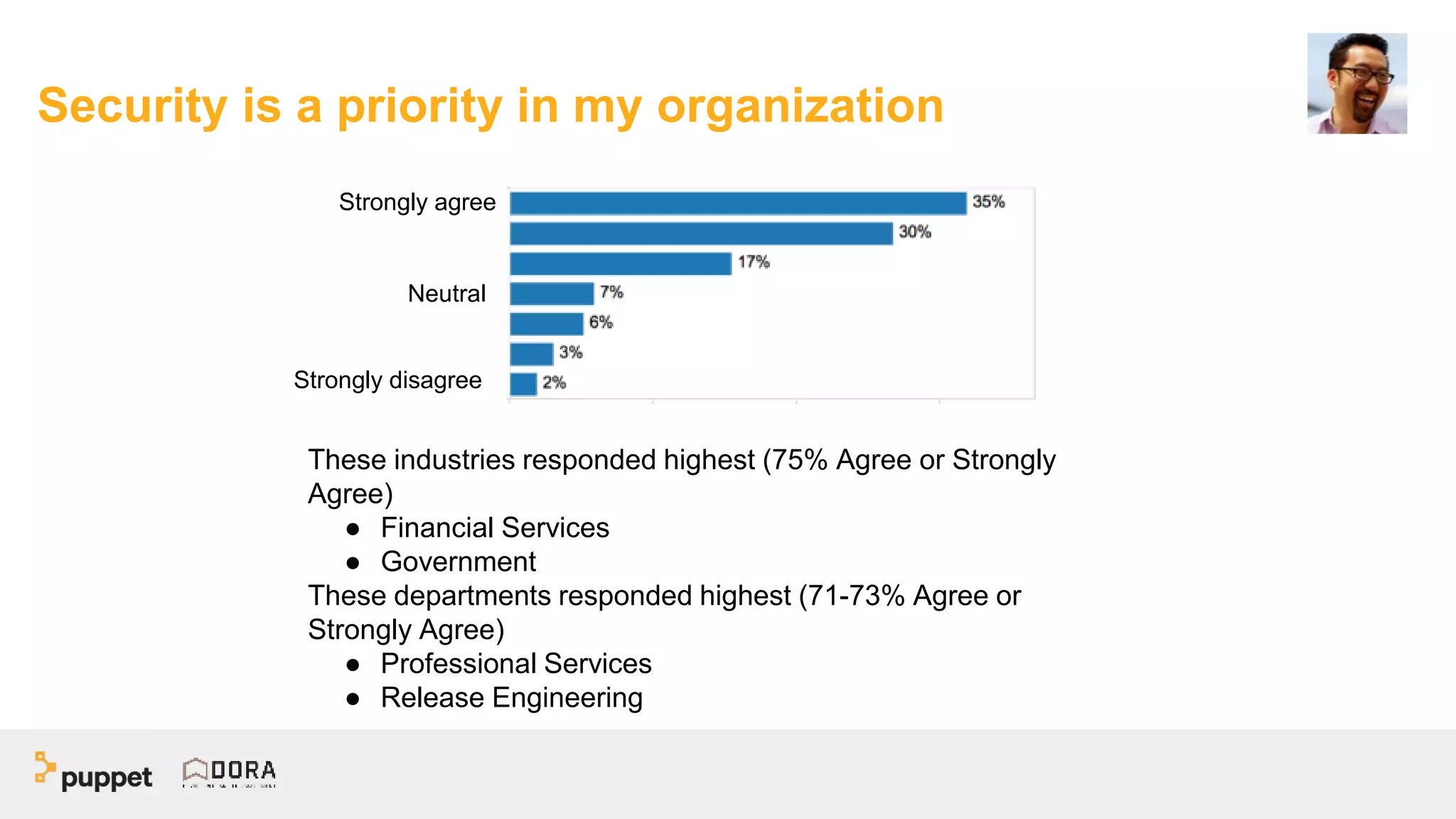
Security is a priority in my organization
Strongly agree
Strongly disagree
Neutral
These industries responded highest (75% Agree or Strongly
Agree)
● Financial Services
● Government
These departments responded highest (71-73% Agree or
Strongly Agree)
● Professional Services
● Release Engineering
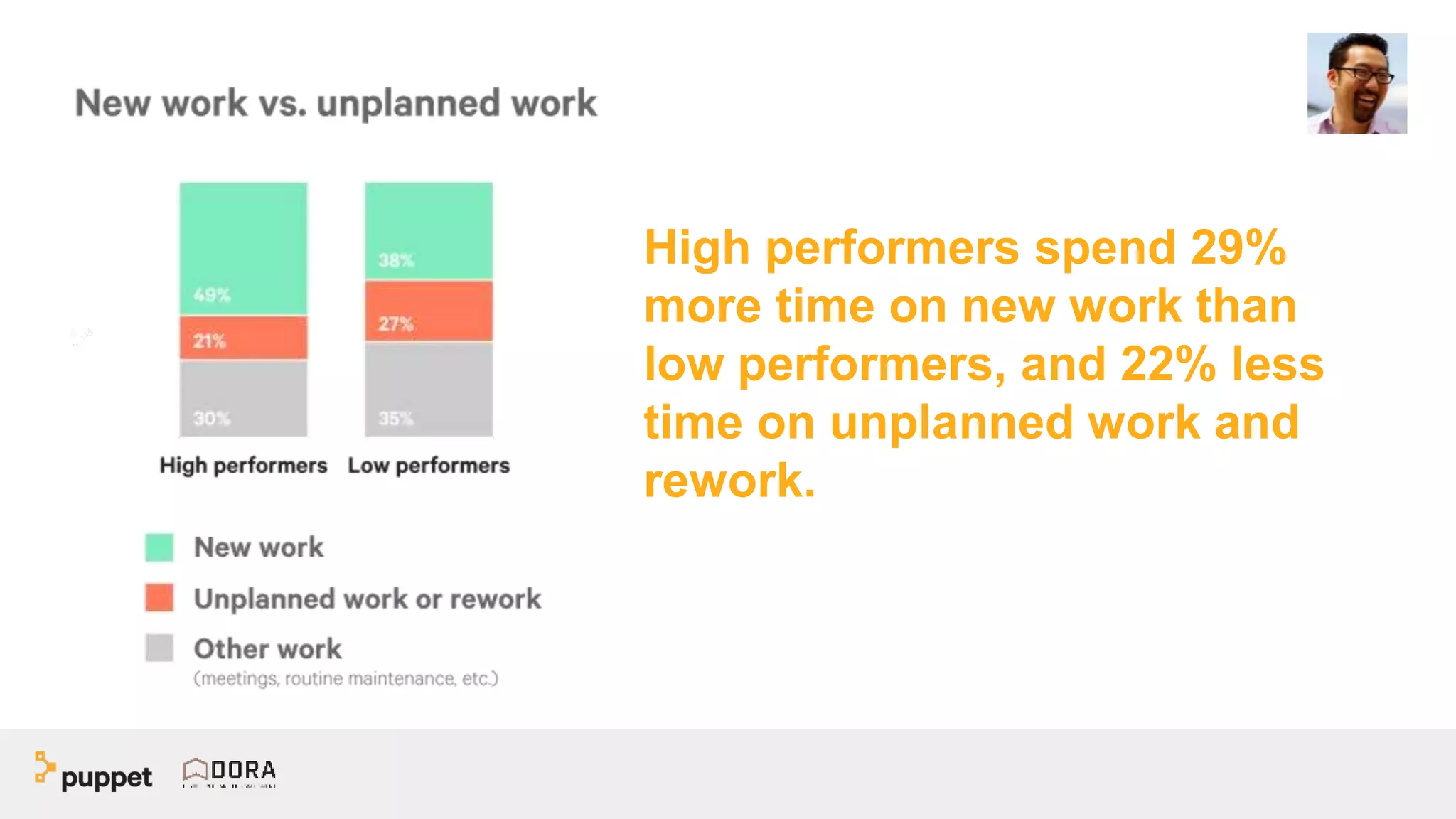
High performers spend 29%
more time on new work than
low performers, and 22% less
time on unplanned work and
rework.
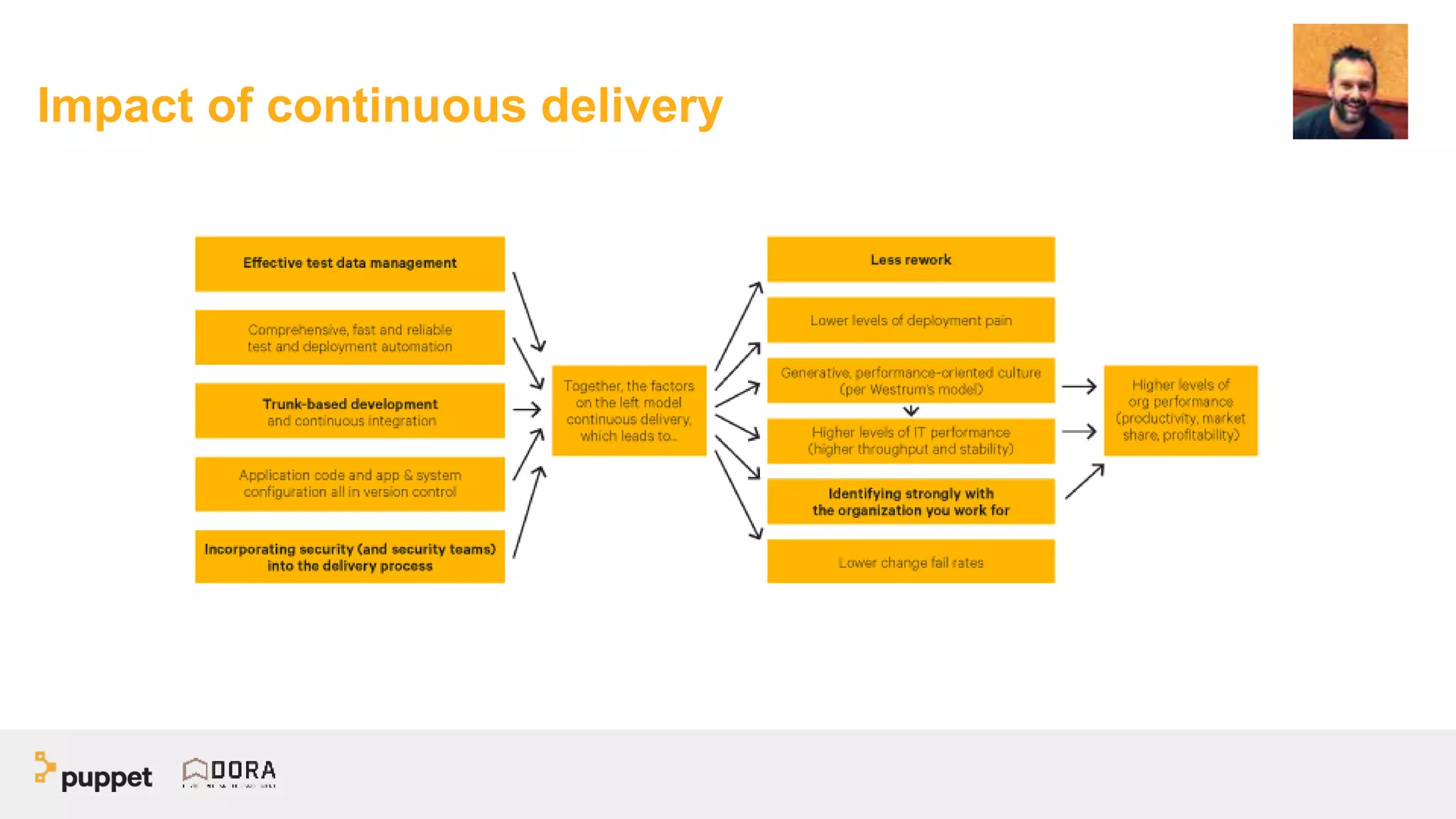
Impact of continuous delivery
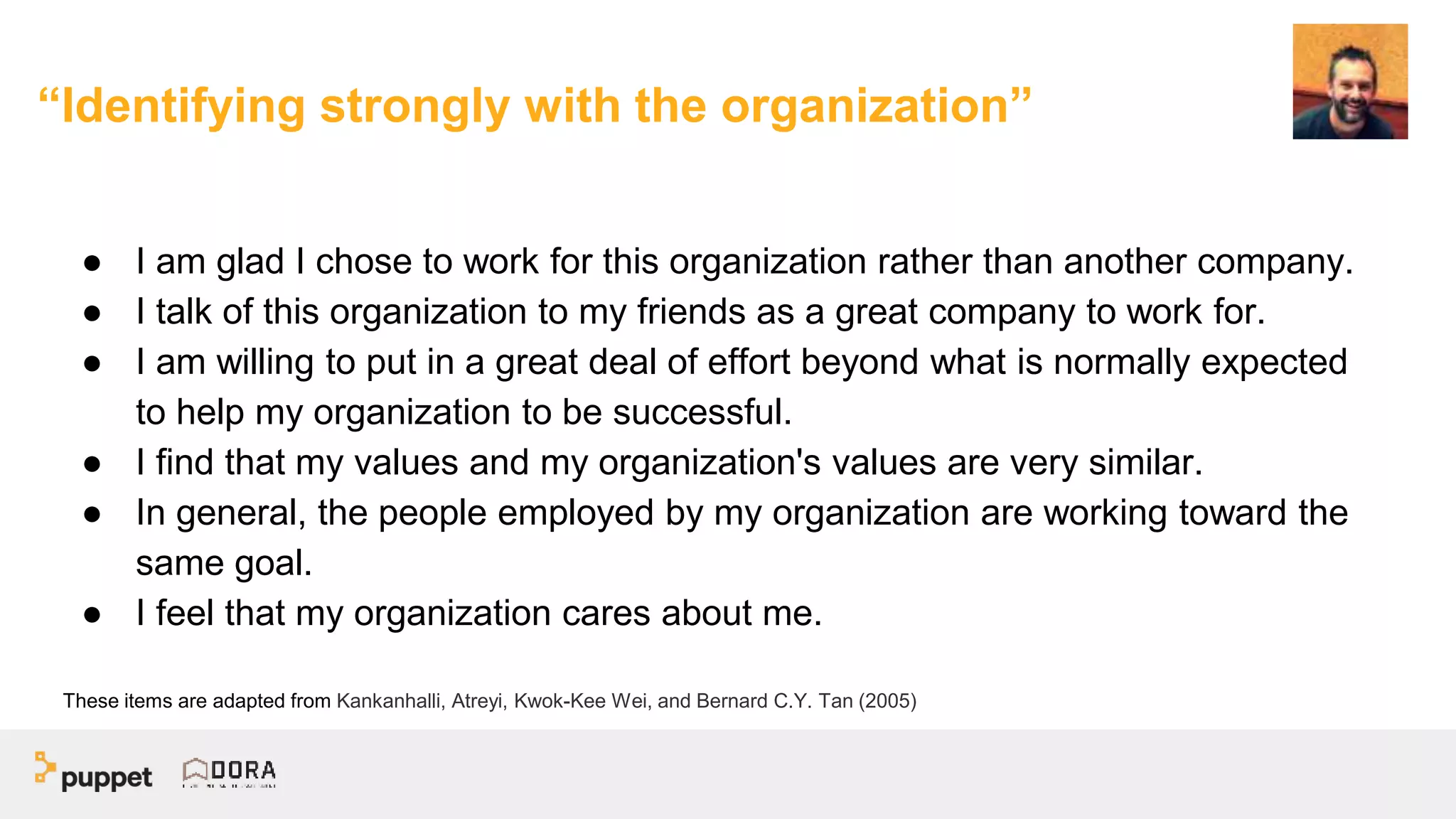
“Identifying strongly with the organization”
● I am glad I chose to work for this organization rather than another company.
● I talk of this organization to my friends as a great company to work for.
● I am willing to put in a great deal of effort beyond what is normally expected
to help my organization to be successful.
● I find that my values and my organization's values are very similar.
● In general, the people employed by my organization are working toward the
same goal.
● I feel that my organization cares about me.
These items are adapted from Kankanhalli, Atreyi, Kwok-Kee Wei, and Bernard C.Y. Tan (2005)
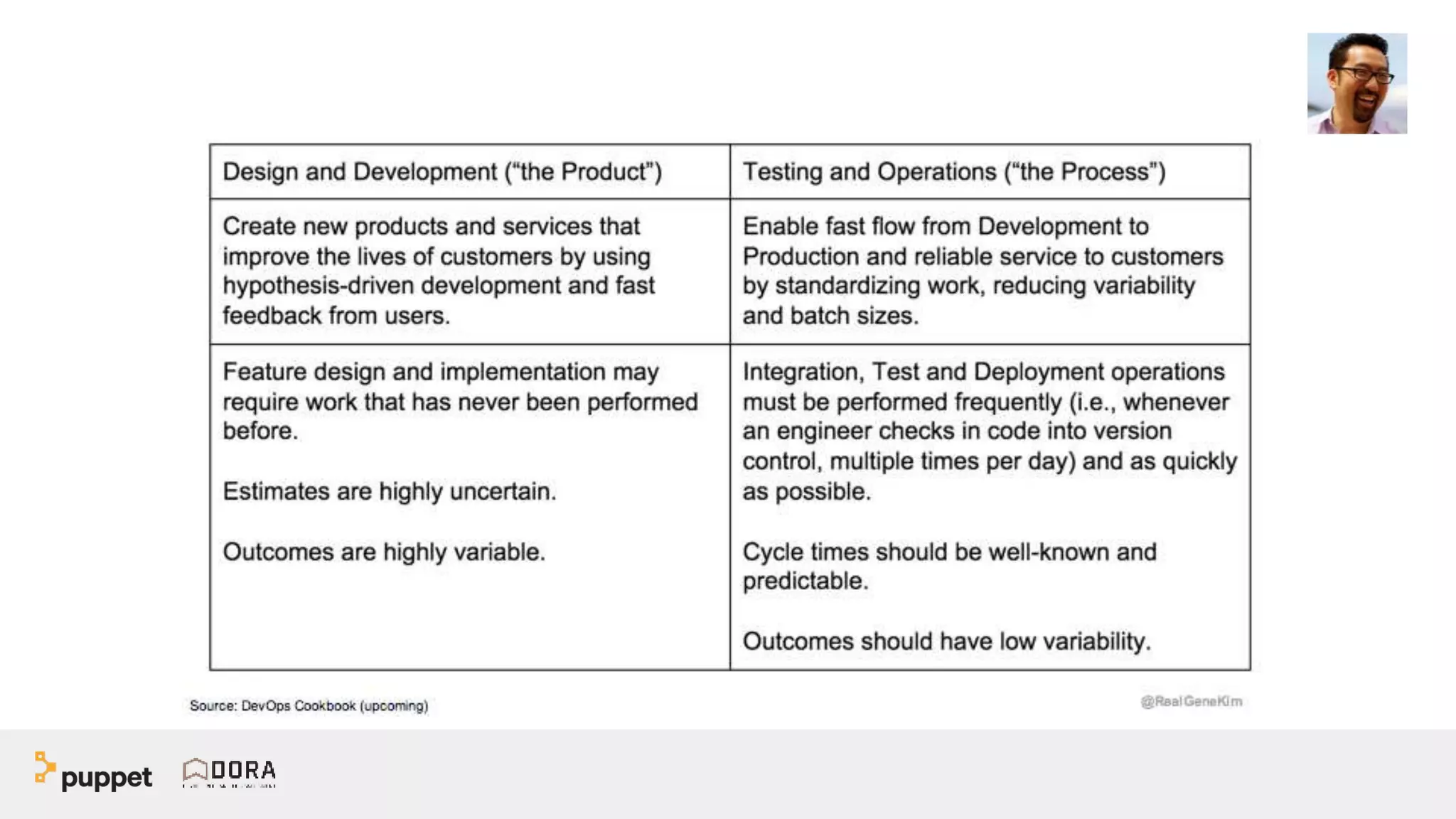
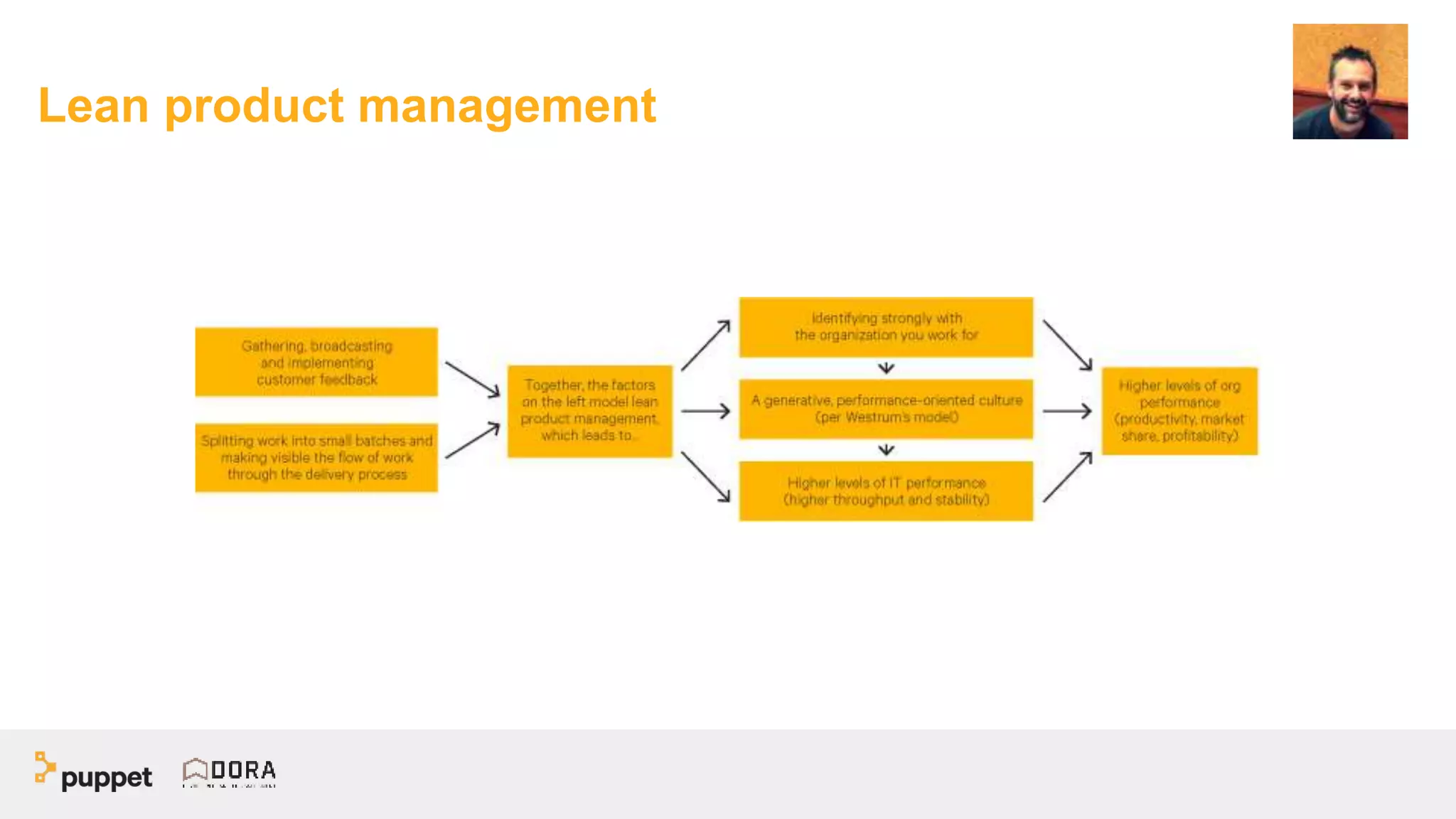
Lean product management
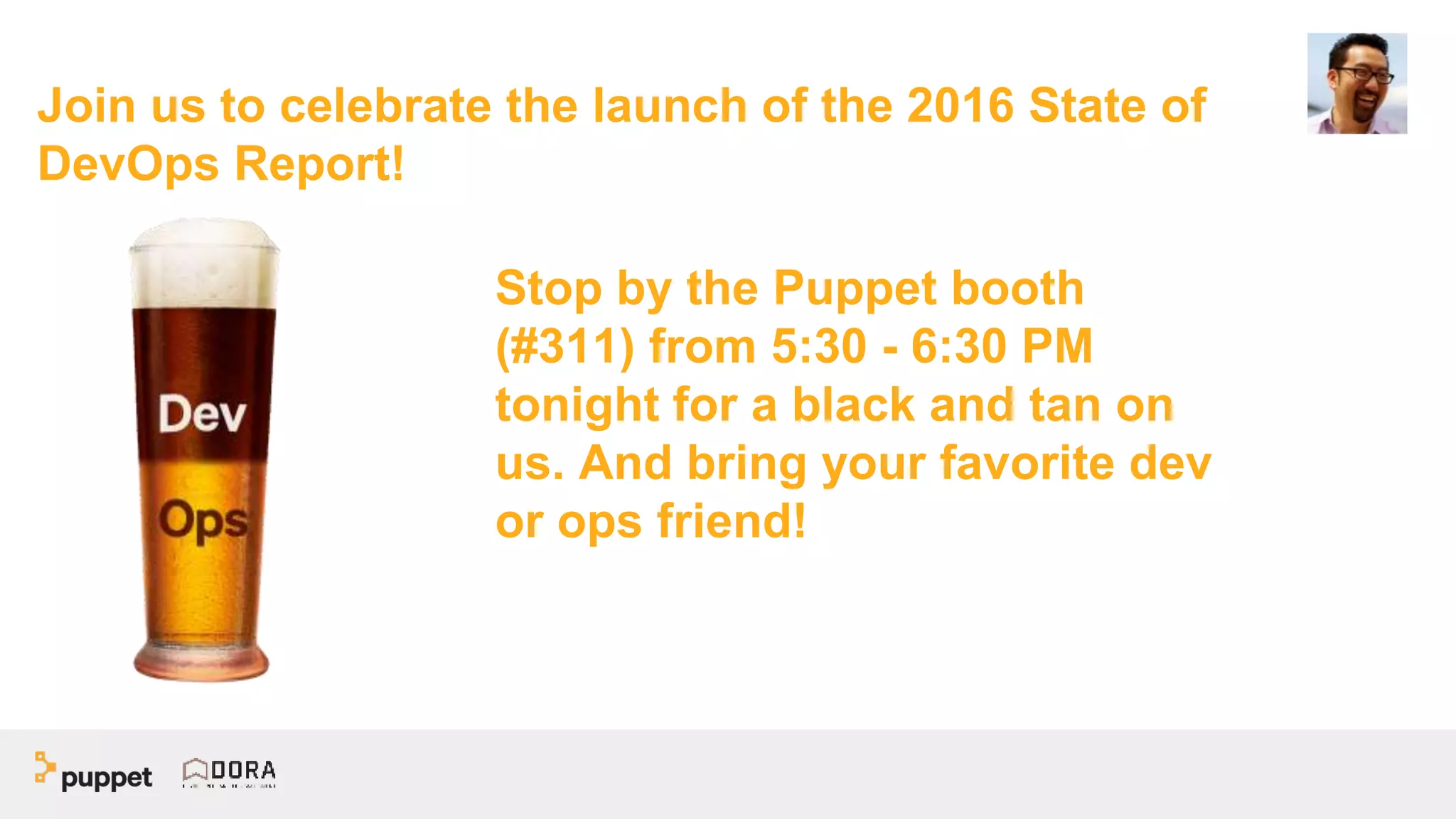
Join us to celebrate the launch of the 2016 State of
DevOps Report!
Stop by the Puppet booth
(#311) from 5:30 - 6:30 PM
tonight for a black and tan on
us. And bring your favorite dev
or ops friend!
Get your copy of the
2016 State of DevOps Report
puppet.com/devops-report-2016
Sign up for our ROI
whitepaper & get peer-
reviewed research
devops-research.com
Email jezhumble@sendyourslides.com with the subject DevOps for more info!
Thank you!
32

2016 velocity santa clara state of dev ops report deck final

  • 2.
    Agenda A brief historyof the State of DevOps Report Theory, survey design, demographics and psychographics IT and security performance findings Continuous integration/delivery redux
  • 3.
    About the authors AlannaBrown @alannapb Nicole Forsgren, PhD @nicolefv Jez Humble @jezhumble Nigel Kersten @nigelkersten Gene Kim @realgenekim
  • 4.
    DevOps Grows Up 2012:What is devops? 2013: DevOps adoption is accelerating. 2014: Holy cow! DevOps works! 2015: IT goes lean. 2016: Shifting left.
  • 5.
    IT performance matters! “Firmswith high-performing IT organizations were twice as likely to exceed their profitability, market share and productivity goals.” http://bit.ly/2015-devops-report/http://bit.ly/2014-devops- report/
  • 6.
    IT performance lead timefor changes release frequency time to restore service change fail rate
  • 7.
    Not all datais created equal Who here thinks surveys are sh*t? [Nicole should probably turn around] Who here LOVES the data from their log files? And who has seen sh*t data in a log file?
  • 8.
    What is alatent construct?
  • 9.
    We use PSYCHOMETRICS to makeour survey data good* *or give us a reasonable assurance that it’s telling us what we think it’s telling us (& some of this can also apply to your log data)
  • 10.
    Construct creation (manual) Whenpossible: use previously validated constructs Based on definitions and theory, carefully and precisely worded, card sorting task, pilot tested Construct evaluation (statistics) Establishing Validity: discriminant and convergent Establishing Reliability Psychometrics includes:
  • 11.
    Statistics bingo! Measure assessment:measures exhibit good psychometric properties (composite reliability, AVE, EFA measures load well and do not cross-load, etc) Model assessment: PLS was used to assess the structured equation models Analysis methods
  • 12.
    A note aboutprediction: one of three conditions must be met: 1. Longitudinal (no, this is cross-sectional) 2. Randomized, experimental design (no, this is a non-experime 3. Theory-based design When this condition was not met, only correlations were tested and reported. Analysis methods
  • 16.
    High-performing organizations are decisivelyoutperforming their lower-performing peers in terms of throughput.
  • 17.
    “What is yourlead time for changes?” “How long does it take to go from code committed to code successfully running in production?”
  • 20.
  • 21.
    Employees in high-performing organizationsare 2.2 times more likely to recommend their organization as a great place to work.
  • 22.
    Because they addresssecurity at every stage, high-performing teams spend less time fixing security issues.
  • 23.
  • 24.
    High performers achievebetter outcomes by: ● Conducting security review for all major features while ensuring that the security review process does not slow down development. ● Integrating Information Security into the daily work of the entire software delivery lifecycle. This includes providing input during the design of the application, attending software demos and providing feedback during demos. ● Testing security requirements as a part of the automated testing process. ● Ensuring that Information Security has made pre-approved, easy-to-consume libraries, packages, toolchains and processes for developers and IT operations to use in their work.
  • 25.
    Security is apriority in my organization Strongly agree Strongly disagree Neutral These industries responded highest (75% Agree or Strongly Agree) ● Financial Services ● Government These departments responded highest (71-73% Agree or Strongly Agree) ● Professional Services ● Release Engineering
  • 26.
    High performers spend29% more time on new work than low performers, and 22% less time on unplanned work and rework.
  • 27.
  • 28.
    “Identifying strongly withthe organization” ● I am glad I chose to work for this organization rather than another company. ● I talk of this organization to my friends as a great company to work for. ● I am willing to put in a great deal of effort beyond what is normally expected to help my organization to be successful. ● I find that my values and my organization's values are very similar. ● In general, the people employed by my organization are working toward the same goal. ● I feel that my organization cares about me. These items are adapted from Kankanhalli, Atreyi, Kwok-Kee Wei, and Bernard C.Y. Tan (2005)
  • 29.
  • 30.
    Join us tocelebrate the launch of the 2016 State of DevOps Report! Stop by the Puppet booth (#311) from 5:30 - 6:30 PM tonight for a black and tan on us. And bring your favorite dev or ops friend!
  • 31.
    Get your copyof the 2016 State of DevOps Report puppet.com/devops-report-2016 Sign up for our ROI whitepaper & get peer- reviewed research devops-research.com Email jezhumble@sendyourslides.com with the subject DevOps for more info!
  • 32.