PROPER
DOCUMENTATION
A Review on MaintainingCompleteness andAccuracy
- For Coders and other HIM personnel -
Clinical
Documentation
Improvement:
Why?
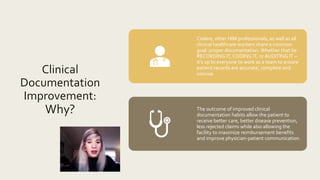
Coders, other HIM professionals, as well as all
clinical healthcare workers share a common
goal: proper documentation. Whether that be
RECORDING IT, CODING IT, or AUDITING IT –
it’s up to everyone to work as a team to ensure
patient records are accurate, complete and
concise.
The outcome of improved clinical
documentation habits allow the patient to
receive better care, better disease prevention,
less rejected claims while also allowing the
facility to maximize reimbursement benefits
and improve physician-patient communication.
PROPER DOCUMENTATION
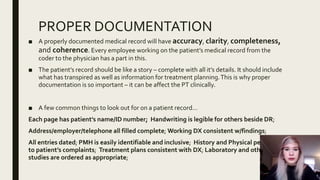
■ A properly documented medical record will have accuracy, clarity, completeness,
and coherence. Every employee working on the patient’s medical record from the
coder to the physician has a part in this.
■ The patient’s record should be like a story – complete with all it’s details. It should include
what has transpired as well as information for treatment planning.This is why proper
documentation is so important – it can be affect the PT clinically.
■ A few common things to look out for on a patient record…
Each page has patient’s name/ID number; Handwriting is legible for others beside DR;
Address/employer/telephone all filled complete; Working DX consistent w/findings;
All entries dated; PMH is easily identifiable and inclusive; History and Physical pertinent
to patient’s complaints; Treatment plans consistent with DX; Laboratory and other
studies are ordered as appropriate;
THE FIRST
STEPTO
IMPROVEMEN
T
■ There are many ways to jumpstart a clinical
documentation improvement program within an office,
but a good starter point would be an internal audit to self
check the facility’s own documentation for completeness.
■ In order to carry this out, Staff MUST be knowledgeable of
WHAT entails proper documentation.This may include
going over guidelines of different record types (i.e.
inpatient vs. outpatient) to understand what are required
elements of each.
The following slides will consist of (4) different patient records
and explore any missing or inaccurate elements as well as the
information that was recorded correctly.
PATIENT RECORD #410057
CODES GIVEN:
■ Diagnosis Codes:
■ Dx Reason forVisit: C50.411 Malignant neoplasm of
upper outer quadrant of right female breast
■ Primary Diagnosis: C50.411 Malignant neoplasm of
upper outer quadrant of right female breast
■ Secondary Diagnosis: Z17.1 Estrogen receptor
negative status [ER-]
■ Detailed CPT Procedures:
■ 19301-RT Partial Mastectomy; (RT Right side of
body)
■ 14301 Adjnt tis trnsfr/reargmt any area 30.160 sq
cm
■ 19285-RT Placement of breast localization
device(s), percutaneous; first lesion, including
ultrasound guidance; (RT – Right side of the body)
CORRECTIONS/TIPS:
■ For this case, I’m not finding the information
that would cause the coder to select the
secondary diagnosis. I think further
information in the HPI would be needed to
confirm the negative estrogen receptor
status.
■ It’s important for medical necessity to be met
when coding documents and in this case,
there may be additional information needed
that may have been left out somewhere (PMH
or Laboratory Reports) to apply the secondary
diagnosis as on the patient’s record.There is
no clinical mention other than in the
secondary DX of the condition.
■ A good example of documentation would be
the CPT modifiers of “RT” that signify the
patient’s right breast was the one in which the
procedure was performed. It’s important not
to forget these.
PATIENT RECORD #410092
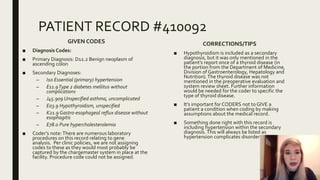
GIVEN CODES
■ Diagnosis Codes:
■ Primary Diagnosis: D12.2 Benign neoplasm of
ascending colon
■ Secondary Diagnoses:
– I10 Essential (primary) hypertension
– E11.9Type 2 diabetes mellitus without
complications
– J45.909 Unspecified asthma, uncomplicated
– E03.9 Hypothyroidism, unspecified
– K21.9 Gastro-esophageal reflux disease without
esophagitis
– E78.0 Pure hypercholesterolemia
■ Coder’s note:There are numerous laboratory
procedures on this record relating to gene
analysis. Per clinic policies, we are not assigning
codes to these as they would most probably be
captured by the chargemaster system in place at the
facility. Procedure code could not be assigned.
CORRECTIONS/TIPS
■ Hypothyroidism is included as a secondary
diagnosis, but it was only mentioned in the
patient’s report once of a thyroid disease (in
the portion from the Department of Medicine,
Division of Gastroenterology, Hepatology and
Nutrition).The thyroid disease was not
mentioned in the preoperative evaluation and
system review sheet. Further information
would be needed for the coder to specific the
type of thyroid disease.
■ It’s important for CODERS not to GIVE a
patient a condition when coding by making
assumptions about the medical record.
■ Something done right with this record is
including hypertension within the secondary
diagnosis. This will always be listed as
hypertension complicates disorders.
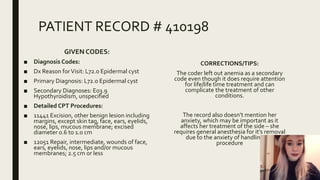
PATIENT RECORD # 410198
GIVEN CODES:
■ Diagnosis Codes:
■ Dx Reason forVisit: L72.0 Epidermal cyst
■ Primary Diagnosis: L72.0 Epidermal cyst
■ Secondary Diagnoses: E03.9
Hypothyroidism, unspecified
■ Detailed CPT Procedures:
■ 11441 Excision, other benign lesion including
margins, except skin tag, face, ears, eyelids,
nose, lips, mucous membrane; excised
diameter 0.6 to 1.0 cm
■ 12051 Repair, intermediate, wounds of face,
ears, eyelids, nose, lips and/or mucous
membranes; 2.5 cm or less
CORRECTIONS/TIPS:
The coder left out anemia as a secondary
code even though it does require attention
for life/life time treatment and can
complicate the treatment of other
conditions.
The record also doesn’t mention her
anxiety, which may be important as it
affects her treatment of the side – she
requires general anesthesia for it’s removal
due to the anxiety of handling the
procedure
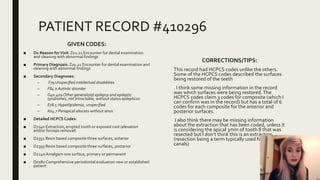
PATIENT RECORD #410296
GIVEN CODES:
■ Dx Reason forVisit: Z01.21 Encounter for dental examination
and cleaning with abnormal findings
■ Primary Diagnosis: Z01.21 Encounter for dental examination and
cleaning with abnormal findings
■ Secondary Diagnoses:
– F79 Unspecified intellectual disabilities
– F84.0 Autistic disorder
– G40.409 Other generalized epilepsy and epileptic
syndromes, not intractable, without status epilepticus
– E78.5 Hyperlipidemia, unspecified
– K04.7 Periapical abscess without sinus
■ Detailed HCPCS Codes:
■ D7140 Extraction, erupted tooth or exposed root (elevation
and/or forceps removal)
■ D2332 Resin based composite three surfaces, anterior
■ D2393 Resin based composite three surfaces, posterior
■ D2140 Amalgam one surface, primary or permanent
■ D0180 Comprehensive periodontal evaluation new or established
patient
CORRECTIONS/TIPS:
This record had HCPCS codes unlike the others.
Some of the HCPCS codes described the surfaces
being restored of the teeth
. I think some missing information in the record
was which surfaces were being restored.The
HCPCS codes claim 3 codes for composite (which I
can confirm was in the record) but has a total of 6
codes for each composite for the anterior and
posterior surfaces.
I also think there may be missing information
about the extraction that has been coded, unless it
is considering the apical 3mm of tooth 8 that was
resected but I don’t think this is an extraction.
(resection being a term typically used for root
canals)
Works Cited
- Centers of Medicare and Medicaid Services –
Your Medical Documentation Matters. (n.d.). Retrieved November 29, 2019, from
https://www.cms.gov/Medicare-Medicaid-Coordination/Fraud-Prevention/Medicaid-
Integrity-Education/Downloads/docmatters-presentation-handout.pdf
- American Health Information ManagementAssociation
Defining the Core Clinical Documentation Set. (n.d.). Retrieved November 29, 2019, from
https://bok.ahima.org/PdfView?oid=105782.
- American Health Information ManagementAssociation
Documentation and Data Improvement Fundamentals. (n.d.). Retrieved November 29,
2019, from http://bok.ahima.org/doc?oid=60174#.XdClaFdKg2w
- National Committee for Quality Assurance
“CommonlyAccepted Standards for Medical Record Documentation.” NCQA. Accessed
November 29, 2019. https://www.ncqa.org/wp-
content/uploads/2018/07/20180110_Guidelines_Medical_Record_Documentation.pdf

Documentation Improvement Presentation

  • 1.
    PROPER DOCUMENTATION A Review onMaintainingCompleteness andAccuracy - For Coders and other HIM personnel -
  • 2.
    Clinical Documentation Improvement: Why? Coders, other HIMprofessionals, as well as all clinical healthcare workers share a common goal: proper documentation. Whether that be RECORDING IT, CODING IT, or AUDITING IT – it’s up to everyone to work as a team to ensure patient records are accurate, complete and concise. The outcome of improved clinical documentation habits allow the patient to receive better care, better disease prevention, less rejected claims while also allowing the facility to maximize reimbursement benefits and improve physician-patient communication.
  • 3.
    PROPER DOCUMENTATION ■ Aproperly documented medical record will have accuracy, clarity, completeness, and coherence. Every employee working on the patient’s medical record from the coder to the physician has a part in this. ■ The patient’s record should be like a story – complete with all it’s details. It should include what has transpired as well as information for treatment planning.This is why proper documentation is so important – it can be affect the PT clinically. ■ A few common things to look out for on a patient record… Each page has patient’s name/ID number; Handwriting is legible for others beside DR; Address/employer/telephone all filled complete; Working DX consistent w/findings; All entries dated; PMH is easily identifiable and inclusive; History and Physical pertinent to patient’s complaints; Treatment plans consistent with DX; Laboratory and other studies are ordered as appropriate;
  • 4.
    THE FIRST STEPTO IMPROVEMEN T ■ Thereare many ways to jumpstart a clinical documentation improvement program within an office, but a good starter point would be an internal audit to self check the facility’s own documentation for completeness. ■ In order to carry this out, Staff MUST be knowledgeable of WHAT entails proper documentation.This may include going over guidelines of different record types (i.e. inpatient vs. outpatient) to understand what are required elements of each. The following slides will consist of (4) different patient records and explore any missing or inaccurate elements as well as the information that was recorded correctly.
  • 5.
    PATIENT RECORD #410057 CODESGIVEN: ■ Diagnosis Codes: ■ Dx Reason forVisit: C50.411 Malignant neoplasm of upper outer quadrant of right female breast ■ Primary Diagnosis: C50.411 Malignant neoplasm of upper outer quadrant of right female breast ■ Secondary Diagnosis: Z17.1 Estrogen receptor negative status [ER-] ■ Detailed CPT Procedures: ■ 19301-RT Partial Mastectomy; (RT Right side of body) ■ 14301 Adjnt tis trnsfr/reargmt any area 30.160 sq cm ■ 19285-RT Placement of breast localization device(s), percutaneous; first lesion, including ultrasound guidance; (RT – Right side of the body) CORRECTIONS/TIPS: ■ For this case, I’m not finding the information that would cause the coder to select the secondary diagnosis. I think further information in the HPI would be needed to confirm the negative estrogen receptor status. ■ It’s important for medical necessity to be met when coding documents and in this case, there may be additional information needed that may have been left out somewhere (PMH or Laboratory Reports) to apply the secondary diagnosis as on the patient’s record.There is no clinical mention other than in the secondary DX of the condition. ■ A good example of documentation would be the CPT modifiers of “RT” that signify the patient’s right breast was the one in which the procedure was performed. It’s important not to forget these.
  • 6.
    PATIENT RECORD #410092 GIVENCODES ■ Diagnosis Codes: ■ Primary Diagnosis: D12.2 Benign neoplasm of ascending colon ■ Secondary Diagnoses: – I10 Essential (primary) hypertension – E11.9Type 2 diabetes mellitus without complications – J45.909 Unspecified asthma, uncomplicated – E03.9 Hypothyroidism, unspecified – K21.9 Gastro-esophageal reflux disease without esophagitis – E78.0 Pure hypercholesterolemia ■ Coder’s note:There are numerous laboratory procedures on this record relating to gene analysis. Per clinic policies, we are not assigning codes to these as they would most probably be captured by the chargemaster system in place at the facility. Procedure code could not be assigned. CORRECTIONS/TIPS ■ Hypothyroidism is included as a secondary diagnosis, but it was only mentioned in the patient’s report once of a thyroid disease (in the portion from the Department of Medicine, Division of Gastroenterology, Hepatology and Nutrition).The thyroid disease was not mentioned in the preoperative evaluation and system review sheet. Further information would be needed for the coder to specific the type of thyroid disease. ■ It’s important for CODERS not to GIVE a patient a condition when coding by making assumptions about the medical record. ■ Something done right with this record is including hypertension within the secondary diagnosis. This will always be listed as hypertension complicates disorders.
  • 7.
    PATIENT RECORD #410198 GIVEN CODES: ■ Diagnosis Codes: ■ Dx Reason forVisit: L72.0 Epidermal cyst ■ Primary Diagnosis: L72.0 Epidermal cyst ■ Secondary Diagnoses: E03.9 Hypothyroidism, unspecified ■ Detailed CPT Procedures: ■ 11441 Excision, other benign lesion including margins, except skin tag, face, ears, eyelids, nose, lips, mucous membrane; excised diameter 0.6 to 1.0 cm ■ 12051 Repair, intermediate, wounds of face, ears, eyelids, nose, lips and/or mucous membranes; 2.5 cm or less CORRECTIONS/TIPS: The coder left out anemia as a secondary code even though it does require attention for life/life time treatment and can complicate the treatment of other conditions. The record also doesn’t mention her anxiety, which may be important as it affects her treatment of the side – she requires general anesthesia for it’s removal due to the anxiety of handling the procedure
  • 8.
    PATIENT RECORD #410296 GIVENCODES: ■ Dx Reason forVisit: Z01.21 Encounter for dental examination and cleaning with abnormal findings ■ Primary Diagnosis: Z01.21 Encounter for dental examination and cleaning with abnormal findings ■ Secondary Diagnoses: – F79 Unspecified intellectual disabilities – F84.0 Autistic disorder – G40.409 Other generalized epilepsy and epileptic syndromes, not intractable, without status epilepticus – E78.5 Hyperlipidemia, unspecified – K04.7 Periapical abscess without sinus ■ Detailed HCPCS Codes: ■ D7140 Extraction, erupted tooth or exposed root (elevation and/or forceps removal) ■ D2332 Resin based composite three surfaces, anterior ■ D2393 Resin based composite three surfaces, posterior ■ D2140 Amalgam one surface, primary or permanent ■ D0180 Comprehensive periodontal evaluation new or established patient CORRECTIONS/TIPS: This record had HCPCS codes unlike the others. Some of the HCPCS codes described the surfaces being restored of the teeth . I think some missing information in the record was which surfaces were being restored.The HCPCS codes claim 3 codes for composite (which I can confirm was in the record) but has a total of 6 codes for each composite for the anterior and posterior surfaces. I also think there may be missing information about the extraction that has been coded, unless it is considering the apical 3mm of tooth 8 that was resected but I don’t think this is an extraction. (resection being a term typically used for root canals)
  • 9.
    Works Cited - Centersof Medicare and Medicaid Services – Your Medical Documentation Matters. (n.d.). Retrieved November 29, 2019, from https://www.cms.gov/Medicare-Medicaid-Coordination/Fraud-Prevention/Medicaid- Integrity-Education/Downloads/docmatters-presentation-handout.pdf - American Health Information ManagementAssociation Defining the Core Clinical Documentation Set. (n.d.). Retrieved November 29, 2019, from https://bok.ahima.org/PdfView?oid=105782. - American Health Information ManagementAssociation Documentation and Data Improvement Fundamentals. (n.d.). Retrieved November 29, 2019, from http://bok.ahima.org/doc?oid=60174#.XdClaFdKg2w - National Committee for Quality Assurance “CommonlyAccepted Standards for Medical Record Documentation.” NCQA. Accessed November 29, 2019. https://www.ncqa.org/wp- content/uploads/2018/07/20180110_Guidelines_Medical_Record_Documentation.pdf