Do ratios form a
proportion?
What is a ratio?
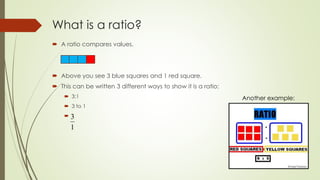
 A ratio compares values.
 Above you see 3 blue squares and 1 red square.
 This can be written 3 different ways to show it is a ratio:
 3:1
 3 to 1

1
3
Another example:
Scale up or scale down . . .
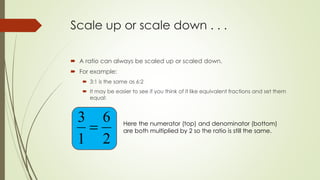
 A ratio can always be scaled up or scaled down.
 For example:
 3:1 is the same as 6:2
 It may be easier to see if you think of it like equivalent fractions and set them
equal:
2
6
1
3
 Here the numerator (top) and denominator (bottom)
are both multiplied by 2 so the ratio is still the same.
Proportion
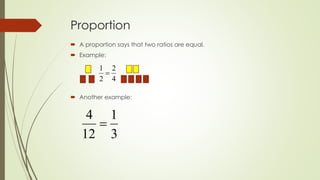
 A proportion says that two ratios are equal.
 Example:
 Another example:
4
2
2
1

3
1
12
4

How do you know if ratios form a
proportion?
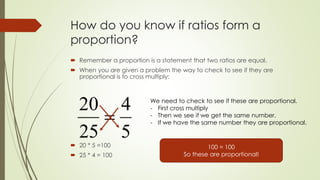
 Remember a proportion is a statement that two ratios are equal.
 When you are given a problem the way to check to see if they are
proportional is to cross multiply:
 20 * 5 =100
 25 * 4 = 100
5
4
25
20

We need to check to see if these are proportional.
- First cross multiply
- Then we see if we get the same number.
- If we have the same number they are proportional.
100 = 100
So these are proportional!
Let’s look at a few more examples . . .
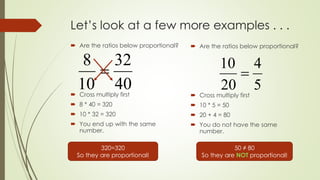
 Are the ratios below proportional?
 Cross multiply first
 8 * 40 = 320
 10 * 32 = 320
 You end up with the same
number.
 Are the ratios below proportional?
 Cross multiply first
 10 * 5 = 50
 20 + 4 = 80
 You do not have the same
number.
40
32
10
8

320=320
So they are proportional!
5
4
20
10

50 ≠ 80
So they are NOT proportional!

Do ratios form a proportion

  • 1.
    Do ratios forma proportion?
  • 2.
    What is aratio?  A ratio compares values.  Above you see 3 blue squares and 1 red square.  This can be written 3 different ways to show it is a ratio:  3:1  3 to 1  1 3 Another example:
  • 3.
    Scale up orscale down . . .  A ratio can always be scaled up or scaled down.  For example:  3:1 is the same as 6:2  It may be easier to see if you think of it like equivalent fractions and set them equal: 2 6 1 3  Here the numerator (top) and denominator (bottom) are both multiplied by 2 so the ratio is still the same.
  • 4.
    Proportion  A proportionsays that two ratios are equal.  Example:  Another example: 4 2 2 1  3 1 12 4 
  • 5.
    How do youknow if ratios form a proportion?  Remember a proportion is a statement that two ratios are equal.  When you are given a problem the way to check to see if they are proportional is to cross multiply:  20 * 5 =100  25 * 4 = 100 5 4 25 20  We need to check to see if these are proportional. - First cross multiply - Then we see if we get the same number. - If we have the same number they are proportional. 100 = 100 So these are proportional!
  • 6.
    Let’s look ata few more examples . . .  Are the ratios below proportional?  Cross multiply first  8 * 40 = 320  10 * 32 = 320  You end up with the same number.  Are the ratios below proportional?  Cross multiply first  10 * 5 = 50  20 + 4 = 80  You do not have the same number. 40 32 10 8  320=320 So they are proportional! 5 4 20 10  50 ≠ 80 So they are NOT proportional!