Introduction
The topics, ratios, proportion and percentages are concerned with dividing something
into parts. A ratio shows the relative sizes of two or more values. Ratios can be shown in
different ways. Using the ":" to separate. A ratio is one thing compared to or related to
another thing; it is just a statement or an expression. A proportion is two ratios that have
been set equal to each other; a proportion is an equation that can be solved. A
percentage is a fraction whose denominator (bottom) is 100. So if we say 50%, we mean
50/100 = 1/2 (after cancelling). So 50% means ½. If want to find 10% of something, 'of'
just means 'times'.
1.1 Ratio
Meaning:
A ratio is a comparison of the relative values of numbers or quantities. We can write a
ratio for any statement containing such a comparison. For example, that there are twice
as many married employees as single employees, we mean that the ratio of married to
single employees is 2:1, where 2 represents married employees and 1 represents single
employees.
Definitions:
a) Giri & Banerjee:
“A ratio a: b is said to be the ratio of greater inequality if a > b and of lesser inequality
if a < b. lf a = b, the ratio a : b is called the ratio of equality.”
b) Om P. Chug:
“A ratio is a comparative relationship of two similar quantities with regards to their
magnitudes and expresses what multiple or pan the first quantity is of the second.”
1.1 Ratio
Example:
The ratio of the no. of boys to the no. of girls in a school of 720 students is 3: 5. If 18
new girls are admitted in the school, find how many new boys may be admitted so that
the ratio of the no. of boys to the no. of girls may change to 2: 3.
Solution:
The ratio of the no. of boys to the no. of girls = 3:5
Sum of the ratios = 3 + 5 = 8
So, the no. of boys in the school = (3 x 720)/8 = 270
And the no. of girls in the school = (5 x 720)/8 = 450
Let the no. of new boys admitted be x, then the no. of boys become (270 + x).
After admitting 18 new girls, the no. of girls become 450 + 18 = 468
According to given description of the problem, (270 + x)/468 = 2/3
or,3(270+x)=2x468
or, 810 + 3x = 936 or, 3x = 126 or, x = 42.
Hence the no. of new boys admitted = 42.
1.1 Ratio
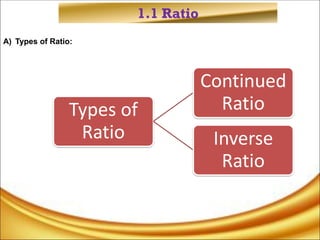
A) Types of Ratio:
Types of
Ratio
Continued
Ratio
Inverse
Ratio
1.1 Ratio
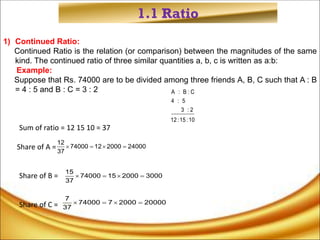
1) Continued Ratio:
Continued Ratio is the relation (or comparison) between the magnitudes of the same
kind. The continued ratio of three similar quantities a, b, c is written as a:b:
Example:
Suppose that Rs. 74000 are to be divided among three friends A, B, C such that A : B
= 4 : 5 and B : C = 3 : 2
Sum of ratio = 12 15 10 = 37
Share of A =
Share of B =
Share of C =
A : B : C
4 : 5
3 : 2
12 :15 :10
12
74000 12 2000 24000
37
   
15
74000 15 2000 3000
37
   
7
74000 7 2000 20000
37
   
1.1 Ratio
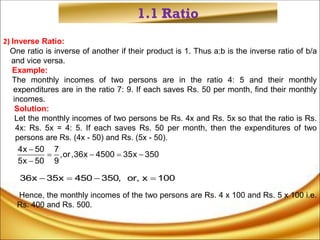
2) Inverse Ratio:
One ratio is inverse of another if their product is 1. Thus a:b is the inverse ratio of b/a
and vice versa.
Example:
The monthly incomes of two persons are in the ratio 4: 5 and their monthly
expenditures are in the ratio 7: 9. If each saves Rs. 50 per month, find their monthly
incomes.
Solution:
Let the monthly incomes of two persons be Rs. 4x and Rs. 5x so that the ratio is Rs.
4x: Rs. 5x = 4: 5. If each saves Rs. 50 per month, then the expenditures of two
persons are Rs. (4x - 50) and Rs. (5x - 50).
Hence, the monthly incomes of the two persons are Rs. 4 x 100 and Rs. 5 x 100 i.e.
Rs. 400 and Rs. 500.
4x 50 7
,or,36x 4500 35x 350
5x 50 9

   

36x 35x 450 350, or, x 100
   
1.2 Proportion
Meaning:
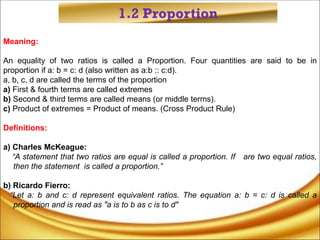
An equality of two ratios is called a Proportion. Four quantities are said to be in
proportion if a: b = c: d (also written as a:b :: c:d).
a, b, c, d are called the terms of the proportion
a) First & fourth terms are called extremes
b) Second & third terms are called means (or middle terms).
c) Product of extremes = Product of means. (Cross Product Rule)
Definitions:
a) Charles McKeague:
“A statement that two ratios are equal is called a proportion. If are two equal ratios,
then the statement is called a proportion.”
b) Ricardo Fierro:
“Let a: b and c: d represent equivalent ratios. The equation a: b = c: d is called a
proportion and is read as "a is to b as c is to d"
1.2 Proportion
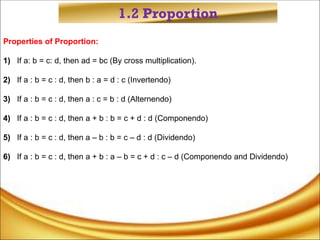
Properties of Proportion:
1) If a: b = c: d, then ad = bc (By cross multiplication).
2) If a : b = c : d, then b : a = d : c (Invertendo)
3) If a : b = c : d, then a : c = b : d (Alternendo)
4) If a : b = c : d, then a + b : b = c + d : d (Componendo)
5) If a : b = c : d, then a – b : b = c – d : d (Dividendo)
6) If a : b = c : d, then a + b : a – b = c + d : c – d (Componendo and Dividendo)
1.2 Proportion
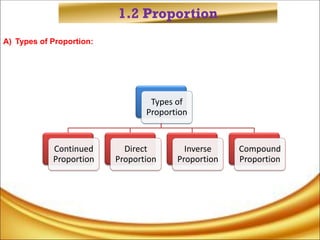
A) Types of Proportion:
Types of
Proportion
Continued
Proportion
Direct
Proportion
Inverse
Proportion
Compound
Proportion
1.2 Proportion
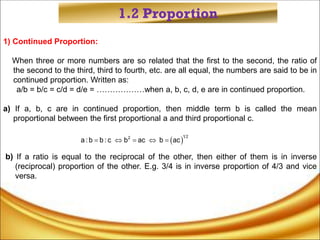
1) Continued Proportion:
When three or more numbers are so related that the first to the second, the ratio of
the second to the third, third to fourth, etc. are all equal, the numbers are said to be in
continued proportion. Written as:
a/b = b/c = c/d = d/e = ………………when a, b, c, d, e are in continued proportion.
a) If a, b, c are in continued proportion, then middle term b is called the mean
proportional between the first proportional a and third proportional c.
b) If a ratio is equal to the reciprocal of the other, then either of them is in inverse
(reciprocal) proportion of the other. E.g. 3/4 is in inverse proportion of 4/3 and vice
versa.
 
1 2
2
a :b b : c b ac b ac
    
1.2 Proportion
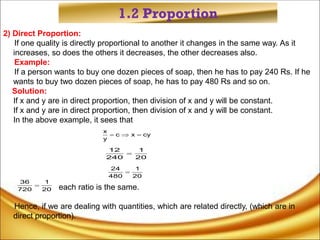
2) Direct Proportion:
If one quality is directly proportional to another it changes in the same way. As it
increases, so does the others it decreases, the other decreases also.
Example:
If a person wants to buy one dozen pieces of soap, then he has to pay 240 Rs. If he
wants to buy two dozen pieces of soap, he has to pay 480 Rs and so on.
Solution:
If x and y are in direct proportion, then division of x and y will be constant.
In the above example, it sees that
each ratio is the same.
Hence, if we are dealing with quantities, which are related directly, (which are in
direct proportion).
x
c x cy
y
  
12 1
240 20

36 1
720 20

24 1
480 20

1.2 Proportion
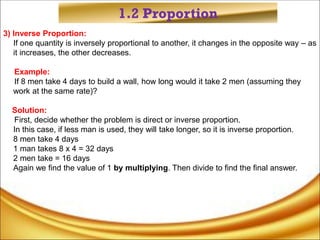
3) Inverse Proportion:
If one quantity is inversely proportional to another, it changes in the opposite way – as
it increases, the other decreases.
Example:
If 8 men take 4 days to build a wall, how long would it take 2 men (assuming they
work at the same rate)?
Solution:
First, decide whether the problem is direct or inverse proportion.
In this case, if less man is used, they will take longer, so it is inverse proportion.
8 men take 4 days
1 man takes 8 x 4 = 32 days
2 men take = 16 days
Again we find the value of 1 by multiplying. Then divide to find the final answer.
1.2 Proportion
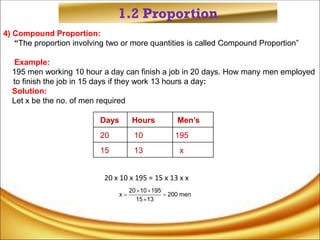
4) Compound Proportion:
“The proportion involving two or more quantities is called Compound Proportion”
Example:
195 men working 10 hour a day can finish a job in 20 days. How many men employed
to finish the job in 15 days if they work 13 hours a day:
Solution:
Let x be the no. of men required
Days Hours Men’s
20 10 195
15 13 x
20 x 10 x 195 = 15 x 13 x x
20 10 195
x 200 men
15 13
 
 

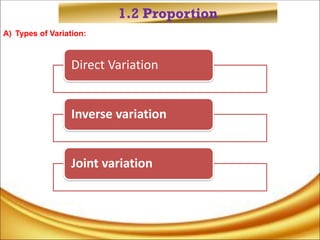
1.2 Proportion
A) Types of Variation:
Direct Variation
Inverse variation
Joint variation
1.3Variation
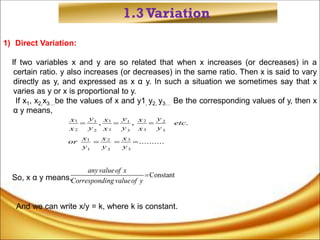
1) Direct Variation:
lf two variables x and y are so related that when x increases (or decreases) in a
certain ratio. y also increases (or decreases) in the same ratio. Then x is said to vary
directly as y, and expressed as x α y. In such a situation we sometimes say that x
varies as y or x is proportional to y.
If x1, x2,x3…be the values of x and y1, y2, y3… Be the corresponding values of y, then x
α y means,
So, x α y means,
And we can write x/y = k, where k is constant.
1 1 2
1 1 2
2 3 3
2 3 3
1 2 3
1 2 3
, , .
..........
  
  
y y y
x x x
etc
y y y
x x x
x x x
or
y y y
Constant

anyvalueof x
Corresponding valueof y
1.3Variation
Example:
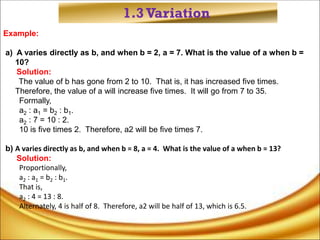
a) A varies directly as b, and when b = 2, a = 7. What is the value of a when b =
10?
Solution:
The value of b has gone from 2 to 10. That is, it has increased five times.
Therefore, the value of a will increase five times. It will go from 7 to 35.
Formally,
a2 : a1 = b2 : b1.
a2 : 7 = 10 : 2.
10 is five times 2. Therefore, a2 will be five times 7.
b) A varies directly as b, and when b = 8, a = 4. What is the value of a when b = 13?
Solution:
Proportionally,
a2 : a1 = b2 : b1.
That is,
a2 : 4 = 13 : 8.
Alternately, 4 is half of 8. Therefore, a2 will be half of 13, which is 6.5.
1.3Variation
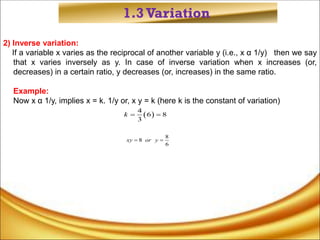
2) Inverse variation:
If a variable x varies as the reciprocal of another variable y (i.e., x α 1/y) then we say
that x varies inversely as y. In case of inverse variation when x increases (or,
decreases) in a certain ratio, y decreases (or, increases) in the same ratio.
Example:
Now x α 1/y, implies x = k. 1/y or, x y = k (here k is the constant of variation)
 
4
6 8
3
k  
8
8
6
xy or y
 
1.3Variation
3) Joint Variation:
If a variable x varies as the product of a finite number of variables u, v, w, etc., (i.e., x
α uvw ...), then x is said to vary jointly with u, v, w, etc.
Here we state an important theorem, known as theorem on joint variation.
If x α y, when z is constantan x α z, when y is constant. then x α y z, when both y and
z vary.
B) Some Important Results:
a) If x α y then y α x.
b) If x α y and y α z, then x α z.
c) If x α y, then x n α y n, where n is a constant
d) lf x α z and y α z, then x+y α z, x - y α z and x y α z2
e) If x α y and w α z, then x w α y z and x/w α y/z.
1.4 Percentage
Percentage is a mathematical concept that appears very frequently in everyday life. You
read that a merchant is offering a twenty percent discount on a selected group of items.
The manufacturer of an article of clothing states that the material is sixty-five percent
Dacron and thirty five percent polyester.
A) The Meaning of Percent:
Percent is a term derived from two Latin words per centum which mean by the
hundred. The symbol for percent is i.e. observing this symbol carefully, one notices
that it contains the numerals which represent the number one hundred. Percent
means hundredths. One hundred hundredths equal one whole item. If a percent is
less than 100% it is equivalent to a fraction less than one. If a percent is more than
100% it is equivalent to a fraction greater than one.
1.4 Percentage
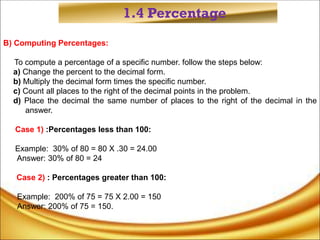
B) Computing Percentages:
To compute a percentage of a specific number. follow the steps below:
a) Change the percent to the decimal form.
b) Multiply the decimal form times the specific number.
c) Count all places to the right of the decimal points in the problem.
d) Place the decimal the same number of places to the right of the decimal in the
answer.
Case 1) :Percentages less than 100:
Example: 30% of 80 = 80 X .30 = 24.00
Answer: 30% of 80 = 24
Case 2) : Percentages greater than 100:
Example: 200% of 75 = 75 X 2.00 = 150
Answer: 200% of 75 = 150.
1.4 Percentage
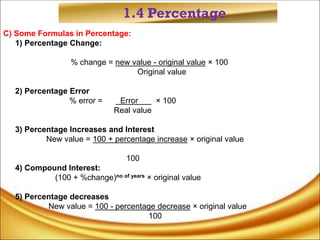
C) Some Formulas in Percentage:
1) Percentage Change:
% change = new value - original value × 100
Original value
2) Percentage Error
% error = Error × 100
Real value
3) Percentage Increases and Interest
New value = 100 + percentage increase × original value
100
4) Compound Interest:
(100 + %change)no of years × original value
5) Percentage decreases
New value = 100 - percentage decrease × original value
100
1.4 Percentage
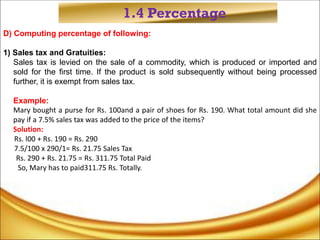
D) Computing percentage of following:
1) Sales tax and Gratuities:
Sales tax is levied on the sale of a commodity, which is produced or imported and
sold for the first time. If the product is sold subsequently without being processed
further, it is exempt from sales tax.
Example:
Mary bought a purse for Rs. 100and a pair of shoes for Rs. 190. What total amount did she
pay if a 7.5% sales tax was added to the price of the items?
Solution:
Rs. l00 + Rs. 190 = Rs. 290
7.5/100 x 290/1= Rs. 21.75 Sales Tax
Rs. 290 + Rs. 21.75 = Rs. 311.75 Total Paid
So, Mary has to paid311.75 Rs. Totally.
1.4 Percentage
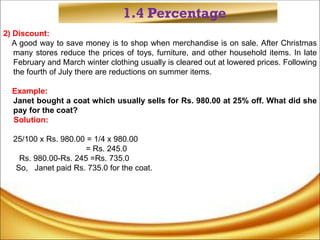
2) Discount:
A good way to save money is to shop when merchandise is on sale. After Christmas
many stores reduce the prices of toys, furniture, and other household items. In late
February and March winter clothing usually is cleared out at lowered prices. Following
the fourth of July there are reductions on summer items.
Example:
Janet bought a coat which usually sells for Rs. 980.00 at 25% off. What did she
pay for the coat?
Solution:
25/100 x Rs. 980.00 = 1/4 x 980.00
= Rs. 245.0
Rs. 980.00-Rs. 245 =Rs. 735.0
So, Janet paid Rs. 735.0 for the coat.
1.4 Percentage
3) Commission:
Manufacturers and producers of goods are not always able to sell their own products.
It is necessary for them to employ agents to sell the articles for them. The pay
received by the agent, or salesman, for work or services performed is called
commission. Sometimes the commission is a certain amount for each article sold.
Sometimes the commission is a certain amount for each article sold. Other times it is
a percentage of the dollar value of the sales.
Example:
A salesman who works on a commission basis receives 12% of his sales. How
much was his commission on a sale amounting to Rs. 2650?
Solution:
Let N= the missing number.
Change 12% to 12/100.
12/100 x 2650/1= N
31800/100= N
N = Rs. 318.0
The salesman earned Rs. 318.0 commission.
1.4 Percentage
4) Simple interest:
Just as people pay for the use of items belonging to others, they pay for the use of
money belonging to someone else. The price paid for the use of money is called
interest. Simple interest is the amount paid on a sum of money, borrowed or
invested, which remains unchanged for a specific period of time.
Example:
Steve borrowed Rs. 120000 at 14% per year simple interest for 8 months. What
was the total amount due when he repaid the loan?
Solution:
Principal = Rs. 120000 Rate of Interest = 14/100
Time = 8/12 year
Interest = Principal x Rate x Time
Interest = Rs. 120000/1 x 14/100 x 8/12
= Rs. 11200.00
Amount Due = Principal + Interest
Amount Due = Rs. 120000 + Rs. 11200.0 = Rs. 131200.0
1.4 Percentage
5) Compound Interest:
Simple interest is computed on a principal which remains unchanged for a specific
period of time. Compound interest is calculated on a principal that changes at the end
of stated time period when interest is added to it. The time period may be any interval
during the year such as annually, semi-annually, quarterly, monthly or daily.
Example:
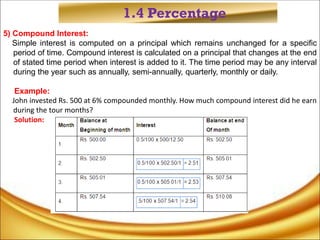
John invested Rs. 500 at 6% compounded monthly. How much compound interest did he earn
during the tour months?
Solution:

Ratio_Proportion_And_Percentage.pdf.....

  • 2.
    Introduction The topics, ratios,proportion and percentages are concerned with dividing something into parts. A ratio shows the relative sizes of two or more values. Ratios can be shown in different ways. Using the ":" to separate. A ratio is one thing compared to or related to another thing; it is just a statement or an expression. A proportion is two ratios that have been set equal to each other; a proportion is an equation that can be solved. A percentage is a fraction whose denominator (bottom) is 100. So if we say 50%, we mean 50/100 = 1/2 (after cancelling). So 50% means ½. If want to find 10% of something, 'of' just means 'times'.
  • 3.
    1.1 Ratio Meaning: A ratiois a comparison of the relative values of numbers or quantities. We can write a ratio for any statement containing such a comparison. For example, that there are twice as many married employees as single employees, we mean that the ratio of married to single employees is 2:1, where 2 represents married employees and 1 represents single employees. Definitions: a) Giri & Banerjee: “A ratio a: b is said to be the ratio of greater inequality if a > b and of lesser inequality if a < b. lf a = b, the ratio a : b is called the ratio of equality.” b) Om P. Chug: “A ratio is a comparative relationship of two similar quantities with regards to their magnitudes and expresses what multiple or pan the first quantity is of the second.”
  • 4.
    1.1 Ratio Example: The ratioof the no. of boys to the no. of girls in a school of 720 students is 3: 5. If 18 new girls are admitted in the school, find how many new boys may be admitted so that the ratio of the no. of boys to the no. of girls may change to 2: 3. Solution: The ratio of the no. of boys to the no. of girls = 3:5 Sum of the ratios = 3 + 5 = 8 So, the no. of boys in the school = (3 x 720)/8 = 270 And the no. of girls in the school = (5 x 720)/8 = 450 Let the no. of new boys admitted be x, then the no. of boys become (270 + x). After admitting 18 new girls, the no. of girls become 450 + 18 = 468 According to given description of the problem, (270 + x)/468 = 2/3 or,3(270+x)=2x468 or, 810 + 3x = 936 or, 3x = 126 or, x = 42. Hence the no. of new boys admitted = 42.
  • 5.
    1.1 Ratio A) Typesof Ratio: Types of Ratio Continued Ratio Inverse Ratio
  • 6.
    1.1 Ratio 1) ContinuedRatio: Continued Ratio is the relation (or comparison) between the magnitudes of the same kind. The continued ratio of three similar quantities a, b, c is written as a:b: Example: Suppose that Rs. 74000 are to be divided among three friends A, B, C such that A : B = 4 : 5 and B : C = 3 : 2 Sum of ratio = 12 15 10 = 37 Share of A = Share of B = Share of C = A : B : C 4 : 5 3 : 2 12 :15 :10 12 74000 12 2000 24000 37     15 74000 15 2000 3000 37     7 74000 7 2000 20000 37    
  • 7.
    1.1 Ratio 2) InverseRatio: One ratio is inverse of another if their product is 1. Thus a:b is the inverse ratio of b/a and vice versa. Example: The monthly incomes of two persons are in the ratio 4: 5 and their monthly expenditures are in the ratio 7: 9. If each saves Rs. 50 per month, find their monthly incomes. Solution: Let the monthly incomes of two persons be Rs. 4x and Rs. 5x so that the ratio is Rs. 4x: Rs. 5x = 4: 5. If each saves Rs. 50 per month, then the expenditures of two persons are Rs. (4x - 50) and Rs. (5x - 50). Hence, the monthly incomes of the two persons are Rs. 4 x 100 and Rs. 5 x 100 i.e. Rs. 400 and Rs. 500. 4x 50 7 ,or,36x 4500 35x 350 5x 50 9       36x 35x 450 350, or, x 100    
  • 8.
    1.2 Proportion Meaning: An equalityof two ratios is called a Proportion. Four quantities are said to be in proportion if a: b = c: d (also written as a:b :: c:d). a, b, c, d are called the terms of the proportion a) First & fourth terms are called extremes b) Second & third terms are called means (or middle terms). c) Product of extremes = Product of means. (Cross Product Rule) Definitions: a) Charles McKeague: “A statement that two ratios are equal is called a proportion. If are two equal ratios, then the statement is called a proportion.” b) Ricardo Fierro: “Let a: b and c: d represent equivalent ratios. The equation a: b = c: d is called a proportion and is read as "a is to b as c is to d"
  • 9.
    1.2 Proportion Properties ofProportion: 1) If a: b = c: d, then ad = bc (By cross multiplication). 2) If a : b = c : d, then b : a = d : c (Invertendo) 3) If a : b = c : d, then a : c = b : d (Alternendo) 4) If a : b = c : d, then a + b : b = c + d : d (Componendo) 5) If a : b = c : d, then a – b : b = c – d : d (Dividendo) 6) If a : b = c : d, then a + b : a – b = c + d : c – d (Componendo and Dividendo)
  • 10.
    1.2 Proportion A) Typesof Proportion: Types of Proportion Continued Proportion Direct Proportion Inverse Proportion Compound Proportion
  • 11.
    1.2 Proportion 1) ContinuedProportion: When three or more numbers are so related that the first to the second, the ratio of the second to the third, third to fourth, etc. are all equal, the numbers are said to be in continued proportion. Written as: a/b = b/c = c/d = d/e = ………………when a, b, c, d, e are in continued proportion. a) If a, b, c are in continued proportion, then middle term b is called the mean proportional between the first proportional a and third proportional c. b) If a ratio is equal to the reciprocal of the other, then either of them is in inverse (reciprocal) proportion of the other. E.g. 3/4 is in inverse proportion of 4/3 and vice versa.   1 2 2 a :b b : c b ac b ac     
  • 12.
    1.2 Proportion 2) DirectProportion: If one quality is directly proportional to another it changes in the same way. As it increases, so does the others it decreases, the other decreases also. Example: If a person wants to buy one dozen pieces of soap, then he has to pay 240 Rs. If he wants to buy two dozen pieces of soap, he has to pay 480 Rs and so on. Solution: If x and y are in direct proportion, then division of x and y will be constant. If x and y are in direct proportion, then division of x and y will be constant. In the above example, it sees that each ratio is the same. Hence, if we are dealing with quantities, which are related directly, (which are in direct proportion). x c x cy y    12 1 240 20  36 1 720 20  24 1 480 20 
  • 13.
    1.2 Proportion 3) InverseProportion: If one quantity is inversely proportional to another, it changes in the opposite way – as it increases, the other decreases. Example: If 8 men take 4 days to build a wall, how long would it take 2 men (assuming they work at the same rate)? Solution: First, decide whether the problem is direct or inverse proportion. In this case, if less man is used, they will take longer, so it is inverse proportion. 8 men take 4 days 1 man takes 8 x 4 = 32 days 2 men take = 16 days Again we find the value of 1 by multiplying. Then divide to find the final answer.
  • 14.
    1.2 Proportion 4) CompoundProportion: “The proportion involving two or more quantities is called Compound Proportion” Example: 195 men working 10 hour a day can finish a job in 20 days. How many men employed to finish the job in 15 days if they work 13 hours a day: Solution: Let x be the no. of men required Days Hours Men’s 20 10 195 15 13 x 20 x 10 x 195 = 15 x 13 x x 20 10 195 x 200 men 15 13     
  • 15.
    1.2 Proportion A) Typesof Variation: Direct Variation Inverse variation Joint variation
  • 16.
    1.3Variation 1) Direct Variation: lftwo variables x and y are so related that when x increases (or decreases) in a certain ratio. y also increases (or decreases) in the same ratio. Then x is said to vary directly as y, and expressed as x α y. In such a situation we sometimes say that x varies as y or x is proportional to y. If x1, x2,x3…be the values of x and y1, y2, y3… Be the corresponding values of y, then x α y means, So, x α y means, And we can write x/y = k, where k is constant. 1 1 2 1 1 2 2 3 3 2 3 3 1 2 3 1 2 3 , , . ..........       y y y x x x etc y y y x x x x x x or y y y Constant  anyvalueof x Corresponding valueof y
  • 17.
    1.3Variation Example: a) A variesdirectly as b, and when b = 2, a = 7. What is the value of a when b = 10? Solution: The value of b has gone from 2 to 10. That is, it has increased five times. Therefore, the value of a will increase five times. It will go from 7 to 35. Formally, a2 : a1 = b2 : b1. a2 : 7 = 10 : 2. 10 is five times 2. Therefore, a2 will be five times 7. b) A varies directly as b, and when b = 8, a = 4. What is the value of a when b = 13? Solution: Proportionally, a2 : a1 = b2 : b1. That is, a2 : 4 = 13 : 8. Alternately, 4 is half of 8. Therefore, a2 will be half of 13, which is 6.5.
  • 18.
    1.3Variation 2) Inverse variation: Ifa variable x varies as the reciprocal of another variable y (i.e., x α 1/y) then we say that x varies inversely as y. In case of inverse variation when x increases (or, decreases) in a certain ratio, y decreases (or, increases) in the same ratio. Example: Now x α 1/y, implies x = k. 1/y or, x y = k (here k is the constant of variation)   4 6 8 3 k   8 8 6 xy or y  
  • 19.
    1.3Variation 3) Joint Variation: Ifa variable x varies as the product of a finite number of variables u, v, w, etc., (i.e., x α uvw ...), then x is said to vary jointly with u, v, w, etc. Here we state an important theorem, known as theorem on joint variation. If x α y, when z is constantan x α z, when y is constant. then x α y z, when both y and z vary. B) Some Important Results: a) If x α y then y α x. b) If x α y and y α z, then x α z. c) If x α y, then x n α y n, where n is a constant d) lf x α z and y α z, then x+y α z, x - y α z and x y α z2 e) If x α y and w α z, then x w α y z and x/w α y/z.
  • 20.
    1.4 Percentage Percentage isa mathematical concept that appears very frequently in everyday life. You read that a merchant is offering a twenty percent discount on a selected group of items. The manufacturer of an article of clothing states that the material is sixty-five percent Dacron and thirty five percent polyester. A) The Meaning of Percent: Percent is a term derived from two Latin words per centum which mean by the hundred. The symbol for percent is i.e. observing this symbol carefully, one notices that it contains the numerals which represent the number one hundred. Percent means hundredths. One hundred hundredths equal one whole item. If a percent is less than 100% it is equivalent to a fraction less than one. If a percent is more than 100% it is equivalent to a fraction greater than one.
  • 21.
    1.4 Percentage B) ComputingPercentages: To compute a percentage of a specific number. follow the steps below: a) Change the percent to the decimal form. b) Multiply the decimal form times the specific number. c) Count all places to the right of the decimal points in the problem. d) Place the decimal the same number of places to the right of the decimal in the answer. Case 1) :Percentages less than 100: Example: 30% of 80 = 80 X .30 = 24.00 Answer: 30% of 80 = 24 Case 2) : Percentages greater than 100: Example: 200% of 75 = 75 X 2.00 = 150 Answer: 200% of 75 = 150.
  • 22.
    1.4 Percentage C) SomeFormulas in Percentage: 1) Percentage Change: % change = new value - original value × 100 Original value 2) Percentage Error % error = Error × 100 Real value 3) Percentage Increases and Interest New value = 100 + percentage increase × original value 100 4) Compound Interest: (100 + %change)no of years × original value 5) Percentage decreases New value = 100 - percentage decrease × original value 100
  • 23.
    1.4 Percentage D) Computingpercentage of following: 1) Sales tax and Gratuities: Sales tax is levied on the sale of a commodity, which is produced or imported and sold for the first time. If the product is sold subsequently without being processed further, it is exempt from sales tax. Example: Mary bought a purse for Rs. 100and a pair of shoes for Rs. 190. What total amount did she pay if a 7.5% sales tax was added to the price of the items? Solution: Rs. l00 + Rs. 190 = Rs. 290 7.5/100 x 290/1= Rs. 21.75 Sales Tax Rs. 290 + Rs. 21.75 = Rs. 311.75 Total Paid So, Mary has to paid311.75 Rs. Totally.
  • 24.
    1.4 Percentage 2) Discount: Agood way to save money is to shop when merchandise is on sale. After Christmas many stores reduce the prices of toys, furniture, and other household items. In late February and March winter clothing usually is cleared out at lowered prices. Following the fourth of July there are reductions on summer items. Example: Janet bought a coat which usually sells for Rs. 980.00 at 25% off. What did she pay for the coat? Solution: 25/100 x Rs. 980.00 = 1/4 x 980.00 = Rs. 245.0 Rs. 980.00-Rs. 245 =Rs. 735.0 So, Janet paid Rs. 735.0 for the coat.
  • 25.
    1.4 Percentage 3) Commission: Manufacturersand producers of goods are not always able to sell their own products. It is necessary for them to employ agents to sell the articles for them. The pay received by the agent, or salesman, for work or services performed is called commission. Sometimes the commission is a certain amount for each article sold. Sometimes the commission is a certain amount for each article sold. Other times it is a percentage of the dollar value of the sales. Example: A salesman who works on a commission basis receives 12% of his sales. How much was his commission on a sale amounting to Rs. 2650? Solution: Let N= the missing number. Change 12% to 12/100. 12/100 x 2650/1= N 31800/100= N N = Rs. 318.0 The salesman earned Rs. 318.0 commission.
  • 26.
    1.4 Percentage 4) Simpleinterest: Just as people pay for the use of items belonging to others, they pay for the use of money belonging to someone else. The price paid for the use of money is called interest. Simple interest is the amount paid on a sum of money, borrowed or invested, which remains unchanged for a specific period of time. Example: Steve borrowed Rs. 120000 at 14% per year simple interest for 8 months. What was the total amount due when he repaid the loan? Solution: Principal = Rs. 120000 Rate of Interest = 14/100 Time = 8/12 year Interest = Principal x Rate x Time Interest = Rs. 120000/1 x 14/100 x 8/12 = Rs. 11200.00 Amount Due = Principal + Interest Amount Due = Rs. 120000 + Rs. 11200.0 = Rs. 131200.0
  • 27.
    1.4 Percentage 5) CompoundInterest: Simple interest is computed on a principal which remains unchanged for a specific period of time. Compound interest is calculated on a principal that changes at the end of stated time period when interest is added to it. The time period may be any interval during the year such as annually, semi-annually, quarterly, monthly or daily. Example: John invested Rs. 500 at 6% compounded monthly. How much compound interest did he earn during the tour months? Solution: