IRT Modelling Situational judgment tests:
                             Items vs. Testlets
                                             Tao Li, Hogrefe Ltd. UK
                                                      BACKGROUND
   Surge of interest in utilising Situational judgment Tests (SJTs) in personnel selection and development
   Despite its popularity, little is known about the psychometric properties of SJTs
   SJTs pose challenges for measurement: classical test theory methods are often inadequate to deal with its complexity
   This study addresses the applications of item response theory (IRT) to SJTs and seeks for a greater understanding of SJTs

            sTJS gnilledoM ni segnellahC                                         sTJS gnilledoM TRI rof seigetartS
Multidimensional both at the item and test level                   Multidimensional Model: Explicitly model and account for
                                                                    multidimensionality at the items level
Items are nested within scenarios and response to
 items are context dependent, introducing local dependency
These features violate key assumptions of dominantly               Testlet Model: treat each scenario and related items as a single
employed unidimensional IRT model                                   polytomous item to estimate an unidimensional IRT model

                                                           METHOD
Instrument: Leadership judgment Indicator® (Hogrefe). A theory-based, construct-driven SJT that measures accuracy of
judgment in using four styles of leadership (directive, consultative, consensual, delegative) when dealing with leadership decisions
 Sample: 1345 UK managers across industry sectors and organisational hierarchies.
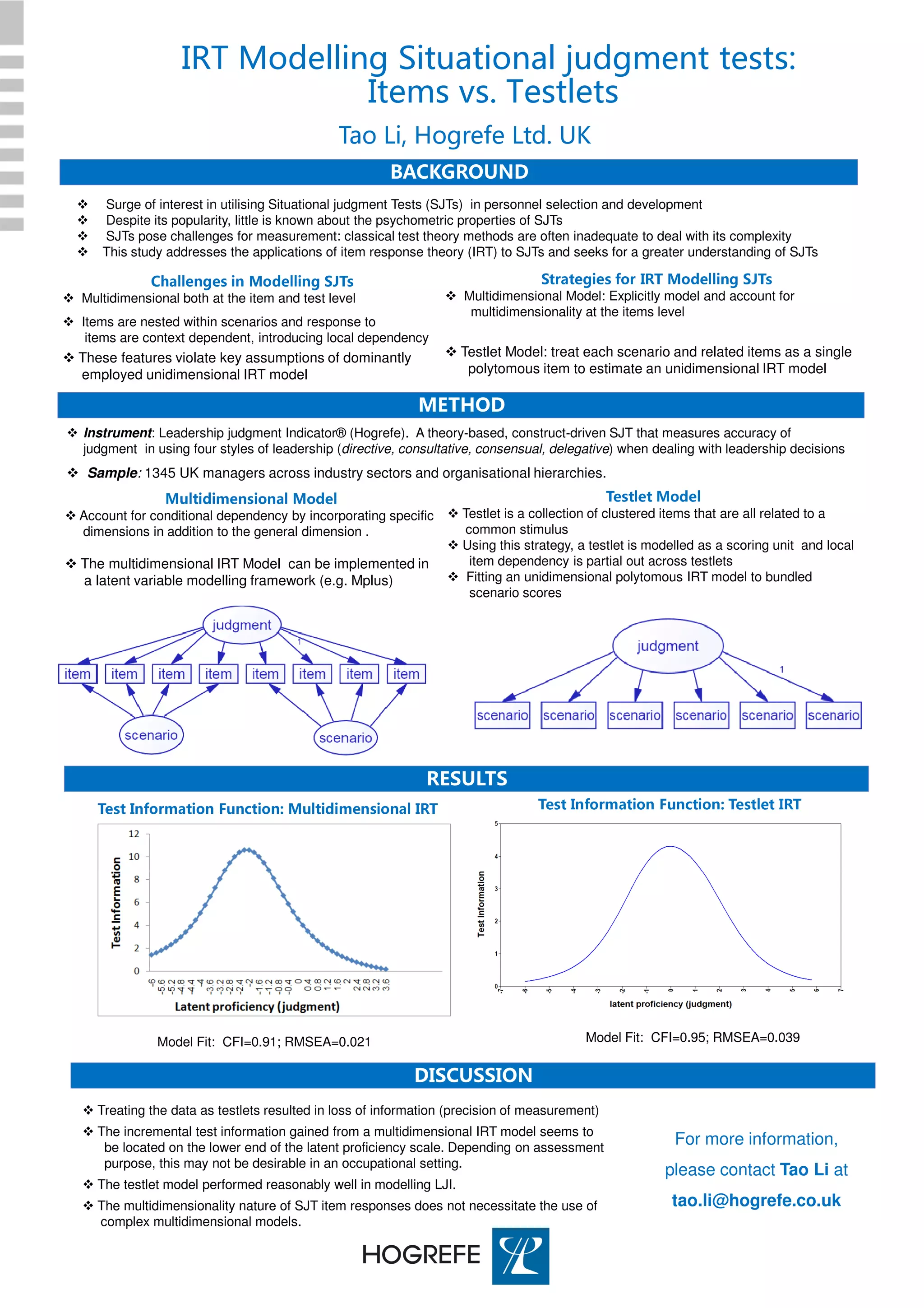
              ledoM lanoisnemiditluM                                                          ledoM teltseT
Account for conditional dependency by incorporating specific       Testlet is a collection of clustered items that are all related to a
dimensions in addition to the general dimension .                  common stimulus
                                                                   Using this strategy, a testlet is modelled as a scoring unit and local
The multidimensional IRT Model can be implemented in                item dependency is partial out across testlets
a latent variable modelling framework (e.g. Mplus)                  Fitting an unidimensional polytomous IRT model to bundled
                                                                    scenario scores


                                                            RESULTS
   TRI lanoisnemiditluM :noitcnuF noitamrofnI tseT                              TRI teltseT :noitcnuF noitamrofnI tseT


             Model Fit: CFI=0.91; RMSEA=0.021                                            Model Fit: CFI=0.95; RMSEA=0.039


                                                          DISCUSSION
   Treating the data as testlets resulted in loss of information (precision of measurement)
   The incremental test information gained from a multidimensional IRT model seems to
    be located on the lower end of the latent proficiency scale. Depending on assessment
                                                                                                        For more information,
    purpose, this may not be desirable in an occupational setting.
                                                                                                       please contact Tao Li at
   The testlet model performed reasonably well in modelling LJI.
   The multidimensionality nature of SJT item responses does not necessitate the use of                 tao.li@hogrefe.co.uk
   complex multidimensional models.

IRT Modelling SJTs

  • 1.
    IRT Modelling Situationaljudgment tests: Items vs. Testlets Tao Li, Hogrefe Ltd. UK BACKGROUND Surge of interest in utilising Situational judgment Tests (SJTs) in personnel selection and development Despite its popularity, little is known about the psychometric properties of SJTs SJTs pose challenges for measurement: classical test theory methods are often inadequate to deal with its complexity This study addresses the applications of item response theory (IRT) to SJTs and seeks for a greater understanding of SJTs sTJS gnilledoM ni segnellahC sTJS gnilledoM TRI rof seigetartS Multidimensional both at the item and test level Multidimensional Model: Explicitly model and account for multidimensionality at the items level Items are nested within scenarios and response to items are context dependent, introducing local dependency These features violate key assumptions of dominantly Testlet Model: treat each scenario and related items as a single employed unidimensional IRT model polytomous item to estimate an unidimensional IRT model METHOD Instrument: Leadership judgment Indicator® (Hogrefe). A theory-based, construct-driven SJT that measures accuracy of judgment in using four styles of leadership (directive, consultative, consensual, delegative) when dealing with leadership decisions Sample: 1345 UK managers across industry sectors and organisational hierarchies. ledoM lanoisnemiditluM ledoM teltseT Account for conditional dependency by incorporating specific Testlet is a collection of clustered items that are all related to a dimensions in addition to the general dimension . common stimulus Using this strategy, a testlet is modelled as a scoring unit and local The multidimensional IRT Model can be implemented in item dependency is partial out across testlets a latent variable modelling framework (e.g. Mplus) Fitting an unidimensional polytomous IRT model to bundled scenario scores RESULTS TRI lanoisnemiditluM :noitcnuF noitamrofnI tseT TRI teltseT :noitcnuF noitamrofnI tseT Model Fit: CFI=0.91; RMSEA=0.021 Model Fit: CFI=0.95; RMSEA=0.039 DISCUSSION Treating the data as testlets resulted in loss of information (precision of measurement) The incremental test information gained from a multidimensional IRT model seems to be located on the lower end of the latent proficiency scale. Depending on assessment For more information, purpose, this may not be desirable in an occupational setting. please contact Tao Li at The testlet model performed reasonably well in modelling LJI. The multidimensionality nature of SJT item responses does not necessitate the use of tao.li@hogrefe.co.uk complex multidimensional models.