HMU KHANT HTWAY
                  TP021928
                UC3F1201BM
             BM014-3.5-3-DMKG
     SUERAYA BINTI MOHAMAD ALWIE
             16TH AUGUST 2012
           28TH SEPTEMBER 2012
2390 words excluding tables in part 2, table of
           contents and references
Decision Making Assignment

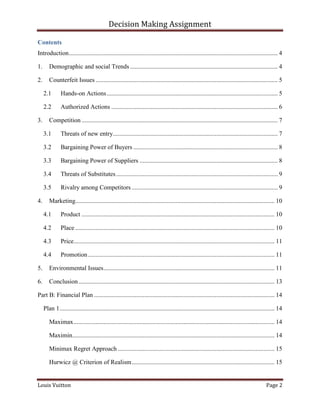
Contents
Introduction ..................................................................................................................................... 4

1.      Demographic and social Trends .............................................................................................. 4

2.      Counterfeit Issues .................................................................................................................... 5

     2.1       Hands-on Actions ............................................................................................................. 5

     2.2       Authorized Actions .......................................................................................................... 6

3.      Competition ............................................................................................................................. 7

     3.1       Threats of new entry......................................................................................................... 7

     3.2       Bargaining Power of Buyers ............................................................................................ 8

     3.3       Bargaining Power of Suppliers ........................................................................................ 8

     3.4       Threats of Substitutes ....................................................................................................... 9

     3.5       Rivalry among Competitors ............................................................................................. 9

4.      Marketing............................................................................................................................... 10

     4.1       Product ........................................................................................................................... 10

     4.2       Place ............................................................................................................................... 10

     4.3       Price................................................................................................................................ 11

     4.4       Promotion ....................................................................................................................... 11

5.      Environmental Issues ............................................................................................................. 11

6.      Conclusion ............................................................................................................................. 13

Part B: Financial Plan ................................................................................................................... 14

     Plan 1 ......................................................................................................................................... 14

        Maximax ................................................................................................................................ 14

        Maximin................................................................................................................................. 14

        Minimax Regret Approach .................................................................................................... 15

        Hurwicz @ Criterion of Realism ........................................................................................... 15


Louis Vuitton                                                                                                                                 Page 2
Decision Making Assignment

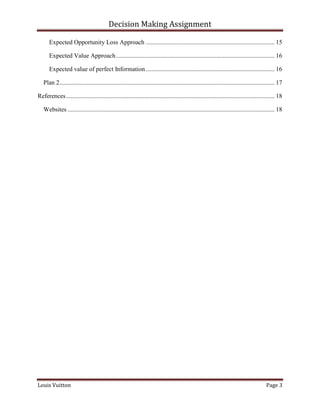
      Expected Opportunity Loss Approach .................................................................................. 15

      Expected Value Approach ..................................................................................................... 16

      Expected value of perfect Information .................................................................................. 16

   Plan 2 ......................................................................................................................................... 17

References ..................................................................................................................................... 18

   Websites .................................................................................................................................... 18


Louis Vuitton                                                                                                                               Page 3
Decision Making Assignment

Introduction


Louis Vuitton Malletier, commonly referred to as Louis or shortened to LV, is a French fashion
house founded in 1854 by Louis Vuitton. According to fundinguniverse (2000), LVMH Moët
Hennessy Louis Vuitton SA, created through a $4 billion merger in 1987, is the world's leading
luxury goods vendor, providing products –perfumes, designer handbags, jewelry, accessories,
sunglasses and books.

The mission of LVMH group is to represent around the world with the most refined qualities of
Western `Art de Vivre’. LVMH must continue to be synonymous with both elegance and
creativity.


    1. Demographic and social Trends

Understanding demographic and social trends is vital in the luxury industry because it assists in
identifying target market especially in the apparel segment. The demographic development
across many states reveals itself in terms of rising ageing population, powerful generation Y and
X consumers, slightly less powerful but still significant baby boomers and greater spending
power of consumers in the evolving economies (China, India, Brazil, etc). As a result, this has
contributed enormously to a rapid rise of luxury brands’ profits especially in Asia (China and
Japan).
In order to respond to demographic and social trends effectively LV should alter some of their
strategies to design goods made-to-order for specific demographic groups. Such degree would
allow the brand to correctly identify the needs of the target market(s) and ensure long term
profitability.

Initially, LV should consider scheming products to gratify the necessities of the women’s plus-
size and men’s big and tall markets. Such quantity is essential chiefly because of the American’s
snowballing average weight and the fact that they characterise one of the well-off civilisations in
the world (Nguyen, 2004). In addition, these two buyer groups have been branded as the wildest
upward industry sectors.


Louis Vuitton                                                                               Page 4
Decision Making Assignment

Furthermore, the mounting petition for luxury goods among fresher age group of China, the
world’s largest realm, requires LV to respond consequently. For illustration, LV can exercise
adapting the enterprises of some of their products (bags, clothing) to the ethnic requirements in
this unindustrialized market. Such measure can significantly help in accomplishing extensive
tenure effectiveness since no other nation has so many impoverished or well-heeled clients
yelling for stuff. Later, retorting to these demographic/social trends can assuage some of the
topics for LV in the extensive run and consequence in competitive advantage.


   2. Counterfeit Issues


Counterfeit issues have beleaguered extravagance brands including LV for years and the
company spends massive amount of possessions to contest this problem. To crack this problem,
LV should commence both hands-on and authorized actions to contest the counterfeit issues in a
methodical way.

   2.1 Hands-on Actions


Expressive your producers denote to occupy only with reliable manufacturers that take loyal
actions and ladders to secure LV’s engineering know-how and registered evidence (Anderson,
2012). In other words, LV should join forces with producers that are enthusiastic to shield the
company’s trade know-how to contest the counterfeiting issues over the extensive period.

Adjusting the circulation cable implies LV should have a more national scattering of the goods.
Such quantity can edge the total of counterfeit goods being distributed and traded in numerous
journeys’ end. For illustration, distribution goods to wholesalers from single opinion or in receipt
of them at one address can back in sensing counterfeit goods more effectually.

Speculation in anti-counterfeiting machineries recommends LV should spend more properties on
special fibres and holograms that allow wholesalers, clients and duties representatives to ensure
the legitimacy of the goods (Anderson, 2012). This can simplify the lessening of counterfeiting
in the global marketplace regardless of high cost. However, the assistances of these technologies
bring in contesting counterfeiting far compensate the costs of executing them in the lengthy term.


Louis Vuitton                                                                                Page 5
Decision Making Assignment

At that point, this portion along can hypothetically lessen the undesirable outcome of counterfeit
goods on LVMH’s revenues, brand image and sales bulk.

   2.2 Authorized Actions


Intended for the determination of diminishing the negative effect of counterfeit goods, LV might
commence several legal actions with the most vivacious actuality: recordkeeping fundamental
brands, soundtrack emblem processes and specialist care online mart websites (Anderson, 2012).

Record-keeping essential brands provide significant recompenses predominantly by insertion the
participants or possible fraudsters on announcement of the company’s rights. It is vital to
catalogue the core brands both locally and out of the country with the reverential powers that be.
Record -keeping can assistance LV in terms of “establishing of nationwide priority of rights as of
the application’s filing date” (Anderson, 2012). Therefore, it is vigorous for LV to contemplate
record-keeping its essential brands in the following types of countries:

       Countries where the company manufactures the products
       Countries where the company currently distributes goods or is planning on distributing
       Countries where suppliers or vendors are located
       Countries that are well-known for manufacturing counterfeits in the company’s product
       category (e.g. Morocco, China, Turkey)
       Countries which are major transhipments points for fake and original (authentic) goods in
       the company’s product category
Source: Anderson.A., 2012


The second measure LV might take to contest counterfeiting is recording the emblem
registrations with duties. This means the possessors (LV) of registered emblems could get some
help from duties authorities in battling counterfeiting (Anderson, 2012). Since duties authorities
scrutinize products on a regular basis that flow between the countries, LV can work together with
them to avert fake goods from entering the markets. Furthermore, in most countries duties
authorities have anauthorization to abolish or dispose of counterfeit products immediately upon


Louis Vuitton                                                                              Page 6
Decision Making Assignment

noticing them. Nevertheless, this system is not without its defects as in most cases only a small
portion of goods are inspected for imitations (OECD, 2007).


   3. Competition

In order to appraise the competition in the luxury goods industry from LV’s standpoint, it is
compulsory to apply the Porter’s Five Forces model. So LVMH’s competitive position can be
investigated from the following approaches: risk of new entrants, bargaining power of buyers,
bargaining power of suppliers, rivalry among established firms and the threat of substitutes.

   3.1 Threats of new entry


Potential competitors (new entrants) are basically companies that currently do not contend in the
industry; however they have the competence to do so if they choose (Hill and Jones, 2010). To
evaluate how much of a threat of new entrants are for LVMH it is critical to scrutinise the
blockades of entry into the business.

The major barrier of entry into the industry for potential competitors is brand loyalty. This point
toward LV has fashioned and continuous a deep-rooted customer favourite which makes it
tremendouslyproblematic for new entrants to take market share away from LVMH and other
significant brands (Gucci, YSL, Chanel and others). Besides, the amassedpractice of functioning
in the luxury goods market that LV has assimilated since its inception in 19th century
recommendscomplete cost advantage in production (high quality) or key business
developmentsabsolute to new entrants. In addition, possible competitors do not have the benefit
of lower monetaryjeopardies in contrast to LV. However, other barricades such as substituting
costs for buyers, administration regulation are not as high which is good for possiblecontestants.
Bearing in mind that financial prudence of scale in this particular industry is not really clear the
threat of new entrants for LV is relatively low.


Louis Vuitton                                                                                Page 7
Decision Making Assignment

   3.2 Bargaining Power of Buyers


The buyer power in this industry is relatively low. Originally, the substituting costs for buyers or
end-users are low which means they do not sustain any supplementary costs if they were no need
to doadjustment to another seller (Gucci, Cartier, etc) or they can even purchase products from
several companies at once. Furthermore, the manufacturing as a whole is in need of on buyers in
anintellect that they buying a large proportion of companies’ total orders.

However, the buyer power is to a great amount limited chiefly because buyers are not large and
few in numbers. In other words, they are not overriding and mostly do not purchase LV’s
products in large measures, thus abolishing leverage for price bargains. In addition, there is little
to no hazard of buyers toward the inside the industry themselves and manufacturing luxury
goods.

   3.3 Bargaining Power of Suppliers


The supplier power comparative to LV is at a sensible level as suppliers provide vigorous
products to the industry that have few alternatives. Also the substituting costs for luxury brands
including LV can be noteworthy, therefore limiting the capability to play suppliers contrary to
each other.

Conversely, there are influences which reduce the supplier power. Primarily, suppliers cannot
certainly threaten to enter the luxury industry and strive with recognised brands. Moreover, the
industry itself is vigorous customers for suppliers point toward those suppliers is greatly
exaggerated by customer’s (LVMH) petition. Furthermore, companies in the industry have
competences to precipitously fit in and enter suppliers’ industry.


Louis Vuitton                                                                                 Page 8
Decision Making Assignment

   3.4 Threats of Substitutes


Substitute products are fundamentally goods from other industries or business that can mollify
similar needs of the customers. In this case, LVMH faces a low threat of substitutes largely
because industry’s products have a rare adjacent substitute which empowers firms to increase
prices (charge first-class) and earn additional profit. This is primarilysince only few if any
products have the same petition as LV’s in terms of quality,statusallied with retaining them and
value.

   3.5 Rivalry among Competitors


Competitive competition refers to the scuffle between firms in the same industry in order to
acquire greater market share (Hill and Jones, 2010). According to the case study, the competition
is very powerful in this industry as LVMH’s principally contends with Pinault-Printems-Redoute
(Gucci and Yves Saint Laurent) and CompagnieFinanciereRichemont (Cartier and Montblanc).

The competition between LV and its competitors is strong because the modest assembly of the
industry includes reasonably high number of firms which are more or less equal in their size.
Additionally, there is no clear and overriding leader making it a split industry, thus escalating
race. Furthermore, the petition and cost conditions have a tendency to stimulus the concentration
of competition in any industry and in this case, they create a very strong race. Also the stature of
exit barricadesis high which avoids companies leaving the industry.


Louis Vuitton                                                                                Page 9
Decision Making Assignment

    4. Marketing


LVMH applies noteworthy resources on publicity its brands and the entire marketing strategy of
the company can be appraised by spread over the marketing mix analysis (product, place, price,
promotion).

    4.1 Product


In terms of product, LV dissimilar overall consumer goods stresses the notion of complete
superiority whereby it situations of the goods as actuality of top indentation quality and with
super attention to good performance.

Regardless of LV’s good performance in the luxury goods industry, there are still zones which it
can progress upon. For instance, the speedily mounting demand for luxury products in China
gives LV a chance to alter the designs of their bags, watches, clothes and other goods to uniform
the needs of Chinese customers. This will undeniably demand to potential buyers and help to
increase brand’s profits. Furthermore, it wills additional separate LV’s products from the
competitors’ and intensification barriers of entry to the industry over higher customer loyalty in a
big market.

    4.2 Place


Since LV is a luxury brand it does not essentially apply wide range of spreading channels
(retailers, non-department stores) to distribute the goods to end customers but relatively offers its
products over and done with limited distribution channels. Put alternative way, LV’s place
strategy is based national control of distribution channels.

To additional strengthening for spreading of LV’s products the company should consider
opening up more than existing four stores in India (Louis Vuitton, 2012) since it is one of the
world’s fastest growing economies and population’s income is rising. Furthermore, LV should
open up at least one store in Central Asia because currently there are no official branches in there
(Louis Vuitton, 2012). This will coagulate company’s position in a highly modest industry even
extra.

Louis Vuitton                                                                                Page 10
Decision Making Assignment

    4.3 Price


LV proposals its products at a remarkably high price contrast with the general marketing strategy
primarily because it is a luxury brand and it accentuates the concept of providing the highest
value.

    4.4 Promotion


The promotion tools utilised by LV are not based on the concept of mass advertising and
promotion. Regardless of having relatively successful promotion strategy LV can further
improve it by using other superstars depending on the geographic region. For example, in Asian
region LV can work with Michelle Yeoh or Ken Watanabe to promote products. This force
assists in having greater inspiration of attracting and retentivecustomers thus make best use of
profits.


    5. Environmental Issues


Achieving environmental objectives as well as profit associated goals has become very important
for organisations. According to Waller and Hingorani, 2012, LVMH is the world’s largest luxury
goods corporation which means the company is predictable to subsidize to the improvement of
social welfare and environment. In other words, LVMH is predictable to manner CSR activities.
Though originally costly to gadget, operative CSR programme can result in competitive
advantage in the long term and further strengthen LV’s position as one of the world’s top brands.

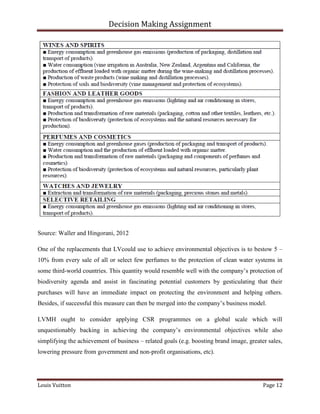
Currently LVMH has several initiatives that focus on “Protecting the environment”. The
activities related to this programme are shown in below. It should be distinguished these
activities are industry detailed and explain the environmental impact of the organisation.


Louis Vuitton                                                                                Page 11
Decision Making Assignment


Source: Waller and Hingorani, 2012

One of the replacements that LVcould use to achieve environmental objectives is to bestow 5 –
10% from every sale of all or select few perfumes to the protection of clean water systems in
some third-world countries. This quantity would resemble well with the company’s protection of
biodiversity agenda and assist in fascinating potential customers by gesticulating that their
purchases will have an immediate impact on protecting the environment and helping others.
Besides, if successful this measure can then be merged into the company’s business model.

LVMH ought to consider applying CSR programmes on a global scale which will
unquestionably backing in achieving the company’s environmental objectives while also
simplifying the achievement of business – related goals (e.g. boosting brand image, greater sales,
lowering pressure from government and non-profit organisations, etc).


Louis Vuitton                                                                             Page 12
Decision Making Assignment

   6. Conclusion


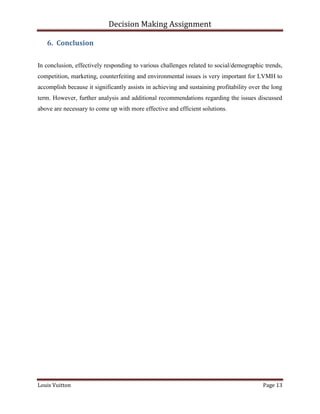
In conclusion, effectively responding to various challenges related to social/demographic trends,
competition, marketing, counterfeiting and environmental issues is very important for LVMH to
accomplish because it significantly assists in achieving and sustaining profitability over the long
term. However, further analysis and additional recommendations regarding the issues discussed
above are necessary to come up with more effective and efficient solutions.


Louis Vuitton                                                                              Page 13
Decision Making Assignment

Part B: Financial Plan


Plan 1


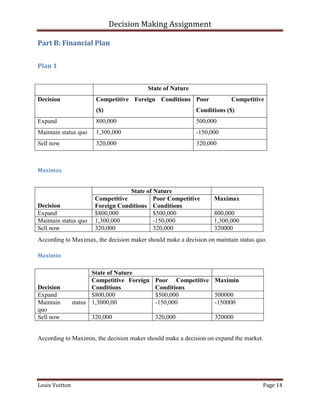
                                         State of Nature
Decision                Competitive Foreign Conditions Poor              Competitive
                        ($)                                 Conditions ($)
Expand                  800,000                             500,000
Maintain status quo     1,300,000                           -150,000
Sell now                320,000                             320,000


Maximax


                                   State of Nature
                       Competitive          Poor Competitive       Maximax
Decision               Foreign Conditions Conditions
Expand                 $800,000             $500,000               800,000
Maintain status quo    1,300,000            -150,000               1,300,000
Sell now               320,000              320,000                320000
According to Maximax, the decision maker should make a decision on maintain status quo.

Maximin

                       State of Nature
                       Competitive Foreign   Poor Competitive Maximin
Decision               Conditions            Conditions
Expand                 $800,000              $500,000         500000
Maintain        status 1,3000,00             -150,000         -150000
quo
Sell now              320,000                320,000               320000


According to Maximin, the decision maker should make a decision on expand the market.


Louis Vuitton                                                                        Page 14
Decision Making Assignment

Minimax Regret Approach


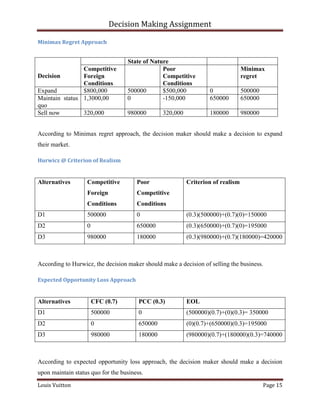
                                   State of Nature
                Competitive                     Poor                              Minimax
Decision        Foreign                         Competitive                       regret
                Conditions                      Conditions
Expand          $800,000           500000       $500,000           0              500000
Maintain status 1,3000,00          0            -150,000           650000         650000
quo
Sell now        320,000            980000        320,000           180000         980000


According to Minimax regret approach, the decision maker should make a decision to expand
their market.

Hurwicz @ Criterion of Realism


Alternatives       Competitive         Poor                Criterion of realism
                   Foreign             Competitive
                   Conditions          Conditions
D1                 500000              0                   (0.3)(500000)+(0.7)(0)=150000
D2                 0                   650000              (0.3)(650000)+(0.7)(0)=195000
D3                 980000              180000              (0.3)(980000)+(0.7)(180000)=420000


According to Hurwicz, the decision maker should make a decision of selling the business.

Expected Opportunity Loss Approach


Alternatives           CFC (0.7)        PCC (0.3)          EOL
D1                     500000           0                  (500000)(0.7)+(0)(0.3)= 350000
D2                     0                650000             (0)(0.7)+(650000)(0.3)=195000
D3                     980000           180000             (980000)(0.7)+(180000)(0.3)=740000


According to expected opportunity loss approach, the decision maker should make a decision
upon maintain status quo for the business.

Louis Vuitton                                                                              Page 15
Decision Making Assignment

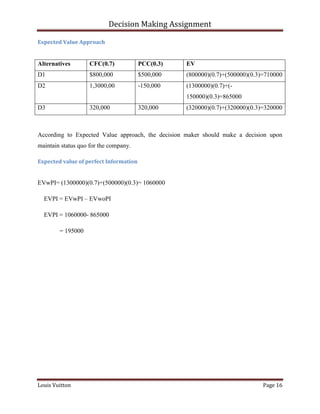
Expected Value Approach


Alternatives        CFC(0.7)            PCC(0.3)   EV
D1                  $800,000            $500,000   (800000)(0.7)+(500000)(0.3)=710000
D2                  1,3000,00           -150,000   (1300000)(0.7)+(-
                                                   150000)(0.3)=865000
D3                  320,000             320,000    (320000)(0.7)+(320000)(0.3)=320000


According to Expected Value approach, the decision maker should make a decision upon
maintain status quo for the company.

Expected value of perfect Information


EVwPI= (1300000)(0.7)+(500000)(0.3)= 1060000

  EVPI = EVwPI – EVwoPI

  EVPI = 1060000- 865000

        = 195000


Louis Vuitton                                                                 Page 16
Decision Making Assignment

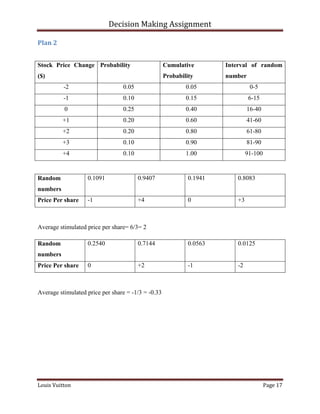
Plan 2


Stock Price Change Probability                      Cumulative        Interval of random
($)                                                 Probability       number
          -2                     0.05                       0.05               0-5
          -1                     0.10                       0.15               6-15
          0                      0.25                       0.40              16-40
          +1                     0.20                       0.60              41-60
          +2                     0.20                       0.80              61-80
          +3                     0.10                       0.90              81-90
          +4                     0.10                       1.00              91-100


Random             0.1091               0.9407               0.1941      0.8083
numbers
Price Per share    -1                   +4                   0           +3


Average stimulated price per share= 6/3= 2

Random             0.2540               0.7144               0.0563      0.0125
numbers
Price Per share    0                    +2                   -1          -2


Average stimulated price per share = -1/3 = -0.33


Louis Vuitton                                                                          Page 17
Decision Making Assignment

References


ANDERSON, A., 2012, Combating Counterfeiting: Simple Steps You Can Take Now to Protect
Your Brand from Piracy, Holland and Harts. [Accessed: 26th August 2012]

BERAD, N.R., 2011, Corporate Social Responsibility – Issues and Challenges in India,
International Conference on Technology and Business Management. [Accessed: 5th September
2012]

HILL, C., W., JONES, G., R., Strategic Management Theory: An Integrated Approach, 9th
Edition, South-Western, Cengage Learning. [Accessed: 13th September 2012]

NGUYEN, V., 2004, Analysis of the Luxury Goods & Apparel and Footwear Industries.
[Accessed: 15th September 2012]

OECD, 2007, Organisation for Economic Co-operation and Development, The Economic impact
of counterfeiting and piracy: Executive Summary. [Accessed: 19th September 2012]

WALLER, D., S., HINGORANI, A., G., 2011, Luxury Brands: What Are They Doing About
Social Responsibility, University of Technology Sydney. [Accessed: 21st September 2012]

Websites


History of Louis Vuitton, (2000), (online), Available at:

http://www.fundinguniverse.com/company-histories/lvmh-mo%C3%ABt-hennessy-louis-
vuitton-sa-history/ [Accessed: 26th August 2012]

LOUIS VUITTON, 2012 (Online), Louis Vuitton Store Locator, Available at:

http://www.louisvuitton.com/front/#/eng_US/Homepage [Accessed: 21st September 2012]


Louis Vuitton                                                                         Page 18

Dmkg assignment final

  • 1.
    HMU KHANT HTWAY TP021928 UC3F1201BM BM014-3.5-3-DMKG SUERAYA BINTI MOHAMAD ALWIE 16TH AUGUST 2012 28TH SEPTEMBER 2012 2390 words excluding tables in part 2, table of contents and references
  • 2.
    Decision Making Assignment Contents Introduction..................................................................................................................................... 4 1. Demographic and social Trends .............................................................................................. 4 2. Counterfeit Issues .................................................................................................................... 5 2.1 Hands-on Actions ............................................................................................................. 5 2.2 Authorized Actions .......................................................................................................... 6 3. Competition ............................................................................................................................. 7 3.1 Threats of new entry......................................................................................................... 7 3.2 Bargaining Power of Buyers ............................................................................................ 8 3.3 Bargaining Power of Suppliers ........................................................................................ 8 3.4 Threats of Substitutes ....................................................................................................... 9 3.5 Rivalry among Competitors ............................................................................................. 9 4. Marketing............................................................................................................................... 10 4.1 Product ........................................................................................................................... 10 4.2 Place ............................................................................................................................... 10 4.3 Price................................................................................................................................ 11 4.4 Promotion ....................................................................................................................... 11 5. Environmental Issues ............................................................................................................. 11 6. Conclusion ............................................................................................................................. 13 Part B: Financial Plan ................................................................................................................... 14 Plan 1 ......................................................................................................................................... 14 Maximax ................................................................................................................................ 14 Maximin................................................................................................................................. 14 Minimax Regret Approach .................................................................................................... 15 Hurwicz @ Criterion of Realism ........................................................................................... 15 Louis Vuitton Page 2
  • 3.
    Decision Making Assignment Expected Opportunity Loss Approach .................................................................................. 15 Expected Value Approach ..................................................................................................... 16 Expected value of perfect Information .................................................................................. 16 Plan 2 ......................................................................................................................................... 17 References ..................................................................................................................................... 18 Websites .................................................................................................................................... 18 Louis Vuitton Page 3
  • 4.
    Decision Making Assignment Introduction LouisVuitton Malletier, commonly referred to as Louis or shortened to LV, is a French fashion house founded in 1854 by Louis Vuitton. According to fundinguniverse (2000), LVMH Moët Hennessy Louis Vuitton SA, created through a $4 billion merger in 1987, is the world's leading luxury goods vendor, providing products –perfumes, designer handbags, jewelry, accessories, sunglasses and books. The mission of LVMH group is to represent around the world with the most refined qualities of Western `Art de Vivre’. LVMH must continue to be synonymous with both elegance and creativity. 1. Demographic and social Trends Understanding demographic and social trends is vital in the luxury industry because it assists in identifying target market especially in the apparel segment. The demographic development across many states reveals itself in terms of rising ageing population, powerful generation Y and X consumers, slightly less powerful but still significant baby boomers and greater spending power of consumers in the evolving economies (China, India, Brazil, etc). As a result, this has contributed enormously to a rapid rise of luxury brands’ profits especially in Asia (China and Japan). In order to respond to demographic and social trends effectively LV should alter some of their strategies to design goods made-to-order for specific demographic groups. Such degree would allow the brand to correctly identify the needs of the target market(s) and ensure long term profitability. Initially, LV should consider scheming products to gratify the necessities of the women’s plus- size and men’s big and tall markets. Such quantity is essential chiefly because of the American’s snowballing average weight and the fact that they characterise one of the well-off civilisations in the world (Nguyen, 2004). In addition, these two buyer groups have been branded as the wildest upward industry sectors. Louis Vuitton Page 4
  • 5.
    Decision Making Assignment Furthermore,the mounting petition for luxury goods among fresher age group of China, the world’s largest realm, requires LV to respond consequently. For illustration, LV can exercise adapting the enterprises of some of their products (bags, clothing) to the ethnic requirements in this unindustrialized market. Such measure can significantly help in accomplishing extensive tenure effectiveness since no other nation has so many impoverished or well-heeled clients yelling for stuff. Later, retorting to these demographic/social trends can assuage some of the topics for LV in the extensive run and consequence in competitive advantage. 2. Counterfeit Issues Counterfeit issues have beleaguered extravagance brands including LV for years and the company spends massive amount of possessions to contest this problem. To crack this problem, LV should commence both hands-on and authorized actions to contest the counterfeit issues in a methodical way. 2.1 Hands-on Actions Expressive your producers denote to occupy only with reliable manufacturers that take loyal actions and ladders to secure LV’s engineering know-how and registered evidence (Anderson, 2012). In other words, LV should join forces with producers that are enthusiastic to shield the company’s trade know-how to contest the counterfeiting issues over the extensive period. Adjusting the circulation cable implies LV should have a more national scattering of the goods. Such quantity can edge the total of counterfeit goods being distributed and traded in numerous journeys’ end. For illustration, distribution goods to wholesalers from single opinion or in receipt of them at one address can back in sensing counterfeit goods more effectually. Speculation in anti-counterfeiting machineries recommends LV should spend more properties on special fibres and holograms that allow wholesalers, clients and duties representatives to ensure the legitimacy of the goods (Anderson, 2012). This can simplify the lessening of counterfeiting in the global marketplace regardless of high cost. However, the assistances of these technologies bring in contesting counterfeiting far compensate the costs of executing them in the lengthy term. Louis Vuitton Page 5
  • 6.
    Decision Making Assignment Atthat point, this portion along can hypothetically lessen the undesirable outcome of counterfeit goods on LVMH’s revenues, brand image and sales bulk. 2.2 Authorized Actions Intended for the determination of diminishing the negative effect of counterfeit goods, LV might commence several legal actions with the most vivacious actuality: recordkeeping fundamental brands, soundtrack emblem processes and specialist care online mart websites (Anderson, 2012). Record-keeping essential brands provide significant recompenses predominantly by insertion the participants or possible fraudsters on announcement of the company’s rights. It is vital to catalogue the core brands both locally and out of the country with the reverential powers that be. Record -keeping can assistance LV in terms of “establishing of nationwide priority of rights as of the application’s filing date” (Anderson, 2012). Therefore, it is vigorous for LV to contemplate record-keeping its essential brands in the following types of countries: Countries where the company manufactures the products Countries where the company currently distributes goods or is planning on distributing Countries where suppliers or vendors are located Countries that are well-known for manufacturing counterfeits in the company’s product category (e.g. Morocco, China, Turkey) Countries which are major transhipments points for fake and original (authentic) goods in the company’s product category Source: Anderson.A., 2012 The second measure LV might take to contest counterfeiting is recording the emblem registrations with duties. This means the possessors (LV) of registered emblems could get some help from duties authorities in battling counterfeiting (Anderson, 2012). Since duties authorities scrutinize products on a regular basis that flow between the countries, LV can work together with them to avert fake goods from entering the markets. Furthermore, in most countries duties authorities have anauthorization to abolish or dispose of counterfeit products immediately upon Louis Vuitton Page 6
  • 7.
    Decision Making Assignment noticingthem. Nevertheless, this system is not without its defects as in most cases only a small portion of goods are inspected for imitations (OECD, 2007). 3. Competition In order to appraise the competition in the luxury goods industry from LV’s standpoint, it is compulsory to apply the Porter’s Five Forces model. So LVMH’s competitive position can be investigated from the following approaches: risk of new entrants, bargaining power of buyers, bargaining power of suppliers, rivalry among established firms and the threat of substitutes. 3.1 Threats of new entry Potential competitors (new entrants) are basically companies that currently do not contend in the industry; however they have the competence to do so if they choose (Hill and Jones, 2010). To evaluate how much of a threat of new entrants are for LVMH it is critical to scrutinise the blockades of entry into the business. The major barrier of entry into the industry for potential competitors is brand loyalty. This point toward LV has fashioned and continuous a deep-rooted customer favourite which makes it tremendouslyproblematic for new entrants to take market share away from LVMH and other significant brands (Gucci, YSL, Chanel and others). Besides, the amassedpractice of functioning in the luxury goods market that LV has assimilated since its inception in 19th century recommendscomplete cost advantage in production (high quality) or key business developmentsabsolute to new entrants. In addition, possible competitors do not have the benefit of lower monetaryjeopardies in contrast to LV. However, other barricades such as substituting costs for buyers, administration regulation are not as high which is good for possiblecontestants. Bearing in mind that financial prudence of scale in this particular industry is not really clear the threat of new entrants for LV is relatively low. Louis Vuitton Page 7
  • 8.
    Decision Making Assignment 3.2 Bargaining Power of Buyers The buyer power in this industry is relatively low. Originally, the substituting costs for buyers or end-users are low which means they do not sustain any supplementary costs if they were no need to doadjustment to another seller (Gucci, Cartier, etc) or they can even purchase products from several companies at once. Furthermore, the manufacturing as a whole is in need of on buyers in anintellect that they buying a large proportion of companies’ total orders. However, the buyer power is to a great amount limited chiefly because buyers are not large and few in numbers. In other words, they are not overriding and mostly do not purchase LV’s products in large measures, thus abolishing leverage for price bargains. In addition, there is little to no hazard of buyers toward the inside the industry themselves and manufacturing luxury goods. 3.3 Bargaining Power of Suppliers The supplier power comparative to LV is at a sensible level as suppliers provide vigorous products to the industry that have few alternatives. Also the substituting costs for luxury brands including LV can be noteworthy, therefore limiting the capability to play suppliers contrary to each other. Conversely, there are influences which reduce the supplier power. Primarily, suppliers cannot certainly threaten to enter the luxury industry and strive with recognised brands. Moreover, the industry itself is vigorous customers for suppliers point toward those suppliers is greatly exaggerated by customer’s (LVMH) petition. Furthermore, companies in the industry have competences to precipitously fit in and enter suppliers’ industry. Louis Vuitton Page 8
  • 9.
    Decision Making Assignment 3.4 Threats of Substitutes Substitute products are fundamentally goods from other industries or business that can mollify similar needs of the customers. In this case, LVMH faces a low threat of substitutes largely because industry’s products have a rare adjacent substitute which empowers firms to increase prices (charge first-class) and earn additional profit. This is primarilysince only few if any products have the same petition as LV’s in terms of quality,statusallied with retaining them and value. 3.5 Rivalry among Competitors Competitive competition refers to the scuffle between firms in the same industry in order to acquire greater market share (Hill and Jones, 2010). According to the case study, the competition is very powerful in this industry as LVMH’s principally contends with Pinault-Printems-Redoute (Gucci and Yves Saint Laurent) and CompagnieFinanciereRichemont (Cartier and Montblanc). The competition between LV and its competitors is strong because the modest assembly of the industry includes reasonably high number of firms which are more or less equal in their size. Additionally, there is no clear and overriding leader making it a split industry, thus escalating race. Furthermore, the petition and cost conditions have a tendency to stimulus the concentration of competition in any industry and in this case, they create a very strong race. Also the stature of exit barricadesis high which avoids companies leaving the industry. Louis Vuitton Page 9
  • 10.
    Decision Making Assignment 4. Marketing LVMH applies noteworthy resources on publicity its brands and the entire marketing strategy of the company can be appraised by spread over the marketing mix analysis (product, place, price, promotion). 4.1 Product In terms of product, LV dissimilar overall consumer goods stresses the notion of complete superiority whereby it situations of the goods as actuality of top indentation quality and with super attention to good performance. Regardless of LV’s good performance in the luxury goods industry, there are still zones which it can progress upon. For instance, the speedily mounting demand for luxury products in China gives LV a chance to alter the designs of their bags, watches, clothes and other goods to uniform the needs of Chinese customers. This will undeniably demand to potential buyers and help to increase brand’s profits. Furthermore, it wills additional separate LV’s products from the competitors’ and intensification barriers of entry to the industry over higher customer loyalty in a big market. 4.2 Place Since LV is a luxury brand it does not essentially apply wide range of spreading channels (retailers, non-department stores) to distribute the goods to end customers but relatively offers its products over and done with limited distribution channels. Put alternative way, LV’s place strategy is based national control of distribution channels. To additional strengthening for spreading of LV’s products the company should consider opening up more than existing four stores in India (Louis Vuitton, 2012) since it is one of the world’s fastest growing economies and population’s income is rising. Furthermore, LV should open up at least one store in Central Asia because currently there are no official branches in there (Louis Vuitton, 2012). This will coagulate company’s position in a highly modest industry even extra. Louis Vuitton Page 10
  • 11.
    Decision Making Assignment 4.3 Price LV proposals its products at a remarkably high price contrast with the general marketing strategy primarily because it is a luxury brand and it accentuates the concept of providing the highest value. 4.4 Promotion The promotion tools utilised by LV are not based on the concept of mass advertising and promotion. Regardless of having relatively successful promotion strategy LV can further improve it by using other superstars depending on the geographic region. For example, in Asian region LV can work with Michelle Yeoh or Ken Watanabe to promote products. This force assists in having greater inspiration of attracting and retentivecustomers thus make best use of profits. 5. Environmental Issues Achieving environmental objectives as well as profit associated goals has become very important for organisations. According to Waller and Hingorani, 2012, LVMH is the world’s largest luxury goods corporation which means the company is predictable to subsidize to the improvement of social welfare and environment. In other words, LVMH is predictable to manner CSR activities. Though originally costly to gadget, operative CSR programme can result in competitive advantage in the long term and further strengthen LV’s position as one of the world’s top brands. Currently LVMH has several initiatives that focus on “Protecting the environment”. The activities related to this programme are shown in below. It should be distinguished these activities are industry detailed and explain the environmental impact of the organisation. Louis Vuitton Page 11
  • 12.
    Decision Making Assignment Source:Waller and Hingorani, 2012 One of the replacements that LVcould use to achieve environmental objectives is to bestow 5 – 10% from every sale of all or select few perfumes to the protection of clean water systems in some third-world countries. This quantity would resemble well with the company’s protection of biodiversity agenda and assist in fascinating potential customers by gesticulating that their purchases will have an immediate impact on protecting the environment and helping others. Besides, if successful this measure can then be merged into the company’s business model. LVMH ought to consider applying CSR programmes on a global scale which will unquestionably backing in achieving the company’s environmental objectives while also simplifying the achievement of business – related goals (e.g. boosting brand image, greater sales, lowering pressure from government and non-profit organisations, etc). Louis Vuitton Page 12
  • 13.
    Decision Making Assignment 6. Conclusion In conclusion, effectively responding to various challenges related to social/demographic trends, competition, marketing, counterfeiting and environmental issues is very important for LVMH to accomplish because it significantly assists in achieving and sustaining profitability over the long term. However, further analysis and additional recommendations regarding the issues discussed above are necessary to come up with more effective and efficient solutions. Louis Vuitton Page 13
  • 14.
    Decision Making Assignment PartB: Financial Plan Plan 1 State of Nature Decision Competitive Foreign Conditions Poor Competitive ($) Conditions ($) Expand 800,000 500,000 Maintain status quo 1,300,000 -150,000 Sell now 320,000 320,000 Maximax State of Nature Competitive Poor Competitive Maximax Decision Foreign Conditions Conditions Expand $800,000 $500,000 800,000 Maintain status quo 1,300,000 -150,000 1,300,000 Sell now 320,000 320,000 320000 According to Maximax, the decision maker should make a decision on maintain status quo. Maximin State of Nature Competitive Foreign Poor Competitive Maximin Decision Conditions Conditions Expand $800,000 $500,000 500000 Maintain status 1,3000,00 -150,000 -150000 quo Sell now 320,000 320,000 320000 According to Maximin, the decision maker should make a decision on expand the market. Louis Vuitton Page 14
  • 15.
    Decision Making Assignment MinimaxRegret Approach State of Nature Competitive Poor Minimax Decision Foreign Competitive regret Conditions Conditions Expand $800,000 500000 $500,000 0 500000 Maintain status 1,3000,00 0 -150,000 650000 650000 quo Sell now 320,000 980000 320,000 180000 980000 According to Minimax regret approach, the decision maker should make a decision to expand their market. Hurwicz @ Criterion of Realism Alternatives Competitive Poor Criterion of realism Foreign Competitive Conditions Conditions D1 500000 0 (0.3)(500000)+(0.7)(0)=150000 D2 0 650000 (0.3)(650000)+(0.7)(0)=195000 D3 980000 180000 (0.3)(980000)+(0.7)(180000)=420000 According to Hurwicz, the decision maker should make a decision of selling the business. Expected Opportunity Loss Approach Alternatives CFC (0.7) PCC (0.3) EOL D1 500000 0 (500000)(0.7)+(0)(0.3)= 350000 D2 0 650000 (0)(0.7)+(650000)(0.3)=195000 D3 980000 180000 (980000)(0.7)+(180000)(0.3)=740000 According to expected opportunity loss approach, the decision maker should make a decision upon maintain status quo for the business. Louis Vuitton Page 15
  • 16.
    Decision Making Assignment ExpectedValue Approach Alternatives CFC(0.7) PCC(0.3) EV D1 $800,000 $500,000 (800000)(0.7)+(500000)(0.3)=710000 D2 1,3000,00 -150,000 (1300000)(0.7)+(- 150000)(0.3)=865000 D3 320,000 320,000 (320000)(0.7)+(320000)(0.3)=320000 According to Expected Value approach, the decision maker should make a decision upon maintain status quo for the company. Expected value of perfect Information EVwPI= (1300000)(0.7)+(500000)(0.3)= 1060000 EVPI = EVwPI – EVwoPI EVPI = 1060000- 865000 = 195000 Louis Vuitton Page 16
  • 17.
    Decision Making Assignment Plan2 Stock Price Change Probability Cumulative Interval of random ($) Probability number -2 0.05 0.05 0-5 -1 0.10 0.15 6-15 0 0.25 0.40 16-40 +1 0.20 0.60 41-60 +2 0.20 0.80 61-80 +3 0.10 0.90 81-90 +4 0.10 1.00 91-100 Random 0.1091 0.9407 0.1941 0.8083 numbers Price Per share -1 +4 0 +3 Average stimulated price per share= 6/3= 2 Random 0.2540 0.7144 0.0563 0.0125 numbers Price Per share 0 +2 -1 -2 Average stimulated price per share = -1/3 = -0.33 Louis Vuitton Page 17
  • 18.
    Decision Making Assignment References ANDERSON,A., 2012, Combating Counterfeiting: Simple Steps You Can Take Now to Protect Your Brand from Piracy, Holland and Harts. [Accessed: 26th August 2012] BERAD, N.R., 2011, Corporate Social Responsibility – Issues and Challenges in India, International Conference on Technology and Business Management. [Accessed: 5th September 2012] HILL, C., W., JONES, G., R., Strategic Management Theory: An Integrated Approach, 9th Edition, South-Western, Cengage Learning. [Accessed: 13th September 2012] NGUYEN, V., 2004, Analysis of the Luxury Goods & Apparel and Footwear Industries. [Accessed: 15th September 2012] OECD, 2007, Organisation for Economic Co-operation and Development, The Economic impact of counterfeiting and piracy: Executive Summary. [Accessed: 19th September 2012] WALLER, D., S., HINGORANI, A., G., 2011, Luxury Brands: What Are They Doing About Social Responsibility, University of Technology Sydney. [Accessed: 21st September 2012] Websites History of Louis Vuitton, (2000), (online), Available at: http://www.fundinguniverse.com/company-histories/lvmh-mo%C3%ABt-hennessy-louis- vuitton-sa-history/ [Accessed: 26th August 2012] LOUIS VUITTON, 2012 (Online), Louis Vuitton Store Locator, Available at: http://www.louisvuitton.com/front/#/eng_US/Homepage [Accessed: 21st September 2012] Louis Vuitton Page 18