
Uploaded byJessica Allison
(Mchg) individual assignment question
Motorola established a large and successful mobile phone manufacturing plant in a European town that was recovering from the decline of traditional industries, employing 3000 people. The plant was highly productive and invested heavily in training. However, when the electronics and telecom sectors hit economic troubles in 2001, Motorola had to review its operations. While the plant had a skilled workforce, Motorola ultimately decided to close the plant and retain production at another facility in a different country. The plant's closure resulted in massive job losses, similar to those the town had previously experienced.
More Related Content
![[Challenge:Future] Creating Human Capital](https://cdn.slidesharecdn.com/ss_thumbnails/challengefuture-creating-human-capital580-130228031604-phpapp01-thumbnail.jpg?width=640&height=640&fit=bounds)


Similar to (Mchg) individual assignment question


(Mchg) individual assignment question
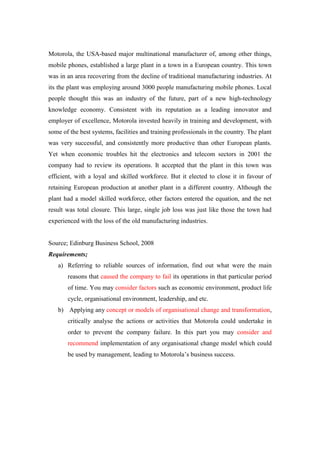
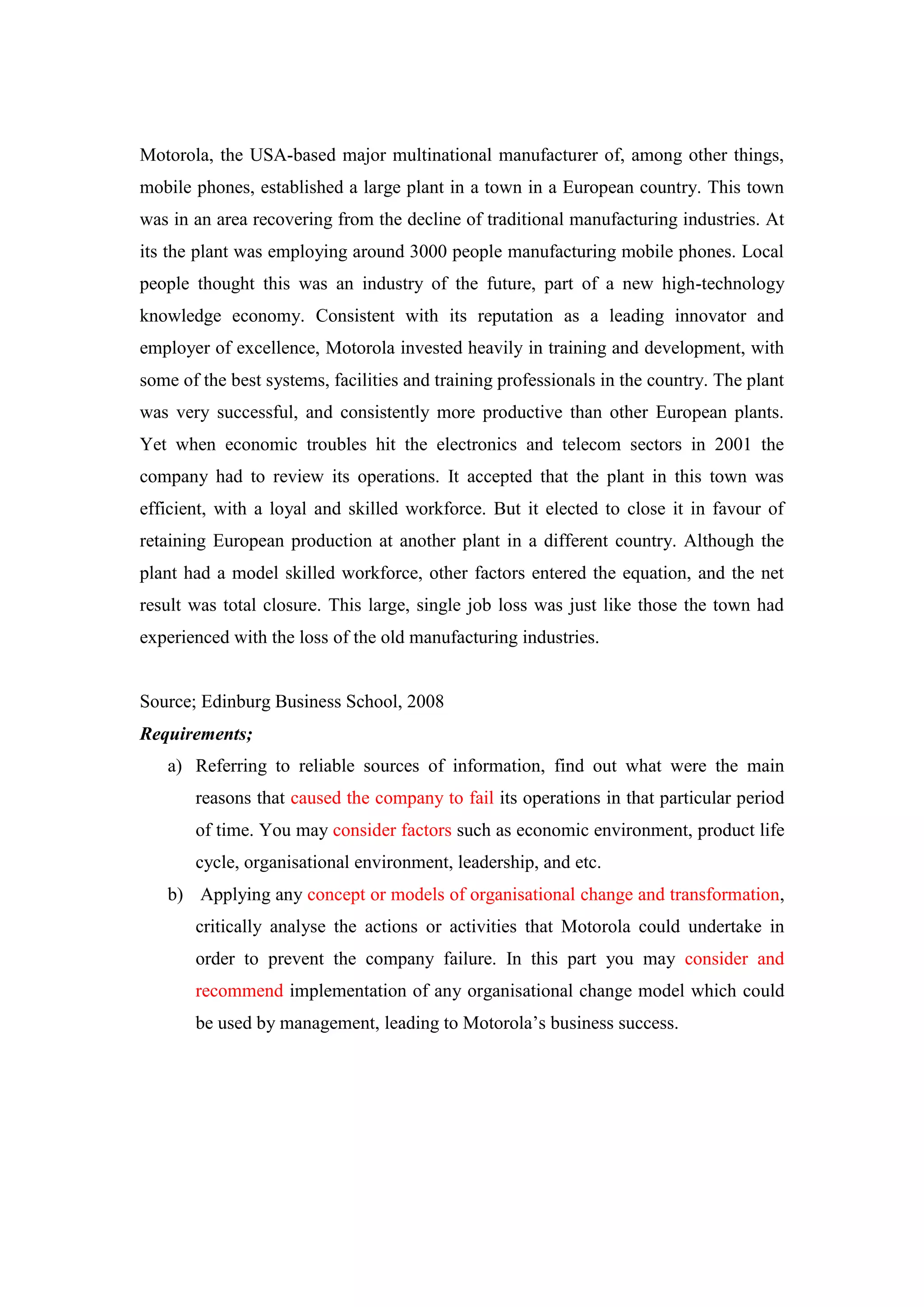
- 1. Motorola, the USA-basedmajor multinational manufacturer of, among other things, mobile phones, established a large plant in a town in a European country. This town was in an area recovering from the decline of traditional manufacturing industries. At its the plant was employing around 3000 people manufacturing mobile phones. Local people thought this was an industry of the future, part of a new high-technology knowledge economy. Consistent with its reputation as a leading innovator and employer of excellence, Motorola invested heavily in training and development, with some of the best systems, facilities and training professionals in the country. The plant was very successful, and consistently more productive than other European plants. Yet when economic troubles hit the electronics and telecom sectors in 2001 the company had to review its operations. It accepted that the plant in this town was efficient, with a loyal and skilled workforce. But it elected to close it in favour of retaining European production at another plant in a different country. Although the plant had a model skilled workforce, other factors entered the equation, and the net result was total closure. This large, single job loss was just like those the town had experienced with the loss of the old manufacturing industries. Source; Edinburg Business School, 2008 Requirements; a) Referring to reliable sources of information, find out what were the main reasons that caused the company to fail its operations in that particular period of time. You may consider factors such as economic environment, product life cycle, organisational environment, leadership, and etc. b) Applying any concept or models of organisational change and transformation, critically analyse the actions or activities that Motorola could undertake in order to prevent the company failure. In this part you may consider and recommend implementation of any organisational change model which could be used by management, leading to Motorola’s business success.