Data Mining:
Classification
Classification and
Prediction
What is classification? What is prediction?
Classification by decision tree induction
Bayesian Classification
Other Classification Methods
Prediction
Classification accuracy
Summary
Classification:
predicts categorical class labels
classifies data (constructs a model) based on the
training set and the values (class labels) in a
classifying attribute and uses it in classifying new data
Prediction:
models continuous-valued functions, i.e., predicts
unknown or missing values
Typical Applications
credit approval
target marketing
medical diagnosis
treatment effectiveness analysis
Classification vs.
Prediction
Classification—A Two-Step
Process
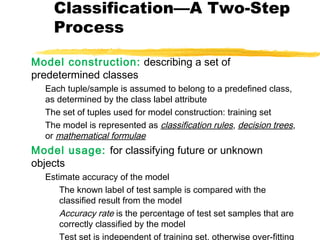
Model construction: describing a set of
predetermined classes
Each tuple/sample is assumed to belong to a predefined class,
as determined by the class label attribute
The set of tuples used for model construction: training set
The model is represented as classification rules, decision trees,
or mathematical formulae
Model usage: for classifying future or unknown
objects
Estimate accuracy of the model
The known label of test sample is compared with the
classified result from the model
Accuracy rate is the percentage of test set samples that are
correctly classified by the model
Test set is independent of training set, otherwise over-fitting
Classification Process
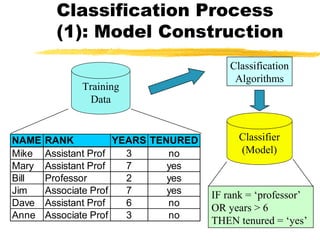
(1): Model Construction
Training
Data
NAME RANK YEARS TENURED
Mike Assistant Prof 3 no
Mary Assistant Prof 7 yes
Bill Professor 2 yes
Jim Associate Prof 7 yes
Dave Assistant Prof 6 no
Anne Associate Prof 3 no
Classification
Algorithms
IF rank = ‘professor’
OR years > 6
THEN tenured = ‘yes’
Classifier
(Model)
Classification Process (2): Use
the Model in Prediction
Classifier
Testing
Data
NAME RANK YEARS TENURED
Tom Assistant Prof 2 no
Merlisa Associate Prof 7 no
George Professor 5 yes
Joseph Assistant Prof 7 yes
Unseen Data
(Jeff, Professor, 4)
Tenured?
Supervised vs.
Unsupervised Learning
Supervised learning (classification)
Supervision: The training data (observations,
measurements, etc.) are accompanied by labels
indicating the class of the observations
New data is classified based on the training set
Unsupervised learning (clustering)
The class labels of training data is unknown
Given a set of measurements, observations, etc. with
the aim of establishing the existence of classes or
clusters in the data
Classification and
Prediction
What is classification? What is prediction?
Classification by decision tree induction
Bayesian Classification
Other Classification Methods
Prediction
Classification accuracy
Summary
Classification Methods
(1) Decision Tree Induction
Classification by Decision
Tree Induction
Decision tree
A flow-chart-like tree structure
Internal node denotes a test on an attribute
Branch represents an outcome of the test
Leaf nodes represent class labels or class distribution
Decision tree generation consists of two phases
Tree construction
At start, all the training examples are at the root
Partition examples recursively based on selected attributes
Tree pruning
Identify and remove branches that reflect noise or outliers
Use of decision tree: Classifying an unknown sample
Test the attribute values of the sample against the decision tree
Conditions for stopping
partitioning
All samples for a given node belong to the
same class
There are no remaining attributes for
further partitioning – majority voting is
employed for classify g in the leaf
There are no samples left
Training Dataset
age income student credit_rating
<=30 high no fair
<=30 high no excellent
31…40 high no fair
>40 medium no fair
>40 low yes fair
>40 low yes excellent
31…40 low yes excellent
<=30 medium no fair
<=30 low yes fair
>40 medium yes fair
<=30 medium yes excellent
31…40 medium no excellent
31…40 high yes fair
>40 medium no excellent
This
follows
an
example
from
Quinlan’s
ID3
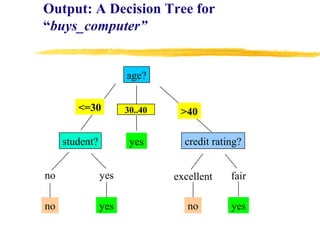
Output: A Decision Tree for
“buys_computer”
age?
overcast
student? credit rating?
no yes fairexcellent
<=30 >40
no noyes yes
yes
30..40
How to Construct Decision
Tree?
Which attribute to select?
(1) Attribute Selection Measure
Information Gain in Decision Tree
Induction
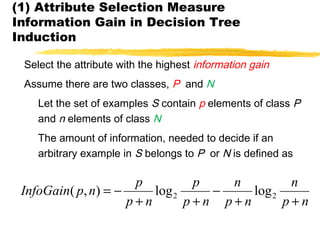
Select the attribute with the highest information gain
Assume there are two classes, P and N
Let the set of examples S contain p elements of class P
and n elements of class N
The amount of information, needed to decide if an
arbitrary example in S belongs to P or N is defined as
np
n
np
n
np
p
np
p
npInfoGain
++
−
++
−= 22 loglog),(
(2) Impurity/Entropy
(informal)
– Measures the level of impurity in a
group of examples
Entropy
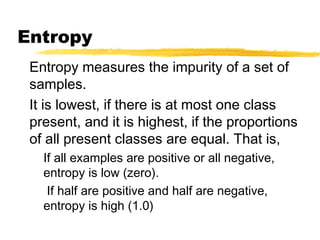
Entropy measures the impurity of a set of
samples.
It is lowest, if there is at most one class
present, and it is highest, if the proportions
of all present classes are equal. That is,
If all examples are positive or all negative,
entropy is low (zero).
If half are positive and half are negative,
entropy is high (1.0)
Impurity/Entropy (informal)
How to find Entropy
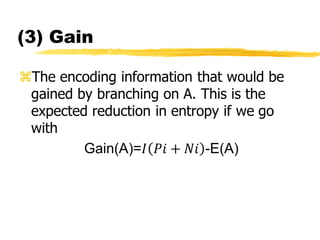
(3) Gain
Decision Tree Induction
(Formula to Remember)
How to Draw the Decision
Tree?
Note Down this Table
2) What will be the entropy
of attributes?
Firstly we will find the Information Gain of
Outlook attribute.
I(2,3)=(-2/5)log2(2/5)-(3/5)log2(3/5)
= 0.528+0.441
= 0.970
I(3,2)=(-3/5)log2(3/5)-(2/5)log2(2/5)
Outlook Pi Ni I(Pi,Ni) Entropy
Sunny 2 3 0.970 0.692
Overcast 4 0 0 0
Rain 3 2 0.970 0.692
Gain(outlook)=I(9,5)-E(outlook)
=0.97-0.692
=0.248
Avoid Overfitting in
Classification
The generated tree may overfit the training data
Too many branches, some may reflect anomalies
due to noise or outliers
Result is in poor accuracy for unseen samples
Two approaches to avoid overfitting
Prepruning: Halt tree construction early—do not split
a node if this would result in the goodness measure
falling below a threshold
Difficult to choose an appropriate threshold
Postpruning: Remove branches from a “fully grown”
tree—get a sequence of progressively pruned trees
Use a set of data different from the training data
to decide which is the “best pruned tree”
Approaches to Determine
the Final Tree Size
Separate training (2/3) and testing (1/3) sets
Use cross validation
Use all the data for training
but apply a statistical test (e.g., chi-square) to
estimate whether expanding or pruning a node
may improve the entire distribution
Enhancements to basic
decision tree induction
Allow for continuous-valued attributes
Dynamically define new discrete-valued attributes that
partition the continuous attribute value into a discrete
set of intervals
Handle missing attribute values
Assign the most common value of the attribute
Assign probability to each of the possible values
Attribute construction
Create new attributes based on existing ones that are
sparsely represented
This reduces fragmentation, repetition, and replication
Classification in Large
Databases
Classification—a classical problem extensively studied by
statisticians and machine learning researchers
Scalability: Classifying data sets with millions of examples
and hundreds of attributes with reasonable speed
Why decision tree induction in data mining?
relatively faster learning speed (than other classification
methods)
convertible to simple and easy to understand
classification rules
can use SQL queries for accessing databases
comparable classification accuracy with other methods
Question?
Outlook=overcast
Temperature=hot
Humidity=high
Windy=false
Play=?

Dm bs-lec7-classification - dti

  • 1.
  • 2.
    Classification and Prediction What isclassification? What is prediction? Classification by decision tree induction Bayesian Classification Other Classification Methods Prediction Classification accuracy Summary
  • 3.
    Classification: predicts categorical classlabels classifies data (constructs a model) based on the training set and the values (class labels) in a classifying attribute and uses it in classifying new data Prediction: models continuous-valued functions, i.e., predicts unknown or missing values Typical Applications credit approval target marketing medical diagnosis treatment effectiveness analysis Classification vs. Prediction
  • 4.
    Classification—A Two-Step Process Model construction:describing a set of predetermined classes Each tuple/sample is assumed to belong to a predefined class, as determined by the class label attribute The set of tuples used for model construction: training set The model is represented as classification rules, decision trees, or mathematical formulae Model usage: for classifying future or unknown objects Estimate accuracy of the model The known label of test sample is compared with the classified result from the model Accuracy rate is the percentage of test set samples that are correctly classified by the model Test set is independent of training set, otherwise over-fitting
  • 5.
    Classification Process (1): ModelConstruction Training Data NAME RANK YEARS TENURED Mike Assistant Prof 3 no Mary Assistant Prof 7 yes Bill Professor 2 yes Jim Associate Prof 7 yes Dave Assistant Prof 6 no Anne Associate Prof 3 no Classification Algorithms IF rank = ‘professor’ OR years > 6 THEN tenured = ‘yes’ Classifier (Model)
  • 6.
    Classification Process (2):Use the Model in Prediction Classifier Testing Data NAME RANK YEARS TENURED Tom Assistant Prof 2 no Merlisa Associate Prof 7 no George Professor 5 yes Joseph Assistant Prof 7 yes Unseen Data (Jeff, Professor, 4) Tenured?
  • 7.
    Supervised vs. Unsupervised Learning Supervisedlearning (classification) Supervision: The training data (observations, measurements, etc.) are accompanied by labels indicating the class of the observations New data is classified based on the training set Unsupervised learning (clustering) The class labels of training data is unknown Given a set of measurements, observations, etc. with the aim of establishing the existence of classes or clusters in the data
  • 8.
    Classification and Prediction What isclassification? What is prediction? Classification by decision tree induction Bayesian Classification Other Classification Methods Prediction Classification accuracy Summary
  • 9.
  • 10.
    Classification by Decision TreeInduction Decision tree A flow-chart-like tree structure Internal node denotes a test on an attribute Branch represents an outcome of the test Leaf nodes represent class labels or class distribution Decision tree generation consists of two phases Tree construction At start, all the training examples are at the root Partition examples recursively based on selected attributes Tree pruning Identify and remove branches that reflect noise or outliers Use of decision tree: Classifying an unknown sample Test the attribute values of the sample against the decision tree
  • 11.
    Conditions for stopping partitioning Allsamples for a given node belong to the same class There are no remaining attributes for further partitioning – majority voting is employed for classify g in the leaf There are no samples left
  • 12.
    Training Dataset age incomestudent credit_rating <=30 high no fair <=30 high no excellent 31…40 high no fair >40 medium no fair >40 low yes fair >40 low yes excellent 31…40 low yes excellent <=30 medium no fair <=30 low yes fair >40 medium yes fair <=30 medium yes excellent 31…40 medium no excellent 31…40 high yes fair >40 medium no excellent This follows an example from Quinlan’s ID3
  • 13.
    Output: A DecisionTree for “buys_computer” age? overcast student? credit rating? no yes fairexcellent <=30 >40 no noyes yes yes 30..40
  • 14.
    How to ConstructDecision Tree?
  • 15.
  • 16.
    (1) Attribute SelectionMeasure Information Gain in Decision Tree Induction Select the attribute with the highest information gain Assume there are two classes, P and N Let the set of examples S contain p elements of class P and n elements of class N The amount of information, needed to decide if an arbitrary example in S belongs to P or N is defined as np n np n np p np p npInfoGain ++ − ++ −= 22 loglog),(
  • 17.
    (2) Impurity/Entropy (informal) – Measuresthe level of impurity in a group of examples
  • 18.
    Entropy Entropy measures theimpurity of a set of samples. It is lowest, if there is at most one class present, and it is highest, if the proportions of all present classes are equal. That is, If all examples are positive or all negative, entropy is low (zero). If half are positive and half are negative, entropy is high (1.0)
  • 19.
  • 20.
    How to findEntropy
  • 21.
  • 22.
  • 23.
    How to Drawthe Decision Tree?
  • 24.
  • 27.
    2) What willbe the entropy of attributes? Firstly we will find the Information Gain of Outlook attribute. I(2,3)=(-2/5)log2(2/5)-(3/5)log2(3/5) = 0.528+0.441 = 0.970 I(3,2)=(-3/5)log2(3/5)-(2/5)log2(2/5)
  • 29.
    Outlook Pi NiI(Pi,Ni) Entropy Sunny 2 3 0.970 0.692 Overcast 4 0 0 0 Rain 3 2 0.970 0.692 Gain(outlook)=I(9,5)-E(outlook) =0.97-0.692 =0.248
  • 30.
    Avoid Overfitting in Classification Thegenerated tree may overfit the training data Too many branches, some may reflect anomalies due to noise or outliers Result is in poor accuracy for unseen samples Two approaches to avoid overfitting Prepruning: Halt tree construction early—do not split a node if this would result in the goodness measure falling below a threshold Difficult to choose an appropriate threshold Postpruning: Remove branches from a “fully grown” tree—get a sequence of progressively pruned trees Use a set of data different from the training data to decide which is the “best pruned tree”
  • 31.
    Approaches to Determine theFinal Tree Size Separate training (2/3) and testing (1/3) sets Use cross validation Use all the data for training but apply a statistical test (e.g., chi-square) to estimate whether expanding or pruning a node may improve the entire distribution
  • 32.
    Enhancements to basic decisiontree induction Allow for continuous-valued attributes Dynamically define new discrete-valued attributes that partition the continuous attribute value into a discrete set of intervals Handle missing attribute values Assign the most common value of the attribute Assign probability to each of the possible values Attribute construction Create new attributes based on existing ones that are sparsely represented This reduces fragmentation, repetition, and replication
  • 33.
    Classification in Large Databases Classification—aclassical problem extensively studied by statisticians and machine learning researchers Scalability: Classifying data sets with millions of examples and hundreds of attributes with reasonable speed Why decision tree induction in data mining? relatively faster learning speed (than other classification methods) convertible to simple and easy to understand classification rules can use SQL queries for accessing databases comparable classification accuracy with other methods
  • 34.