Daily Lesson Log
Learning Area English Quarter 2
Teacher Elysa B. Micu Grade Level and Section Grade 8 Faith
Teaching Dates and Time
November 6, 2023 November 7, 2023 November 8, 2023 November 9, 2023 November 10, 2023
Monday Tuesday Wednesday Thursday Friday
10:20 am 8:20 am 1:00 p.m 1:00 p.m 1:00 p.m
Week
I. OBJECTIVES
Objectives must be met over the week and connected to the curriculum standards. To meet the objectives, necessary procedures must be followed and if needed, additional lessons, exercises and remedial activities may be done
for developing content knowledge and competencies. These are assessed using Formative Assessment strategies. Valuing objectives support the learning of content and competencies and enable children to find significance and
joy in learning the lessons. Weekly objectives shall be derived from the curriculum guides.
Content Standards
The learner demonstrates understanding of: East Asian literature as an art form inspired and influenced by nature; relationship of visual sensory, and verbal signals in both literary and
expository texts; strategies in listening to long descriptive and narrative texts; value of literal and figurative language: and appropriate grammatical signals or expressions suitable to patterns
of idea development.
Performance
Standards
The learner transfers learning by composing and delivering a brief and creative entertainment speech featuring a variety of effective paragraphs, appropriate grammatical signals or
expressions in topic development, and appropriate prosodic features, stance, and behavior.
Institutional Core
Value/s
Character: LISTENING STRATEGIES
Learning
Competencies
Evaluate the personal
significance of a literary
text. -EN8RC-IIb-2.22
Relate content or theme to
previous experiences and
background knowledge. -
EN8RC-IIb-2.18
Evaluate the personal significance
of a literary text. -EN8RC-IIb-2.22
Relatate content or theme to
previous experiences and
background knowledge.-EN8RC-
IIb-2.18
Evaluate the personal
significance of a literary text.-
EN8RC-IIb-2.22
Relate content or theme to
previous experiences and
background knowledge.-
EN8RC-IIb-2.18
East Asian Literature: Exchanges and Cultural
Networks- EN12Lit-IIc-29
Learning Targets:
In this lesson, the students can:
1. Read and identify the elements of a short
story.
2. Employ projective listening strategies with
Learning Targets
In this lesson, the students
can:
1. Explain the details of
the short story read.
2. Organize the
information of the
story using a Venn
Diagram.
3. Demonstrate
appreciation of one’s
belief as depicted in
the story.
Learning Targets
In this lesson, the students can:
1. Identify the types of conflict
2. Evaluate the conflict and
resolution to a given situation
3. Display open-mindedness and
perseverance in working with the
given task.
Learning Targets
In this lesson, the students
can:
1.
longer stories.
3. Identify how words are connected between
and among paragraphs in the texts read.
Determine some concepts related to common key
values among Asians and Africans
II. CONTENT
Content is what the lesson is all about. It pertains to the subject matter that the teacher aims to teach. In the CG, the content can be tackled in a week or two.
Quarter II Embracing Our
Heritage Topic: A
Taximan’s Story by:
Catherine Lim Poh Imm
Lesson 2 Revisiting Our
Rich Past
Quarter II Embracing Our
Heritage Topic: Conflict,
Character, and Point of View
Lesson 2 Revisiting Our Rich Past
Quarter II Embracing Our
Heritage Topic: A Taximan’s
Story by: Catherine Lim Poh
Imm
Lesson 2 Revisiting Our Rich
Past
Viewing: “The Present”
III. LEARNING
RESOURCES
List the materials to be used in different days. Varied sources of materials sustain children’s interest in the lesson and in learning. Ensure that there is a mix of concrete and manipulative materials as well as paper-based materials.
Hands-on learning promotes concept development.
Teacher’s Guide
pages
Essential English 8, Teacher’s Resource Material,
page 13
Learner’s Material
pages
Textbook pages Essential English 8, pages 99
Additional Materials
from Learning
Resources (LR) portal
Other Learning
Resources
The Present – CGI Awarded Short Film (2014)
https://www.youtube.com/watch?v=3XA0bB79oGc
IV. PROCEDURES These steps should be done across the week. Spread out the activities appropriately so that students will learn well. Always be guided by demonstration of learning by the students which you can infer from formative
assessment activities. Sustain learning systematically by providing students with multiple ways to learn new things, practice their learning, question their learning processes, draw conclusions about what they learned in
relation to their life experiences and previous knowledge. Indicate the time allotment for each step.
Monday Tuesday Wednesday Thursday Friday
A. Reviewing previous
lesson and/or presenting
the new lesson
Review on the 5 elements of
Short Story
Ask the students about the insights
that they have learned from A
Taximan’s Story
Ask the following questions:
- What are the two parts of a
sentence? (subject and
predicate)
-What are the two types of
clauses? (dependent and
independent clauses)
-What are words used to
connect two independent
clauses together?
(coordinating conjunctions and
conjunctive adverbs)
Reviewing prior knowledge via
picture reading: family portraits
B. Establishing a purpose of
the lesson
(Modeling)
Students will be acquainted
with different literary pieces
from East Asian Countries
and unravel inspirations that
their literature reveals.
As you immerse in the
different selection, think about
these questions:
1. What’s the difference
among the literature of
Malaysia, Singapore, and the
Philippines?
2. What’s the same with the
literature of those three
countries?
Fill in the blanks with the correct
letters to complete the kinds of
conflict, character and point of
view.
EX. 1. HU_AN VS. SO_IE_Y
3. D_R_CT CH_RA_T_RIZA_IO_
 Simple sentence: A
sentence with with one
independent clause and
no dependent clauses.
 Compound Sentence: A
sentence with multiple
independent clauses but
no dependent clauses.
 Complex Sentence:
A sentence with one
independent clauses and
at least one dependent
clause.
QUESTION-ANSWER
1. What country does each
family represent? How do you
know?
2. What countries are
represented by the festival
photos?
3. Do you think Asian-African
families or countries have similar
characteristics?
C. Presenting examples /
instances of the new
lesson
(Guided Practice)
Present pictures/ slides about
Singapore. Tell something about
the pictures.
Identify the characters, and conflict
on different scene of the movies
presented. EX: (Spider Man
punches Sand Man in a battle
scene.) Spider man 3- Human VS.
Human
 Simple sentence:
1. I must go off to Hotel
Elroy.
2. I have beeb a taximan for
twenty years.
3. Lay Choo and her friends
wait outside the coffee
shop.
 Compound Sentence:
1. My father was very strict,
and it is a good thing for
parents to be strict.
QUESTION-ANSWER:
As a Filipino, how can you
better understand your identity
as an Asian?
2. I was big enough to be
married, and still, I got
caned.
3. The Taxi man and the
teacher love their
conversation; however
that taxi man has to leave.
4. SIngapore is a good place
for travel: Cultural
diversity is evident.
 Complex Sentence:
1. After following Lay Choo
for couple of days, he
discovered that her
daughter is just like the
girls he fetches in his taxi.
2. While the taxi man
believes her daughter is
at school, Lay Choo is
doing something that his
father never thought of.
 Compound -Complex
Sentence
1. While Tom reads novels,
Jack reads comics, but
Sam reads only
magazines.
2. Tom reads novels, but
Jack read comics
because books are too
difficult.
3. People who read comics
rarely read novels; they
often find books difficult.
D. Discussing new concepts
and practicing new skills
#1
(Guided Practice)
Introduce the short biography of
Catherine Lim Poh Imm.
Let the students read the guide
questions. Introduce the story to
the class. Have them read the
story silently.
Have an open discussion about the
kinds of conflict, Character and
Point of View.
 The teacher will give the
objectives for the session.
Define the following:
Diagramming Sentences
Worksheet.
Fill out the column
Conflict is a literary device
characterized by a struggle
between two opposing forces.
Internal conflict is when a
character struggles with their own
opposing desires or beliefs.
External conflict sets a character
against something or someone
beyond their control.
Violent is using or involving
physical force intended to hurt,
damage, or kill someone or
something.
NOn-Violent- is using peaceful
means rather than force, especially
to bring about political or social
change.
E. Discussing new concepts
and practicing new skills
#2
Have an open discussion about
“A Taximan’s Story”. Let the
students answer the guide
questions.
Ask the students to create movie
house organizer. Think of their four
favorite movies and complete the
details of the organizer.
Board- Work Activity The malfunction of the heart is to
pump blood. It never stops
pumping blood even when the
individual is asleep. When a
person is resting, the heart can
ump as much as 5 liters of blood
per minute or about 75 milliliters
per heartbeat. This means that
the total amount of blood in the
body passes through the heart
every minute, day and night.
Comprehension Questions:
1. Where is the human heart
located?
2. How small is the human
heart?
3. What is the main function
of the human heart?
4. Why do you think human heart
works every single day?
F. Developing Mastery
(Leads to Formative
Assessment)
Describe the characters using
characterization chart.
Enumerate the important details
of the story using graphic
organizer.
ACTIVITY 1 MOVIE HOUSE
ORGANIZER
Do the activity.
 After giving initial activity on
the values and traditions of
Asians, the teacher will now
introduce a folktale from
China, The Soul of the
Great Bell, focusing on the
question, "What are you
willing to sacrifice for your
family?"
 Unlocking of Difficulties (Let
the students use the words
in their own sentence
 Reading of the folktale
through a power point
presentation (five
representatives among the
class who will read the
story)
Activating prior Knowledge
on adjectives, and
conjunctions
G. Finding practical
applications of concepts
and skills in daily living
Pointing out some social
problems which people never
thought existed in an affluent
country like Singapore.
Conflict and point of view contribute
to the development of character in
a short story. It is important to
establish conflict and point of view
effectively in revealing and
developing the character/s in a
short story.
Sentences have a subject and
predicate, and express a
complete though. That’s the
basic sentence, but there is
much more to understand and
to write. It is better to
understand how words,
phrases, and clauses are used
to enhance the meaning and
clarity of a sentence.
QUESTION-ANSWER:
1. Who are involved in the story?
2. Where did this happen?
3. When did this happen?
Why did the author tell this
story?
H. Making generalizations
and abstractions about the
lesson
Ask the students’ insights about
the lesson discussed. Let the
students share their ideas about
how the young generation today
acts and behave due to the
influence of modernism of our
times now.
A well and clear establishment of
conflict provide direction for a story.
It is important to understand the
conflict, characters, and point of
view in reading narratives.
It is important to learn about
the different sentence structure
so that they can write
grammatically correct sentence
and able to understand easily.
Enrichment Activity (RING THAT
BELL)
- The students will look for a
partner and fill out the two
columns with the description of
the great bell.
QUESTION-ANSWER:
1. From what paragraph did you
find your answer?
2. What two sounds were
produced when the bell was
completed? Why?
If this is a folktale, how then do
you define a folktale?
I. Evaluating learning
(Individual Practice)
Make a short reflection.
Compare the plight of the Filipino
youth with the Singaporean
teenagers.
Go after the Story of the Great
Bell, in the chart; identify the
values and tradition of the
Chinese people that you can
deduce from it.
(The chart is posted on the
board)
Question- Answer:
1. Did you discover
similarities/differences on your
values and traditions with that of
the Chinese? What are they?
2. How can your
knowledge of the traditions and
values of China help promote
peace between our country and
China?
3. How can you better
understand your identity as an
Asian?
4. What are you willing
to sacrifice for your family?
- Signals to Connect!
- Conjunctions make the words
sentences, and paragraphs
connected with each other.
J. Additional activities for
application or remediation
Story House: Complete the
story house below by writing the
details about A Taximan’s Story.
Close the discussion by giving
the students a quote.
“We ache with the yearning that
turns half into whole and offer
no excuses for the beauty of our
souls.”
 Presentation of the
output!
 Each pair should explain
their output in front of the
class. Be ready with the
question of the teacher.
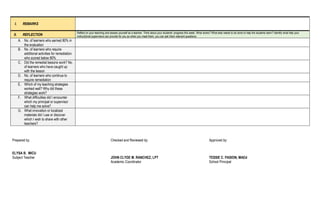
I. REMARKS
II. REFLECTION
Reflect on your teaching and assess yourself as a teacher. Think about your students’ progress this week. What works? What else needs to be done to help the students learn? Identify what help your
instructional supervisors can provide for you so when you meet them, you can ask them relevant questions.
A. No. of learners who earned 80% in
the evaluation
B. No. of learners who require
additional activities for remediation
who scored below 80%
C. Did the remedial lessons work? No.
of learners who have caught up
with the lesson
D. No. of learners who continue to
require remediation
E. Which of my teaching strategies
worked well? Why did these
strategies work?
F. What difficulties did I encounter
which my principal or supervisor
can help me solve?
G. What innovation or localized
materials did I use or discover
which I wish to share with other
teachers?
Prepared by:
ELYSA B. MICU
Subject Teacher
Checked and Reviewed by:
JOHN CLYDE M. RANCHEZ, LPT
Academic Coordinator
Approved by:
TESSIE C. PASION, MAEd
School Principal

DLL GRADE 8 SECOND QUARTER. grade 8 lesson

  • 1.
    Daily Lesson Log LearningArea English Quarter 2 Teacher Elysa B. Micu Grade Level and Section Grade 8 Faith Teaching Dates and Time November 6, 2023 November 7, 2023 November 8, 2023 November 9, 2023 November 10, 2023 Monday Tuesday Wednesday Thursday Friday 10:20 am 8:20 am 1:00 p.m 1:00 p.m 1:00 p.m Week I. OBJECTIVES Objectives must be met over the week and connected to the curriculum standards. To meet the objectives, necessary procedures must be followed and if needed, additional lessons, exercises and remedial activities may be done for developing content knowledge and competencies. These are assessed using Formative Assessment strategies. Valuing objectives support the learning of content and competencies and enable children to find significance and joy in learning the lessons. Weekly objectives shall be derived from the curriculum guides. Content Standards The learner demonstrates understanding of: East Asian literature as an art form inspired and influenced by nature; relationship of visual sensory, and verbal signals in both literary and expository texts; strategies in listening to long descriptive and narrative texts; value of literal and figurative language: and appropriate grammatical signals or expressions suitable to patterns of idea development. Performance Standards The learner transfers learning by composing and delivering a brief and creative entertainment speech featuring a variety of effective paragraphs, appropriate grammatical signals or expressions in topic development, and appropriate prosodic features, stance, and behavior. Institutional Core Value/s Character: LISTENING STRATEGIES Learning Competencies Evaluate the personal significance of a literary text. -EN8RC-IIb-2.22 Relate content or theme to previous experiences and background knowledge. - EN8RC-IIb-2.18 Evaluate the personal significance of a literary text. -EN8RC-IIb-2.22 Relatate content or theme to previous experiences and background knowledge.-EN8RC- IIb-2.18 Evaluate the personal significance of a literary text.- EN8RC-IIb-2.22 Relate content or theme to previous experiences and background knowledge.- EN8RC-IIb-2.18 East Asian Literature: Exchanges and Cultural Networks- EN12Lit-IIc-29 Learning Targets: In this lesson, the students can: 1. Read and identify the elements of a short story. 2. Employ projective listening strategies with
  • 2.
    Learning Targets In thislesson, the students can: 1. Explain the details of the short story read. 2. Organize the information of the story using a Venn Diagram. 3. Demonstrate appreciation of one’s belief as depicted in the story. Learning Targets In this lesson, the students can: 1. Identify the types of conflict 2. Evaluate the conflict and resolution to a given situation 3. Display open-mindedness and perseverance in working with the given task. Learning Targets In this lesson, the students can: 1. longer stories. 3. Identify how words are connected between and among paragraphs in the texts read. Determine some concepts related to common key values among Asians and Africans II. CONTENT Content is what the lesson is all about. It pertains to the subject matter that the teacher aims to teach. In the CG, the content can be tackled in a week or two. Quarter II Embracing Our Heritage Topic: A Taximan’s Story by: Catherine Lim Poh Imm Lesson 2 Revisiting Our Rich Past Quarter II Embracing Our Heritage Topic: Conflict, Character, and Point of View Lesson 2 Revisiting Our Rich Past Quarter II Embracing Our Heritage Topic: A Taximan’s Story by: Catherine Lim Poh Imm Lesson 2 Revisiting Our Rich Past Viewing: “The Present” III. LEARNING RESOURCES List the materials to be used in different days. Varied sources of materials sustain children’s interest in the lesson and in learning. Ensure that there is a mix of concrete and manipulative materials as well as paper-based materials. Hands-on learning promotes concept development. Teacher’s Guide pages Essential English 8, Teacher’s Resource Material, page 13 Learner’s Material pages Textbook pages Essential English 8, pages 99 Additional Materials from Learning Resources (LR) portal Other Learning Resources The Present – CGI Awarded Short Film (2014) https://www.youtube.com/watch?v=3XA0bB79oGc IV. PROCEDURES These steps should be done across the week. Spread out the activities appropriately so that students will learn well. Always be guided by demonstration of learning by the students which you can infer from formative assessment activities. Sustain learning systematically by providing students with multiple ways to learn new things, practice their learning, question their learning processes, draw conclusions about what they learned in relation to their life experiences and previous knowledge. Indicate the time allotment for each step. Monday Tuesday Wednesday Thursday Friday
  • 3.
    A. Reviewing previous lessonand/or presenting the new lesson Review on the 5 elements of Short Story Ask the students about the insights that they have learned from A Taximan’s Story Ask the following questions: - What are the two parts of a sentence? (subject and predicate) -What are the two types of clauses? (dependent and independent clauses) -What are words used to connect two independent clauses together? (coordinating conjunctions and conjunctive adverbs) Reviewing prior knowledge via picture reading: family portraits B. Establishing a purpose of the lesson (Modeling) Students will be acquainted with different literary pieces from East Asian Countries and unravel inspirations that their literature reveals. As you immerse in the different selection, think about these questions: 1. What’s the difference among the literature of Malaysia, Singapore, and the Philippines? 2. What’s the same with the literature of those three countries? Fill in the blanks with the correct letters to complete the kinds of conflict, character and point of view. EX. 1. HU_AN VS. SO_IE_Y 3. D_R_CT CH_RA_T_RIZA_IO_  Simple sentence: A sentence with with one independent clause and no dependent clauses.  Compound Sentence: A sentence with multiple independent clauses but no dependent clauses.  Complex Sentence: A sentence with one independent clauses and at least one dependent clause. QUESTION-ANSWER 1. What country does each family represent? How do you know? 2. What countries are represented by the festival photos? 3. Do you think Asian-African families or countries have similar characteristics? C. Presenting examples / instances of the new lesson (Guided Practice) Present pictures/ slides about Singapore. Tell something about the pictures. Identify the characters, and conflict on different scene of the movies presented. EX: (Spider Man punches Sand Man in a battle scene.) Spider man 3- Human VS. Human  Simple sentence: 1. I must go off to Hotel Elroy. 2. I have beeb a taximan for twenty years. 3. Lay Choo and her friends wait outside the coffee shop.  Compound Sentence: 1. My father was very strict, and it is a good thing for parents to be strict. QUESTION-ANSWER: As a Filipino, how can you better understand your identity as an Asian?
  • 4.
    2. I wasbig enough to be married, and still, I got caned. 3. The Taxi man and the teacher love their conversation; however that taxi man has to leave. 4. SIngapore is a good place for travel: Cultural diversity is evident.  Complex Sentence: 1. After following Lay Choo for couple of days, he discovered that her daughter is just like the girls he fetches in his taxi. 2. While the taxi man believes her daughter is at school, Lay Choo is doing something that his father never thought of.  Compound -Complex Sentence 1. While Tom reads novels, Jack reads comics, but Sam reads only magazines. 2. Tom reads novels, but Jack read comics because books are too difficult. 3. People who read comics rarely read novels; they often find books difficult. D. Discussing new concepts and practicing new skills #1 (Guided Practice) Introduce the short biography of Catherine Lim Poh Imm. Let the students read the guide questions. Introduce the story to the class. Have them read the story silently. Have an open discussion about the kinds of conflict, Character and Point of View.  The teacher will give the objectives for the session. Define the following: Diagramming Sentences Worksheet. Fill out the column
  • 5.
    Conflict is aliterary device characterized by a struggle between two opposing forces. Internal conflict is when a character struggles with their own opposing desires or beliefs. External conflict sets a character against something or someone beyond their control. Violent is using or involving physical force intended to hurt, damage, or kill someone or something. NOn-Violent- is using peaceful means rather than force, especially to bring about political or social change. E. Discussing new concepts and practicing new skills #2 Have an open discussion about “A Taximan’s Story”. Let the students answer the guide questions. Ask the students to create movie house organizer. Think of their four favorite movies and complete the details of the organizer. Board- Work Activity The malfunction of the heart is to pump blood. It never stops pumping blood even when the individual is asleep. When a person is resting, the heart can ump as much as 5 liters of blood per minute or about 75 milliliters per heartbeat. This means that the total amount of blood in the body passes through the heart every minute, day and night. Comprehension Questions: 1. Where is the human heart located? 2. How small is the human heart? 3. What is the main function of the human heart? 4. Why do you think human heart works every single day?
  • 6.
    F. Developing Mastery (Leadsto Formative Assessment) Describe the characters using characterization chart. Enumerate the important details of the story using graphic organizer. ACTIVITY 1 MOVIE HOUSE ORGANIZER Do the activity.  After giving initial activity on the values and traditions of Asians, the teacher will now introduce a folktale from China, The Soul of the Great Bell, focusing on the question, "What are you willing to sacrifice for your family?"  Unlocking of Difficulties (Let the students use the words in their own sentence  Reading of the folktale through a power point presentation (five representatives among the class who will read the story) Activating prior Knowledge on adjectives, and conjunctions G. Finding practical applications of concepts and skills in daily living Pointing out some social problems which people never thought existed in an affluent country like Singapore. Conflict and point of view contribute to the development of character in a short story. It is important to establish conflict and point of view effectively in revealing and developing the character/s in a short story. Sentences have a subject and predicate, and express a complete though. That’s the basic sentence, but there is much more to understand and to write. It is better to understand how words, phrases, and clauses are used to enhance the meaning and clarity of a sentence. QUESTION-ANSWER: 1. Who are involved in the story? 2. Where did this happen? 3. When did this happen? Why did the author tell this story? H. Making generalizations and abstractions about the lesson Ask the students’ insights about the lesson discussed. Let the students share their ideas about how the young generation today acts and behave due to the influence of modernism of our times now. A well and clear establishment of conflict provide direction for a story. It is important to understand the conflict, characters, and point of view in reading narratives. It is important to learn about the different sentence structure so that they can write grammatically correct sentence and able to understand easily. Enrichment Activity (RING THAT BELL) - The students will look for a partner and fill out the two columns with the description of the great bell. QUESTION-ANSWER: 1. From what paragraph did you find your answer?
  • 7.
    2. What twosounds were produced when the bell was completed? Why? If this is a folktale, how then do you define a folktale? I. Evaluating learning (Individual Practice) Make a short reflection. Compare the plight of the Filipino youth with the Singaporean teenagers. Go after the Story of the Great Bell, in the chart; identify the values and tradition of the Chinese people that you can deduce from it. (The chart is posted on the board) Question- Answer: 1. Did you discover similarities/differences on your values and traditions with that of the Chinese? What are they? 2. How can your knowledge of the traditions and values of China help promote peace between our country and China? 3. How can you better understand your identity as an Asian? 4. What are you willing to sacrifice for your family? - Signals to Connect! - Conjunctions make the words sentences, and paragraphs connected with each other. J. Additional activities for application or remediation Story House: Complete the story house below by writing the details about A Taximan’s Story. Close the discussion by giving the students a quote. “We ache with the yearning that turns half into whole and offer no excuses for the beauty of our souls.”  Presentation of the output!  Each pair should explain their output in front of the class. Be ready with the question of the teacher.
  • 8.
    I. REMARKS II. REFLECTION Reflecton your teaching and assess yourself as a teacher. Think about your students’ progress this week. What works? What else needs to be done to help the students learn? Identify what help your instructional supervisors can provide for you so when you meet them, you can ask them relevant questions. A. No. of learners who earned 80% in the evaluation B. No. of learners who require additional activities for remediation who scored below 80% C. Did the remedial lessons work? No. of learners who have caught up with the lesson D. No. of learners who continue to require remediation E. Which of my teaching strategies worked well? Why did these strategies work? F. What difficulties did I encounter which my principal or supervisor can help me solve? G. What innovation or localized materials did I use or discover which I wish to share with other teachers? Prepared by: ELYSA B. MICU Subject Teacher Checked and Reviewed by: JOHN CLYDE M. RANCHEZ, LPT Academic Coordinator Approved by: TESSIE C. PASION, MAEd School Principal