GRADE 1 to 12
DAILY LESSON LOG
School: Grade Level: 8
Teacher: Learning Area: ENGLISH
Teaching Dates and Time: WEEK 2 Quarter:
2ND
I. OBJECTIVES
MONDAY TUESDAY WEDNESDAY THURSDAY FRIDAY
Objectives must be meet over the week and connected to the curriculum standards. To meet the objectives, necessary procedures must be followed and if needed, additional lessons,
exercises and remedial activities may be done for developing content knowledge and competencies. These are using Formative Assessment strategies. Valuing objectives support the
learning of content and competencies and enable children to find significance and joy in learning the lessons. Weekly objectives shall be derived from the curriculum guides.
A. Content Standards: The learner transfers learning by composing and delivering a brief and creative entertainment speech featuring a variety of
effective paragraphs , appropriate grammatical signals or expressions in topic development, and appropriate prosodic feature,
stance, and behavior.
B. Performance Standards: The learner transfers learning by composing and delivering a brief and creative entertainment speech featuring a variety of
effective paragraphs , appropriate grammatical signals or expressions in topic development, and appropriate prosodic feature,
stance, and behavior.
C. Learning Competencies/Objectives:
Write the LC Code for each
EN8RC-IIc-2.22
Evaluate the personal
significance of a literary text
EN8RC-IIc-2.1.7:
React to assertions made by
the author in the text
EN8LC-IIc-7
Employ appropriate listening
skills and strategies suited to
long descriptive and narrative
texts
EN8LC-IIc-2.13:
Determine the tone and mood
of the speaker or characters
in the narrative listened to
EN8VC-IIb-1.3:
Predict the gist of the material
viewed based on the title,
pictures, and excerpts
EN8VC-IIb-17:
Discern positive and negative
messages conveyed in a
material viewed
EN8V-IIb-24.1:
Distinguish between and
among verbal situational, and
dramatic types of irony and
give examples of each
EN8LT-IIb-9.1:
Describe the notable literary
genres contributed by East
Asian writers
EN8LT-IIb-9.2:
Identify the distinguishing
features of notable East Asian
poems, folktales, and short
stories
EN8WC-IIb-2.8
Compose effective
paragraphs
EN8WC-IIb-2.8.8:
Use a variety of techniques to
introduce a topic
EN8OL-IIb-5: Use the
appropriate prosodic
features of speech when
delivering an entertainment
speech
EN8G-IIa-9:
Use appropriate grammatical
signals or expressions
suitable to each pattern of
idea development:
 General to particular
 Claim and
counterclaim
 Problem-solution
 Cause-effect
 And others
II. CONTENT
Content is what the lesson is all about. It pertains to the subject matter that the teacher aims to teach. In the CG, the content can be tackled in a week or two.
SAWATDEE… HELLO, MY
BEAUTIFUL BANGKOK
(Thailand)
BAWANGPUTI,
BAWANGMERAH: A TALE
FROM MALAYSIA
BIBLIOGRAPHY IDIOMATIC EXPRESSION
III. LEARNING RESOURCES
Lists the materials to be used in different days. Varied sources of materials sustain children’s interest in the lesson and in learning. Ensure that there is a mix of concrete and manipulative
materials as well as paper-based materials. Hands-on learning promotes concept development.
A. References
1. Teacher’s Guide Pages
2. Learner’s Materials Pages Page 34
3. Textbook Pages
4. Additional Materials from
Learning Resource (LR) Portal
Use English Worksheets and
Learn (UEWL), pp 49 – 64
B. Other Learning Resources http://www.academia.edu/59
81417/A_detailed lesson
plan on how to teach
idioms and develop
speaking in teenager
classrooms
IV. PROCEDURES
MONDAY TUESDAY WEDNESDAY THURSDAY FRIDAY
These steps should be done across the week. Spread out the activities appropriately so that students will learn well. Always be guided by demonstration of learning by the students which
you can infer from formative assessment activities. Sustain learning systematically by providing students with multiple ways to learn new things, practice their learning, question their
learning processes, and draw conclusions about what they learned in relation to their life experiences and previous knowledge. Indicate the time allotment for each step.
A. Reviewing Previous Lesson or
Presenting the New Lesson
Give a brief introduction
about Thailand
Pre-viewing:
Ask the students if they are
familiar with the character and
story of Cinderella as shown
in the picture
Bibliography contains a list of
books or articles, or both,
relating to a particular subject.
Warm-up (‘Help me!’): Write
on the board the word
‘EMERGENCY’ and ask
students to say some
situations when they had to
ask for help. Make questions
like ‘What happened?’,
‘What did you do?’ and ‘Who
did you call in an
emergency?
B. Establishing a Purpose for the
Lesson
Determine the similarities and
differences of Thailand and
Philippines in terms
ofcustoms, traditions, and
beliefs
Discern positive and negative
messages conveyed in the
story viewed
In a research paper, a
bibliography is an alphabetical
list, sometimes grouped into
categories, containing the
names of all works quoted
from or generally used in its
preparation.
Use idioms to make the
speech more attractive and
impressive. Idioms make
language more vivid and
descriptive.
C. Presenting Examples/Instances of
the Lesson
Show a set of pictures
(attractions of Thailand), set
of words, and meanings. The
students will workon the
vocabulary by matching the
words and meanings that
describe the givenpictures.
Reading Selection:
SAWATDEE…Hello,
View a Cinderella-like tale
from Malaysia. The title is
“BawangPutihBawangMerah”
The title literally means “red
onions and white garlic”
II. VIEWING PROPER
Bibliographical items should
be arranged correctly and
consistently at the end of the
research paper.
Reading task:.
Appendix 01
“Ray needed a bookcase.
He had been making do with
planks of wood on bricks,
but hewanted something
nicer now. His sister, Sandy,
suggested buying a self-
assemblybookcase where
Beautiful Bangkok
By: Ethel Soliven-Timbol
the pieces came in a flat
pack for him to put together
himself. Ray knewhe wasn’t
much good at that sort of
thing, but he decided to give
it a shot
. When heopened the pack,
it all looked very confusing,
but he was decided to get to
the grips withit. After a
couple of hours, he had
something that looked a bit
like a bookcase but was not
rather wobbly. To be on the
safe side, he asked Sandy to
check it for him.
‘There’ssomething not quite
right about this,’ she said. ‘I
think we’d better get to the
bottom of itbefore you put
your books on it.
D. Discussing New Concepts and
Practicing New Skills #1
Activity 1. Say You…Say Me While viewing, inform the
students that they have to
take notes and observe how
the story is similar or different
to the Disney version of
Cinderella
III. POST VIEWING
Discussion:
 Books
 Magazine
 Journal
Idioms activity:
Write all of the idioms that
are in the text on Appendix
01. Makequestions using
these expressions and
stimulate students to answer
using them.
E. Discussing New Concepts and
Practicing New Skills #2
How do traditions and beliefs
bring about diversity and or
harmony?
Pair Work: Allow students to
identify the similarities and
differences of
“BawangPutihBawangMerah”
to the Disney version of
Cinderella. Have them record
their ideas in the Venn
Diagram. Provide some
example entry to support
struggling learners. Allow
some students to present their
work.
Discussion:
 Newspaper
 World Wide Web
After that, they can practice
in pairs and, by the end,
present some answers tothe
class.
F. Developing Mastery
(Leads to Formative Assessment 3)
Reporting: The teacher will
divide the class into two
groups. Each group will have
their own taskin relation to
the topic.Group 1. Culture of
Thailand
Group Differentiated :
By group, complete the story
map by extracting the
important narrative elements
of the story.
Do the activity 32:
Formatting
Activity 26:
Working with Idioms
Group 2. Culture of
Philippines
G. Finding Practical Applications of
Concepts and Skills in Daily Living
Identify pictures noticed in
the film and see some
connections and similarities
in terms our culture, beliefs
and traditions.
Probe deeper by asking the
following focus questions
What do you know about the
events in the Cinderella story?
Group Activities:
Multiple Intelligence Activities
H. Making Generalizations and
Abstractions about the Lesson
Summarize and trace the
significant event s of the story
by completing the graphic
organizer
Do you know any story in the
Philippines or other countries
that have the same theme or
plot as that of Cinderella or
BawangPuti, BawangMerah?
Using comparison and
contrast, fill in the grid with
positive-interesting-negative
aspects of Filipinos
 Love for family
 Reverence to God
 Desire to Succeed in
Life
An idiom is an expression
that takes on a figurative
meaning when certain words
are combined which is
different from the literal
definition of the individual
words
I. Evaluating Learning Using the graphic organizer,
draw out the values and traits
of the character which
enable him to become
successful and better person
Group Differentiated Activity
By group : Story Interview.
Complete the graphic
organizer by answering
questions based from the
viewing selection.
Group Activities:
With your group, look for
some readings related to the
topic the topics below. Come
up with 10 bibliographies,
using on line resources for
additional information.
 Multi-Cultural
Dialects of Filipinos
 Religious Beliefs of
Filipinos
 Filipino Treasured
Values
 4. Filipino Traditions
and Beliefs
Activity 27:
Idiomatic Expressions
J. Additional Activities for Application
or Remediation
Find out the author’s purpose
of writing this selection
Research on another
Cinderella type of story and
create a story map out of it.
Present another samples of
bibliography from books,
newspapers/magazines and
websites.
Use English Worksheets and
Learn (UEWL), pp 49 – 64
V. REMARKS
VI. REFLECTION
Reflect on your teaching and assess yourself as a teacher. Think about your student’s progress this week. What works? What else needs to be done to help the students learn?
Identify what help your instructional supervisors can provide for you so when you meet them, you can ask them relevant questions.
A. No. of learners who earned 80% in
the evaluation
B. No. of learners who require
additional activities for remediation
C. Did the remedial lessons work? No.
of learners who have caught up with
the lesson?
D. No. of learners who continue to
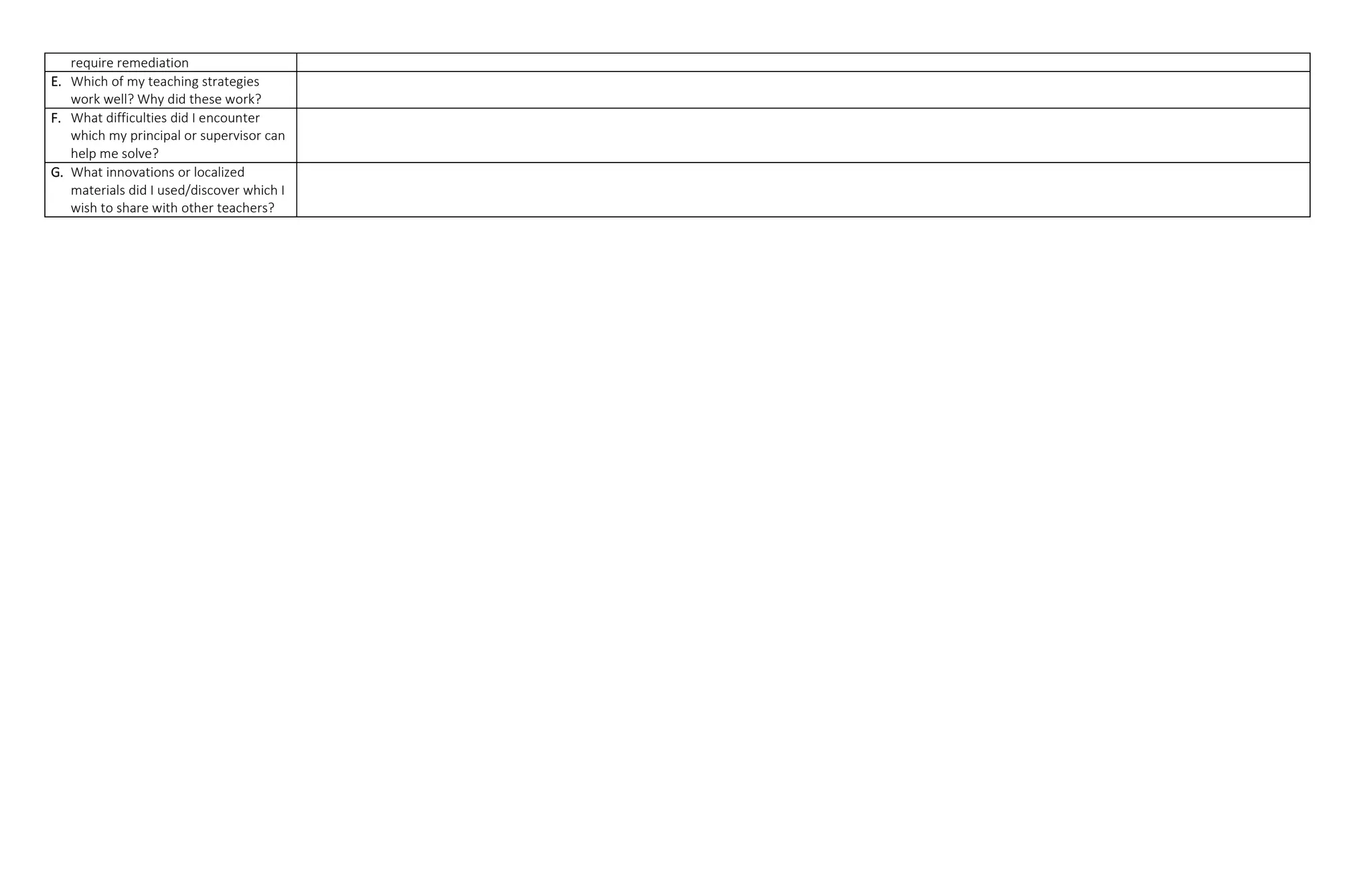
require remediation
E. Which of my teaching strategies
work well? Why did these work?
F. What difficulties did I encounter
which my principal or supervisor can
help me solve?
G. What innovations or localized
materials did I used/discover which I
wish to share with other teachers?

DLL-ENG8-2NDQ-2nd-week edited.docx.2023a

  • 1.
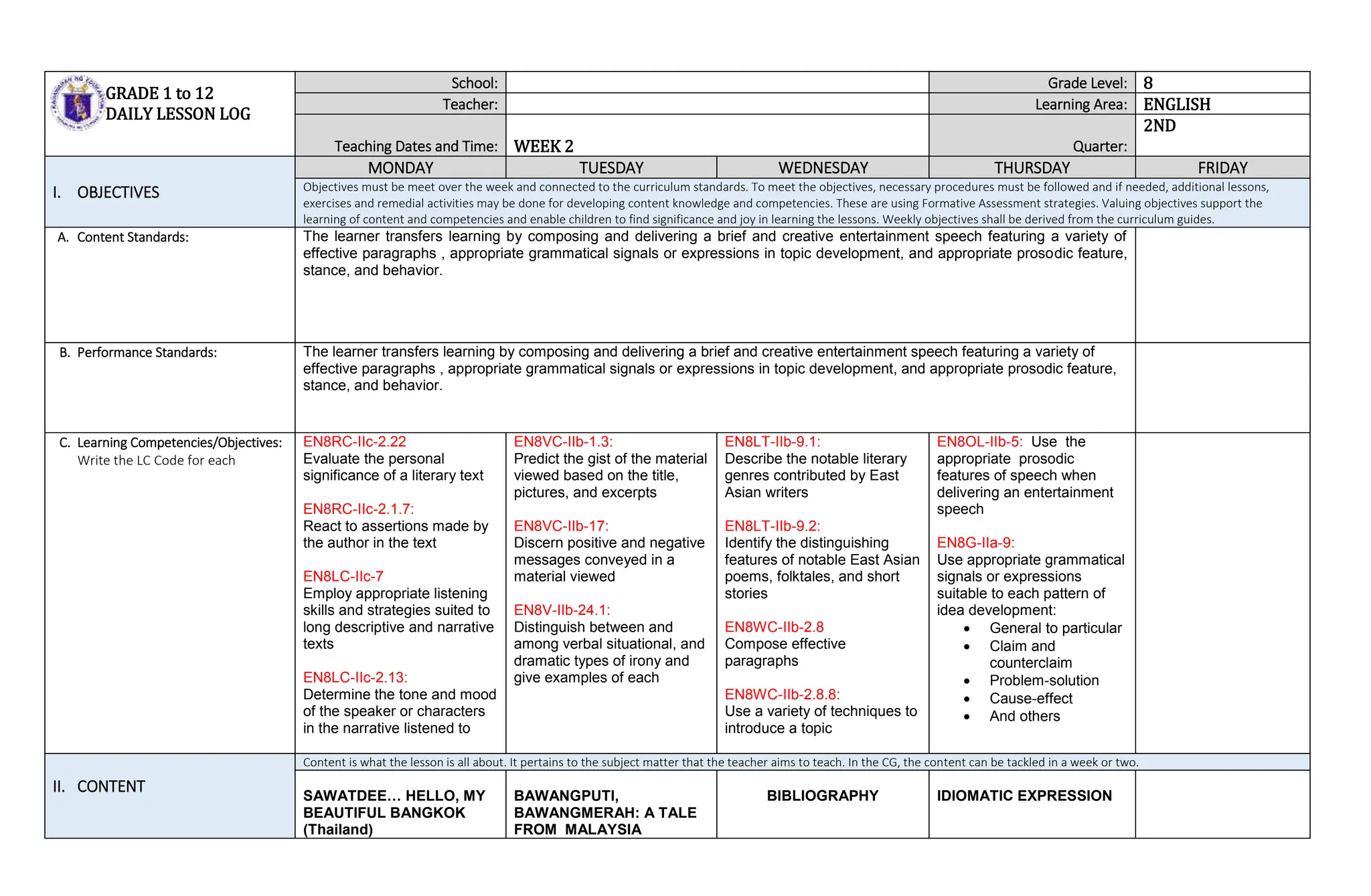
    GRADE 1 to12 DAILY LESSON LOG School: Grade Level: 8 Teacher: Learning Area: ENGLISH Teaching Dates and Time: WEEK 2 Quarter: 2ND I. OBJECTIVES MONDAY TUESDAY WEDNESDAY THURSDAY FRIDAY Objectives must be meet over the week and connected to the curriculum standards. To meet the objectives, necessary procedures must be followed and if needed, additional lessons, exercises and remedial activities may be done for developing content knowledge and competencies. These are using Formative Assessment strategies. Valuing objectives support the learning of content and competencies and enable children to find significance and joy in learning the lessons. Weekly objectives shall be derived from the curriculum guides. A. Content Standards: The learner transfers learning by composing and delivering a brief and creative entertainment speech featuring a variety of effective paragraphs , appropriate grammatical signals or expressions in topic development, and appropriate prosodic feature, stance, and behavior. B. Performance Standards: The learner transfers learning by composing and delivering a brief and creative entertainment speech featuring a variety of effective paragraphs , appropriate grammatical signals or expressions in topic development, and appropriate prosodic feature, stance, and behavior. C. Learning Competencies/Objectives: Write the LC Code for each EN8RC-IIc-2.22 Evaluate the personal significance of a literary text EN8RC-IIc-2.1.7: React to assertions made by the author in the text EN8LC-IIc-7 Employ appropriate listening skills and strategies suited to long descriptive and narrative texts EN8LC-IIc-2.13: Determine the tone and mood of the speaker or characters in the narrative listened to EN8VC-IIb-1.3: Predict the gist of the material viewed based on the title, pictures, and excerpts EN8VC-IIb-17: Discern positive and negative messages conveyed in a material viewed EN8V-IIb-24.1: Distinguish between and among verbal situational, and dramatic types of irony and give examples of each EN8LT-IIb-9.1: Describe the notable literary genres contributed by East Asian writers EN8LT-IIb-9.2: Identify the distinguishing features of notable East Asian poems, folktales, and short stories EN8WC-IIb-2.8 Compose effective paragraphs EN8WC-IIb-2.8.8: Use a variety of techniques to introduce a topic EN8OL-IIb-5: Use the appropriate prosodic features of speech when delivering an entertainment speech EN8G-IIa-9: Use appropriate grammatical signals or expressions suitable to each pattern of idea development:  General to particular  Claim and counterclaim  Problem-solution  Cause-effect  And others II. CONTENT Content is what the lesson is all about. It pertains to the subject matter that the teacher aims to teach. In the CG, the content can be tackled in a week or two. SAWATDEE… HELLO, MY BEAUTIFUL BANGKOK (Thailand) BAWANGPUTI, BAWANGMERAH: A TALE FROM MALAYSIA BIBLIOGRAPHY IDIOMATIC EXPRESSION
  • 2.
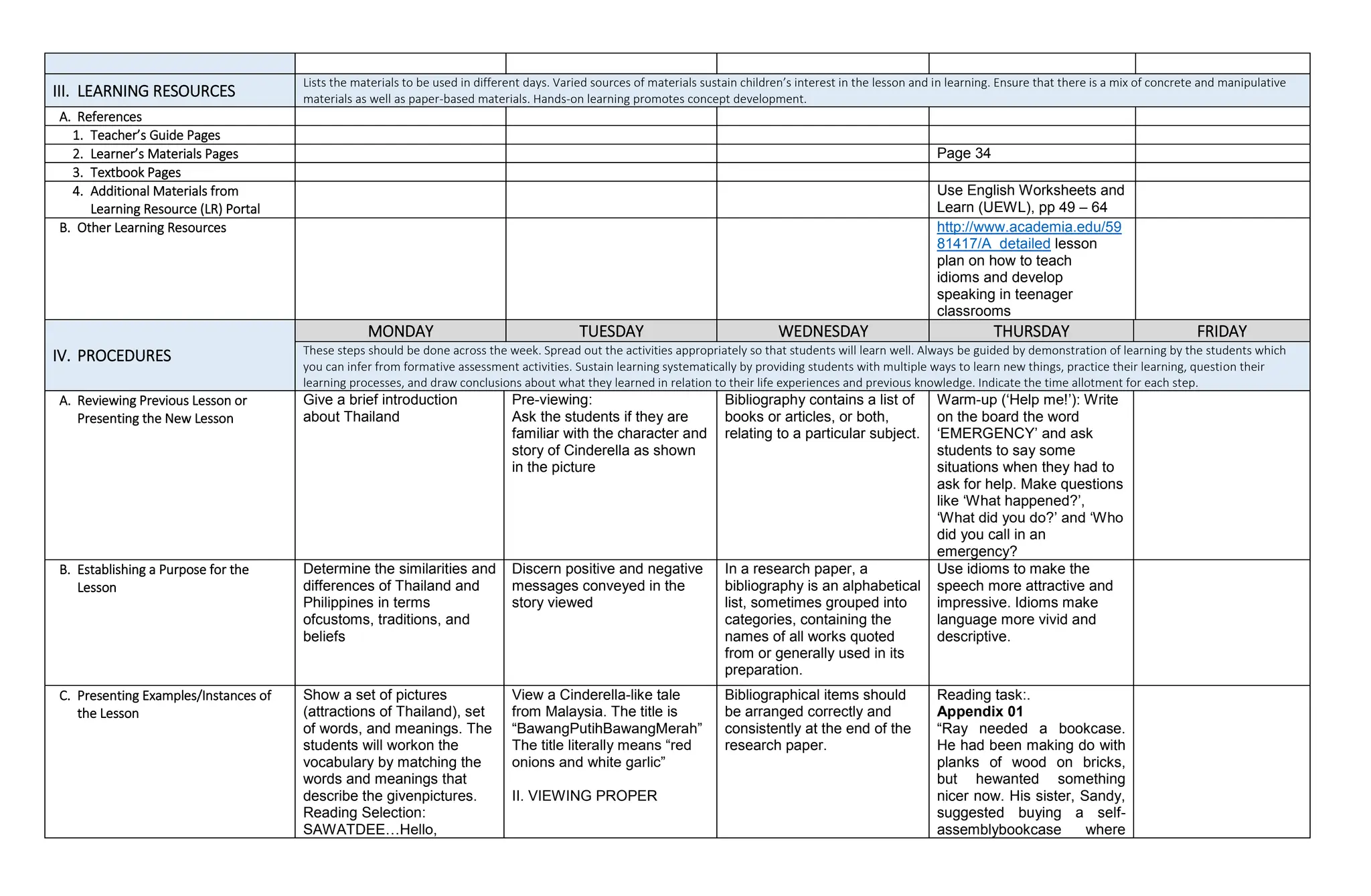
    III. LEARNING RESOURCES Liststhe materials to be used in different days. Varied sources of materials sustain children’s interest in the lesson and in learning. Ensure that there is a mix of concrete and manipulative materials as well as paper-based materials. Hands-on learning promotes concept development. A. References 1. Teacher’s Guide Pages 2. Learner’s Materials Pages Page 34 3. Textbook Pages 4. Additional Materials from Learning Resource (LR) Portal Use English Worksheets and Learn (UEWL), pp 49 – 64 B. Other Learning Resources http://www.academia.edu/59 81417/A_detailed lesson plan on how to teach idioms and develop speaking in teenager classrooms IV. PROCEDURES MONDAY TUESDAY WEDNESDAY THURSDAY FRIDAY These steps should be done across the week. Spread out the activities appropriately so that students will learn well. Always be guided by demonstration of learning by the students which you can infer from formative assessment activities. Sustain learning systematically by providing students with multiple ways to learn new things, practice their learning, question their learning processes, and draw conclusions about what they learned in relation to their life experiences and previous knowledge. Indicate the time allotment for each step. A. Reviewing Previous Lesson or Presenting the New Lesson Give a brief introduction about Thailand Pre-viewing: Ask the students if they are familiar with the character and story of Cinderella as shown in the picture Bibliography contains a list of books or articles, or both, relating to a particular subject. Warm-up (‘Help me!’): Write on the board the word ‘EMERGENCY’ and ask students to say some situations when they had to ask for help. Make questions like ‘What happened?’, ‘What did you do?’ and ‘Who did you call in an emergency? B. Establishing a Purpose for the Lesson Determine the similarities and differences of Thailand and Philippines in terms ofcustoms, traditions, and beliefs Discern positive and negative messages conveyed in the story viewed In a research paper, a bibliography is an alphabetical list, sometimes grouped into categories, containing the names of all works quoted from or generally used in its preparation. Use idioms to make the speech more attractive and impressive. Idioms make language more vivid and descriptive. C. Presenting Examples/Instances of the Lesson Show a set of pictures (attractions of Thailand), set of words, and meanings. The students will workon the vocabulary by matching the words and meanings that describe the givenpictures. Reading Selection: SAWATDEE…Hello, View a Cinderella-like tale from Malaysia. The title is “BawangPutihBawangMerah” The title literally means “red onions and white garlic” II. VIEWING PROPER Bibliographical items should be arranged correctly and consistently at the end of the research paper. Reading task:. Appendix 01 “Ray needed a bookcase. He had been making do with planks of wood on bricks, but hewanted something nicer now. His sister, Sandy, suggested buying a self- assemblybookcase where
  • 3.
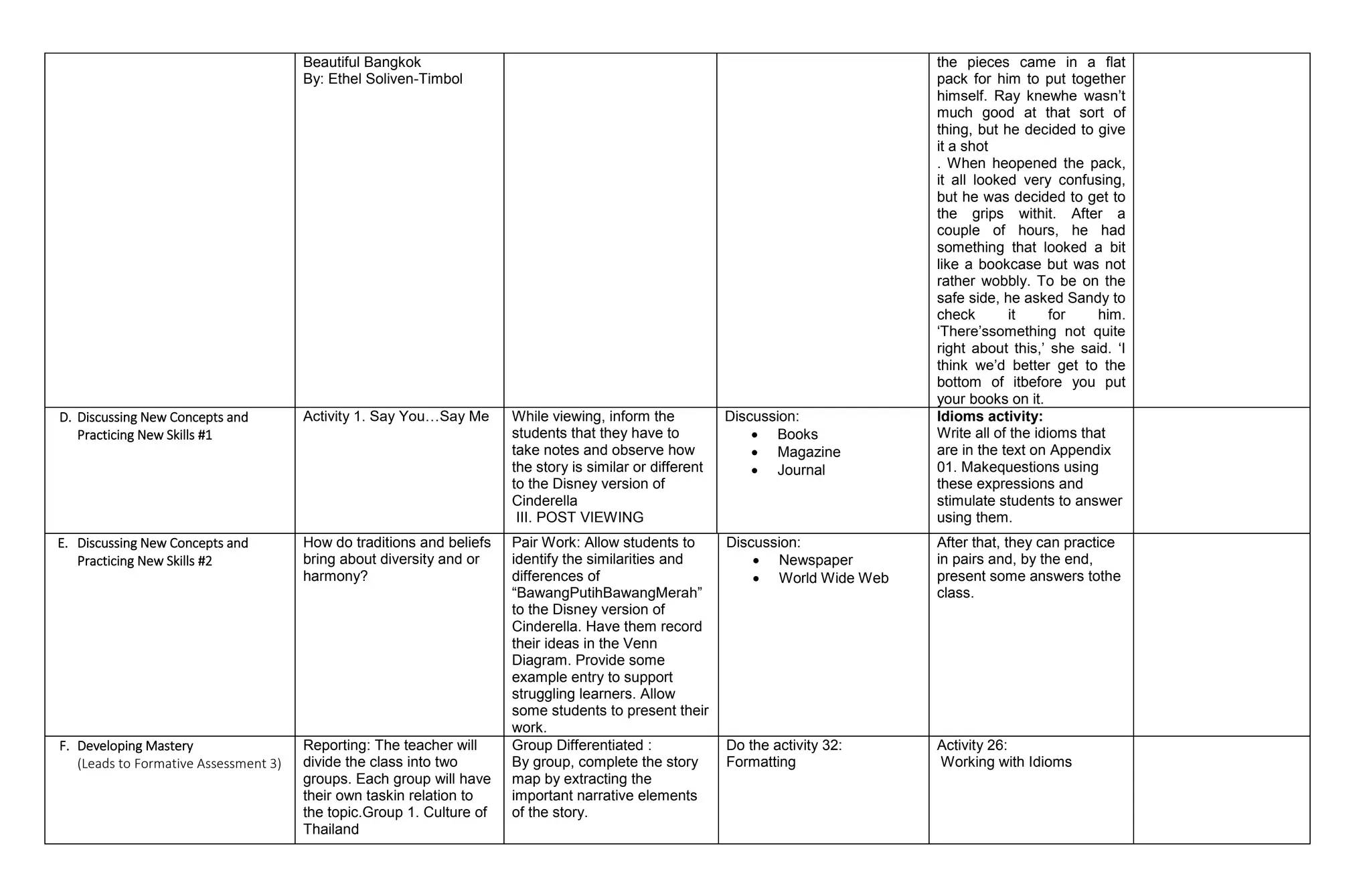
    Beautiful Bangkok By: EthelSoliven-Timbol the pieces came in a flat pack for him to put together himself. Ray knewhe wasn’t much good at that sort of thing, but he decided to give it a shot . When heopened the pack, it all looked very confusing, but he was decided to get to the grips withit. After a couple of hours, he had something that looked a bit like a bookcase but was not rather wobbly. To be on the safe side, he asked Sandy to check it for him. ‘There’ssomething not quite right about this,’ she said. ‘I think we’d better get to the bottom of itbefore you put your books on it. D. Discussing New Concepts and Practicing New Skills #1 Activity 1. Say You…Say Me While viewing, inform the students that they have to take notes and observe how the story is similar or different to the Disney version of Cinderella III. POST VIEWING Discussion:  Books  Magazine  Journal Idioms activity: Write all of the idioms that are in the text on Appendix 01. Makequestions using these expressions and stimulate students to answer using them. E. Discussing New Concepts and Practicing New Skills #2 How do traditions and beliefs bring about diversity and or harmony? Pair Work: Allow students to identify the similarities and differences of “BawangPutihBawangMerah” to the Disney version of Cinderella. Have them record their ideas in the Venn Diagram. Provide some example entry to support struggling learners. Allow some students to present their work. Discussion:  Newspaper  World Wide Web After that, they can practice in pairs and, by the end, present some answers tothe class. F. Developing Mastery (Leads to Formative Assessment 3) Reporting: The teacher will divide the class into two groups. Each group will have their own taskin relation to the topic.Group 1. Culture of Thailand Group Differentiated : By group, complete the story map by extracting the important narrative elements of the story. Do the activity 32: Formatting Activity 26: Working with Idioms
  • 4.
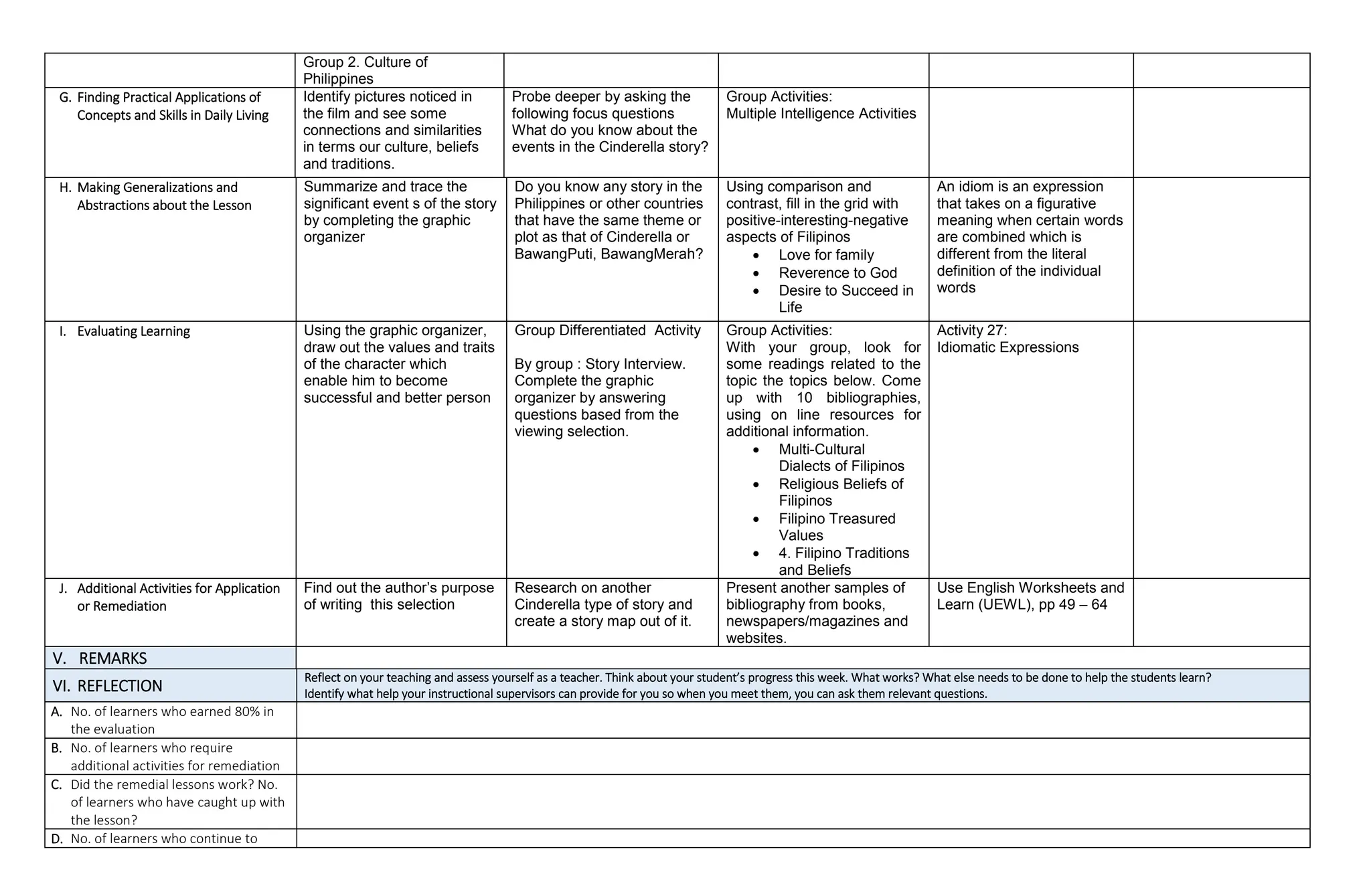
    Group 2. Cultureof Philippines G. Finding Practical Applications of Concepts and Skills in Daily Living Identify pictures noticed in the film and see some connections and similarities in terms our culture, beliefs and traditions. Probe deeper by asking the following focus questions What do you know about the events in the Cinderella story? Group Activities: Multiple Intelligence Activities H. Making Generalizations and Abstractions about the Lesson Summarize and trace the significant event s of the story by completing the graphic organizer Do you know any story in the Philippines or other countries that have the same theme or plot as that of Cinderella or BawangPuti, BawangMerah? Using comparison and contrast, fill in the grid with positive-interesting-negative aspects of Filipinos  Love for family  Reverence to God  Desire to Succeed in Life An idiom is an expression that takes on a figurative meaning when certain words are combined which is different from the literal definition of the individual words I. Evaluating Learning Using the graphic organizer, draw out the values and traits of the character which enable him to become successful and better person Group Differentiated Activity By group : Story Interview. Complete the graphic organizer by answering questions based from the viewing selection. Group Activities: With your group, look for some readings related to the topic the topics below. Come up with 10 bibliographies, using on line resources for additional information.  Multi-Cultural Dialects of Filipinos  Religious Beliefs of Filipinos  Filipino Treasured Values  4. Filipino Traditions and Beliefs Activity 27: Idiomatic Expressions J. Additional Activities for Application or Remediation Find out the author’s purpose of writing this selection Research on another Cinderella type of story and create a story map out of it. Present another samples of bibliography from books, newspapers/magazines and websites. Use English Worksheets and Learn (UEWL), pp 49 – 64 V. REMARKS VI. REFLECTION Reflect on your teaching and assess yourself as a teacher. Think about your student’s progress this week. What works? What else needs to be done to help the students learn? Identify what help your instructional supervisors can provide for you so when you meet them, you can ask them relevant questions. A. No. of learners who earned 80% in the evaluation B. No. of learners who require additional activities for remediation C. Did the remedial lessons work? No. of learners who have caught up with the lesson? D. No. of learners who continue to
  • 5.
    require remediation E. Whichof my teaching strategies work well? Why did these work? F. What difficulties did I encounter which my principal or supervisor can help me solve? G. What innovations or localized materials did I used/discover which I wish to share with other teachers?